Future of AI Productivity Tools: What's Next in AI-Powered Work
Turn this article into takeaways for your work.


Each assistant summarizes the article only for you and suggests best practices for your work.
AI capabilities are doubling every 6-12 months. The tools you're using today will seem primitive in two years. The impossible use cases of 2023 are table stakes in 2026.
This acceleration isn't slowing down. It's speeding up.
As an executive, you can't plan for the future by extrapolating from the present. You need to understand where AI productivity tools are headed so you can position your organization to capitalize on what's coming, not scramble to catch up.
Let's look at what's next in AI-powered work and what it means for how you prepare today.
Near-Term Trends (2026-2026)
The next 12-18 months will bring capabilities that are already emerging in research labs and early products. These aren't speculative; they're inevitable.
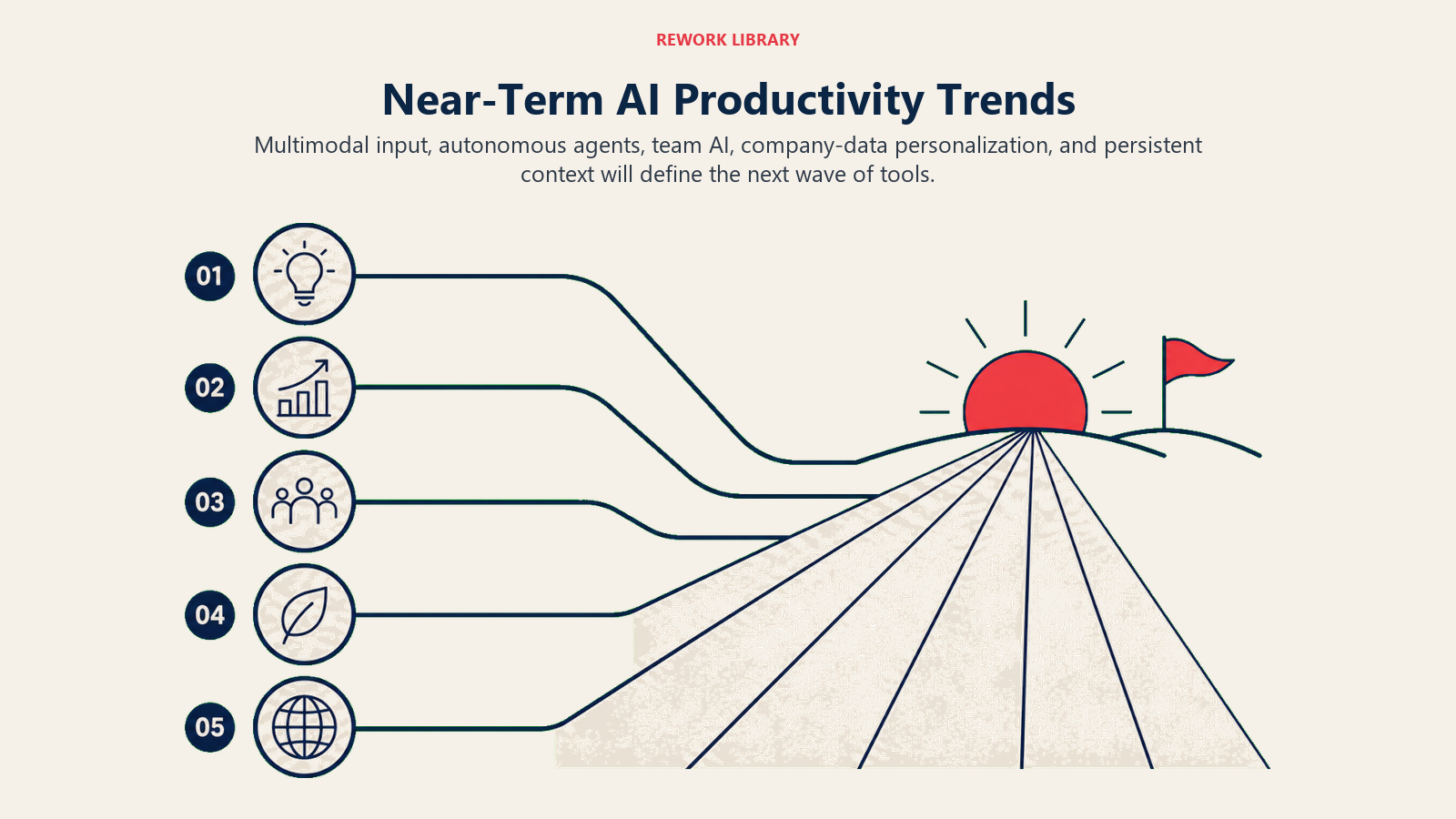
Multimodal AI integration: Current AI tools mostly work with one type of input. You've got text-based AI writing assistants for content. Image AI for visuals. Voice AI for transcription. That separation is ending.
Near-term AI will seamlessly handle text, images, video, audio, and data in the same interaction. You'll describe a concept in words, reference a few images, point to some data, and AI will generate a comprehensive presentation combining all those elements (complete with charts, visuals, and speaker notes).
The productivity implications are massive. Instead of using five different tools and manually combining their outputs, you'll work with one AI that handles the entire workflow.
Autonomous agents for complex workflows: Today's AI tools are powerful assistants. Tomorrow's will be autonomous agents that complete multi-step workflows with minimal supervision through advanced AI workflow automation.
Tell your AI agent "Research our top competitors' pricing strategies, analyze how they compare to ours, and draft a proposal for pricing adjustments with projected revenue impact." Then come back in an hour to review a complete analysis with recommendations, not just scattered research notes.
These agents will plan their own task sequences, use multiple tools, make decisions about which information matters, and produce finished work, not just drafts.
Real-time collaboration AI assistants: Instead of AI as a tool you use individually, it'll be an active participant in team collaboration. In your next video meeting, AI won't just transcribe. It'll track action items, notice when discussion goes off-topic, suggest relevant information from previous meetings or documents, and even mediate when conversation becomes unproductive.
Think of it as having an infinitely patient chief of staff in every meeting who never forgets anything and always has the relevant context ready.
Personalized AI trained on company data: Generic AI tools know a lot about the world. Personalized AI will know a lot about your company. Your products, your customers, your strategies, your culture, your specific language and terminology.
When you ask this AI to draft a product positioning document, it doesn't just understand "product positioning" generically. It knows your existing positioning, your target customers, your competitive landscape, and your brand voice. The first draft is 80% ready rather than 40% ready.
Enhanced context awareness: Current AI tools have limited memory. They forget previous conversations quickly. They don't know what you were working on yesterday or last month.
Near-term AI will maintain persistent context about your work. It'll remember that you're working on the Q2 product launch. When you ask for competitive analysis, it'll automatically frame it around Q2 launch timing. When you ask for a customer case study, it'll suggest customers relevant to the product being launched.
This context awareness means less time spent explaining background and more time spent on actual work.
Medium-Term Evolution (2026-2028)
Look out 2-3 years and things get really interesting. These capabilities are emerging from research but not yet mainstream.
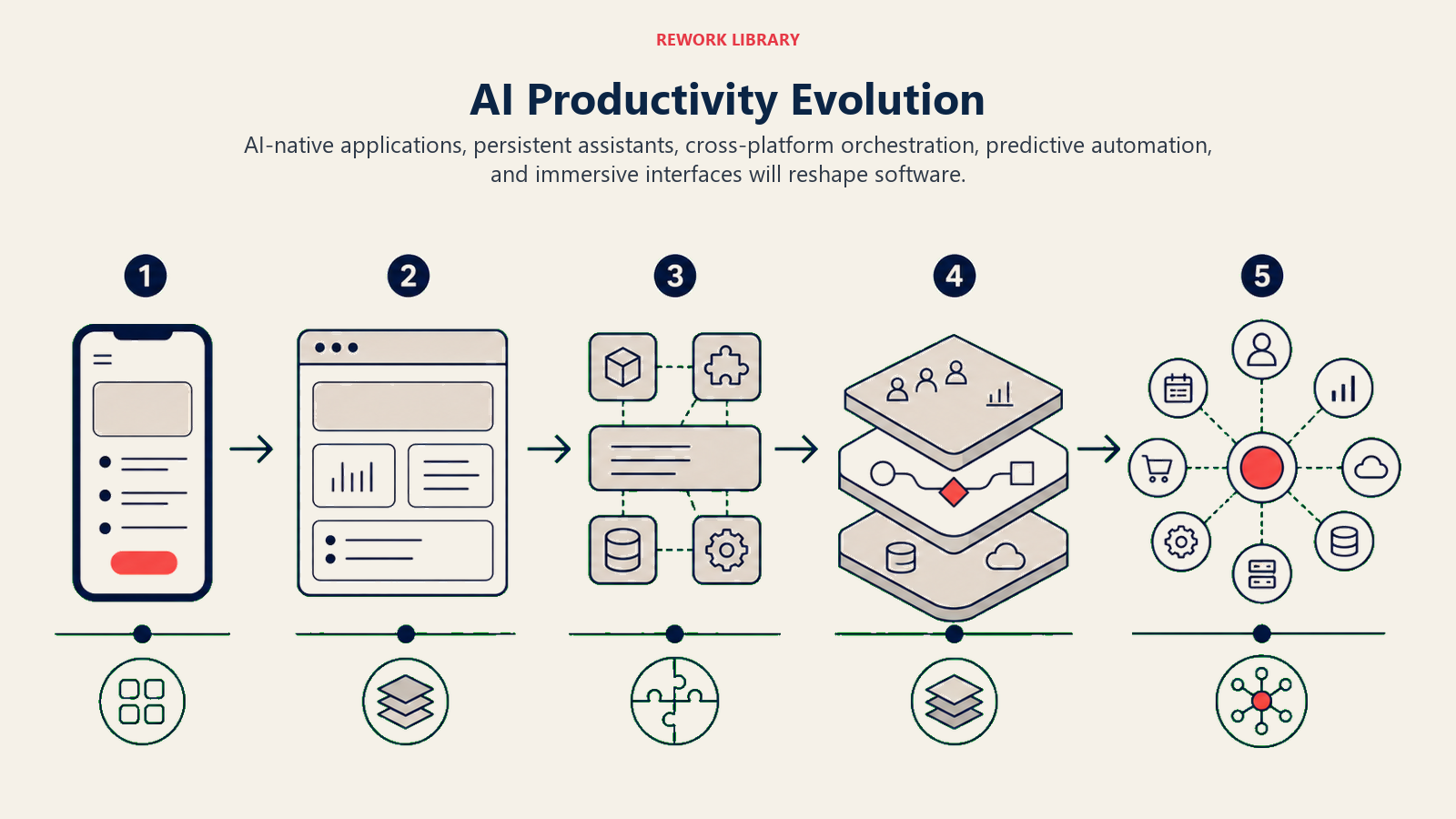
AI-native applications: Today's AI productivity tools? They're mostly traditional software with AI features bolted on. Word with Copilot. Excel with AI formulas. Existing tools, AI-enhanced.
AI-native applications will be built from the ground up for AI interaction. Instead of documents, you'll have living workspaces where AI continuously generates, updates, and optimizes content based on your goals and changing information.
Instead of managing tasks in lists, you'll describe outcomes you want to achieve and AI will dynamically manage the plan to get there, adjusting as conditions change.
Persistent AI assistants that learn over time: Imagine an AI that works with you for years, learning your preferences, your style, your priorities, your weaknesses, and your strengths. It becomes genuinely personalized, not through configuration settings but through observation and adaptation.
This AI knows that you tend to overcommit so it flags when your schedule is getting unsustainable. It knows you do your best strategic thinking in the morning so it schedules your focused work then. It knows which team members need more detailed instructions and which prefer autonomy.
That's the direction AI assistants are heading: from tools you configure to partners that learn.
Cross-platform AI orchestration: Right now, even when you have multiple AI tools, they don't really work together. You use one for writing, another for analysis, another for scheduling, and you manually connect their outputs.
Future AI will orchestrate across platforms automatically. You ask for something that requires multiple tools and AI figures out the optimal workflow: query this database, analyze the results here, generate a report there, schedule a meeting to review it, and prepare briefing materials. All triggered by a single request.
Predictive automation: Current automation is reactive. It waits for you to do something, then automates what happens next. Predictive automation anticipates what you'll need and prepares it before you ask.
Your AI notices that you always review sales performance data on Monday mornings. It starts generating updated reports Sunday night. It sees that customer complaints about a specific issue are rising. It drafts a response plan before you've noticed the pattern. It predicts which projects are likely to miss deadlines and suggests interventions early.
Immersive AI interfaces: As AR and VR technology matures, AI interaction will extend beyond screens. Imagine working with data visualizations that float in three-dimensional space around you, manipulated through gesture and voice with AI responding to your exploratory questions in real-time.
Or AI-mediated collaboration where remote team members feel present in the same space, with AI handling the technical complexity of making that illusion work seamlessly.
This feels like science fiction today. It'll be normal in three years.
Technology Enablers
These future capabilities depend on several technology trends that are already underway.
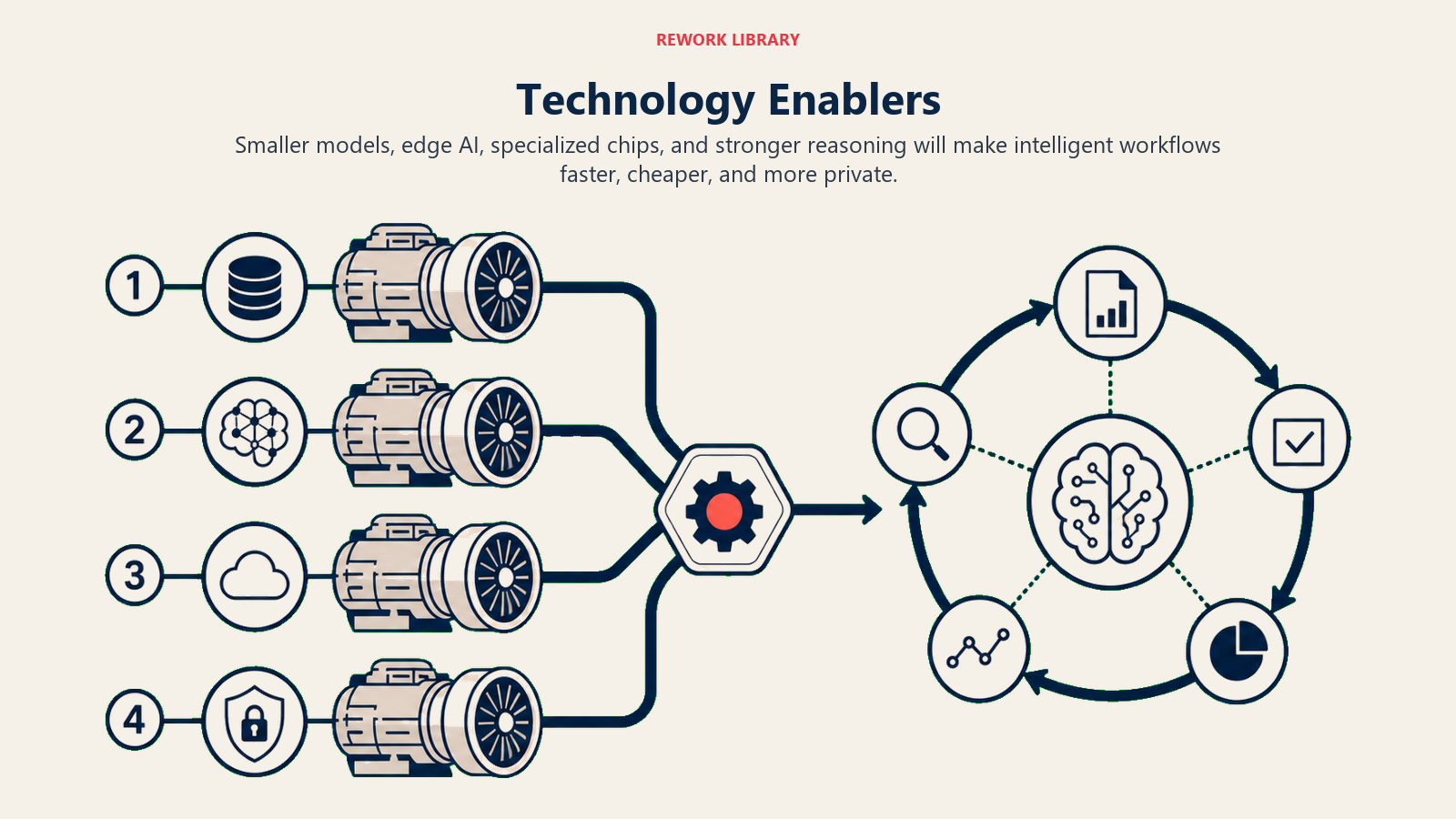
Smaller, faster, cheaper models: The AI models powering these tools are getting dramatically more efficient. What required massive cloud infrastructure last year now runs on your laptop. What cost dollars per query now costs pennies.
This efficiency enables AI to be everywhere: embedded in every application, running locally on your devices, always available without cloud latency or connectivity requirements.
Edge AI for privacy and speed: More AI processing will happen on your device rather than in the cloud. This solves two problems at once: privacy (your data never leaves your control) and speed (no waiting for round-trip to distant servers).
Edge AI enables real-time AI assistance with sensitive data, opening use cases that weren't feasible when everything had to be sent to cloud servers.
Specialized AI chips: Just as graphics cards revolutionized gaming and video, specialized AI processors are revolutionizing AI application performance. These chips make AI computation orders of magnitude faster and more energy-efficient.
As these chips become standard in computers and phones, AI capabilities that seem impressive today will be baseline expectations tomorrow.
Advanced reasoning capabilities: Current AI is impressive at pattern matching and generation but limited at complex reasoning. It can write well but struggles with multi-step logical problems.
That's changing. Research into AI reasoning is producing systems that can plan, solve complex problems, verify their own logic, and explain their reasoning. When these capabilities reach productivity tools, the range of knowledge work AI can handle expands dramatically.
Changing Work Patterns
As these tools evolve, work patterns will shift in fundamental ways.
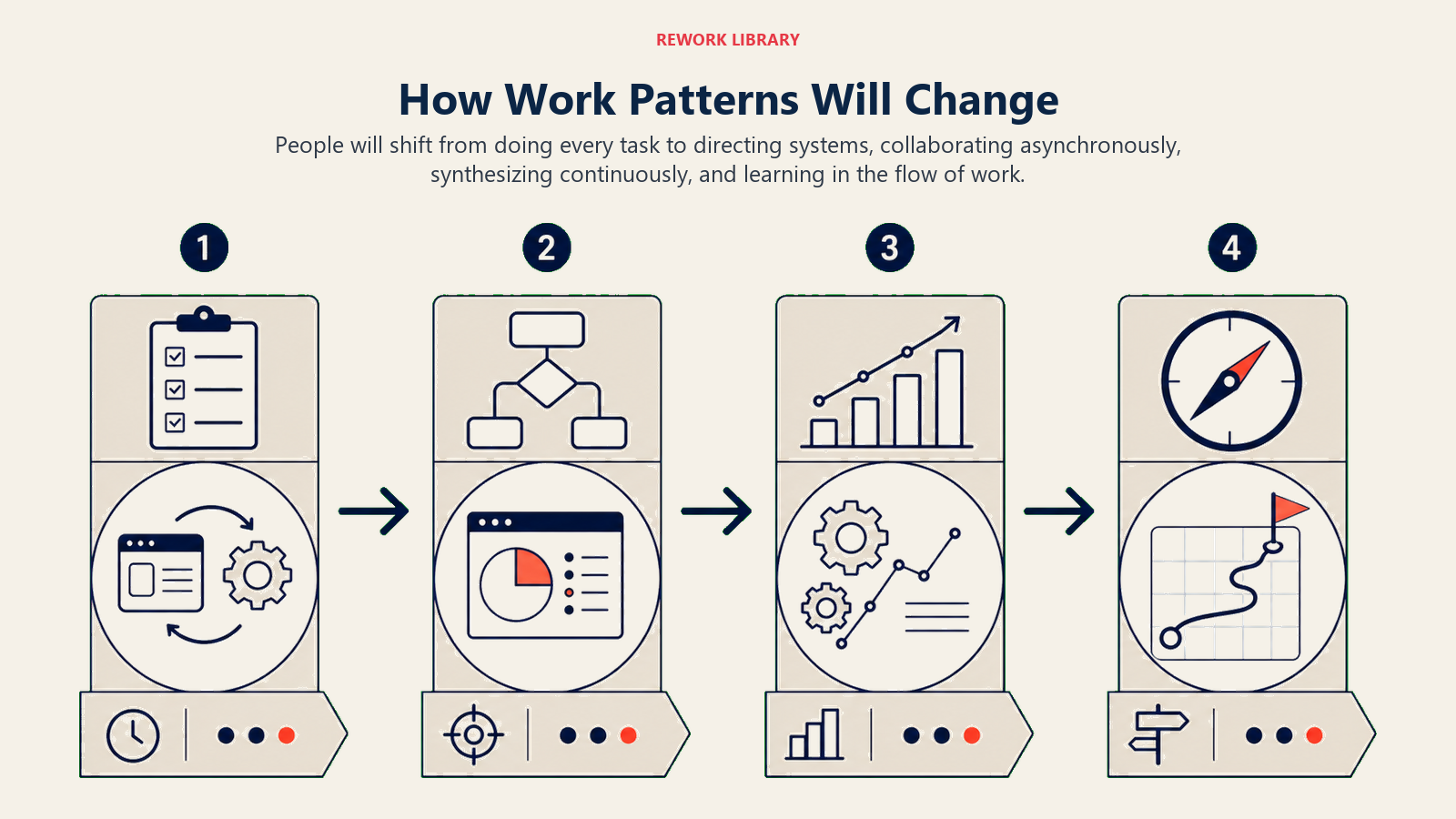
From "doing work" to "directing AI": The core skill of knowledge work is shifting from executing tasks to effectively directing AI to execute tasks. Your value increasingly comes from knowing what needs to be done and how to evaluate results, not from doing the mechanical work yourself.
This isn't dehumanizing work. It's elevating it. You spend more time on strategy, creativity, and judgment (the things humans are uniquely good at) and less time on execution that AI handles better.
Async collaboration with AI intermediaries: Today, collaboration requires synchronous time together or asynchronous back-and-forth that's often inefficient. Future collaboration will be AI-mediated.
You contribute your perspective. Your colleagues contribute theirs. AI synthesizes these perspectives, identifies areas of agreement and disagreement, asks clarifying questions, and produces a coherent outcome. All without requiring everyone to be in the same meeting at the same time.
Real-time knowledge synthesis: Instead of knowledge living in documents that get outdated, future knowledge systems will be continuously synthesized and updated by AI. When you ask a question, you don't get a document written last quarter. You get an answer synthesized from all current information.
When information changes, AI automatically updates everywhere that information is referenced. No more manually tracking down outdated documentation.
Continuous skill evolution: The half-life of specific skills is getting shorter. The tool you mastered last year has new capabilities this year. The workflow that was optimal six months ago is outdated now.
Future work requires continuous learning and adaptation. Organizations that build cultures of ongoing skill development will thrive. Those that treat training as one-time events will struggle.
Organizational Implications
These technology and work pattern changes create organizational challenges and opportunities.
New roles emerge: AI workflow designer. Prompt engineer. AI training specialist. AI ethics officer. Human-AI collaboration consultant. These weren't job titles three years ago. Some are common today. New roles will keep emerging as AI capabilities expand.
Smart organizations are already thinking about these roles, developing talent pipelines, and creating career paths for AI-related positions.
Evolving skill requirements: The skills that made someone successful five years ago aren't sufficient anymore. Success increasingly requires: AI literacy, prompt engineering skills, ability to evaluate AI outputs, understanding of AI limitations, ethical judgment about AI usage.
You'll need to invest continuously in upskilling your workforce, not as a one-time initiative but as an ongoing organizational capability.
Changed team structures: When AI can handle many coordination and execution tasks, team structures that evolved around human limitations may not be optimal. You might need smaller teams with broader scope. Flatter hierarchies with less middle management. More fluid team compositions that shift based on project needs.
Different productivity metrics: Traditional productivity metrics (hours worked, tasks completed, documents produced) matter less when AI handles much of that output. What matters is outcomes achieved, decisions made, value created.
You'll need new frameworks for measuring and managing productivity in AI-augmented work environments.
Preparing for the Future
Given this rapid evolution, how do you prepare your organization for what's coming?
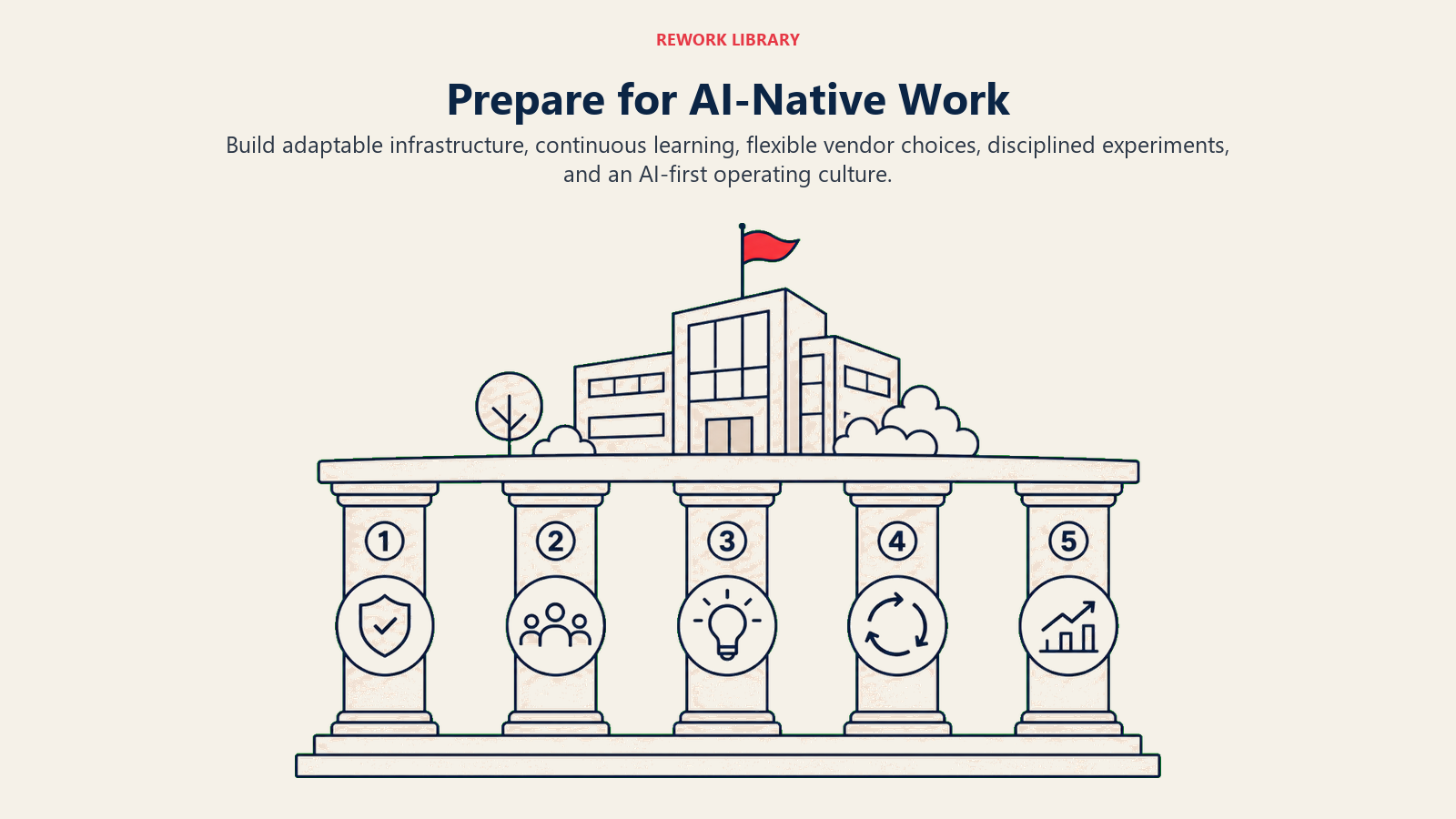
Build adaptable AI infrastructure: Don't lock yourself into rigid technology stacks. Choose platforms and architectures that can evolve as AI capabilities advance through AI tool stack optimization. Favor composable systems over monolithic ones. Prioritize vendors that are investing heavily in AI innovation.
Invest in continuous learning: Make ongoing AI education core to your culture, not a program you run occasionally. Create learning systems that help people keep pace with evolving capabilities. Budget for continuous training, not just initial training.
Maintain flexible vendor relationships: The AI landscape is changing too fast for long-term exclusive commitments to make sense for most organizations. Structure vendor relationships that give you flexibility to adopt new capabilities as they emerge without being locked into outdated approaches.
Experiment with emerging capabilities: Don't wait for technologies to be mature before engaging with them. Run small experiments with emerging AI capabilities. Learn what works in your context. Build organizational muscle for rapid technology adoption.
Some experiments will fail. That's fine. The learning and capability-building are the real value, not success in every pilot.
Develop AI-first culture now: Culture changes slowly. If you wait until future capabilities arrive to start building an AI-first culture, you'll be years behind. Start now building the mindsets, practices, and behaviors that will let you capitalize on future AI tools when they arrive.
Think about talent strategy: The competition for AI-savvy talent is intensifying. How will you attract, develop, and retain people with strong AI skills? What does career development look like in an AI-augmented organization? What skills will be valuable in five years?
Answer these questions now and start building accordingly.
Strategic Questions for Leaders
As you think about the future of AI productivity tools, consider these questions:
Where is AI heading in your industry specifically? General trends matter, but industry-specific evolution matters more. Healthcare AI will evolve differently than financial services AI. What's coming in your domain?
What capabilities would be game-changing for your business? If AI could do X, what would that enable? Build a wishlist of future capabilities and monitor for when they become available.
How fast is your organization learning? Can you adopt new AI capabilities every quarter? Every year? What's limiting your pace and how can you accelerate?
Who are your AI innovators and how are you leveraging them? You have people in your organization who are naturally experimenting with AI. Are you learning from them and scaling their innovations?
What's your plan B if AI progress stalls? Unlikely, but what if AI capabilities plateau? Are you building value from current capabilities rather than just betting on the future?
How are you balancing innovation and risk? Moving fast with AI creates opportunities but also risks addressed through AI security and compliance. How do you maintain appropriate balance?
What ethical principles will guide your AI usage? As AI capabilities expand, ethical questions become more complex. Having clear AI ethics and data privacy principles established now helps you navigate future decisions.
The Accelerating Future
Here's what's certain about the future of AI productivity tools: they'll be more capable, more accessible, more integrated, and more essential to knowledge work than they are today.
What's uncertain is exactly how fast these changes will arrive and which specific capabilities will matter most. The safest assumption is that things will change faster than you expect and in ways that surprise you.
The organizations that thrive in this environment won't be those with the best predictions about the future. They'll be those that build adaptability, learning, and innovation into their core operations. They'll be ready to capitalize on new capabilities as they emerge without knowing exactly what those capabilities will be.
Start with the tools and capabilities available today. Build value from them. Develop AI-first culture. Create learning systems. Build flexible infrastructure. Then, as new capabilities arrive, you'll be positioned to adopt them quickly and effectively rather than starting from zero.
The future of AI productivity tools is coming fast. The question isn't whether it'll transform knowledge work (it will). The question is whether your organization will be ready to lead that transformation or scrambling to keep up. Your choices today determine which future you get.