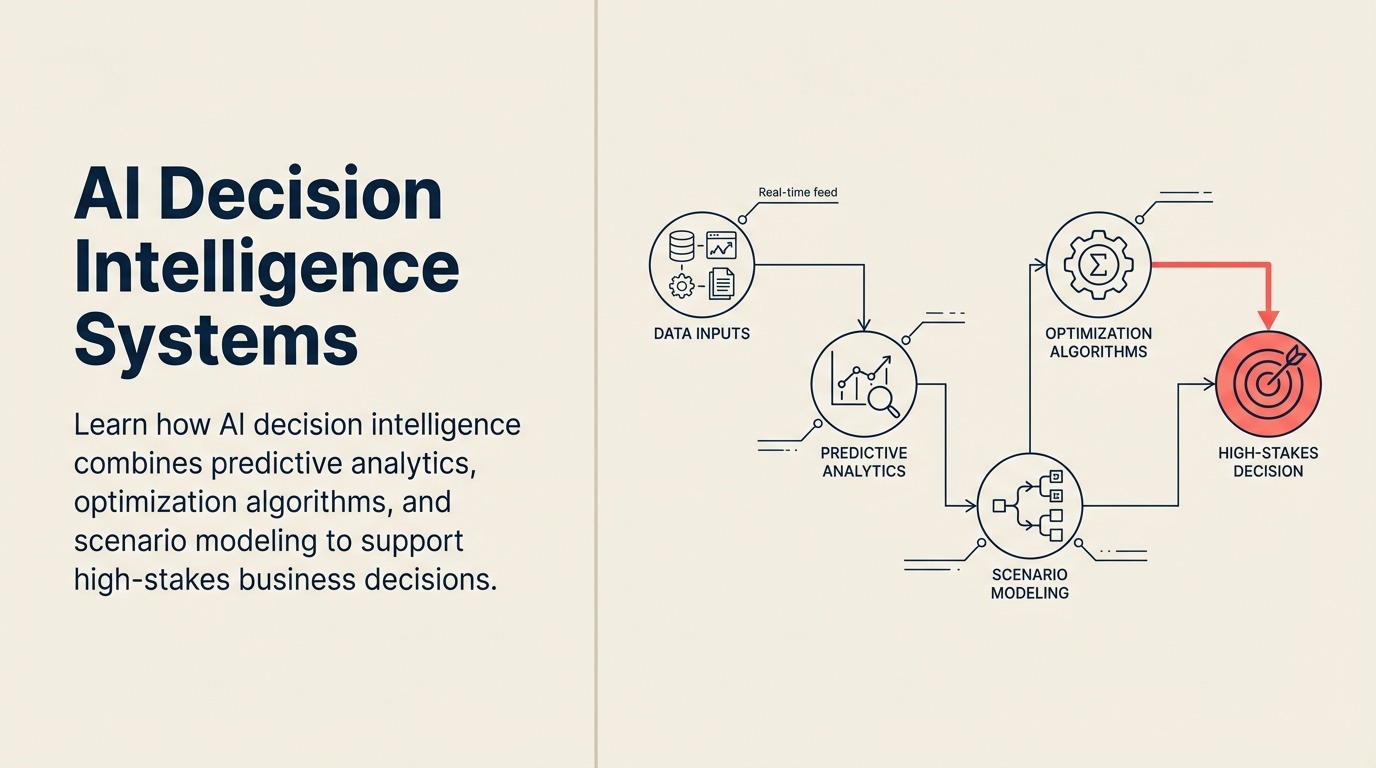
AI Decision Intelligence Systems
Turn this article into takeaways for your work.


Each assistant summarizes the article only for you and suggests best practices for your work.
Your CEO is deciding whether to enter a new market segment. The opportunity looks promising, but it requires significant investment, carries execution risk, and competes with other strategic priorities for resources. Someone built a financial model with three scenarios. The team had two strategy meetings. Everyone has opinions. And ultimately, the decision comes down to executive judgment based on incomplete information under uncertainty.
That's how most strategic decisions get made. Analysis helps, but it's limited by the number of scenarios you can model, the variables you remember to consider, and the patterns humans can identify in complex data. You make the best decision you can with the information you have.
AI decision intelligence systems don't make decisions for you. They dramatically expand the scope and quality of analysis informing your decisions.
The Decision Complexity Problem
Strategic business decisions involve numerous variables, uncertain outcomes, and competing objectives.
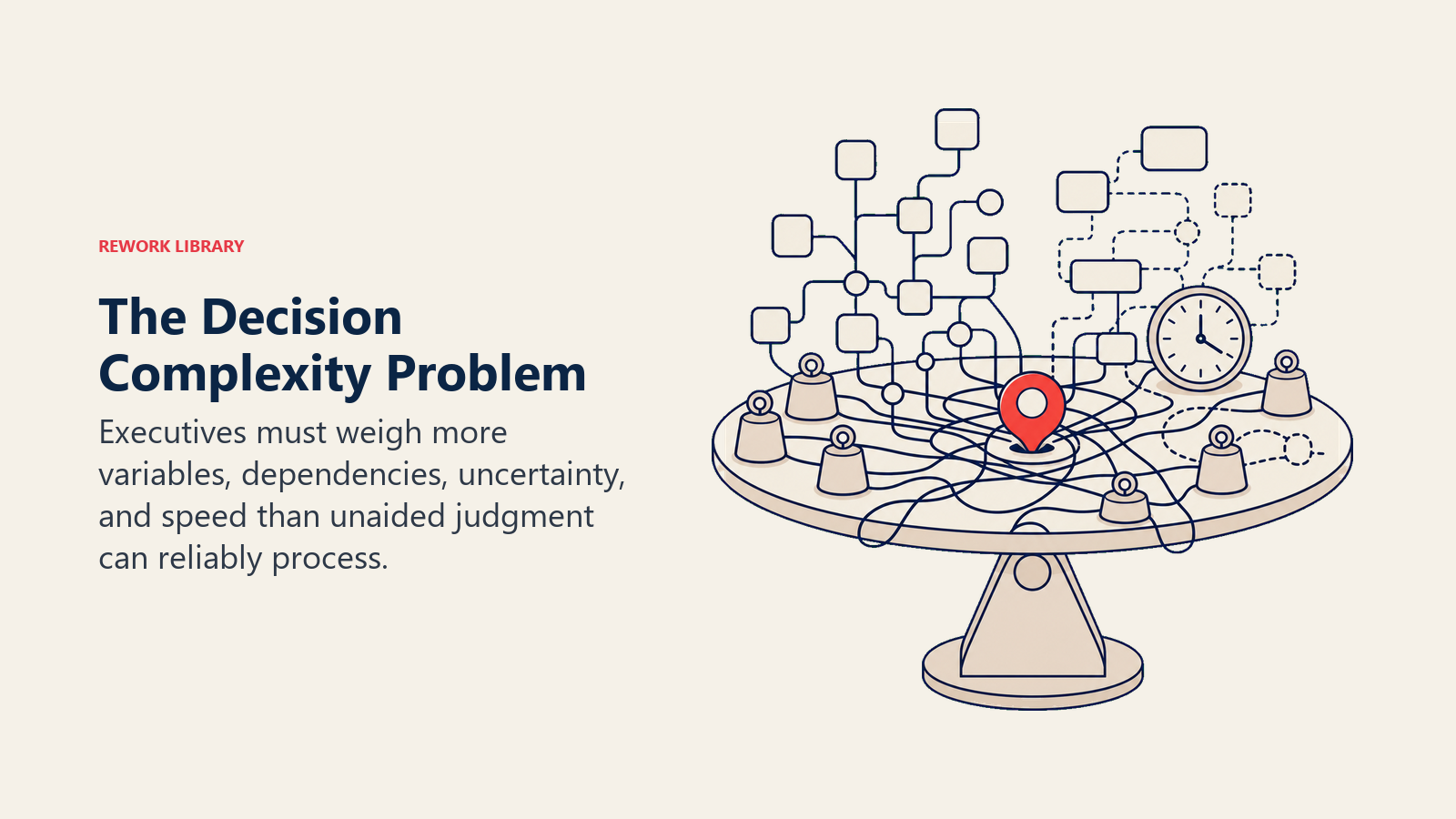
Consider a pricing decision. You're weighing revenue impact, competitive response, customer retention effects, brand perception, channel partner reactions, cost structure implications, and market share dynamics. Each variable has uncertainty. Each outcome has dependencies on others. And you need to make a decision next week.
A human executive might model three pricing scenarios, consider a handful of key variables, and make a judgment call. That's not incompetence. It's the limit of what's practically possible without AI.
An AI decision intelligence system can model thousands of scenarios, consider dozens of variables simultaneously, incorporate predictive models for uncertain outcomes, run optimization algorithms to identify optimal approaches, and quantify the expected value and risk of each option.
You're not replacing executive judgment. You're dramatically expanding the analytical foundation supporting that judgment.
What Are AI Decision Intelligence Systems
Decision intelligence goes beyond traditional analytics and business intelligence.
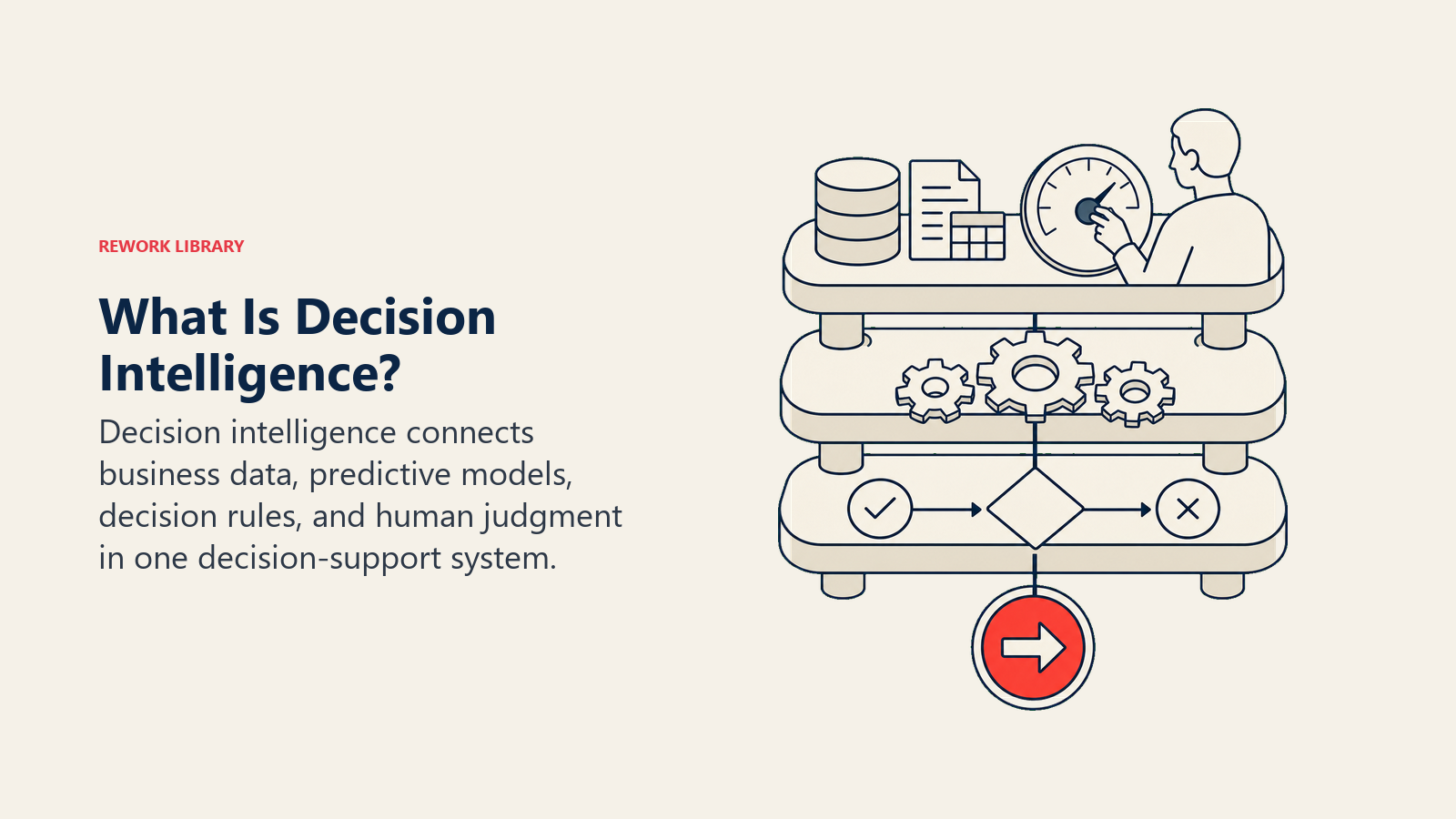
Beyond Analytics to Decision Recommendations: Analytics tells you what happened and why. Decision intelligence tells you what to do about it. The system doesn't just report that customer churn increased 15%. It models the impact of different retention interventions and recommends the approach with the highest expected ROI. This moves beyond what AI data analysis tools provide into actionable decision support.
Combining Predictive Models, Optimization, and Simulation: These systems integrate multiple AI techniques. Predictive models forecast outcomes. Optimization algorithms identify best approaches. Simulation models test scenarios. The combination enables comprehensive decision analysis.
Scenario Modeling and What-If Analysis: Decision intelligence systems generate and evaluate numerous scenarios automatically. "What if we raise prices 10% and competitors match?" "What if we increase marketing spend 20% in the enterprise segment?" "What if supply costs increase 15%?" The system models outcomes for each scenario.
Risk and Opportunity Quantification: Instead of vague statements like "this option has higher risk," decision intelligence quantifies it. "Option A has 70% probability of achieving target outcomes but 15% probability of loss exceeding $500K. Option B has 85% probability of achieving minimum targets but lower upside potential."
This isn't about eliminating uncertainty. It's about understanding and quantifying it so you can make informed risk-reward tradeoffs.
How Decision Intelligence Works
Understanding the underlying process helps you apply these systems effectively.
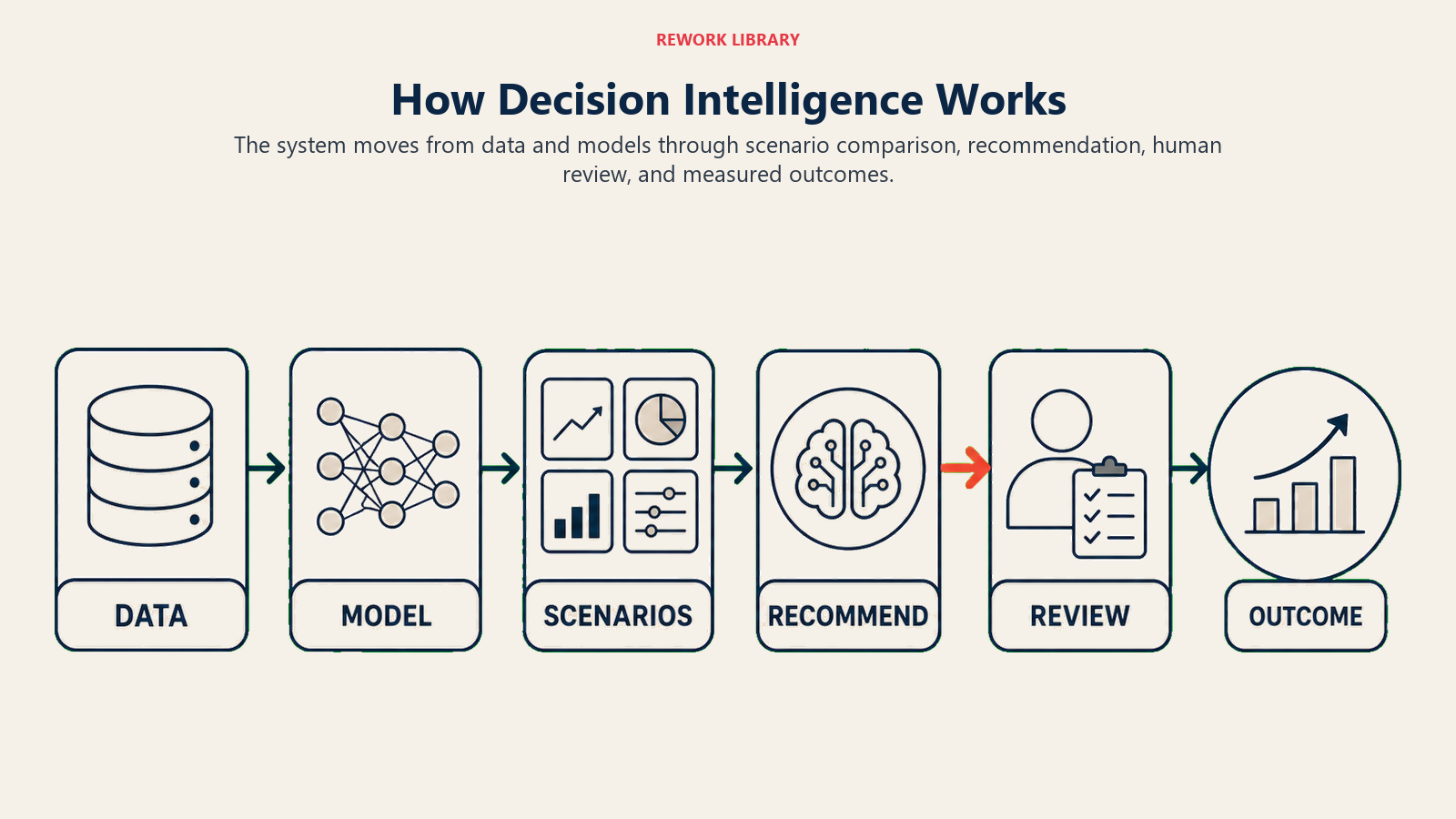
Data Integration from Multiple Sources: Decision intelligence requires comprehensive data: historical performance, market trends, customer behavior, competitive intelligence, financial metrics, operational data. The system integrates these diverse sources into a unified analytical foundation.
AI Model Ensemble for Predictions: Rather than relying on a single predictive model, advanced systems use ensemble approaches combining multiple models. One model might predict customer behavior based on historical patterns. Another incorporates market trends. A third factors in seasonal effects. The ensemble produces more reliable predictions than any single model, similar to how AI predictive analytics platforms combine multiple forecasting techniques.
Optimization Algorithm Application: Once predictions are available, optimization algorithms identify approaches that maximize desired outcomes given constraints. This might mean maximizing revenue while maintaining customer satisfaction above a threshold, or minimizing cost while meeting service level requirements.
Decision Scenario Generation: The system generates relevant decision scenarios to evaluate. For a market entry decision, it might model scenarios varying by market segment, pricing approach, go-to-market strategy, and competitive response. Each scenario gets evaluated for expected outcomes and risks.
Recommendation with Confidence Levels: Final output includes specific recommendations with confidence levels and supporting rationale. "Recommend entering market segment A with premium pricing strategy. 75% confidence of achieving target outcomes within 18 months. Key risks: competitive response uncertainty, customer acquisition cost assumptions."
Business Decision Types Supported
Different decision types benefit from decision intelligence in different ways.
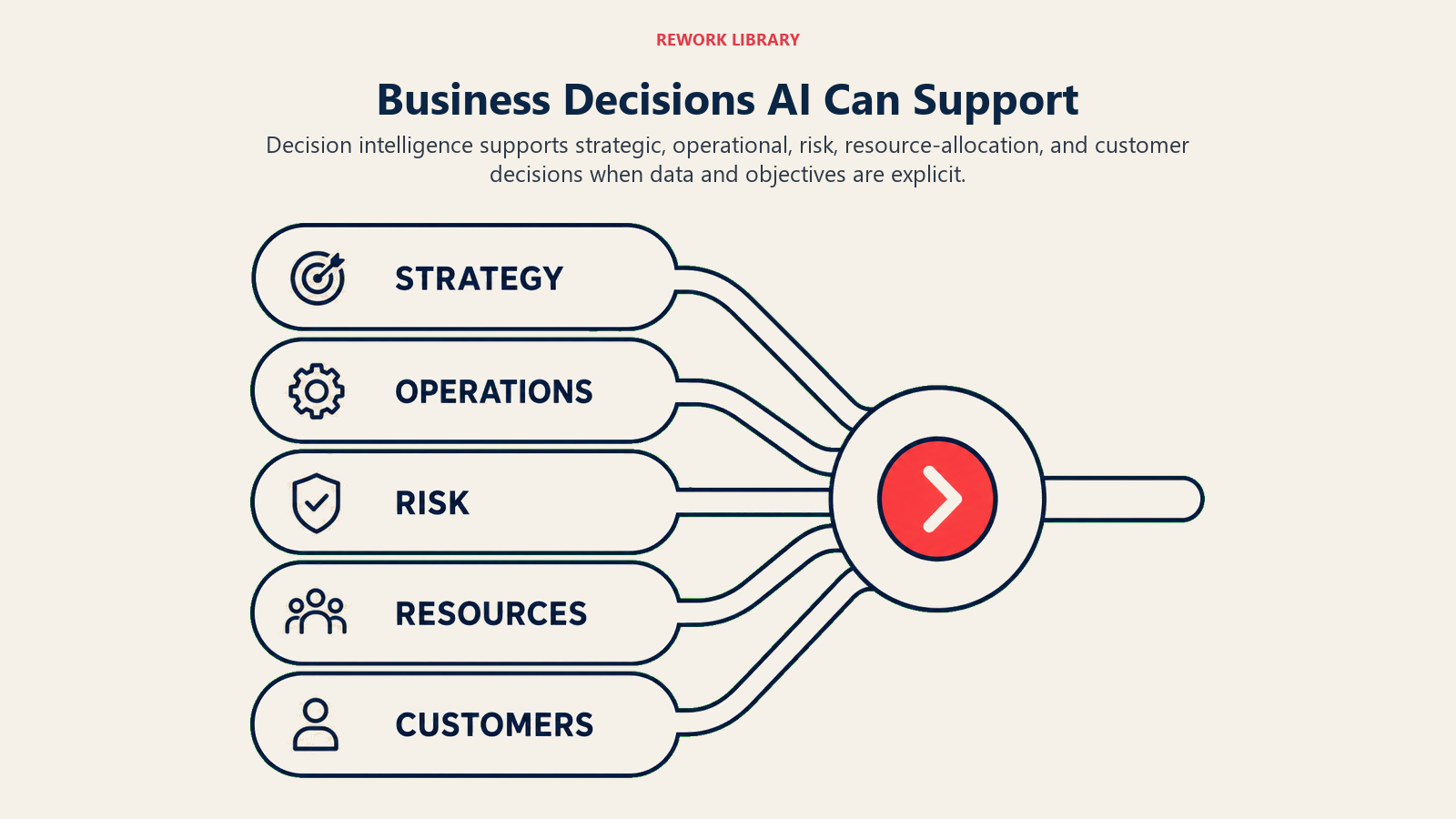
Pricing and Promotion Decisions: AI models customer price sensitivity, competitive dynamics, and market conditions to recommend optimal pricing. For promotions, it evaluates which offers drive highest incremental revenue (considering margin impact and customer behavior changes). Insights from AI for market research feed directly into these pricing and promotion models.
One retail chain uses decision intelligence for promotional planning. The system analyzes historical promotion performance, current inventory levels, competitive promotions, and predicted demand to recommend which products to promote, at what discounts, through which channels. Promotional ROI improved 35% after implementation.
Resource Allocation and Capacity Planning: Decisions about where to deploy resources (budget, headcount, equipment, inventory) involve numerous tradeoffs. Decision intelligence models expected outcomes of different allocation approaches and recommends optimal distribution.
Strategic Investment Choices: Major investments in new markets, products, technology, or M&A require evaluating complex scenarios with significant uncertainty. Decision intelligence models potential outcomes, quantifies risks and returns, and provides structured decision frameworks.
Risk Management Decisions: How much insurance to carry? Which risks to mitigate versus accept? What backup systems to implement? Decision intelligence quantifies risk exposure, models mitigation options, and recommends approaches that optimize risk-adjusted outcomes.
Supply Chain Optimization: Decisions about supplier selection, inventory levels, distribution strategies, and production scheduling involve complex interdependencies. AI models the entire system, identifies bottlenecks and opportunities, and recommends optimization approaches.
Leading Decision Intelligence Platforms
The decision intelligence market includes both established platforms and emerging solutions.
Quantexa: Specializes in decision intelligence for complex operational decisions, particularly in financial services and government. Quantexa platform excels at network analysis and relationship mapping, helping organizations understand connected risks and opportunities. Strong in anti-money laundering, fraud detection, and customer intelligence use cases.
Ople.ai: Focuses on accessible decision intelligence for business users without data science backgrounds. Ople.ai platform automates model building, scenario generation, and recommendation delivery. Designed for operational decisions (pricing, resource allocation, demand forecasting) where speed and accessibility matter.
Peak.ai: Provides decision intelligence specifically for commercial decisions: pricing, promotions, inventory, assortment. Peak.ai AI models are pre-trained for retail and e-commerce use cases, enabling faster implementation. Strong focus on ROI measurement and continuous improvement.
Domino Data Lab: A platform for building custom decision intelligence solutions. Domino Data Lab provides infrastructure for data scientists to develop, deploy, and manage decision models at scale. Best for organizations with advanced data science capabilities wanting to build proprietary decision intelligence.
Custom Solutions: Many organizations build decision intelligence using general-purpose AI tools like ChatGPT or Claude combined with specialized predictive models, optimization libraries, and simulation frameworks. This approach offers maximum flexibility but requires significant technical expertise.
The Decision Intelligence Workflow
Implementing decision intelligence effectively requires structured processes.
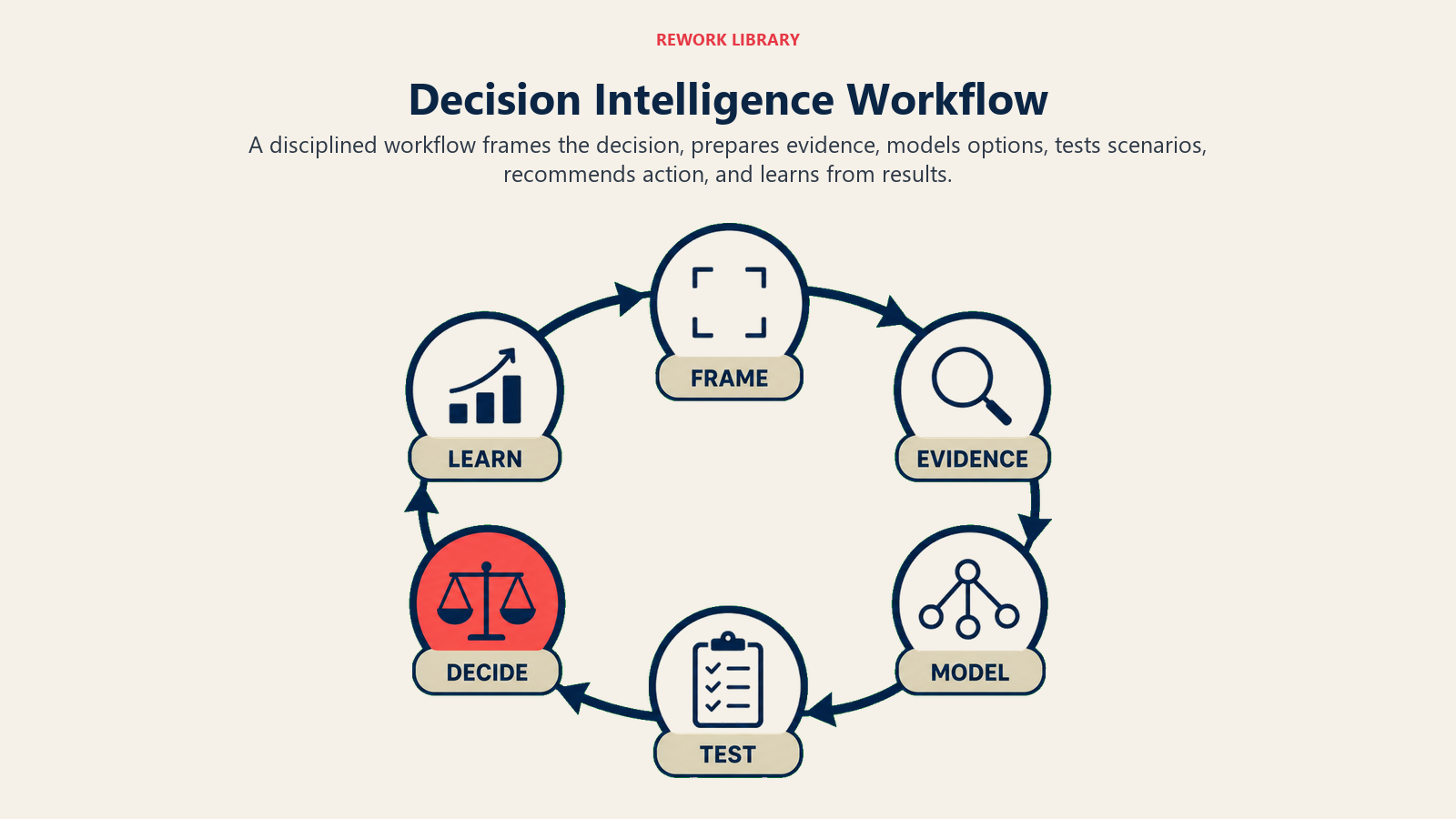
Decision Framing and Objective Setting: Start by clearly defining the decision, available options, constraints, and success criteria. For example, "Should we enter market segment X?" becomes "Which of five target segments offers the highest risk-adjusted ROI given our current resources and strategic priorities?"
Clear framing ensures the analysis addresses the actual decision rather than interesting-but-irrelevant questions.
Data and Model Integration: Connect relevant data sources and incorporate appropriate predictive models. For a market entry decision, you might integrate market size data, customer research, competitive intelligence, financial projections, and operational capacity models.
Scenario Generation: Define key variables and generate scenarios. You might vary target segment, pricing approach, sales strategy, and market conditions to create hundreds of potential scenarios to evaluate.
Impact Analysis: Model expected outcomes for each scenario. What revenue, margin, market share, and strategic position results from each approach? What's the probability distribution of outcomes (not just the most likely scenario)?
Recommendation Review: Evaluate AI-generated recommendations with human judgment. Does the analysis make sense given business context? Are there factors the model doesn't capture? What are you assuming, and how sensitive are conclusions to those assumptions?
Decision Execution and Monitoring: Once decisions are made, track actual outcomes versus predictions. This feedback loop improves future decision intelligence by refining models based on real results.
One manufacturing company uses this workflow for major capital investment decisions. They evaluate equipment upgrades, facility expansions, and automation projects using decision intelligence. The system models expected productivity improvements, cost savings, quality impacts, and risk factors. Investment decisions informed by this analysis have 60% higher ROI than historical decisions made with traditional analysis.
Human Oversight and Judgment
The relationship between AI recommendations and human decisions matters critically.
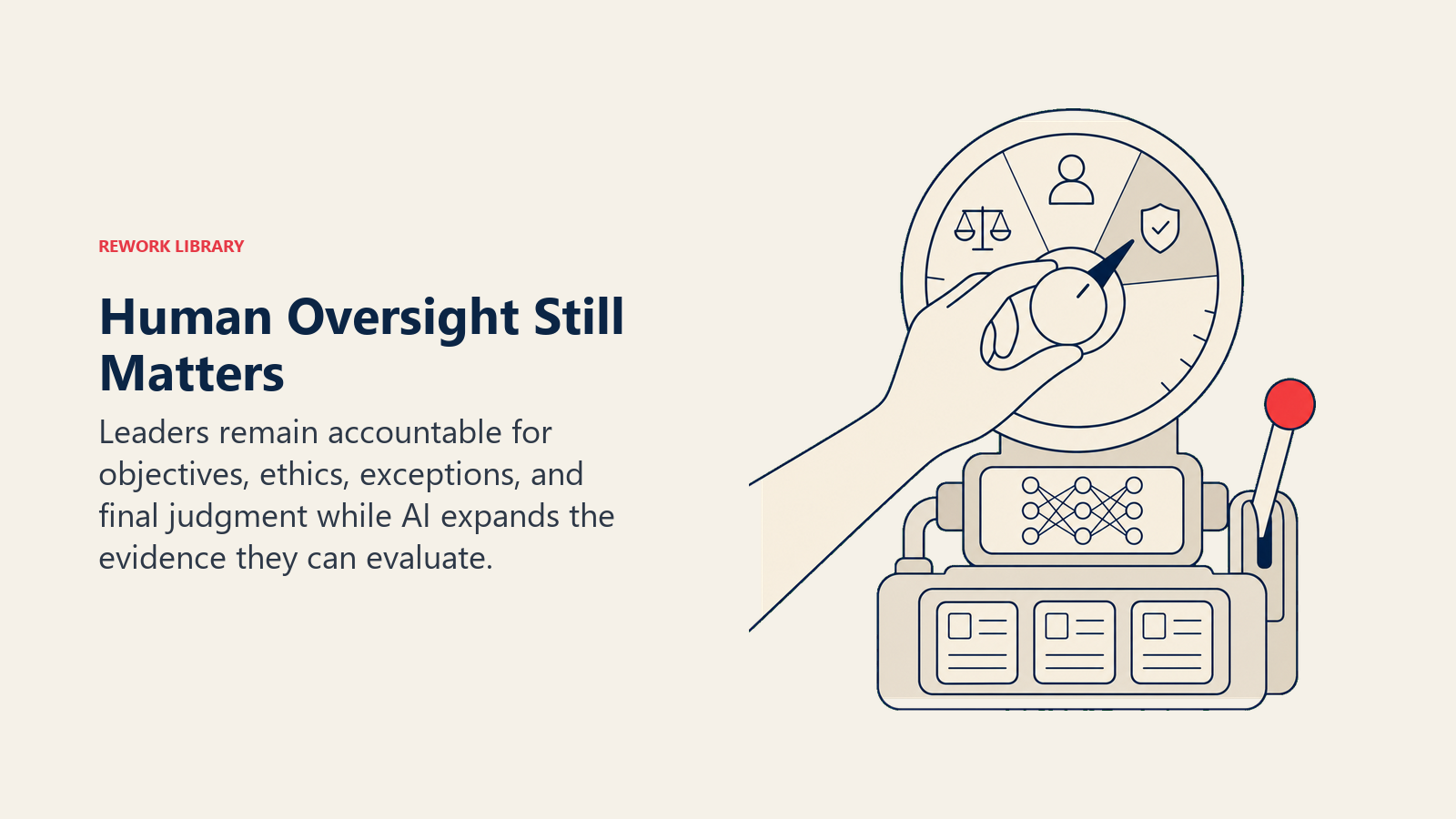
When AI Recommends, Humans Decide: Decision intelligence systems provide recommendations and supporting analysis. Executives make final decisions. This division of labor leverages AI's analytical capabilities while preserving human judgment about factors the system can't quantify: strategic intuition, organizational readiness, political considerations, cultural fit.
Understanding Model Assumptions: Every AI model makes assumptions. Understanding them helps you judge when recommendations are reliable versus when human judgment should override them. If the pricing model assumes competitors won't respond aggressively, and you have intelligence suggesting otherwise, human judgment should adjust the recommendation.
Recognizing Model Limitations: AI models are trained on historical data and identified patterns. They work well for decisions similar to past situations. They're less reliable for unprecedented situations or rapid market shifts. Human judgment is essential for recognizing when you're outside model validity range.
Incorporating Unquantifiable Factors: Some decision factors resist quantification: organizational culture, team morale, brand values, strategic vision. Decision intelligence handles quantifiable analysis. Human judgment incorporates broader considerations.
The goal isn't AI making decisions or humans ignoring AI analysis. It's humans making better decisions informed by comprehensive AI-powered analysis.
Measuring Decision Quality
Traditional decision evaluation focuses on outcomes. Did the decision produce good results? But outcomes reflect both decision quality and luck.
Process Quality Metrics: How comprehensive was the analysis? How many scenarios were evaluated? Were key risks identified? Was the decision based on data or intuition? Process quality is within your control, unlike outcomes.
Calibration Tracking: When the system says an outcome has 70% probability, does it actually occur 70% of the time across many decisions? Calibration measures whether probability estimates are accurate. Well-calibrated systems enable better risk management.
Outcome Comparison: Compare decisions made with AI support versus those made without. Are AI-informed decisions producing better results on average? How does the distribution of outcomes differ?
Learning Velocity: Are decision models improving over time as they incorporate new data and decision outcomes? Continuous improvement indicates the system is learning from experience.
One private equity firm tracks decision quality across their portfolio companies. Companies using decision intelligence for major strategic decisions show 40% better performance against plan than companies using traditional analysis. More importantly, they identify and correct course earlier when actual results deviate from predictions.
Implementation Considerations
Successfully deploying decision intelligence requires addressing several organizational challenges.
Start with Repeatable Decisions: Begin with decisions you make frequently: pricing, promotions, resource allocation, hiring. Repeatable decisions provide rapid feedback for model improvement and clear ROI measurement. This aligns with the broader AI tool selection framework of starting with high-frequency, high-impact use cases.
Build Trust Through Transparency: Decision-makers won't trust recommendations they don't understand. Ensure the system explains its reasoning, shows supporting data, and highlights key assumptions. Transparency builds confidence in AI-generated insights.
Integrate with Decision Processes: Decision intelligence works best when integrated into existing decision workflows, not as a separate analysis exercise. If your pricing committee meets monthly, have decision intelligence analysis ready for those meetings.
Maintain Human Expertise: AI augments decision-making, doesn't replace domain expertise. The best results come when experienced decision-makers use AI to expand their analytical capabilities, not when inexperienced people delegate decisions to AI.
Iterate and Improve: First implementations won't be perfect. Plan to refine models, adjust algorithms, and improve processes based on feedback and results. Decision intelligence gets better with use.
The Future of Strategic Decision-Making
As AI decision intelligence matures, the gap between organizations that leverage it and those that don't will widen.
Companies making major decisions based on spreadsheet models and executive intuition? They're competing against companies modeling thousands of scenarios with comprehensive data and sophisticated AI. The analytical advantage compounds over time as AI-informed decisions lead to better outcomes, generating better data for future decisions.
This doesn't mean smaller companies can't compete. Decision intelligence tools are increasingly accessible. What matters is willingness to augment human judgment with AI capabilities, not the size of your data science team.
The executives making the best decisions won't be those with the strongest intuition or the most experience. They'll be those who effectively combine human judgment with AI-powered analysis: using AI to handle the analytical complexity humans can't process, while applying human judgment to factors AI can't quantify.
That market entry decision? You'll still need to make the final call. But instead of choosing between three scenarios based on limited analysis, you'll be evaluating comprehensive scenario modeling with quantified risks and expected outcomes. Your judgment won't be replaced. It'll be informed by analysis that was impossible before AI.
Related Resources:

On this page
- The Decision Complexity Problem
- What Are AI Decision Intelligence Systems
- How Decision Intelligence Works
- Business Decision Types Supported
- Leading Decision Intelligence Platforms
- The Decision Intelligence Workflow
- Human Oversight and Judgment
- Measuring Decision Quality
- Implementation Considerations
- The Future of Strategic Decision-Making