AI vs Traditional Productivity Software: Understanding the Fundamental Shift in Business Tools
Turn this article into takeaways for your work.


Each assistant summarizes the article only for you and suggests best practices for your work.
The $50 billion question facing every executive right now: should we upgrade our existing productivity software or replace it entirely with AI-powered alternatives?
It's not a simple decision. Your teams are already trained on Microsoft Office, Salesforce, and whatever project management tool you've standardized on. Switching carries risk. But so does staying put while competitors gain AI-powered advantages.
The answer starts with understanding the fundamental difference between these two types of tools. It's not just about features or performance. It's about how the software actually works under the hood. Before diving into comparisons, ensure you understand what AI productivity tools actually are and the different types available.
The Core Distinction: Rules vs Learning
Traditional productivity software runs on rules. If this happens, then do that. Click here to get this result. Every behavior is programmed explicitly by developers who anticipated specific use cases.
AI-powered productivity software learns. It observes patterns, adapts to your context, and improves over time. The developers didn't program every possible outcome - they built systems that figure out what to do based on data and usage patterns.
This architectural difference ripples through everything else. It changes how the software behaves, how much it costs, what skills users need, and ultimately whether it makes sense for your business.
Five Key Differentiators That Actually Matter
Let's get specific. Here are the differences that impact business outcomes, not just technical specs.
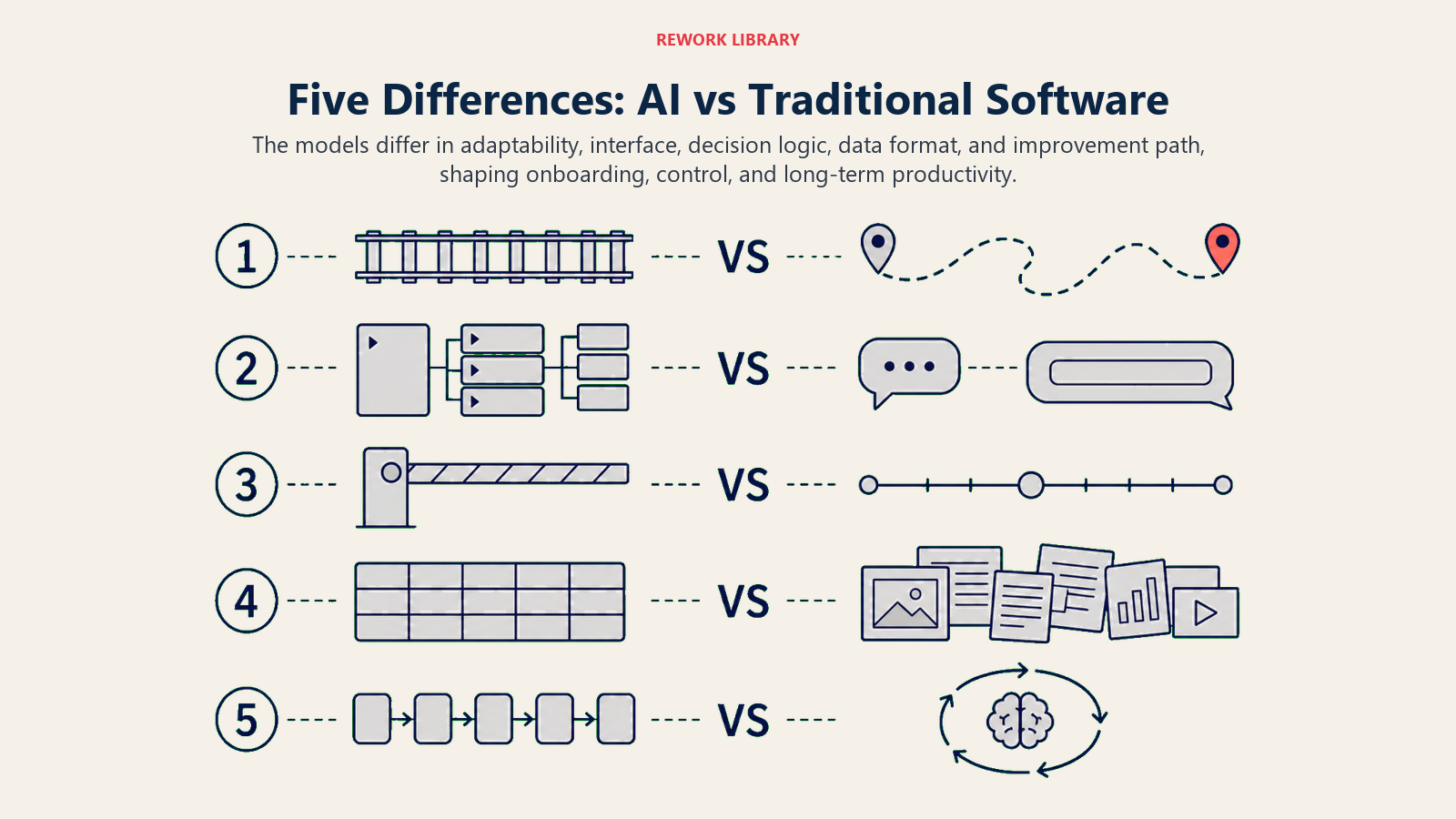
1. Adaptability: Static Workflows vs Learning Systems
Traditional Software: When your business process changes, someone has to reconfigure the software. You update templates, change workflow rules, rebuild dashboards. Every variation requires explicit programming or configuration.
A sales team using traditional CRM needs IT support to add new pipeline stages or change approval workflows. The system can't adapt on its own.
AI-Powered Software: The software observes how people actually work and suggests improvements. It identifies patterns you didn't explicitly program. When processes change, it adapts without reconfiguration.
An AI-powered CRM notices that deals in a certain category close faster when specific actions happen. It automatically recommends those actions for similar deals, without anyone building that logic.
Business Impact: Traditional software becomes outdated as your business evolves. AI software stays current. For fast-moving companies, this difference is worth 10-15% productivity improvement annually.
2. Interface: Menu-Driven vs Conversational
Traditional Software: You learn where every feature lives. Click this menu, select that option, fill in these fields. Power users memorize keyboard shortcuts. Everyone else struggles with features they use infrequently.
Training new employees takes weeks. Even experienced users waste time navigating menus to find capabilities they need.
AI-Powered Software: You describe what you want to accomplish. The software figures out how to do it. No need to memorize menu structures or remember which button does what.
"Show me accounts that haven't been contacted in 30 days with open opportunities over $50K" - the AI understands and delivers results. Traditional software requires you to know which reports exist and how to filter them.
Business Impact: Onboarding time drops from weeks to days. Feature usage increases because people don't need to know features exist to use them. User satisfaction improves dramatically.
3. Decision-Making: Programmatic vs Probabilistic
Traditional Software: Every decision follows explicit rules. If sales amount exceeds $100K, route to VP for approval. Otherwise, route to manager. The rules are deterministic and predictable.
This works well when business logic is clear and stable. It breaks down when exceptions are common or context matters.
AI-Powered Software: The system makes recommendations based on probability and context. It might suggest routing a $95K deal to the VP because similar deals from this customer typically expand during negotiation.
AI software handles nuance that rule-based systems can't capture. But it also means you can't always explain exactly why it made a specific recommendation.
Business Impact: For simple, well-defined processes, traditional software is more predictable. For complex, context-dependent decisions, AI software is far more effective. The key is knowing which situations you're dealing with.
4. Data Requirements: Structured vs Unstructured
Traditional Software: Everything needs to be in the right format. Data goes in specific fields. Spreadsheets have defined columns. Documents follow templates. The system can't process information that doesn't fit its structure.
This creates data entry overhead. People spend hours formatting information so the system can use it.
AI-Powered Software: The system understands unstructured data. Drop in an email, a meeting transcript, or a PDF - the AI extracts relevant information without requiring specific formatting.
An AI tool can read a contract, extract key terms, and populate deal details automatically. Traditional software would need someone to manually enter each field.
Business Impact: AI software dramatically reduces data entry time. The average knowledge worker spends 4.5 hours per week on data entry that AI tools could eliminate.
5. Improvement Path: Updates vs Continuous Learning
Traditional Software: The vendor ships new versions with additional features. You upgrade periodically, retrain users on new capabilities, and adapt processes to take advantage of improvements.
Between upgrades, the software stays the same. You get what you paid for, but no more.
AI-Powered Software: The system improves continuously as it processes more data and observes more usage patterns. Today's version is smarter than last month's, even without official updates.
An AI writing assistant gets better at matching your company's tone as it sees more examples. Traditional grammar checkers never improve beyond their programmed rules.
Business Impact: Traditional software has predictable, stepped improvement. AI software provides continuous but less predictable enhancement. Both models have value depending on your risk tolerance and need for consistency.
Practical Comparison Across Common Use Cases
Theory is useful, but let's look at how these differences play out in actual business situations.
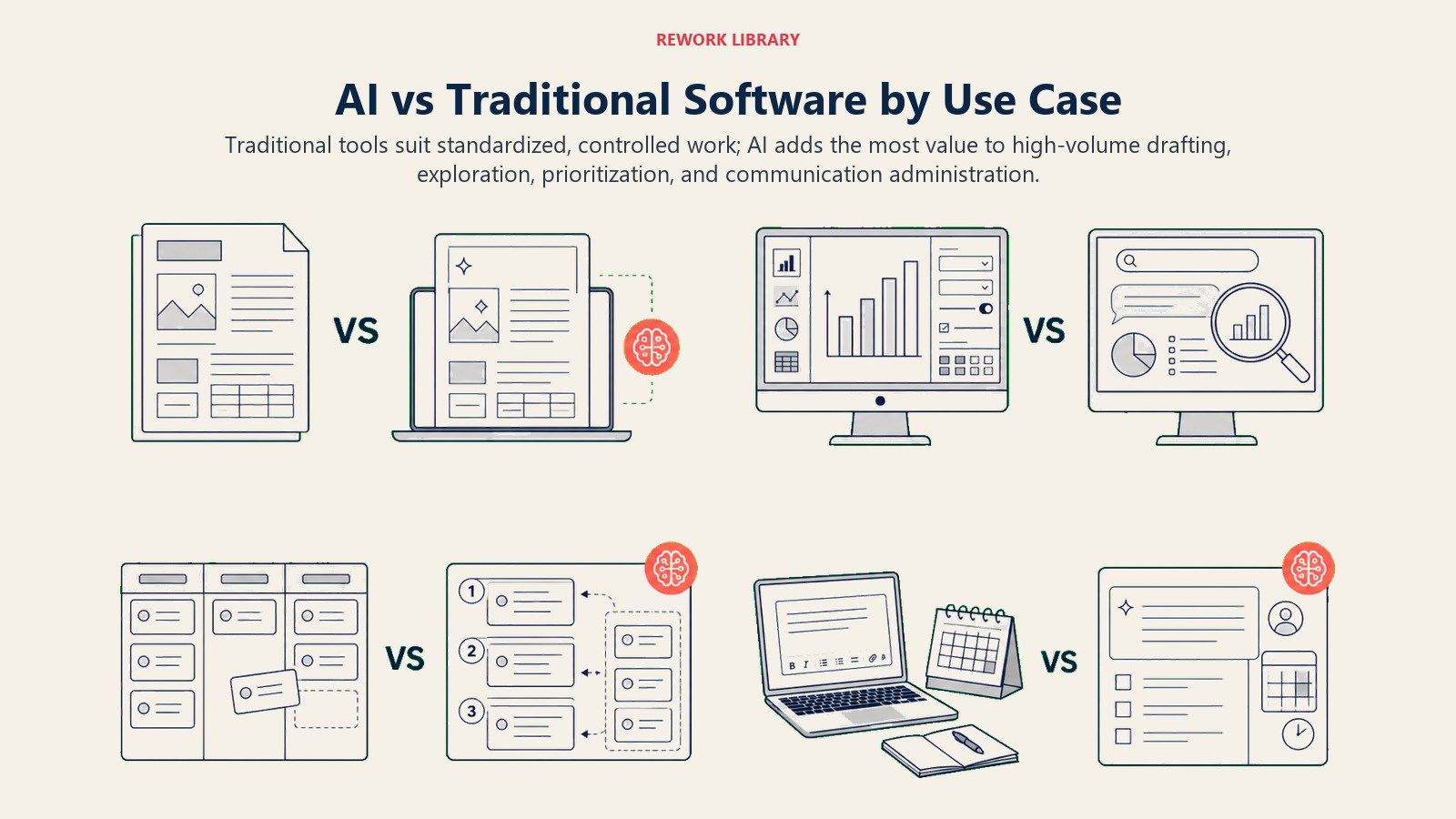
Document Creation
Traditional Approach: Open template, fill in sections, apply formatting, run spell check, export. The software provides structure and editing tools. You provide all content and creative decisions.
AI Approach: Describe the document you need. The AI generates a first draft based on your requirements and existing examples. You refine and approve. The software generates both structure and content.
When to Use Each: Use traditional tools for highly standardized documents where templates work well. Use AI tools when you need customized content at scale or first drafts that save significant time.
Data Analysis
Traditional Approach: Connect to data source, select fields, apply filters, choose visualization type, configure display options. You decide what to analyze and how to present it.
AI Approach: Ask a question in plain language. The AI selects relevant data, applies appropriate analysis, and presents results with context. It might also suggest related analyses you didn't ask for.
When to Use Each: Traditional BI tools are better when you know exactly what analysis you need and want complete control over methodology. AI analytics shine when exploring data or democratizing analysis across non-technical users.
Task Management
Traditional Approach: Create tasks, assign them, set due dates, track status. The system organizes and displays your manually entered information. You make all prioritization and scheduling decisions.
AI Approach: The system suggests task creation based on emails and meetings. It recommends priorities based on deadlines, dependencies, and your work patterns. It automatically adjusts schedules when priorities change.
When to Use Each: Use traditional task managers when you want explicit control over every task and priority. Use AI task management when you're overwhelmed by volume and need help with triage and prioritization.
Communication
Traditional Approach: Compose emails, schedule meetings, take notes. The software provides communication channels and recording capabilities. You handle all content and coordination.
AI Approach: The system drafts emails based on context, suggests optimal meeting times, transcribes discussions, and extracts action items automatically. It doesn't replace communication but eliminates administrative overhead.
When to Use Each: Traditional communication tools are sufficient for low-volume, straightforward interactions. AI communication tools provide massive time savings when meeting load is high or you need searchable records of discussions.
When Traditional Software is Still the Right Choice
AI isn't always better. Here are situations where traditional productivity software remains the smarter investment:
You Need Perfect Predictability In regulated industries or safety-critical applications, rule-based behavior might be required. AI's probabilistic nature can be a liability when every decision needs audit trails and guaranteed outcomes.
Your Processes Are Highly Standardized If you've spent years optimizing workflows and everyone follows the exact same process, traditional software's rigidity is an asset. There's no advantage to adaptability when the optimal path is already known.
Data Privacy Requirements Are Strict Some AI tools require sending data to external systems for processing. If your compliance requirements prevent that, traditional on-premise software with no external connectivity might be your only option. Learn more about managing these concerns in our guide on AI ethics and data privacy.
User Skills Are Limited AI tools still require users to articulate needs and evaluate results. In environments where users struggle with technology generally, well-designed traditional software with familiar interfaces might be more successful.
Budget Is Severely Constrained AI tools often carry higher per-user costs and usage-based fees. Mature traditional software with perpetual licensing can be more economical if upfront cost is more manageable than ongoing subscriptions.
The Hybrid Model: Best of Both Worlds
The smartest companies aren't choosing between AI and traditional software. They're building hybrid environments that leverage the strengths of both.
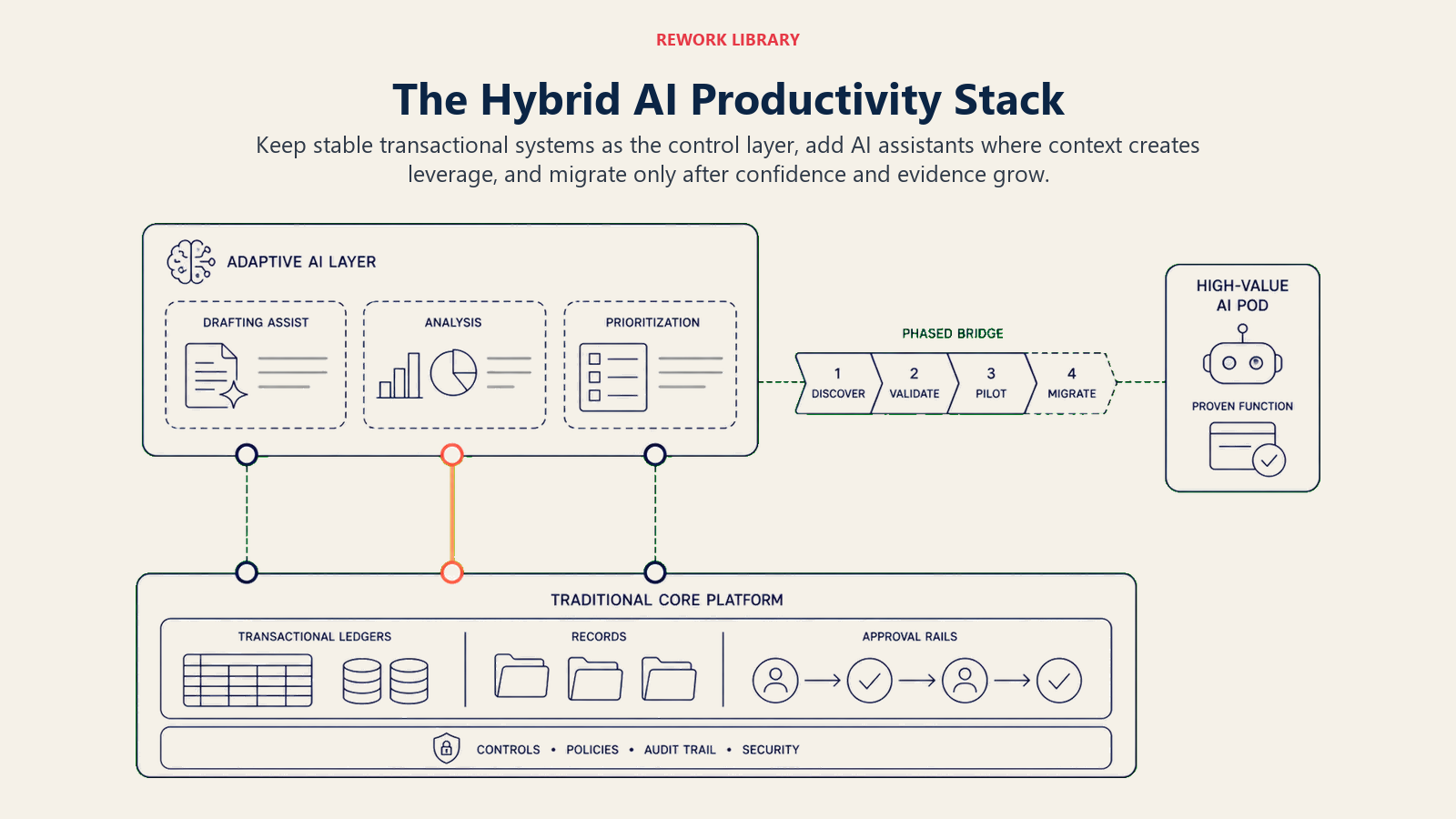
This typically means:
- Keeping traditional software for core transactional systems
- Adding AI layers that enhance traditional tools with intelligent capabilities
- Using standalone AI tools for specific high-value use cases
- Gradually migrating functions to AI as confidence builds
Microsoft's approach with Microsoft 365 Copilot illustrates this model. Excel and PowerPoint remain fundamentally rule-based tools, but Copilot adds AI capabilities that augment them without replacing their core functionality. This hybrid approach aligns with Gartner's recommendations for gradual AI adoption in enterprise environments.
Cost Structure Differences
The financial models differ significantly, and this impacts ROI timelines and budgeting approaches.
Traditional Software:
- High upfront licensing costs or predictable per-seat subscriptions
- Implementation costs front-loaded
- Maintenance fees typically 15-20% of license cost
- Upgrade costs every 2-3 years
- Generally CapEx or predictable OpEx model
AI Software:
- Lower upfront costs but usage-based fees
- Implementation often faster but ongoing optimization required
- Costs grow with usage (which means they grow with value)
- Continuous updates included
- Variable OpEx model that scales with business
ROI Timelines: Traditional software often has 18-24 month payback periods with stepped returns at each upgrade. AI software typically shows faster initial returns (6-12 months) but with more variance depending on adoption and use patterns.
Hidden Costs: Traditional software hides costs in workarounds and manual processes. AI software hides costs in the time spent training the system and managing output quality.
Decision Framework: Five Questions to Ask
When evaluating whether to stick with traditional tools or adopt AI alternatives, work through these questions:
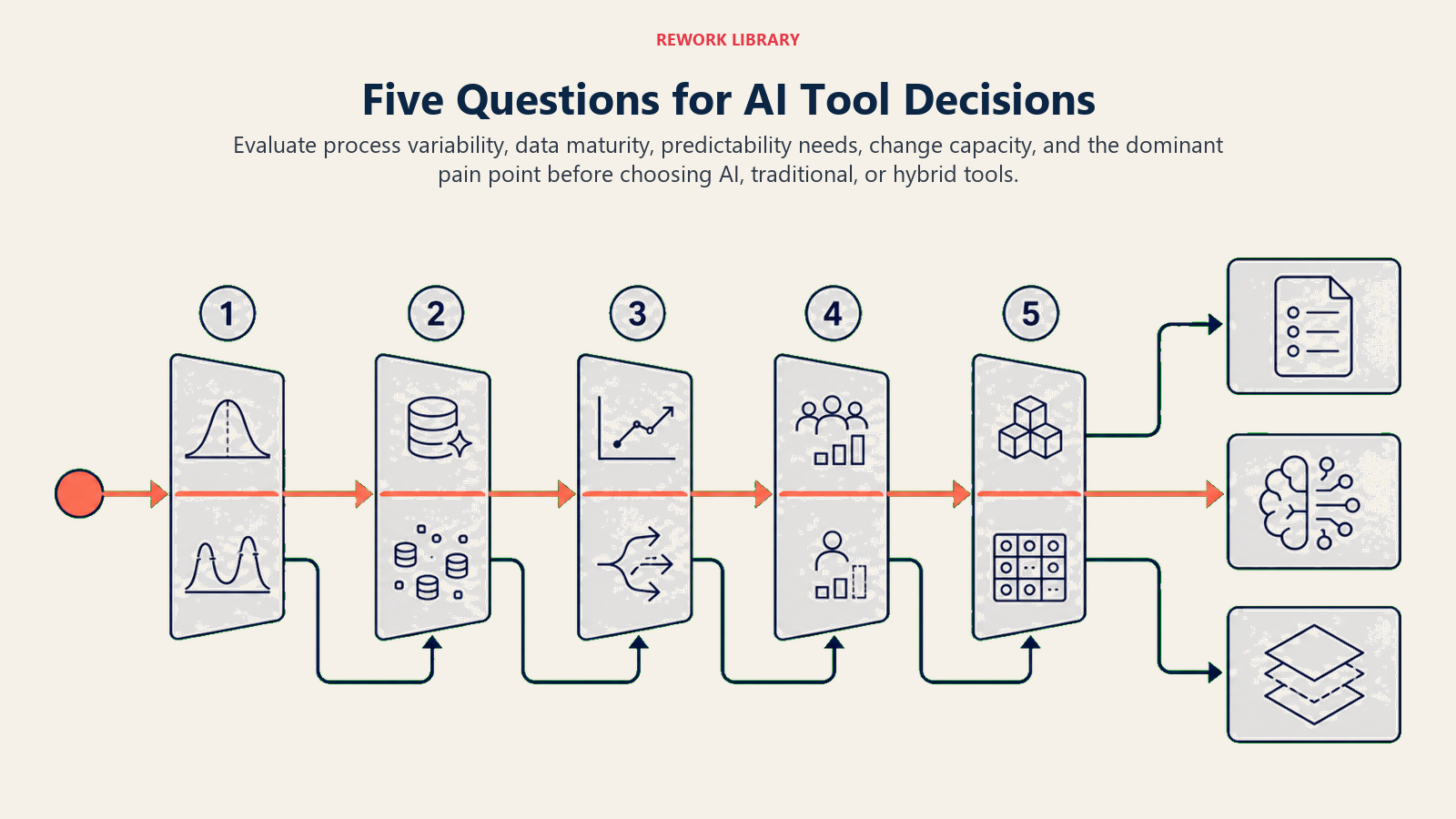
1. How Dynamic Are Our Processes? If processes change frequently or vary by context, AI tools will adapt better. If processes are stable and standardized, traditional tools are sufficient.
2. What's Our Data Management Maturity? AI tools require clean, accessible data to be effective. If your data is siloed or poorly maintained, traditional tools might be more reliable until you address data foundation issues.
3. How Critical Is Predictability? In high-stakes or regulated environments, traditional tools' deterministic behavior might be required. In creative or analytical contexts, AI's adaptability is more valuable than predictability.
4. What's Our Change Management Capacity? AI tools often require different mental models and workflows. If your organization is already managing significant change, adding AI tool adoption might be too much. Traditional upgrades are more familiar territory.
5. Where's the Biggest Pain Point? If you're drowning in volume (emails, documents, data), AI tools excel at processing high volumes. If you're struggling with consistency or compliance, traditional tools with strict rules might be more appropriate.
Once you've made the decision to adopt AI tools, use a structured AI tool selection framework to evaluate specific solutions, and establish proper AI security and compliance protocols before deployment.
Making the Smart Investment
The AI vs traditional software decision isn't binary. Most organizations will run both for years, gradually shifting more functions to AI as capabilities mature and comfort levels increase.
Start by identifying where AI can make the biggest impact with the least disruption. Communication and content creation tools typically offer the fastest wins. Then expand to automation and analytics as you build AI literacy and confidence.
And don't throw out traditional tools just because AI is trendy. Some problems are still best solved with good old-fashioned rule-based software.
Related Resources
Learn more about making strategic technology decisions:
- What are AI Productivity Tools - Foundational concepts
- AI Tool Selection Framework - Systematic evaluation methodology
- AI Integration with Existing Systems - Implementation strategies
- AI Tool Cost Management - Financial planning guide
The shift from traditional to AI-powered software isn't a revolution. It's an evolution. The winners won't be the companies that switch fastest - they'll be the ones that choose most strategically.

On this page
- The Core Distinction: Rules vs Learning
- Five Key Differentiators That Actually Matter
- 1. Adaptability: Static Workflows vs Learning Systems
- 2. Interface: Menu-Driven vs Conversational
- 3. Decision-Making: Programmatic vs Probabilistic
- 4. Data Requirements: Structured vs Unstructured
- 5. Improvement Path: Updates vs Continuous Learning
- Practical Comparison Across Common Use Cases
- Document Creation
- Data Analysis
- Task Management
- Communication
- When Traditional Software is Still the Right Choice
- The Hybrid Model: Best of Both Worlds
- Cost Structure Differences
- Decision Framework: Five Questions to Ask
- Making the Smart Investment
- Related Resources