AI Security and Compliance: Protect Your Business While Using AI Tools
Turn this article into takeaways for your work.


Each assistant summarizes the article only for you and suggests best practices for your work.
Your marketing team just used a public AI tool to analyze customer feedback. The analysis was brilliant. It was also a potential data breach.
They pasted hundreds of customer emails containing names, purchase history, and personal preferences into a third-party AI system. The data might now be part of that system's training data. Your compliance team doesn't know it happened. Your customers don't know their information was shared. And you might have violated GDPR, CCPA, or industry-specific regulations.
This is the AI security paradox. The tools that boost productivity can expose your most sensitive data if used carelessly. Employees eager to work efficiently don't think about data classification or third-party vendor agreements. They just want to get their work done, and AI productivity tools help dramatically.
Blocking AI tools entirely isn't the answer. Your competitors are using them, and your ban just pushes usage underground into unmonitored consumer accounts. The answer? Building security and compliance frameworks that enable safe, productive AI use while protecting what matters.
AI-Specific Security Risks
AI tools create unique security challenges that traditional IT security doesn't fully address.
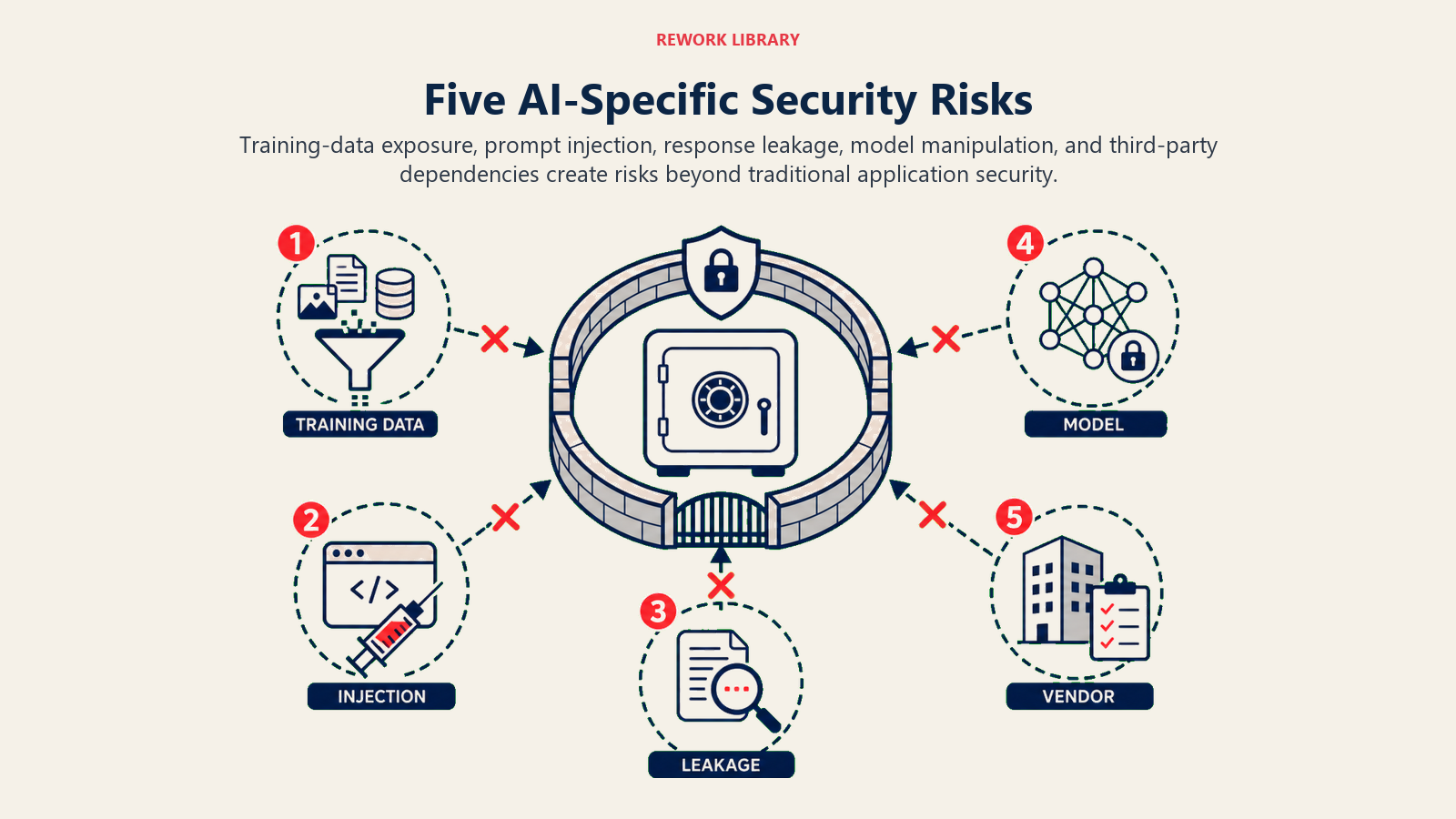
Training data exposure is the nightmare scenario. When employees paste confidential information into AI tools, they might be giving it away permanently. Many AI systems use inputs to improve their models. Your trade secrets, customer data, or strategic plans could end up training the model that your competitor uses tomorrow.
Some vendors explicitly don't train on user data. Others do. Many have complex policies where enterprise customers get protection but free-tier users don't. Employees using personal ChatGPT accounts on work laptops might not understand the distinction.
Prompt injection attacks exploit how AI systems process instructions. Malicious users can craft inputs that make AI tools ignore their guardrails or reveal information they shouldn't. An employee might innocently ask an AI to summarize a document without realizing that document contains instructions designed to make the AI extract and share sensitive data.
These attacks are subtle and hard to detect. Traditional security tools watching for SQL injection or cross-site scripting might miss prompt injection entirely because it looks like normal text.
Data leakage through AI responses happens when AI tools inadvertently reveal information from their training data or other users' inputs. An employee asks a seemingly innocent question, and the AI response includes confidential details from another company that used the same tool.
This isn't theoretical. AI systems have leaked personal information, proprietary code snippets, and confidential business data through their responses. You might think you're just receiving AI-generated content, but you're actually receiving recombined fragments of other users' inputs.
Model manipulation occurs when attackers deliberately poison training data to bias AI outputs. If your organization fine-tunes AI models on internal data, compromised training data can corrupt the model to produce specific wrong answers when certain conditions exist.
Think of a financial AI trained on data that includes subtle manipulation. It might approve fraudulent transactions that meet certain patterns or flag legitimate transactions for review, creating denial-of-service conditions.
Third-party vendor risks multiply with AI tools because you're not just trusting the vendor with data storage and access. You're trusting them with data processing, model training, output generation, and decisions about what happens to your information long-term.
Many AI vendors are startups with strong technology but immature security practices. Some are acquired mid-contract, changing ownership and data handling. Some go out of business, leaving questions about what happens to customer data. Traditional vendor risk assessment becomes more complex.
Compliance Frameworks Affecting AI Use
AI tools must operate within existing regulatory requirements, many of which weren't designed with AI in mind.
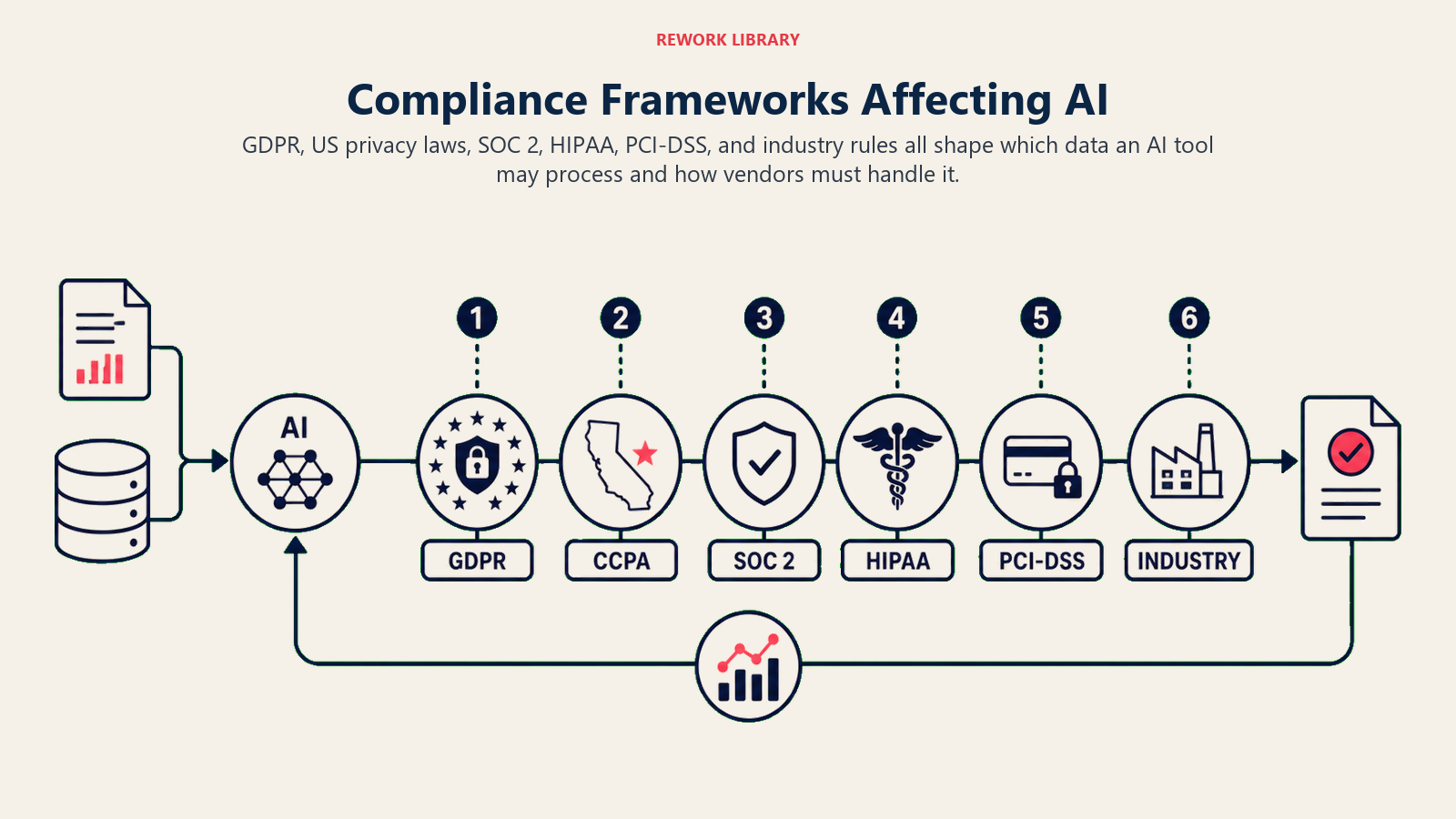
GDPR governs how European data is processed. It requires explicit consent for data processing, the right to explanation for automated decisions, data portability rights, and the right to be forgotten. AI tools complicate these requirements.
When you use AI to process EU customer data, you're a data processor subject to GDPR. If the AI vendor stores that data, they're a sub-processor requiring a data processing agreement. If the AI makes decisions affecting individuals, you need to explain how those decisions were made - challenging with black-box AI models.
Violations carry penalties up to 4% of global annual revenue. The risk is real, and ignorance isn't a defense.
CCPA and US state privacy laws create a patchwork of US data privacy requirements. California's law gives consumers rights to know what data is collected, delete their data, and opt out of data sales. Other states are passing similar laws with variations.
Using AI tools that share customer data with third parties might constitute "selling" data under CCPA, requiring consumer notice and opt-out mechanisms. Processing California residents' data with AI tools requires ensuring vendor compliance.
SOC 2 requirements apply if you're providing services to other businesses. SOC 2 certification requires controls around security, availability, processing integrity, confidentiality, and privacy. AI tools in your stack must meet these standards or create compliance gaps.
If you're SOC 2 certified and introduce AI tools without proper vetting, you might fail your next audit. If you're pursuing certification, unvetted AI tools block the path.
Industry-specific regulations add layers. Healthcare organizations using AI must comply with HIPAA, which restricts how protected health information is shared and stored. Most public AI tools aren't HIPAA-compliant. Using them with patient data violates federal law.
Financial services face similar restrictions. PCI-DSS governs payment card data. FINRA regulates securities communications. Using AI tools to process this data without ensuring compliance creates legal exposure.
Emerging AI regulations are coming. The EU AI Act classifies AI systems by risk level and imposes requirements based on that classification. High-risk AI systems face strict requirements around transparency, human oversight, and documentation.
While focused on deploying AI systems rather than using AI productivity tools, the regulatory direction is clear: AI use will face increasing oversight. Building compliant practices now prepares you for future requirements.
Security Controls for AI Tools
Protecting your organization requires implementing multiple layers of security controls.
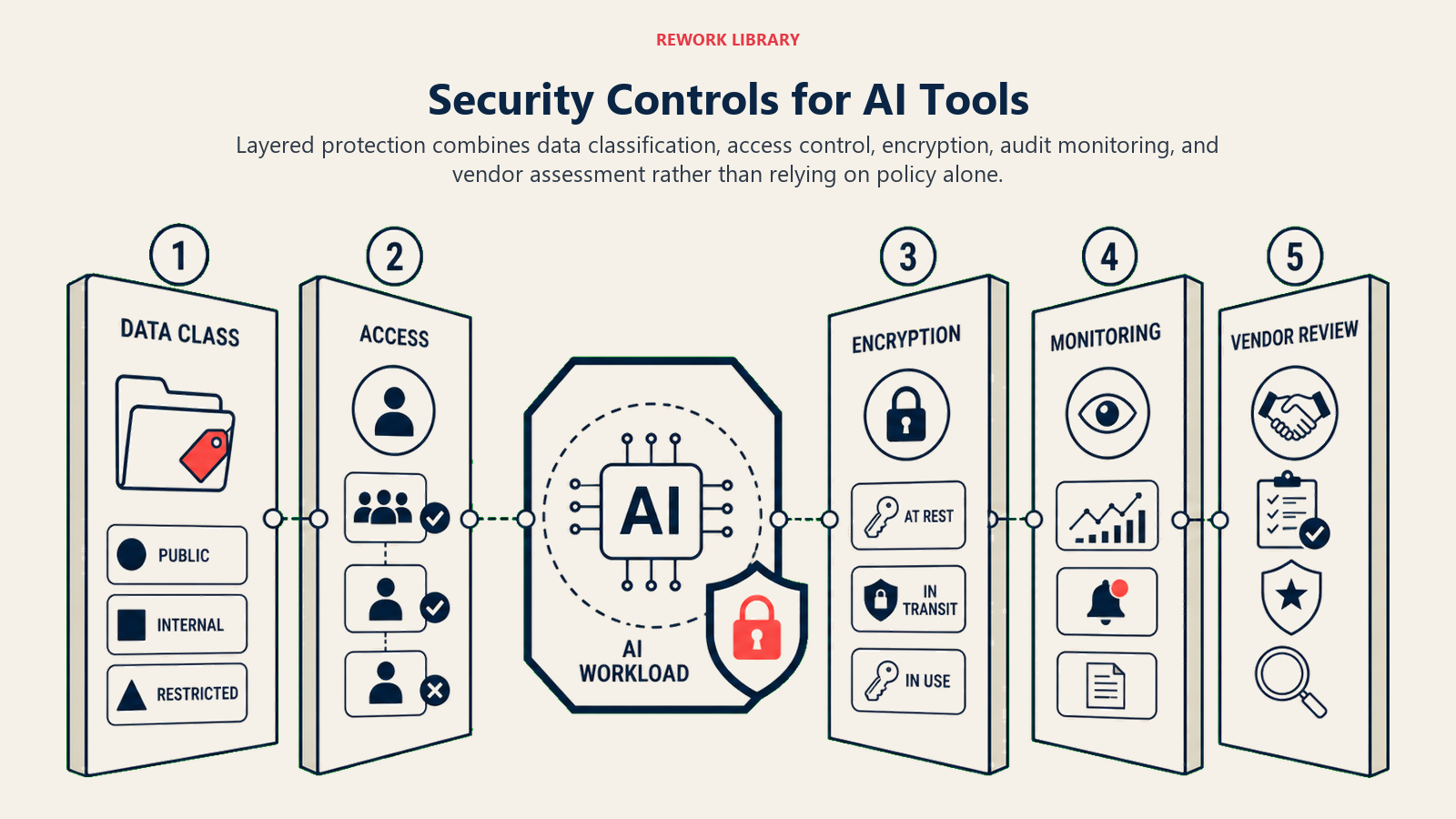
Data classification and access control start with knowing what data you have and who should access it. Classify data as public, internal, confidential, or restricted. Establish clear rules about what data types can be processed with AI tools based on your AI tool selection framework.
Public data (marketing materials, published research)? No restrictions. Internal data (employee directories, general business information)? Approved AI tools only. Confidential data (customer records, financial information)? Restricted AI tools with DPAs. Restricted data (trade secrets, personal health information)? No AI tools without explicit security review.
Enforce these controls technically where possible. Data loss prevention tools can detect and block attempts to paste certain data into web applications. Access controls can limit who can use which AI tools. Technical controls scale better than policy alone.
Encryption protects data in transit and at rest. Ensure AI tools use encrypted connections (HTTPS/TLS) for all communications. Verify that data stored by AI vendors is encrypted. Understand encryption key management - who controls the keys that protect your data?
This seems basic, but many AI tools are built fast and security is an afterthought. Don't assume encryption. Verify it.
Audit logging and monitoring provide visibility into AI tool usage. Log who uses which tools, what data they process, and what outputs they receive. Monitor for suspicious patterns: unusual volumes of data being processed, access from unexpected locations, or use of tools that should be restricted.
Logs let you detect problems: "Why did this employee process 50,000 customer records through an unapproved AI tool?" Investigation reveals a well-meaning efficiency effort that created compliance risk. You can remediate before it becomes a breach notification.
Vendor security assessment evaluates AI tool providers before you adopt their tools. Review their security questionnaires, examine compliance certifications (SOC 2, ISO 27001, specific regulations), test their security practices, and assess their incident response capabilities.
Don't just accept vendor marketing claims. Verify. Ask hard questions about data handling, model training, retention policies, and what happens during termination. Get answers in writing, preferably in contracts.
Incident response procedures prepare for when things go wrong. Despite best efforts, security incidents happen. Have clear procedures for AI-specific incidents: data accidentally shared with AI tools, suspicious AI outputs suggesting data leakage, or AI tool compromise.
Know who to notify, how to investigate, when to report to regulators, and how to remediate. Practice these procedures. A data breach mid-crisis isn't the time to figure out your response process.
Acceptable Use Policies
Clear policies help employees understand what's allowed, what's prohibited, and why it matters.
What data can be shared with AI should be explicitly defined. Create simple decision trees: "Before using AI to process data, check its classification. Public and internal data is OK with approved tools. Confidential and restricted data requires manager approval and specific tools with appropriate safeguards."
Provide examples: "You can use AI to draft social media posts, summarize published articles, or generate meeting agendas. You can't use AI to analyze customer databases, process financial records, or summarize confidential strategy documents without specific approval."
Prohibited use cases set clear boundaries. Define activities that are never acceptable: processing personal information in public AI tools, using AI to make consequential decisions without human review, sharing authentication credentials with AI systems, or using AI to generate communications that require professional certification.
These prohibitions protect both the organization and employees. A prohibited use policy gives employees cover: "I'd love to help, but policy prohibits this use case. Let's find an approved alternative."
Review requirements for AI outputs address quality and accuracy. Require human review of AI-generated content before it's published, shared with customers, or used for decisions. The level of review should match the consequence: quick check for low-stakes content, thorough verification for high-stakes decisions.
Make clear that employees remain responsible for accuracy. "AI wrote it" isn't an excuse for errors. Employees must understand that AI augments their judgment - it doesn't replace their accountability.
Compliance checkpoints integrate verification into workflows. Before launching campaigns using AI-generated content, check compliance. Before sharing AI analysis with customers, verify accuracy. Before implementing AI recommendations, assess risk.
Build these checkpoints into process rather than relying on people to remember. Checklists, review stages, and approval workflows embed compliance thinking into operations.
Vendor Risk Management
Third-party AI vendors require ongoing management, not just initial vetting.
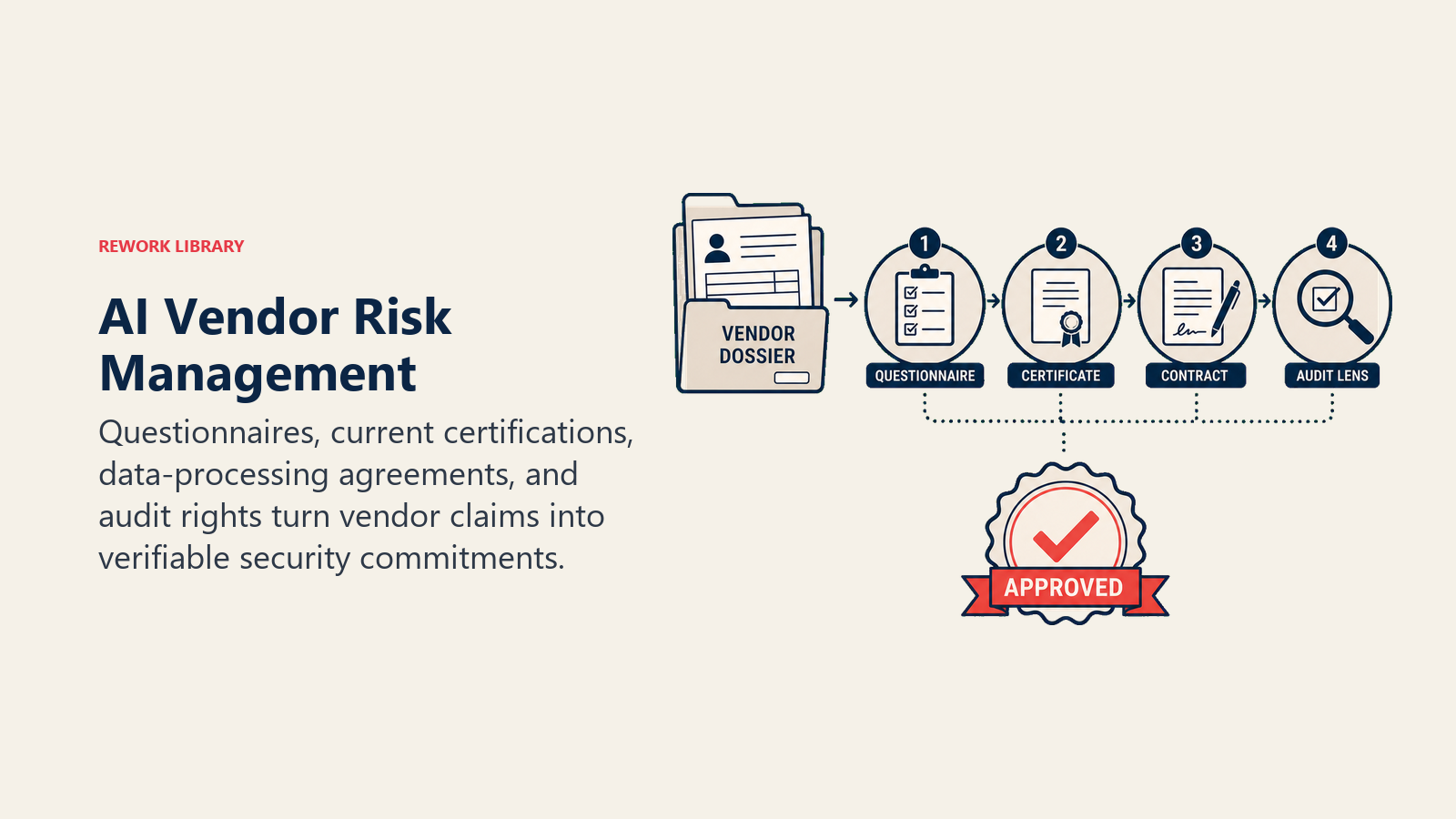
Security questionnaires gather detailed information about vendor security practices. Ask about data handling procedures, encryption practices, access controls, employee screening, incident response capabilities, and disaster recovery plans.
Use standardized questionnaires when possible (CAIQ, SIG, custom security assessment forms). Document responses. Compare answers across vendors. This creates transparency and lets you make informed risk decisions.
Compliance certifications provide third-party validation of security practices. SOC 2 Type II attestations show that vendors maintain security controls over time. ISO 27001 certification demonstrates information security management systems. Industry-specific certifications (HIPAA, PCI-DSS, FedRAMP) show capability to meet regulatory requirements.
Don't accept certifications at face value. Verify they're current. Understand scope - what's covered and what isn't. Review audit reports when available.
Data processing agreements contractually define how vendors handle your data. These agreements should specify: purpose limitations (what vendors can do with your data), data retention periods, deletion requirements upon termination, sub-processor disclosure, security requirements, and breach notification obligations.
For GDPR compliance, DPAs must include standard contractual clauses or alternative transfer mechanisms. Don't skip this. It's not just a formality - it's legal protection when things go wrong.
Right to audit clauses let you verify vendor practices. Include contract language allowing you or third parties to audit vendor security controls. While you might not exercise this right often, having it creates leverage and vendor accountability.
For critical vendors, consider periodic audits beyond certifications. Spot-check actual practices. Verify that contractual commitments match operational reality.
Employee Training on Secure AI Use
Technology controls are necessary but insufficient. Employee behavior determines whether security frameworks succeed or fail through comprehensive AI training and onboarding programs.
Recognizing security risks helps employees identify problems before they become incidents. Train people to recognize: sensitive data that shouldn't be shared with AI, AI outputs that might contain other users' data, unusual AI behavior suggesting compromise, and social engineering attempts using AI-generated content.
Use realistic scenarios. Show examples of how well-meaning employees create security problems. Make it concrete: "This looks like an efficiency win, but here's the security problem it creates."
Safe prompting practices teach employees to interact with AI without exposing sensitive data. Show how to anonymize data before AI processing, use synthetic examples instead of real data for testing, structure prompts to avoid sharing context that includes confidential information, and validate that outputs don't inadvertently reveal sensitive inputs.
This requires changing habits. Employees naturally want to use real data because it produces relevant results. Teach alternatives that balance utility with security.
Data handling guidelines clarify responsibilities. Employees must understand: what data classifications mean, how to determine if specific information can be processed with AI, where to find approved tool lists, who to ask when uncertain, and what to do if they accidentally share inappropriate data with AI.
Make guidance accessible. A 50-page security policy no one reads doesn't help. A one-page quick reference guide, a decision tree flowchart, or a simple chat interface where employees ask questions works better.
Reporting mechanisms remove barriers to disclosure. Create safe channels for employees to report mistakes or concerns: "I think I accidentally shared customer data with an unapproved AI tool. What do I do?"
Psychological safety matters. If employees fear punishment for honest mistakes, they hide problems until they become breaches. If they trust that reporting leads to help rather than punishment, they report early when remediation is possible.
Monitoring and Auditing
Ongoing oversight ensures that security practices remain effective as usage evolves.
Detecting AI security incidents requires monitoring for specific patterns. Watch for unusual data volumes being processed with AI tools, access to AI services from unexpected locations or devices, use of unapproved AI tools, or employees requesting exceptions to AI policies frequently.
Implement automated alerting where possible. Manual reviews happen too infrequently to catch problems quickly.
Responding to incidents follows your incident response plan. Contain the incident by disabling compromised accounts or blocking tool access. Investigate scope by determining what data was exposed and how. Notify stakeholders including compliance, legal, and affected parties. Remediate by fixing vulnerabilities and preventing recurrence.
Document everything. Incident response creates a record for compliance demonstration, lessons learned, and process improvement.
Regular compliance audits verify adherence to policies. Quarterly reviews sample AI tool usage, check that employees follow data classification rules, verify approved tool lists are current, and assess whether security controls work as designed.
Annual comprehensive audits examine the entire AI security program: policy currency, control effectiveness, training completion, incident trends, and vendor compliance. Use results to improve continuously.
The Path Forward
AI security and compliance isn't about preventing AI use. It's about enabling safe, productive AI adoption that protects what matters: customer trust, regulatory compliance, competitive advantage, and business reputation.
Build comprehensive protection: understand AI-specific risks, comply with relevant regulations, implement layered security controls, establish clear usage policies, manage vendor relationships, train employees thoroughly, and monitor continuously.
Make security enablement rather than obstruction. Fast-track approvals for low-risk AI tools. Create pre-approved tool lists so teams don't wait weeks for permission. Provide secure alternatives when employees request tools that don't meet security standards.
Partner across functions. Security teams bring risk expertise. Compliance teams understand regulatory requirements. IT teams implement controls. Business teams identify productivity needs. Legal teams draft contracts. Success requires collaboration.
Balance security with innovation. Perfect security that blocks all AI use protects data by preventing any value creation. Lax security that allows anything creates catastrophic risk. Find the middle ground through AI change management strategies: strong protection for high-risk data, reasonable controls for moderate risk, and minimal friction for low-risk use cases.
Remember that the threat landscape evolves. AI capabilities advance, attack techniques improve, and regulations tighten. Your security program must adapt continuously. Annual policy reviews, quarterly threat assessments, and ongoing training keep protection current.
The organizations thriving with AI aren't those that ignore security until problems surface. They're those that built security into AI adoption from the start, enabling innovation while maintaining protection.
That balance is achievable. It requires intention, investment, and ongoing commitment. But it's not optional. In a world where data breaches can cost millions and destroy reputations, AI security and compliance is the foundation for sustainable AI productivity gains.
Start building that foundation now if you haven't already. Define policies, implement controls, train employees, and monitor actively. The time to address security isn't after an incident. It's before.