AI Training and Onboarding: Build AI Competency Across Your Organization
Turn this article into takeaways for your work.


Each assistant summarizes the article only for you and suggests best practices for your work.
You've selected your AI tools. Your implementation roadmap is solid. Leadership is aligned. But there's a critical gap between deployment and value realization: your people don't know how to use these tools effectively.
This isn't about intelligence or willingness. It's about capability. AI tools require new mental models, different workflows, and skills most employees don't have. Deploying AI without training is like giving someone a piano and expecting them to play concertos. The instrument works fine, but the problem is human readiness.
The skills gap kills AI initiatives. Teams default to old methods because they're comfortable. They try AI once, get poor results from bad prompts, and conclude it doesn't work. They use 10% of features because they don't know the rest exist. Six months later, you've invested millions in tools that deliver thousands in value.
Training bridges this gap. Not generic vendor training that teaches features. Real training that builds competency, changes behavior, and creates organizational capability that compounds over time.
AI Literacy Levels
Effective training recognizes that AI competency isn't binary. It's a progression from awareness to mastery, with different needs at each level.
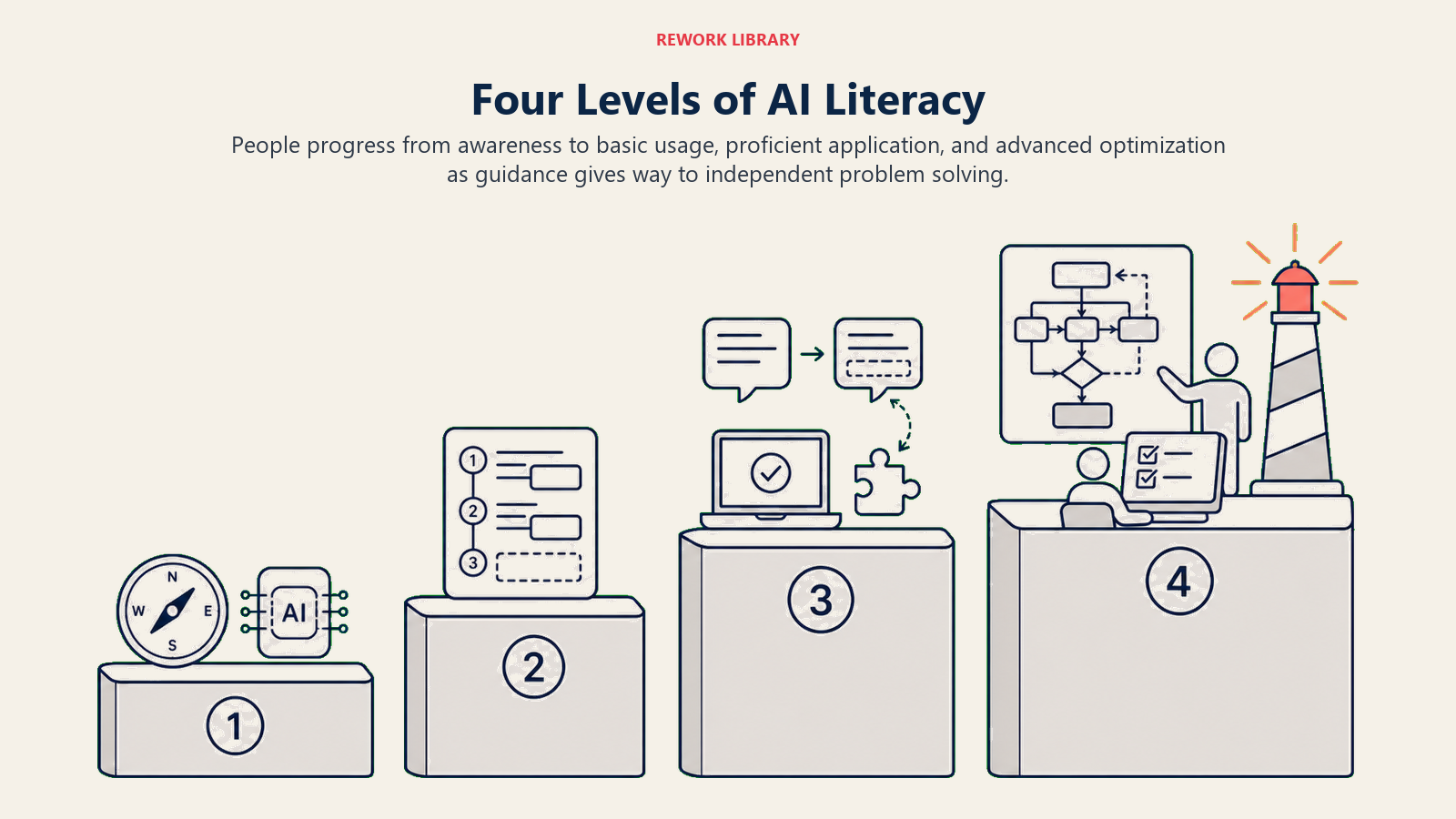
Level 1: AI awareness establishes foundational understanding. Employees at this level know what AI is, what it can and can't do, and why the organization is investing in it. They understand basic concepts like machine learning, natural language processing, and pattern recognition without needing technical depth.
This level addresses the fear factor. When people understand that AI recognizes patterns in data rather than "thinking" like humans, it demystifies the technology. When they grasp that AI augments human judgment rather than replacing it, anxiety decreases. Awareness training creates informed curiosity instead of fearful resistance.
Level 2: Basic usage focuses on following established workflows. Employees can log in, navigate the interface, and complete common tasks following job aids or templates. They're using AI, but they're not yet independent problem-solvers.
A marketing coordinator at this level can use an AI writing tool to generate social media posts by following provided prompts. They know which buttons to click and where to paste the output. They're productive, but they need guidance for anything outside standard procedures.
Level 3: Proficient application marks the shift from following instructions to solving problems. Users understand principles well enough to adapt AI to their specific needs. They troubleshoot issues independently, modify prompts for better results, and identify new use cases without being told.
That same marketing coordinator now crafts custom prompts for different audiences, adjusts tone and length based on platform, and experiments with the AI to find what works best. They've moved from executing tasks to making strategic choices about when and how to use AI.
Level 4: Advanced optimization represents mastery. These users understand AI capabilities deeply enough to design novel workflows, teach others, and push the boundaries of what's possible. They're prompt engineering experts, integration designers, innovation drivers.
They create reusable prompt libraries for their team, build custom workflows that chain multiple AI operations, and identify opportunities to automate complex processes others assume require human intervention. This level produces exponential value because these experts don't just use AI well - they enable others.
Your training program should move people through these levels systematically, not expect everyone to reach Level 4 but ensuring everyone achieves at least Level 3 proficiency in tools relevant to their role.
The AI Training Curriculum
Comprehensive AI training requires structured content that builds knowledge progressively while addressing practical application.
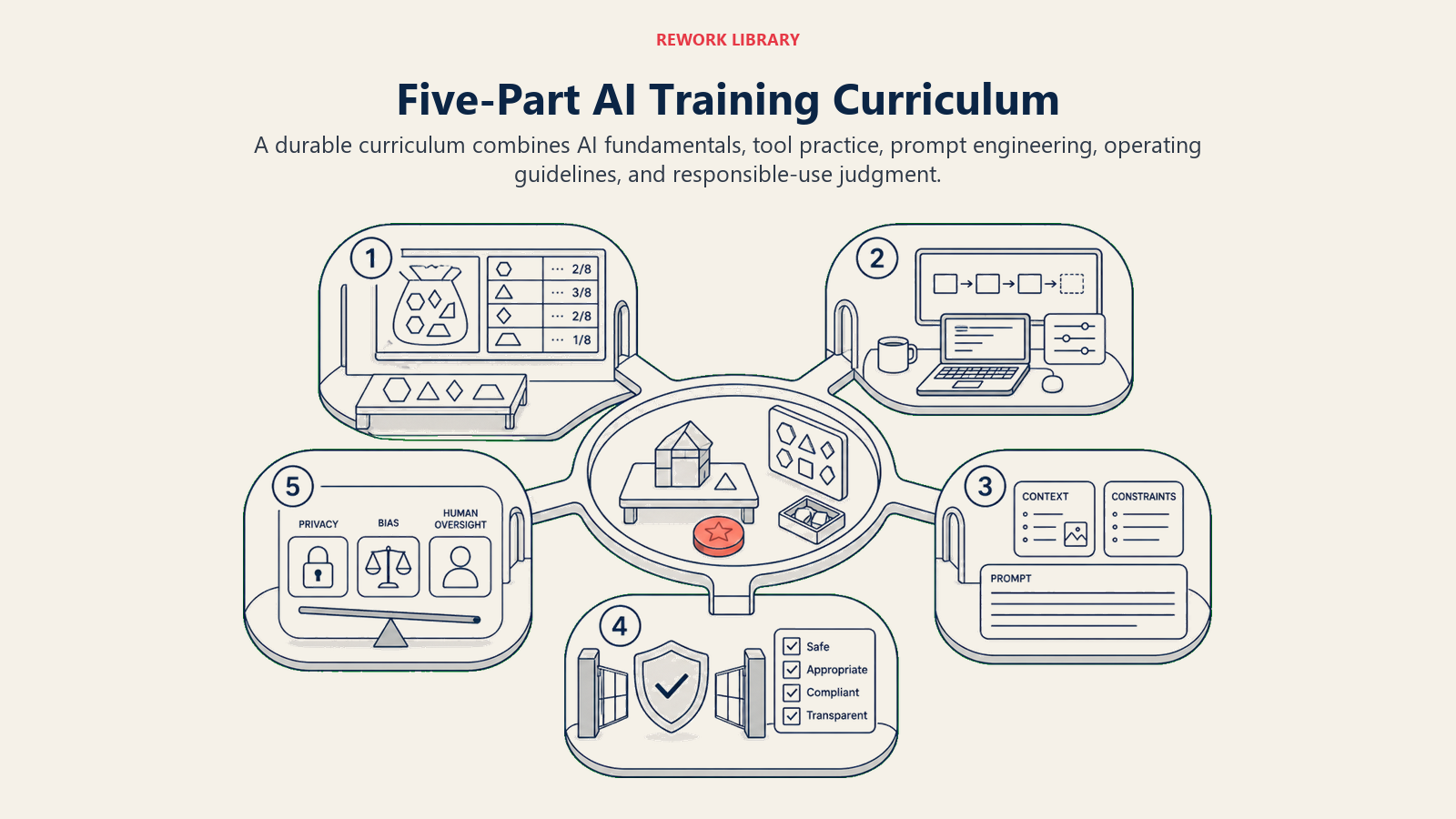
AI fundamentals and concepts form the bedrock. Before teaching people which buttons to click, teach them how AI works at a conceptual level. This doesn't mean diving into neural networks and algorithms. It means explaining that AI learns from examples, identifies patterns, and generates outputs based on probability, not certainty.
Cover key concepts: what training data is and why it matters, why AI sometimes produces incorrect but confident-sounding answers, how bias creeps into AI systems, and what "prompt engineering" means. These fundamentals help users develop appropriate mental models for working with AI effectively.
Tool-specific training teaches the mechanics of your chosen platforms. This is where most organizations stop, but it should only be one component. Cover the interface, core features, integration points, and common workflows. Provide hands-on practice with realistic scenarios from users' actual work.
Make this training role-specific. Don't teach salespeople features they'll never use. Don't waste engineers' time on basic functions they'll master independently. Targeted training respects people's time and demonstrates relevance.
Prompt engineering skills deserve special attention because they determine AI output quality. Effective prompt engineering best practices are a skill that dramatically improves results, yet most users never learn it. They type vague questions and blame the AI when results disappoint.
Teach the anatomy of effective prompts: context setting, clear instructions, desired format specification, constraint definition, and example provision. Show before-and-after examples: a vague prompt producing generic output versus a specific prompt generating exactly what's needed. Let people practice and get feedback on their prompt quality.
Best practices and guidelines translate principles into actionable rules. When should employees use AI versus doing tasks manually? What types of content or data should never be shared with AI systems? How should they validate AI outputs before trusting them? What's the escalation path when AI produces concerning results?
Document these as clear policies, but also explain the reasoning. Rules without rationale breed workarounds. When employees understand why they shouldn't share confidential client data with public AI systems, they're more likely to comply than if you just say "don't do it."
Ethics and responsible use addresses the implications of AI adoption beyond efficiency. Cover bias in AI systems and how to recognize it, privacy considerations when using AI with customer data, transparency requirements about AI involvement in customer-facing content, and the importance of human oversight for critical decisions. Understanding AI ethics and data privacy principles is essential for responsible deployment.
This isn't just risk mitigation. It's building an organizational conscience about AI use that prevents problems before they happen.
Training Delivery Methods
How you deliver training matters as much as what you teach. Different people learn differently, and a single delivery method leaves gaps.
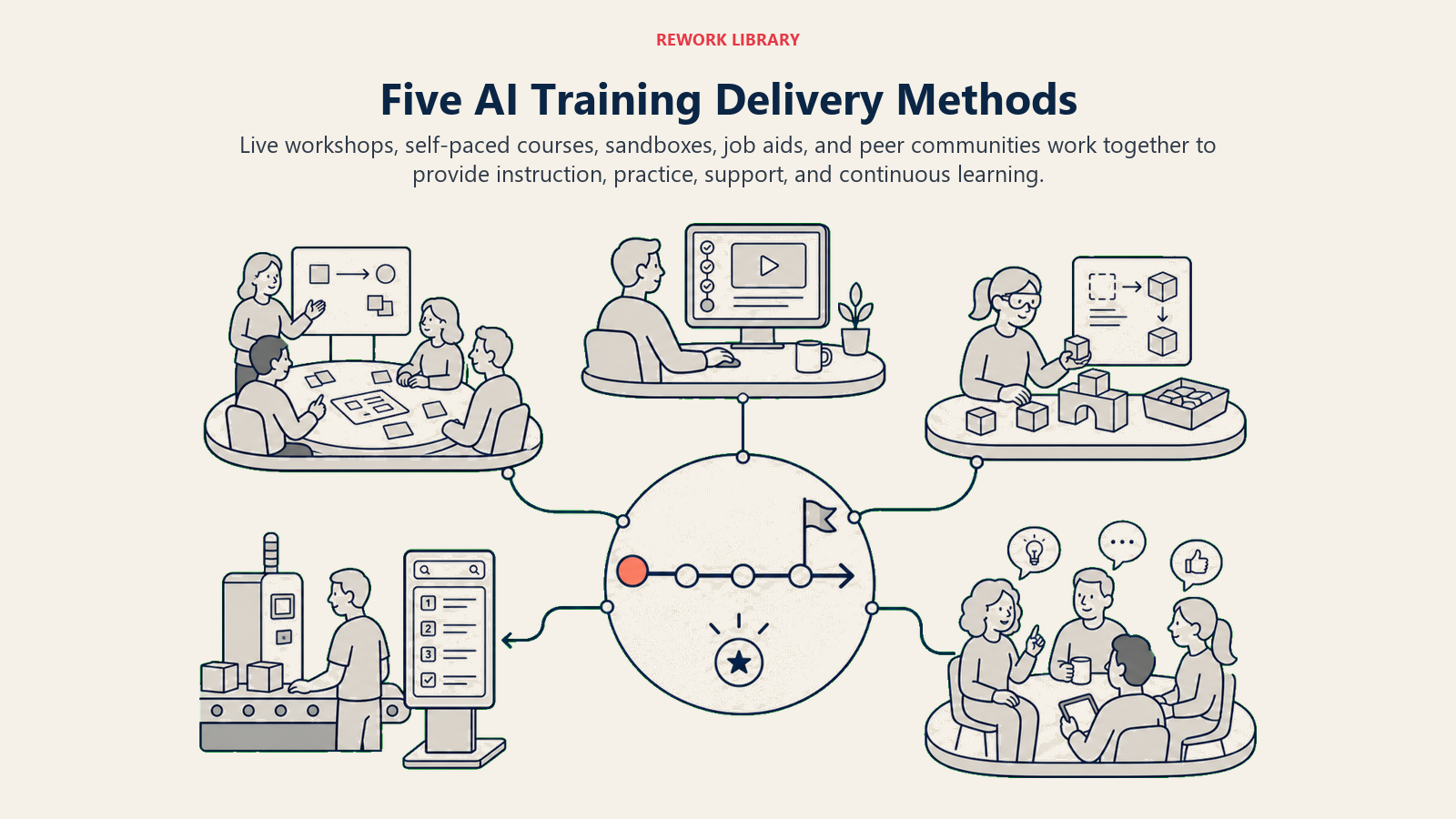
Live workshops and sessions work well for foundational training and complex topics requiring discussion. They create space for questions, peer learning, and immediate feedback. Schedule them when launching new tools or introducing advanced concepts that benefit from instructor guidance.
Keep them interactive. Death by PowerPoint kills engagement. Use live demonstrations, hands-on exercises, small group discussions, and real-world problem-solving. A 90-minute workshop where people spend 60 minutes practicing beats a 4-hour lecture where they passively listen.
Self-paced online courses provide flexibility and scalability. Create modules covering key topics that employees can complete on their schedule. Include video demonstrations, written guides, quizzes to check understanding, and practical exercises that let people apply concepts immediately.
The advantage is personalization. Fast learners move quickly through basics and dive into advanced content. Strugglers replay difficult sections without feeling embarrassed. People learn when they're ready, not according to a trainer's schedule.
Hands-on labs and sandboxes accelerate learning through practice. Set up safe environments where employees experiment without fear of breaking things or producing visible mistakes. Provide realistic datasets, sample projects, and guided exercises that simulate actual work scenarios.
This is where learning sticks. Reading about prompt engineering is one thing. Writing 20 prompts, seeing what works and what doesn't, and iterating based on results builds competency that lasts.
Job aids and quick reference guides support ongoing performance. Even trained employees need reminders. Create cheat sheets for common tasks, prompt templates for frequent use cases, troubleshooting guides for typical problems, and workflow diagrams showing when to use which tools.
Make these easily accessible - pinned in Slack channels, bookmarked in browsers, printed and posted near workstations. Reduce friction between "I need to do this" and "I remember how to do this."
Community of practice extends learning beyond formal training. Create spaces where users share tips, ask questions, showcase innovative uses, and help each other improve. This might be a dedicated Slack channel, regular lunch-and-learns, monthly showcases, or an internal wiki.
Communities do what formal training can't: they capture emergent knowledge, adapt to changing needs, and create peer-to-peer learning that scales naturally.
Role-Based Training Approaches
One-size-fits-all training fails because different roles need different AI capabilities and have different learning priorities.
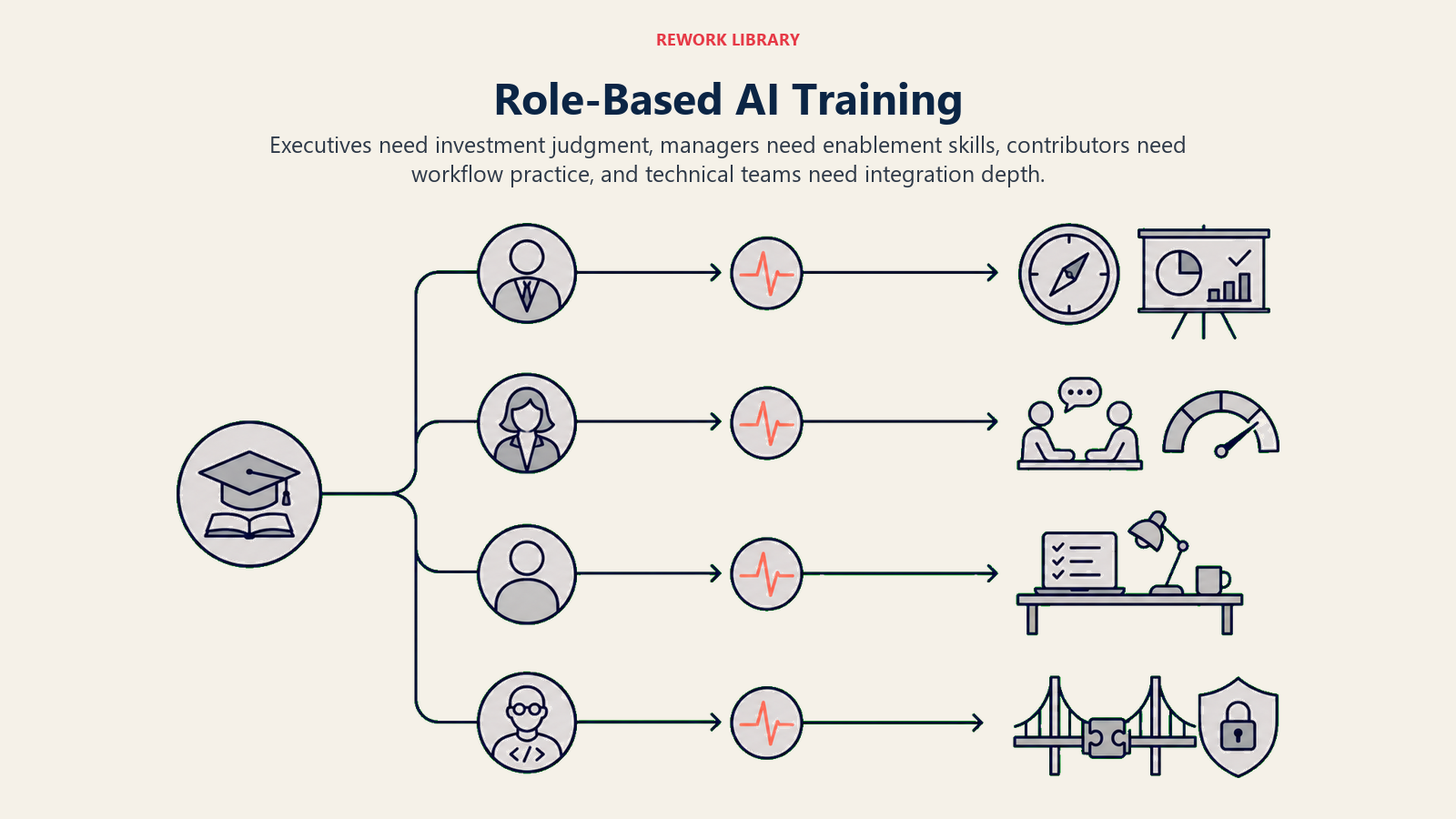
Executives need strategic AI use training focused on high-level applications. They don't need to know every feature. They need to understand how AI changes decision-making, where it adds strategic value, and how to evaluate AI investments. Train them on using AI for market research, competitive analysis, strategic planning support, and board presentation preparation.
Keep it concise and high-impact. An executive's AI training might be two focused hours covering powerful use cases relevant to their role, not a full-day workshop covering features they'll never touch.
Managers need team enablement skills. Yes, teach them to use AI tools for their own work. But more importantly, teach them to coach their teams, identify opportunities for AI application, troubleshoot adoption challenges, and measure AI impact on team performance.
Include change management principles, common resistance patterns and responses, and techniques for building AI proficiency across their team. Managers who become enablers drive far more value than managers who just use the tools personally.
Individual contributors need daily productivity training focused on their specific workflows. A content marketer needs deep training on AI writing assistants, content generation techniques, and editing AI outputs. They don't need training on AI data analysis tools they'll never use.
Map common job tasks to relevant AI capabilities. Show concrete examples: "Here's how AI cuts your weekly reporting time from 3 hours to 30 minutes" or "Here's how to use AI for customer research before sales calls." Specificity drives adoption.
Technical teams need integration and customization training that goes deeper than end-user training. Teach them API access, automation possibilities, integration patterns with existing systems, and security considerations for AI tool deployment.
These are the people who'll build advanced workflows, troubleshoot complex problems, and extend AI capabilities beyond out-of-box features. Invest in making them expert enablers who amplify everyone else's capabilities.
Onboarding New Users
First experiences shape long-term adoption. Poor onboarding creates lasting negative impressions that are hard to reverse. Great onboarding builds confidence and momentum.
Pre-deployment preparation sets expectations and generates readiness. Before granting access, communicate what's coming, why it matters, what employees should expect, and what success looks like. Share success stories from early adopters. Address common concerns preemptively.
This primes people psychologically. They're not surprised by sudden change. They're prepared for planned evolution.
Initial setup and configuration should be frictionless. Don't make users figure out installation, account creation, or permission settings independently. Automate what you can. Provide step-by-step guides for what you can't. Offer IT support for setup assistance.
Remove barriers between "I have access" and "I'm successfully using this." Every friction point is an opportunity for people to give up.
Guided first tasks build confidence through small wins. Don't start with complex workflows. Start with simple, successful experiences: "Let's draft an email response," "Let's summarize this meeting," "Let's generate three social media posts." Pick tasks where AI clearly adds value quickly.
These early successes create positive associations. The tool works. I can use it. This is helpful. Now users are motivated to learn more.
Follow-up support catches people before they disengage. Check in after the first week. How's it going? What's working? What's confusing? Offer additional training for those struggling. Recognize and celebrate those succeeding.
This follow-up communicates that adoption matters to the organization, surfaces problems while they're fixable, and provides ongoing encouragement that sustains initial momentum.
Continuous Learning
AI training isn't a one-time event. Tools evolve, capabilities expand, and proficiency deepens over time. Continuous learning transforms initial skills into lasting organizational capability.
Advanced technique sessions help proficient users reach mastery. Once people master basics, teach sophisticated approaches: complex prompt engineering, workflow chaining, advanced feature combinations, and creative applications others haven't discovered.
These sessions serve another purpose: they signal that growth is possible and valued. There's always more to learn, and the organization supports that journey.
New feature training keeps capabilities current. When your AI tools release updates, don't assume people will discover and adopt them organically. They won't. Actively teach new features through quick demos, updated documentation, and use case examples.
This prevents capability drift where the tools get better but organizational usage stays static.
Use case sharing spreads innovation laterally. When someone discovers a clever application, share it broadly. Create regular showcases where teams demo their best AI wins. Build an internal library of use cases categorized by department and task type.
This crowdsources innovation. You're not dependent on training teams to anticipate every valuable use. The organization teaches itself.
Skill assessment identifies gaps and targets improvement efforts. Periodically evaluate proficiency across teams. Who's stuck at basic usage? Who's ready for advanced training? Where are capability gaps affecting business results?
Use assessments diagnostically, not punitively. The goal is identifying where to invest additional training, not punishing low performers.
Measuring Training Effectiveness
Training is an investment that should deliver measurable returns. Track outcomes to justify continued investment and optimize your approach.
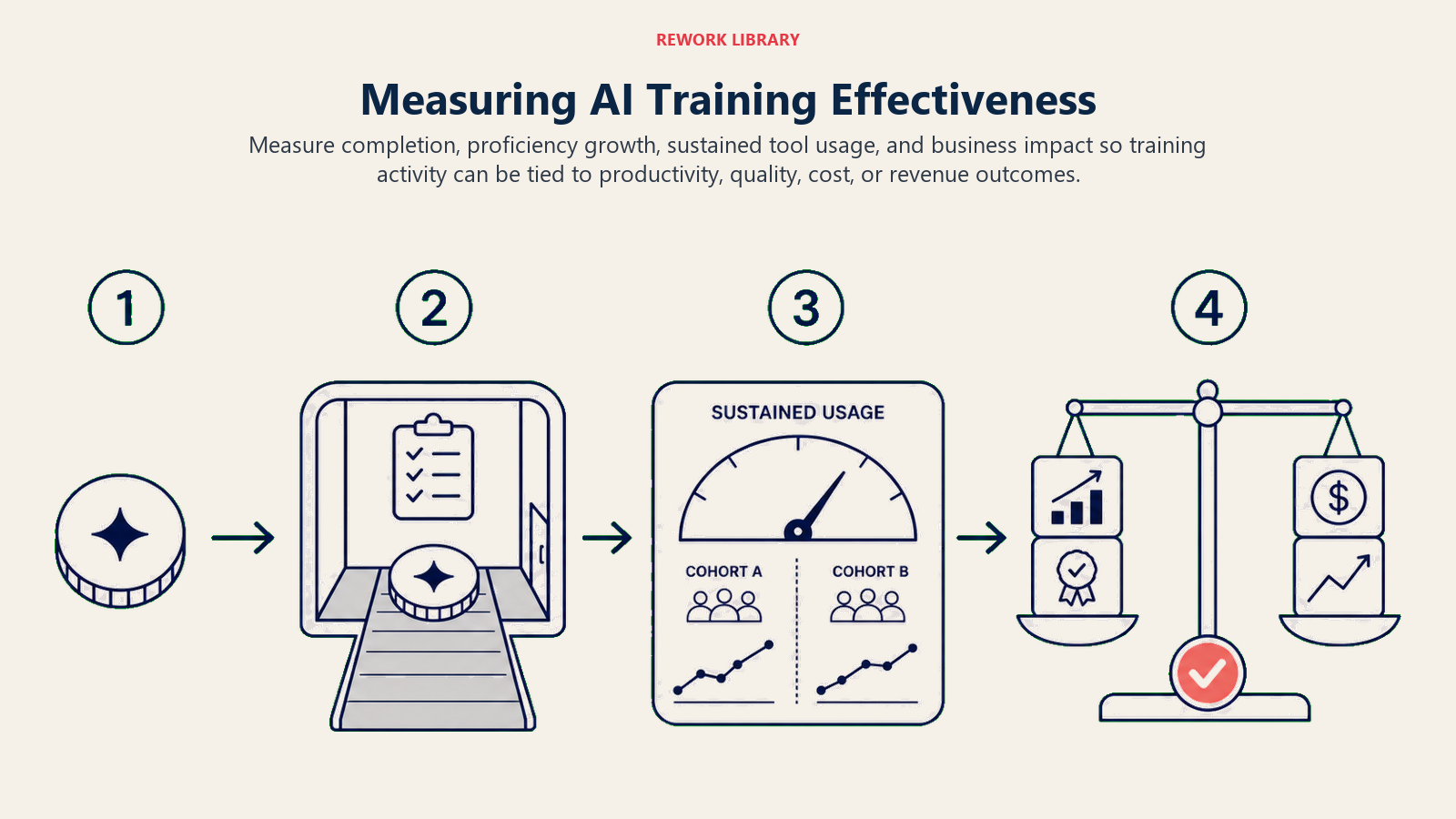
Proficiency vs business impact distinguishes activity from outcomes. High training completion rates are nice, but they don't matter if business metrics don't improve. Connect training metrics to business results using AI performance measurement frameworks.
Track: training completion rates by cohort, proficiency level progression over time, tool usage rates among trained versus untrained employees, efficiency gains correlating with training completion, and satisfaction scores from trained users.
Then connect these to business outcomes: productivity improvements, quality enhancements, cost reductions, or revenue impacts. This builds the case that training isn't an expense - it's an investment that multiplies AI tool ROI.
When you can show that teams completing advanced training generate 3x more value from AI tools than those with just basic training, securing budget for ongoing learning becomes easy.
The Path Forward
AI tools are powerful. But tools without skills are expensive paperweights. Your training program determines whether AI investments generate returns or gather dust.
Build systematic capability development: clear proficiency levels, comprehensive curriculum, multiple delivery methods, role-specific training, effective onboarding, and continuous learning. Make training ongoing, not a one-time event.
Measure relentlessly. Connect training to business outcomes. Adjust based on what works. Celebrate growth and skill development publicly.
Remember that the goal isn't just teaching people to use specific tools. It's building an organization that learns continuously, adapts quickly, and maximizes value from emerging capabilities. The training program you build now prepares your organization not just for current AI tools, but for the next generation and the one after that.
In a world where AI capabilities evolve monthly, organizational learning agility becomes the competitive advantage. Not having the best tools. Having people who can extract maximum value from whatever tools exist.
That's what effective AI training and onboarding delivers: not one-time skill transfer, but sustained learning capability that compounds over time.