AI Tool Cost Management: Control Spending While Scaling AI Adoption
Turn this article into takeaways for your work.


Each assistant summarizes the article only for you and suggests best practices for your work.
Your CFO approved a $50,000 annual budget for AI tools. Twelve months later, you're spending $175,000, and every department wants more. What happened?
AI tool costs are different. Unlike traditional software with predictable per-seat pricing, AI productivity tools scale with usage in ways that are hard to forecast. A team that starts using an AI writing tool moderately can suddenly 10x their usage when they discover a breakthrough application. Token-based pricing means your bill grows with every prompt, every analysis, every generation.
This isn't about AI tools being expensive. It's about costs being unpredictable and growing fast as adoption succeeds. The better your AI implementation works, the more people use it, the higher your costs climb. Success creates budget surprises.
The answer isn't limiting AI adoption to control costs. That's like declining to hire salespeople because they cost money. The answer is sophisticated cost management that enables scale while maintaining financial discipline.
AI Tool Pricing Models
Understanding how vendors charge is the foundation for managing costs effectively.
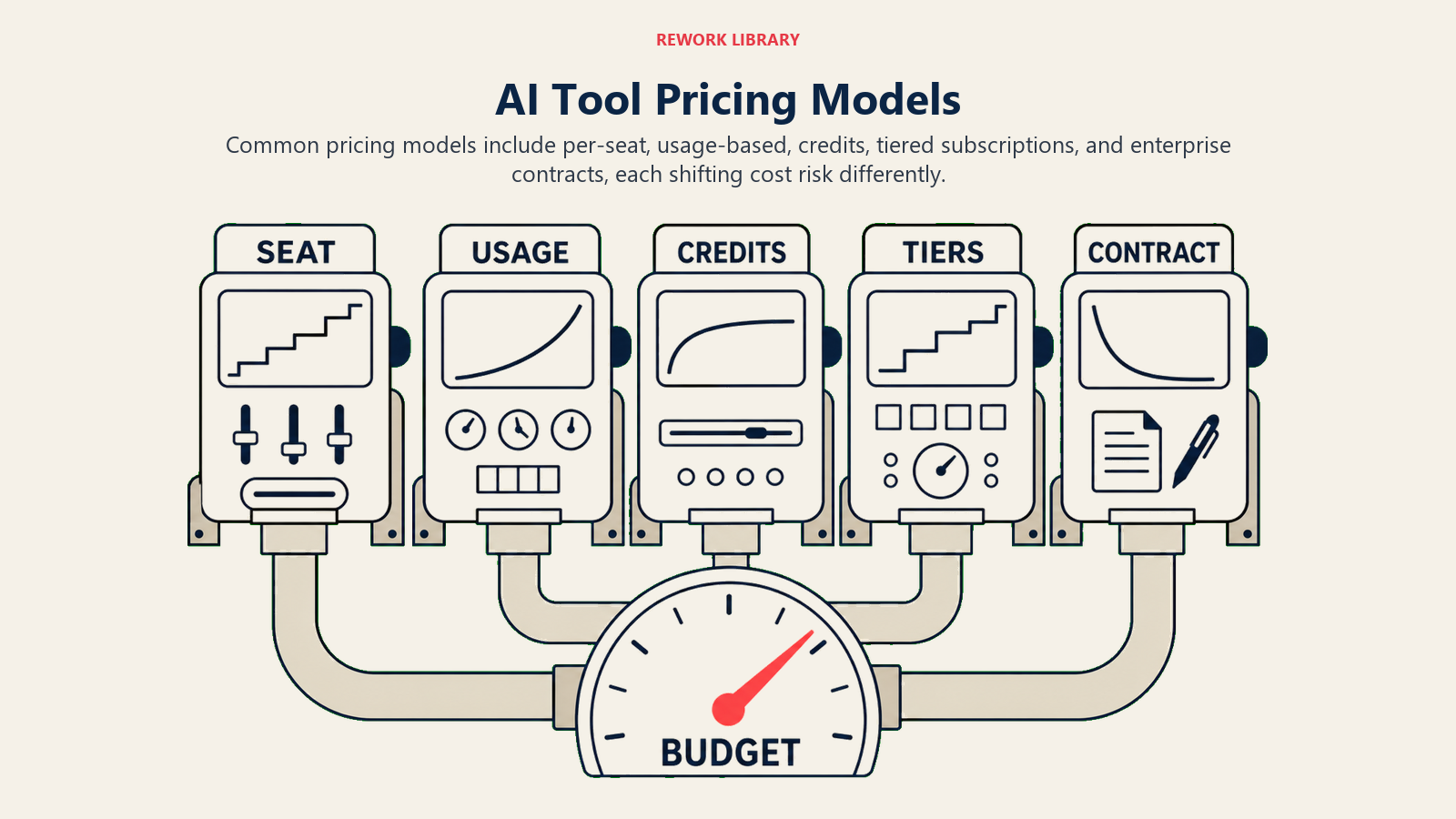
Per-user subscription is the most familiar model. You pay a monthly or annual fee per user, regardless of how much they use the tool. This provides cost predictability: 100 users at $30/month equals $3,000/month, period.
The challenge is optimization. Are you paying for users who barely log in? Do power users need higher tiers while casual users could use cheaper plans? Many organizations overspend because they provision everyone at the same tier "just in case" rather than right-sizing licenses to actual needs.
Usage-based pricing charges for consumption: API calls, tokens processed, compute hours, or transactions completed. This seems fair - you pay for what you use. But it creates forecasting nightmares. Usage can spike unpredictably as teams discover new applications or seasonal demand increases.
A marketing team might use 50,000 tokens monthly writing social content. Then they launch a new campaign and suddenly need 500,000 tokens. Your bill jumps 10x without warning. Usage-based pricing punishes success unless you manage it carefully.
Tiered pricing offers different feature access at different price points. Basic, Professional, Enterprise - each tier unlocks additional capabilities. This creates upgrade pressure. Teams start with Basic, hit limitations, need Professional features, then discover they need Enterprise integration capabilities.
The trap is over-tiering. Do you really need Enterprise features for everyone, or just your power users? Can most employees work effectively at Professional level? Over-provisioning "just to be safe" wastes money.
Enterprise licensing provides custom pricing for large deployments, often with volume discounts, bundled features, and negotiated terms. This offers better unit economics at scale but requires commitment - usually annual contracts with minimum user counts.
The risk is over-committing. If you negotiate a 500-user deal but only reach 300 active users, you're paying for 200 unused licenses. Enterprise deals favor the vendor unless you negotiate well and manage usage actively.
Hybrid models combine elements: base subscription plus usage charges, tiered plans with add-on features, or package deals with volume discounts. These provide flexibility but create complexity. You need to track multiple cost components and understand how different usage patterns affect your total spend.
The Total Cost of AI Ownership
License fees are just the beginning. True costs include everything required to make AI tools productive.
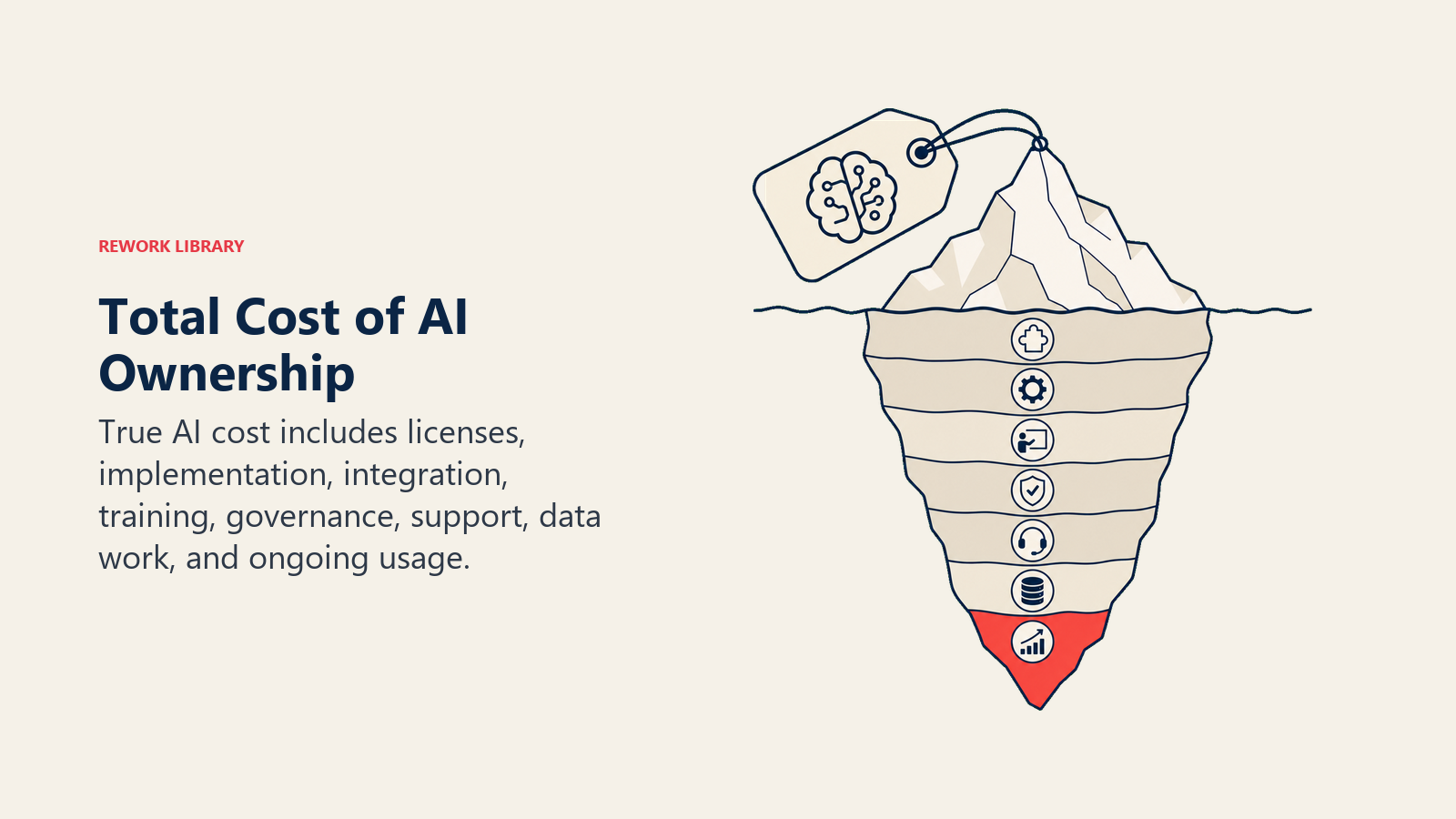
License and subscription fees are the obvious costs: monthly or annual charges for user access. But don't forget about multiplier effects. Ten tools at $20 per user per month equals $200 per user monthly. For 200 employees, that's $40,000 monthly or $480,000 annually. Costs compound as tool stacks grow.
Implementation and integration costs hit upfront and sporadically. You need technical resources to integrate AI tools with existing systems, configure security settings, set up user provisioning, and customize workflows. For simple tools, this might be minimal. For enterprise platforms, it can require months of development work.
Budget for external consultants if internal teams lack expertise, ongoing maintenance as systems change, and periodic re-integration when vendors update APIs or you switch systems.
Training and enablement expenses include developing training materials, conducting workshops, creating documentation, paying for external trainers, and the opportunity cost of employee time spent learning instead of producing. Comprehensive AI training and onboarding programs are essential investments.
Don't underestimate this. Effective training often costs 20-30% of first-year license fees. Inadequate training wastes money in a different way - you pay for tools people can't use effectively.
Ongoing support and maintenance covers help desk time answering user questions, troubleshooting technical issues, managing user access changes, and staying current with vendor updates. As your AI tool stack grows, so does support burden.
If you have five AI tools, support is manageable. If you have 25, you might need dedicated staff just managing AI tool operations.
Infrastructure and compute costs matter for self-hosted or compute-intensive AI applications. Cloud costs for running models, storage fees for training data, bandwidth charges for API calls, and infrastructure for custom implementations add up.
Even with vendor-hosted tools, you might incur costs for data pipelines feeding AI systems or infrastructure required for integrations.
Add these up and the "total cost of ownership" can easily be 150-200% of license fees. A tool with $100,000 in annual licenses might cost $250,000 fully loaded. Budgeting only for licenses sets you up for surprise overruns.
Cost Forecasting Challenges
Traditional software budgeting doesn't work for AI tools because growth patterns are fundamentally different.
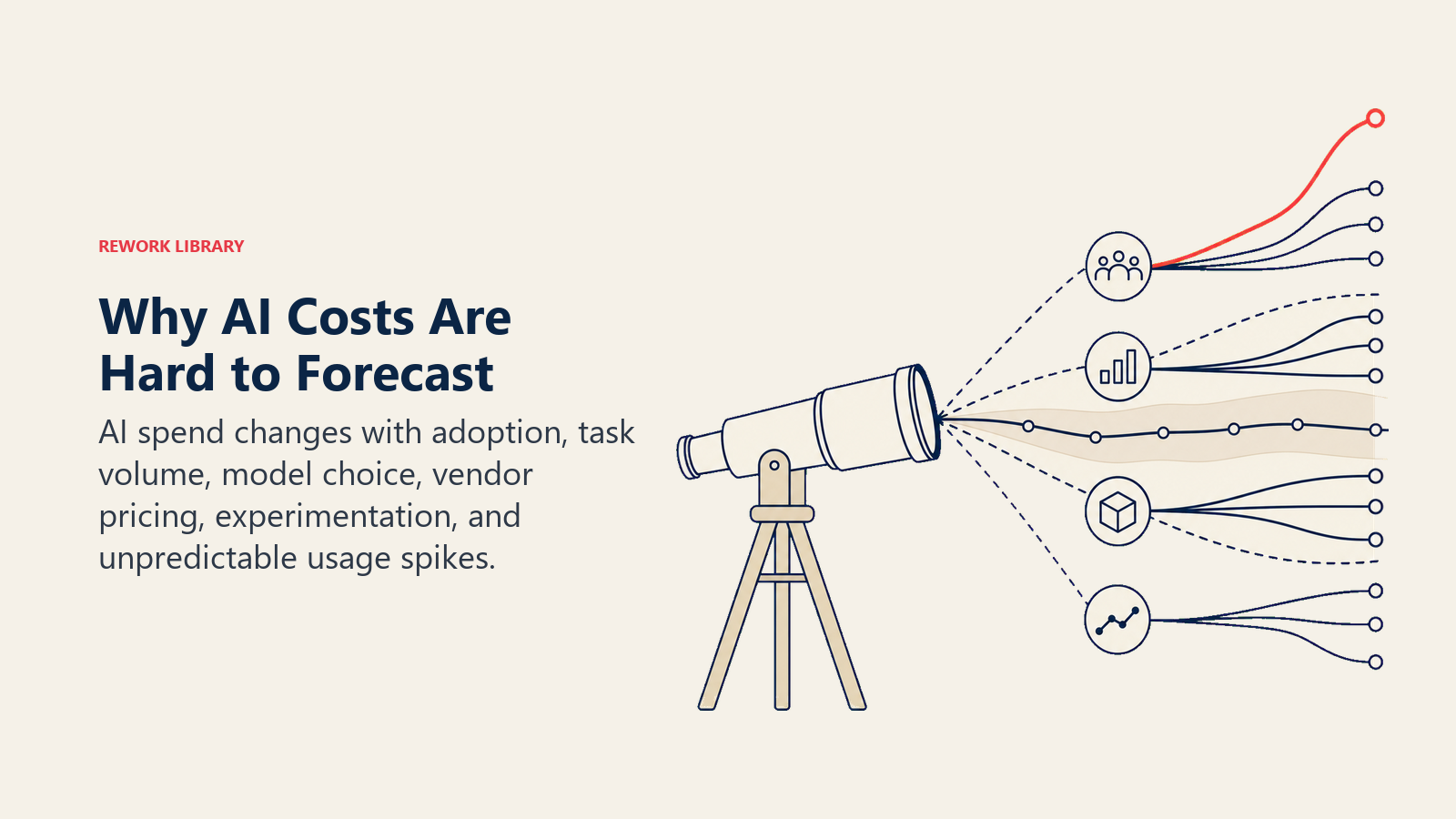
Unpredictable usage growth is the primary challenge. With traditional software, adding ten users increases costs linearly. With usage-based AI pricing, adding ten users might increase costs 2x if they're heavy users or barely move the needle if they're light users.
Adoption success compounds this. When an early adopter demonstrates massive value, everyone wants access. When a team discovers an effective use case, usage spikes as they apply it broadly. Your forecast becomes obsolete as soon as adoption accelerates.
Variable usage-based pricing creates month-to-month volatility. Q4 marketing campaigns might drive 3x normal AI content generation. Year-end financial analysis might spike AI data processing. Seasonal business patterns that barely affected software costs suddenly swing AI bills wildly.
Some vendors help by offering usage commitments with overage charges, providing more predictable bills in exchange for minimum spending commitments. This reduces volatility but creates new risk - paying for unused capacity if adoption disappoints.
Feature creep and tier upgrades drive costs up over time. Teams start with basic tiers, discover limitations, and request upgrades. "We need the API access only available in Enterprise tier" becomes a steady drumbeat of escalating costs.
Vendors incentivize this. Pricing is designed to make upgrades attractive as usage grows. What seems like unnecessary features at launch becomes "must-haves" six months in.
Shadow AI tool adoption undermines budget control. Employees frustrated by approval processes or procurement delays sign up for consumer AI tools using personal credit cards or departmental budgets. You think you're spending $100,000 on approved tools while another $50,000 in unapproved tools flies under the radar.
This creates security risks, compliance issues, and budget surprises when you discover and try to consolidate these rogue tools.
Cost Optimization Strategies
Controlling costs doesn't mean limiting adoption. It means spending smarter while enabling scale.
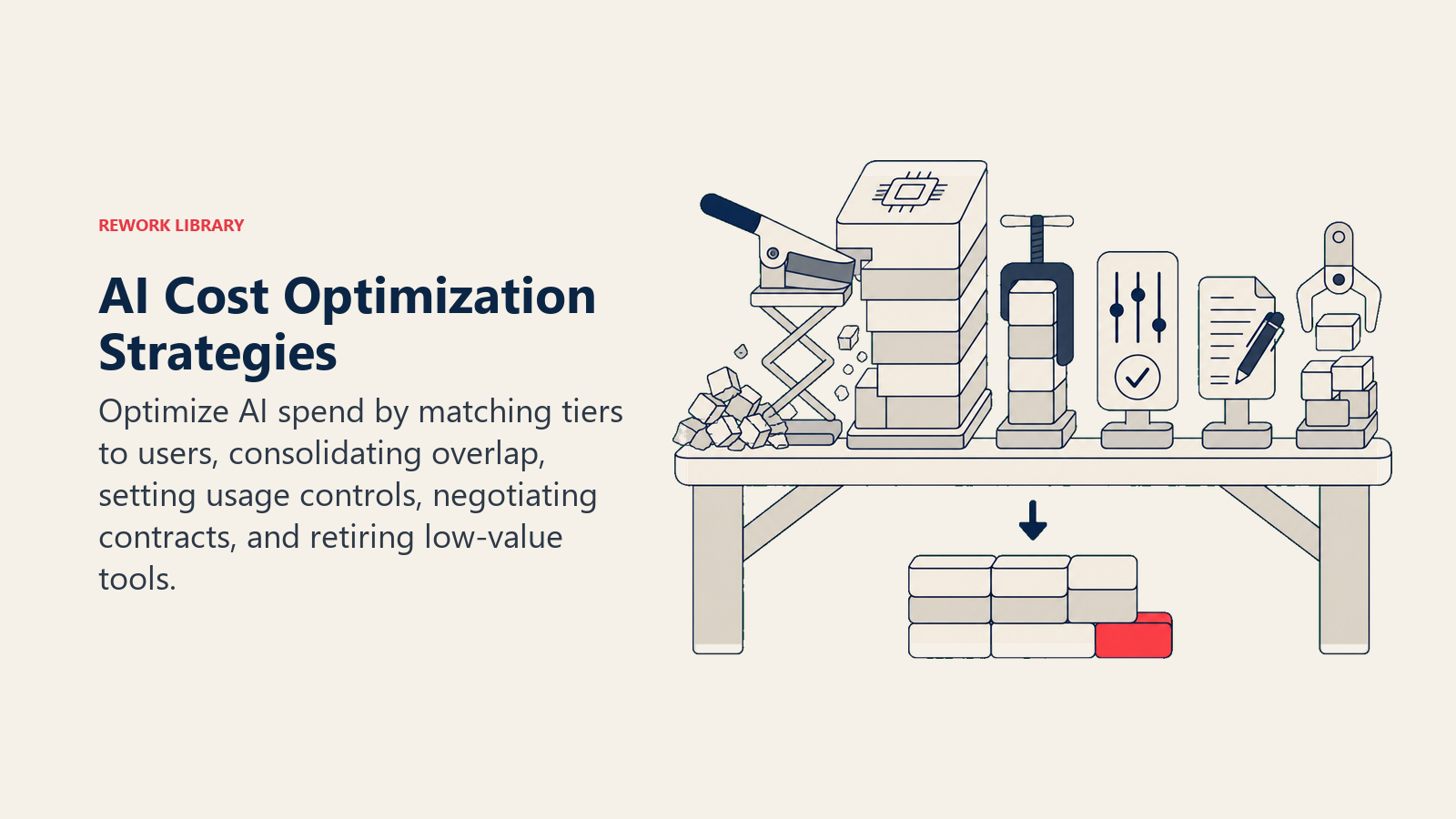
License tier optimization starts with right-sizing. Audit current usage and match users to appropriate tiers. Maybe 20% of users need Enterprise features while 80% work fine with Professional or Basic tiers. Downsizing the 80% saves money without impacting capability.
Review this quarterly. Usage patterns change. Users who needed advanced features for a specific project might not need them ongoing. Don't let licenses drift upward without occasional downward corrections.
Usage monitoring and governance prevents runaway costs. Implement dashboards showing consumption by team, user, and use case. Set alerts when usage spikes unexpectedly. Investigate high-usage outliers - are they getting exceptional value or using tools inefficiently?
Establish usage guidelines: "Use AI for first drafts, not iterating 20 times on the same content." Teach efficient prompting that gets desired results in fewer tries. Eliminate waste without limiting valuable use.
Vendor consolidation reduces both costs and complexity. If you have three different AI writing tools across departments, standardizing on one typically gets you better volume pricing, simpler administration, easier training, and reduced support burden. Effective AI tool stack optimization drives significant savings.
But consolidate thoughtfully. Sometimes specialized tools deliver better value than general platforms. The goal is eliminating redundancy, not forcing everyone onto one platform regardless of fit.
Negotiation tactics improve pricing for significant spend. When renewing contracts or scaling up, negotiate. Vendors have flexibility, especially for:
- Multi-year commitments (lock in current pricing against increases)
- Volume discounts (better rates for hitting usage thresholds)
- Bundled services (training, support, or implementation included)
- Favorable terms (monthly billing instead of annual, easier cancellation, or usage pooling)
Don't accept posted pricing at scale. Vendors expect negotiation. Leaving money on the table helps their margins, not yours.
Right-sizing strategies match tool capabilities to actual needs. Don't buy enterprise platforms for simple use cases where basic tools suffice. Don't provision advanced features no one uses. Don't pay for integration capabilities you don't need.
This requires honest assessment. Yes, you might need that feature someday. But if "someday" is 18 months away, you can upgrade then and save money now.
Budget Planning for AI Tools
Effective budgeting balances predictability with flexibility for a rapidly evolving category.
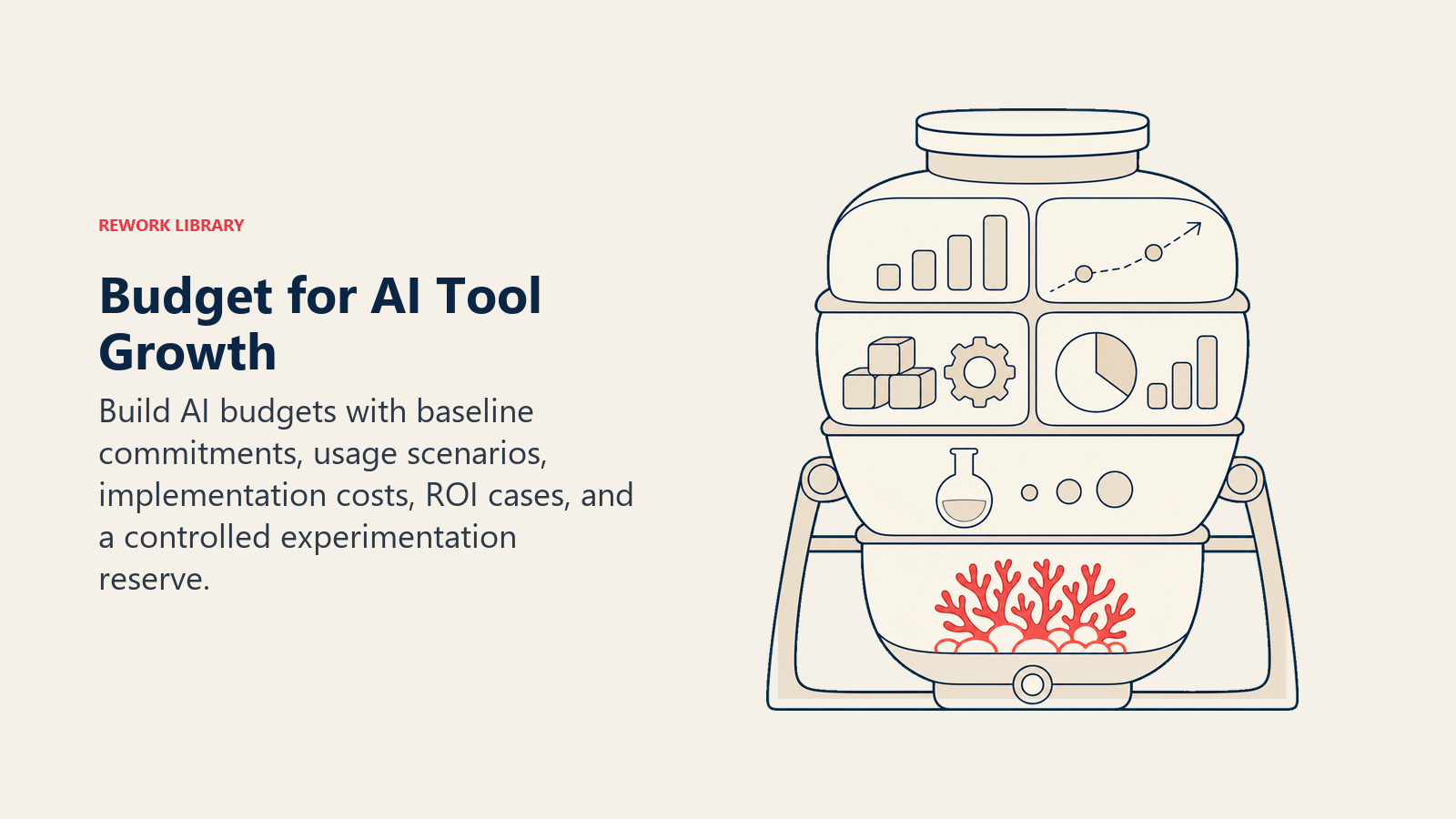
Initial deployment budget should include first-year licenses, implementation costs, training expenses, and a 20-30% buffer for underestimated needs. It's better to budget conservatively and have surplus than to run out of money mid-implementation.
Break this into phases. If you're rolling out tools to 500 people, budget for phased deployment: pilot (50 users), expansion (200 users), and full rollout (500 users). This spreads costs over time and lets you adjust based on actual patterns.
Scaling cost projections require modeling different scenarios. Build a baseline forecast assuming current adoption rates continue. Then model accelerated adoption: what if usage doubles? Triples? Slows to half?
Use these scenarios to establish a cost range rather than a single number. Present to finance as: "We expect $150K-$225K in year two depending on adoption success." This sets realistic expectations and prevents sticker shock when costs grow with successful implementation.
ROI-based budget justification shifts the conversation from cost to value. Don't just request money for AI tools. Show the return using AI productivity ROI metrics: "We'll spend $200,000 on AI tools to save 5,000 employee hours annually, equivalent to $400,000 in cost avoidance. Net positive: $200,000 year one, growing as efficiency compounds."
Connect costs to specific business outcomes: faster sales cycles, improved customer satisfaction, reduced operational expenses, or increased revenue. Finance leaders approve investments that deliver returns, even if absolute costs seem high.
Reserve for experimentation acknowledges that AI is evolving rapidly. Budget 10-15% of your AI spending for testing new tools, piloting emerging capabilities, and exploring innovative applications. This prevents every new tool requiring a budget battle.
Position this as strategic investment in future capability. The reserve lets you move quickly when valuable new tools emerge without waiting for next year's budget cycle.
Governance to Control Costs
Centralized governance balances enabling teams with preventing chaos.
Approval workflows establish clear processes for AI tool requests. Teams propose tools, provide business justification, demonstrate alternatives don't meet needs, and show expected ROI. This prevents impulse purchases while enabling legitimate needs.
Make approvals fast for tools under certain thresholds. Requiring six weeks and three committees to approve a $30/month tool creates shadow IT. Reserve heavy process for significant commitments.
Usage policies set expectations about appropriate use. Define what AI tools should and shouldn't be used for, establish efficiency guidelines, clarify who gets access to what tiers, and specify how to escalate needs for additional capacity.
Policies prevent both underspending (teams avoiding AI because they're unsure if it's allowed) and overspending (individuals using AI for personal projects on company accounts).
Vendor evaluation standards create consistency in tool selection. Establish criteria based on your AI tool selection framework: security requirements, compliance needs, integration capabilities, vendor financial stability, and total cost analysis including all ownership components.
This prevents teams from selecting tools that create expensive integration problems or compliance risks that swamp any operational benefits.
Tool rationalization periodically reviews your AI tool portfolio. What tools have low adoption? What overlaps exist? What consolidation opportunities would save money without losing capability?
Run this annually. Technology evolves, better alternatives emerge, and vendor consolidation opportunities appear. Your optimal tool stack changes over time.
Cost vs Value Trade-offs
The goal isn't minimizing costs. It's maximizing value per dollar spent.
Sometimes higher costs are absolutely worth it. If a $100/month AI tool saves a $150,000/year employee five hours per week, that's $15,000 in annual value for $1,200 in costs. Buy it immediately and don't negotiate for a better price.
Other times lower costs make sense. If two tools deliver similar value, choose the cheaper one. If a feature costs 50% more but delivers 10% more value, skip it.
Build value-based decision frameworks. Cost per hour saved. Cost per task automated. Cost per quality improvement point. These metrics let you compare across different AI applications and make rational investment decisions.
Watch for false economies. Choosing the cheapest AI tool that frustrates users and limits adoption wastes more money than buying the more expensive tool that drives engagement. Initial purchase price is only one cost component.
Similarly, watch for gold-plating. The most expensive tool isn't always the best. Enterprise features you don't need waste money regardless of how impressive they sound.
The Path Forward
AI tool costs will grow as adoption succeeds. That's not a problem to avoid - it's a reality to manage. The organizations that thrive won't be those that spend the least on AI. They'll be those that spend wisely: enabling broad adoption while maintaining cost discipline.
Build sophisticated cost management: understand pricing models, calculate total ownership costs, forecast multiple scenarios, optimize continuously, establish governance, and focus on value per dollar spent.
Measure rigorously. Track costs, monitor usage, assess ROI, and adjust based on data. Make cost management a competency, not an afterthought.
Partner with finance. Don't position IT and finance as adversaries where IT wants to spend and finance wants to block. Build shared ownership of maximizing AI value within sustainable budgets. Show finance leaders the ROI. Give them visibility into usage and costs. Collaborate on optimization.
Remember that in a world where AI capabilities expand monthly, yesterday's "expensive" quickly becomes tomorrow's "essential." Your job isn't minimizing AI spending. It's ensuring every dollar spent delivers maximum organizational value.
The companies that get this right won't just control costs. They'll out-invest competitors in high-value AI applications while spending less on low-value uses. That's the competitive advantage: capital efficiency in AI deployment.
It starts with treating cost management as strategic capability, not administrative burden.