Prompt Engineering Best Practices
Turn this article into takeaways for your work.


Each assistant summarizes the article only for you and suggests best practices for your work.
Here's what most people experience with AI tools: they get started with enthusiasm, try a few prompts, get mediocre results, and conclude the tool isn't as impressive as the hype suggested. But the problem isn't the AI. It's the prompts.
The difference between "Write a blog post about project management" and a well-engineered prompt can mean the difference between generic, unusable output and content that needs only minor tweaking. Prompt engineering is the skill that separates people who get frustrated with AI from those who use it to 10x their productivity.
The good news is that prompt engineering isn't magic. It's a learnable framework that produces consistent results once you understand the principles. Whether you're using AI writing assistants, automation tools, or analysis platforms, prompt quality determines output quality.
What is Prompt Engineering
Prompt engineering is the practice of designing inputs that get AI models to produce the outputs you want. It's part science, part art. You need to understand how AI interprets instructions while learning what works through experimentation.
Think of it like learning to communicate with a brilliant but literal colleague. They'll do exactly what you ask, but if your instructions are vague or incomplete, you won't get what you actually wanted. The more specific, structured, and clear your requests, the better the results.
The skill matters because AI tools are increasingly central to knowledge work. Writing, analysis, coding, and research all rely on your ability to translate what's in your head into prompts that guide AI effectively.
Core Prompt Engineering Principles
Four principles underlie all effective prompts:
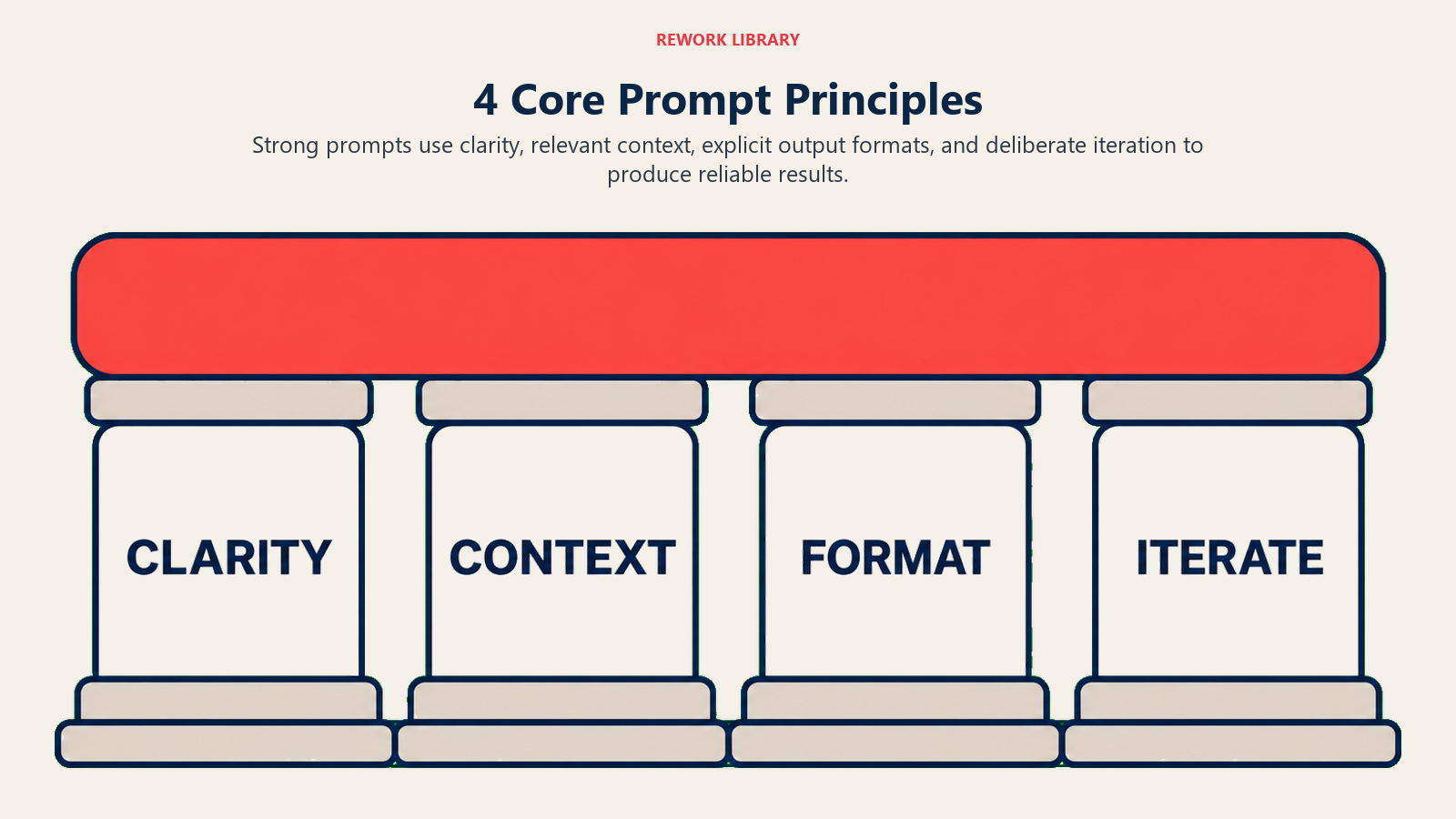
Clarity and specificity beat vague instructions every time. "Analyze this data" produces generic observations. "Analyze this sales data to identify which product categories declined in Q3 and suggest three possible causes" produces actionable insights.
Be explicit about what you want. Don't make the AI guess.
Context provision gives the AI information it needs to understand your situation. Generic advice applies broadly but helps no one specifically. Context lets AI tailor responses to your actual needs.
Include relevant background: your industry, company size, current situation, constraints you're working within. The AI can't read your mind. Tell it what it needs to know.
Output format specification prevents the AI from choosing formats that don't work for you. Do you want bullet points or paragraphs? A table or narrative? Three options or one recommendation?
Specify the structure upfront instead of reformatting outputs later.
Iteration and refinement improve prompts over time. Your first attempt rarely produces perfect results. Analyze what worked and what didn't, adjust your prompt, and try again. The best prompts are refined through multiple iterations.
The Prompt Framework
This six-part framework works across virtually all AI applications:
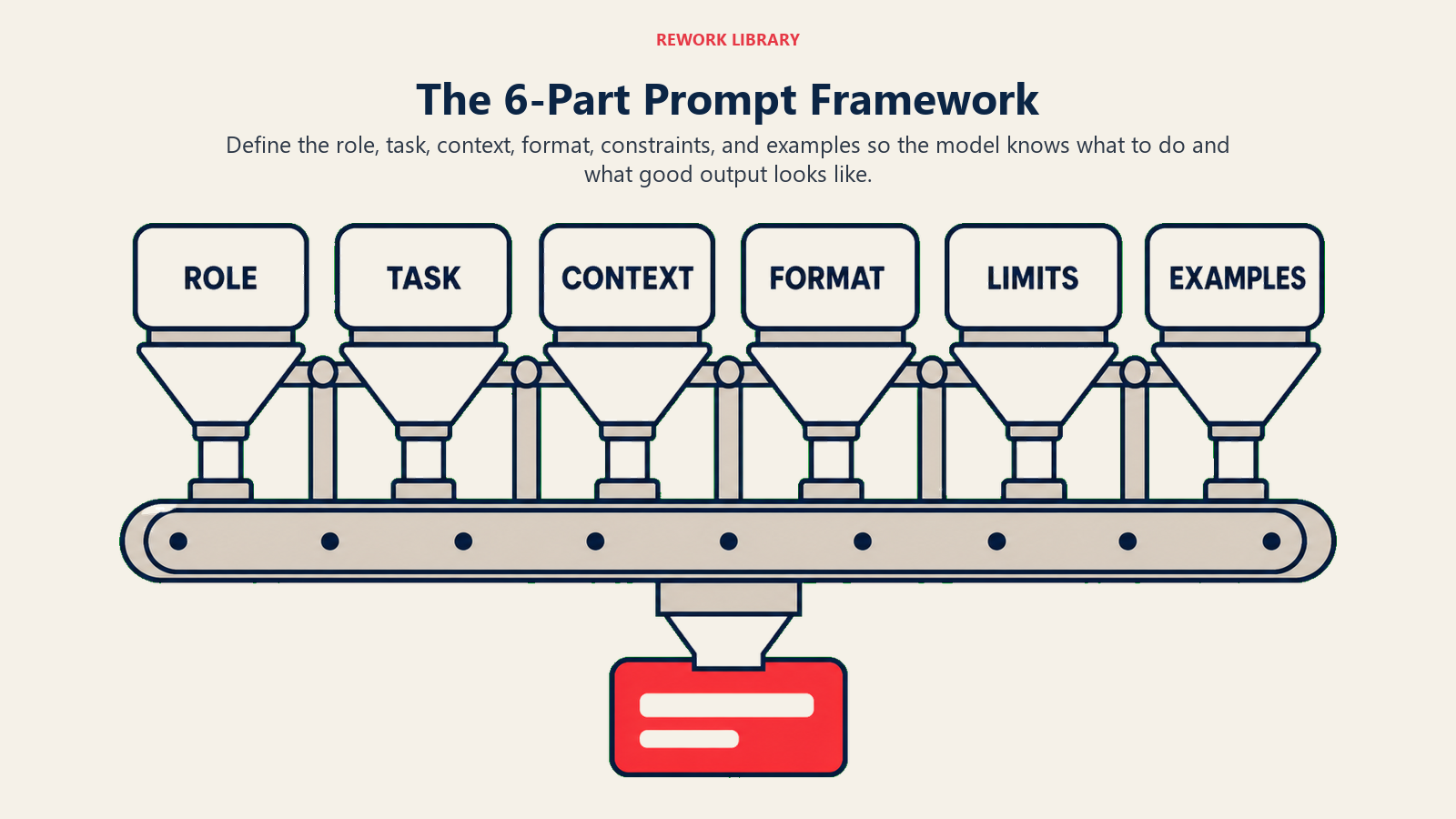
Role: Who the AI should act as
Start by defining the AI's role or perspective. This primes the model to respond from a specific knowledge base and mindset.
Examples:
- "You are an experienced CFO reviewing budget proposals"
- "You are a senior product manager evaluating feature requests"
- "You are a content strategist optimizing blog posts for SEO"
The role sets context for everything that follows. For comprehensive guidance on effective prompting strategies, see Anthropic's prompt engineering guide and OpenAI's best practices.
Task: What you want it to do
State clearly what you want the AI to accomplish. Use action verbs and be specific.
Examples:
- "Analyze this customer feedback to identify the top 5 complaints"
- "Rewrite this email to be more concise while maintaining a friendly tone"
- "Generate 10 headline options for this blog post about remote work"
Context: Background information
Provide relevant details the AI needs to understand your situation. This includes:
- Industry or domain
- Current situation or problem
- Relevant constraints or requirements
- Target audience
- Success criteria
Example: "Our SaaS company sells to mid-market HR departments. We're launching a new feature that streamlines employee onboarding. Our typical customer has 100-500 employees and currently uses spreadsheets to manage onboarding tasks."
Format: How to structure output
Specify exactly how you want the response formatted:
- Bullet points vs paragraphs
- Tables vs narrative
- Length limits
- Section structure
- Specific fields to include
Example: "Provide your analysis in a table with three columns: Issue, Impact Level (High/Medium/Low), and Recommended Action. Include 5-7 rows."
Constraints: What to avoid or include
Define boundaries and requirements:
- Tone and style guidelines
- Things to avoid
- Required elements
- Specific word counts or limits
Example: "Use business casual tone. Avoid jargon. Include specific examples. Keep total response under 300 words."
Examples: Sample inputs/outputs
When possible, show the AI examples of what you want. Few-shot learning (providing examples) significantly improves output quality.
Example: "Here's an example of the format I want:
Problem: Low email open rates Analysis: Subject lines are too long (avg 62 characters) and use corporate language Solution: Test subject lines under 40 characters with conversational tone
Now analyze this problem: [your content]"
Prompt Patterns by Use Case
Different tasks benefit from specific prompt patterns.
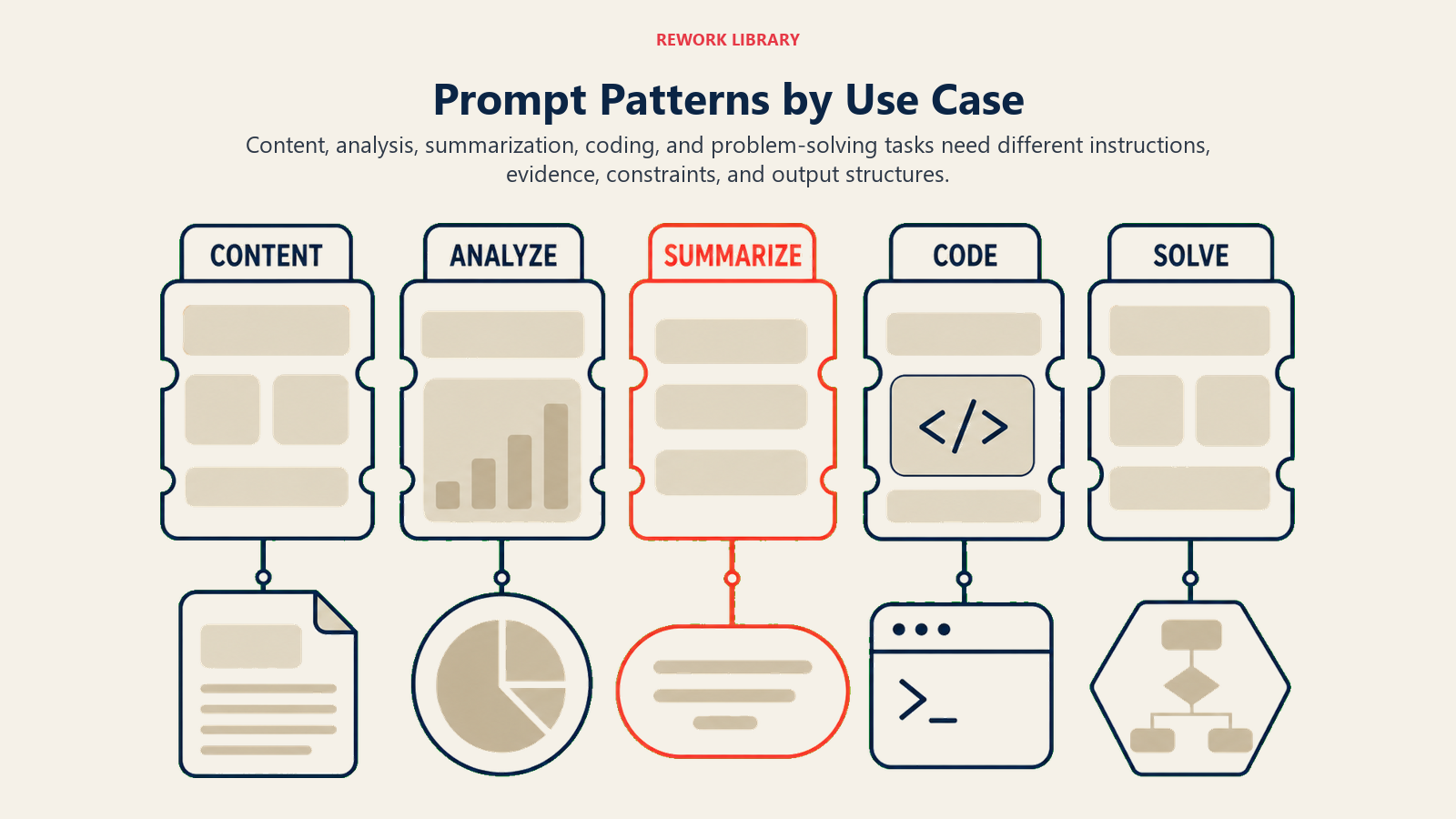
Content generation:
You are an experienced content marketer writing for [audience].

Create a [content type] about [topic] that:
- Addresses [specific pain point]
- Includes [required elements]
- Uses a [tone] tone
- Is [length] words

Structure:
[outline or format]

Examples of our content style:
[paste 1-2 examples]
This pattern works across AI content generation tools and general-purpose models for consistent, high-quality outputs.
Data analysis:
You are a data analyst reviewing [data type] for [company/department].

Analyze this data to:
1. [Specific question]
2. [Specific question]
3. [Specific question]

Present findings in:
- Executive summary (3-4 sentences)
- Key insights (bullet points)
- Recommendations (numbered list with rationale)

Focus on actionable insights, not just observations.
Summarization:
Summarize this [content type] for [audience] who needs to understand:
- [Key point to capture]
- [Key point to capture]
- [Key point to capture]

Format: [structure]
Length: [limit]
Focus: [angle]

Original content:
[paste content]
Code generation:
You are an experienced [language] developer.

Write a function that:
- [Functionality requirement]
- [Functionality requirement]
- [Functionality requirement]

Requirements:
- [Technical constraint]
- [Technical constraint]
- Include error handling
- Add comments explaining key logic

Return: [expected output format]
Problem-solving:
You are an expert in [domain] helping solve [type of problem].

Problem: [describe situation]

Analyze this by:
1. Identifying root causes
2. Evaluating potential solutions
3. Recommending the best approach with rationale

Consider these constraints:
- [Constraint]
- [Constraint]

Provide reasoning for your recommendations.
Common Prompt Mistakes
These mistakes reduce output quality:
Being too vague: "Write about marketing" produces generic content. "Write a 500-word article explaining how B2B SaaS companies can reduce customer acquisition cost through content marketing" produces focused, useful content.
Not providing context: AI can't infer your specific situation. "Review this email" might check grammar. "Review this email to a prospect who went dark after a demo, making it more personable while acknowledging they're busy" produces relevant feedback.
Asking for too much at once: Complex multi-step requests often fail. Break them into sequential prompts where each builds on the previous output.
Not specifying format: You'll get whatever format the AI chooses, which might not work for your needs. Specify upfront.
Ignoring iteration: First attempts rarely produce perfect results. Refine prompts based on what you learn from outputs.
Forgetting examples: Showing the AI what you want works better than describing it. Include samples when quality matters.
Advanced Techniques
Once you master basics, these techniques unlock better results:
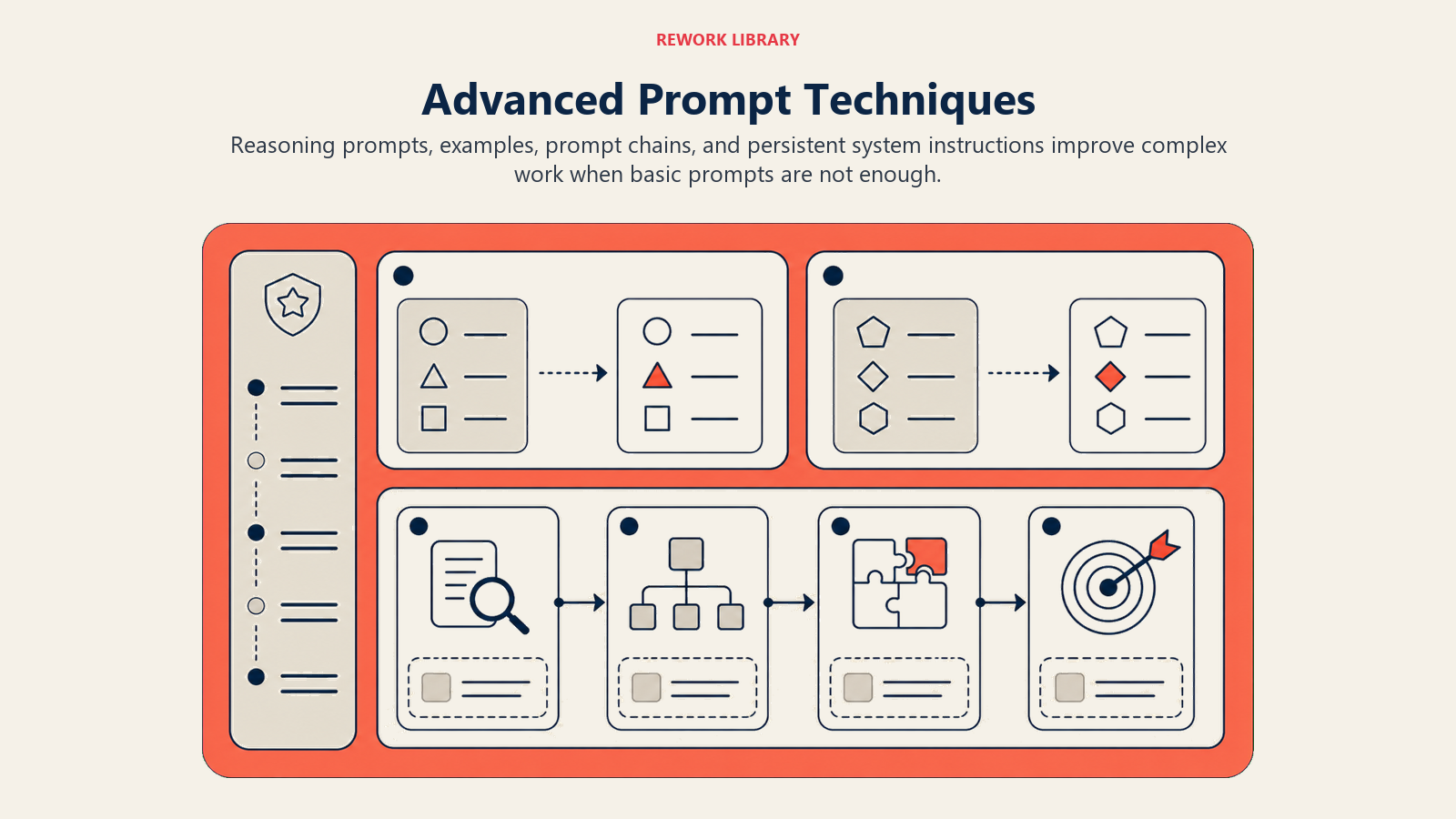
Chain-of-thought prompting asks the AI to show its reasoning before answering. Add "Let's think through this step-by-step" or "Explain your reasoning" to prompts. This often produces more accurate, thoughtful responses.
Example: "Analyze why our conversion rate dropped 15% in March. Think through potential causes step-by-step before presenting your conclusion."
Few-shot learning provides examples that show the AI what you want. Two to three examples of input-output pairs dramatically improve quality.
Example: "Convert features to benefits using these examples:
Feature: 256-bit encryption Benefit: Your customer data stays secure, protecting your reputation and ensuring compliance
Feature: Automated backups every hour Benefit: You'll never lose work, even if systems fail unexpectedly
Now convert: Real-time collaboration features"
Prompt chaining breaks complex tasks into sequences where each prompt uses the previous output. This handles sophisticated workflows that single prompts can't manage.
Example flow:
- "Extract key themes from this customer feedback"
- "For each theme, identify specific product improvements we could make"
- "Prioritize these improvements based on impact and effort"
- "Write a product brief for the highest-priority improvement"
System message optimization sets persistent context that applies to all subsequent prompts. Many AI tools let you set a system message that establishes role, constraints, and guidelines upfront.
Example system message: "You are a business analyst helping mid-market SaaS companies improve operational efficiency. Your responses should be data-driven, practical, and focused on ROI. Use business casual tone and avoid jargon. Include specific examples and actionable recommendations."
Building Prompt Libraries
Teams get more value from AI by standardizing prompts instead of everyone reinventing them.
Document prompts that work: When someone creates a prompt that produces great results, save it to a shared library. Include the prompt, sample output, and notes on when to use it.
Create templates with variables: Build reusable prompt templates where team members fill in specifics.
Example template:
Analyze this [type of data] to determine [objective].

Context:
- Industry: [fill in]
- Time period: [fill in]
- Current situation: [fill in]

Provide insights on:
1. [Question]
2. [Question]
3. [Question]

Format: [specify format]
Organize by use case: Group prompts by department or function (sales prompts, marketing prompts, product prompts, etc.). Make them easily searchable.
Version prompts: Track improvements over time. When someone refines a prompt to work better, update the library with notes on what changed and why.
Share results and learnings: Create feedback loops where people share particularly good or bad results from prompts, helping everyone learn faster.
Testing and Optimization
Treat prompt engineering like any other skill: measure results and improve systematically.
A/B test different approaches: When quality matters, try multiple prompt variations and compare outputs. You'll discover which structures and phrasings work best.
Measure consistency: Run the same prompt multiple times to check output consistency. High variance might mean the prompt is too vague or context-dependent. For comprehensive quality tracking, implement AI performance measurement frameworks that monitor prompt effectiveness over time.
Get feedback from end users: If outputs go to customers or stakeholders, collect feedback on quality. Let real-world results guide prompt improvements.
Track time to useful output: Better prompts reduce editing and refinement time. Measure how many iterations it takes to get usable results.
Document what works: Keep notes on which techniques produce best results for different tasks. Build institutional knowledge around prompt engineering.
The goal isn't perfection on the first try. It's building prompts that consistently produce good enough results that you only need minor adjustments. That's when AI transforms from impressive demo to genuine productivity multiplier.
Most people never get there because they don't treat prompt engineering as a skill worth learning. The ones who do find that AI tools live up to the hype after all. Organizations scaling AI adoption successfully integrate prompt training into their AI training and onboarding programs to ensure team-wide competency.