AI Translation and Localization
Turn this article into takeaways for your work.


Each assistant summarizes the article only for you and suggests best practices for your work.
Here's the reality most global companies face: they want to expand into new markets, but the cost of translating all their content makes it financially impossible. Marketing pages, product documentation, support articles, customer emails. It all adds up fast. At $0.15-0.30 per word for professional human translation, launching in just five new languages can cost hundreds of thousands of dollars.
That's where AI translation has changed the game. Modern neural machine translation doesn't just swap words between languages. It understands context, maintains meaning, and can process millions of words for a fraction of traditional costs. But it's not about replacing human translators entirely. It's about building a smarter workflow that combines AI speed with human expertise where it matters most. As part of a comprehensive AI content generation strategy, translation tools enable truly global content operations.
AI Translation vs Traditional Translation
Neural machine translation works differently than the phrase-based systems from a decade ago. Instead of translating word by word or phrase by phrase, neural networks process entire sentences and paragraphs to understand context and meaning.
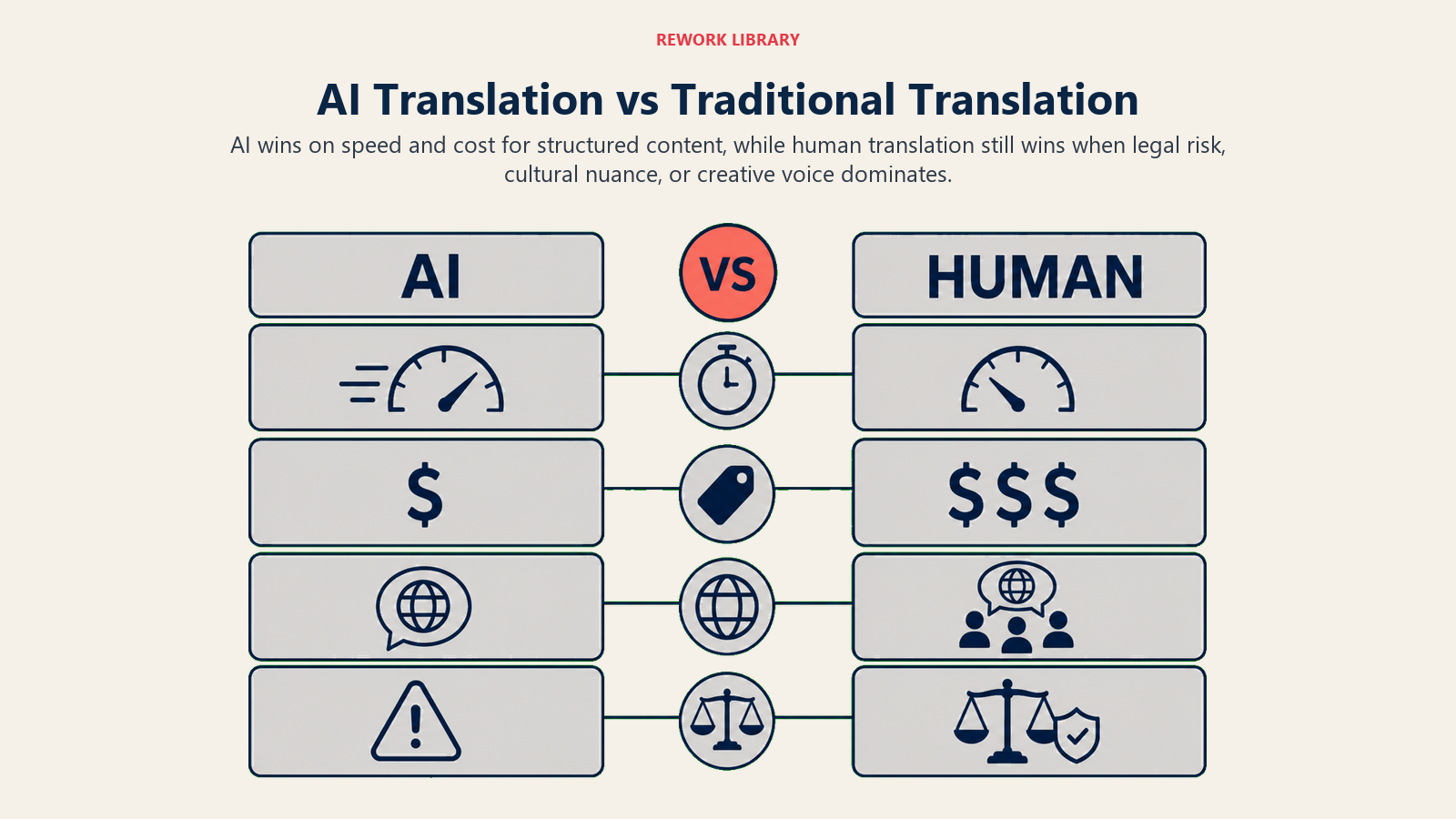
Quality comparison by content type:
Technical documentation performs exceptionally well with AI translation. The structured nature of technical writing, consistent terminology, and focus on clarity rather than creativity means AI can handle 80-90% of technical content with minimal human review.
Marketing content sits in the middle. AI translation captures the basic message but often misses cultural nuances, idiomatic expressions, and brand voice subtleties. You'll want native speakers to review and adapt marketing translations, but starting with AI saves significant time and cost.
Support content works well with a hybrid approach. Common questions, standard responses, and help articles translate cleanly with AI. The key is having native speakers review the most frequently accessed content while AI handles the long tail.
Legal and compliance content still requires human translation. The consequences of mistranslation are too high, and legal terminology varies significantly across jurisdictions. Use AI for initial drafts if needed, but budget for full human review.
Cost and speed advantages:
Traditional translation costs $0.15-0.30 per word. AI translation costs $0.001-0.01 per word through platforms like DeepL Pro or Google Cloud Translation. That's a 60-80% cost reduction on the translation itself, even before accounting for the reduced human review time.
Speed improves dramatically. Human translators typically produce 2,000-3,000 words per day. AI translation processes that in seconds. A 50,000-word website that would take weeks to translate traditionally can be done in hours with AI, plus review time.
When human translation still wins:
Creative content with wordplay, humor, or cultural references needs human translators who understand both cultures deeply. Brand messaging that defines your company's voice requires human oversight to maintain consistency. Customer-facing content where tone and emotional resonance matter deserves human attention.
Modern AI Translation Platforms
DeepL Pro for business has become the gold standard for quality. Their neural networks consistently produce more natural-sounding translations than competitors, particularly for European languages. The API integrates cleanly with content management systems, and the CAT (Computer-Assisted Translation) tool helps translators work efficiently.
Pricing starts at $6.49 per month for 5 million characters. Enterprise plans offer unlimited translation with dedicated support.
Google Cloud Translation Advanced provides the broadest language coverage (over 130 languages) and excels at detecting source languages automatically. The glossary feature lets you define custom terminology, maintaining brand consistency across translations.
AutoML Translation lets you train custom models on your specific content, improving quality for industry-specific terminology. Pricing is $20 per million characters for neural machine translation.
Microsoft Translator integrates seamlessly if you're already using Microsoft's ecosystem. The Custom Translator feature lets you build domain-specific translation models. Real-time conversation translation makes it valuable for customer support scenarios.
Pricing is $10 per million characters through Azure Cognitive Services.
Specialized tools like Lokalise, Phrase, and Crowdin add workflow management and collaboration features on top of AI translation engines. They connect your codebase, design tools, and content systems to manage translations across web, mobile, and product interfaces.
These platforms typically charge based on source strings or target languages, ranging from $100-500+ per month depending on volume and features.
The Human-in-the-Loop Translation Workflow
The most cost-effective approach combines AI translation with strategic human review. Here's what works:
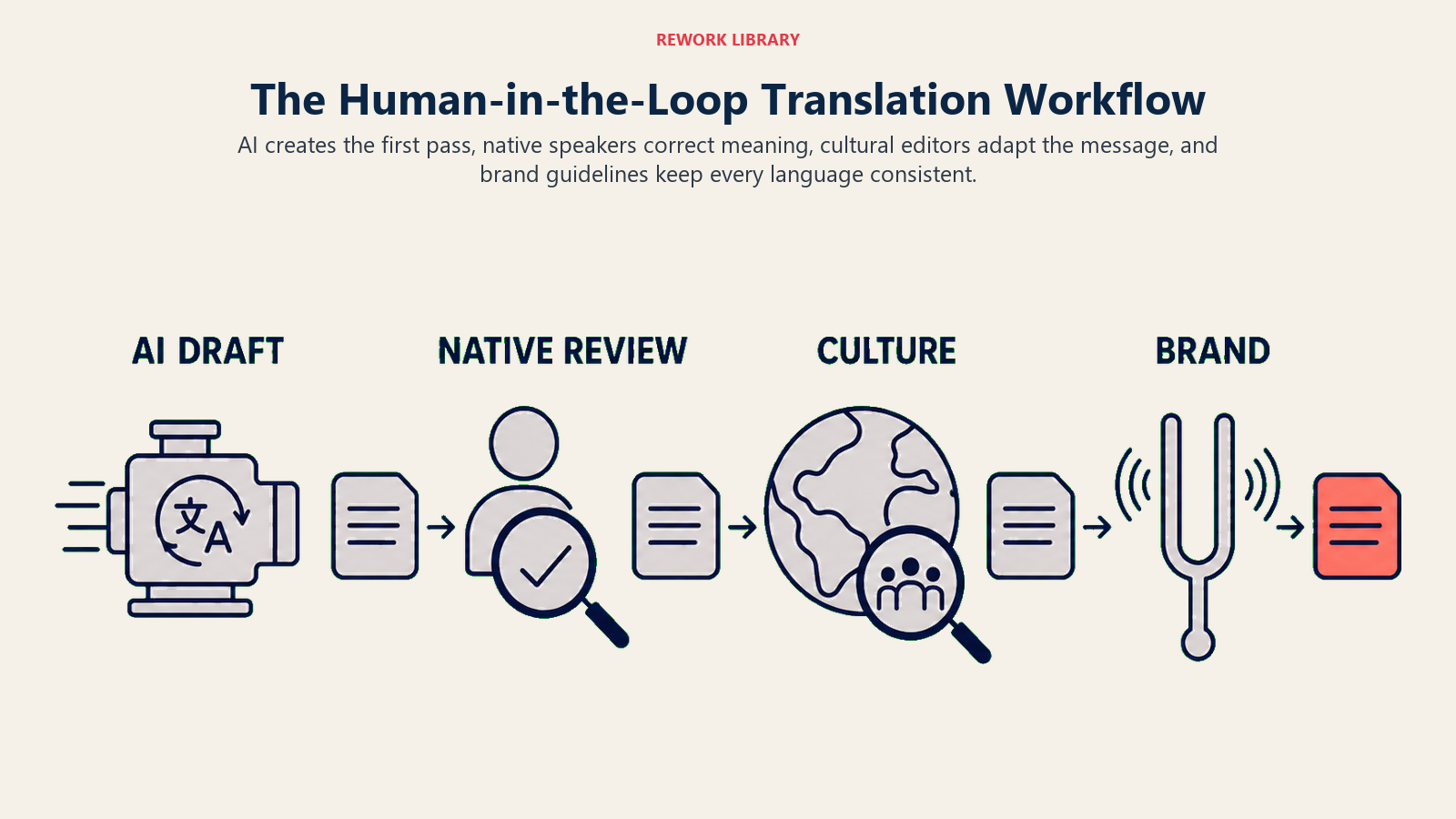
AI first-pass translation: Run all content through your AI translation platform to create initial drafts. This takes minutes and costs pennies, giving translators a solid starting point instead of blank pages.
Native speaker review: Have native speakers review translations, focusing on meaning accuracy and naturalness. They're editing rather than translating from scratch, which is 3-5x faster and costs less.
Cultural adaptation: For marketing content, go beyond literal translation. Native speakers adapt messaging to resonate with local culture, using appropriate idioms, examples, and references. This is where human expertise adds real value.
Brand voice consistency: Create translation guidelines and glossaries that define how your brand voice translates into each language. Some expressions don't translate literally. You need equivalents that maintain the same tone and impact.
Integration with Content Management
Modern translation workflows integrate directly with your content systems, automating much of the coordination work.
CMS integration: Platforms like WordPress, Contentful, and Strapi offer translation plugins that send content to AI translation services automatically. Translators review changes in-context, seeing exactly how content appears on your site.
Automated translation triggers: Set up workflows where publishing new content in your primary language automatically creates translation tasks. Translators receive notifications, review AI translations, and publish localized versions without manual coordination. These workflows align with broader AI workflow automation capabilities.
Version management: When you update content in your primary language, translation systems flag which localized versions need updating. This prevents the common problem where English content evolves while other languages fall behind.
ROI of AI Translation
Let's run the numbers on a real example. Say you're launching in five new markets and need to translate:
- 50,000-word website
- 200,000-word documentation library
- 1,000 support articles (150,000 words)
- Ongoing blog content (20,000 words/month)
Traditional human translation approach:
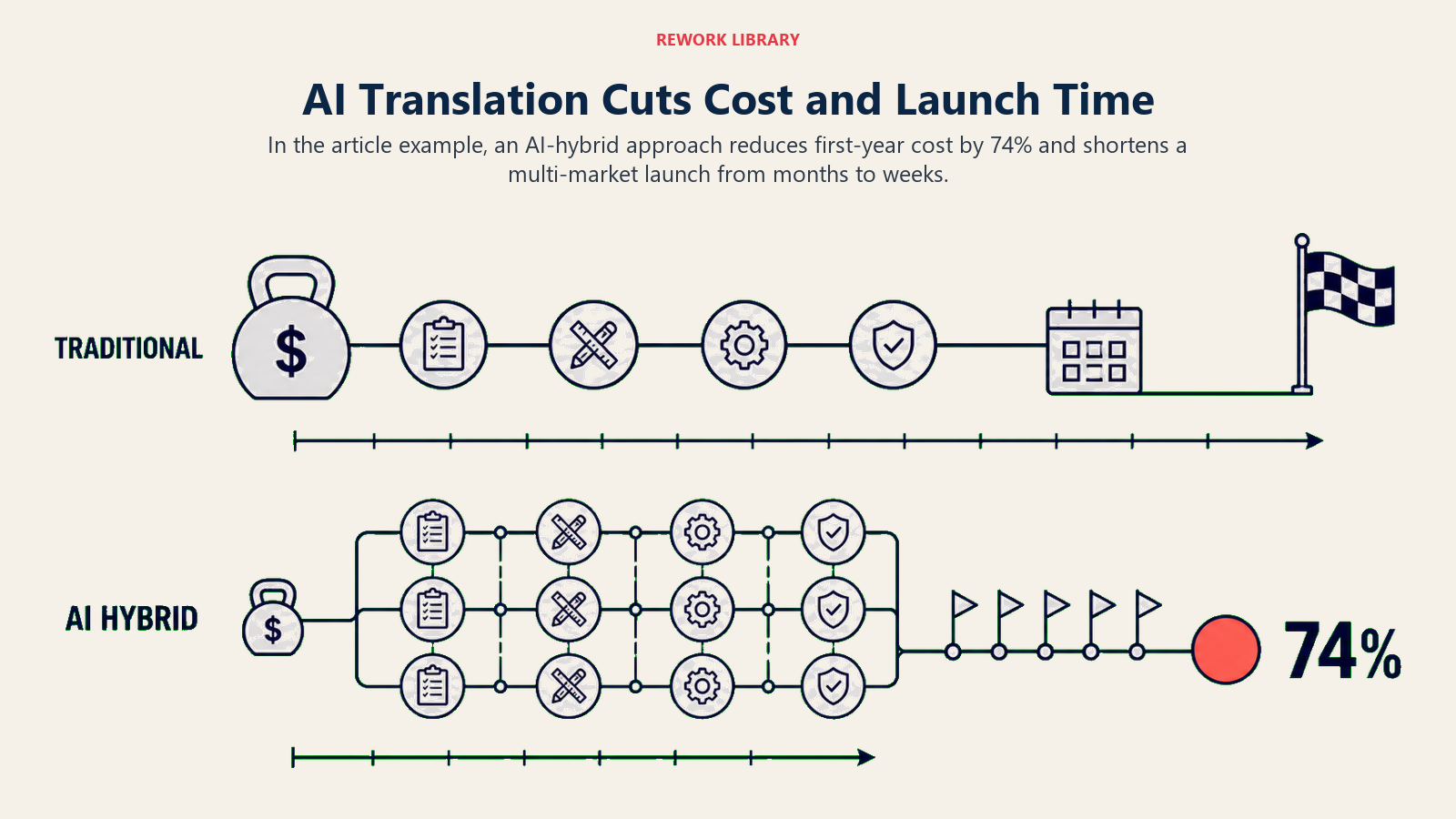
Initial content: 400,000 words × $0.20/word × 5 languages = $400,000 Ongoing content: 20,000 words × $0.20/word × 5 languages × 12 months = $240,000/year Total first year: $640,000
AI-hybrid approach:
Initial content:
- AI translation: 400,000 words × $0.005/word × 5 languages = $10,000
- Human review (50% of content needs review at $0.08/word): 200,000 words × $0.08 × 5 = $80,000
- Cultural adaptation for key marketing pages: $20,000
Ongoing content:
- AI translation: 20,000 words × $0.005/word × 5 languages × 12 = $6,000/year
- Human review: 10,000 words × $0.08 × 5 languages × 12 = $48,000/year
Total first year: $164,000
That's a 74% cost reduction that enables market expansion that wasn't financially viable before.
Speed improvement matters too. The traditional approach takes 3-6 months to launch in new markets. The AI-hybrid approach completes initial translation in 2-4 weeks, with human review happening in parallel. You're in market months earlier while competitors are still translating.
Market expansion enablement is the real value. Companies that couldn't afford to localize content for smaller markets can now test new regions cost-effectively. Instead of committing $100,000+ to launch in a new country, you can start with $15,000-20,000 and scale based on results.
Content Types and Translation Quality
Not all content benefits equally from AI translation. Match your approach to content type:
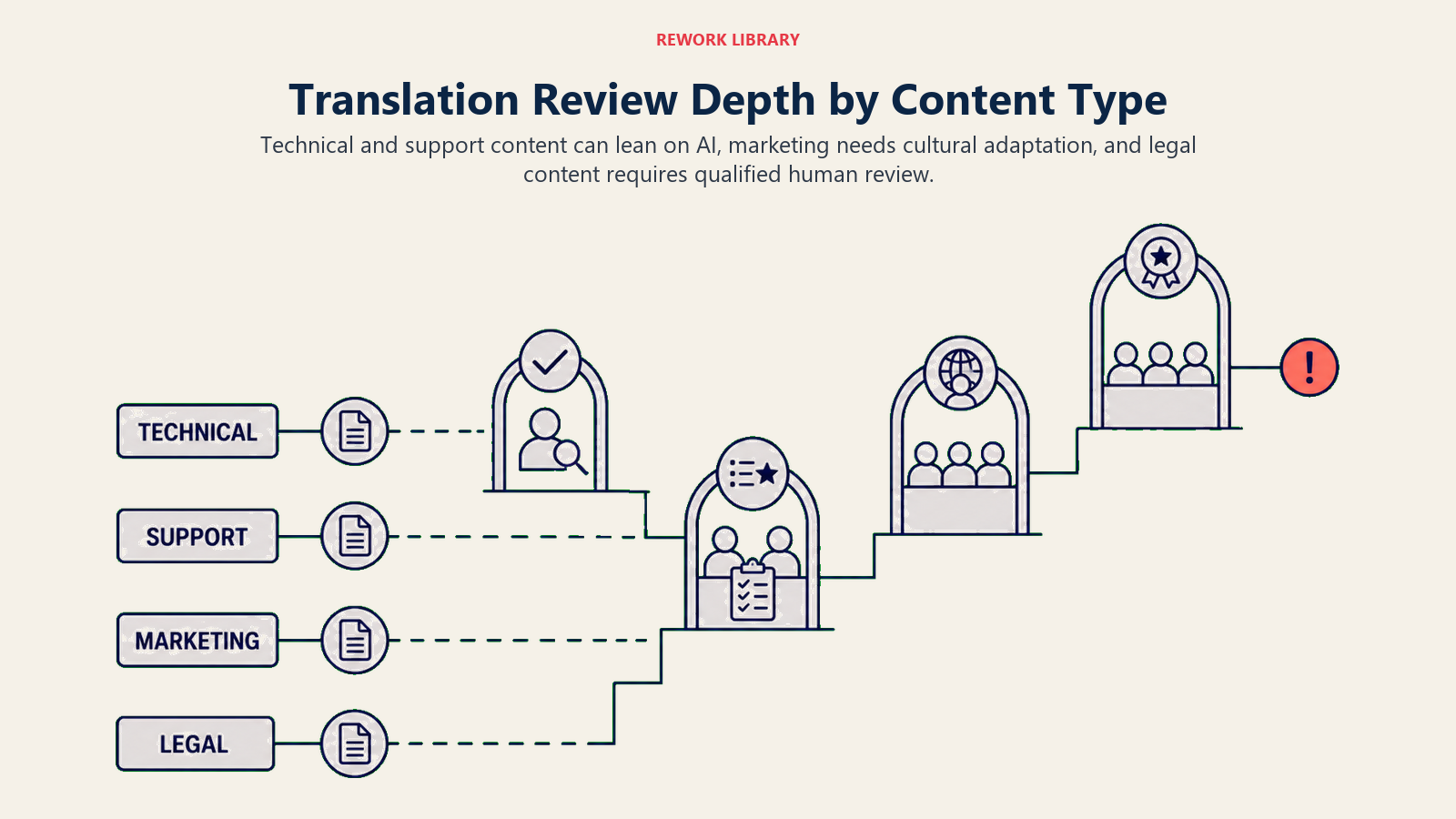
Marketing content requires human review. Brand positioning, value propositions, and calls-to-action need cultural adaptation. Use AI for the first draft, but budget for native speakers to make it resonate locally. Priority should go to homepage, product pages, and campaign landing pages.
Technical documentation shows strong AI performance. API documentation, integration guides, and technical specifications translate cleanly because they prioritize clarity and use consistent terminology. Human review can focus on high-traffic pages while AI handles the long tail. Organizations with extensive technical documentation benefit from dedicated AI documentation tools integrated with translation workflows.
Support content works well with a hybrid approach. Translate your entire knowledge base with AI, then prioritize human review based on page views. The top 20% of articles likely get 80% of traffic. Review those thoroughly while accepting good-enough AI translations for rarely viewed content.
Legal and compliance documents need human expertise. Privacy policies, terms of service, and regulatory documentation carry legal weight. Mistranslations can create liability. Use qualified legal translators familiar with local regulations.
Quality Assurance: Ensuring Translations Maintain Meaning and Brand Voice
Build quality checks into your workflow:
Back-translation testing: For critical content, translate it back to your source language and compare. This catches meaning changes and awkward phrasings that native speakers might miss.
Native speaker review checklist:
- Does it sound natural to a native speaker?
- Is the meaning accurate?
- Does it match brand voice guidelines?
- Are cultural references appropriate?
- Do calls-to-action make sense?
Consistency checks: Use translation memory tools to ensure the same phrases translate consistently across your content. Inconsistent terminology confuses users and looks unprofessional.
A/B testing: For marketing content, test AI translations against human translations on actual users. You might find AI performs better than expected for some content types, letting you allocate budget more effectively.
The key is knowing where quality matters most and investing human expertise there. Your pricing page deserves more attention than your 404 error message.
AI translation isn't about choosing between quality and cost anymore. It's about building workflows that deliver both, enabling global expansion that traditional economics made impossible. Companies that master this hybrid approach can compete globally without enterprise budgets. Before scaling translation efforts, establish clear AI productivity ROI metrics to measure cost savings and quality improvements across languages.