AI Sentiment Analysis Tools
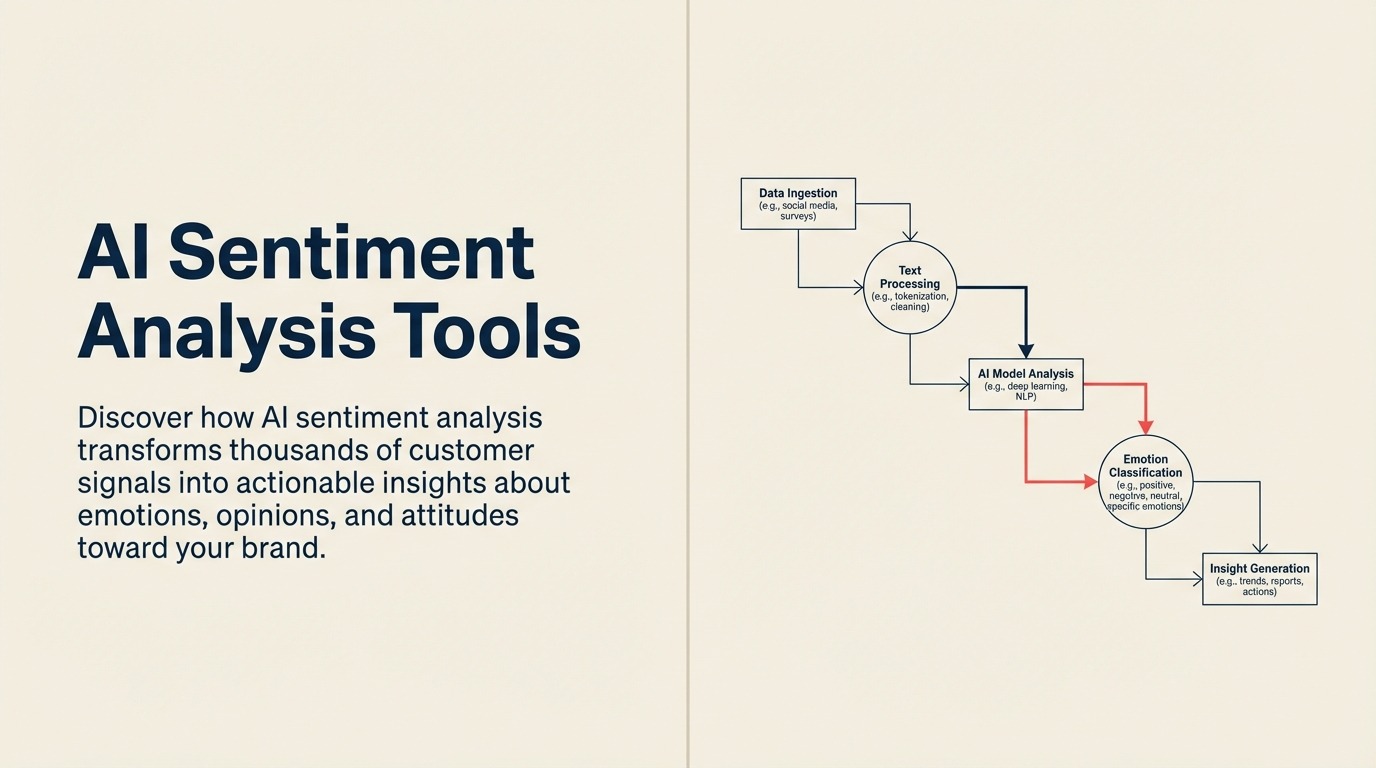
Turn this article into takeaways for your work.


Each assistant summarizes the article only for you and suggests best practices for your work.
Your company received 4,200 customer reviews last quarter. Customer success logged 8,100 support tickets. Social media monitoring captured 15,300 brand mentions. Marketing collected 2,800 survey responses. That's over 30,000 individual customer signals, and someone needs to understand what they collectively mean.
Good luck reading all of that. Even if you could, you'd be looking at patterns your brain simply isn't wired to process across that volume. Are customers getting more or less satisfied? Which specific issues matter most? How does sentiment vary by customer segment or product area?
AI sentiment analysis doesn't just save time reading feedback. It reveals patterns that are invisible when you're looking at individual comments one at a time, representing a fundamental capability among AI productivity tools that transform how organizations understand their customers.
The Feedback Overload Problem
Customer feedback is valuable in theory, useless in practice if you can't process it at scale.
Reading individual reviews gives you anecdotes. "This customer loves our onboarding." "That customer is frustrated with pricing." "Someone wants a mobile app." Those are data points, not insights.
Insights come from patterns. "Customer satisfaction with onboarding improved 12% after we released the guided setup wizard." "Pricing concerns increased 35% among small business customers but decreased 8% among enterprise clients." "Mobile app requests appear in 18% of feedback from field sales users but only 3% from office-based teams."
You can't identify those patterns by reading feedback sequentially. The human brain loses track after a few dozen examples. AI processes thousands of examples and identifies statistically significant patterns.
What is AI Sentiment Analysis
At its core, sentiment analysis uses natural language processing to understand the emotional tone and opinion expressed in text.
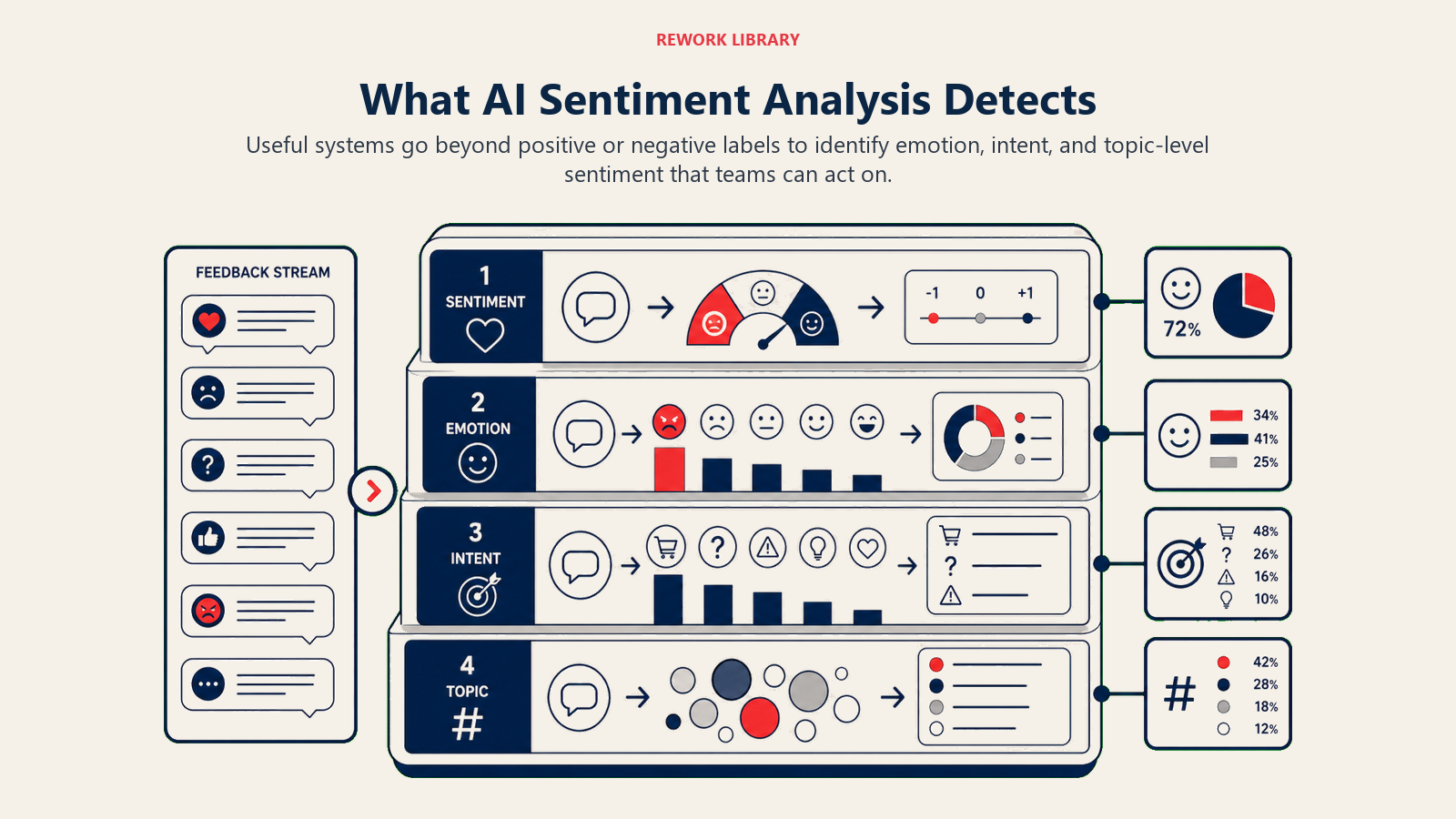
Positive/Negative/Neutral Classification: The most basic level assigns each piece of text an overall sentiment score. A review saying "This software is terrible: constant crashes and zero support response" is clearly negative. "The features are solid, but the UI could be more intuitive" is mixed or neutral. "Best platform we've ever used, and support is incredibly responsive" is positive.
But most business value comes from going beyond simple classification.
Emotion Categorization: Advanced systems identify specific emotions (frustration, delight, confusion, anger, satisfaction). "This is confusing" and "This is broken" are both negative, but they indicate different problems requiring different solutions.
Intent Detection: Sentiment analysis can identify what customers are trying to do. Are they requesting features? Reporting bugs? Asking questions? Expressing satisfaction? Different intents require different responses.
Topic-Based Sentiment: The most valuable analysis connects sentiment to specific topics. Overall sentiment might be neutral, but when you analyze by topic, you discover that customers love your features but hate your pricing structure. That's actionable intelligence.
Sentiment Analysis Applications
Different business functions use sentiment analysis for different purposes.
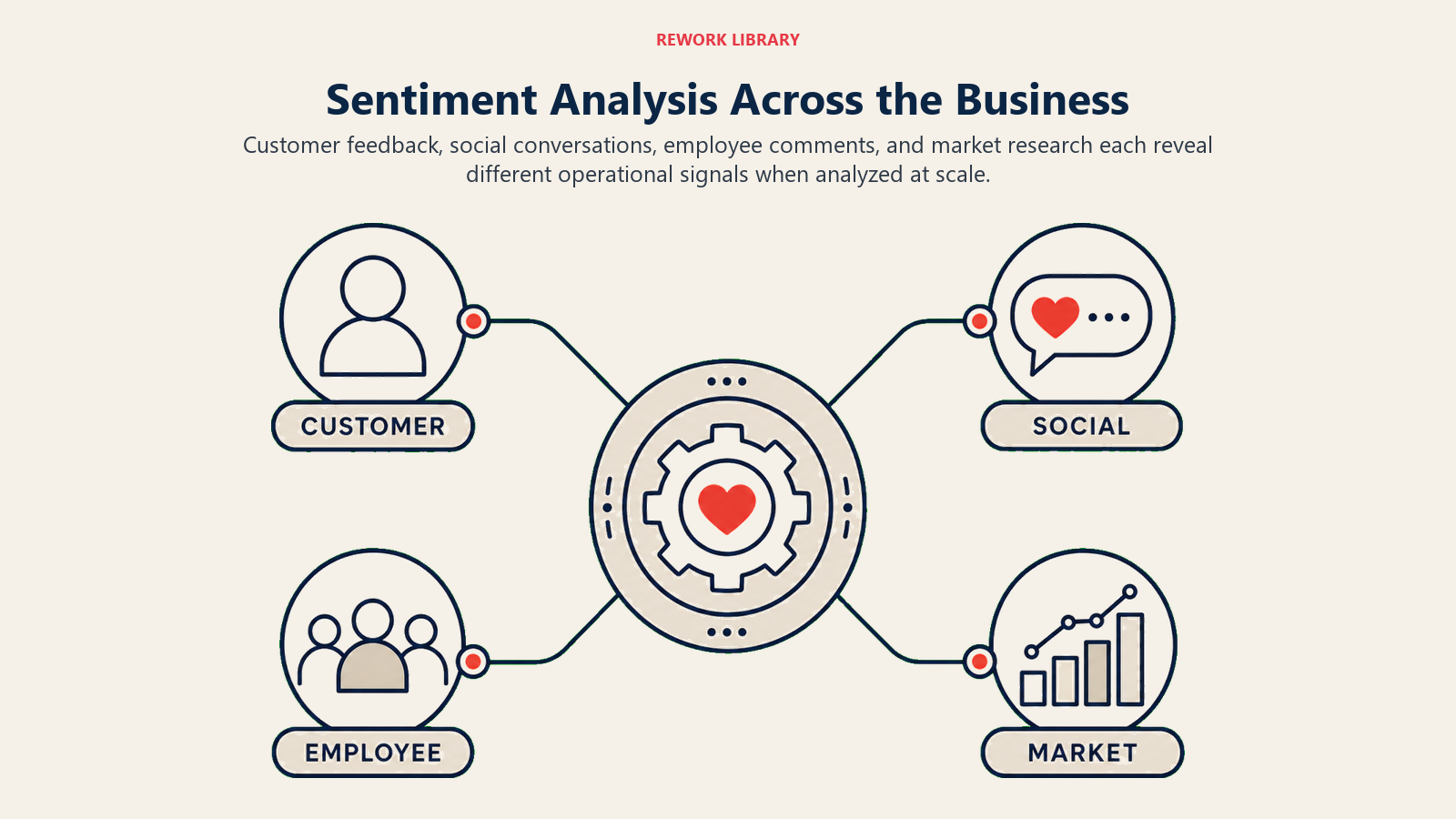
Customer Feedback Analysis: Reviews, surveys, and NPS responses contain rich feedback, but volume makes manual analysis impractical. AI processes all feedback, identifies common themes, tracks sentiment trends over time, and highlights issues requiring attention.
One SaaS company processes 500+ customer reviews monthly across G2, Capterra, and their own feedback system. AI categorizes reviews by topic (features, support, pricing, usability), measures sentiment for each category, and tracks trends month-over-month. Product teams receive reports showing which features drive positive sentiment and which areas generate frustration. This intelligence directly supports AI for market research efforts to understand competitive positioning.
Social Media Monitoring: Brand mentions across Twitter, LinkedIn, Reddit, and other platforms provide unfiltered customer perspective. AI monitoring identifies sentiment trends, highlights influential voices, detects emerging issues, and measures campaign impact.
When a major software company launched a controversial pricing change, sentiment analysis caught the negative reaction within hours. They saw specific concerns (mid-market customers felt priced out, grandfathered pricing was unclear), measured the scale of negative response, and identified key influencers amplifying concerns. That intelligence enabled a rapid response addressing specific issues rather than generic messaging.
Employee Feedback Analysis: Engagement surveys, exit interviews, and anonymous feedback channels generate volumes of text data. AI identifies patterns in employee satisfaction, highlights retention risks, and surfaces cultural issues that might not reach leadership through normal channels.
Market Research: Understanding how customers perceive competitors helps inform positioning and product strategy. AI can process competitor reviews, analyze sentiment differences between your brand and competitors, and identify competitive strengths and weaknesses as perceived by actual users.
Leading Sentiment Analysis Platforms
The sentiment analysis landscape includes specialized platforms and general-purpose tools with sentiment capabilities.
Social Listening Tools: Brandwatch, Sprinklr, and Hootsuite Insights specialize in social media monitoring. They track brand mentions across platforms, measure sentiment in real-time, identify trending topics, and highlight influencer conversations. Brandwatch's AI processes billions of social conversations monthly, providing sentiment analysis at massive scale.
Customer Feedback Platforms: Qualtrics and Medallia focus on structured feedback (surveys, NPS, review management). Their AI analyzes open-ended survey responses, identifies themes in customer comments, and correlates sentiment with structured data like NPS scores or customer segments. Qualtrics' Text iQ can process survey responses in multiple languages and provide theme-based sentiment analysis.
Specialized Sentiment Tools: Platforms like MonkeyLearn and Lexalytics provide sentiment analysis APIs and customizable models. They're designed for organizations that want to integrate sentiment analysis into custom applications or workflows. You can train models on your specific terminology and use cases, enabling deep AI integration with existing systems.
General AI for Sentiment Analysis: Large language models like GPT-4 and Claude have strong sentiment analysis capabilities. You can feed them customer reviews, support tickets, or survey responses and request structured sentiment analysis. The flexibility enables custom analysis workflows without specialized platforms.
Understanding Sentiment Metrics
Raw sentiment scores matter less than how you interpret and act on them.
Overall Sentiment Scores: Most platforms provide aggregate sentiment metrics (percentage positive, negative, and neutral). But averages hide important nuances. 60% positive sentiment might sound good, but if it was 75% last month, you've got a problem.
Emotion Breakdowns: Understanding the specific emotions in feedback provides more actionable insight than positive/negative classification. Are negative reviews expressing frustration (usability issues), anger (broken functionality), or disappointment (unmet expectations)? Each requires different responses.
Sentiment Trends Over Time: The direction matters more than the absolute value. Is sentiment improving or declining? Did a recent product release impact satisfaction? How did that marketing campaign affect brand perception?
Topic-Based Sentiment: Break down sentiment by specific topics or features. You might have 70% positive sentiment overall, but only 40% positive sentiment about pricing and 85% positive sentiment about features. That tells you where to focus improvement efforts.
Segment-Based Sentiment: Different customer segments often have different sentiment profiles. Enterprise customers might love your comprehensive feature set while small business customers feel overwhelmed. Geographic regions might perceive your brand differently. Segment analysis reveals these variations.
The Sentiment Analysis Workflow
Effective sentiment analysis requires structured processes, not just tools.
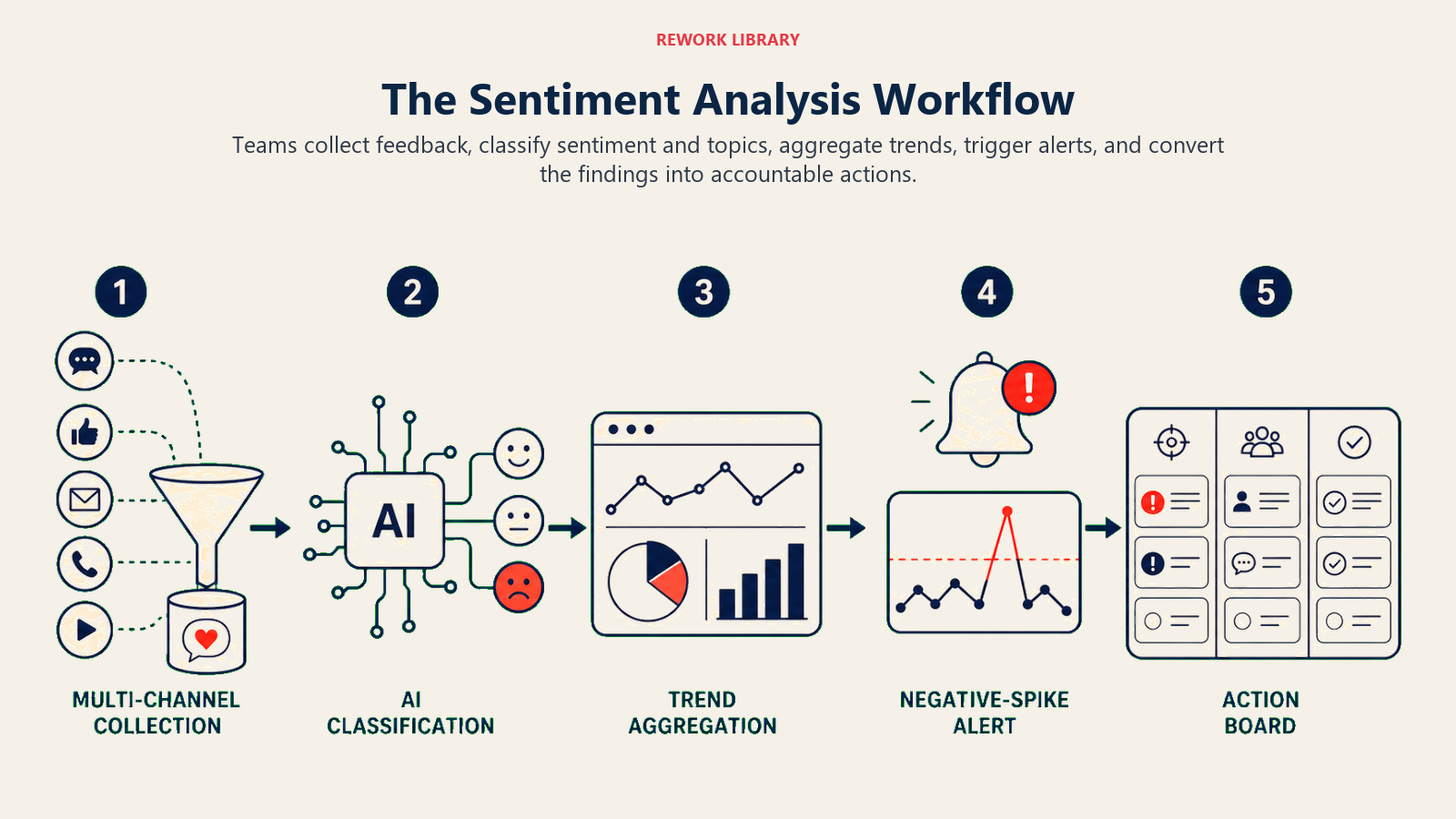
Data Collection from Sources: Aggregate feedback from all relevant channels (review sites, social media, support tickets, surveys, sales calls, chat transcripts). Comprehensive sentiment analysis requires comprehensive data.
AI Sentiment Processing: Feed collected data through sentiment analysis algorithms. The system categorizes sentiment, identifies emotions, extracts topics, and structures results for analysis.
Aggregation and Trending: Combine sentiment data across sources and time periods. Calculate aggregate scores, identify trends, compare segments, and highlight changes.
Alert Triggers for Negative Sentiment: Configure alerts for significant negative sentiment spikes or critical issues. When sentiment around a specific feature drops 20% in a week, someone needs to investigate immediately.
Action Planning: Translate sentiment insights into actions. Negative pricing sentiment might trigger pricing review. Feature requests appearing in 25% of feedback might prioritize development. Product complaints from a specific customer segment might prompt targeted outreach.
One customer success team built a workflow where support tickets are analyzed for sentiment in real-time. Tickets with strong negative sentiment or frustration are automatically escalated to senior support. Recurring topics with negative sentiment trigger product team reviews. Positive sentiment in tickets prompts requests for reviews or testimonials. This exemplifies how AI workflow automation can transform reactive processes into proactive interventions.
Business Actions from Sentiment Insights
The value of sentiment analysis comes from what you do with the insights.
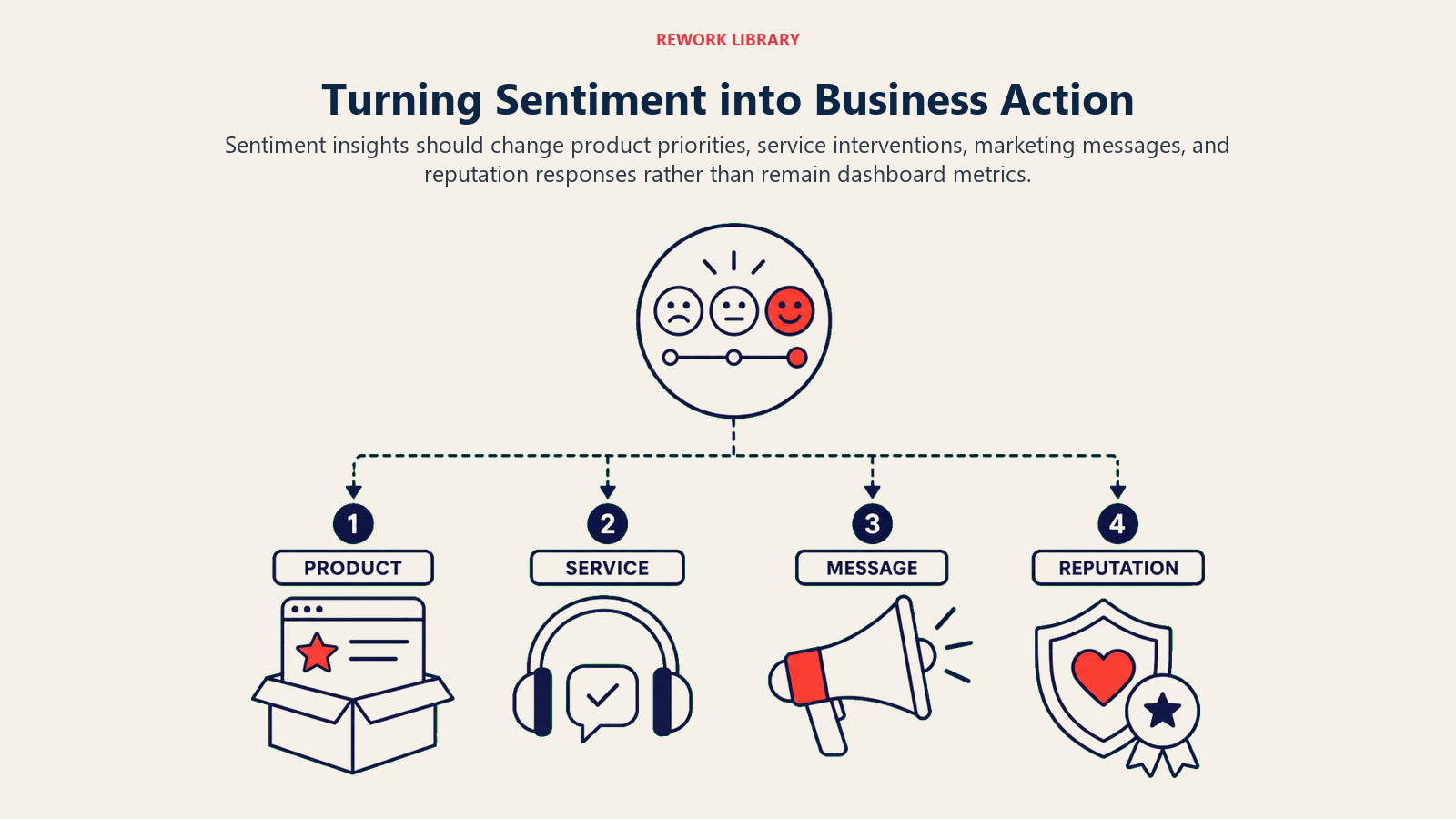
Product Improvements: Sentiment analysis identifies which features delight customers and which cause frustration. Product roadmaps informed by actual customer sentiment create better product-market fit than roadmaps based on internal assumptions.
Customer Service Interventions: Real-time sentiment analysis enables proactive support. When a customer expresses strong frustration in a support interaction, you can escalate immediately rather than letting the situation deteriorate.
Marketing Message Adjustment: Understanding how customers perceive your brand and value proposition helps refine messaging. If sentiment analysis reveals customers primarily value ease-of-use but your marketing emphasizes features, you're misaligned with customer perception.
Brand Reputation Management: Sentiment monitoring provides early warning of reputation issues. A surge in negative sentiment across social media or review sites signals a problem requiring rapid response.
One e-commerce company uses sentiment analysis to inform product listings and marketing. They analyze review sentiment by product category, identify which product attributes drive positive sentiment (material quality, fit accuracy, shipping speed), and adjust product descriptions and imagery to emphasize those attributes. Products with consistently negative sentiment about specific aspects trigger product improvement or discontinuation decisions.
Accuracy Considerations and Limitations
Sentiment analysis is powerful but not perfect. Understanding limitations helps you use it effectively.
Sarcasm and Irony: "Oh great, another outage. This platform is just amazing." That's sarcasm expressing frustration, but simple sentiment analysis might classify it as positive because of the word "amazing." Advanced models handle this better, but it remains challenging.
Context Dependency: "This is sick" means something different in feedback from teenagers versus executives. Domain-specific language, industry jargon, and cultural variations affect sentiment interpretation.
Mixed Sentiment: "The features are incredible, but it's way too expensive" contains both positive and negative sentiment. Overall classification as neutral misses the nuance that the product is valued but has a pricing problem.
Language and Translation: Sentiment analysis accuracy varies by language. English models are most mature. Other languages have improving accuracy but may miss nuances. Translation before analysis can introduce errors.
The solution isn't to avoid sentiment analysis due to these limitations. It's to use it appropriately: as a tool for identifying patterns and trends at scale, not as absolute truth for individual feedback items. Combine automated sentiment analysis with human review of flagged issues.
Making Sentiment Analysis Operational
Implementation determines whether sentiment analysis provides value or just generates more reports nobody reads.
Start by identifying specific business questions sentiment analysis should answer. "Are customers satisfied with our new onboarding flow?" "How does perception of our brand compare to competitors?" "Which feature requests appear most frequently?" Specific questions drive focused analysis.
Integrate sentiment analysis into existing workflows rather than creating separate processes. Support teams should see sentiment in their ticketing systems. Product managers should see sentiment trends in their dashboards. Executives should see sentiment in their weekly metrics.
Establish clear ownership for acting on sentiment insights. If nobody is responsible for responding to negative sentiment trends, analysis becomes academic.
Train teams to interpret sentiment data appropriately. Raw sentiment scores require context. Trends matter more than absolute values. Qualitative review complements quantitative analysis.
The goal isn't perfect sentiment measurement. It's transforming thousands of customer signals into actionable intelligence that improves products, services, and customer experience. AI handles the scale problem. Your job is translating insights into actions.
Those 30,000 customer signals aren't noise to ignore or an impossible analysis challenge. With AI sentiment analysis, they're a continuous stream of intelligence telling you exactly how customers perceive your business and what they need you to improve.
Related Resources:

On this page
- The Feedback Overload Problem
- What is AI Sentiment Analysis
- Sentiment Analysis Applications
- Leading Sentiment Analysis Platforms
- Understanding Sentiment Metrics
- The Sentiment Analysis Workflow
- Business Actions from Sentiment Insights
- Accuracy Considerations and Limitations
- Making Sentiment Analysis Operational