AI Content Generation Tools: Scale Your Content Operations with Intelligent Automation
Turn this article into takeaways for your work.


Each assistant summarizes the article only for you and suggests best practices for your work.
Your content calendar has 50 items next month. Your team can realistically produce 15. This gap is familiar to every content leader. The demand for content grows faster than your ability to create it.
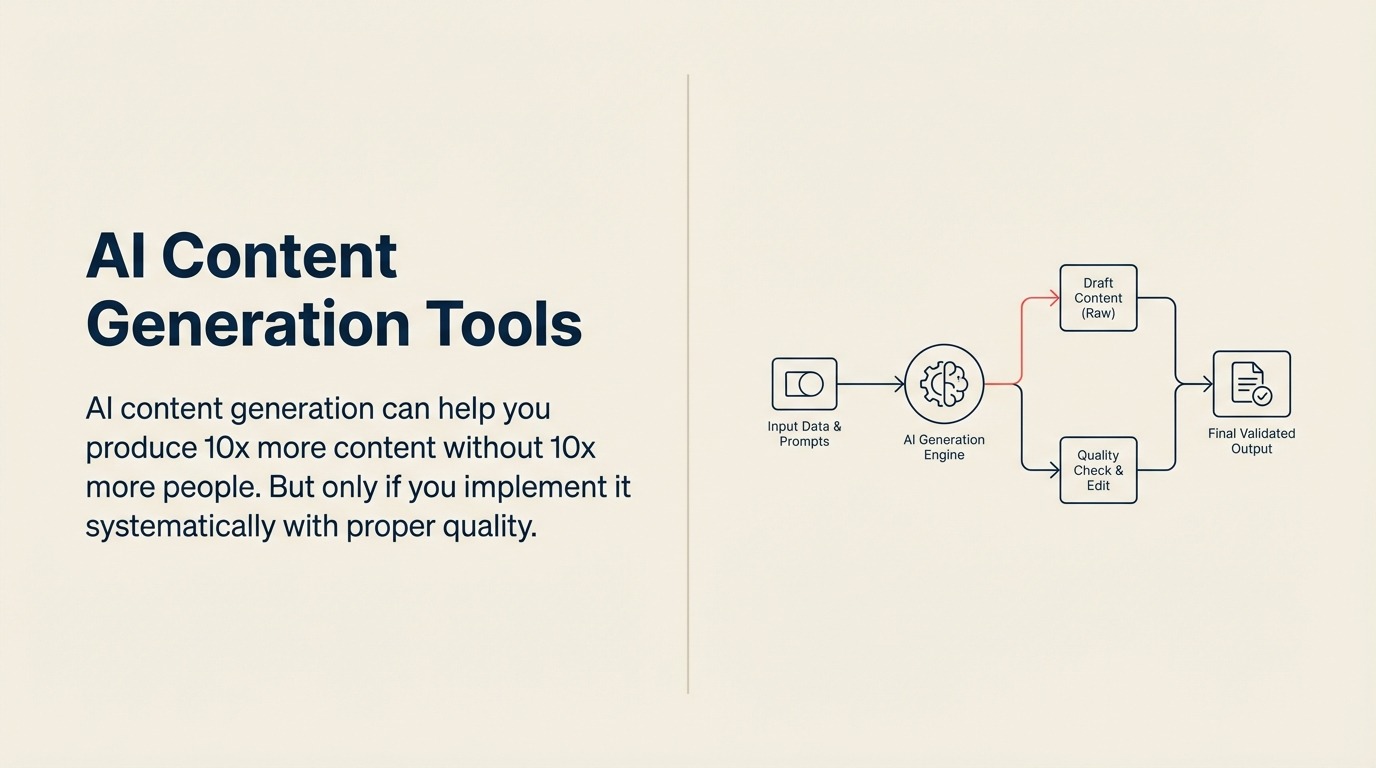
AI content generation tools promise to close that gap. But they're not autopilot systems that churn out perfect content while you sleep. They're sophisticated first-draft machines that need proper workflow design, quality control, and realistic expectations. This guide focuses on scaling content operations. For broader context on AI writing capabilities, see AI writing assistants overview.
How AI Content Generation Actually Works
Understanding the basics helps set realistic expectations and use these tools effectively.
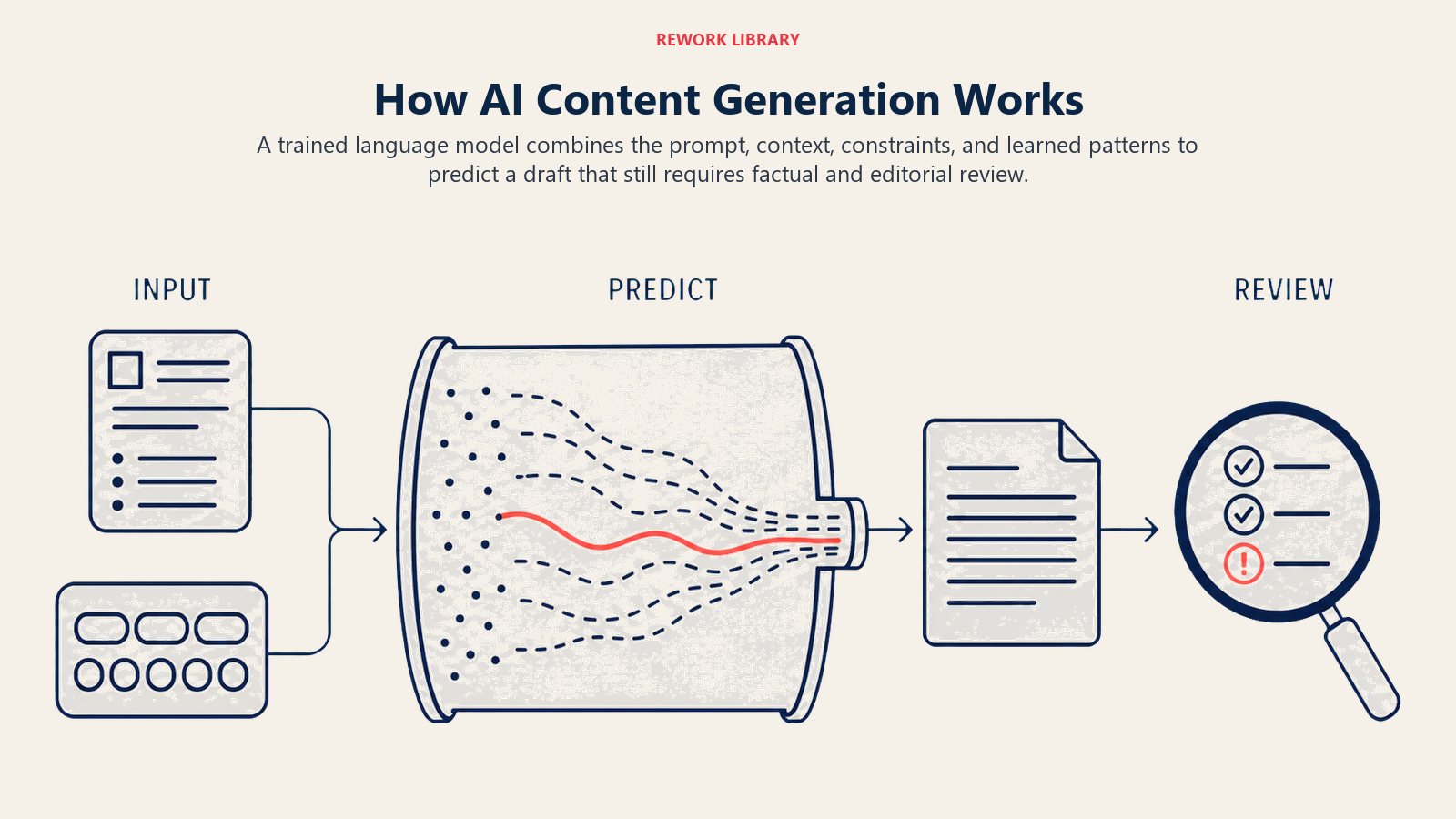
Large language models power most AI content generation. These aren't simple templates or mad-libs. They're systems trained on billions of text examples to predict what text should logically come next. They've learned patterns of language, structure, and content from massive datasets.
This means they're good at producing text that looks right and follows common patterns. It also means they don't actually understand what they're writing. They're pattern-matching, not reasoning.
Training vs generation is an important distinction. Training happened before you ever used the tool (companies like OpenAI and Anthropic trained models on huge text corpora). Generation is what happens when you use the tool. You're not training it (usually), you're prompting it to generate text based on what it already learned.
Some enterprise tools let you fine-tune models on your specific content for better brand voice matching. This is actual additional training, but it's expensive and complex. Most companies don't need it initially.
Prompt engineering fundamentals determine output quality. A vague prompt like "write a blog post about productivity" gets mediocre results. A specific prompt with context, structure requirements, tone guidelines, and examples gets much better output. Master these techniques with our guide on prompt engineering best practices.
Think of prompts as extremely detailed briefs. The more specific you are about what you want (including what you don't want), the better results you'll get.
The models don't improve based on your feedback within a single conversation. If you say "that's wrong," it doesn't learn for next time. It adjusts for the current conversation only. This is why systematic prompt templates matter more than trying to train AI through corrections.
Content Types and Tools
Different content types need different approaches and tools.
Long-form content like blog posts, articles, and guides works well with AI generation for first drafts. The workflow is simple: outline the structure yourself (or with AI assistance), then have AI write each section based on your outline and examples.
Don't expect AI to research and write a comprehensive guide from scratch. But give it a detailed outline, key points to cover, and examples of your writing style, and it'll produce a solid first draft that needs editing, not complete rewriting.
Tools like GPT-4, Claude, and specialized platforms like Jasper handle long-form well. The key is breaking it into sections rather than asking for a full 2,000-word article at once.
Short-form content for social posts, ads, and emails is where AI really shines. You need 50 variations of the same message for different audience segments? AI generates them in minutes.
The catch: AI short-form often sounds generic without specific brand voice examples. Create a library of your best social posts and ad copy to include in prompts as style references.
Copy.ai and similar tools specialize in short-form marketing copy with templates optimized for different platforms and objectives. They're faster to use than general-purpose models for high-volume needs.
Product content like descriptions, specifications, and feature explanations benefits from AI's ability to write consistent descriptions at scale. If you have 500 products that need unique descriptions, AI can generate them based on specifications and examples.
E-commerce companies use this heavily. But verify accuracy. AI will confidently describe features that don't exist if it misinterprets input data.
Visual content is increasingly AI-assisted too. Tools like Midjourney and DALL-E generate images from text descriptions. Canva's AI features help with design layouts. These complement text generation for complete content creation workflows.
The visual tools are less mature than text generation. Expect to spend more time iterating on prompts and editing outputs, but they're still faster than creating everything from scratch.
Quality Spectrum: What AI Can Actually Deliver
AI content quality varies dramatically based on content type and how you use the tools.
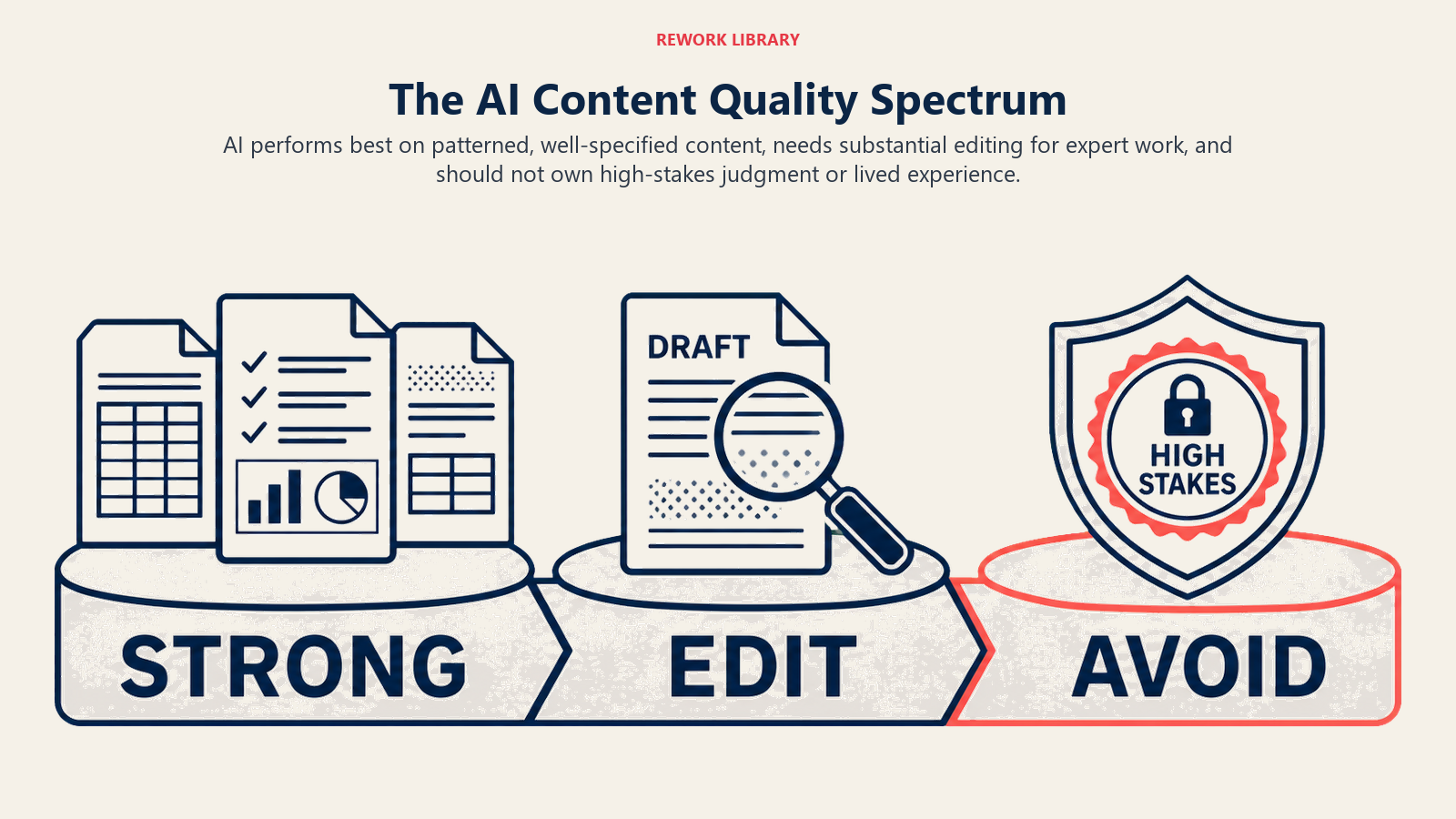
High-quality outputs are achievable for:
- Standard blog posts with clear structure and common topics
- Product descriptions based on specifications
- Email variations on proven templates
- Social media posts with brand voice examples
- Documentation sections following established patterns
These all have predictable patterns AI has seen many times in training. With good prompts, you'll get 80-90% quality that needs polish, not fundamental restructuring.
Medium-quality outputs that need significant editing for:
- Thought leadership content requiring original insights
- Technical content with niche expertise
- Content requiring specific data or research
- Highly creative or unconventional formats
- Content needing precise tone and subtle messaging
AI gives you structure and ideas, but you'll rewrite substantially. Still faster than starting from a blank page.
Poor-quality outputs that aren't worth the editing time for:
- Content requiring genuine strategic thinking
- Pieces needing specific personal experiences
- Technical accuracy-critical content (legal, medical, financial)
- Brand-defining content like mission statements
- Crisis communications or sensitive topics
For these, AI might help with research or outlining, but don't use it for actual draft writing.
The Human-AI Workflow
Successful content operations with AI follow systematic workflows, not ad-hoc generation.
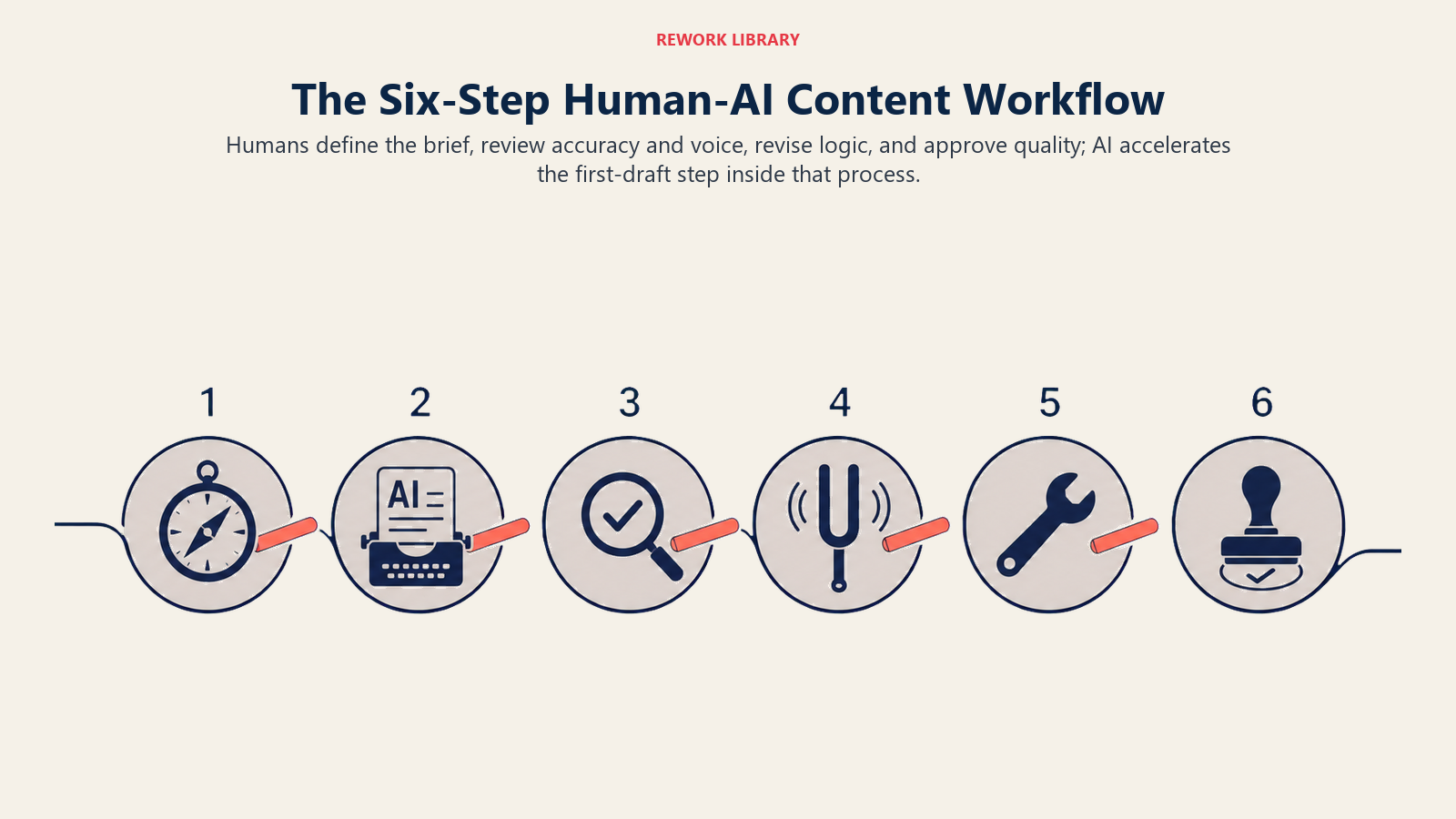
AI for first drafts means treating AI output as the starting point, not the finish line. Your workflow should be:
- Create detailed brief with examples
- Generate first draft with AI
- Human editor reviews for accuracy, brand voice, and logic
- Revise and refine
- Final quality check
- Publish
Don't skip steps 3-5. AI saves time in step 2, but steps 3-5 still need humans.
Human editing and refinement should focus on what AI can't do: strategic framing, factual accuracy, brand voice authenticity, and logical coherence of arguments. For systematic approaches to quality control, explore AI copy editing and proofreading strategies.
Assign editing based on stakes. Junior editors can handle social posts. Senior editors or subject matter experts should review thought leadership and technical content.
Brand voice training improves over time. Start by collecting your best content examples (pieces that perfectly capture your brand voice). Include these in prompts or use them to fine-tune custom models.
Create a "voice guide" specifically for AI prompts. Not your general brand guidelines, but specific examples of phrasing, tone, and style that AI should emulate.
Track which prompts and examples produce on-brand outputs. Refine your prompt library continuously based on results.
Quality assurance process needs defined standards and checkpoints. Create checklists for different content types:
For blog posts:
- Factual accuracy verified by subject matter expert
- Brand voice matches approved examples
- Structure follows content strategy
- SEO requirements met
- Links and CTAs appropriate
For social media:
- Tone appropriate for platform
- Claims factually accurate
- Brand voice consistent
- No reputation risks
Automated tools can check some items (spelling, basic SEO). Humans check the rest.
Content Strategy Integration
AI content generation works best when integrated into broader content strategy, not bolted on as an afterthought.
SEO optimization with AI combines keyword research (humans) with content creation (AI-assisted). Your SEO team identifies target keywords and search intent. AI generates content optimized for those keywords while maintaining readability.
But verify AI isn't keyword-stuffing or sacrificing quality for optimization. Google's algorithms increasingly penalize AI content that reads like it was written to game search rankings.
Multi-channel repurposing becomes much easier with AI. Write one long-form article, then use AI to create:
- Social media posts highlighting key points
- Email newsletter version with different framing
- LinkedIn article adaptation
- Short video scripts
- Infographic copy
The original article still needs human authorship for quality. AI handles the time-consuming adaptation work.
Personalization at scale lets you generate variations of content for different audience segments without 10x-ing production time.
One company creates case studies tailored to different industries by generating base content, then prompting AI to adapt it for healthcare, finance, manufacturing, etc. Same core story, language and examples relevant to each sector.
This was theoretically possible before AI, but prohibitively time-consuming. Now it's standard practice.
Measuring Content ROI
Track the right metrics to understand if AI content generation is actually working.
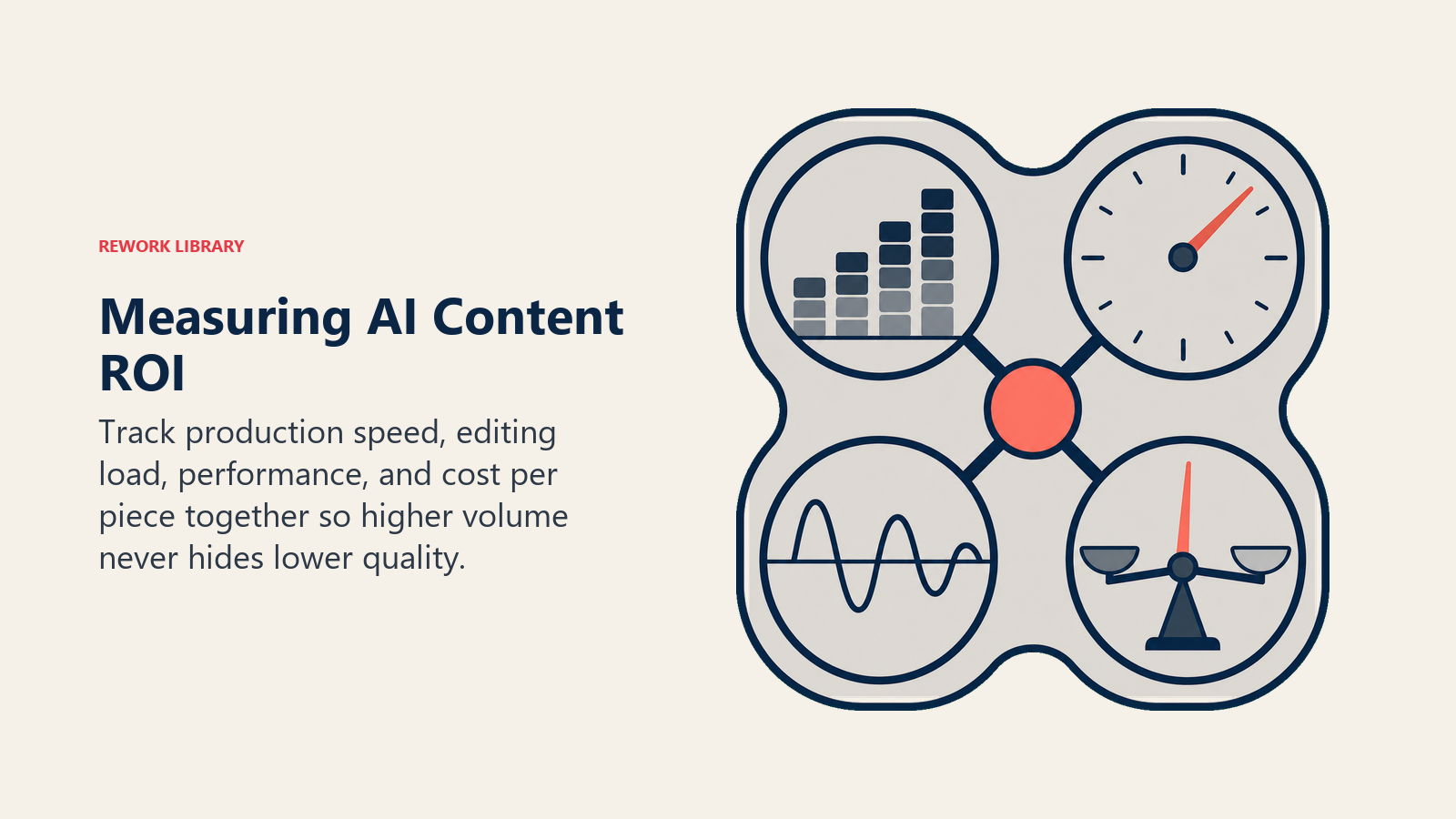
Production efficiency metrics:
- Content pieces per team member per month (before vs. after AI)
- Average time per piece by content type
- First draft to publish time
- Editing time as percentage of total time
A healthy pattern: production volume up 2-3x, editing time stays flat or grows slightly, total time per piece down 40-60%.
Content performance tracking:
- Engagement rates (AI vs. human content)
- Conversion metrics
- SEO performance
- Audience feedback and comments
Watch for AI content underperforming human content. If you see significant gaps, your quality control needs work. Integrate these metrics into your broader AI productivity ROI metrics framework to demonstrate business value.
Cost per piece analysis should factor in tool costs, team time, and opportunity cost of not producing content.
Example calculation:
- Before AI: 10 blog posts/month, 40 hours team time = 4 hours per post
- After AI: 25 blog posts/month, 60 hours team time = 2.4 hours per post
- AI tool cost: $500/month
- Effective cost per piece dropped from $160 (4 hours at $40/hour) to $120 (2.4 hours + $20 tool cost)
Plus you're getting 2.5x more content. The ROI is clear if quality holds.
Governance and Guidelines
Scaling content with AI requires clear governance to maintain quality standards.
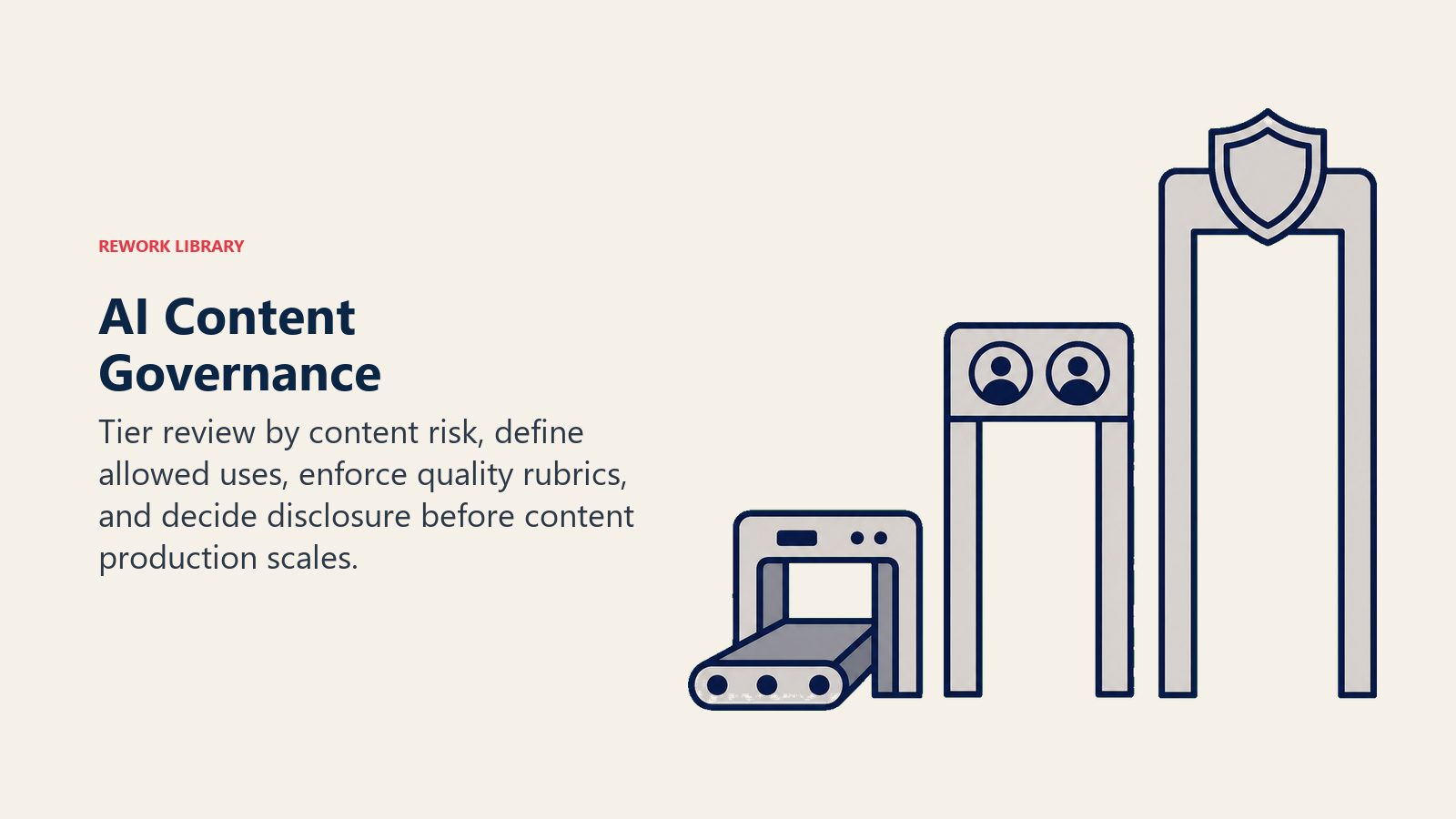
Content approval workflows need updating for AI-generated content. You can't review every piece individually at scale, but you can create tiered review:
- Tier 1 (automated): AI-generated social posts under 280 characters auto-publish after passing automated checks
- Tier 2 (peer review): Blog posts and articles reviewed by another content team member
- Tier 3 (senior review): Thought leadership, executive content, anything customer-facing and high-stakes
Usage policies should specify when AI can and can't be used. Example policy:
"Use AI for first drafts of blog posts, social content, product descriptions, and email templates. Do not use AI for legal content, crisis communications, executive bylines (without explicit review), or customer support responses to complex issues."
Quality standards must be explicit and enforced. "Good enough" isn't a standard. Define what good looks like for each content type, with examples.
Create quality rubrics that reviewers use consistently. A blog post might be scored on: factual accuracy (pass/fail), brand voice (1-5), strategic value (1-5), technical quality (pass/fail).
Attribution and disclosure policies matter for transparency. Some companies disclose AI use, others don't. There's no consensus best practice yet, but you should have a policy.
Consider context: AI-assisted editing probably doesn't need disclosure. Fully AI-generated content representing expert opinion probably does.
Moving Forward with AI Content Generation
The companies scaling content successfully with AI share common patterns:
They treat AI as a team member who's really fast at first drafts but needs oversight. They invest in prompt engineering and quality control systems. They measure both efficiency and quality metrics. And they continuously refine their approach based on results.
Start with one high-volume, lower-stakes content type. Learn what works. Expand gradually to more use cases. Build quality control systems that scale. And maintain realistic expectations. AI helps you create more content with the same resources, but it doesn't eliminate the need for skilled content creators and editors.
For related capabilities, see AI Writing Assistants Overview for broader context, Prompt Engineering Best Practices for better outputs, AI Copy Editing and Proofreading for quality control, and AI Documentation Tools for technical content generation.