AI Predictive Analytics
Turn this article into takeaways for your work.


Each assistant summarizes the article only for you and suggests best practices for your work.
You're making decisions about next quarter based on what happened last quarter. You're allocating resources based on historical patterns. You're planning for the future using only backward-looking data.
This is the decision gap that every business faces.
AI predictive analytics transforms this equation by forecasting what's likely to happen next. Instead of just understanding past performance, you can anticipate future outcomes, identify emerging problems before they fully develop, and make proactive decisions based on data-driven predictions.
What is AI Predictive Analytics
Predictive analytics uses machine learning to forecast future outcomes based on historical patterns.
Machine learning for forecasting trains algorithms on historical data to identify patterns that predict future events. These models learn what factors correlate with outcomes you care about, then apply those patterns to current situations. This represents a fundamental shift from traditional productivity software that simply processes data to AI that learns from it.
Pattern recognition in historical data finds relationships that aren't immediately obvious to humans. The AI can identify that customers who exhibit certain behaviors in their first 30 days are much more likely to churn, or that deals with specific characteristics have higher close rates.
Probability-based predictions provide forecasts with likelihood estimates rather than absolute certainty. Predictive models don't claim to know the future, they calculate the probability of different outcomes based on available data.
Confidence scoring indicates how reliable each prediction is. When the model has seen many similar situations before, confidence is high. When it's extrapolating to novel circumstances, confidence scores reflect that uncertainty.
Common Business Predictions
Predictive analytics addresses different business challenges across functions.
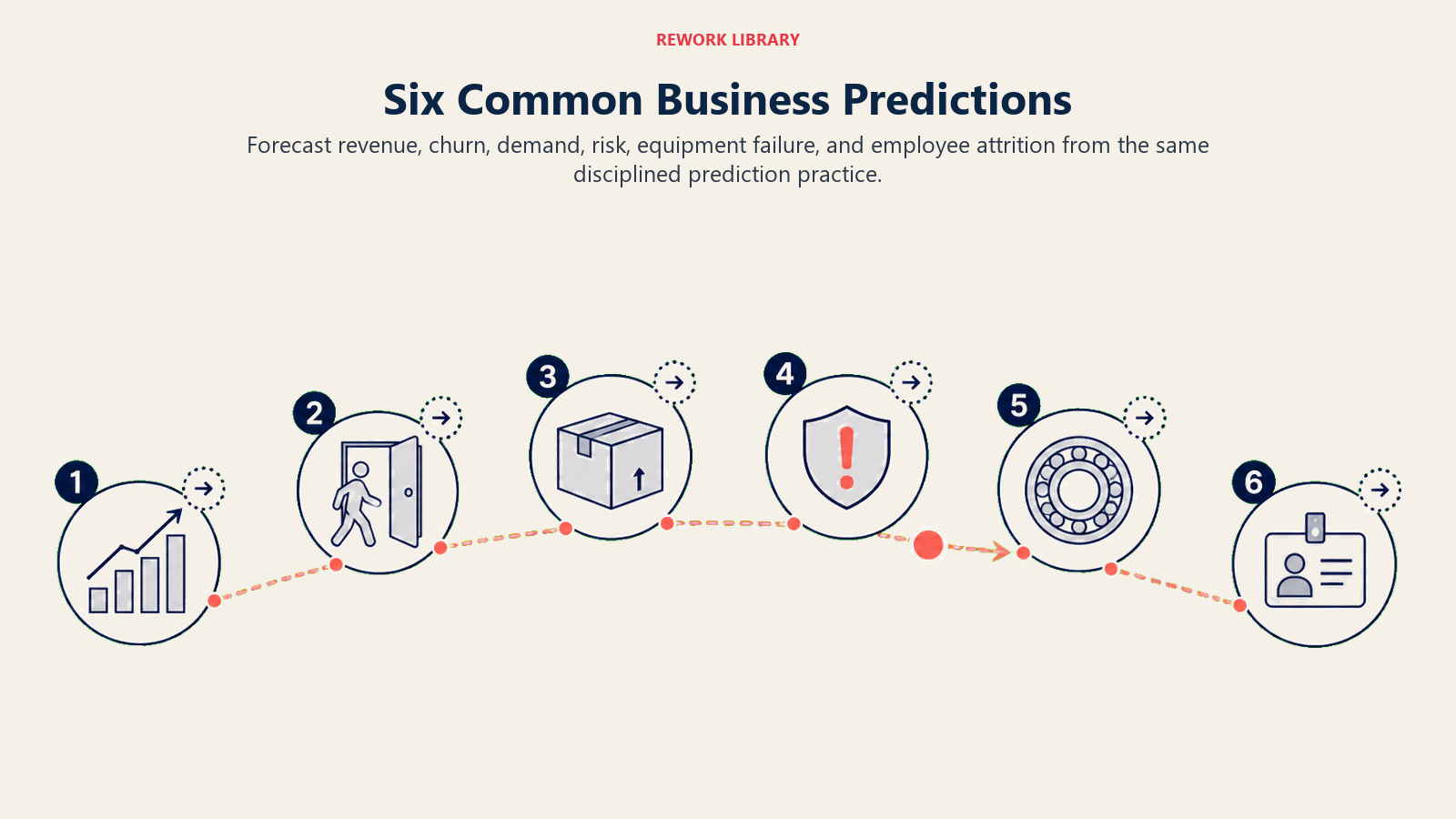
Revenue and Sales Forecasting
Sales predictions help with resource planning and goal setting:
- Forecast quarterly revenue based on current pipeline and historical close patterns
- Predict which opportunities will close and when
- Estimate deal sizes based on customer characteristics and engagement patterns
- Project seasonal revenue variations for better capacity planning
Customer Churn Prediction
Understanding which customers are likely to leave enables proactive retention:
- Identify accounts showing early warning signs of churn
- Calculate churn risk scores for each customer
- Predict lifetime value based on usage patterns and engagement
- Forecast subscription renewals and cancellations
Demand Forecasting
Product and inventory planning requires accurate demand predictions:
- Predict product demand by region and time period
- Forecast seasonal variations in purchase patterns
- Anticipate the impact of promotions on demand
- Optimize inventory levels based on predicted need
Risk Assessment
Financial and operational risk predictions support better decision-making:
- Assess credit risk for new customers
- Predict payment delays and potential defaults
- Forecast fraud risk for transactions
- Estimate project risk based on characteristics and complexity
Equipment Failure Prediction
Maintenance planning improves when you can anticipate problems:
- Predict when equipment is likely to fail
- Identify maintenance needs before breakdowns occur
- Optimize maintenance schedules based on predicted wear
- Reduce unplanned downtime through proactive intervention
Employee Attrition
HR teams benefit from understanding retention risk:
- Identify employees at high risk of leaving
- Predict which roles will be hardest to fill
- Forecast hiring needs based on expected attrition
- Understand factors that correlate with retention
Leading Predictive Analytics Platforms
Different platforms serve varying levels of technical sophistication.
Enterprise tools like SAS and IBM Watson Analytics offer comprehensive predictive capabilities for large organizations with dedicated analytics teams. These platforms provide extensive features for model building, testing, and deployment but require significant expertise.
Cloud platforms including AWS SageMaker, Azure Machine Learning, and Google Vertex AI enable organizations to build custom predictive models using cloud infrastructure. These services provide the tools and computing power but require data science skills to use effectively.
Business-focused platforms like DataRobot and H2O.ai automate much of the model building process, making predictive analytics accessible to users without deep data science backgrounds. These tools guide users through prediction projects and handle technical complexity behind the scenes, democratizing capabilities that previously required specialized expertise. Understanding different types of AI productivity tools helps you recognize where predictive analytics fits in your overall AI strategy.
Domain-specific solutions focus on particular use cases like customer analytics, fraud detection, or supply chain optimization. These specialized platforms offer pre-built models and industry-specific features that reduce implementation time.
The Predictive Analytics Workflow
Building and deploying predictions follows a structured process.
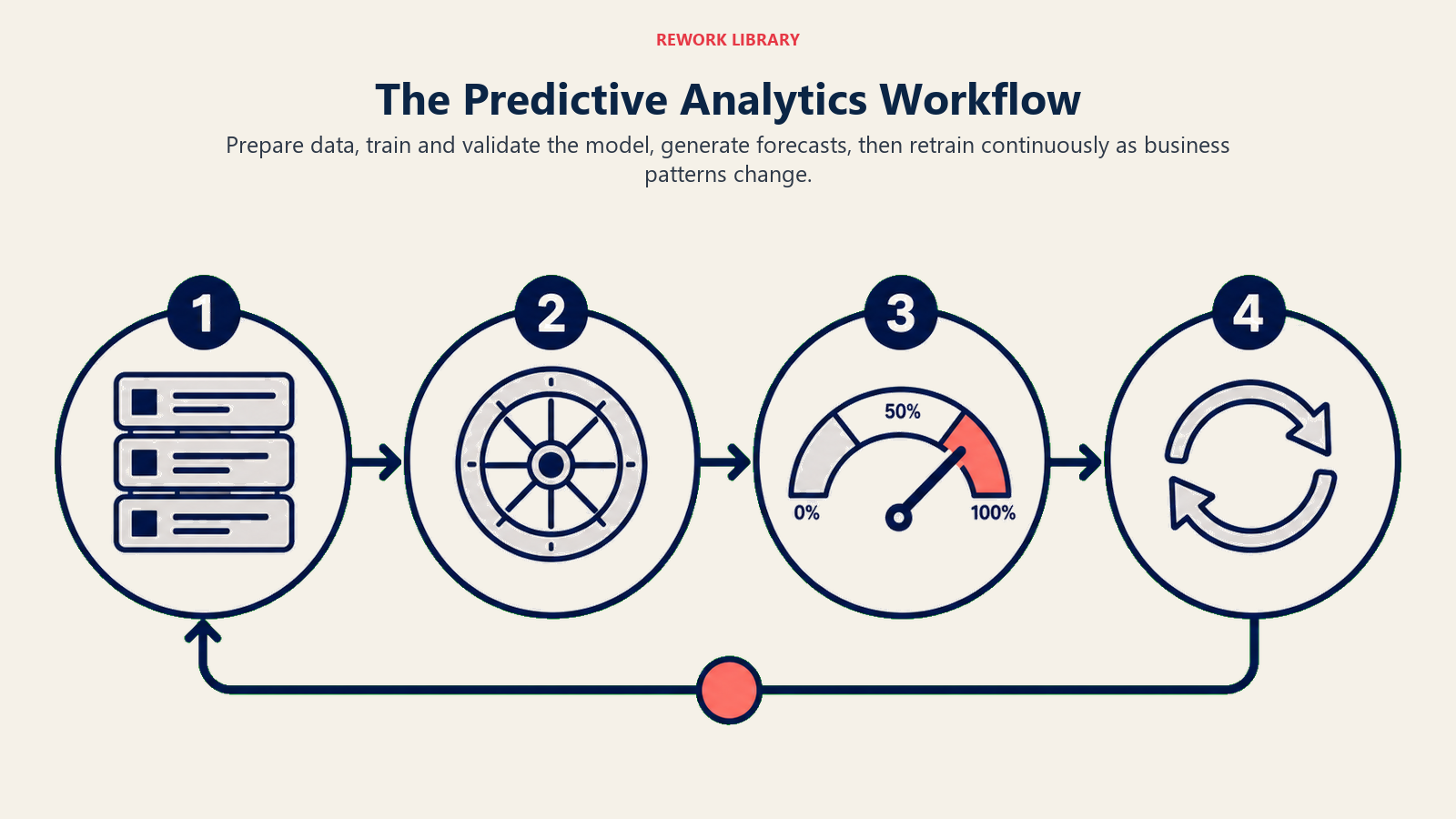
Data preparation and feature engineering creates the inputs that models learn from. You identify which data points might predict the outcome you care about and organize them for model training. This often requires combining data from multiple systems.
Model training and validation teaches the algorithm to recognize patterns. The platform uses historical data where you know both the inputs and actual outcomes to learn what predicts what. A portion of data is held back to test whether the model can accurately predict outcomes it hasn't seen before.
Prediction generation applies the trained model to current situations. Once the model demonstrates reliable prediction accuracy on test data, you can use it to forecast outcomes for ongoing business situations.
Continuous model updating keeps predictions accurate as conditions change. Business patterns evolve, so models need regular retraining with recent data to maintain performance.
Accuracy and Reliability
Understanding prediction quality is crucial for making good decisions.
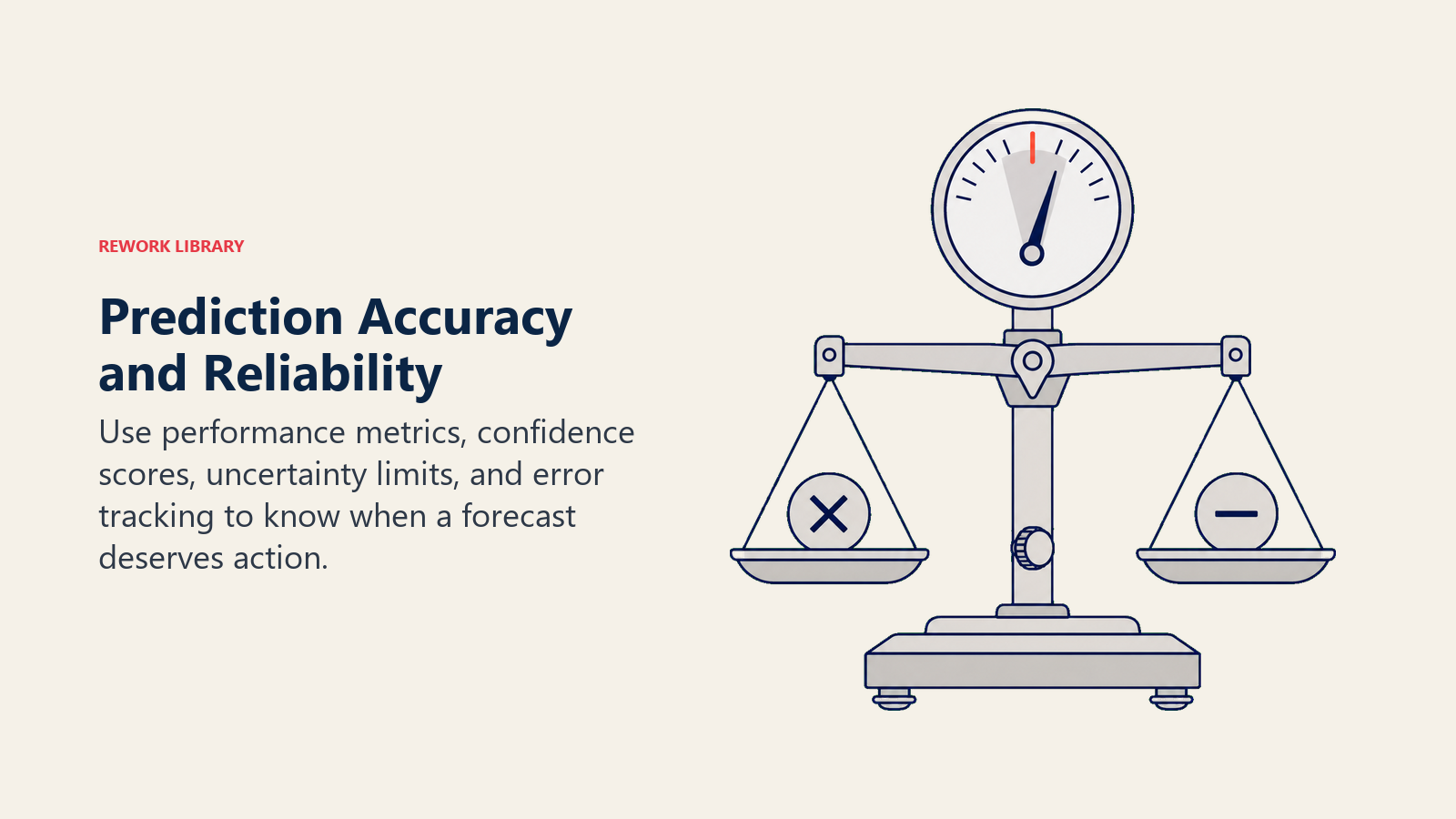
Model performance metrics quantify how well predictions match reality. Metrics like accuracy, precision, recall, and mean absolute error help you understand model reliability for different use cases.
If you're predicting customer churn, you care about both false positives (predicting churn that doesn't happen) and false negatives (missing actual churn). Different metrics help you understand each type of error.
Prediction confidence indicates how certain the model is about each forecast. High-confidence predictions deserve more weight in decision-making than low-confidence predictions.
Handling uncertainty means understanding what predictions can and can't tell you. Models work best when predicting situations similar to what they've seen before. They struggle with truly novel scenarios or rapidly changing conditions.
When predictions fail teaches you about model limitations. Track prediction errors to understand where models struggle and what additional data or different approaches might improve accuracy.
Business Integration
Predictions only deliver value when integrated into actual business processes.
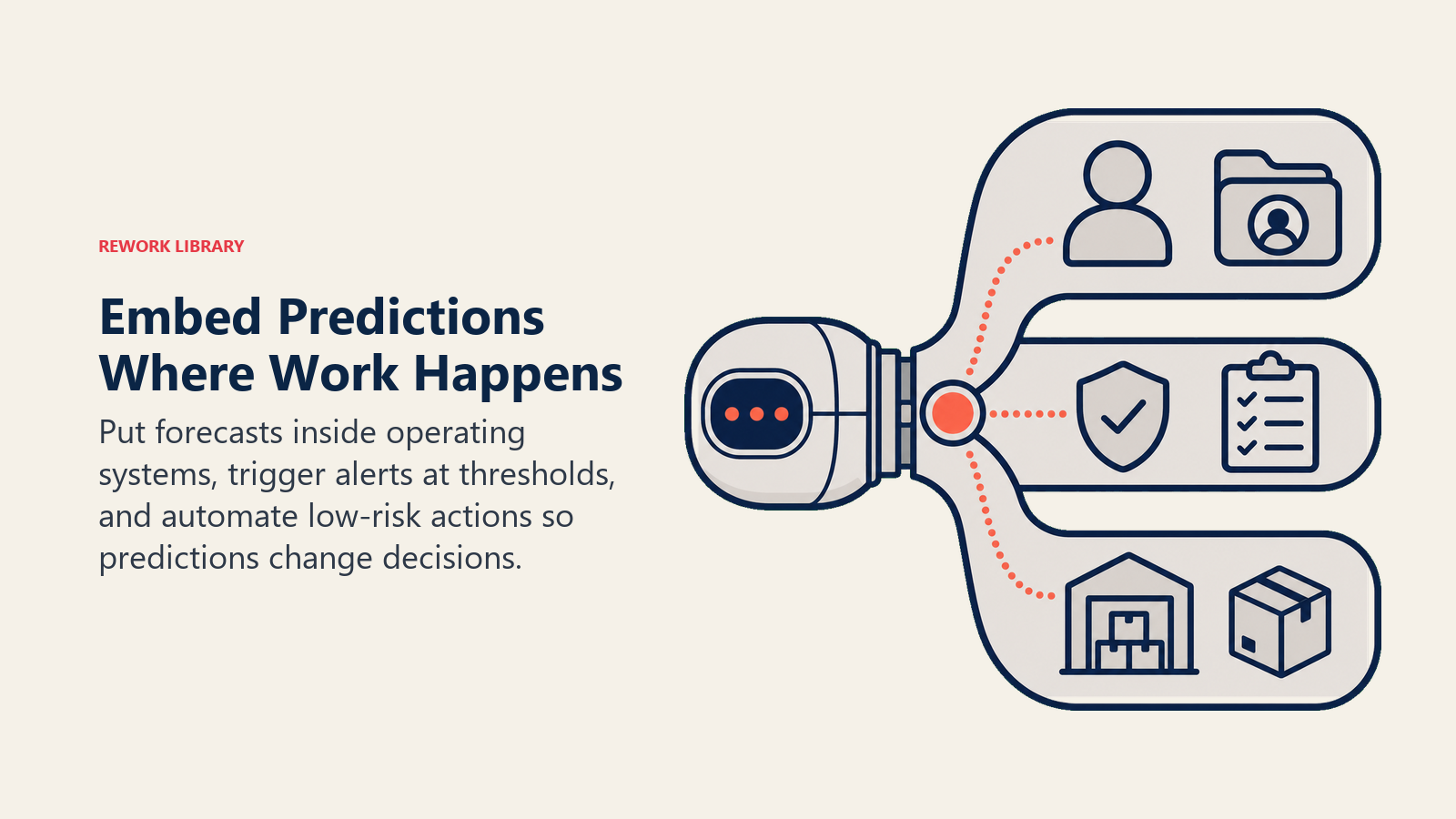
Embedding predictions in workflows makes forecasts available where decisions happen. Churn predictions should appear in customer success platforms. Sales forecasts should feed into resource planning systems. Risk scores should inform approval workflows. This integration approach mirrors the broader strategy needed for AI integration with existing systems.
Alert-based decision support notifies people when predictions indicate action is needed. When a customer's churn risk crosses a threshold, alert the account manager. When inventory predictions indicate a shortage, notify procurement.
Automated actions based on predictions enable the fastest response to emerging situations. Some predictions can trigger automatic processes: flagging high-risk transactions for review, routing leads to appropriate sales reps based on close probability, or adjusting pricing based on demand forecasts.
ROI and Value Measurement
Predictive analytics delivers value through better decisions and proactive action.
Improved forecast accuracy reduces the cost of over- and under-preparation. Better revenue forecasts enable appropriate resource allocation. Better demand forecasts minimize both stockouts and excess inventory.
A retailer improved demand forecasting accuracy by 25%, which reduced inventory carrying costs by 15% while maintaining service levels. That translated to $2M in annual savings.
Earlier problem detection enables intervention before issues fully develop. Predicting customer churn two months before it happens gives you time to implement retention efforts. Predicting equipment failure allows scheduled maintenance instead of emergency repairs.
A SaaS company implemented churn prediction and reduced customer attrition by 18% through proactive outreach to at-risk accounts. Each prevented churn represented $50K in retained revenue.
Better resource allocation happens when you can anticipate where capacity is needed. Predicting call volume lets contact centers schedule appropriately. Predicting sales activity helps allocate sales engineering resources.
Risk mitigation prevents losses from fraud, defaults, or operational failures. Banks use predictive models to catch fraudulent transactions before they're completed. Manufacturers predict equipment failures to avoid costly production downtime.
Getting Started with Predictive Analytics
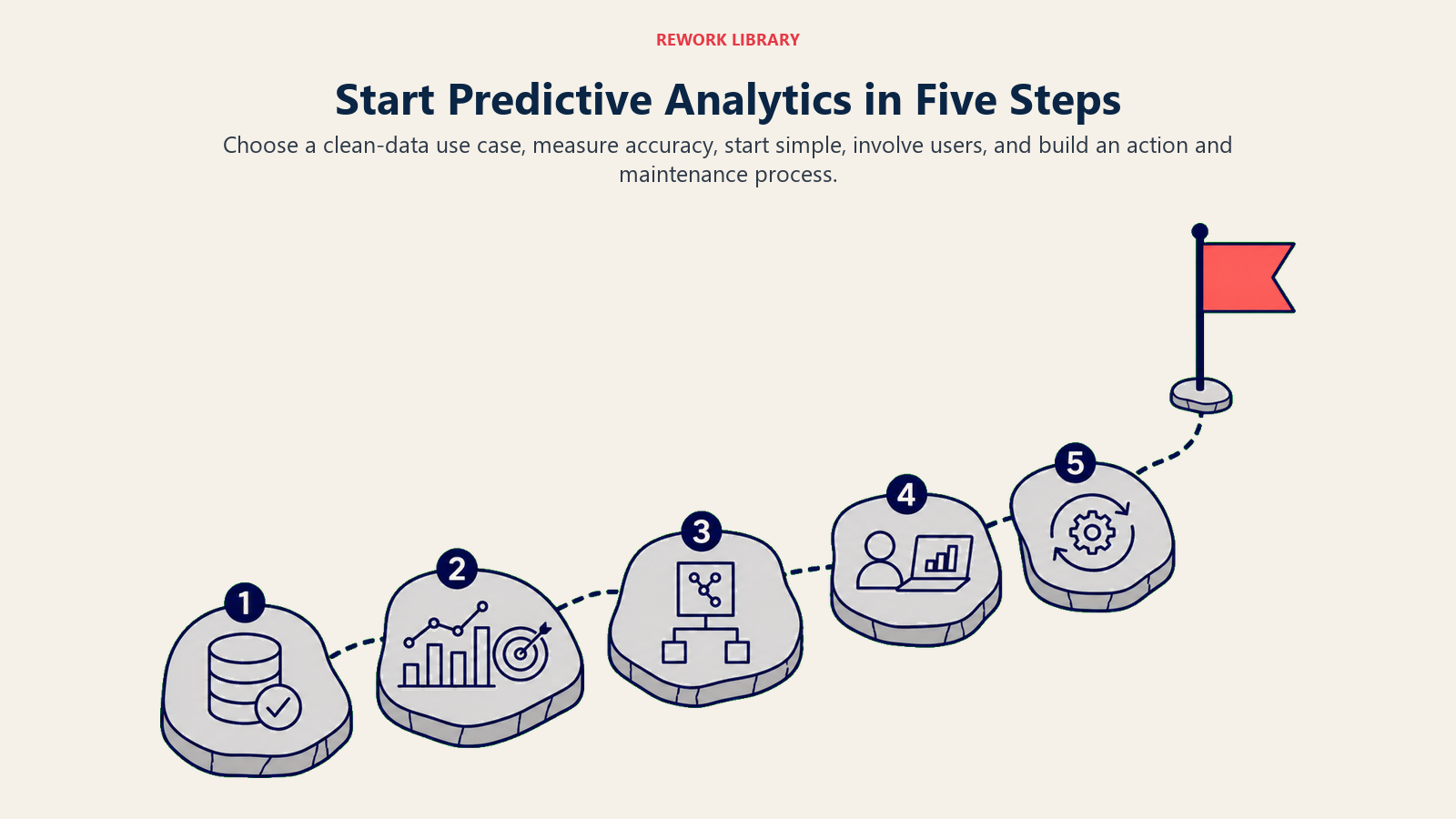
Begin with a use case where you have clean historical data and clear business value. Don't start with your hardest prediction problem, choose one where success will be obvious and data is readily available. This aligns with the broader guidance in AI tool selection framework to prioritize high-value, achievable implementations.
Sales forecasting, customer churn, or demand prediction often make good starting points because companies have historical data and clear metrics for success.
Ensure you can measure prediction accuracy against actual outcomes. You need to track whether predictions come true so you can validate model performance and build trust in the system.
Start simple before getting sophisticated. A basic churn prediction model that identifies high-risk customers is better than a complex model that never gets deployed because it's too difficult to understand.
Involve business stakeholders who'll use predictions in the model development process. They can validate whether predictions make business sense and help determine the right confidence thresholds for taking action.
Build processes for acting on predictions, not just generating them. A churn prediction that sits unused delivers zero value. A churn prediction that triggers outreach from customer success can save accounts.
Plan for ongoing model maintenance. Predictive models degrade over time as business conditions change. Schedule regular retraining and monitor prediction accuracy continuously.
Real-World Examples
A telecommunications company built a churn prediction model that identified customers likely to cancel in the next 60 days. Their retention team used these predictions to prioritize outreach. They reduced churn by 12% and saved $15M in annual revenue.
A manufacturing company implemented predictive maintenance for production equipment. By predicting failures before they occurred, they reduced unplanned downtime by 35% and maintenance costs by 20%.
An e-commerce company used demand forecasting to optimize inventory across their distribution network. Better predictions reduced stockouts by 40% while decreasing inventory carrying costs by 18%.
A financial services firm deployed fraud detection models that flagged suspicious transactions in real-time. They caught 30% more fraud while reducing false positives by 25%, improving both security and customer experience.
The Future of Predictive Analytics
AI predictive analytics is becoming more accessible and automated. Modern platforms handle much of the technical complexity that previously required data science expertise.
But technology alone doesn't create value. The companies succeeding with predictive analytics focus on embedding predictions into business processes and building organizational capability to act on forecasts.
When you can anticipate which customers will churn, which deals will close, which equipment will fail, and which risks will materialize, you shift from reactive to proactive management. That's the fundamental value of prediction: the ability to see problems coming and opportunities emerging in time to actually do something about them.
The difference between companies that succeed with predictive analytics and those that don't isn't the sophistication of their models. It's whether they build the processes and culture to make decisions based on probabilities instead of certainties.
Related Articles:

On this page
- What is AI Predictive Analytics
- Common Business Predictions
- Revenue and Sales Forecasting
- Customer Churn Prediction
- Demand Forecasting
- Risk Assessment
- Equipment Failure Prediction
- Employee Attrition
- Leading Predictive Analytics Platforms
- The Predictive Analytics Workflow
- Accuracy and Reliability
- Business Integration
- ROI and Value Measurement
- Getting Started with Predictive Analytics
- Real-World Examples
- The Future of Predictive Analytics