Trade Marketing and Field Sales Alignment: Making Sure Promotions Actually Hit the Shelf

Turn this article into takeaways for your work.


Each assistant summarizes the article only for you and suggests best practices for your work.
A trade scheme nobody told the DSR (distributor sales representative) about is a budget line that does not move product.
That describes a larger portion of FMCG promotional investment than most commercial directors want to acknowledge. Trade marketing is the discipline focused on increasing demand at the wholesaler, retailer, and distributor level, and the execution gap between that HQ planning and what actually happens on the shelf is where promotional ROI disappears. A trade marketing team designs a scheme, runs it through the brand approval process, produces POS materials, and loads the promotion details into a trade investment system. Then the activation date arrives. The field team doesn't know the mechanic. The POS hasn't been delivered to the distributor. The DSR visits the outlet and either says nothing about the promotion or explains it wrong. The retailer orders the same quantity they always order because nobody pre-sold the scheme.
The consumer sees none of it. The distributor ships normal volume. The trade marketing budget is spent, but the sell-out uplift never happens. When finance reviews the promotion ROI three months later, the promotion shows weak results and the trade marketing budget comes under pressure. The fix proposed is better creative. But the creative was never the problem.
The problem is an execution gap between HQ and the shelf, and it's a governance problem, not a creative problem.
Where Does Trade Marketing and Field Alignment Break Down?
Key Facts: Trade Promotion Execution Gap
- McKinsey analysis of US CPG data finds that 72 percent of trade promotions fail to break even. Broader McKinsey and Nielsen analysis across markets puts a comparable failure rate in the range of 59 percent. The execution gap between HQ planning and shelf reality is the primary driver, not weak creative. (McKinsey, How Analytics Can Drive Growth in CPG Trade Promotions)
- CPG companies invest approximately 20 percent of revenue annually in trade promotions, a widely cited industry figure drawn from McKinsey and Nielsen CPG research. Only around 22 percent can measure ROI accurately at the individual promotion level.
- According to FieldAssist, a sales force automation vendor whose benchmarks reflect their FMCG customer base, field sales reps spend on average only 38 to 40 percent of their time on active selling activities, the rest goes to administrative tasks, reporting, and non-selling activities. (FieldAssist FMCG Field Sales Productivity Benchmarks, 2026) This figure is directionally consistent with broader sales productivity research but comes from a vendor source.
Failure 1: Trade marketing designs schemes without field input. The trade marketing team is typically staffed with brand planners and category managers who spend most of their time at HQ. They understand shopper psychology, category dynamics, and brand strategy. What they often don't know is that the 200-outlet format the promotion was designed for represents only 30% of the outlets on the distributor's route, or that the secondary display unit the scheme requires won't fit in the layout of most general trade stores in the northern territories, or that three other promotions from competing brands are running the same week, making visibility commitments unrealistic.
Field input gathered 4-6 weeks before scheme finalization catches these issues before they become expensive mistakes. Without it, trade marketing produces schemes that are technically sound and operationally undeliverable.
Failure 2: The field receives promotion details too late to pre-sell and execute. Pre-selling a promotion means the DSR visits the outlet before the activation date, explains the mechanic, secures the retailer's agreement to participate, and places a forward order so the product is on shelf when the promotion starts. Pre-selling requires at least two weeks of lead time. If the field receives promotion details one week before activation, or worse, on activation day, pre-selling is impossible. The promotion starts cold, product isn't pre-loaded, and the first week of a four-week promotion is effectively lost.
In most FMCG organizations, the communication chain from trade marketing to field runs through multiple layers: brand team to regional sales manager to area manager to DSR team lead to individual DSR. Each layer adds lag. A brief issued from HQ 10 days before activation may reach the DSR 4 days before, too late to do anything meaningful.
Failure 3: No measurement loop from field back to trade marketing on compliance. After the promotion runs, someone needs to know whether the mechanic was executed as planned: was the POS placed in the right position, was the price marked correctly, was the secondary display set up, was the product actually in stock during the promotion window? Without a field compliance audit, trade marketing's only feedback is aggregate sell-out data, which can't distinguish between a promotion that performed well because execution was strong and one that performed weakly because execution was poor.
Without the compliance feedback loop, trade marketing can't learn what's working, can't fix execution failures mid-promotion, and can't build an honest ROI case for the next scheme approval.
Quotable Nuggets
- "Most trade promotions fail to break even (McKinsey puts the US rate at 72 percent. The fix isn't better creative) it's better execution. And execution starts with a field team that knew about the promotion two weeks before launch.", McKinsey / Nielsen
- "A compliance rate below 70% in the first week of a promotion is a signal to investigate immediately. Either the pre-sell didn't happen, the POS wasn't delivered on time, or the DSR training on the mechanic was insufficient.", FMCG field execution management principle
- "When both teams own the compliance score, both teams have a reason to make the promotion work. That shared accountability is what trade marketing ROI actually looks like.", Trade marketing alignment principle
The W-6 Alignment Gate: A pre-launch governance checkpoint set six weeks before any trade promotion activation. At W-6, trade marketing shares the promotional concept with field leadership for an operational feasibility review. The gate covers three questions: Can the DSR network execute this at the proposed outlet coverage? Are there distribution gaps that need closing before the promotion runs? Are there competing promotional commitments from other brands in the same activation window? Field feedback at W-6 can change the scheme materially. Organizations that enforce the W-6 gate report fewer last-minute brief changes, fewer under-loaded activation days, and more accurate volume projections compared to teams that brief the field two weeks out.
The Joint Planning Cycle: How Aligned Teams Operate
Alignment between trade marketing and field sales isn't a relationship outcome. It's the product of a shared planning calendar with defined handoffs, decision gates, and communication milestones.
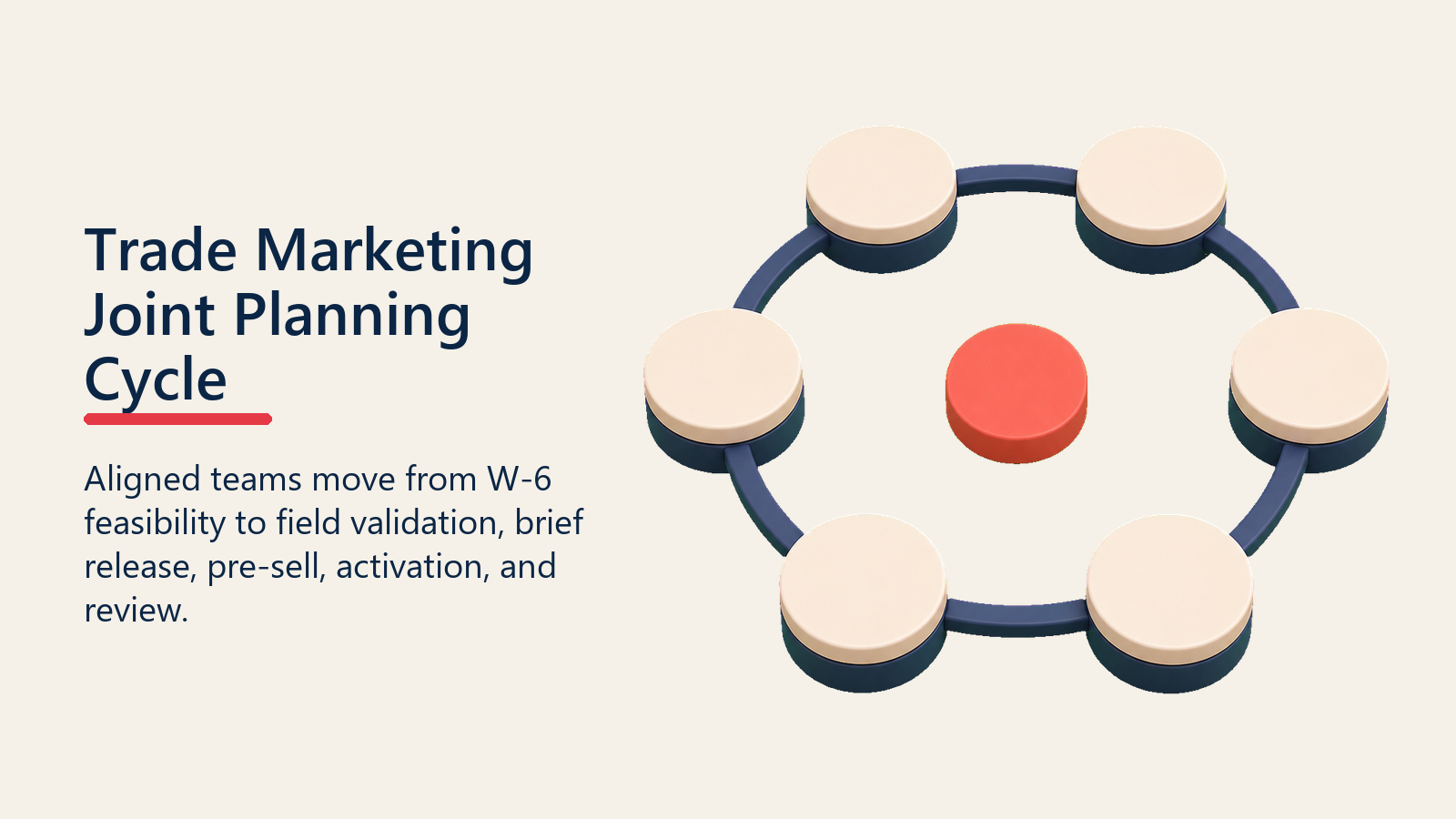
Week minus 6: Trade marketing briefs field leadership. The brand or trade marketing manager shares the promotional concept with regional sales managers and the distributor channel lead. At this stage, the brief covers the mechanic, the eligible outlet types, the investment level, and the proposed duration. Field leadership reviews for operational feasibility: Can the DSR network execute this at the proposed outlet coverage? Are there distribution gaps that need to be closed before the promotion runs? Are there competing promotional commitments from other brands or categories in the same window?
Field feedback at this stage can change the scheme materially. That's the point. Better to change it in planning than discover the problems after launch.
Week minus 5: Field validates scheme feasibility with key outlets. Area managers and DSR team leads consult with their top 20% of outlets by volume. Not a full pre-sell, but a feasibility check: "We're planning a promotion of this type in four weeks. Would your store participate? Do you have space for a secondary display? Do you have any competing commitments?" The responses shape the realistic outlet coverage target for the scheme. Trade marketing adjusts volume projections accordingly.
Week minus 4: Final scheme confirmed; field-ready brief issued. Trade marketing confirms the final mechanic, eligible outlets, POS requirements, and sell-in pricing. The field-ready brief (see format below) is issued to all field staff simultaneously. POS materials are dispatched to distributors with instructions tied to route delivery schedules. DSRs begin pre-selling.
Week minus 2: Pre-sell completion check. Area managers verify that pre-sell has been completed for all tier-A outlets in the promotion zone. Any outlet where pre-sell hasn't happened gets a follow-up call from the area manager. Outlets where the retailer hasn't committed are removed from the activation target list, so the compliance denominator is accurate.
Activation week: Compliance audit begins. From day one of the promotion, the SFA system captures compliance data at every outlet visit. POS placement, price marking, product availability, and secondary display compliance are logged by the DSR during the call. This data feeds the compliance dashboard.
Post-promotion week 2: Performance review meeting. Trade marketing and field sales review sell-out data against baseline, compliance rate against target, and qualitative outlet feedback collected by the field team. Actions identified: which outlets underperformed and why, what execution fix was missing, what the revised ROI estimate is.
| Timeline | Action | Owner | Output |
|---|---|---|---|
| Week -6 | Trade marketing briefs field on promotional concept | Trade marketing | Operational feasibility feedback from field leadership |
| Week -5 | Field validates feasibility with key outlets | Area managers | Realistic outlet coverage target; adjusted volume projection |
| Week -4 | Final scheme confirmed; field-ready brief issued | Trade marketing | Brief delivered to all DSRs; POS dispatched to distributors |
| Week -2 | Pre-sell completion check | Area managers | Pre-sell confirmed for A-tier outlets; stragglers followed up |
| Week 0 | Promotion activates; compliance audit begins | DSRs via SFA | Daily compliance data by outlet |
| Week +2 | Post-promotion performance review | Joint: trade marketing + field | Sell-out lift, compliance rate, ROI estimate, lessons learned |
Field-Friendly Brief Format: What Reps Need to Execute
The brief is the translation layer between trade marketing's plan and what the DSR actually does in an outlet. Most promotion briefs written by brand teams are not written for DSRs. They include brand language, category context, and strategic rationale that a DSR neither needs nor has time to read during a 10-minute outlet call.
A field-ready brief for a trade promotion should contain exactly six things:
1. What the promotion is, in one sentence. "Buy 3 cases of 500ml Orange, get 10% off invoice." No brand strategy. No category context. One sentence.
2. Which outlets are eligible. "All supermarkets and convenience stores with a trade license, excluding kiosks and street vendors." If there's a product-code list of eligible outlets in the SFA, reference it by name: "See Promotion Outlet List in your SFA app under Active Promotions."
3. What you need to place in the store. "One A3 price strip at the shelf. One counter card on the checkout counter. Photo required of both before leaving the store."
4. What the dates are. "Activation date: August 1. End date: August 28. POS must be placed on August 1. Photo evidence required within 48 hours of activation."
5. What to tell the retailer. Two or three sentences the DSR can actually say: "We're running a promotion on the 500ml range this month. If you order at least 3 cases, you get a 10% discount on your invoice. I'll set up the price strip and counter card now so your customers can see the deal."
6. How to log it. "Open the SFA, go to Active Promotions, select [Promotion Name], and complete the compliance checklist for this outlet. Upload photos before you leave the store."
That's it. A brief that fits on one page or one screen is a brief a DSR will actually use. A 12-page brand deck is something they'll scroll past at the team meeting.
For POS visibility execution details on placement standards and photo audit requirements, the field-ready brief should link directly to the relevant SFA reference rather than repeating the standards inline. The brief gets the rep to the shelf. What happens at the shelf is what the compliance audit measures.
How Do You Measure Whether the Promotion Actually Reached the Shelf?
Compliance measurement is what converts trade promotion investment from a budget spend into a learning system. Without it, you can't distinguish strong creative from strong execution.
Deloitte's analysis of trade promotion management challenges identifies misallocated funds, missed deductions, volume validation gaps, and rebate processing errors as the most common failure modes when human review processes can't keep pace with the volume of active promotions across a field network.
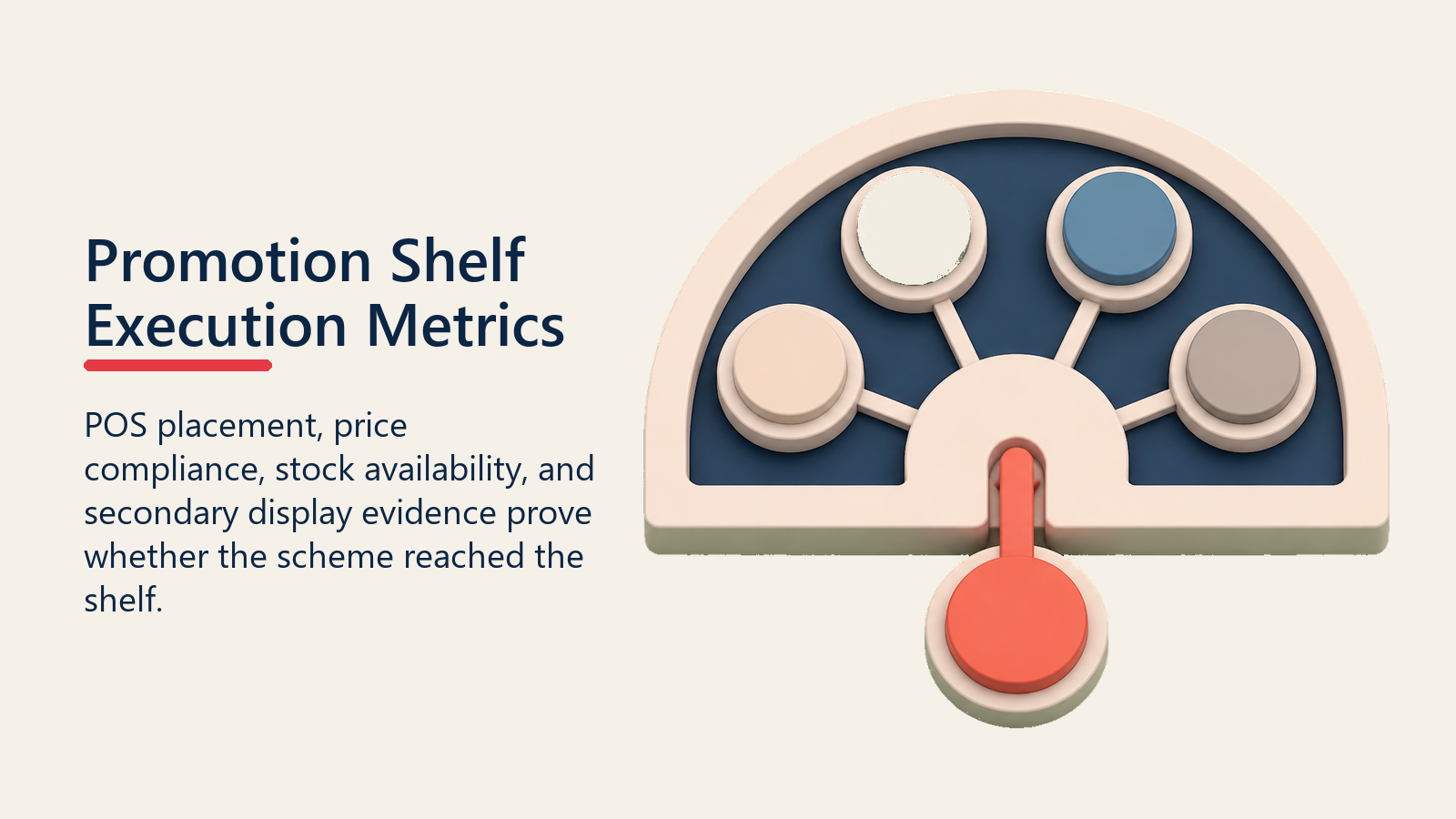
Compliance audit scorecard: four elements per outlet per visit
| Compliance Element | What to Check | How to Verify | Passing Standard |
|---|---|---|---|
| POS placed | Price strips, counter cards, shelf talkers in designated position | SFA photo capture + visual check | 100% of required POS present and correctly positioned |
| Price correctly marked | Promoted price visible and matches the scheme | SFA photo capture | Promoted price on all eligible facings |
| Product in stock | SKU available for purchase during promotion window | Shelf check + back-stock check | Zero OOS events on promoted SKU during promotion period |
| Secondary display set | Secondary display unit in agreed position with agreed facings | SFA photo capture | Secondary display present in all outlets where agreed at pre-sell |
Compliance rate calculation: Compliance rate = (Outlets where all four elements pass / Total outlets in promotion universe) x 100. A compliance rate below 70% in the first week of a promotion is a signal to investigate immediately. Either the pre-sell didn't happen, the POS wasn't delivered on time, or the DSR training on the mechanic was insufficient.
SFA photo capture as compliance evidence is standard practice in most modern FMCG field operations and should be non-negotiable for any promotion where trade investment exceeds a defined threshold. Photos create an auditable record, eliminate disputes about what was or wasn't in place, and give trade marketing team visibility into real execution conditions that no report can replicate.
For trade schemes involving retailer loyalty programs or performance bonuses to retailers, photo evidence of compliance also protects the manufacturer in any dispute over whether the scheme earned the agreed payout. See retailer loyalty programs for how compliance evidence connects to retailer incentive administration.
Workflow automation tools that trigger escalations when compliance data falls below threshold, or automatically notify area managers when SFA data shows a gap in photo uploads for an active promotion, can materially reduce the manual management burden of running compliance audits across a large field network.
Post-Promotion Review: Closing the Loop
The post-promotion review is the mechanism that turns a completed promotion into institutional learning. Without it, every promotion is a one-time event. With it, each promotion builds the organization's knowledge of what works, in which outlets, for which mechanics, under what execution conditions.
Sell-out lift vs. baseline is the primary ROI metric. Baseline is defined as the same outlet's sales in the same week of the prior year (if seasonality is significant) or the average of the prior four weeks. Lift = (Promoted period sales / Baseline sales) - 1. A promotion that produces 25% lift with 80% compliance and a promotion that produces 8% lift with 35% compliance are telling completely different stories. Disaggregating lift by compliance quartile is the most useful analysis: it shows what the promotion could have produced if execution had been consistent.
Compliance rate vs. target should be reviewed at the outlet level for the top 20% of accounts by volume, not just as an aggregate. An 80% overall compliance rate that includes 100% compliance in the high-volume accounts and 50% compliance in the mid-volume accounts points to a different fix than an 80% rate with uniform underperformance across all tiers.
Outlet feedback from field is qualitative but often more predictive of future promotion design than quantitative sell-out data. DSRs who completed the promotion cycle know which mechanics retailers liked, which POS formats caused problems, which price points generated genuine retailer enthusiasm, and which outlets chose not to participate and why. That feedback, collected through a structured debrief at the next team meeting, is the input trade marketing needs to improve the next scheme.
The post-promotion review should also update the promotion's performance in the trade promotion management system so ROI benchmarks improve over time. See trade promotion management for how to build a promotion performance database that supports annual trade budget allocation decisions.
Connecting Field Alignment to Distributor Alignment
Trade marketing and field sales alignment doesn't exist in isolation from distributor alignment. The distributor is the link between the manufacturer's promotional plan and the outlet. If the distributor's DSRs aren't briefed, motivated, and tracked on promotion execution, the best-designed joint planning process between trade marketing and manufacturer field sales still won't reach the shelf.

This is why sales and distributor alignment governance structures should include promotion execution compliance as a distributor scorecard metric. A distributor whose DSRs achieve 85% compliance on manufacturer promotions gets credit for it in the joint business plan review. A distributor whose compliance rate sits at 40% despite being briefed and trained should face a formal performance conversation, not just a follow-up email.
The manufacturer's field sales team and the distributor's DSR network need to receive the same brief, at the same time, with the same standard. Joint briefing sessions at the start of each promotional period, attended by both manufacturer reps and distributor DSRs, are one of the most effective structural fixes for closing the promotion execution gap.
For how field-level alignment connects to the broader commercial operating model across different channel types, sales and operations field force alignment in pharmaceutical growth offers a useful parallel: the same structural principles apply when a field force depends on an intermediary channel to reach the end customer.
Conclusion
Alignment is not a meeting. It's a shared calendar, a rep-ready brief, and a compliance score that both trade marketing and field sales own.
A trade marketing team that plans in isolation, briefs the field late, and measures only aggregate sell-out data doesn't have an alignment problem they're aware of. They have a structural gap producing poor ROI that gets blamed on the wrong things: weak creative, difficult outlets, price sensitivity, competitor pressure.
The field team that receives a promotion the week it launches, executes inconsistently across the route, and never sees the sell-out results doesn't know what good looks like. They execute what they're told, when they're told, as best they can given the time available.
And both problems are solved by the same structure: a joint planning cycle that involves field expertise before scheme commitment, a brief format that DSRs can actually use, a compliance audit that makes execution visible in real time, and a post-promotion review that connects the compliance score to the sell-out result.
When both teams own the compliance score, both teams have a reason to make the promotion work. That shared accountability is what trade marketing ROI actually looks like.
Frequently Asked Questions about Trade Marketing and Field Sales Alignment
What is trade marketing and field sales alignment in FMCG?
Trade marketing and field sales alignment is the operating discipline that ensures promotions designed at HQ are actually executed at the shelf by field reps and distributor sales representatives. Misalignment produces the most common source of poor trade promotion ROI: a scheme that is well-designed strategically but arrives at the DSR level too late to pre-sell, with POS that wasn't delivered on time and a mechanic the DSR explains inconsistently. McKinsey analysis finds most trade promotions fail to break even, and field execution quality is a primary driver of that number.
What is pre-selling in FMCG promotions and why does it matter?
Pre-selling is the practice of a DSR visiting the outlet before the promotion activation date, explaining the mechanic, securing the retailer's agreement to participate, and placing a forward order so the product is on shelf when the promotion starts. Pre-selling requires at least two weeks of lead time before the activation date. When the field receives promotion details one week before launch (or on launch day), pre-selling is impossible, the promotion starts cold, the shelf isn't pre-loaded, and the first week of a four-week scheme is effectively lost revenue. The W-6 planning gate exists to prevent this.
What is a field-ready promotion brief and what should it contain?
A field-ready brief is the translation layer between trade marketing's plan and what the DSR actually does in an outlet. A DSR doesn't need brand strategy or category context during a 10-minute outlet call. An effective field-ready brief contains six things: what the promotion is in one sentence, which outlets are eligible, what physical materials need to be placed in the store, the exact activation and end dates, two or three sentences the DSR can say to the retailer, and how to log the compliance evidence in the SFA. Anything longer than one page or one screen is a brief the DSR will scroll past at the team meeting.
How do you calculate trade promotion compliance rate?
Compliance rate = (Outlets where all required execution elements pass / Total outlets in promotion universe) x 100. Required execution elements typically include: POS placed correctly, promoted price accurately marked, product in stock on the promoted SKU during the promotion window, and secondary display set up where agreed during pre-sell. A compliance rate below 70 percent in the first week is an immediate signal to investigate, either the pre-sell didn't happen, POS wasn't delivered on time, or DSR training on the mechanic was insufficient. Below 70 percent compliance means the majority of the promotion budget is running without the in-store conditions needed to convert shopper intent to purchase.
What is sell-out lift and how is it used to assess promotion ROI?
Sell-out lift measures the percentage increase in outlet sales during the promotion period compared to a baseline. Baseline is typically the same outlet's sales in the equivalent period of the prior year (to control for seasonality) or the average of the four weeks preceding the promotion. Lift = (Promoted period sales / Baseline sales) - 1. A promotion that produces 25 percent lift with 80 percent compliance and one that produces 8 percent lift with 35 percent compliance are telling completely different stories. Disaggregating lift by compliance quartile (what the promotion would have generated if execution had been consistent) is the most useful analysis for improving future scheme design.
Why should promotion compliance be a distributor scorecard metric?
Distributors whose DSRs execute manufacturer promotions at high compliance rates are creating more outlet sell-out and more consumer exposure to the brand than distributors with low compliance rates. Including promotion execution compliance as a distributor scorecard metric creates accountability at the level where the execution gap actually lives. A distributor whose compliance rate sits at 40 percent despite briefing and training should face a formal performance conversation in the monthly JBP review, not just a follow-up email. McKinsey's analysis of winning manufacturer-distributor partnerships shows that leading organizations spend most of their joint review time on strategic execution initiatives rather than just reporting on the annual volume plan.
Learn More

Senior Implementation Consultant
On this page
- Where Does Trade Marketing and Field Alignment Break Down?
- The Joint Planning Cycle: How Aligned Teams Operate
- Field-Friendly Brief Format: What Reps Need to Execute
- How Do You Measure Whether the Promotion Actually Reached the Shelf?
- Post-Promotion Review: Closing the Loop
- Connecting Field Alignment to Distributor Alignment
- Conclusion
- Learn More