In-Store Merchandising and Planograms: Owning the Shelf at Every General Trade Outlet
Turn this article into takeaways for your work.


Each assistant summarizes the article only for you and suggests best practices for your work.
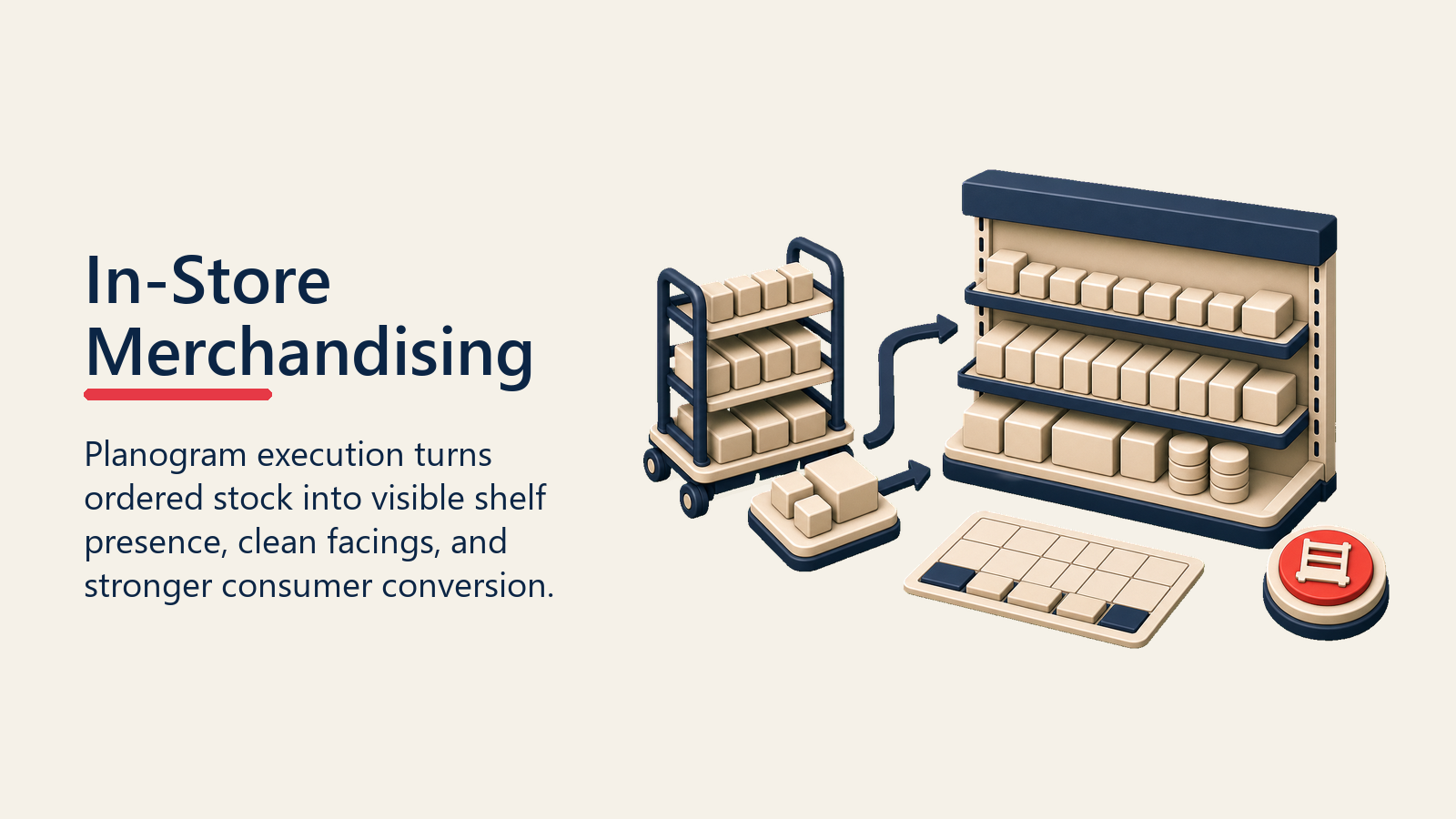
The product in the back room sells nothing. This seems obvious enough that it shouldn't need saying, yet in most general trade territories, a significant share of ordered stock sits behind the counter or in the storeroom while the shelf in front of the consumer shows gaps, poorly faced product, and competitor brands in the positions your brand was supposed to occupy.
The rep who collects the order and leaves without fixing the shelf has done half the commercial work and left the other half for the competitor. In-store merchandising isn't a trade marketing function that happens between visits. It's a rep responsibility that happens at every call. The rep who understands planograms (shelf layout schematics showing exactly where each product goes) and executes them consistently is the last merchandiser between the factory and the consumer's hand.
Why Is In-Store Merchandising a Selling Act, Not a Housekeeping Task?
The link between shelf position and consumer purchase rate is not a trade marketing concept. It's a commercial reality that field reps can either use or ignore. As Wikipedia's visual merchandising article notes, "eye level is buy level" is a foundational retail principle, and products at eye height receive significantly more attention than items placed higher or lower. Eye-level placement in the primary category section generates higher consumer trial rates than any secondary placement. A brand with three facings at eye level moves more units than the same brand with six facings at waist height. A brand with a shelf talker at the point of decision converts more browsers than the same brand without one.
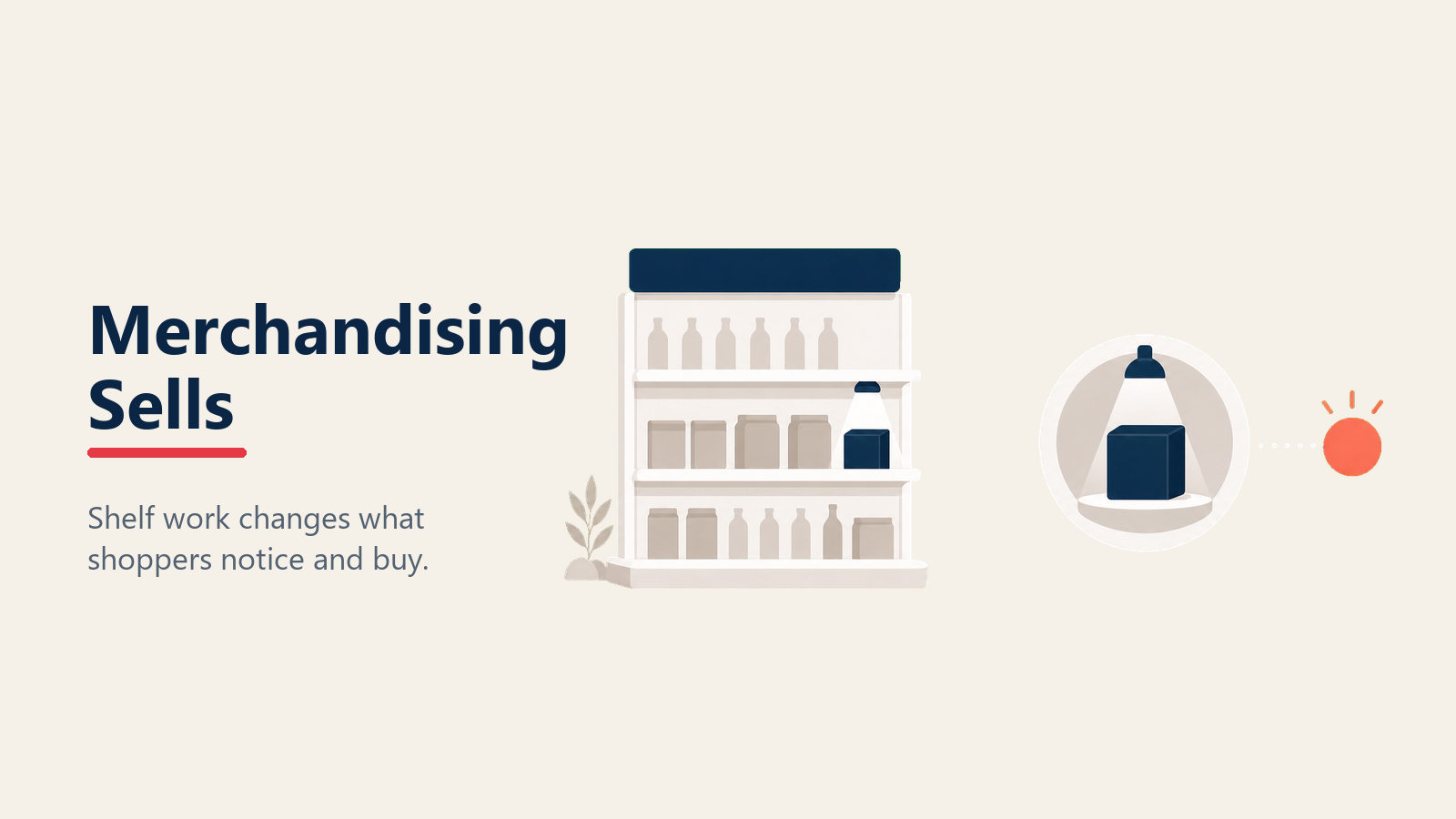
These aren't soft observations. They're the reason trade marketing teams produce planograms in the first place. And they're the reason that a rep who spends three minutes fixing the shelf before leaving an outlet has done more commercial work than the one who spent those three minutes chatting at the counter.
Key Facts: In-Store Merchandising Execution
- NielsenIQ research across 15 categories and 155 brands found that optimised product placement and accessibility can deliver a 20-40% sales uplift at the outlet level, and that 30% of stores account for 80% of category sales, making correct shelf position in the right outlets disproportionately valuable.
- Eye-level shelf placement delivers 20-30% higher sales than the same product at lower or higher positions, according to retail placement research published by Fieldpie (a field-execution software vendor); the direction of the effect is consistent with broader retail shelf research, and is strongest in categories where shoppers make quick in-aisle decisions rather than comparing specifications. (Fieldpie retail placement research)
- Planogram compliance rates below 60% at the outlet level typically correlate with distribution gaps appearing in monthly sales data six to eight weeks later, because facing loss precedes stockout which precedes missed sales (practitioner pattern observed across general trade territories; no single published study).
Merchandising execution also compounds. A rep who consistently maintains eye-level placement and minimum facing counts at 150 outlets builds a shelf position advantage that makes the next competitor promotional attack less effective. The brand that's already at eye level on three facings is much harder to displace than the brand sitting at waist height on one facing.
Planogram Basics for Field Reps
A planogram (a visual schematic specifying exactly where each SKU sits on a shelf: which row, which horizontal position, how many facings, and in what orientation) is produced by trade marketing based on category sales data, shopper research, and brand investment. Field reps execute it. The full taxonomy of display types is documented in the Wikipedia overview of planograms.
Reading a planogram. Most FMCG planograms for general trade use a simple grid format. Rows correspond to shelf levels (top, eye, waist, floor). Columns correspond to horizontal positions on the shelf. Each cell shows an SKU code or product image, a facing count, and sometimes a stock depth. A rep reading a planogram for a 1.5-meter shampoo section should be able to identify within thirty seconds which SKUs go where, what the minimum facing count is for each, and which competitor products should be adjacent to maintain category flow.
Executing the planogram at the outlet. The field execution of a planogram has three steps. First, the rep checks the current shelf state against the planogram template on their SFA device. Second, the rep identifies the gaps: missing facings, SKUs in wrong positions, competitor encroachment, expired product still on shelf. Third, the rep fixes what she can fix immediately (facing resets, position swaps, expired product removal) and negotiates with the retailer on anything that requires his permission to change (clearing competitor product, adding a shelf tier, installing a shelf strip).
The difference between the ideal planogram and the negotiated reality. Trade marketing's ideal planogram assumes the brand owns the entire shelf section. General trade reality is that the retailer has five brands competing for the same section, limited shelf space, and a personal relationship with whoever visited most recently and was most helpful. The rep's job is to negotiate the brand into the best possible position within that reality, document it accurately, and move the position closer to the ideal at each subsequent visit.
The Five Merchandising Priorities at General Trade
Not all merchandising elements are equal. The Five-Priority Merchandising Stack: eye-level placement first, facing count second, price label accuracy third, brand blocking fourth, secondary display opportunity fifth. When a rep has limited time at an outlet, she prioritizes in this order:
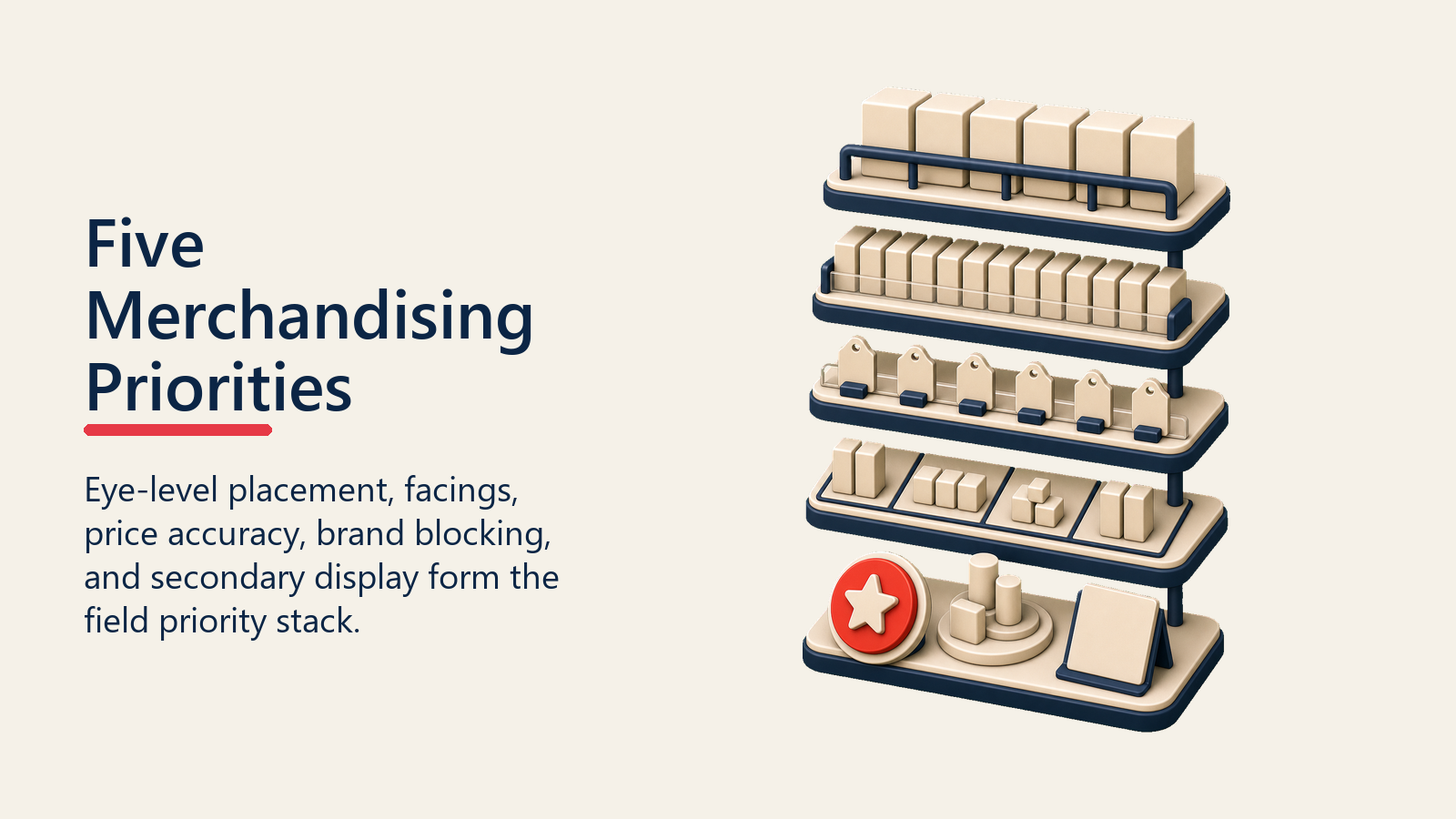
Priority 1: Primary shelf placement. Eye-level position in the category section is the first win. If your brand is below waist level or above reach level, getting it to eye level is worth more commercial effort than any other merchandising action. The right of the door and the high-traffic aisle are secondary location priorities after eye level is secured.
Priority 2: Facing count. Minimum facing requirements vary by SKU tier. Hero SKUs (the top-selling lines in the must-sell assortment) should have a minimum of two to three facings in an outlet of standard size. Secondary SKUs should have at least one facing. A facing count below minimum means the product is technically present but commercially invisible to a shopper making a quick scan of the shelf.
Priority 3: Price tag accuracy and shelf label compliance. An unlabelled product or a label showing a different price than what the retailer is actually charging creates a friction point that loses sales at the moment of decision. Price tags should match the current recommended retail price or the in-cycle promotional price. Shelf strips and price labels supplied in POSM (point-of-sale materials) kits should be installed at the same time as any POS visibility execution materials.
Priority 4: Blocking and category adjacency. Blocking means grouping the same brand across the category section rather than scattering individual SKUs between competitor products. A blocked brand presence reads clearly to the consumer and signals market leadership. Category adjacency means the brand sits next to logically associated products (body wash next to soap, not next to cooking oil) so the shopper's category scan reaches your product naturally.
Priority 5: Secondary display and off-shelf opportunity. A secondary display (a floor stack near the checkout, a counter display, a gondola end) gives a brand double exposure in the outlet and drives impulse purchase from shoppers who didn't come in looking for the category. Secondary displays require retailer permission and usually a commercial incentive. Prioritize them at A-class outlets with high footfall where the incremental visibility is worth the negotiation time.
| Priority | Element | What to check | Time required |
|---|---|---|---|
| 1 | Primary shelf placement | Eye-level position secured in category section | 1 min |
| 2 | Facing count | Minimum facings met for hero and secondary SKUs | 1 min |
| 3 | Price tag accuracy | Labels present and matching current pricing | 30 sec |
| 4 | Blocking and adjacency | Brand grouped, not scattered between competitors | 1 min |
| 5 | Secondary display | Off-shelf opportunity negotiated and installed | 3-5 min |
Executing Planograms Without Upsetting Retailers
The retailer owns the shelf. The rep doesn't. This is the working reality of general trade execution, and it determines how planogram conversations need to be framed.
A rep who walks in and starts moving product without asking will lose the relationship faster than any competitive promotion. The rep who explains what she's doing and why, and asks permission, gets the same outcome and keeps the retailer's goodwill. The language matters.
"I want to make sure your Dove soap section is making you the most money it can. Can I take two minutes to tidy the shelf and move the family size into the front row? Your shoppers will see it first when they walk past, and the 800g pack is your fastest-moving variant."
That framing gives the retailer two things: a reason (more money) and a specific action (moving one SKU, not rebuilding the entire section). Reps who try to restructure the whole shelf section in one visit typically face resistance because it's disruptive. Reps who make one specific improvement per visit and link it to the retailer's commercial interest typically succeed because the ask is small and the logic is clear.
The outlet relationship management framework covers this in more depth, but the short version is: earn permission through logic and consistency, not through persistence.
When the retailer refuses a specific shelf change, note it in the SFA and return to it at the next visit with additional context. If a competitor has moved into a position you need, document it and escalate to the field manager if the account is commercially significant. Don't argue at the counter. Arguing at the counter is the fastest way to lose the conversation and the shelf position.
Audit and Compliance Scoring
Planogram compliance can't be managed by the rep asking herself whether she thought the shelf looked right on exit. It needs a structured check that produces a consistent compliance score across all outlets in the territory.
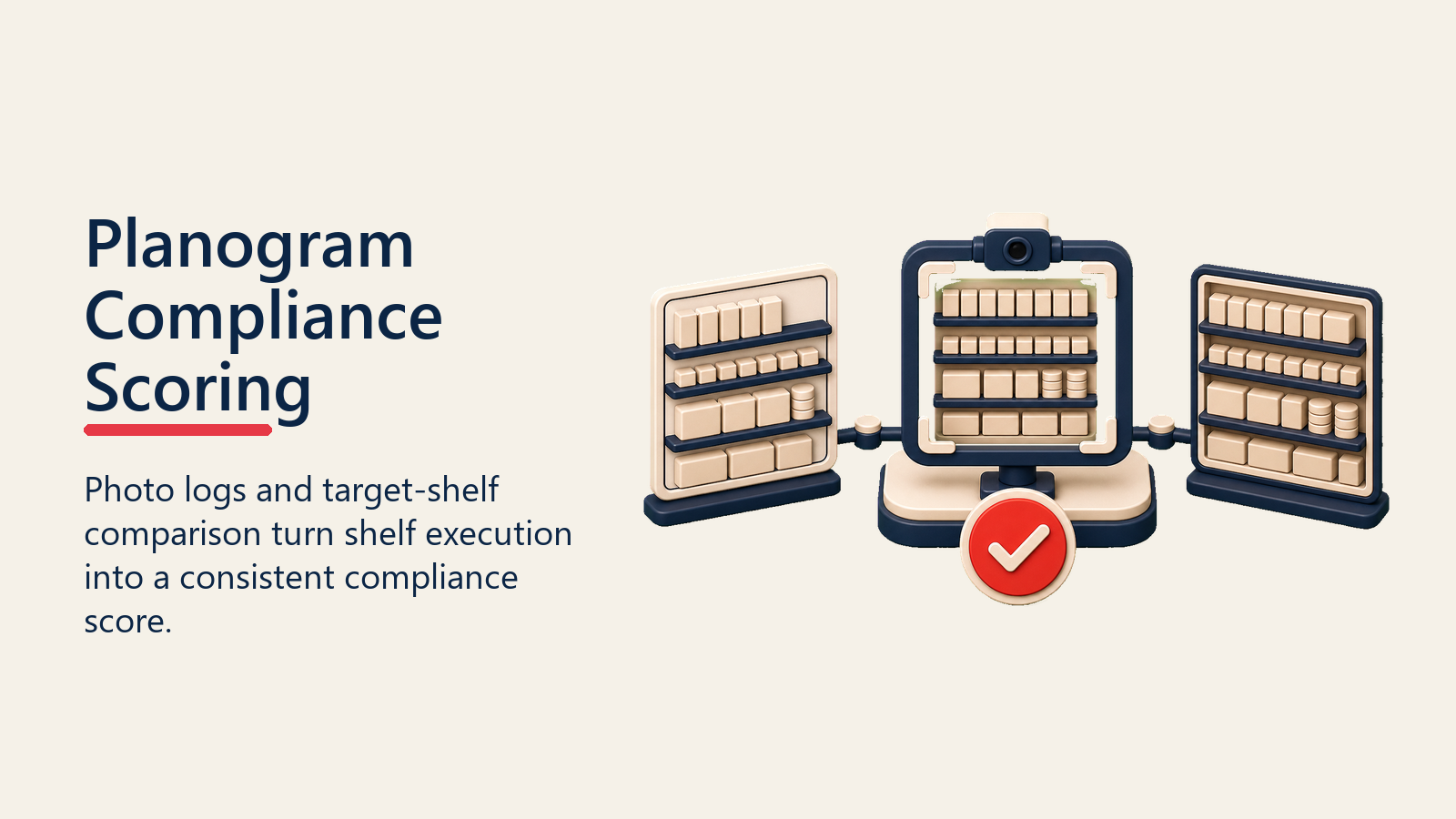
The compliance audit at each visit takes under two minutes if the rep knows what to check. The SFA should display the target planogram for the outlet alongside the current shelf photo from the previous visit, so the rep can compare what she's looking at with what she committed to last cycle.
Compliance photo log template:
Take one photo per section: the full category shelf (including competitor positions), a close-up of your brand's facing count, and any secondary display or POS material deployed. Tag each photo with the outlet ID and GPS coordinates automatically through the SFA. The photo timestamp is the audit record.
The photo serves three purposes. It's proof of execution for internal compliance reporting. It's a baseline for the next visit comparison. And it's evidence in the event of a promotional claim dispute where the brand needs to show what was actually deployed in-store.
Compliance scoring should happen at the field manager level, not just the rep level. A manager who reviews ten outlet photos per week across her team's territory can identify patterns (the same shelf position being lost repeatedly at a cluster of outlets, one rep consistently scoring below minimum on facing counts) that individual rep self-reporting would miss. The retail merchandising and shelf visibility audit framework used in pharmaceutical field sales applies equally here, with the outlet visit cadence and shelf check sequence adapted to FMCG call volumes.
The trade marketing and field alignment function is the bridge between what trade marketing designed in the planogram and what field reps execute at the outlet. When compliance data shows systematic gaps, the conversation between trade marketing and field is the mechanism for adjusting either the planogram standard or the rep coaching program.
When Competitors Have Already Moved In
Competitor shelf takeovers happen. A competitor rep visited this morning, offered a trade scheme on the condition the retailer gave up your facing positions, and the retailer agreed. You arrive to find your hero SKU pushed to the bottom shelf and a competitor range occupying eye level.
The immediate response has three steps.
First, assess what's been lost. Take the compliance photo before touching anything. This documents the before state and establishes the gap that needs to be recovered.
Second, make the immediate ask. Don't accept the situation as settled. Ask the retailer directly and calmly: "I see the Sunsilk has been moved down. Can we discuss moving it back to the eye-level section? I can offer a display incentive for this cycle if that helps." Sometimes the retailer is open to it if the conversation is commercial rather than confrontational.
Third, if the retailer declines, note the exact competitor position, the SKUs they've placed, and the approximate date of the move. Log it in the SFA as a competitive event. Escalate to the field manager if the account is an A or B-tier outlet. A single competitor shelf win at one kirana is noise. A pattern of competitor shelf takeovers across fifteen outlets in a suburb is a territory-level competitive risk that needs a trade marketing response.
Recovery from competitor encroachment happens over multiple visits, not one. The rep who shows up consistently, maintains relationships, and uses the must-sell list and assortment framework to demonstrate the commercial value of her range will recover shelf position faster than the rep who escalates loudly once and then accepts the loss.
For chilled and ambient products requiring cooler space, the same principles apply with additional considerations covered in the cooler and chiller space management framework.
Quotable Nuggets
"Planogram compliance isn't a reporting exercise. It's the last commercial act of the outlet visit." (Field merchandising practitioners, general trade FMCG)
"The brand that's already at eye level on three facings is much harder to displace than the brand sitting at waist height on one facing." (Field execution principle, route-to-market practitioners)
Conclusion: The Rep Who Fixes the Shelf Has Done the Commercial Work
There are two ways to leave an outlet. The rep who confirmed the order, took the payment terms, and is already en route to the next call. And the rep who spent three extra minutes fixing the shelf, confirmed the order, and left the product at eye level with minimum facings and a clean shelf talker.
In the next two weeks, the second outlet will outsell the first one on those SKUs. Over a quarter, across a territory of two hundred outlets, the difference is market share.
Planogram compliance isn't a reporting exercise. It's the last commercial act of the outlet visit. Train reps to see the shelf as part of their job, not as trade marketing's problem. Measure compliance through photos, not self-report. And coach the deviations on joint visits before they become patterns.
Learn More

Senior Implementation Consultant
On this page
- Why Is In-Store Merchandising a Selling Act, Not a Housekeeping Task?
- Planogram Basics for Field Reps
- The Five Merchandising Priorities at General Trade
- Executing Planograms Without Upsetting Retailers
- Audit and Compliance Scoring
- When Competitors Have Already Moved In
- Quotable Nuggets
- Conclusion: The Rep Who Fixes the Shelf Has Done the Commercial Work
- Learn More