New Outlet Acquisition: How FMCG Sales Teams Win and Activate New Retail Points

Turn this article into takeaways for your work.


Each assistant summarizes the article only for you and suggests best practices for your work.
New outlet addition is the fastest route to distribution gain available to a field sales team. It doesn't require price repositioning. It doesn't depend on category growth. It doesn't hinge on your competitor making a mistake. You identify an outlet that isn't stocking your brand, you sell it in, you activate it, and your numeric distribution ticks up. The math is clean and the outcome is yours to control.
But walk into most area manager reviews and new outlet acquisition looks nothing like a controlled process. It looks like rep heroics. A rep happens to pass a new shop, drops in, and gets a first order. The area manager celebrates it at the Friday call review. Two weeks later, no one's followed up. The outlet ordered once, didn't reorder, and by week four it's lapsed. The distribution number went up and then came back down, and no one tracked either movement carefully enough to learn from it.
Most teams don't have a formal new outlet acquisition process. They have intent and individual effort. The difference between intent and a process is what this article is about.
Why Does Every FMCG Team Need a Formal New Outlet Process?
Most teams mistake intent for process. A rep opens a new outlet, the area manager celebrates it on the Friday call, and nobody follows up. By week four the outlet has lapsed and no one tracked either movement carefully enough to learn from it. A formal process changes the math: targets are set, activation is sequenced, and lapse is caught early rather than counted at month-end.
Key Facts: New Outlet Acquisition
- In one NielsenIQ Vietnam study (biscuits and cakes category), a manufacturer with 85% national distribution had only around 33% effective coverage in one key region, absent from stores accounting for 57% of category sales, representing a 10% incremental market share opportunity, per NielsenIQ's distribution analysis. These are single-market figures, not global norms.
- In markets where numeric distribution is below 70%, a 10-percentage-point distribution gain typically delivers 8-12% volume growth before any change in visibility or promotional investment. (Industry estimate based on category throughput modeling; actual lift varies by market and channel.)
- First-order lapse rates without a structured 90-day activation process are estimated at 30-50% in emerging-market operations, based on field observations reported by route-to-market (RTM) practitioners. (Practitioner estimate; published benchmarks vary by category and market.)
Quotable Nuggets: New Outlet Acquisition
- "The lapse problem is not a small problem. It's the difference between a distribution strategy that compounds and one that leaks." Adding 200 outlets per month while losing 100 to lapse cuts net distribution gain in half.
- According to Bain's consumer-products commercial excellence practice, consumer goods companies with structured route-to-market execution achieved 3-10% sales improvement and reduced the cost of the sales contact by 10-25%, compared to teams relying on informal outlet coverage habits.
- The first-order moment is not an activation event. An outlet becomes activated only when it has placed a minimum of three repeat orders and holds minimum assortment compliance through the 90-day window.
Why New Outlets Matter: The Compounding Math
Here's the math that makes new outlet acquisition so commercially valuable. Suppose your brand has 60% numeric distribution in a territory of 10,000 outlets: 6,000 outlets are stocking you, 4,000 are not. Each active outlet generates an average of 20 cases per month. That gives you 120,000 cases per month.
Now suppose your field team adds 200 new outlets per month and retains 85% of them as active accounts after 90 days. After six months, you've added roughly 1,020 net new active outlets. Your distribution is now at approximately 70%. Monthly volume is 140,400 cases. That's a 17% volume uplift from distribution alone, before you've changed a price, a promotion, or a shelf position.
The compounding effect runs both ways. If you're adding 200 outlets per month but losing 100 to lapse because you have no activation follow-up, the net gain is 100 per month and the volume growth is half what it could be. Adding outlets while losing them to lapse is not a distribution strategy. It's a distribution treadmill.
The 90-Day Activation Protocol: A named commercial standard in which a newly opened outlet is subject to seven structured rep touchpoints across 90 days (days 7, 14, 21, 30, 45, 60, and 90), with a graduation review confirming that the outlet has placed a minimum of three repeat orders and achieved minimum assortment compliance. Outlets that fail to reach the day-30 milestone are escalated to the area manager as at-risk accounts before the first call cycle is complete.
The New Outlet Funnel
Think about new outlet acquisition as a funnel with four stages. Each stage has a conversion rate. Managing the process means measuring conversion at each stage and intervening where it drops.
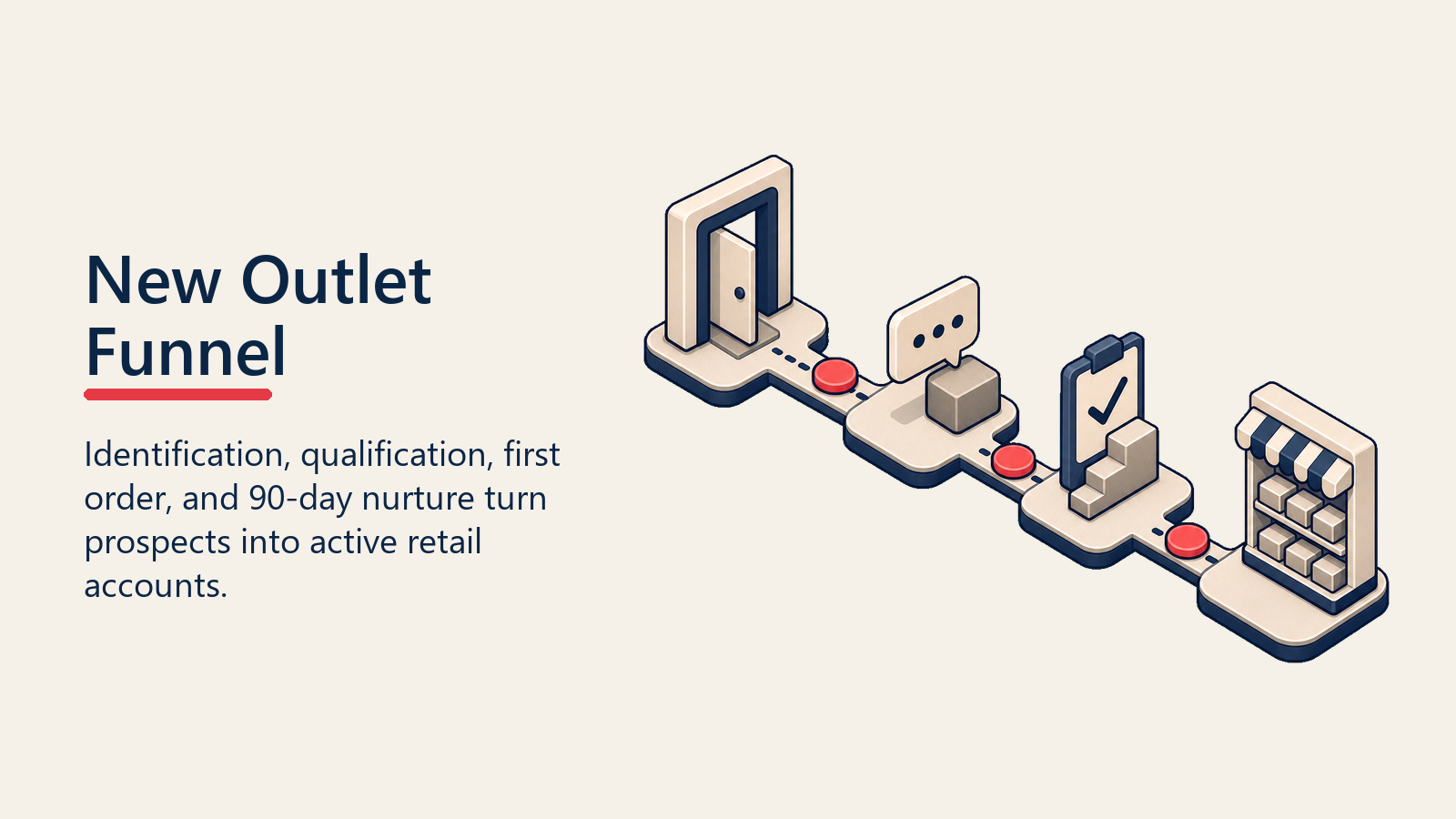
Stage 1: Identification
You can't acquire outlets you haven't found. Identification draws from three sources:
Census gap analysis: Compare your active outlet list against your outlet universe census. Every outlet in the census that isn't in your active list is a prospecting target. If your outlet universe census is current and accurate, this is your most reliable identification source because it's systematic rather than opportunistic.
Rep prospecting: Reps identify uncovered outlets during their regular beat visits. A rep walking past a new shop opening should log it as a prospect in the Sales Force Automation (SFA) system on the spot, even if they can't stop that day. Train reps to flag new outlets as a standard part of every visit, not an exceptional activity.
Competitive mapping: Where is your competitor distributed that you aren't? In markets where a competitor has higher numeric distribution, their coverage map is a prospecting list. Identify clusters of outlets where they're present and you're not, and prioritise those geographies for acquisition activity.
Stage 2: Qualification
Not every unserved outlet is worth acquiring. Before a rep invests call time and the distributor invests credit in a new account, it should meet a minimum qualification threshold:
| Qualification Criterion | Pass Standard |
|---|---|
| Category active | Outlet currently sells the category in some form (any brand) |
| Volume potential | Estimated monthly offtake meets Bronze tier minimum |
| Location viability | Located within an accessible beat, not isolated from route |
| Owner receptivity | Owner willing to take first meeting / first order discussion |
| Credit eligibility | Passes distributor credit check or willing to trade cash-first |
Reps who skip qualification end up opening outlets that can't meet minimum volume, creating credit risk for the distributor, and cluttering the active outlet list with accounts that will lapse within 60 days. The qualification step should take no more than 5-10 minutes at the outlet. It filters out the deals that look good at the door and fail at the first repeat.
Stage 3: First Order and Activation
This is the commercial moment. The rep gets the first order placed. But the first order alone doesn't mean the outlet is activated. Activation means:
Minimum assortment on shelf: The outlet isn't just holding stock in the back room. The defined minimum SKU set for that channel class is on the shelf, in the right position, with visible pricing.
Planogram compliance: For outlets with defined shelf standards, the first visit after order placement should include a shelf-set. Don't leave this to chance or to the outlet owner's preference.
Credit terms confirmed: The distributor has the outlet on the right credit terms and the rep has confirmed the owner understands the order cycle. Ambiguity about payment terms is the most common cause of early lapse.
SFA record complete: The outlet is in the system with GPS, channel class, segment, assigned rep, and the 90-day activation checklist triggered.
Stage 4: 90-Day Nurture to Secure Repeat
This is where most operations fail. The first order is celebrated. The follow-up doesn't happen on schedule. By day 30 the outlet hasn't reordered, the shelf is nearly empty, and the rep has moved on to other priorities.
The 90-day activation sequence is non-negotiable for any outlet you've invested rep time in acquiring:
| Day | Activity |
|---|---|
| Day 7 | First follow-up visit: check stock, confirm shelf position, take second order |
| Day 14 | SFA check: has second order been received and delivered? If not, investigate |
| Day 21 | Second rep visit: business review, assess sell-through, introduce second SKU if sell-through strong |
| Day 30 | Activation review: is the outlet on track for repeat ordering? Flag at-risk accounts to area manager |
| Day 45 | Mid-cycle check: volume trend against tier projection |
| Day 60 | Third visit: provisional tier classification, planogram review |
| Day 90 | 90-day graduation review: confirm tier, integrate into standard beat schedule |
An outlet that completes the 90-day sequence with three or more repeat orders and minimum assortment compliance can be considered fully activated. It earns its place on the standard beat and is classified at its appropriate tier. An outlet that hasn't placed a second order by day 30 is at high risk of lapse and needs manager attention, not just rep follow-up.
Common Failure Points
Understanding where the process breaks down is as important as understanding the process itself.
Reps open outlets but don't return
The most common failure. A rep opens five new outlets in a week, feels good about the numbers, and doesn't have the beat capacity to follow up on all of them within seven days. By the time they return, two outlets are out of stock and have started selling a competitor instead.
The fix is capacity management. Don't let reps take on more new outlet activation than their beat can support in the 90-day follow-up window. A rep who can only do two meaningful new outlet follow-ups per week should open a maximum of two new outlets per week. See Beat and Journey Planning for how to build new outlet follow-up capacity into beat design.
First orders are too small to sustain
A rep who wants to make a sale easy takes whatever order the outlet is willing to give. An outlet ordering two packs of one SKU isn't really activated; it's a trial that will run out before the rep returns. First orders should meet a minimum volume threshold that guarantees enough stock to sell through at the expected rate and still have residual stock when the rep returns at day 7.
The minimum first order should be defined by category and enforced in the SFA. If the outlet won't take the minimum, it hasn't been sold in; it's been given a sample.
Credit issues block repeat purchases
In markets where outlet credit is tight and distributor credit terms are strict, an outlet that can't extend its credit line after the first order can't place a second order even if it wants to. The rep then gets blamed for a lapse that's actually a finance process failure.
The fix is to include a credit check in the qualification stage and to have a clear escalation path for credit term issues: who decides, how quickly, and with what criteria. Credit ambiguity is a silent lapse driver that most teams don't surface until month-end.
Setting New Outlet Targets
New outlet acquisition should be a managed key performance indicator (KPI) at area manager and national sales manager level, not an incidental activity. Here's a practical target-setting formula:
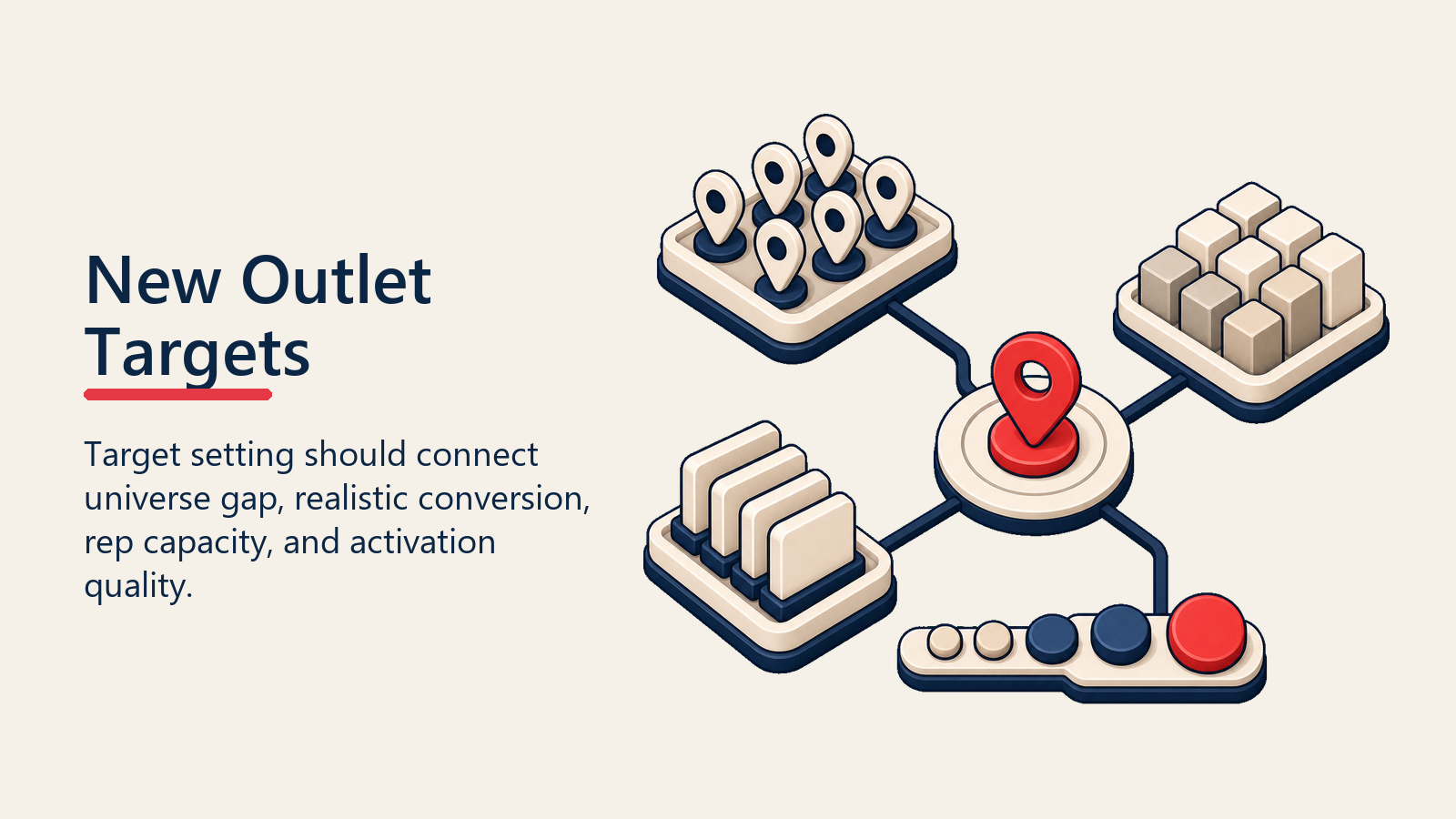
Monthly new outlet target per area = (Distribution gap x territory outlet universe) / 12 months
If an area has 2,000 outlets, currently covers 1,400 (70%), and the target is 85% distribution by year end, the gap is 300 outlets. Divided across 12 months, that's 25 new outlets per month per area. Adjusted for lapse rate (say 20%), the gross acquisition target is 31 new outlets per month to yield 25 net new active accounts.
At rep level, divide the area target by the number of reps with available new outlet capacity. A rep who is already fully loaded on existing account coverage shouldn't carry a new outlet acquisition target without a beat redesign to create the capacity.
Track actuals weekly. If a rep is running behind their monthly target mid-cycle, the area manager has enough time to intervene before the month closes. Monthly-only review means you can't recover when things slip.
Incentivising New Outlet Activation
Most incentive schemes pay on volume. A rep who opens 10 new outlets and nurtures them through 90 days of activation earns the same commission as a rep who ignores new outlet acquisition entirely if the volume from those new outlets is smaller than the volume from a single Diamond account.
Weight your incentive scheme to create an explicit new outlet premium. A points-based multiplier on first orders from net new accounts (accounts with no order history in the last 12 months) rewards acquisition without penalising existing account service. Set the multiplier high enough to make new outlet acquisition commercially attractive relative to the time cost of the 90-day follow-up sequence.
But don't make the incentive pay on first order alone. If the incentive pays at day 1, reps will open outlets and move on. If it pays at day 90 conditional on a minimum of three repeat orders, reps will nurture. Structure the incentive to reward the outcome you want, not the activity that precedes it.
For prospecting strategy guidance on how to structure targeted acquisition effort and prioritise where to prospect, that framework applies directly to the outlet identification stage.
SFA and DMS Workflow
The new outlet acquisition process only scales if it's built into the SFA workflow, not run on spreadsheets or messaging groups.
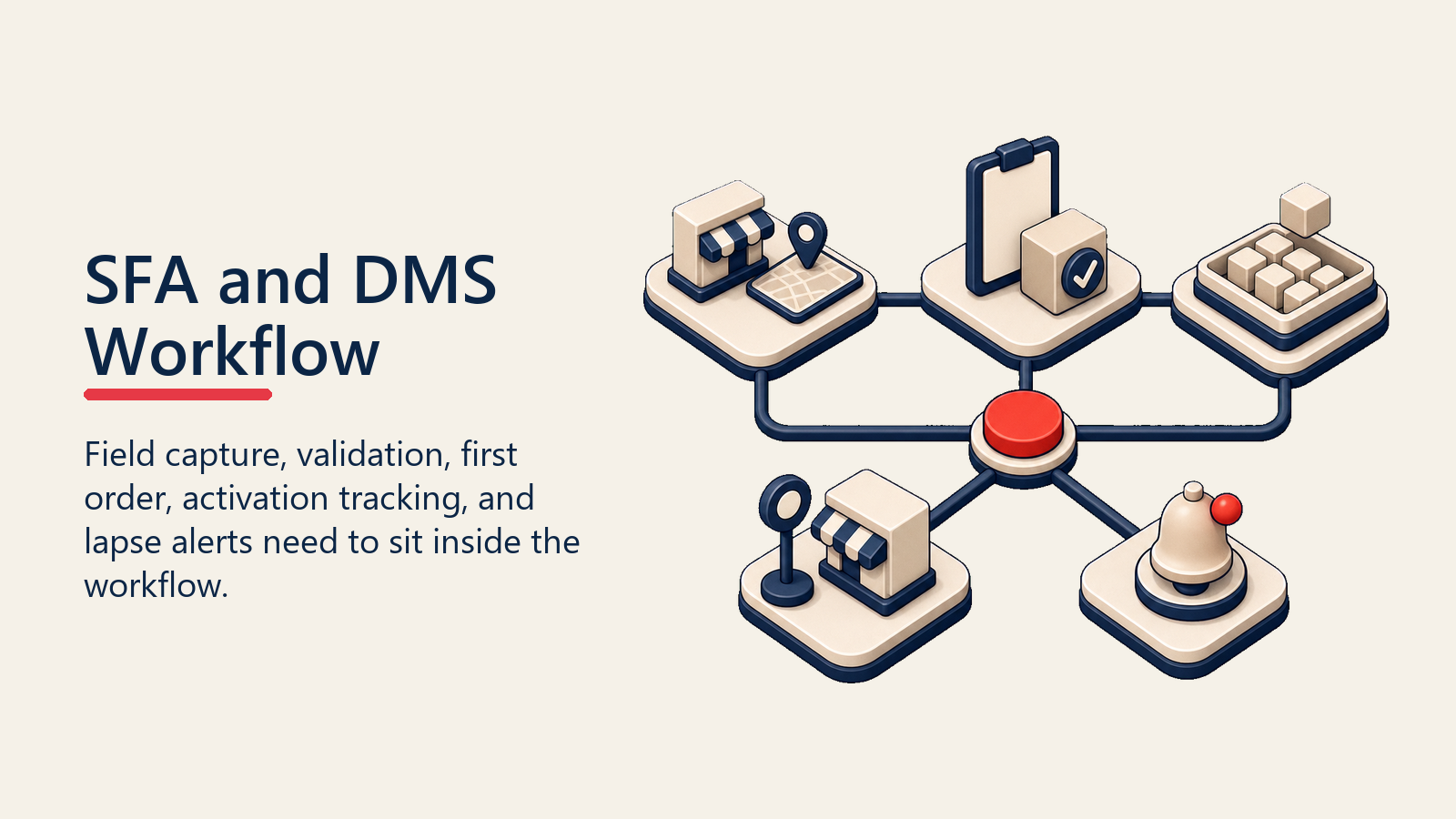
New outlet capture: When a rep identifies a new outlet, the SFA should allow them to create a new outlet record immediately in the field, capturing GPS, outlet name, owner name, channel class, and estimated volume tier. The record is created with status "prospect" and goes into a validation queue for the area manager.
Qualification flag: Once qualified, the record moves to "approved prospect" status and is assigned to a rep's beat for the first visit and first order call.
Activation checklist trigger: On first order placement, the SFA automatically creates the 90-day activation task list assigned to the responsible rep, with day-specific reminders.
Lapse alert: If a second order hasn't been placed by day 14, the SFA flags the account to the area manager as an at-risk activation. This removes the dependency on the rep self-reporting a problem that makes them look bad.
Beat integration: At day 90 graduation, the outlet is formally assigned to the standard beat schedule at its classified tier and removed from the activation tracking queue.
This workflow requires the SFA to have a new outlet lifecycle module. If yours doesn't, a shared tracking sheet managed by the area manager can replicate the logic, but it won't scale beyond 20-30 new outlets per month before becoming unmanageable. Bain's consumer-products commercial excellence practice reports that companies with structured route-to-market processes and systematic outlet coverage achieve 3-10% sales improvement while reducing the cost of the sales contact by 10-25%. That's the case for investing in this infrastructure rather than relying on informal tracking.
Frequently Asked Questions about New Outlet Acquisition
What is new outlet acquisition in FMCG?
New outlet acquisition is the process by which a field sales team identifies retail outlets that are not yet stocking the brand, converts them to first-order customers, and activates them into sustained accounts through structured follow-up over 90 days. It is the primary mechanism for growing numeric distribution without relying on price changes, promotional spend, or category growth.
What is a realistic monthly new outlet target for an area manager?
A practical formula: take the numeric distribution gap (target percentage minus current percentage) multiplied by the territory outlet universe, divide by 12 months, and adjust upward by the expected lapse rate. For an area with 2,000 outlets at 70% coverage targeting 85% in 12 months, the gap is 300 outlets. Divided by 12, that's 25 net new active outlets per month. At an estimated 20% lapse rate, the gross acquisition target is 31 new outlets per month to yield 25 net.
Why do new outlets lapse after the first order?
The most common causes are insufficient follow-up (no second visit within 7 days), first orders too small to sustain minimum shelf presence until the rep returns, and credit term ambiguity that blocks the second order even when the outlet wants to reorder. These are process failures, not outlet failures. The 90-Day Activation Protocol addresses all three by creating a structured rep visit schedule and escalating at-risk accounts to the area manager at day 30 rather than day 90.
How do you qualify a new outlet before investing rep time?
A basic qualification check covers five criteria: the outlet sells the category in some form (any brand), its estimated monthly offtake meets the Bronze tier minimum, it is located within an accessible beat, the owner is willing to take a first meeting, and it passes the distributor's credit check or is willing to trade cash-first. The check should take no more than 5-10 minutes at the outlet. Skipping qualification results in opened accounts that can't sustain minimum volume, create credit risk, and clutter the active account list with accounts that will lapse within 60 days.
What is the 90-day activation window and why does it matter?
The 90-day window is the period during which a new outlet is most vulnerable to lapse and most responsive to rep investment. Research from FMCG route-to-market practice suggests that an outlet that does not place a second order within 14 days of its first delivery is unlikely to become a sustained active account without direct management intervention. The 90-day sequence structures seven rep touchpoints at days 7, 14, 21, 30, 45, 60, and 90, with a graduation review at the end to confirm that the outlet is ready to enter the standard beat cycle.
How should new outlet acquisition be incentivised without rewarding early lapse?
Do not pay incentives on first order alone. If the incentive pays at day 1, reps will open outlets and move on. A points multiplier on new accounts that pays at day 90, conditional on a minimum of three repeat orders, rewards the outcome: a sustained active account. Use the multiplier on the first orders from accounts with no order history in the last 12 months to make new outlet acquisition commercially attractive relative to the time cost of the 90-day follow-up sequence.
What SFA features are necessary to run a formal new outlet acquisition process?
The SFA needs four capabilities: (1) a new outlet creation flow in the field that captures GPS, channel class, owner name, and estimated tier; (2) a qualification status flag (prospect, approved prospect, active) that triggers area manager review; (3) an automatic 90-day activation task list on first order placement, with day-specific rep reminders; (4) a lapse alert that flags accounts with no second order by day 14 to the area manager without requiring the rep to self-report. Teams running this process on spreadsheets typically hit a ceiling at 20-30 new outlets per month before the tracking becomes unmanageable.
Learn More
For FMCG commercial teams building or improving their new outlet acquisition capability, these articles connect the acquisition process to the broader distribution growth framework:
- Outlet Universe and Census - building the outlet database that identifies acquisition targets
- Outlet Segmentation and Classification - classifying new outlets at the point of acquisition
- Beat and Journey Planning - building follow-up capacity into rep routes for 90-day activation
- Numeric and Weighted Distribution - measuring the distribution gain from new outlet activation
- Prospecting Strategy - systematic prospecting frameworks applicable to outlet identification
- Beat and Route Journey Planning - activation and follow-up visit structure from pharmaceutical field sales