Outlet Segmentation and Classification: How to Prioritize Every Retail Outlet in Your Territory
Turn this article into takeaways for your work.


Each assistant summarizes the article only for you and suggests best practices for your work.
Not all outlets are equal. But walk into most fast-moving consumer goods (FMCG) area manager reviews and you'll find the same problem. Rep routes visit a 200-square-metre supermarket and a two-shelf kirana on the same weekly schedule. Trade investment is spread evenly across account tiers. Call objectives look nearly identical regardless of what the outlet actually sells.
The cost of this isn't just inefficiency. It's misallocated revenue. Reps who should be spending more time at high-value outlets get pulled to low-potential accounts. Trade spend that should be concentrated on volume drivers is scattered across outlets that can't move enough product to justify the investment. And commercial plans built on that undifferentiated foundation almost always underperform.
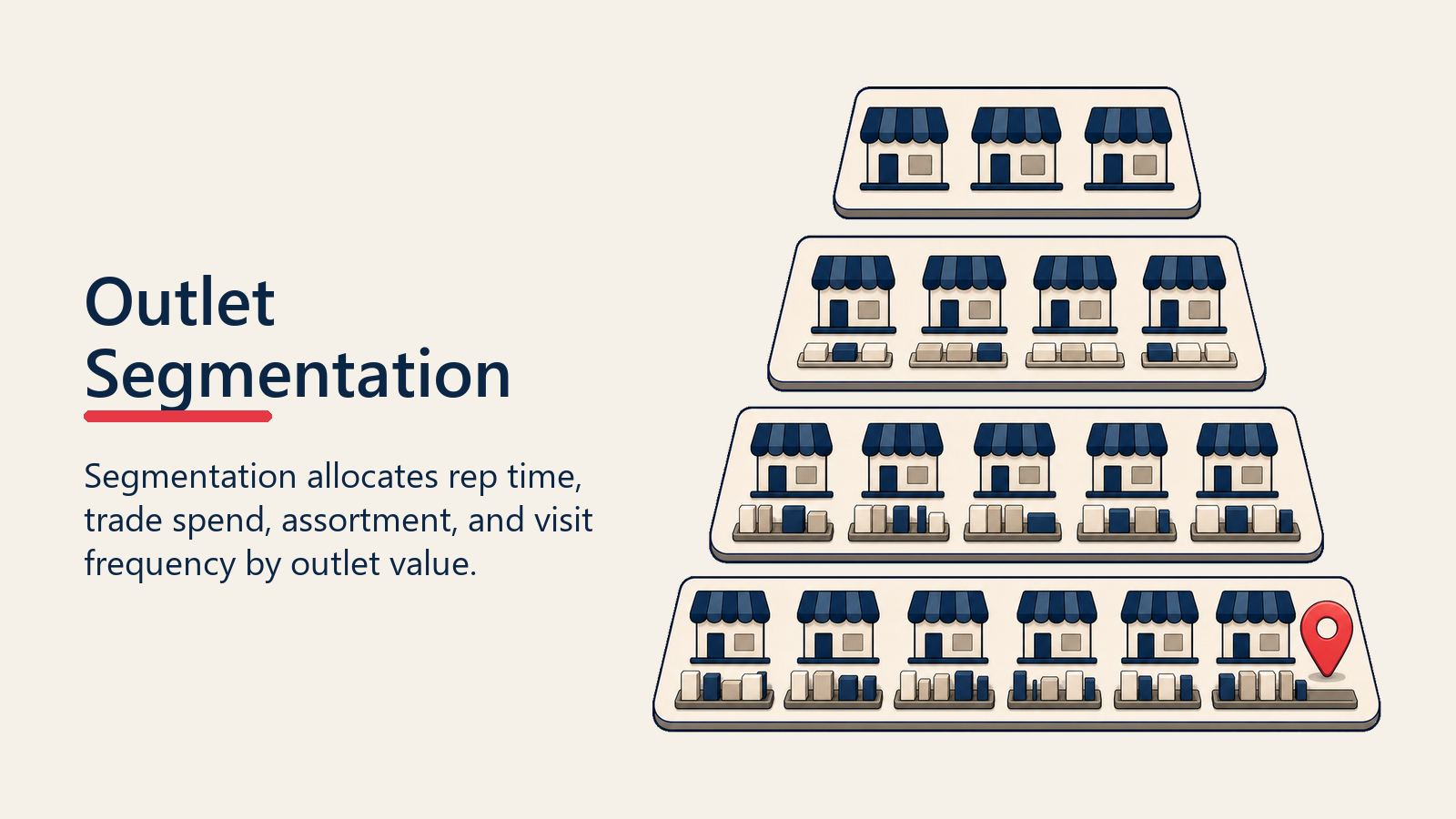
Outlet segmentation is the discipline that fixes this. Done well, it turns your outlet universe from a flat list of accounts into a prioritised, fundable commercial plan where rep time, call frequency, assortment standards, and trade investment are allocated in proportion to each outlet's real and potential value to the brand.
Key Facts
- In one NielsenIQ Vietnam study (biscuits and cakes category, Mekong Delta region), the top 50% of stores by volume accounted for 86% of category sales, and a manufacturer absent from 44,000 Gold and Silver priority stores was missing 57% of category sales volume, per NielsenIQ's distribution analysis in Vietnam. The specific numbers vary by category and market, but the underlying pattern (that outlet value is highly concentrated) is consistent across FMCG contexts.
- FMCG companies applying differentiated service models typically find the top 20% of outlets by volume account for 60 to 70% of total brand offtake, as a rough planning benchmark widely observed in distributor secondary sales data audits. Undifferentiated coverage models systematically underserve the accounts in this top tier.
- Over-classification inflates service cost without proportional revenue return. The highest-performing FMCG field operations typically maintain Diamond-tier outlets at under 5% of the total universe, as a calibration guideline based on field operations experience across emerging markets.
Segmentation Dimensions: The Variables That Matter
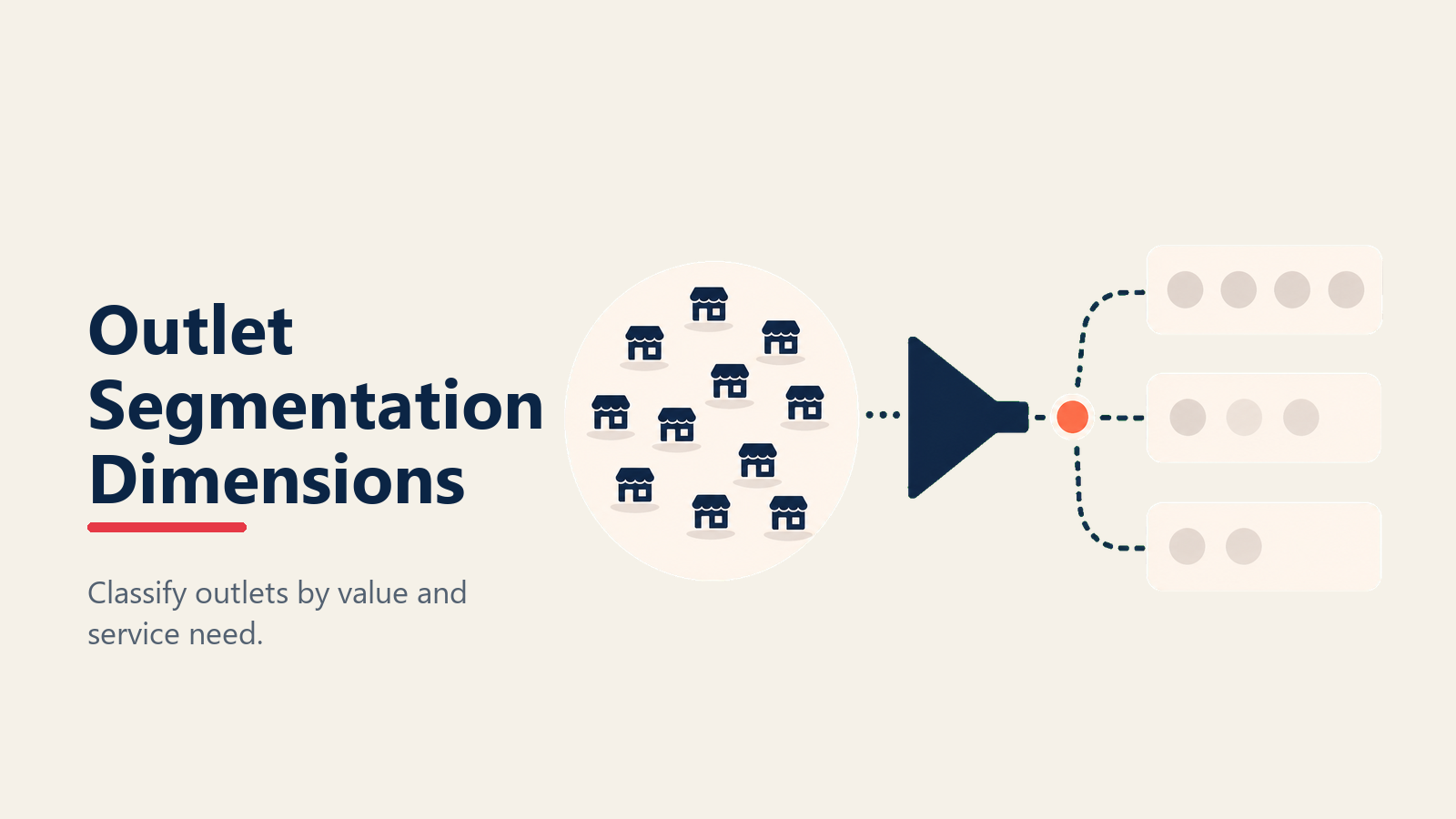
Outlet segmentation starts with deciding which variables actually predict commercial value. There are dozens of factors you could consider. The ones that reliably discriminate between high- and low-priority outlets in FMCG field sales are:
Volume Tier (Current Offtake)
What is this outlet actually moving? Monthly secondary sales, drawn from distributor management system (DMS) data or SFA order history, gives you the clearest signal of current commercial weight. An outlet moving 50 cases a month is commercially different from one moving 5, regardless of what the store front looks like. Volume tier is the primary segmentation input because it's objective, quantifiable, and directly linked to revenue.
Growth Potential
Not every high-potential outlet is currently a high-volume outlet. A new convenience store opening in a transit hub might be moving low volumes in its first month but have clear trajectory to becoming a top-20 outlet within a year. Growth potential factors include shopper footfall (estimated from location and format), surrounding residential and commercial density, format trajectory (is this a kirana modernising toward a mini-mart?), and category headroom (what share of the outlet's basket is currently your brand vs. competitor vs. unmet?).
Channel Class
The channel an outlet operates in shapes how you sell to it, what assortment it needs, how it orders, and how it influences shopper behaviour. Kirana and informal trade outlets operate on personal relationships, small frequent orders, and owner-managed shelf decisions. Modern grocery and supermarket channels involve formal ranging processes, planogram compliance, and category management conversations. HoReCa channels consume your product differently from retail and require a separate commercial approach entirely. Channel class isn't a proxy for volume, but it determines the service model that's commercially appropriate.
Strategic Importance
Some outlets matter beyond their volume. A flagship outlet on a high-traffic street anchor might not be your biggest volume account, but it's the outlet that shapes how shoppers perceive your brand's availability. A wholesaler at a market hub might have modest direct offtake but influences the buying decisions of 200 downstream retailers. Strategic importance accounts for these indirect commercial roles. Once you know which dimensions matter, the question is how to turn them into a workable tier structure.
A Practical Four-Tier Model
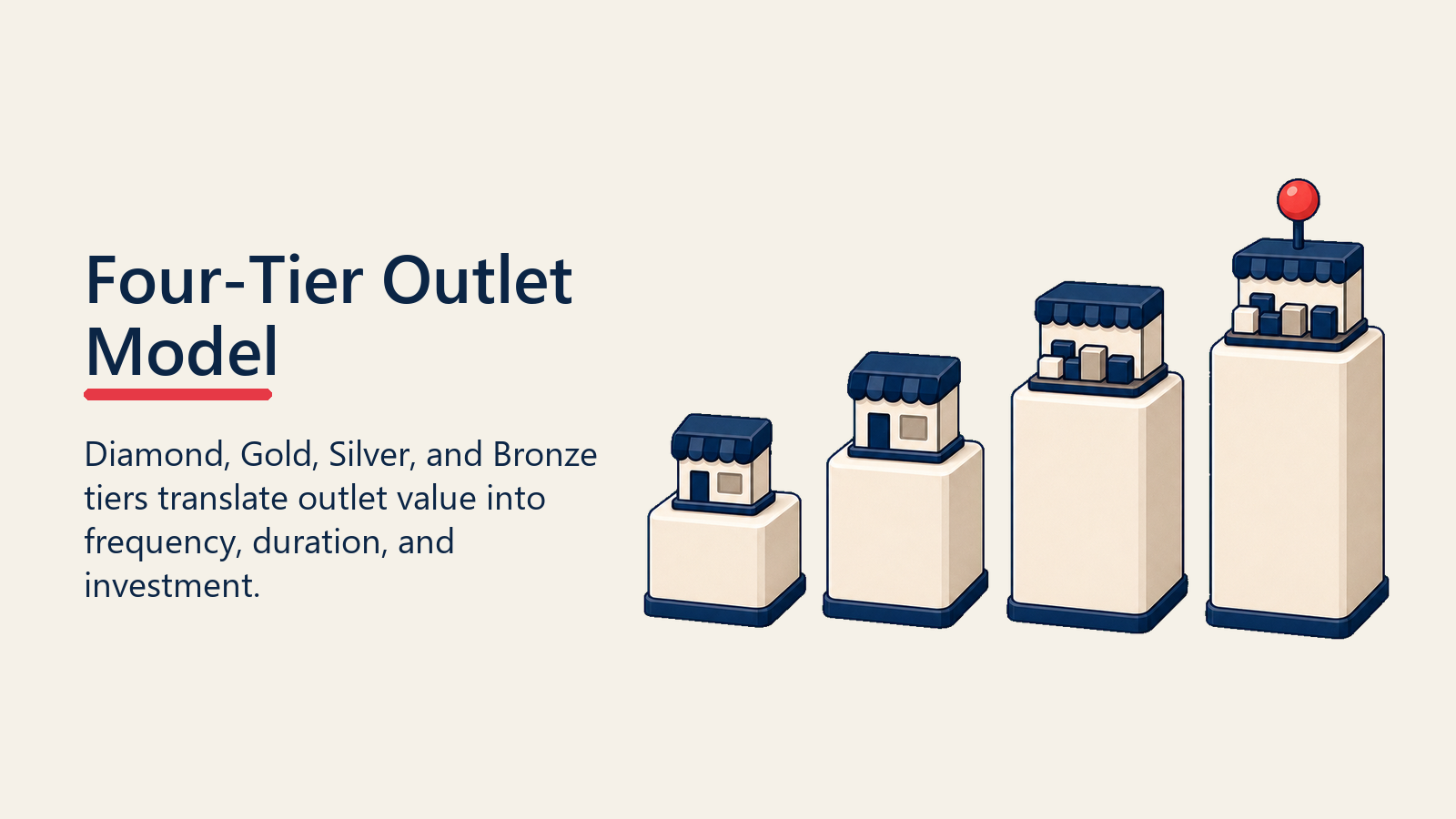
Most FMCG field operations that have moved past the "all outlets are equal" default land on some version of a four-tier model. The labels vary by company, but the structure is consistent: a small top tier of highest-value accounts, a larger second tier of strong performers, a broad third tier of standard accounts, and a foundational fourth tier of low-volume or low-potential outlets that still need coverage but at minimum cost.
| Tier | Criteria | % of Universe (Typical) | Visit Frequency | Call Duration |
|---|---|---|---|---|
| Diamond | Top 5% by volume AND strategic anchor status OR flagship visibility | 3-5% | 2x per week | 45-60 min |
| Gold | Top 20% by volume OR high growth potential AND current volume above threshold | 15-20% | Weekly | 30-45 min |
| Silver | Mid-volume, stable offtake, standard format | 35-45% | Fortnightly | 20-30 min |
| Bronze | Low volume, low potential, or newly acquired outlets not yet classified | 30-40% | Monthly | 15-20 min |
The percentage splits and frequency standards should be calibrated to your specific market and field force capacity. These ranges reflect what tends to work in FMCG field operations across Southeast Asia, South Asia, and sub-Saharan Africa, but the right numbers for your territory come from a capacity calculation that starts with your outlet census. See Outlet Universe and Census for how that census data feeds into tier sizing.
Classification Criteria: How to Assign Tiers at Scale
The Four-Tier Outlet Segmentation Model: a structured classification framework that assigns every outlet in the census to one of four service tiers (Diamond, Gold, Silver, Bronze) based on current volume, growth potential, channel class, and strategic importance. The model then translates each tier into a differentiated service standard: visit frequency, call duration, assortment requirements, and trade spend eligibility. The critical output is not the label but the differentiated action: two outlets classified at Silver should receive identical service standards; a Diamond outlet and a Bronze outlet on the same rep's beat should look like completely different commercial relationships.
Assigning 8,000 outlets to four tiers manually doesn't scale. The practical approach is to define rule-based classification criteria that can be applied systematically using SFA data and distributor offtake.
Step 1: Pull secondary sales data by outlet From your distributor management system (DMS) or sales force automation (SFA) platform, extract monthly offtake per outlet for the last three months. This gives you a current volume ranking that's free from outlier distortion.
Step 2: Apply volume thresholds Define the volume bands that separate Diamond from Gold from Silver from Bronze. In a market where average monthly offtake per outlet is 15 cases, your Diamond threshold might be 60+ cases, Gold 30-60, Silver 10-30, Bronze under 10. These thresholds are market-specific and should reflect your actual offtake distribution, not a generic standard.
Step 3: Apply override rules for growth potential and strategic importance Outlets that fall below the volume threshold for Gold but show strong growth indicators (opened in the last 6 months, high footfall location, format upgrading) should be flagged for manual review and considered for a higher provisional tier. Strategic importance overrides should be applied sparingly, by the area manager, with documented rationale.
Step 4: Validate and assign The system produces a draft classification list. Area managers review outliers, apply overrides, and lock the classification. The final assigned tier is written back to the outlet record in the SFA.
This process can be run in a single day for a territory of several thousand outlets once the data infrastructure is in place. The first run is always the hardest because it exposes data quality gaps. See Coverage and Frequency Optimization for how classification feeds into visit frequency design.
Segment-Specific Service Models
Classification is only valuable if it changes what you actually do at each outlet. Here's what differentiated service looks like across the four tiers:
Diamond: Maximum investment, maximum return Diamond outlets get senior rep coverage where possible, or your strongest performers. Visit frequency is twice weekly. Call objectives always include a business review: secondary sales trend, competitor shelf share, promotional compliance, and an explicit order or ranging ask. Trade spend at Diamond outlets is proactive: funded displays, co-investment in promotional activity, loyalty program participation. Planogram compliance is tracked at every visit. These are the accounts where even a 5% improvement in service quality moves the needle on total brand offtake.
As the NielsenIQ Vietnam biscuits finding in Key Facts shows, the top half of stores by volume accounted for 86% of category sales in that study. If Diamond and Gold tiers are calibrated correctly to cover the volume-generating accounts, the service model is concentrating investment where most of the commercial return actually sits. If Diamond and Gold are over-inflated to cover 30% or 40% of the universe, the concentration effect disappears and the model reverts to something that looks differentiated on paper but operates like an undifferentiated one in practice.
Gold: High frequency, targeted investment Gold outlets receive weekly visits with clear call objectives and a defined assortment standard. Trade spend is allocated based on promotional calendars, with funds available for execution support. Reps at Gold outlets are expected to conduct a stock check and shelf management activity at every visit, not just collect the order.
Silver: Efficient coverage, consistent standards Silver outlets are the backbone of your numeric distribution. Fortnightly visits keep the relationship alive and prevent out-of-stocks, but call duration is shorter and trade spend is lighter. The service objective at Silver is consistency: the right SKUs on shelf, the right position, and a regular order cycle.
Bronze: Minimum viable coverage Monthly visits at Bronze outlets are primarily stock checks and order consolidation. Trade spend here is close to zero. The question to ask about Bronze outlets is whether some of them should be moved to indirect service (served by a sub-distributor or a van sales route rather than a direct rep), which frees rep time for higher-tier accounts. The distinction between numeric and weighted distribution matters here: weighted distribution accounts for how much category volume flows through each outlet, so a Bronze account with high store traffic may carry more commercial weight than its order volume alone suggests. Beat and Journey Planning covers how to incorporate that decision into route design.
How Often Should You Re-Classify Outlets?
Segmentation isn't a one-time labelling exercise. Outlets move up and down, and a classification that was accurate in January becomes misleading by Q3 in any market with meaningful new-outlet activity or economic volatility. A Gold outlet that loses its anchor tenant and sees footfall collapse needs to drop to Silver. A Bronze kirana that a rep has been nurturing and that has now tripled its monthly offtake deserves promotion to Silver or Gold. And new outlets entering the universe need to be classified before they're assigned to a beat, not left on a default tier indefinitely.
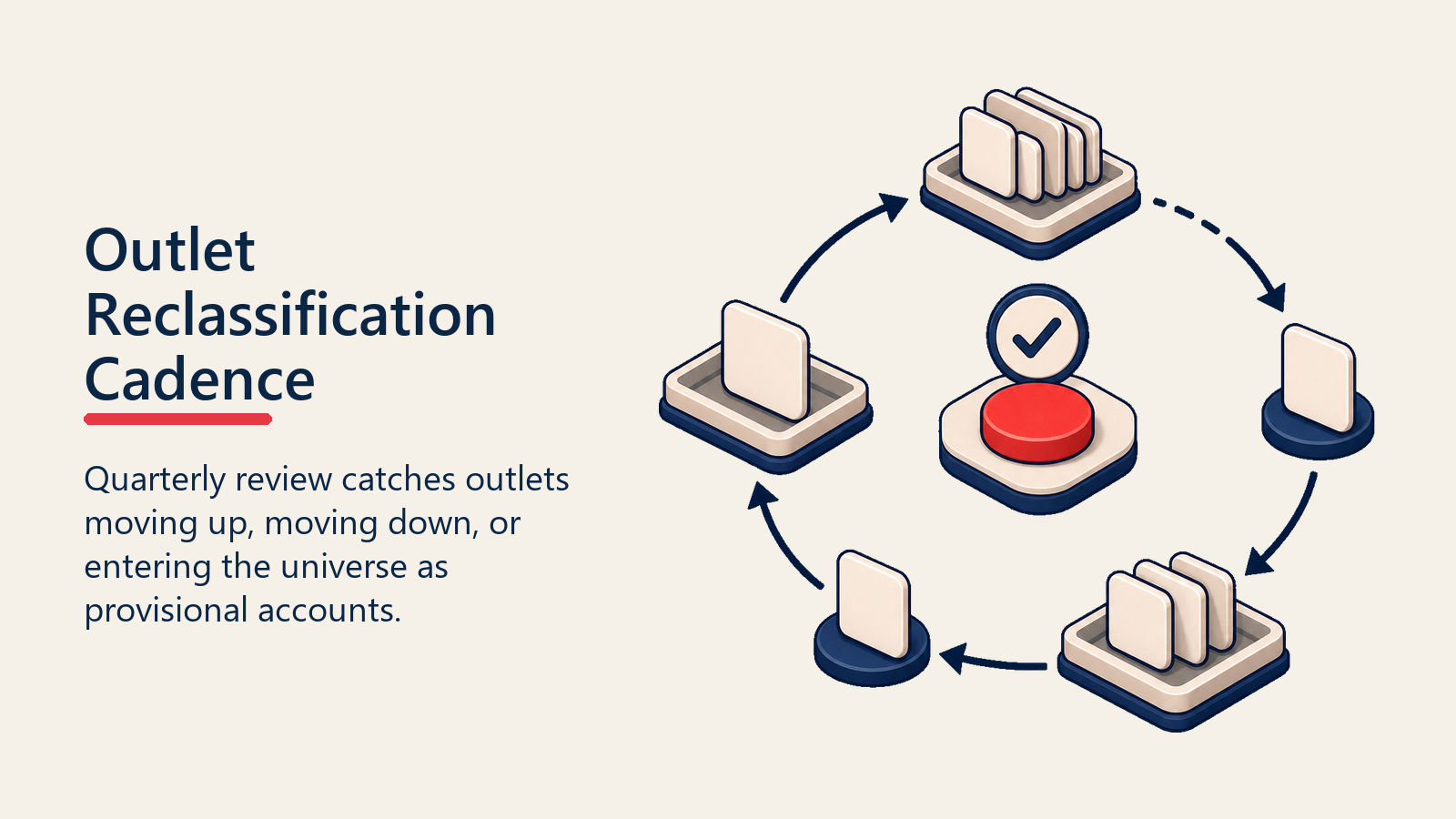
The practical cadence is a quarterly review cycle:
Month 1 and 2: Track performance against tier expectations. Flag outliers (high-tier outlets underperforming, low-tier outlets consistently exceeding their tier ceiling).
Month 3: Pull refreshed offtake data. Apply the classification algorithm. Review flagged outliers manually. Produce an updated classification list. Area managers approve changes. Updated tiers are written to SFA.
Between cycles: New outlets entering the universe get a provisional classification (usually Bronze or Silver based on estimated potential) with a 90-day review scheduled automatically. Don't wait until the next quarterly cycle to classify a new high-potential outlet.
Retailer loyalty programs often tie tier classification to reward levels, which creates an incentive structure that makes reclassification visible to outlet owners and can reinforce the commercial relationship. See Retailer Loyalty Programs for how to connect those programs to your segmentation model.
Common Mistakes
Over-classifying Diamond and Gold The most common failure mode is too many high-tier outlets. When managers want to keep key retailers happy, they bump them to Diamond or Gold regardless of actual volume. This inflates the service cost of the highest tiers and spreads rep time too thin across "strategic" accounts that are only strategically important in a loose sense. Diamond should be genuinely rare: 3-5% of the universe, at most.
Missing high-potential new openings New outlets opening in developing residential or commercial areas often don't get classified at all, or get stuck at Bronze because their first-month offtake is low. The growth signal isn't in the first order; it's in the location, the format, and the rate of ramp. Build explicit rules for provisional upgrade of new outlets based on location score and format indicators.
Ignoring channel class in service model design A Silver-tier kirana and a Silver-tier pharmacy are not the same commercial account. They need different call objectives, different assortment standards, and different relationship management. Pure volume-based segmentation misses the channel dimension. Layer channel class on top of tier to differentiate the service model where it matters.
Treating segmentation as annual Annual classification cycles are too slow for dynamic markets. An outlet that collapsed in February shouldn't still be receiving Diamond service in November. Quarterly is the minimum; in high-churn markets, consider monthly for the top tiers. Which brings up a practical question: how do you handle new outlets that enter the universe between cycles?
Frequently Asked Questions about Outlet Segmentation and Classification
What is outlet segmentation in FMCG?
Outlet segmentation is the process of classifying every retail outlet in your coverage universe into tiers based on commercial value, typically current volume, growth potential, channel class, and strategic importance. Each tier then receives a differentiated service standard: specific visit frequency, call duration, assortment requirements, and trade spend eligibility. The goal is to concentrate rep time, coaching attention, and trade investment proportionally to where the commercial return actually sits, rather than spreading them evenly across accounts that contribute very differently to total brand offtake.
What are the four standard outlet tiers in FMCG segmentation?
The most common framework uses Diamond, Gold, Silver, and Bronze tiers. Diamond outlets, typically 3 to 5% of the universe, are the highest-volume accounts with strategic visibility, receiving twice-weekly rep visits and proactive trade investment. Gold outlets, around 15 to 20% of the universe, get weekly coverage with structured call objectives. Silver outlets, the bulk of the numeric distribution base at 35 to 45%, receive fortnightly visits focused on consistency. Bronze outlets, 30 to 40% of the universe, get monthly visits or indirect service through wholesale or sub-stockist channels.
How do you classify outlets at scale without doing it manually?
Pull three months of secondary sales data by outlet from your DMS or SFA. Apply volume thresholds that match your market's offtake distribution: in a market where average monthly offtake per outlet is 15 cases, Diamond might be 60+ cases, Gold 30 to 60, Silver 10 to 30, Bronze under 10. Apply override rules for growth potential (new openings in high-footfall locations) and strategic importance (hub wholesalers, flagship street positions). The system produces a draft classification; area managers review outliers and lock it. The process takes one day in a territory of several thousand outlets once the data infrastructure is in place.
How do you handle new outlets entering the universe?
New outlets should receive a provisional classification, usually Silver or Bronze based on estimated potential, with a 90-day automatic review scheduled from the date they enter the system. Don't wait for the next quarterly cycle to classify a new high-potential outlet: a convenience store opening in a transit hub with clear trajectory to top-20 volume status will be severely undersupported on a Bronze service model for months if you follow the standard calendar. The 90-day provisional review is the mechanism that catches these.
Why does over-classifying Diamond and Gold outlets hurt commercial performance?
When too many outlets are classified in the top tiers, rep time gets spread across accounts that don't warrant the service intensity. The practical effect is that the reps assigned to Diamond and Gold accounts have too many priority stops to execute each one at the standard the tier requires. Visit duration drops, business review conversations get skipped, and the commercial value of the top-tier service model erodes. Diamond should be genuinely rare: if 15% of your outlets are classified Diamond, the label has lost its meaning as a concentration mechanism.
When should an outlet be moved to indirect service rather than a direct rep visit?
When an outlet's average order value per direct visit falls below the break-even threshold for that rep's cost structure, a direct visit isn't covering the cost of the call. Those outlets, typically lower-volume Bronze accounts in dispersed geography, are better served by a sub-stockist, a wholesale route, or a digital ordering channel. Moving them frees the rep's time for higher-tier accounts and improves the economics of the direct coverage model. The segmentation model is what makes this decision explicit rather than arbitrary.
Learn More
For FMCG commercial teams building an allocation-based service model from their outlet universe, these resources connect the segmentation framework to adjacent decisions:
- Outlet Universe and Census - building the outlet database that segmentation starts from
- Beat and Journey Planning - translating tier-based frequency standards into executable rep routes
- Coverage and Frequency Optimization - calibrating visit frequency by tier to available field force capacity
- Retailer Loyalty Programs - linking tier classification to structured retailer incentives
- Ideal Customer Profile - defining which outlet types to prioritise for acquisition and investment
- Customer Segmentation - post-sale segmentation principles that mirror outlet classification logic
- Call Frequency and Coverage Optimization - frequency-setting methodology from pharmaceutical field sales, directly applicable to FMCG