Quick Commerce and Dark Store Selling: The New FMCG Channel Playbook
Turn this article into takeaways for your work.


Each assistant summarizes the article only for you and suggests best practices for your work.
A quick commerce dark store isn't a small modern trade outlet, and treating it like one is the most common mistake FMCG sales teams make when this channel starts showing up in their revenue mix. There's no shopper walking the aisle. There's no rep-outlet relationship built over years of weekly visits. There's an app, an algorithm deciding what shows up in a 10-minute delivery radius, and a warehouse operations team that cares about pick efficiency more than brand loyalty.
Quick commerce has grown from a niche urban convenience play into a meaningful share of FMCG sales in dense metro markets, and it runs on fundamentally different mechanics than general trade or traditional modern trade. This article covers how listing, fulfillment, merchandising, and commercial terms need to change for this channel, and what a field sales and trade marketing team needs to do differently to compete in it.
How Dark Store Commerce Is Different From Traditional Retail
Four structural differences separate quick commerce from the channels most FMCG go-to-market playbooks were built around.
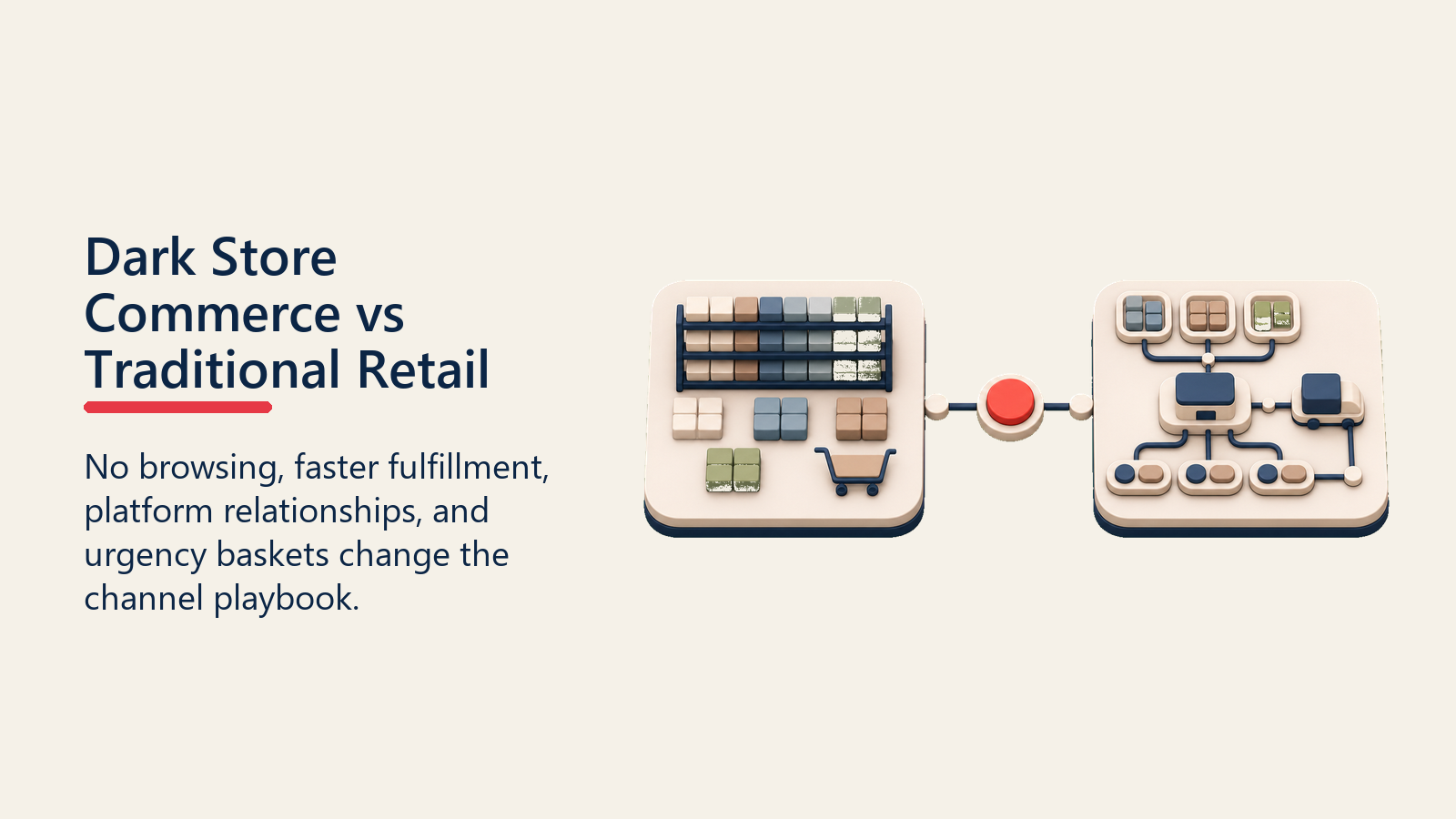
There's no physical browsing, only algorithmic placement. In a physical outlet, a shopper's eye is drawn by shelf position, facing count, and secondary display. In a quick commerce app, placement is determined by search ranking, category page position, and the platform's own algorithm, which weighs factors like historical conversion rate, margin to the platform, and inventory reliability. Winning shelf space in this channel means winning algorithmic visibility, a fundamentally different skill set than winning a planogram negotiation.
Fulfillment speed is the product itself, not a feature bolted onto it. McKinsey's analysis of quick commerce describes delivery windows compressing to 10-15 minutes, down from the 30-60 minute standard of earlier online grocery, fulfilled from dark stores or microfulfillment centers sited close to demand. That compression means the dark store's inventory accuracy and pick speed matter as much as the brand's own execution. A product that's frequently out of stock at the dark store level, even if overall distribution numbers look fine, gets algorithmically deprioritized over time because the platform optimizes for orders it can actually fulfill.
The commercial relationship is with a platform, not an outlet owner. There's no relationship-building visit, no owner to build trust with over time. The relationship is a data and commercial terms negotiation with a platform category manager, closer to a national account negotiation than a beat plan visit. See General Trade and Modern Trade eB2B for how eB2B ordering already shifted general trade partway toward this model, and quick commerce takes it further.
Basket composition skews toward convenience and urgency. Shoppers using quick commerce are frequently filling a gap (ran out of something, need it now) rather than doing a planned weekly shop. This changes which SKUs perform well: smaller pack sizes, higher per-unit margin categories, and impulse-adjacent products often outperform their traditional-trade sales mix on these platforms.
Key Facts: Quick Commerce and Dark Store Selling
- Quick commerce has grown into a meaningful and fast-expanding share of urban FMCG sales in many markets, with growth rates commonly reported well above traditional modern trade growth rates in the same period, though the exact share varies significantly by country and category. In India, one of the category's largest markets, market-research firm RedSeer's quick commerce tracking reported quick commerce GMV (gross merchandise value, the total value of orders placed on the platform) growing roughly 100% year over year as of January 2026, with dark store counts and order volume per dark store both still climbing month to month, a data point worth treating as directional rather than universal.
- Products with algorithmic search-ranking optimization (accurate titles, complete attribute data, strong review scores) see materially higher conversion on quick commerce platforms than products with incomplete listing data, based on common e-commerce merchandising practice.
- Dark store out-of-stock rates above 10-15% are commonly associated with declining platform search ranking over time, since fulfillment reliability is a ranking factor most platforms weigh directly.
Listing and Algorithmic Visibility
Getting listed on a quick commerce platform is a different process than getting listed at a general trade outlet, and it requires different inputs from the brand team. Think of it as Algorithmic Shelf Share: the digital equivalent of facing count and shelf position, earned through data completeness and fulfillment reliability instead of a planogram negotiation.
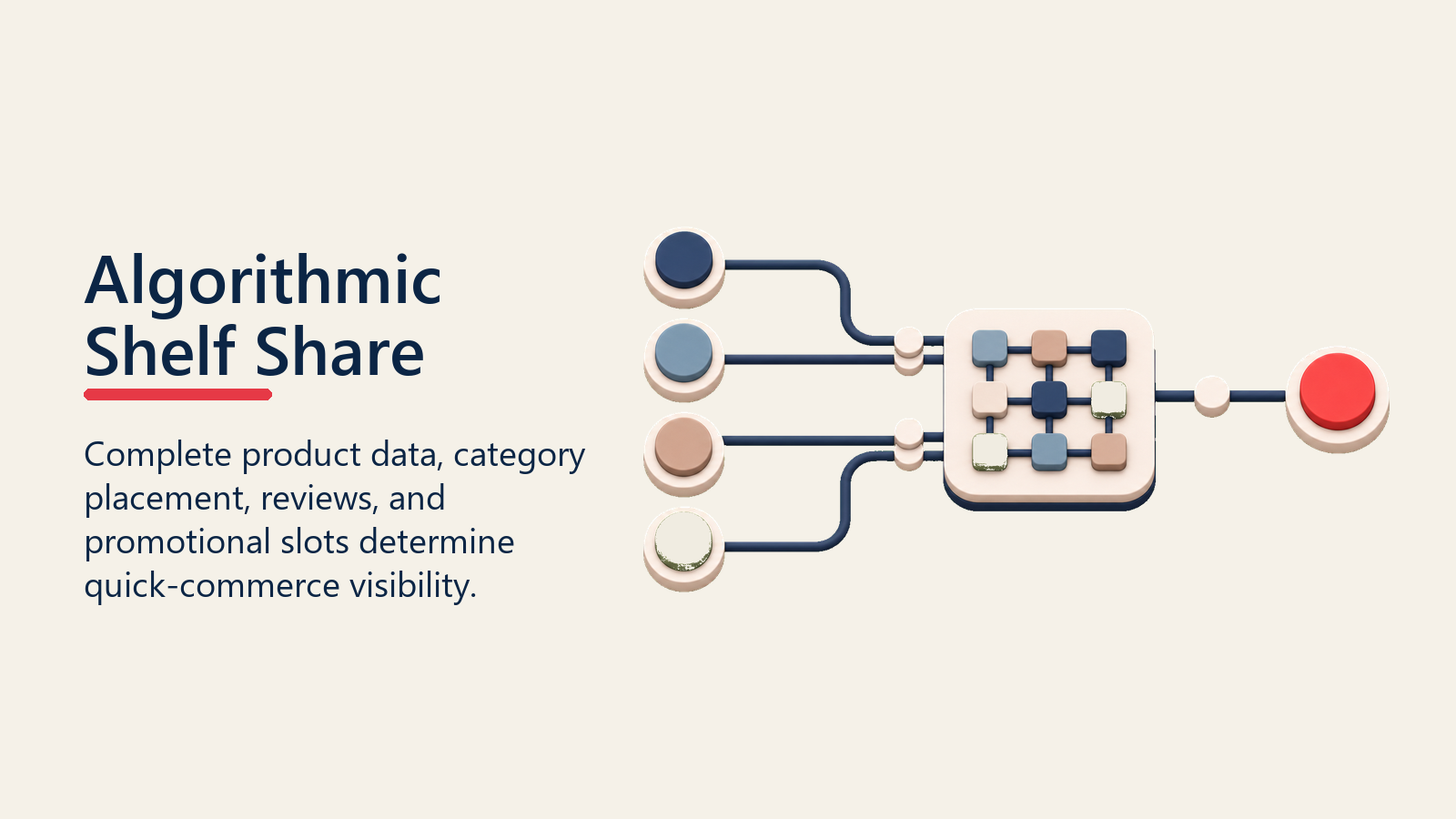
Complete and accurate product data. Title, description, category tags, pack size, and image quality all feed into platform search algorithms. A listing with incomplete attribute data or a generic product photo underperforms a competitor's listing with complete, keyword-optimized data, even if the underlying product is equally good. This is closer to an e-commerce SEO exercise than a traditional trade listing negotiation.
Category and sub-category placement. Platforms categorize products into search-relevant buckets, and getting placed in the right sub-category (and ideally multiple relevant ones) determines how often the product surfaces in a shopper's browse or search path. Review category placement quarterly, since platforms periodically restructure their taxonomy.
Review and rating management. Star ratings and review counts function as a trust signal in the algorithm and to shoppers directly. A product with strong offline brand equity but few platform reviews starts at a disadvantage against a newer competitor with an aggressive review-generation strategy on the same platform.
Promotional slot bidding. Most quick commerce platforms sell featured placement (banner ads, "sponsored" search results, category page takeovers) similar to e-commerce marketplace advertising. This requires a trade marketing budget line that most FMCG companies haven't historically needed for general or modern trade, and it needs its own ROI tracking separate from traditional trade spend.
Fulfillment and Inventory Management for Dark Stores
The commercial relationship with a quick commerce platform lives or dies on fulfillment reliability, which requires a different operational setup than servicing a traditional distributor or outlet.
Dedicated stock allocation, not overflow from general trade. Dark stores need consistent, reliable stock levels, and treating quick commerce as a channel that gets whatever's left over from general trade allocation guarantees stockouts during demand spikes. Set a dedicated minimum stock commitment per dark store cluster based on historical order velocity.
Faster replenishment cycles than traditional trade. A dark store selling through inventory in days, not weeks, needs a replenishment cadence that matches. Standard weekly or bi-weekly distributor delivery cycles are usually too slow for a channel where stockouts damage algorithmic ranking within days. This may require direct-to-dark-store delivery arrangements distinct from your standard Direct Store Delivery model, adapted for smaller, more frequent drop sizes.
Real-time or near-real-time stock visibility. Because the platform's algorithm reacts to stock availability quickly, the brand team needs visibility into dark store stock levels at a similar cadence, not the periodic secondary-sales reporting cycle used for general trade. See Secondary Sales and Stock Visibility for the data infrastructure question, which becomes more urgent, not less, in a quick commerce context.
Dark Store Fulfillment Checklist
- Dedicated minimum stock allocation set per dark store cluster, not shared with general trade
- Replenishment cycle matched to actual sell-through velocity, not a standard weekly default
- Stock visibility dashboard updated daily or near-real-time, shared with the platform where required
- Out-of-stock alert threshold set below 10% to catch ranking-risk stockouts early
- Backup supply arrangement in place for peak demand periods (holidays, weather events, promotional spikes)
Quotable Nuggets
A product that is technically well-distributed but frequently out of stock at the dark store level still loses algorithmic visibility, because most quick commerce platforms weigh fulfillment reliability directly in their search ranking.
Quick commerce delivery windows have compressed to 10-15 minutes from the 30-to-60-minute standard of earlier online grocery, according to McKinsey's analysis of the category, which is why dark store pick speed now matters as much as brand-level distribution strategy.
How Is the Commercial Terms Structure Different?
Quick commerce commercial terms typically differ from both general trade and traditional modern trade in structure, not just rate.
Platform margin or listing fee structures are frequently higher than traditional modern trade margins, reflecting the platform's fulfillment cost (rider network, dark store real estate, technology). Brands need to model the full margin stack, including any promotional slot spend, against the incremental volume the channel generates, rather than assuming general trade or modern trade margin benchmarks apply directly.
Promotional participation is often platform-driven rather than brand-initiated. Platforms run their own discount campaigns and may ask brands to fund a portion of the discount to participate in a featured promotional slot. Evaluate these opportunistically against expected volume lift, using the same cost-per-incremental-unit discipline used for trade promotion management (linked under Learn More), rather than accepting every promotional ask by default.
Payment and reconciliation cycles tend to be faster and more automated than traditional distributor relationships, which is an operational advantage, but requires finance and sales operations alignment on how platform revenue reconciles against the broader sales reporting structure so it doesn't create a blind spot in aggregate sales dashboards.
Merchandising for a Screen, Not a Shelf
Merchandising in quick commerce means optimizing digital presentation, and the skills required overlap only partially with traditional trade merchandising expertise.
Product photography and packaging visibility. A pack design that reads well on a physical shelf at a glance may not translate to a small product thumbnail on a phone screen. Review how key SKUs actually render at typical app thumbnail sizes. A print-quality product shot tells you almost nothing about that.
Bundle and combo offers built for basket-building. Quick commerce baskets tend to be smaller than a traditional grocery trip, so bundle offers ("add this for 20% off") that encourage a shopper to add a second item to an already-initiated order can lift average order value more effectively than a standalone discount.
Search term optimization tied to how shoppers actually search. Shoppers search quick commerce apps the way they search a general search engine, using generic category terms as often as specific brand names. Make sure product listings are tagged and titled to surface under both branded and generic category searches.
Coordinating Quick Commerce With the Rest of the Route-to-Market
Quick commerce shouldn't be managed as an isolated side channel disconnected from the rest of the commercial organization.
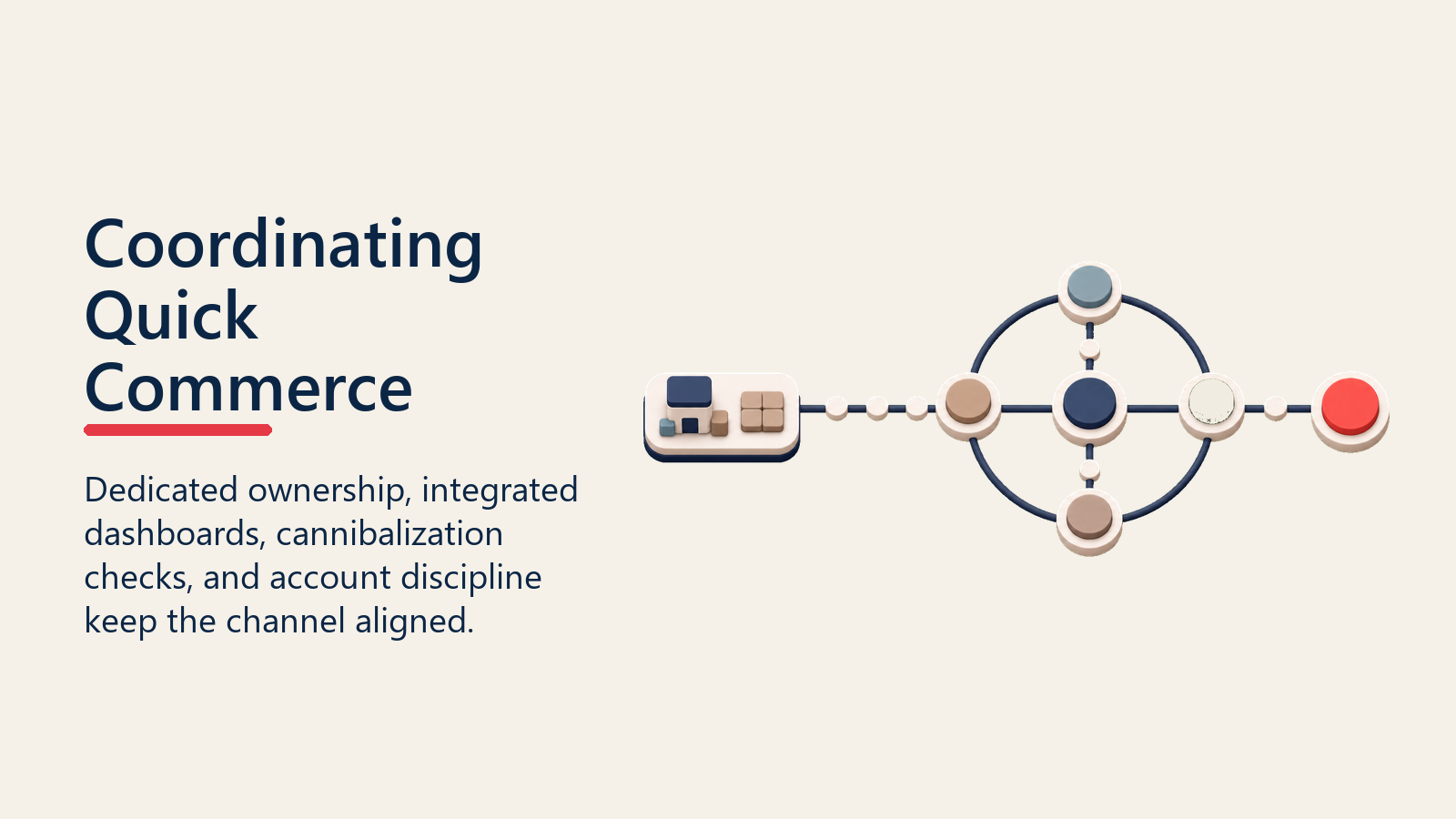
Assign clear internal ownership. Most FMCG companies default to having either the e-commerce team or the modern trade key account team own quick commerce, and both have gaps: e-commerce teams often lack FMCG trade margin experience, while modern trade teams often lack digital merchandising and platform algorithm experience. The strongest setups build a dedicated quick commerce account function that draws on both skill sets.
Track quick commerce performance alongside the rest of the sales dashboard, not in a separate spreadsheet nobody checks, so leadership sees channel mix shift in real time rather than discovering it in a quarterly review. Prioritizing which platform accounts get the most attention should follow the same logic as lead scoring: rank by demonstrated response, not by whoever asks loudest. See FMCG Sales Dashboards for how to integrate a fast-growing channel into existing reporting without creating a parallel, disconnected data source.
Watch for channel cannibalization versus incremental growth. Some quick commerce volume is genuinely incremental (shoppers who wouldn't have made a special trip for a small basket), and some substitutes for general trade or modern trade purchases the shopper would have made anyway. Understanding which is happening in your category matters for evaluating whether quick commerce investment is growing the pie or just shifting where existing demand gets fulfilled.
Apply the same account-level relationship discipline used with any strategic account. Just as retention fundamentals argue that the real commercial work in B2B happens after the initial deal closes, the real work in a quick commerce relationship happens after the initial listing: ongoing algorithm performance monitoring, fulfillment reliability, and platform relationship management, not a one-time onboarding.
When Does Quick Commerce Investment Make Sense?
Quick commerce isn't the right channel priority for every FMCG category or every market. It tends to earn disproportionate investment when the category has genuine convenience/urgency purchase occasions (personal care top-ups, snacking, beverages, household essentials bought on short notice), when the target market has dense urban coverage where dark store delivery radii are commercially viable, and when the brand has the operational capacity to support faster replenishment cycles without disrupting general trade service levels.
It earns less priority when the category is planned-purchase dominated with low urgency (bulk staples, large pack sizes typically bought on a weekly shop), when urban density doesn't support dark store economics in the target market, or when general trade and modern trade service levels would be compromised by diverting supply chain attention to a smaller, newer channel.
Conclusion
Quick commerce runs on different mechanics than the trade channels most FMCG go-to-market playbooks were built for: algorithmic visibility instead of shelf negotiation, platform relationships instead of outlet relationships, and fulfillment speed as a ranking factor rather than a background operational concern.
Companies that succeed in this channel don't just port their general trade or modern trade playbook over with smaller numbers. They build a dedicated commercial and operational approach: complete product data and search optimization, dedicated and faster-cycling stock allocation, margin models that reflect the platform's actual cost structure, and integrated reporting that treats quick commerce as part of the core sales dashboard, not a side experiment.
Frequently Asked Questions about Quick Commerce and Dark Store Selling
How is selling to quick commerce platforms different from selling to modern trade?
Modern trade listing decisions run through category buyers and shelf negotiations tied to physical planogram space. Quick commerce listing success depends on product data completeness, search algorithm optimization, and fulfillment reliability, since there's no physical shelf browsing involved. The commercial terms structure also differs, with quick commerce often carrying platform fulfillment costs baked into margin expectations that don't map directly onto traditional modern trade benchmarks.
What causes a product to lose visibility on a quick commerce platform over time?
The most common cause is stockouts at the dark store level. Most platform algorithms weigh fulfillment reliability directly in search ranking, so a product that's frequently unavailable when ordered gets deprioritized even if its underlying sales performance is strong. Incomplete or outdated product listing data and declining review scores are the next most common causes.
Should quick commerce inventory come from the same distributor supplying general trade?
It can, but the replenishment cycle needs to be faster and the stock allocation needs to be dedicated rather than treated as overflow. Dark stores sell through inventory faster than general trade outlets and are more sensitive to stockout-driven ranking penalties, so a standard weekly distributor cycle built for general trade is often too slow to support quick commerce reliably.
Is quick commerce volume incremental or does it cannibalize general trade sales?
It's typically a mix, and the ratio varies by category and market. Convenience and urgency purchase occasions tend to generate genuinely incremental volume, while planned or bulk purchases that shift from a general trade outlet to a quick commerce order are more likely substitution rather than net-new demand. Tracking category-level trends across channels over time is the most reliable way to understand which pattern applies to a specific brand and market.
Who should own the quick commerce account relationship internally?
The strongest setups build a dedicated quick commerce function that combines e-commerce and digital merchandising skills with FMCG trade commercial experience, rather than defaulting entirely to either the e-commerce team or the modern trade key account team. Both groups typically have a skills gap on one side of this hybrid channel, and a dedicated owner closes that gap faster than splitting responsibility informally.
What is Algorithmic Shelf Share in quick commerce?
Algorithmic Shelf Share is the digital equivalent of shelf position and facing count in a physical store, except it's earned through complete product data, review scores, and fulfillment reliability rather than a planogram negotiation with a category buyer. A brand wins visibility by feeding the platform's ranking algorithm what it needs, not by negotiating physical space.
Learn More

Senior Implementation Consultant
On this page
- How Dark Store Commerce Is Different From Traditional Retail
- Listing and Algorithmic Visibility
- Fulfillment and Inventory Management for Dark Stores
- How Is the Commercial Terms Structure Different?
- Merchandising for a Screen, Not a Shelf
- Coordinating Quick Commerce With the Rest of the Route-to-Market
- When Does Quick Commerce Investment Make Sense?
- Conclusion
- Learn More