Must-Sell List and Assortment: How to Focus Every Rep on the SKUs That Drive Distribution and Revenue
Turn this article into takeaways for your work.


Each assistant summarizes the article only for you and suggests best practices for your work.
A rep with 200 SKUs in the catalog and no clear priorities will sell the five easiest ones. Usually the biggest pack size, the fastest mover, and the two or three items the rep has been selling since she joined the team. The other 195 SKUs sit in the system, accumulating nothing.
That's not a motivation problem. It's a design problem. Without a defined must-sell list (MSL), field teams optimize for ease rather than commercial intent. And the categories and SKUs where the brand genuinely needs distribution growth end up unserved.
The MSL is the commercial team's answer to that problem. It's a short, deliberate, outlet-appropriate SKU set that every rep carries into every call, regardless of what the distributor pushes or what the outlet owner requests by habit.
What the MSL Is (and What It Isn't)
The must-sell list is the minimum assortment a brand requires in a given outlet class for that outlet to be considered commercially served. It's not the full catalog. It's not the sales team's wish list. It's the minimum viable presence that, when achieved across the outlet's tier, delivers the distribution picture the brand needs.
Key Facts: Must-Sell List Execution
- NielsenIQ's assortment optimization research documented a personal care manufacturer in Greece that reduced the number of SKUs per retailer by 10%, driving 11% value sales growth for the category and 11.5% supplier value sales growth. Shelf visibility and category clarity improved when the cluttered range was trimmed to a focused set.
- FMCG commercial teams that implement a structured MSL with compliance tracking report 12-20% improvement in numeric distribution on focus SKUs within two cycles, compared to teams that rely on rep judgment for assortment selling. (Industry estimate from FMCG route-to-market practice; actual improvement varies by category and market.)
- MSL compliance monitoring at the area level is one of the fastest diagnostic tools available to a commercial director. Where compliance is consistently low on a specific SKU, the cause is usually one of three things: a rep coaching gap, a pricing issue at that outlet tier, or a trade marketing listing problem that hasn't been flagged through normal distribution reporting.
Quotable Nuggets: Must-Sell List
- "Without a defined must-sell list, field teams optimize for ease rather than commercial intent." The rep sells the five easiest SKUs. The other 195 sit in the system, accumulating nothing.
- NielsenIQ's product distribution guide emphasizes that weighted distribution reveals whether the outlets carrying each SKU are the high-throughput ones or the low-volume tail. An MSL review that uses only numeric distribution misses the commercial consequence of where the SKU is listed.
- The MSL is not a wish list. It is the minimum viable presence that, when achieved across the outlet's tier, delivers the distribution picture the brand needs.
The Tiered MSL Gate: A commercial structure in which each outlet tier (Diamond, Gold, Silver, Bronze) carries its own defined minimum SKU set, and MSL compliance is treated as a binary gate for rep incentive payouts rather than a standalone bonus track. A rep who hits volume but runs below the compliance threshold (typically 80%) does not access the full variable pay pool. This structure creates a floor on compliance behavior without making the MSL the only metric that matters.
The MSL answers a specific commercial question: if this outlet is only going to carry a subset of our range, which subset delivers the most volume, margin, and strategic value for the brand?
That's different from the range-selling opportunity. Range selling is the full upsell: every SKU the outlet could potentially carry given its storage, turnover, and customer profile. The MSL is the floor. Range selling is the ceiling. Both matter, but a rep who goes into a call trying to sell the ceiling without first securing the floor is selling against herself. Close the floor first. Build toward the ceiling once the floor is solid.
What the MSL is also not: it's not static. It changes with new product development, seasonal launches, range rationalization, and the brand's evolving commercial priorities. A well-governed MSL has a review cycle. The problem in most organizations isn't that the MSL was wrong at launch; it's that it was never updated after the first version was issued.
Building the MSL by Outlet Tier
The MSL is not the same list for every outlet. A Diamond account (large modern trade, flagship traditional trade, high-volume grocery) can carry a broader assortment than a Bronze kiosk that stocks 40 lines total. Applying the same MSL to both is either over-ambitious for the Bronze outlet or commercially insufficient for the Diamond.
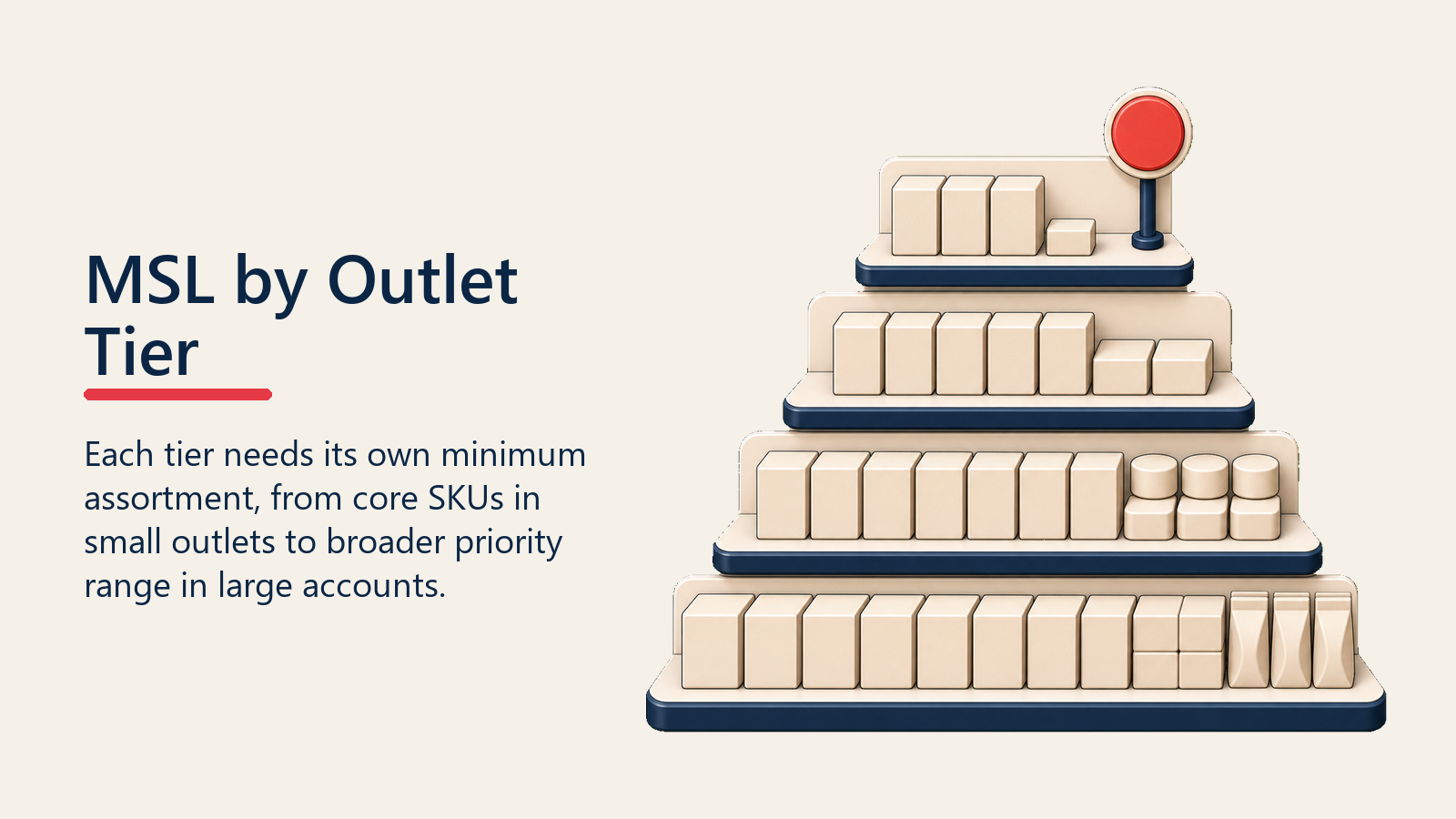
The right structure is a tiered MSL: each outlet tier has its own defined minimum assortment, building from the absolute core at Bronze to the full priority range at Diamond.
MSL Template by Outlet Tier
| SKU Category | Diamond | Gold | Silver | Bronze |
|---|---|---|---|---|
| Core hero SKU (flagship volume driver) | Required | Required | Required | Required |
| Core variant 1 (second-highest volume) | Required | Required | Required | Optional |
| Core variant 2 | Required | Required | Optional | No |
| Promotional focus SKU | Required | Required | Optional | No |
| NPD launch SKU (first 90 days) | Required | Required | Optional | No |
| Seasonal/limited SKU | Required | Gold judgment | No | No |
| Premium tier SKU | Required | Optional | No | No |
The Bronze MSL is typically one to two SKUs: the single core item and, where storage allows, the second-highest velocity variant. Anything more creates resistance from the outlet owner and compliance failure from the rep. Keep the Bronze list achievable.
The Diamond MSL should mirror the perfect store and call steps standard for full execution: every promotional SKU activated, every new product development (NPD) listing within the launch window, every core variant present with correct facing allocation.
Building the MSL without first completing outlet segmentation and classification creates a tool that applies the wrong list to the wrong outlets. Segmentation comes first. The MSL is built on top of it.
MSL vs Range Selling
The MSL is the baseline. Range selling is the commercial opportunity above the baseline.
Once a rep has confirmed MSL compliance at an outlet, the range-selling conversation opens. This is where SKUs outside the MSL but within the outlet's capacity become the agenda. The pack size upgrade. The premium variant alongside the core. The complementary product from an adjacent category.
But the sequencing matters. A rep who leads with range selling in an outlet where the MSL isn't complete is building on an unstable foundation. If the hero SKU isn't stocked and the promotional focus item isn't listed, incremental selling on the premium variant isn't expanding the brand's position. It's substituting for it.
The MSL creates a binary gate: is the outlet compliant or not? If compliant, open the range conversation. If not, the conversation is about why the missing SKUs aren't listed and what it takes to get them in. That's a different conversation, and it's often more commercially important than the upsell.
Value selling principles apply directly here: the argument for listing an MSL SKU shouldn't be "we need you to carry this." It should be "your customers are looking for this, and when they don't find it here they buy it somewhere else. Here's the category data." That's a commercial case. Outlet owners respond to it differently than to a rep pushing because she has a target.
How Do You Measure Whether the MSL Is Working?
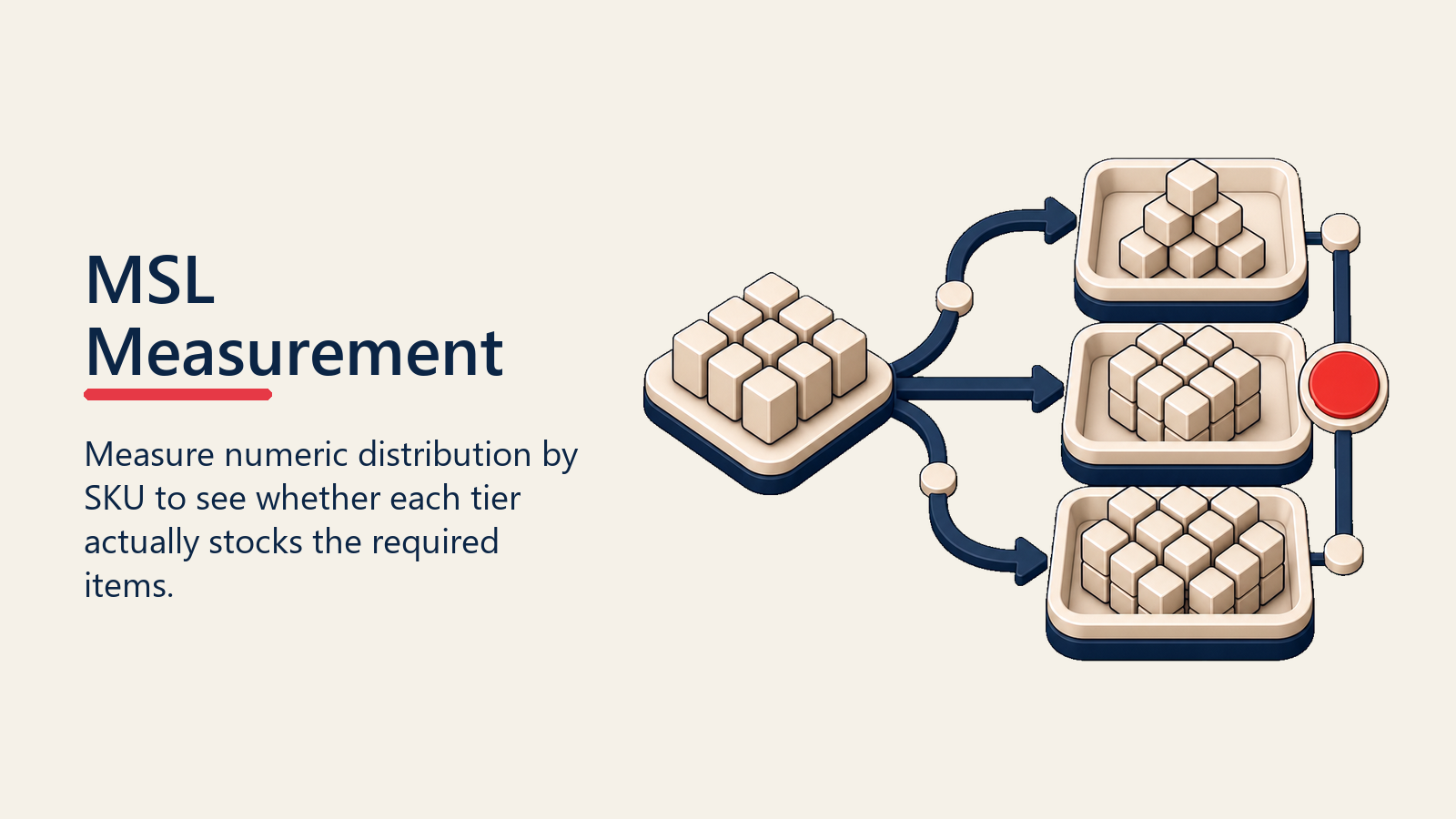
The MSL is only useful if it's being measured. The measurement currency is numeric distribution by SKU: what percentage of outlets in each tier actually have the MSL item stocked and available for purchase.
SKU Distribution Tracking Table
| SKU | Diamond Target | Diamond Actual | Gold Target | Gold Actual | Gap |
|---|---|---|---|---|---|
| Core hero SKU | 98% | 94% | 90% | 87% | 4% / 3% |
| Core variant 1 | 95% | 88% | 85% | 79% | 7% / 6% |
| Promotional focus SKU | 90% | 71% | 80% | 62% | 19% / 18% |
| NPD launch SKU (Week 4 of launch) | 85% | 63% | 70% | 44% | 22% / 26% |
The gap column is where the commercial attention goes. A 4% gap on the core hero SKU at Diamond is a minor operational tidy-up. A 26% gap on the NPD launch SKU at Gold in week four of the launch window is a distribution crisis that needs a named plan, not a monitoring note.
Numeric and weighted distribution tracking ties the SKU-level data to the volume contribution of the outlets where gaps exist. A 20% gap in numeric distribution at Gold outlets that represent 40% of category volume is a different problem from a 20% gap in Bronze outlets that represent 6%. The gap size looks the same; the commercial consequence is not.
In-store merchandising and planograms connect to MSL compliance at the listing level: a SKU can be in the system as ordered but physically absent from the shelf due to back-stock management or competitor displacement. Numeric distribution measurement should be based on observed shelf presence, not order data, for exactly that reason.
MSL Compliance Measurement
MSL compliance is the percentage of outlets in a tier that are stocking all MSL items prescribed for that tier. It's the scorecard metric that tells a commercial director whether the field team is executing the commercial agenda or drifting toward personal habit.
MSL Compliance Scorecard
| Level | Metric | Measurement Frequency | Action Threshold |
|---|---|---|---|
| Rep | % of visited outlets with full MSL compliance | Weekly | Below 70%: coaching conversation |
| Area | % of active accounts in area with full MSL compliance by tier | Bi-weekly | Below 75%: area plan required |
| Region | % of accounts by tier with full MSL compliance | Monthly | Below 80%: regional review |
| National | Weighted MSL compliance across all tiers and geographies | Monthly | Reported at commercial leadership review |
The compliance score at rep level is a coaching input, not a punitive metric. When a rep's MSL compliance on a specific SKU is consistently low, there are typically three causes: the outlet owner has an objection the rep hasn't resolved, the SKU has a pricing issue at that outlet's margin structure, or the rep hasn't received enough support to make the commercial case for the listing. The metric surfaces the pattern; the manager investigates the cause.
The national weighted compliance number is what a commercial director presents to the category leadership team when arguing for resource to close specific distribution gaps. It connects field execution to commercial strategy in one number.
Updating the MSL
The MSL should be reviewed quarterly, with triggered updates outside the cycle when product launches, range rationalization, or significant market changes make the current list commercially obsolete.

The quarterly update process involves three inputs:
Volume performance data: Which MSL SKUs are selling through quickly at each tier? Which are sitting in back stock and not reaching consumers? High sell-through validates the listing. Low sell-through at a tier suggests the SKU might be over-extended into a channel where it doesn't belong.
New product development pipeline: Any SKU in the first 90 days of a launch window typically belongs on the MSL for Diamond and Gold outlets at minimum. NPD that isn't on the MSL won't receive the active selling attention it needs to build distribution in the launch window, which is when distribution gains are most cost-effective to capture.
Range rationalization: When SKUs are discontinued or reformulated, they come off the MSL. The risk is that reps keep selling the old item on inertia, occupying shelf space and sales conversations that should transition to the replacement.
The update shouldn't require a full commercial review meeting. It should have a clear owner (category commercial manager or trade marketing lead), a defined process, and an SFA update that pushes the new list to every rep's device within 48 hours of sign-off. NielsenIQ's optimizing product distribution guide underscores why SKU-level distribution tracking belongs in every MSL review: the weighted distribution metric reveals whether the outlets carrying each SKU are the high-throughput ones or the low-volume tail, which directly determines whether the SKU belongs on the MSL or can be deprioritized for focus accounts only.
Connecting MSL to Incentives
Rep incentive design needs to account for the MSL without distorting the total order mix. A rep paid purely on volume will sell the easiest volume regardless of which SKUs the MSL targets. A rep paid purely on MSL compliance will confirm phantom listings and avoid accounts where compliance will be hard to achieve.

The right structure weights both, with thresholds rather than pure percentages:
An example incentive weighting:
- Base volume target: 70% of variable pay
- MSL compliance threshold: minimum 80% compliance required to access the full variable pay pool (not a separate bonus, a gate condition)
- Distribution KPI bonus: additional 15% of variable pay for achieving specified numeric distribution on NPD or focus SKUs
- Overall performance multiplier: 15% applied to total variable based on territory revenue versus target
The threshold structure means that a rep who hits volume but is running at 60% MSL compliance doesn't unlock the full package. It creates a floor on compliance behavior without making compliance the only thing that matters.
Incentives and target setting covers the full framework for balancing multiple field KPIs in incentive design. The MSL component is one input; the design principle is that it should make compliance a condition of full earnings rather than a parallel track that can be ignored.
Conclusion: The MSL Is a Living Commercial Standard
The must-sell list is the commercial team's shared definition of a well-served outlet. It answers the question that rep judgment can't reliably answer at scale: which SKUs does this brand need in this outlet class, right now, to deliver on its distribution and revenue goals?
Built deliberately by tier, measured weekly in the SFA, updated quarterly and at each launch event, and connected to rep incentives through threshold gates rather than separate tracks, the MSL becomes the behavioral anchor that keeps 15, 50, or 200 reps aligned on the same commercial priorities regardless of geography, relationship history, or distributor pressure.
Without it, the rep sells what's easy. With it, she sells what matters. That difference compounds into percentage points of weighted distribution over a quarter, which at meaningful scale means millions of dollars of incremental revenue that would otherwise stay invisible in the gap between catalog and shelf.
Frequently Asked Questions about Must-Sell List and Assortment
How many SKUs should be on a must-sell list?
The Bronze MSL should have one to two SKUs: the core hero item and, where storage allows, the next highest-velocity variant. The Diamond MSL can extend to eight to twelve SKUs including promotional focus items, NPD, and premium variants. The number that matters isn't the total count; it's that every SKU on the list has a clear commercial justification for being there, and every rep can articulate what that justification is.
How often should MSL compliance be measured?
Weekly at the rep level is the minimum for meaningful coaching. Area managers should review bi-weekly to catch compliance gaps before they compound. Monthly national reporting connects field execution to commercial strategy. If compliance is only measured monthly at all levels, the coaching opportunity for a struggling rep is already two to three call cycles behind by the time the data surfaces.
What should a manager do when a rep's MSL compliance is consistently low?
Investigate before coaching. Low compliance on a specific SKU might reflect a rep behavior issue, but it might also reflect a genuine obstacle: a pricing problem at the outlet level, a competitor promotion that's crowding shelf space, or a listing resistance pattern at that outlet tier that needs a trade marketing intervention rather than a sales coaching session. Ask the rep to show you the accounts where compliance is failing and walk through the conversation that happened at each one.
Should every outlet in the universe be on the same MSL?
No. The MSL is tiered by outlet classification. Applying the Diamond MSL to a Bronze kiosk guarantees compliance failure and damages the rep's relationship with the outlet owner. The tiered structure ensures the minimum requirement is achievable given the outlet's actual storage, turnover, and customer profile. If an outlet regularly orders above its tier's MSL, that's a signal to review its tier classification at the next quarterly segmentation update.
What is the difference between the MSL and a planogram?
The MSL defines which SKUs must be present at an outlet. A planogram defines where they must be placed, how many facings each receives, and in what order relative to competitor and own-brand adjacencies. An outlet can be MSL compliant (the SKUs are present somewhere in the store) while still failing its planogram standard (they are in the wrong position or with insufficient facings). Both need to be measured separately. MSL compliance is the first gate; planogram compliance is the second. Reaching planogram compliance without MSL compliance is not possible.
How should an NPD launch be handled in the MSL?
Any SKU in the first 90 days of a launch window should be added to the MSL for Diamond and Gold outlets at minimum. NPD that is not on the MSL will not receive the active selling attention it needs to build distribution during the launch window, which is when distribution gains are most cost-effective to capture. At the 90-day review, evaluate sell-through by tier and either confirm the SKU on the permanent MSL, extend the launch window for underperforming tiers, or remove it from the MSL and assign it to range-selling opportunity status.
What is the fastest way to identify which MSL SKUs have the biggest compliance gap?
Pull the SKU distribution tracking table from the SFA: for each MSL item, compare the target distribution percentage by tier against the actual distribution recorded on recent call audits. Sort by gap size. The largest gap on the highest-tier outlet group is the priority. A 22-26% gap on NPD at Gold and Diamond in week four of a launch window is a distribution crisis requiring a named action plan, not a monitoring note.
Learn More

Senior Implementation Consultant