Sales and Modern Trade Alignment: Coordinating Field Teams and Key Account Managers Across Channels
Turn this article into takeaways for your work.


Each assistant summarizes the article only for you and suggests best practices for your work.
When the hypermarket runs your product at a price your general-trade retailers can't match, you lose both channels.
The hypermarket wins the transaction. The general-trade shop loses the sale, the shopkeeper calls your distributor sales rep to complain, the rep escalates to the territory manager, the territory manager calls the regional sales manager, and by the time anyone talks to the key account manager who negotiated the hypermarket deal, the promotion has been running for two weeks and you've already triggered retailer resentment in 300 general-trade outlets.
This is one of the most common and expensive coordination failures in FMCG commercial operations. It's not caused by incompetent people. Key account managers negotiate centrally with modern-trade buyers on terms, planograms, and promotional calendars. Field distributor sales reps execute independently at outlet level against targets and routes. Neither team has reliable visibility of what the other committed. The information lives in separate systems, different planning cycles, and entirely different line management structures.
Without a written commercial policy that defines how the two channels coordinate, field reps and KAMs will always optimize for their own targets. And the total business will pay for it.
What Creates the Structural Tension Between General Trade and Modern Trade?
General trade and modern trade operate on different commercial logics, and that difference creates structural misalignment by default.
Modern-trade key account managers (KAMs) work on centrally negotiated commercial terms. They agree annual joint business plans with national and regional buying teams at retailers like Carrefour, Walmart, or local hypermarket chains. Those plans include listing fees, promotional volumes, planogram commitments, and pricing floors. The negotiation happens once or twice a year, and the terms flow from head office to store level. A KAM's target is built around volume and gross profit at the account level, and they have commercial levers (promotional funding, exclusive launches, preferred shelf positioning) that field teams don't control.
Field distributor sales reps (DSRs) work at outlet level in general trade. They visit 20-30 outlets per day, take orders, manage stock rotations, build relationships with shop owners, and execute brand standards on limited shelf space. Their targets are typically built around volume, numeric distribution, and outlet coverage. They're rewarded for getting product onto shelves and keeping it moving, and their commercial toolkit is much narrower than a KAM's.
Neither team is doing anything wrong. But when a KAM negotiates a buy-one-get-one-free promotion at a hypermarket chain that runs for six weeks, and general-trade shop owners within 500 meters of those hypermarkets watch their customers walk out to buy the same product cheaper, you have a coordination failure that no amount of goodwill fixes after the fact. Four specific risk patterns show how this plays out.
Key Facts: Channel Alignment in FMCG
- General trade still accounts for 65-85% of FMCG volume in most emerging markets, including Indonesia where traditional trade held a 69% market share as of Q3 2023 (Statista/Kantar Indonesia FMCG data, 2024). When modern-trade promotions drive channel price gaps above 10%, volume erosion in general trade can eliminate multiple quarters of promotional ROI at the account level.
- Modern-trade buyers in Southeast Asia typically layer slotting fees, visibility charges, promotional contributions, and back-margin deductions. The combined effect can reduce net margins materially for smaller supplier brands; the commonly cited range of 2-4% net on the account's revenue reflects practitioner benchmarks rather than a single audited source. (NielsenIQ Asia Channel Dynamics, 2025)
- BCG's analysis of winning go-to-market strategies in emerging economies identifies formalized channel pricing policies as a practice associated with better commercial outcomes. FMCG companies with written price corridor policies tend to experience fewer retailer conflict escalations than those managing channel pricing informally. (BCG, Six Winning GTM Strategies for Emerging Economies, 2025)
The Four Alignment Risks
1. Price gap between channels triggers retailer complaints and delistings. Modern-trade promotions that push effective consumer prices below general-trade shelf prices generate immediate pushback from general-trade shop owners. In markets where general-trade shops still represent 50-70% of volume, retailer resentment translates into delistings, reduced shelf share, or active substitution to competing brands. The DSR is the one who absorbs this complaint. But the KAM negotiated the deal, and often the DSR has no way to know what was agreed until the promotion is already running.
2. Promotional timing misalignment floods general trade when modern trade is on deal. When a hypermarket chain runs a promotional event that generates significant consumer stock-up, shoppers who normally split their purchases between general and modern trade shift their buying entirely to the modern-trade channel during the promotion period. General-trade outlets see a demand drop, don't reorder, and end up with aging stock. When the modern-trade promotion ends, consumer demand shifts back to general trade but the shop owners have reduced their orders. This creates a boom-bust cycle in general-trade stock levels that the field team manages without ever understanding the cause.
3. Planogram execution at modern-trade store level conflicts with field brand standards. KAMs often negotiate shelf positioning agreements with national buying teams, but execution at individual store level varies. When field brand standards call for a specific shelf height or adjacency and the modern-trade planogram agreement specifies something different, store-level compliance becomes contested. Worse, when field teams conduct retail audits that include modern-trade stores, they flag "non-compliant" execution that the KAM actually agreed to. This creates internal disputes that consume time without producing resolution.
4. Stock allocation during launches favors one channel and leaves the other empty. New product launches typically run through modern trade first because of the velocity, consumer visibility, and retail activation support that hypermarket chains provide. But when launch stock allocations favor modern trade heavily and general-trade outlets receive product two or three weeks later, DSRs are telling shop owners a product is coming while shoppers are already buying it at the supermarket next door. The general-trade shop owner feels like a secondary partner. That perception affects willingness to hold stock and support future launches.
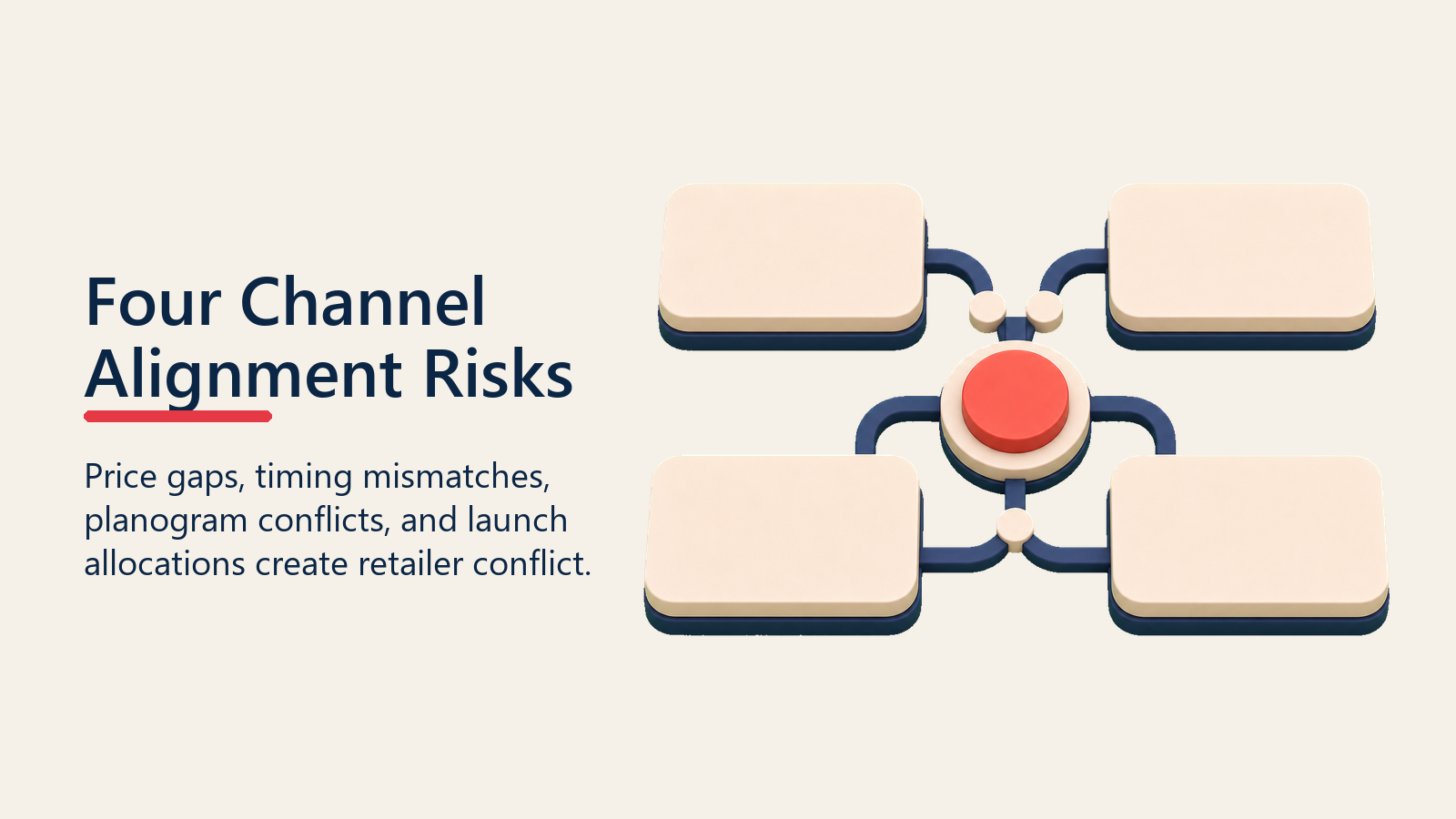
Three coordination mechanisms fix these risks before they become retailer conflicts.
Coordination Mechanisms
Coordination works when shared planning routines define which channel acts, when it acts, and who approves exceptions.
Shared activation calendar with channel-specific execution instructions. The most immediate fix is a monthly activation calendar that both the modern-trade KAM team and the field leadership team review and approve before any promotion launches. The calendar lists every promotional event, the channel(s) it runs in, the consumer pricing in each channel, the promotional mechanics, and the execution requirements for field and modern-trade respectively. Channel-specific execution notes prevent each team from applying their own interpretation to shared events. A launch that runs in modern trade three weeks before general trade is documented as intentional, with the general-trade activation window clearly stated. This prevents the DSR from promising shop owners a launch date that contradicts the actual general-trade timeline.
Price corridor policy: the maximum allowable gap between channels. This is a written commercial policy, not an informal understanding. It defines the maximum allowable consumer price gap between the modern-trade promotional price and the general-trade everyday selling price, expressed as a percentage. A commonly adopted structure sets the corridor at plus or minus 8-10%: modern-trade promotional pricing cannot push effective consumer prices more than 10% below the general-trade shelf price without triggering a formal review and explicit sign-off from the commercial director. The policy doesn't prohibit promotional activity. It requires that any activity exceeding the corridor gets escalated before it runs, not after complaints arrive. See Promotions and Trade Scheme Execution for the full promotional governance framework.
Joint category review: KAM and NSM (national sales manager) in the same quarterly business review (QBR). Quarterly business reviews with major modern-trade accounts should include the national sales manager or regional sales director, not just the KAM team. When the NSM is in the room, decisions about promotional mechanics, launch sequencing, and shelf space commitments are made with field implications visible. The KAM brings the modern-trade commercial lens. The NSM brings the general-trade and distribution lens. The decisions that come out of that joint review are better calibrated across both channels. This requires coordination calendar management: QBRs with major accounts typically require months of scheduling lead time, and adding NSM attendance to those meetings needs to be built into the commercial calendar.
Who Owns What: RACI for Channel Decisions
Alignment requires clarity about who makes which decisions. Without explicit ownership, both teams assume the other team is handling coordination, and no one is.
| Decision | Responsible | Accountable | Consulted | Informed |
|---|---|---|---|---|
| National consumer pricing (RRP) | Commercial director | Commercial director | KAM lead, NSM | All field leadership |
| Modern-trade promotional mechanics | KAM lead | Commercial director | Trade marketing | NSM, field leadership |
| Price corridor compliance review | Commercial director | CEO / MD | KAM lead, NSM | Finance, field leadership |
| General-trade promotional calendar | Trade marketing | NSM | KAM lead | Field leadership |
| New product launch channel sequencing | Commercial director | Commercial director | KAM lead, NSM, supply chain | All field leadership |
| In-store execution standards (modern trade) | KAM lead | KAM lead | Trade marketing | Field leadership |
| Retailer complaint escalation response | NSM (general trade), KAM lead (modern trade) | Commercial director | Both teams | Distribution head |
The critical decisions are price corridor compliance and launch channel sequencing. Both require the commercial director as the accountable party, not a KAM or NSM who can be pressured by their respective channel targets. See Sales and Distributor Alignment for the distributor-level commercial governance that sits beneath this channel coordination model.
With ownership clear, the next step is measuring whether the coordination is actually working.
Channel Alignment Measurement
Price parity index. Track the effective consumer price in modern-trade promotional periods versus the general-trade everyday selling price, expressed as a ratio. A ratio below 0.90 (modern-trade effective price more than 10% below general-trade price) triggers a review under the price corridor policy. Calculate the index monthly for each major modern-trade account and each product category. Review it with the commercial director monthly, not quarterly.
Promotional compliance rate by channel. When a promotional event is planned to run simultaneously in general trade and modern trade, track whether both channels executed on time, in full, and at the agreed terms. Non-compliance by channel, by event, and by territory reveals where coordination is breaking down. Track at 85% compliance as the minimum threshold and build remediation plans when any channel-event combination falls below it.
Distribution overlap analysis. In markets where modern-trade stores and general-trade outlets serve the same consumer catchment, track the share of consumers who switch channel during modern-trade promotional periods. This requires panel data (Kantar Worldpanel, NielsenIQ) rather than just internal sales data, but the investment is justified for any brand where channel price gaps are driving meaningful volume shifts. The overlap analysis tells you whether your price corridor policy is calibrated correctly or needs tightening.
| KPI | Measurement | Target | Review Trigger |
|---|---|---|---|
| Price parity index | Monthly by account and category | Above 0.90 (max 10% MT discount vs GT price) | Below 0.90 for any SKU in any MT account |
| Promotional compliance rate by channel | Per event | Above 85% compliance rate | Any event below 70% compliance in either channel |
| NSM attendance at major account QBRs | Quarterly | 100% of priority accounts | Any priority account QBR without NSM attendance |
| Activation calendar approval | Monthly, before launch | Completed 10 business days before month start | Any month where calendar not approved before first activation |
For the operational data infrastructure that makes these measurements possible, see Revenue Operations Dashboard and Value Stream Mapping, which provides a method for identifying where coordination failures are introducing waste and delay into the commercial execution process.

The Channel Alignment Policy Document
None of the mechanisms above work without a written commercial policy. The policy is a short document, typically two to three pages, that specifies:
- The price corridor: maximum allowable gap between modern-trade promotional price and general-trade everyday selling price, by category
- The activation calendar approval process: who approves, what the lead time is, and what happens when a promotion needs to launch faster than the standard approval cycle allows
- The RACI for key channel decisions, as above
- The escalation path for retailer complaints about channel price gaps: from DSR to territory manager to NSM to commercial director, with defined response windows
- The review cadence: who reviews channel alignment health, how often, and what data they use
The policy document is signed by the commercial director and distributed to all KAMs, the NSM, all regional sales managers, and the trade marketing lead. It's reviewed annually and updated when a new major account relationship or channel changes the competitive context.
Without the policy document, coordination depends on personal relationships and informal understandings between individual KAMs and field leaders. Those understandings don't survive team turnover, and they don't scale as the business grows. General Trade, Modern Trade and eB2B provides the broader channel strategy context within which this coordination model sits. Numeric and Weighted Distribution connects channel execution standards to the distribution coverage metrics that the field team is accountable for.
The Channel Corridor Framework
The corridor turns pricing alignment from an informal negotiation into a shared operating constraint across channels.
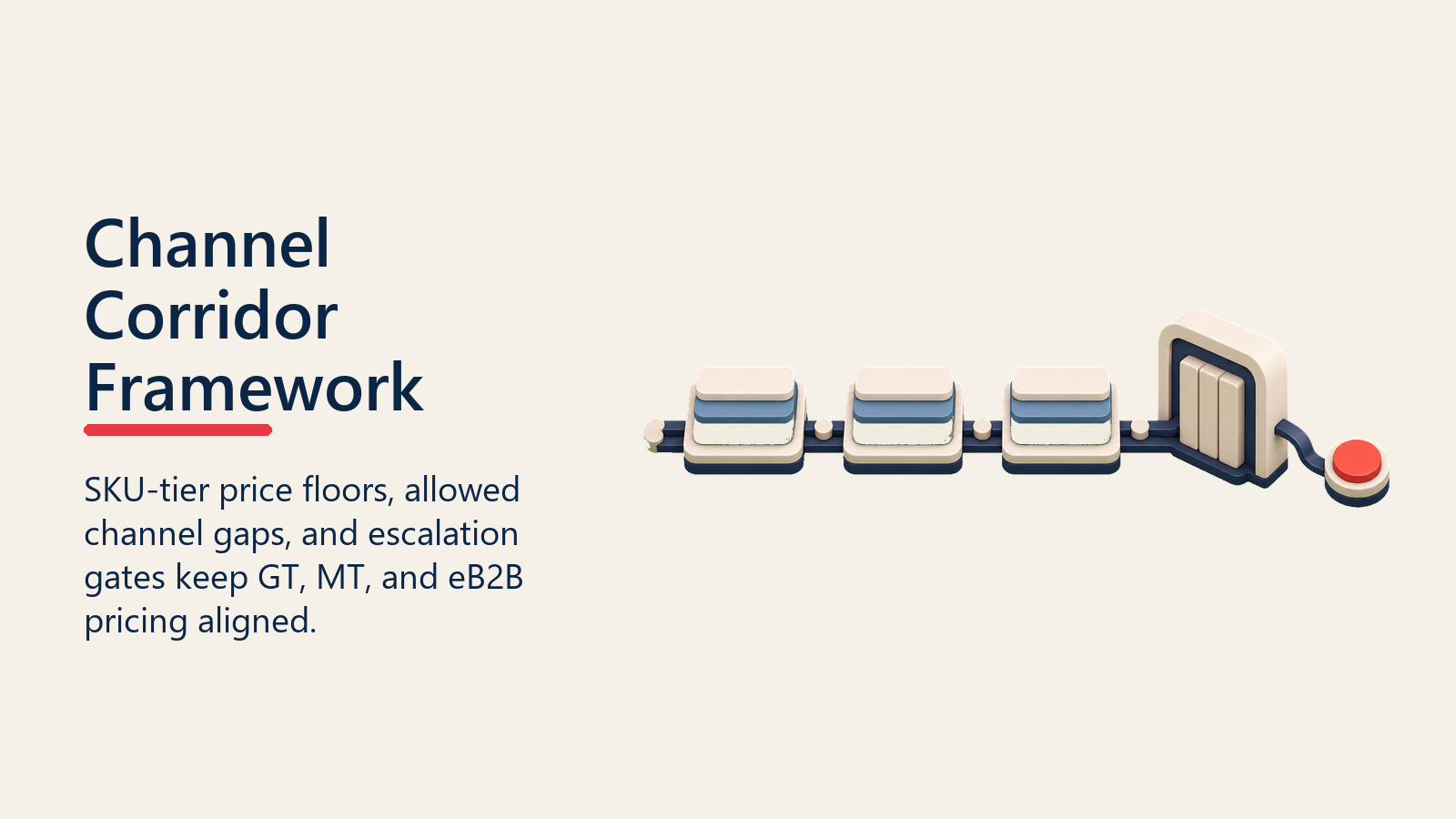
The Channel Corridor Framework: Effective multi-channel FMCG operations define a price corridor for each SKU tier rather than a single national retail price. The corridor specifies the minimum consumer price in any channel (protecting margin floor), the maximum allowable gap between the modern-trade promotional price and the general-trade shelf price (typically 8-10%), and an escalation gate requiring commercial director sign-off before any promotion exceeds corridor limits. The corridor is a live commercial document, reviewed against scan data after each major promotional cycle, not a static annual policy. Without the corridor, KAMs and field teams optimize for their respective channel targets with no shared constraint.
"When the hypermarket runs your product below general-trade prices, you haven't won the sale. You've borrowed it from the channel that was going to make the most money for you long term."
"A price corridor policy is not a restriction on promotional activity. It's the requirement that promotions earn their cost across the whole business, not just the account that negotiated them."
"Field reps absorb the complaints from channel conflict. KAMs rarely hear them. The activation calendar and the commercial policy are the only tools that close this information gap before the damage is done." (Based on channel management practitioner frameworks documented by NielsenIQ and BCG for emerging market FMCG operations, 2024-2025.)
Conclusion
Channel alignment is a commercial policy decision. Without a written policy, field reps and KAMs will always optimize for their own targets, because that's what they're paid to do. And the total business will absorb the cost through retailer conflicts, channel cannibalization, and promotional ROI that doesn't show up the way it was modeled.
The mechanisms aren't complicated: a shared activation calendar, a price corridor policy, and a joint quarterly review with the right leadership in the room. What makes them work is the decision to make them mandatory, document them in writing, and hold both channel teams accountable to the same commercial governance.
One team wins a deal for their channel. Both teams win when the channels hold together.
Frequently Asked Questions about Sales and Modern Trade Alignment
What is the most common cause of modern-trade and general-trade conflict in FMCG?
Promotional price gaps. When modern-trade buyers negotiate significant promotional discounts that push consumer pricing below what general-trade retailers can match, shop owners lose sales and complain to field sales reps. The complaint reaches field leadership without the context of what was negotiated centrally, and resolution requires cross-functional coordination that most FMCG companies aren't set up to do quickly. A written price corridor policy that requires sign-off before any promotion exceeds the allowable gap prevents most of these incidents.
How do you build a price corridor policy?
Start by analyzing the historical price gap that has triggered retailer complaints in your market. In most Southeast Asian and South Asian FMCG markets, a gap above 10% between modern-trade promotional price and general-trade everyday selling price is where complaints escalate to delistings. Set the corridor threshold at 8-10% (modern-trade promotional price no more than 10% below GT price) and require commercial director sign-off for any promotion that would exceed it. Review the threshold annually against market price sensitivity data.
Should the NSM or the KAM lead own the activation calendar process?
Neither should own it exclusively. The activation calendar should be jointly produced by trade marketing and approved by both the KAM lead and the NSM before it's distributed. Joint ownership means both channel leaders have committed to the calendar before it goes to execution, which reduces the scope for mid-month surprises when one team discovers what the other committed.
How do you prevent stock allocation from favoring modern trade during new product launches?
Define the channel allocation sequence in the launch plan, not the promotional calendar. The commercial director's sign-off on channel sequencing (modern trade first, general trade three weeks later, or simultaneous, with rationale) makes the allocation decision explicit before stock arrives. When the NSM knows general-trade allocation is three weeks out, they can brief field leadership on the timeline, and DSRs can set outlet expectations accurately rather than promising product that hasn't been allocated yet.
Who should be the accountable party for channel alignment policy overall?
The commercial director, not the KAM lead or NSM. This matters because both channel team leaders operate under channel-specific targets that create incentive conflicts. A KAM will negotiate the best deal for their account portfolio; a NSM will protect general-trade volume. Neither can make the cross-channel trade-offs required when a promotional decision would benefit one channel and damage another. The commercial director is the only role with full P&L visibility across both channels and the authority to enforce price corridor decisions that neither team likes. Without that role clearly accountable, the policy becomes advisory.
How do you measure the success of a channel alignment initiative?
Three leading indicators signal that the alignment is working: the price parity index stays above 0.90 (modern-trade promotional price no more than 10% below general-trade shelf price) for 12 consecutive months without a corridor breach requiring escalation; retailer complaint volume from general-trade DSRs related to channel pricing drops versus the prior 12-month baseline; and promotional compliance rate across both channels exceeds 85% per event. The lagging indicator is general-trade sell-through velocity in the 30 days following a major modern-trade promotional event: if GT velocity holds rather than dipping, the price corridor is calibrated correctly.
What happens when a major modern-trade account demands promotional terms that breach the price corridor?
The corridor breach goes to commercial director sign-off, not to the KAM to negotiate around. The commercial director reviews the account-level P&L impact of the promotion versus the general-trade revenue risk of the channel price gap. In most cases, the solution is to adjust the promotional mechanic (gift-with-purchase, bundled value, or loyalty reward rather than a straight price cut) so the effective consumer discount is equivalent without the visible price gap that triggers general-trade complaints. If the account insists on a cash-price promotion that breaches the corridor and the commercial director approves it, the NSM is informed before the promotion launches, not after.
Learn More

Senior Implementation Consultant