Order Taking and Upselling: How FMCG Reps Grow the Basket at Every Outlet Visit
Turn this article into takeaways for your work.


Each assistant summarizes the article only for you and suggests best practices for your work.
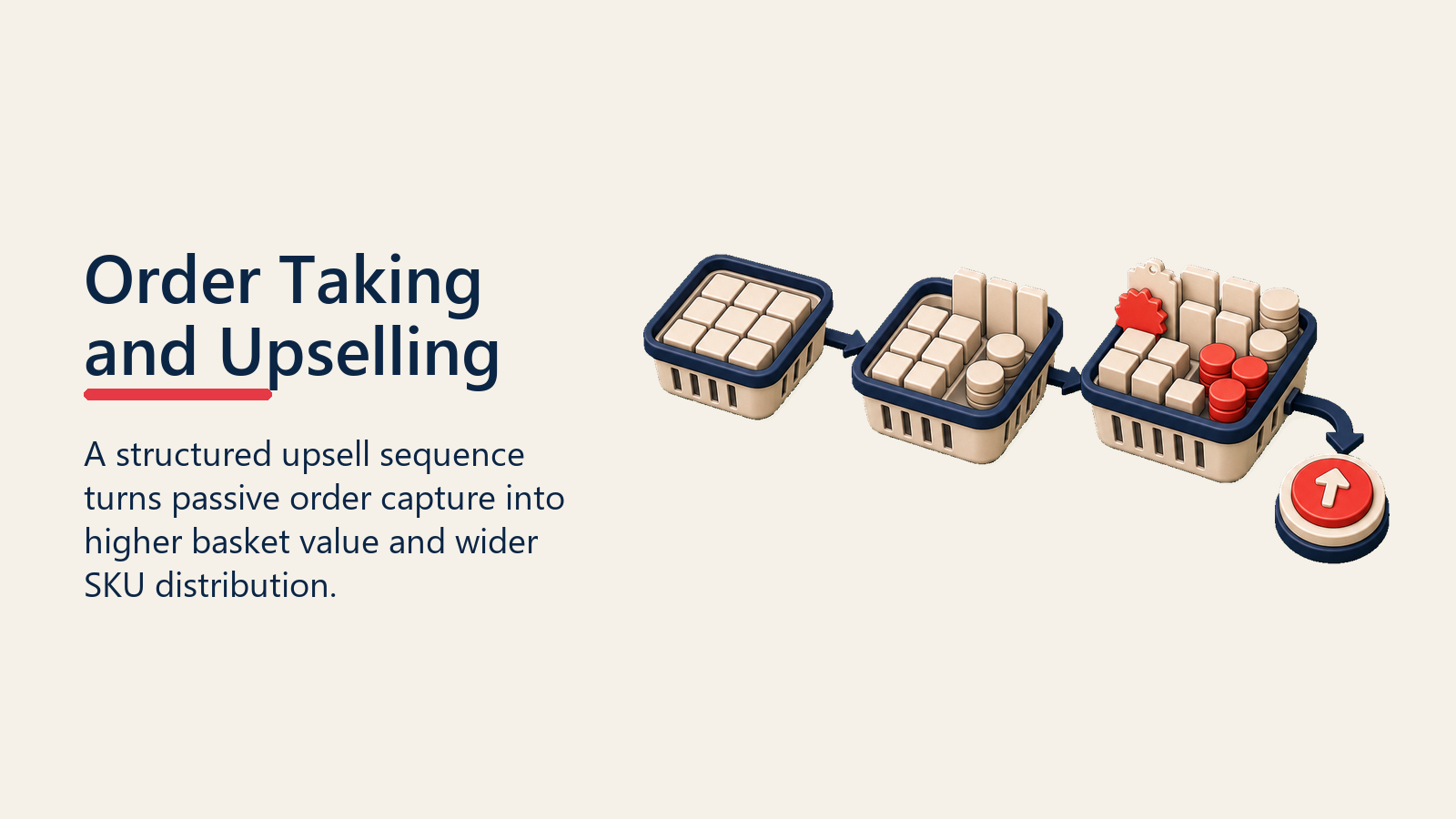
Walk into any FMCG company's sales review and you'll hear the same complaint: distribution is up, call frequency is on target, but average order value is flat. The problem almost always traces back to the same moment inside the outlet. The rep walks to the counter, asks the retailer what he needs, writes down the number, and moves on. The order is captured. The selling opportunity isn't.
That moment, repeated across two hundred outlets on a rep's beat, produces an estimated gap of 15 to 25 percent between what reps actually collect and what those outlets could buy if the rep led the commercial conversation (practitioner benchmarks from route-to-market teams; individual territory variation is significant). Closing that gap doesn't require longer visits or more aggressive selling. It requires a structured sequence that turns order capture into order building, every time, without slowing the call down.
Key Facts: Order Taking and Upselling in FMCG Field Sales
- NielsenIQ research across 15 product categories and 155 brands found that 60% of FMCG sales can be influenced at the store level, with availability and visibility as the primary drivers. Reaching the right stores can boost sales by as much as 33%; improved assortment provides 15% incremental gains on top of that.
- FMCG field reps who shift from passive order capture to structured upselling typically report 15-25% improvement in average order value per call without extending average call duration (practitioner benchmarks from route-to-market teams in Southeast Asia and Sub-Saharan Africa; no single published study).
- New SKU trial rate at existing outlets typically runs below 8% in territories without a structured upsell sequence and climbs to 18-22% where a must-sell list opens every commercial conversation (practitioner estimates from field sales teams; not from a published academic study).
Why Does Order Taking Leave Revenue on the Counter?
Most reps are efficient at the mechanics of order capture. They know the account, they know the regular lines, and they can log an order in the SFA (sales force automation) system in two minutes. But order taking is a reactive activity. The rep responds to what the retailer wants to restock. Selling is a proactive activity. The rep shapes what the retailer will stock by bringing commercial context, shelf data, and promotional terms into the conversation first.
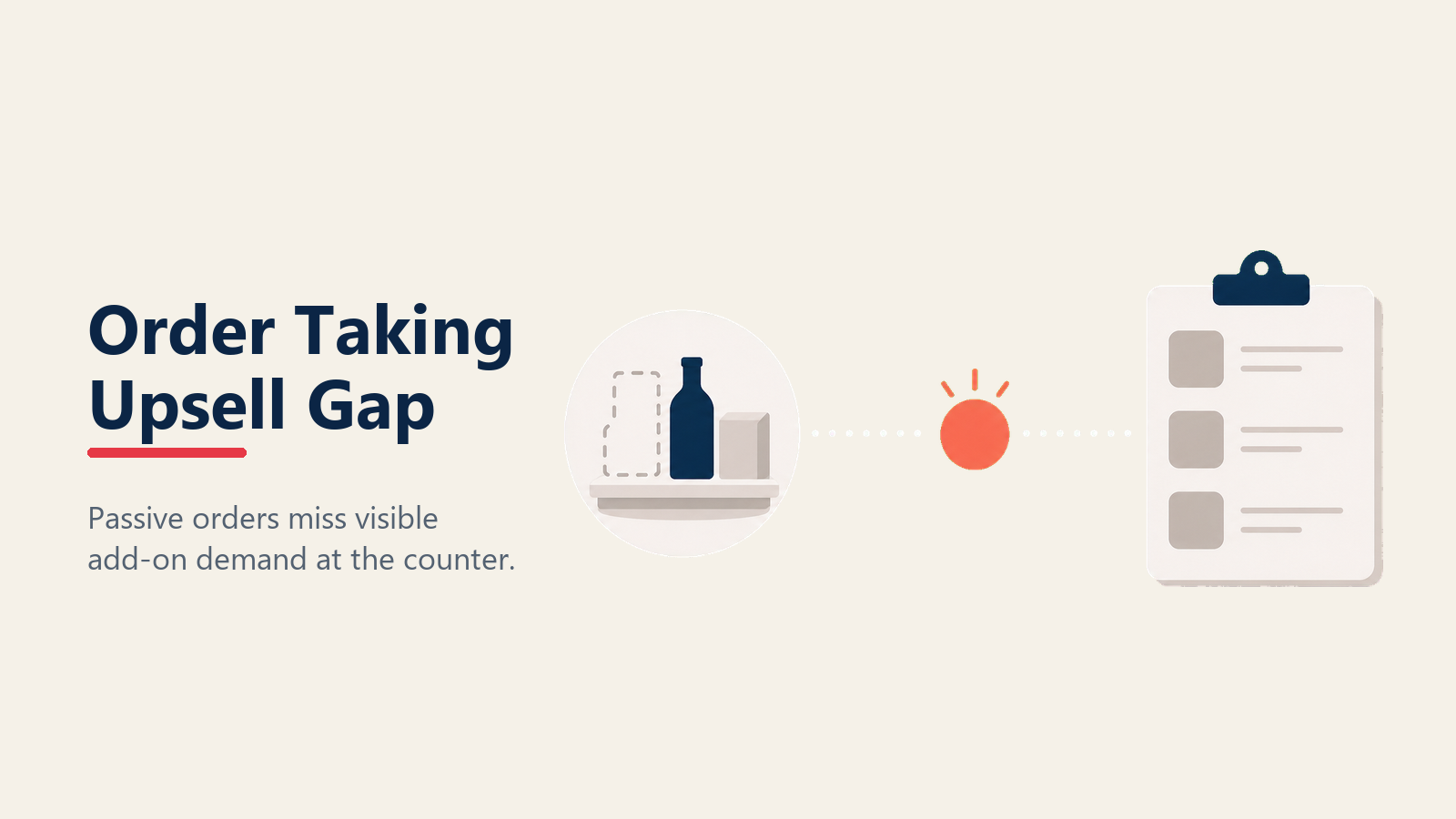
The gap between the two shows up clearly in the numbers. A rep who takes orders averages a predictable basket value because he's restocking the same lines at roughly the same rate every cycle. A rep who sells averages a higher basket value because he's introducing lines the retailer hadn't thought to request and attaching promotional terms that make incremental volume feel like a logical decision rather than a push. The difference compounds across the call cycle. Over a quarter, on a territory of two hundred outlets, that gap is real money.
The shift from taking to selling doesn't require more time. It requires a different opening. The rep who leads with the must-sell list controls the commercial frame of the conversation. The rep who leads with "what do you need this week?" hands that frame to the retailer.
The Must-Sell List as the Opening Frame
The must-sell list and assortment is the commercial anchor every call should start from. It's the minimum required product range that, when in distribution at an outlet, produces the revenue contribution the territory plan is built on. But in most territories, the must-sell list lives in the SFA as a compliance checkbox rather than a conversation opener.
The rep who opens with the must-sell list sounds like this: "Before we talk about your regular order, let me show you the three lines we're prioritizing this cycle and why they matter for your shelf." That's a different opening than "what do you need today?" It positions the rep as a commercial partner bringing information the retailer doesn't have, rather than a logistics contact collecting a restock request.
When the must-sell list opens the call, two things happen. First, the conversation anchors to what the brand needs distributed rather than what the retailer already knows. Second, it creates a natural transition into the upsell sequence that follows.
The Three-Stage Upsell Sequence
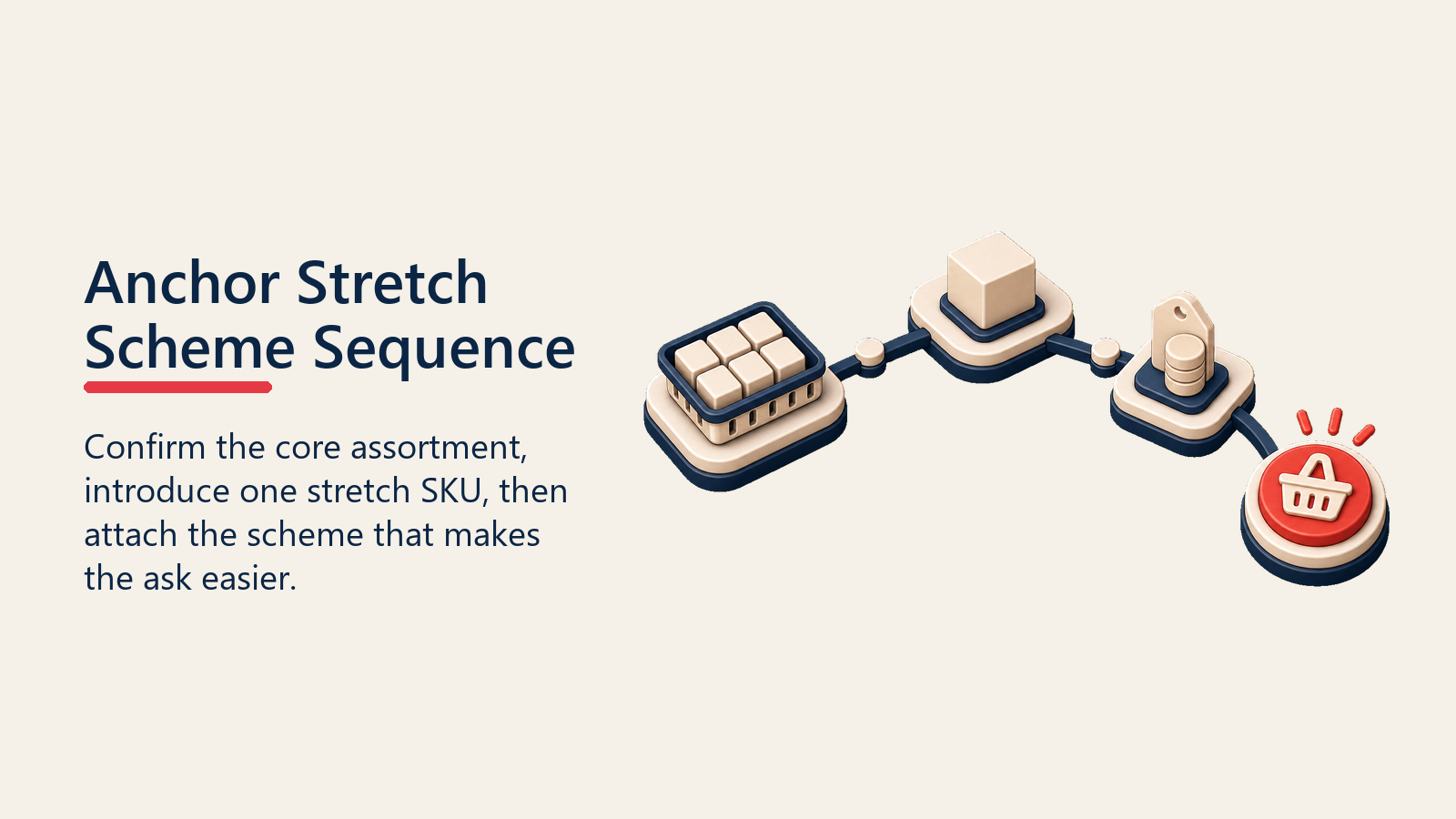
This is the core selling framework. The Anchor-Stretch-Scheme Sequence: anchor the core assortment, introduce one stretch SKU, then layer the promotional term that makes the incremental volume easy to justify. It takes three to five minutes inside a normal outlet call and produces consistently higher basket values when applied with discipline. The sequence never changes. The specific lines and promotional terms vary by call.
Stage 1: Anchor the Core
Confirm the regular assortment first. Run through the must-sell lines, check what's on shelf and what's in back stock, and lock in the restock quantity for each core SKU. Don't try to sell anything in this stage. The goal is to confirm the base business, give the retailer a sense that the regular order is handled, and create the mental space to introduce something new.
"We're starting with your regulars: the 150ml Sunsilk in three variants, the Dove bar in four-pack, and the Lifebuoy family size. Your stock looks low on the Lifebuoy. Based on your sell-through from the last cycle, I'm proposing we add six units to your usual order. Does that work?"
The anchor stage should take ninety seconds. It's not a negotiation. It's a confirmation.
Stage 2: Introduce the Stretch SKU
One new or underperforming line per visit. Not two, not three. One. Reps who try to introduce multiple new lines in a single call typically close none of them because the retailer hears a list and mentally files it as upselling pressure. A single stretch SKU feels like a specific recommendation.
The stretch SKU should be chosen before the rep walks into the outlet, based on the account's current gap versus the target assortment and the commercial priority for the current cycle. A rep who arrives without a stretch SKU in mind will default to whatever feels easiest in the moment, which is usually the line the retailer is most familiar with. That's not a stretch. That's restocking.
The pitch for the stretch SKU is always about the retailer's shelf, not the rep's target: "We've been tracking sell-through on the new Vim concentrated liquid at similar stores in this area, and the 500ml format is moving faster than the standard pack at the same price point. I'd like to get you three units to trial. If it doesn't move in two cycles, I'll take it back."
The offer to take back unsold stock is not a weakness. It removes the retailer's perceived risk and significantly increases trial rate on new lines. Most product that gets trialled doesn't come back.
Stage 3: Layer the Scheme
Once the stretch SKU is accepted or under discussion, introduce the promotional term that makes the incremental volume easier to justify. This is where the promotions and trade scheme execution framework connects to the upsell conversation.
"We have a scheme running this cycle: any order that includes the Vim 500ml gets a 5 percent off-invoice discount on the full soap range. So adding the Vim actually reduces your effective cost on the lines you're already ordering."
This is the structure of a volume-conditional scheme delivered at the outlet level. The rep isn't describing a promotion generically. She's connecting the promotion terms to the specific basket the retailer is about to confirm. That connection is what makes the scheme feel like a commercial benefit rather than a sales device.
The three stages take three to five minutes in total. They work in any outlet type: kiranas, dukas, sari-sari stores, convenience stores, small wholesalers. The specifics change. The sequence doesn't.
| Stage | Action | Time | Goal |
|---|---|---|---|
| Stage 1: Anchor Core | Confirm regular assortment and restock quantities | 90 seconds | Lock in base business |
| Stage 2: Stretch SKU | Introduce one new or underperforming line with a specific sell-through rationale | 2 minutes | Add one incremental line per visit |
| Stage 3: Layer Scheme | Connect the promotional term to the incremental line and the full basket | 90 seconds | Increase basket value through scheme mechanics |
Reading Buying Signals at the Counter
Before the rep opens the commercial conversation, the outlet tells him what to sell. Shelf signals are available in the thirty seconds it takes to walk from the door to the counter, and they're more reliable than asking the retailer what he needs.
Shelf gaps. Empty shelf spaces where a SKU should be mean the product sold faster than expected and the retailer hasn't reordered. A shelf gap in your brand's section is both an order opportunity and a distribution risk. A shelf gap in a competitor's section tells you the retailer isn't prioritizing that brand this cycle.
Competitor facings. If a competitor has expanded their facing count since the last visit, someone pitched the retailer on a promotion or a range extension. That's competitive intelligence worth logging in the SFA. It's also a reason to lead the conversation with your own promotional terms before the retailer brings up the competitor offer.
Empty shelf vs full back room. When the shelf looks full but sell-through data says the line should be depleting, ask to see the back room. Stock that's been ordered but not faced up is stock the retailer has paid for but isn't selling. That's a facing and merchandising conversation, not an order conversation, and it's covered in the perfect store and call steps framework.
Handling "I Already Have Enough"
This objection comes from one of two places. The retailer genuinely has adequate back stock for his expected sell-through rate, or the retailer is using a generic brush-off to avoid a commercial conversation he hasn't been given a reason to engage in.
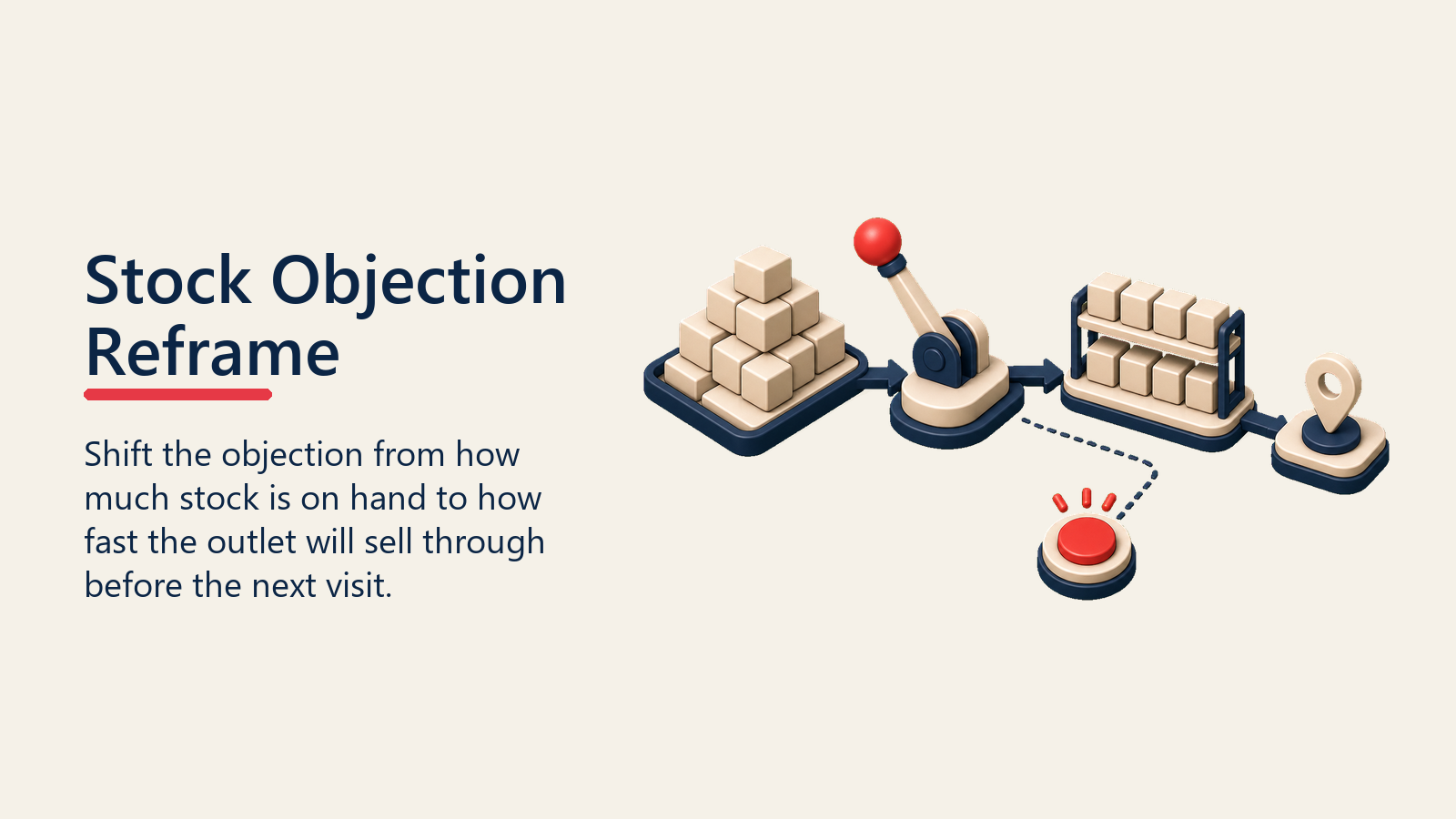
The reframe is always the same: shift the conversation from stock level to sell-out rate.
"I hear you on back stock. I'm not asking you to buy more than you can sell. I'm looking at the fact that your 150ml Sunsilk moved twelve units in three weeks and you have four left. At that rate, you'll run out before my next scheduled visit. I'm proposing we get ahead of that rather than deal with a stockout in the middle of the cycle."
Sell-out rate is a forward-looking number. Stock-on-hand is backward-looking. Retailers who are managing their working capital, which is most general trade retailers, respond to the forward-looking framing because it helps them avoid the situation they actually dislike, which is running out and losing sales.
When the objection is genuine and the retailer genuinely has adequate stock, the response changes: "Fair enough. Let me leave you the promotional terms for the scheme running this cycle. When you're ready to reorder, the discount applies to any full-case order through the end of the month." Don't push. Note it in the SFA, confirm the next visit date, and move on.
SFA and Order Accuracy
Digital order capture through the SFA and DMS systems does two things for upselling that paper-based capture doesn't. First, it shows the rep the account's order history and target assortment on the same screen where he's building the current order, which means the stretch SKU recommendation comes from data rather than memory. Second, it reduces write-backs and shorts by capturing the order in real time with barcode or SKU lookup rather than handwritten quantities that get misread by the distributor.
Reps who log orders in the SFA at the outlet, rather than writing on paper and entering later, consistently produce more accurate orders. More accurate orders mean fewer short deliveries, which means fewer retailer complaints at the next visit, which means more time in Stage 2 and 3 of the upsell sequence rather than resolving delivery issues. The operational discipline and the commercial discipline reinforce each other.
The SFA should also track the stretch SKU introduced at each outlet visit and whether it was accepted or declined. Over time, that data tells the field manager which stretch SKUs are converting across the territory and which ones need a different pitch. That's how value selling principles apply at the outlet level: the data tells you what arguments land with which retailer types.
Metrics That Move
Three metrics track whether upselling discipline is actually improving across a territory:
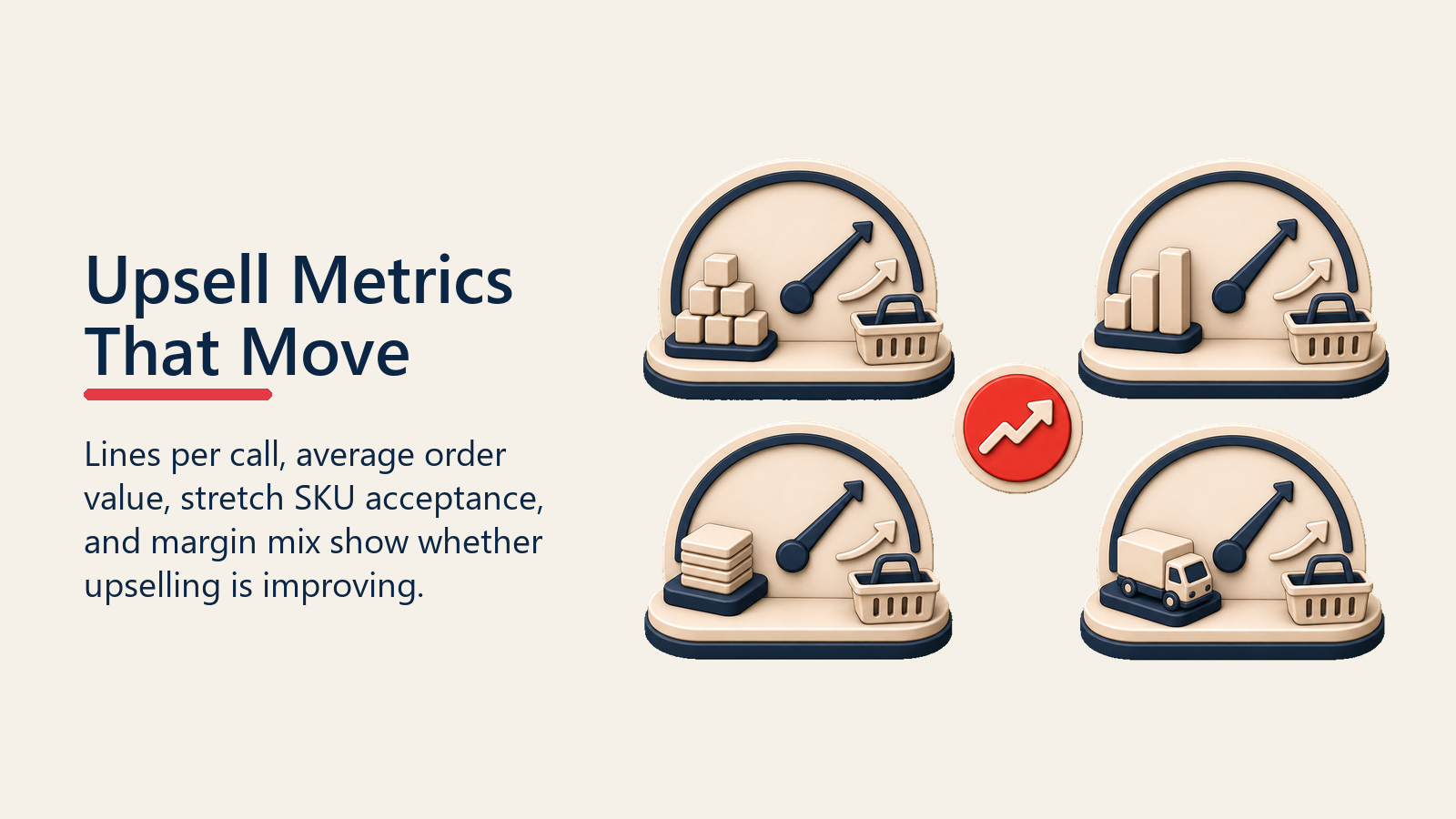
Lines per call. The average number of SKUs included in an outlet order. This is the single most direct measure of upsell effectiveness. A territory where lines per call is flat quarter-over-quarter is a territory where reps are taking orders, not selling. Target a 10 to 15 percent improvement over two sales cycles when a structured upsell sequence is introduced.
Average order value. The mean basket value per outlet visit. This tracks alongside lines per call but also captures price mix effects from promotional schemes. Watch both together because a rising average order value driven entirely by scheme attachments without a rise in lines per call suggests the scheme is doing the work the rep should be doing.
New SKU trial rate. The proportion of visits in a cycle that result in at least one new or previously unlisted SKU being added to the order. This is the sharpest measure of Stage 2 execution. A territory with a new SKU trial rate below 10 percent is a territory where the stretch SKU conversation isn't happening consistently.
| Metric | What it measures | Target range | Warning signal |
|---|---|---|---|
| Lines per call | SKU breadth per outlet order | +10-15% over 2 cycles when sequence is introduced | Flat for more than one cycle |
| Average order value | Basket value per visit | Trending up quarter-over-quarter | Rising only through scheme attachment, not lines |
| New SKU trial rate | % of visits with at least one new line added | 18-22% with structured sequence | Below 10% indicates Stage 2 not executing |
Use the FMCG sales KPIs and metrics framework to set territory-level baselines before introducing the upsell sequence so you can measure the impact with clean before-and-after data. On distribution gaps, NielsenIQ distribution analysis shows that nearly 30% of incremental sales can be achieved by correcting existing distribution and reaching the right stores, making lines-per-call a leading indicator worth tracking weekly.
For field managers, these three metrics should appear on the weekly rep scorecard alongside call count and strike rate. Tracking call count alone tells you reps are showing up. Tracking lines per call and new SKU trial rate tells you what they're doing while they're there.
The trial close in FMCG is the moment you present the stretch SKU and read whether the retailer is leaning in or leaning back, and the response determines whether you go straight to Stage 3 or spend another thirty seconds on the Stage 2 rationale.
Quotable Nuggets
"The rep who leads with 'what do you need this week?' hands the commercial frame to the retailer. The rep who leads with the must-sell list controls it."
"The offer to take back unsold stock is not a weakness. It removes the retailer's perceived risk and significantly increases trial rate on new lines." (Field sales practitioners in route-to-market markets)
Conclusion: Upselling Is a Discipline, Not a Personality Trait
The rep who doubles his average order value in a quarter didn't get more charismatic. He got more structured. Upselling in FMCG general trade is a trainable, measurable discipline that follows a fixed sequence with adaptable content. The three-stage approach, anchor the core, introduce the stretch SKU, and layer the scheme, works because it respects the retailer's time, anchors the ask in commercial logic rather than pressure, and connects every incremental request to a benefit the retailer can articulate.
Train the sequence. Measure the metrics. Coach the deviations. And stop accepting "same as last time" as a call outcome.
Learn More

Senior Implementation Consultant
On this page
- Why Does Order Taking Leave Revenue on the Counter?
- The Must-Sell List as the Opening Frame
- The Three-Stage Upsell Sequence
- Reading Buying Signals at the Counter
- Handling "I Already Have Enough"
- SFA and Order Accuracy
- Metrics That Move
- Quotable Nuggets
- Conclusion: Upselling Is a Discipline, Not a Personality Trait
- Learn More