Cooler and Chiller Space Management: Winning Cold Space at the Point of Purchase
Turn this article into takeaways for your work.


Each assistant summarizes the article only for you and suggests best practices for your work.
There's a branded cooler in a minimart in Petaling Jaya. It cost the beverage company RM 2,400 to manufacture, ship, and install. The loan agreement specifies: primary door-entry placement, exclusively stocked with the brand's cold-chain SKUs, glass door clean and decal-compliant at all times. What it actually has is a fingerprint-clouded glass door, three shelves of the competitor's product, and a position wedged behind the checkout counter where no shopper can reach the handle without asking the cashier to move.
The rep who covers that outlet hasn't done a compliance check in six weeks.
Cold space is one of the highest-value commercial assets in the general trade. A cooler in the door-entry position converts impulse purchases at rates that ambient-shelf product never reaches. Losing that position, or letting it degrade into a competitor's storage unit, is not a merchandising housekeeping problem. It's a revenue problem that shows up in your weekly sell-out numbers before anyone names the cause.
This article covers how to win cooler and chiller positions, maintain them so they stay productive, negotiate for exclusivity, and recover when compliance drops.
Why Cold Space Is a Premium Asset
A shopper walks into a convenience store or wet-market minimart with a general intent: grab something cold on the way out. She doesn't walk in thinking about which brand she wants. She walks toward the cooler. Whatever is in the door-entry position, at eye level, with a clean and lit display, is what she buys.
That's the impulse purchase dynamic that makes cold space categorically different from ambient shelf. On a dry-goods shelf, a shopper usually came in knowing what she needs and scanning for it. At a cooler, the decision often happens at the door. The brand that owns the door-entry position wins that decision by default.
Key Facts: Cold Space and Impulse Purchase
- A Statista survey of US shoppers found that 74% reported purchasing single-serve cold beverages on impulse when shopping in-store. (Statista 2018) The broader figure that "70% of beverage purchases are unplanned" is a widely cited convenience retail practitioner estimate; no single independently verified source is available for that specific number.
- Branded cooler placement in the primary door-entry or checkout-queue position typically delivers 20-35% higher unit movement compared to coolers at the back wall or behind the counter, based on practitioner benchmarks from beverage markets in Southeast Asia and Africa (no single published academic study).
- Compliance audits across FMCG beverage markets in Southeast Asia consistently find 30-45% of branded coolers in non-compliant positions or stock conditions at any given point in the cycle, representing untracked revenue leakage across the outlet universe (practitioner estimate from field audit programs; no published academic study).
The basket impact compounds. A cold beverage in the hand makes it easier for the retailer to cross-sell. Convenience retail practitioners observe that shoppers who pick up an impulse cold drink tend to add other items to their basket during the same trip, though the specific uplift percentage varies by outlet format and market (practitioner observation; no single verified published study). The cooler isn't just selling itself; it's lifting the whole basket.
But this only works when the cooler is positioned, stocked, and maintained properly. A cold-space asset that isn't managed is actively costing you money on the placement investment and the lost impulse volume simultaneously.
What Makes a Cooler Placement Commercially Valuable?
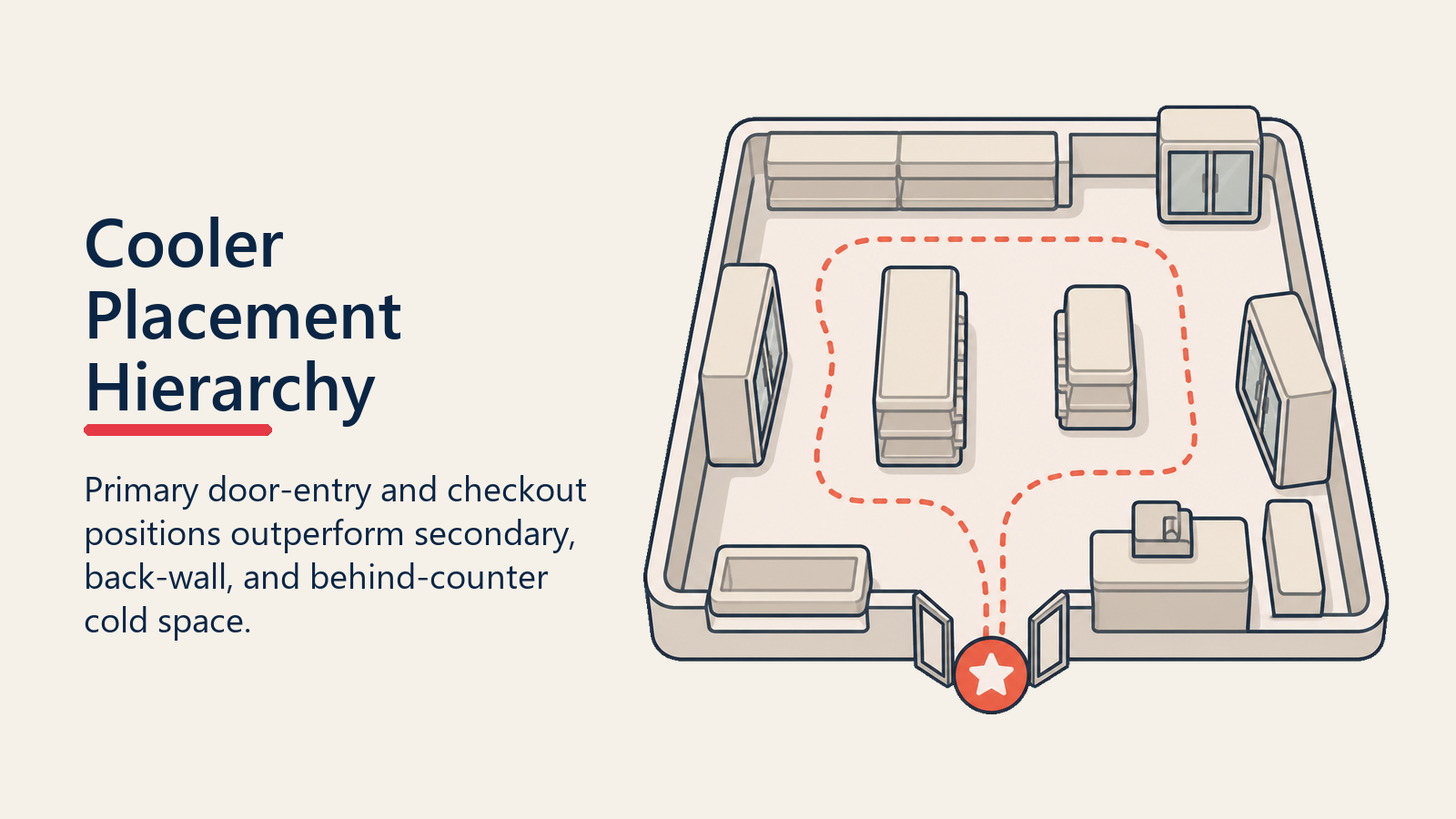
Not all positions in an outlet are equal. The Cooler Placement Hierarchy: primary door-entry or checkout-queue position is the top tier, secondary in-aisle position is acceptable short-term, and back-wall or behind-counter placement is non-compliant and commercially near-invisible. Field reps and trade marketers need this placement hierarchy so that every outlet in the territory is categorized by position quality and every visit includes an assessment of whether the position has been maintained or has degraded.
Primary Position Criteria
A primary cooler position meets three conditions: it sits within the first three meters of the outlet entry or along the checkout queue path, it has unobstructed shopper access (no products, furniture, or other coolers blocking the door), and it has direct line-of-sight from the entry point.
In practical terms, this means:
- Door-entry right or left of the entry threshold, within arm's reach of the first step inside
- Checkout queue flank, beside or behind the cashier counter in a position where queuing shoppers face the cooler door
- Fridge wall primary position in outlets where the entire back wall is cold chain, meaning the brand's unit occupies the first section nearest the highest footfall aisle
Secondary Position Rules
When the primary position is legitimately occupied by a competitor or by the outlet's own chiller unit, a secondary position is acceptable if it meets a minimum standard: within the first half of the outlet footprint, accessible without the shopper needing to ask for help, and not behind any obstruction taller than 1.2 meters.
A secondary position should never be treated as permanent. Every visit to an outlet where the brand holds a secondary position should include a soft negotiation to move toward primary, even if incrementally. "The Sprite unit near the door hasn't been restocked in a while, I noticed. If they move it to the back, would you be okay with us bringing ours forward?" is a legitimate conversation at most revisit cycles.
Competitor Cooler Adjacency
Where a brand's cooler sits adjacent to a competitor's, the placement objective is to ensure the brand's unit is to the left of the competitor's or closer to the entry path. Shopper eye movement in most markets runs left-to-right, so left adjacency captures first visual attention. If the competitor is on the left and the brand is on the right, renegotiate position at the next convenient cycle or flag the account for a manager joint visit focused on placement.
Chiller Share in Mixed Coolers
Not every outlet has or wants a branded cooler. In many general trade and semi-modern trade accounts, the retailer uses a single mixed chiller and allocates space informally to multiple brands based on relationship, order volume, and who asks most recently.
In mixed chillers, the relevant metric is chiller share: the percentage of visible facings that belong to the brand.
Facing Allocation Targets
A brand with meaningful volume and active distribution at a given outlet should target a minimum of 30 percent chiller share in any mixed unit. Below 30 percent, the brand is essentially invisible at a busy counter. The target for a preferred-supplier relationship is 40 to 50 percent, especially for categories where the brand holds the category leadership position in that market.
Brand Blocking
Within the brand's allocated section of a mixed chiller, stock should be blocked by brand and within brand by SKU family. This means all SKUs of the same product line grouped together rather than scattered across shelves. Blocking creates visual dominance that exceeds the actual facing count: three consecutive facings of the same brand look like market leadership; three scattered facings of the same brand look like leftovers.
Competitor Encroachment Protocol
Competitor encroachment in a mixed chiller happens at every visit where the rep isn't present. Retailer staff top-up from whichever case is at hand. Competitors leave extra stock to fill gaps. The brand's allocated section slowly shrinks.
The protocol on every visit is: count facings before restocking, note any encroachment, relocate competitor product that has migrated into the brand's allocated section back to the competitor's section, then restock and block the brand's section to its target facing count. Don't make it confrontational with the retailer; make it routine. "I'm just tidying our section and making sure we're in the right spots" is how most reps handle it.
Maintenance as a Selling Act
A cooler visit that ends without a maintenance check is an incomplete commercial activity. The condition of the cooler on every visit is a direct signal to the retailer about how seriously the brand treats its investment in their shop.
Temperature and Cleanliness Inspection
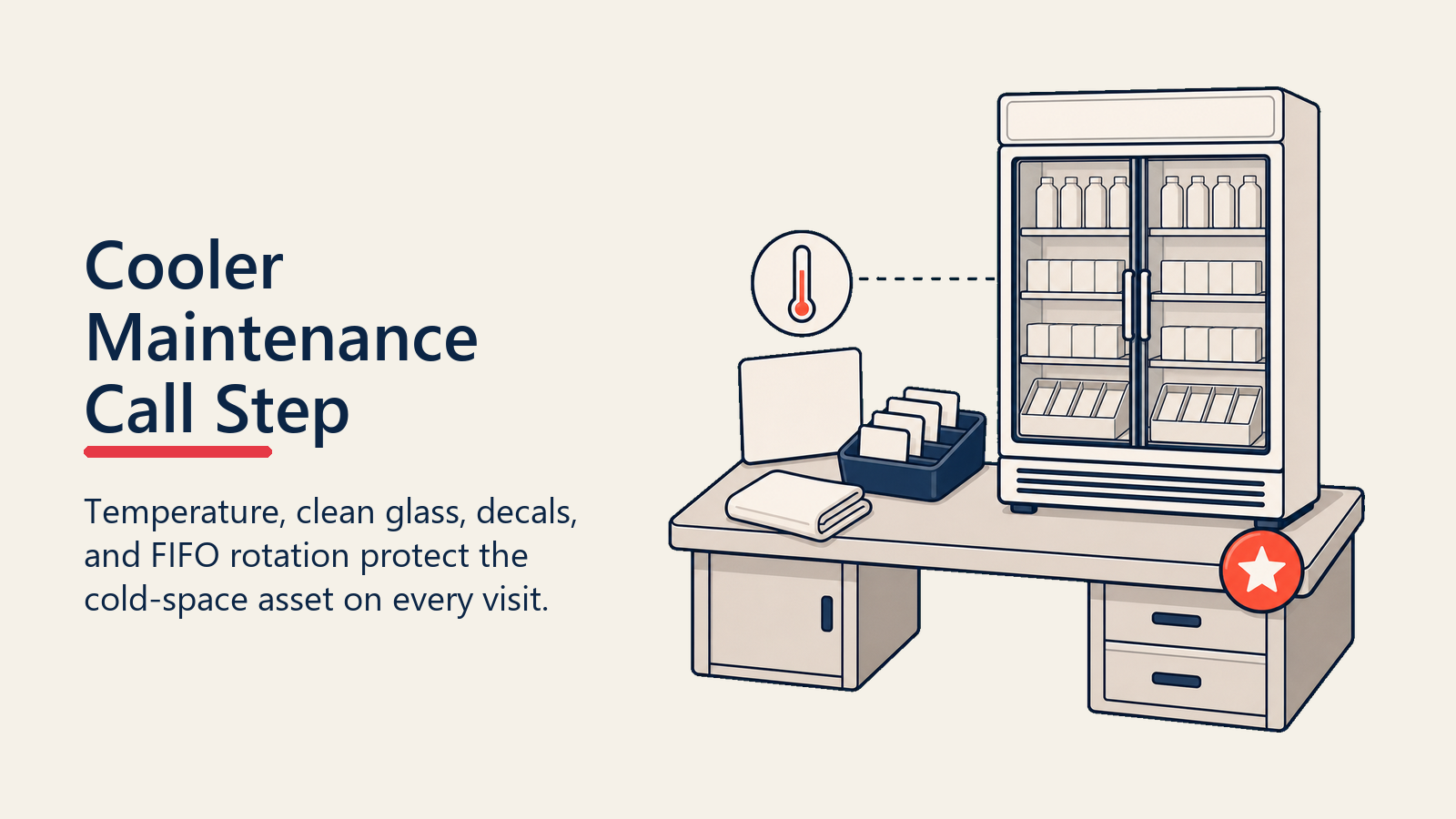
Check the internal temperature setting against the required range for the category (typically 2 to 8 degrees Celsius for most cold-chain beverages). If the cooler isn't reaching temperature, the product quality declines and the brand's assurance of a cold drink at the point of purchase fails. Log a fault call with the equipment team immediately. Don't leave it for the next visit.
Clean the glass door before leaving. Fingerprints and condensation on the door reduce the visibility of the products inside and reduce impulse trigger. A 30-second wipe with a clean cloth is not excessive caretaking; it's protecting a revenue-generating surface.
FIFO Restocking Inside the Cooler
Every restock inside a branded cooler or mixed chiller should follow First In, First Out rotation. Pull the older stock from the back to the front. Load fresh product behind it. This is the same FIFO logic described in more detail in Returns, Damages, and Freshness FIFO, but at the cooler level it serves an additional purpose: it prevents near-expiry stock from sitting behind fresh stock where it becomes invisible until it's a write-off problem.
Glass Door and Brand Sticker Compliance
Check that the brand's door decals or stickers are present, clean, and adhered correctly. A branded cooler without its visual identity marks is just a generic fridge. Replacement stickers should be a standard item in the rep's visit kit. A door that has been re-branded by a retailer with competitor stickers is a compliance breach that escalates to the trade marketing team.
See the broader In-Store Merchandising and Planograms framework for how cooler compliance fits into the full outlet merchandising standard.
Cooler Placement Priority Matrix
| Position Type | Description | Target Share | Visit Priority |
|---|---|---|---|
| Primary A | Door-entry, unobstructed, line-of-sight from entry | 100% brand exclusivity | Check at every visit |
| Primary B | Checkout queue flank, shopper-facing | 100% brand exclusivity | Check at every visit |
| Secondary A | First half of outlet, accessible, no obstruction | 80%+ brand exclusivity | Negotiate upgrade each cycle |
| Mixed chiller preferred | Allocated section in shared unit, left-of-competitor | 40-50% chiller share | Recount facings every visit |
| Mixed chiller minimum | Allocated section in shared unit | 30% chiller share | Escalate if below threshold |
| Non-compliant | Behind counter, obstructed, back wall only | Below minimum | Escalate within 48 hours |
Negotiating Cooler Exclusivity
Most branded coolers are placed on a loan agreement: the manufacturer provides the unit at no cost to the retailer, and in exchange the retailer agrees to stock the unit exclusively with the brand's products. But loan agreements require active management to hold.
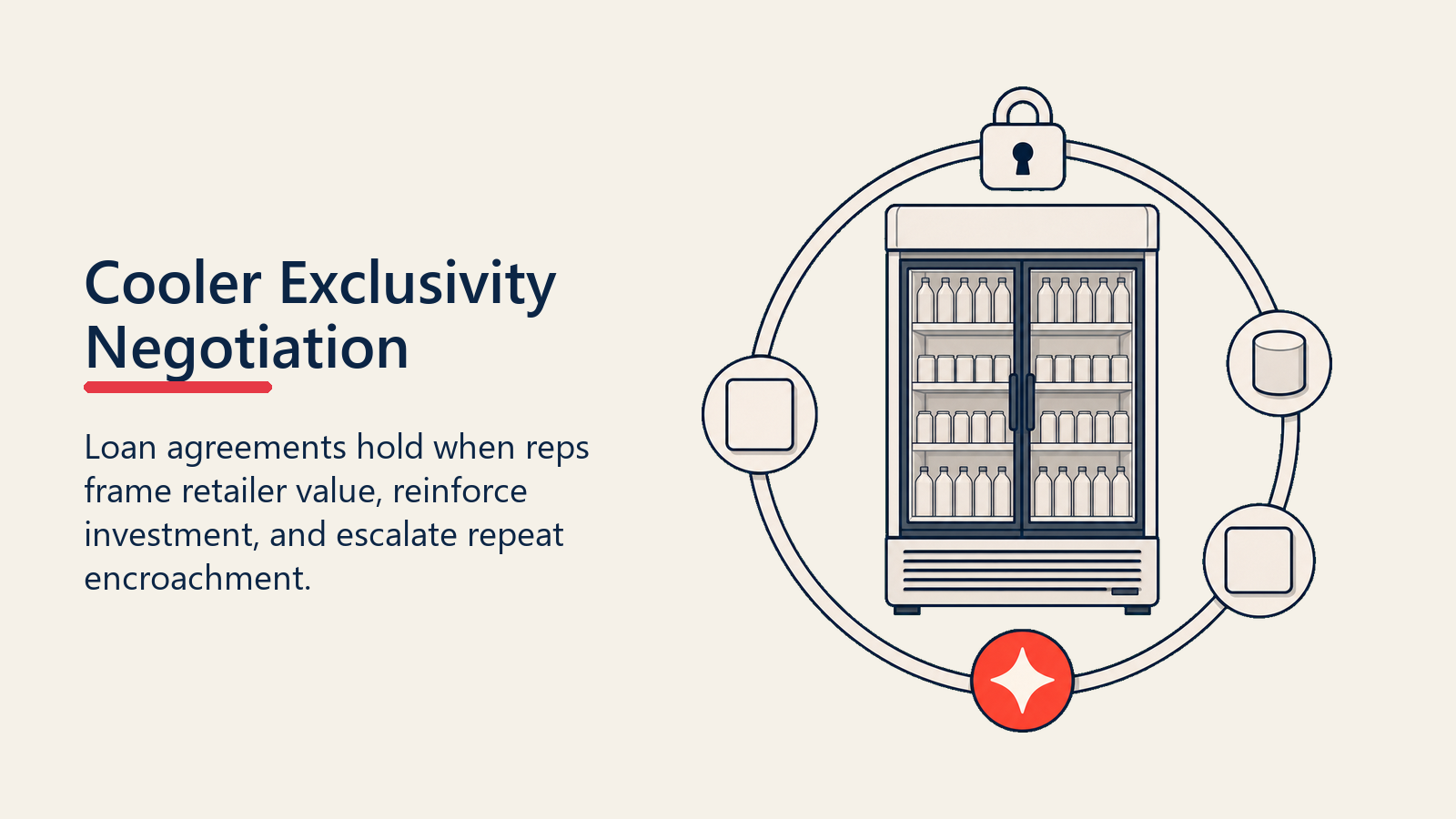
The conversation for exclusivity has three components:
Value framing. The retailer needs to understand what the cooler is worth to their business, not just to the brand. "This unit brings cold drink customers to your counter. When it's stocked correctly in the right position, you're selling more per shopper than if the cooler isn't there at all." That framing makes exclusivity a business decision for the retailer, not a concession to the brand.
Co-investment signals. If the retailer has maintained compliance over the last two or three cycles, a brand investment signal reinforces the relationship: a shelf strip update, a door decal refresh, or a cooler cleaning service. These are small costs that signal that the brand is a committed partner in the cooler's performance, not just a free equipment supplier.
Contract reference. When encroachment is severe or repeated, the loan agreement becomes the reference point. "Our agreement specifies brand-exclusive stocking. I'd like to work with you to get back to that standard before my area manager does a joint visit." This escalates the frame without making it adversarial, because the "joint visit" signal conveys accountability without accusation.
See Outlet Relationship Management for how to position these conversations within the broader relationship equity framework.
Chiller Audit Scorecard
| Audit Item | Standard | Pass | Fail | Weight |
|---|---|---|---|---|
| Position category | Primary A or B | Primary achieved | Secondary or worse | 25% |
| Competitor stock in branded cooler | Zero | None present | Any present | 20% |
| Glass door condition | Clean, decal intact | Clean and compliant | Dirty or missing decal | 15% |
| Temperature reading | Within specified range | Pass | Out of range | 15% |
| FIFO rotation | Oldest stock front-facing | Correctly rotated | New stock over old | 15% |
| Brand facing count (mixed chillers) | At or above 30% minimum | At or above target | Below minimum | 10% |
A pass on 5 of 6 items scores as compliant. A fail on position category or competitor stock alone triggers an escalation, regardless of the overall score.
This scorecard feeds directly into the Perfect Store and the Call Steps compliance score for the outlet, and informs the POS Visibility Execution priorities for the next cycle.
Audit Scoring and Market Share
Commercial teams that run cooler compliance audits across their outlet universe can see the market share correlation clearly. Outlets where the brand maintains primary position and full compliance typically generate an estimated 25 to 35 percent higher sell-out per outlet per month compared to non-compliant outlets in the same territory with comparable footfall (practitioner benchmark from beverage market field audit programs; no single published academic study). The FAO estimates that around 12 percent of global food is lost due to insufficient refrigeration, which makes temperature compliance a direct revenue issue for any brand selling through chilled retail.
That data makes the case to trade marketing and sales leadership that cooler investment and rep maintenance time aren't a service cost; they're a market share lever with a measurable return. Companies running this audit program typically score their outlet universe monthly, categorize outlets by compliance tier, and tie incentive payments for distributors and reps to compliance score improvement, not just to order volume.
The Customer Health Monitoring principles that apply to B2B account health apply here too: the early warning signal for a cooler compliance decline is usually a maintenance score drop two cycles before sell-out starts falling. Track it early and you intervene before the revenue impact.
Recovery When Compliance Drops
When a rep's audit identifies a non-compliant cooler, the recovery path is structured:
Cycle 1 (same visit): Attempt correction immediately. Clean the door, restock to brand-only configuration, move the unit if physically possible. Log the issue, the action taken, and the current position.
Cycle 2 (next visit): If the position has degraded again, bring the conversation to the retailer directly using the relationship conversation framework above. Escalate to the area manager if the retailer is unresponsive.
Cycle 3 (48 hours after second failed visit): Area manager joint visit. If the loan agreement is being violated systematically, the brand has the right to request cooler relocation or retrieval. Retrieval is rarely the right answer commercially; a joint visit that reinforces the partnership and reclarifies the agreement terms usually resolves the issue without destroying the outlet relationship.
The outlet relationship management framework is the backbone of that recovery conversation: the rep's credibility and relationship equity at the outlet determines how the compliance correction is received.
FIFO Restocking Checklist for Reps
Use this at every cooler or chiller restock:
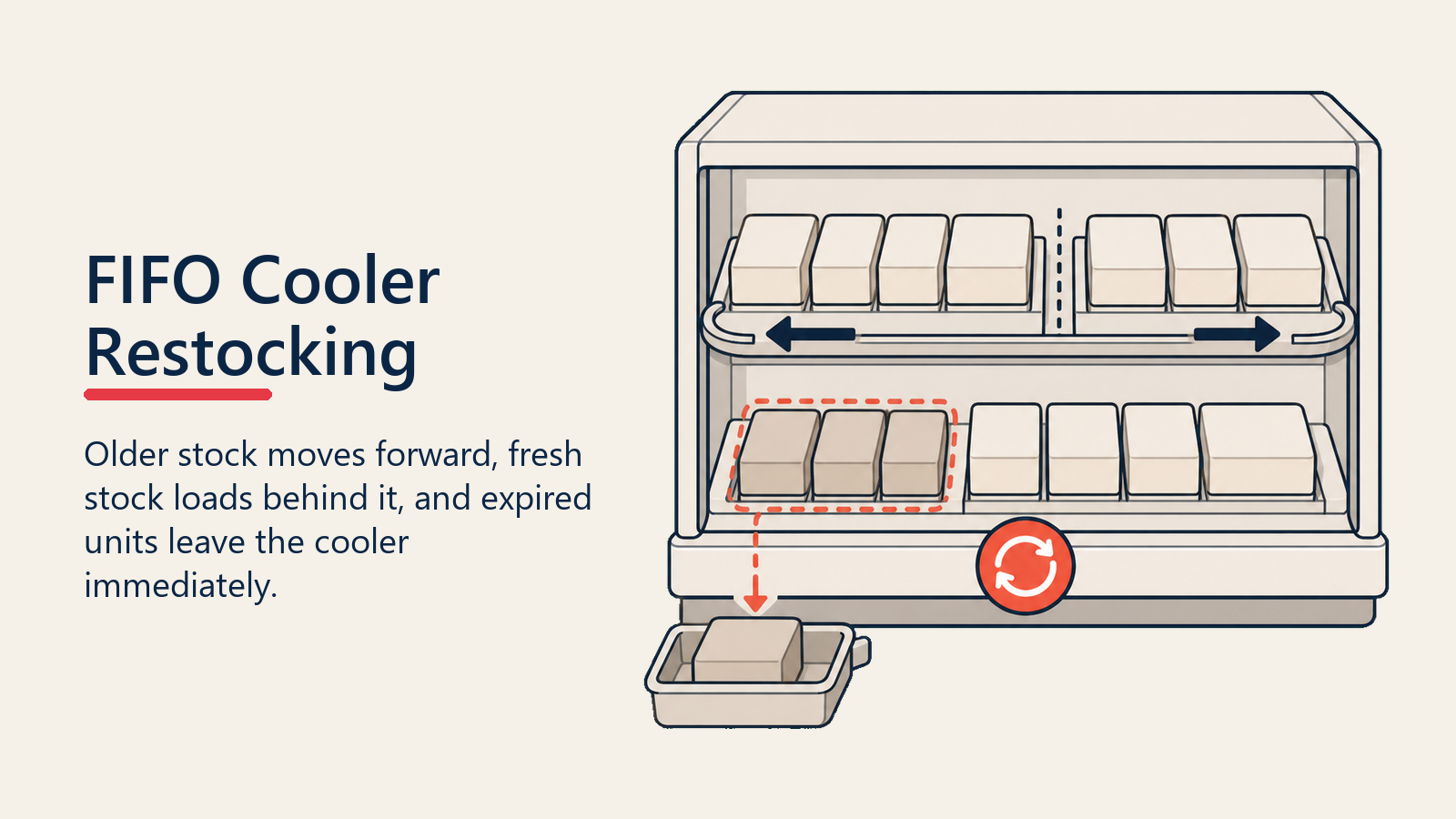
- Pull all existing stock to the front of the shelf
- Check dates on front-facing units: move any within 30 days of expiry to immediate-action status
- Load fresh stock delivered today behind existing stock, not in front of it
- Check that the oldest date on any shelf is the one visible to the shopper
- Remove any expired units immediately and log them on the returns form
- Confirm all product is within temperature range before leaving
This checklist takes under two minutes per shelf. It prevents the write-off accumulation that damages both the brand's financials and the retailer's confidence in the brand's freshness standards.
Conclusion: A Dirty Cooler Is a Brand Risk, Not a Housekeeping Problem
The rep who treats cooler maintenance as a background task rather than a core commercial activity is, slowly and consistently, losing market share at the outlet level. It doesn't show up in a single visit. It shows up in the quarterly sell-out review when one territory is 8 percent behind plan and nobody can explain why until someone checks the audit scores.
Cold space is a commercial battleground. The brand that puts its cooler in the door-entry position, keeps it at temperature, maintains its visual identity, and restocks it on FIFO rotation wins the impulse purchase every time that door opens. The brand whose cooler has been pushed to the corner wins nothing except a depreciation write-off on the equipment.
Own the cold space. Maintain it like it generates revenue, because it does.
Quotable Nuggets
"A dirty cooler shoved behind the checkout is costing you sales. The brand whose cooler sits at door-entry, clean and stocked correctly, wins the impulse purchase every time that door opens."
"The majority of cold-beverage purchases are impulse decisions, Statista data shows 74% of US shoppers reporting impulse single-serve cold beverage purchases. The door-entry cooler position is where those decisions get made. Losing that position is not a housekeeping problem; it is a revenue leak." (Statista, 2018)
"Cooler compliance drops between visits, not during them. Every rep who shows up to check, clean, restock, and reposition is protecting a revenue-generating asset the brand paid to place."
Frequently Asked Questions about Cooler and Chiller Space Management
What is a primary cooler position in FMCG retail?
A primary cooler position meets three criteria: placement within three meters of the outlet entry or along the checkout queue path, unobstructed shopper access to the door handle, and direct line-of-sight from the entry point. Primary positions command significantly higher unit movement than secondary or back-of-store placements because they intercept shoppers at the impulse decision moment rather than requiring them to seek the product out.
How often should a field rep do a cooler compliance check?
Every visit, without exception. The cooler compliance check is not a monthly audit task; it's a call step that happens on every scheduled visit to the outlet. Position, temperature, FIFO rotation, glass door condition, and competitor encroachment can all change between visits. A weekly or biweekly check cadence means the rep catches compliance drops before they compound into sustained revenue loss.
What should a rep do if a competitor has stocked product in a branded cooler?
Relocate the competitor's product to the appropriate section of the store (their own shelf or, if the outlet has a competitor cooler, to that unit), restock the brand's cooler to full exclusivity, and log the incident in the CRM. If this is a first occurrence, address it with the retailer using a value-framing conversation. If it's a recurring pattern, escalate to the area manager and reference the loan agreement.
Why is FIFO important inside a branded cooler?
FIFO (First In, First Out) rotation ensures that the oldest stock is always at the front of the shelf and is sold before newer product arrives behind it. Without FIFO discipline inside a cooler, newer stock gets loaded on top of or in front of older stock, and near-expiry product accumulates at the back until it crosses the expiry date and becomes a write-off. FIFO compliance is a call-step responsibility for field reps, not a warehouse task.
What is the minimum acceptable chiller share for a brand in a mixed chiller?
A brand with meaningful volume and active distribution at a given outlet should target a minimum of 30% of visible facings in any shared chiller unit. Below 30%, the brand is commercially near-invisible to a shopper making a quick scan during peak traffic. The target for a preferred-supplier relationship is 40-50%, particularly in categories where the brand holds category leadership in that market. Recount facings on every visit before restocking, because competitor encroachment between visits is the norm in mixed chillers.
How should a rep handle a retailer who has re-stocked a branded cooler with competitor product despite a loan agreement?
Use a three-step approach. In the same visit: relocate the competitor product to the retailer's own shelf or competitor cooler, restock the branded cooler to full exclusivity, and log the incident. If it is a first occurrence, use a value-framing conversation with the retailer. If it is a recurring pattern, reference the loan agreement and mention that an area manager joint visit is the next step. Do not remove competitor materials confrontationally or create a scene. The goal is restoring compliance and preserving the relationship, not winning an argument.
What does a cooler compliance audit scorecard track?
A standard audit covers six items: cooler position category (primary or secondary), presence of competitor stock inside the branded unit, glass door condition and brand decal integrity, internal temperature within the specified range, FIFO rotation of stock, and facing count against the target for mixed chillers. A pass on five of six items scores as compliant. A fail on position category or competitor stock alone triggers escalation regardless of the overall score.
Learn More

Senior Implementation Consultant
On this page
- Why Cold Space Is a Premium Asset
- What Makes a Cooler Placement Commercially Valuable?
- Primary Position Criteria
- Secondary Position Rules
- Competitor Cooler Adjacency
- Chiller Share in Mixed Coolers
- Facing Allocation Targets
- Brand Blocking
- Competitor Encroachment Protocol
- Maintenance as a Selling Act
- Temperature and Cleanliness Inspection
- FIFO Restocking Inside the Cooler
- Glass Door and Brand Sticker Compliance
- Cooler Placement Priority Matrix
- Negotiating Cooler Exclusivity
- Chiller Audit Scorecard
- Audit Scoring and Market Share
- Recovery When Compliance Drops
- FIFO Restocking Checklist for Reps
- Conclusion: A Dirty Cooler Is a Brand Risk, Not a Housekeeping Problem
- Quotable Nuggets
- Learn More