POS Visibility Execution: How Field Reps Turn Point-of-Sale Materials Into Sales
Turn this article into takeaways for your work.


Each assistant summarizes the article only for you and suggests best practices for your work.
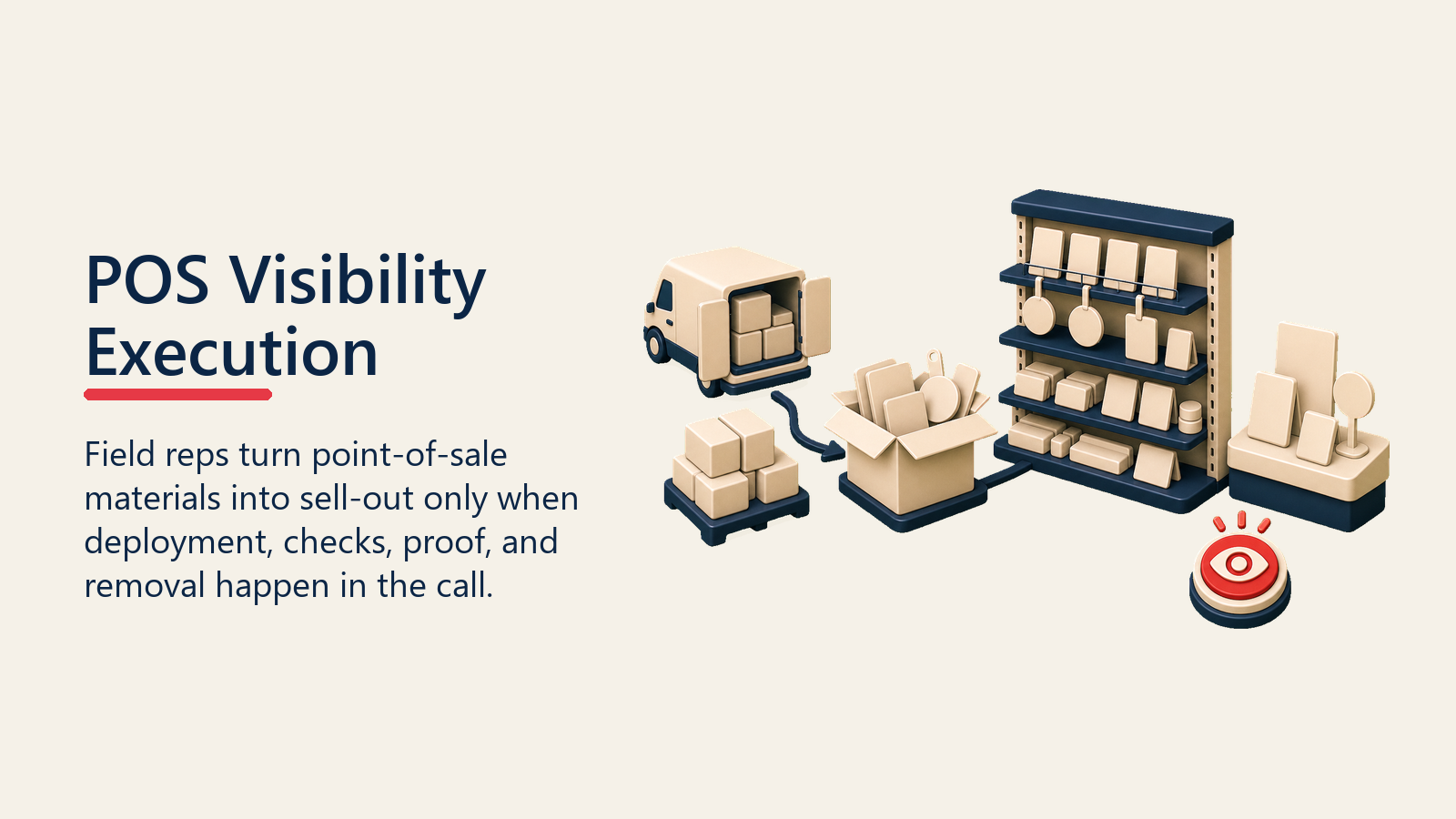
There's a pattern that repeats across FMCG commercial teams when they audit van loads at the end of a call cycle. The rep completed her target call count. The orders are logged. But the box in the back of the van, the one that contains sixty shelf talkers and forty wobblers for the promotional campaign that started three weeks ago, is still full. Not empty. Full.
Nobody made a decision to keep those materials in the van. The rep ran out of time at busy outlets. A few retailers said no. The call rhythm didn't leave space for deployment after the order was confirmed. And so the brand team's visibility investment, the shelf talkers designed to pull consumer attention at the point of decision, sat in a van doing nothing for three weeks of a four-week promotion window.
This is the most common failure mode in FMCG POS execution. It's not a creative problem or a production problem. It's a field discipline problem. And it's fixable with a clear deployment protocol that makes POSM (point-of-sale materials) deployment a non-negotiable part of the call, not an optional add-on after the order is done.
What POS Visibility Covers
Point-of-sale materials in FMCG general trade range from small shelf-level items to large-format secondary displays. Understanding what's in scope for a rep's deployment responsibility prevents the common confusion between what trade marketing places through retailers' own agreement and what the field rep places on every outlet visit.
Key Facts: POS Material Deployment and Visibility
- NielsenIQ research across 15 categories and 155 brands found that 60% of FMCG sales can be influenced at the store level, with product placement and accessibility delivering a 20-40% uplift potential. POS visibility materials are the deployment lever that activates that uplift at the moment of consumer decision.
- According to market research aggregated by Expert Market Research in its PoSM market report, approximately 68% of consumers say they have made an unplanned purchase due to an effective in-store display or promotion; well-positioned POSM in fast-moving categories can raise sales by 20-30% for the promoted SKU. (Note: Expert Market Research is a market-research aggregator; treat this as a directional industry estimate.) (Expert Market Research, PoSM market data)
- In practitioner audits across FMCG general trade markets, 30-40% of POSM produced for a promotion window is estimated to never reach an outlet shelf or display position due to rep time constraints, retailer refusals, and late brief arrival (practitioner field estimate; no single published study)
Shelf-level POSM: shelf talkers (small cards that clip to or slide under shelf edges), wobblers (die-cut cards on a flexible plastic arm that move and catch the eye), price stickers, and shelf strips. These go into the category section at the exact position of the brand's product and direct consumer attention to the SKU or promotional price. The Wikipedia overview of point-of-sale displays covers the full taxonomy of display types used across retail environments.
Counter-level POSM: counter cards (standing displays that sit on the retailer's checkout counter), display risers, and small product holders. These reach consumers at the payment moment, which is the second-highest purchase decision point in general trade after the product shelf.
Hanging and ceiling POSM: hanging boards, bunting, and ceiling danglers. These create macro-level brand presence in the outlet and are most effective in small kirana formats where ceiling height is low and the hanging material is visible from the doorway.
Floor and entry POSM: floor stickers, door decals, and A-frame boards. Floor stickers at the entry aisle create a branded pathway toward the category section. Door decals announce the brand to shoppers before they enter.
POSM kits: pre-packaged sets assembled for a specific promotional campaign, typically containing a mix of shelf talker, wobbler, counter card, and price sticker. Kits are allocated to specific outlet tiers and delivered to reps ahead of the promotion window.
The Deployment Process
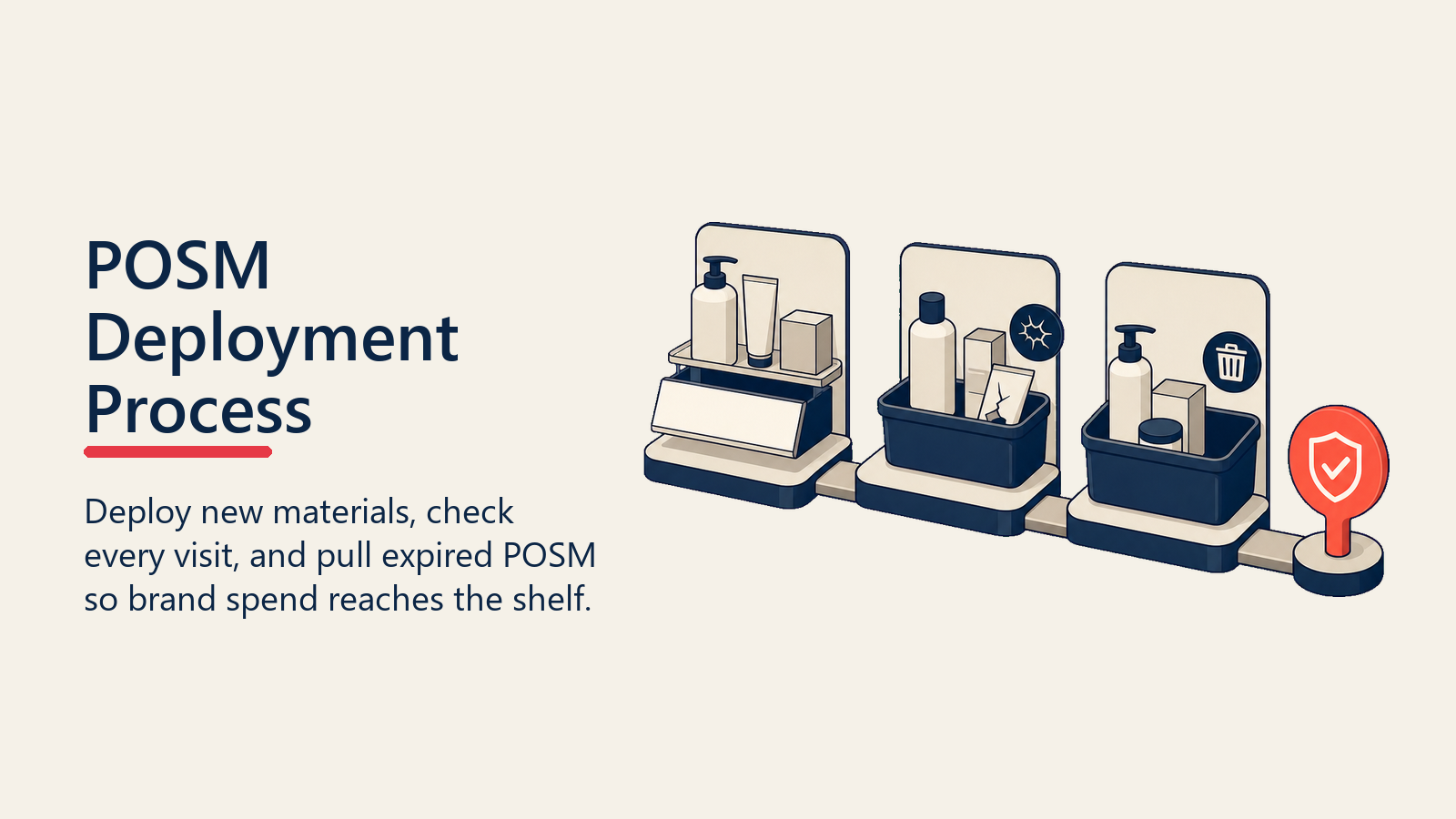
POSM deployment works when it's treated as a separate task from order taking, given a fixed slot in the call sequence, and documented before the rep leaves the outlet. The Deploy-Check-Pull Protocol: deploy new materials in week one, check for damage or competitor removal at every subsequent visit, and pull expired or post-campaign materials without waiting to be asked. Applied consistently, this three-step discipline closes the gap between materials produced and materials visible to consumers.
Outlet segmentation determines which materials go where. Not every outlet gets every POSM type. A/B/C outlet segmentation based on sales volume, footfall, and commercial priority determines the POSM tier allocated to each account. The outlet segmentation and classification framework defines these tiers, but the practical implication for POSM is straightforward:
| Outlet Tier | POSM Allocation |
|---|---|
| A (high-footfall, high-volume) | Full kit: shelf talker, wobbler, counter card, hanging board, floor sticker |
| B (mid-volume, consistent ordering) | Standard kit: shelf talker, wobbler, counter card |
| C (lower volume, irregular ordering) | Basic kit: shelf talker, price sticker |
Reps should load the van with the correct quantity per tier before the route starts. Running out of A-tier materials at a B-tier outlet because the rep depleted his supply early is a supply discipline problem, not a materials shortage problem.
Rep responsibilities at each call. Three POSM responsibilities happen at every visit during an active promotion window:
First, deploy new materials. Any POSM from the current campaign that the outlet hasn't received yet gets deployed during this visit. This includes getting retailer permission for anything that goes on a wall, ceiling, or the retailer's counter.
Second, replace damaged or missing materials from the previous deployment. Wobblers fall off. Price stickers get pulled by competing reps. Shelf talkers get knocked out of position. A thirty-second shelf check catches this.
Third, pull expired materials. Promotional POSM from a campaign that has ended should not be on the shelf. Outdated promotional prices still displayed after the promotion closes create either consumer confusion or retailer disputes. Pull them every visit, without waiting to be asked.
Retailer permission and relationship tactics. General trade retailers vary widely in their receptivity to POSM deployment. Some actively welcome it because they know it drives traffic. Others are reluctant because they've had poor experiences with materials being placed over their own signage or their preferred brands.
The script that consistently works is the one that puts the retailer's interest first: "Can I put this shelf talker on your soap section? It's for the Lifebuoy price promotion we're running this month. Your customers will see the deal and it should bring more through that section." That's permission language, not placement instruction. Reps who frame POSM deployment as something they're doing for the retailer, not to the retailer, get significantly higher placement rates than reps who treat deployment as a task the retailer needs to accommodate.
What Rules Govern Where POSM Goes in the Outlet?
Where POSM goes matters as much as whether it gets deployed at all. Visibility materials placed in sub-optimal positions don't convert.
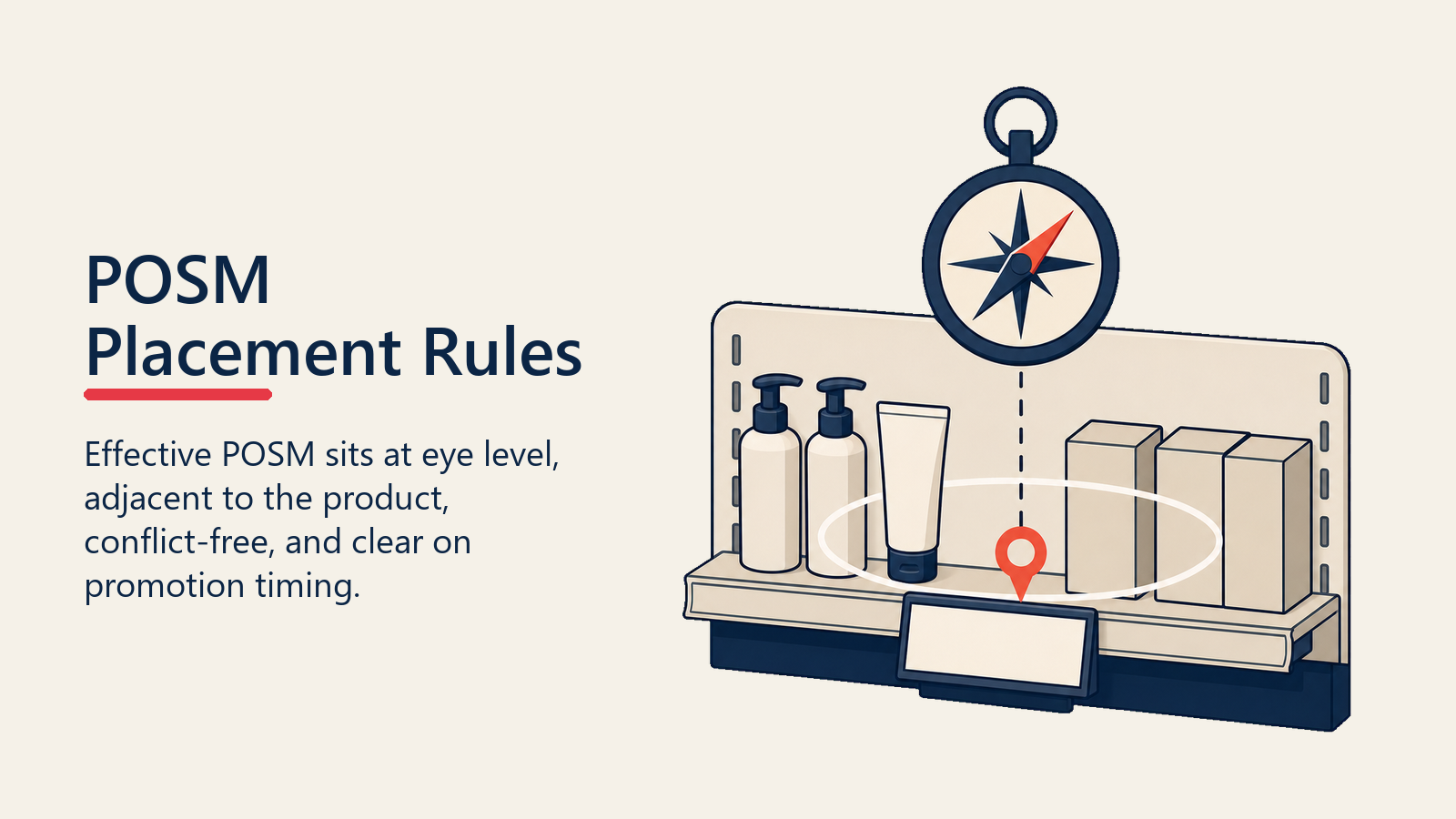
Eye-level height. Shelf talkers and wobblers should be at eye level for the average adult consumer in the market. In markets where average adult height is lower, eye level adjusts accordingly. A shelf talker stuck at ankle height on a bottom shelf doesn't catch anyone's eye during a quick purchase browse.
Product adjacency. POSM must sit next to or directly above the promoted product. A wobbler for Dove soap placed in the biscuit aisle because the soap section is crowded is wasted material. The consumer decision moment happens at the category section. The POSM needs to be there.
Competitor clearance. Materials should not be placed directly covering competitor signage or facing competitor products in a way that could trigger retailer conflict. Place materials within the brand's own shelf space. If the competitor has installed a shelf strip in a position your brand needs, raise it with the field manager rather than pulling the competitor's material unilaterally.
Expiry date visibility. For promotional POSM that features an end date, make sure the date is visible to consumers, not folded behind or hidden by adjacent product. An "Offer valid until 31 July" shelf talker where the date is obscured creates consumer mistrust when the promotion ends and the sticker is still up.
The connection between POSM placement rules and shelf execution standards is direct. Both live in the same outlet visit and require the same thirty seconds of attention to get right. The in-store merchandising and planograms framework covers shelf position discipline; POSM execution layers on top of that foundation.
Freshness and Replacement Cycles
The second most common POSM failure mode, after non-deployment, is stale materials. A shelf talker for a promotion that ended six weeks ago is worse than no shelf talker at all. It tells the consumer the brand doesn't pay attention. It tells the retailer the rep doesn't pay attention. And it creates a price expectation that the brand can't fulfill at the checkout.
Freshness discipline means the rep checks the expiry or end date of any POSM currently on the shelf at every visit, not just during active promotion windows. A forty-five-second scan of the shelf section at the start of the call catches this.
When POSM needs to be pulled but no replacement is immediately available, leave the shelf clean. An empty shelf is more neutral than a stale promotional message. The promotions and trade scheme execution calendar should be in the SFA so reps know at each visit whether a promotion is active, starting, or ending, and can carry the appropriate materials accordingly.
Audit and Photographic Proof
The difference between "I deployed it" and proof of deployment is the compliance photo. Every outlet where POSM is deployed should have a photo taken and logged before the rep leaves.
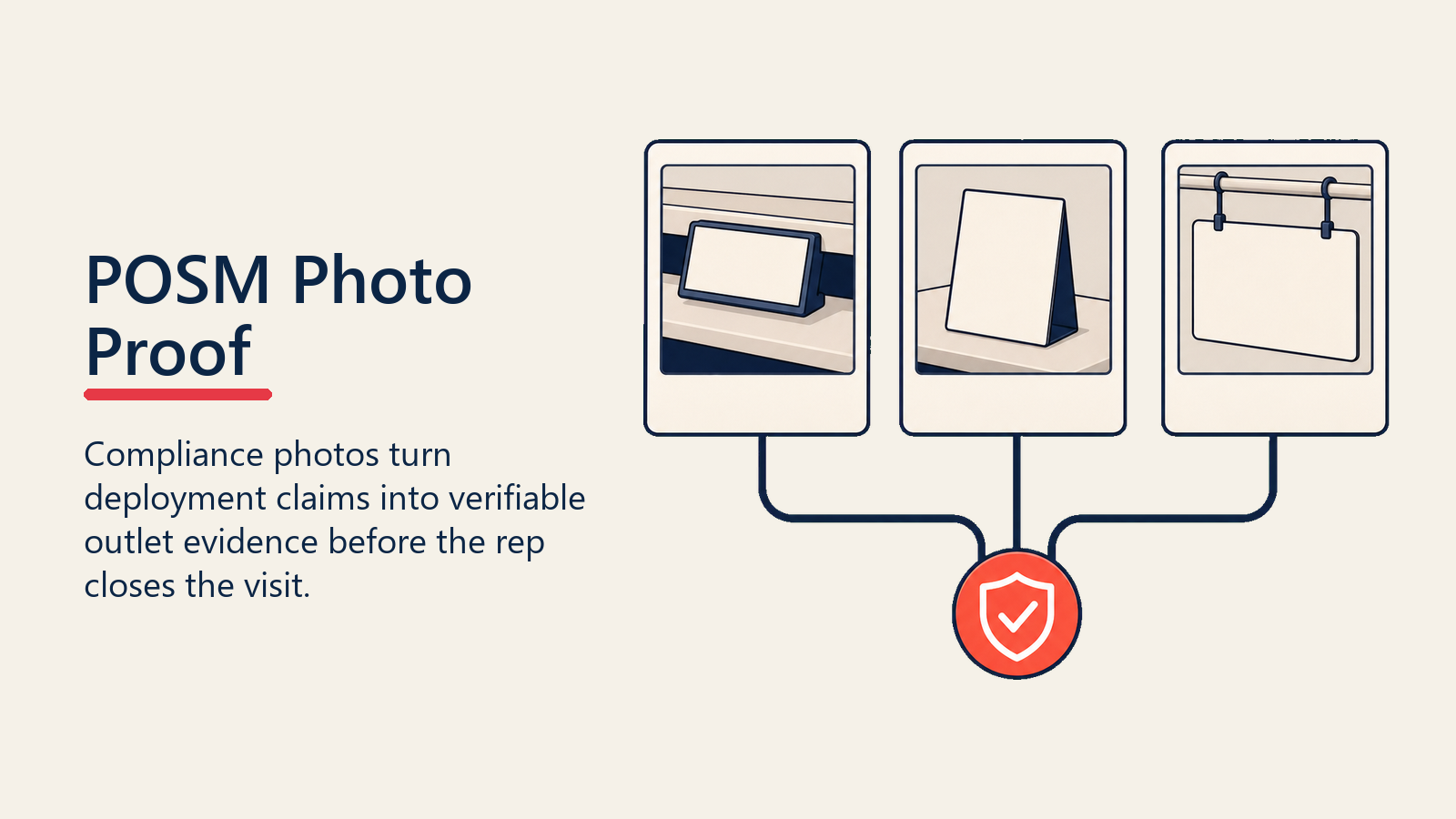
What to photograph. Three shots per outlet: the full shelf section showing the brand's shelf talker and wobbler in position (with adjacent product visible for context), a close-up of any counter card or secondary display, and a shot of any hanging board or floor POSM. The SFA should prompt these photo requirements and block the visit close-out until they're submitted.
How to tag. GPS coordinates and outlet ID should tag automatically through the SFA. The timestamp establishes when the deployment happened. For promotional campaigns with compliance reporting requirements, this data feeds the retail execution analytics dashboard that brand teams use to track deployment rates against campaign targets.
Compliance KPIs. The numbers that matter for POS visibility programs:
| KPI | Definition | Target |
|---|---|---|
| POSM deployment rate | % of targeted outlets with materials confirmed deployed by end-week 1 of promotion window | 85%+ |
| Correct placement rate | % of deployed materials confirmed at eye level and adjacent to product | 80%+ |
| Freshness rate | % of outlets with only current-campaign materials on shelf | 95%+ |
| Photo submission rate | % of outlet visits with compliance photo submitted same day | 90%+ |
Field managers who review these KPIs weekly can identify deployment bottlenecks before the promotion window is half over. Catching a 60% deployment rate in week one of a four-week promotion leaves time to correct. Catching it in week four leaves no time at all.
Common Failure Modes
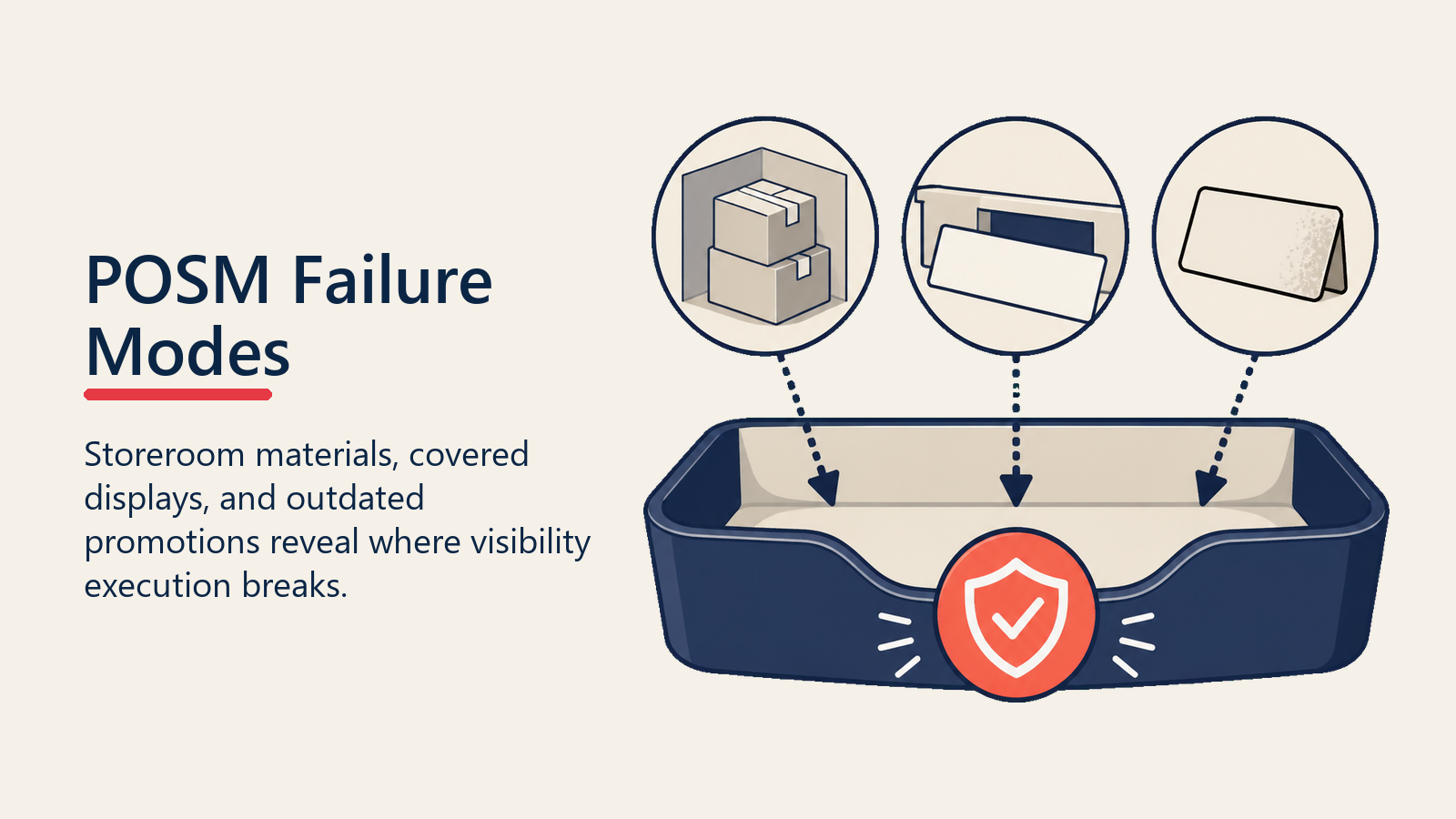
POSM in the storeroom. The retailer accepted the materials and put them in the back. This is a legitimate agreement that then fails at execution because nobody follows up. At every visit after a deployment, the rep should physically confirm the materials are on the shelf, not in the storeroom. "I dropped off the shelf talkers last time. Let me make sure they're up before I go."
Competitor covering your material. A competing rep placed their shelf strip over your price sticker. This is a common competitive tactic in markets where multiple companies are calling on the same outlets. The fix is to document the event (photo, competitor identification if visible) and raise it with the field manager. Don't remove the competitor material unprompted. Re-place your own material in an adjacent position if space permits.
Outdated promotions still up. The promotion ended three weeks ago and the shelf talker is still there. This falls on the rep who didn't pull it on the first visit after campaign close. The SFA should flag any outlet where the last POSM photo is time-stamped before the campaign end date, signaling a freshness check is overdue.
The trade marketing and field alignment function owns the decision about which campaigns run and which outlets they target. But field discipline owns whether those materials reach the shelf. When the two are misaligned, trade marketing sees deployment numbers from reps that don't match what audit photos show. Closing that gap requires the field manager to hold reps accountable for photo submission, not just for call count.
For a broader view of how POSM execution connects to national field force coordination, the sales operations and field force alignment framework outlines the governance layer that keeps regional deployment programs consistent across large territories.
Tracking Visibility Scores
The companies that consistently outperform on POS visibility execution are the ones that track deployment compliance as a commercial KPI, not a reporting exercise. They link POSM compliance rates to sell-out data at the outlet level and use the correlation to make investment decisions.
The logic is straightforward. If outlets with confirmed POSM deployment show 20% higher sell-out on the promoted SKU compared to outlets without deployment, then every percentage point improvement in deployment rate translates directly into incremental sales. NielsenIQ distribution analysis shows that correcting execution gaps in high-priority stores can unlock 10% incremental market share, with top-tier outlets accounting for the vast majority of category sales in most FMCG markets. That's a number brand teams can take to the commercial director to justify higher POSM production budgets and more structured rep training on deployment discipline.
The perfect store and call steps framework uses POS visibility compliance as one of the five pillars of the perfect store score. When visibility compliance is tracked as part of the outlet's overall perfect store rating, it gets the same commercial attention as distribution and display.
The last ten meters of brand investment happen at the shelf, at the counter, and at the moment the consumer decides. POSM is the tool that activates that moment. But only if it's actually on the shelf.
Quotable Nuggets
"Every carton of wobbler displays still in the van at day's end is brand spend that didn't convert. Field discipline is what closes the loop between the media budget and the sell-out number."
"An empty shelf is more neutral than a stale promotional message. A shelf talker for a promotion that ended six weeks ago tells the consumer the brand isn't paying attention."
Frequently Asked Questions about POS Visibility Execution
What is POSM in FMCG and what does a field rep deploy?
POSM (point-of-sale materials) covers every physical brand asset deployed at the outlet below the shelf: shelf talkers, wobblers, counter cards, price stickers, shelf strips, hanging boards, bunting, door decals, floor stickers, and A-frame boards. A rep's deployment responsibility is all shelf-level and counter-level materials that go into the category section on every call during an active promotion window.
Why does POSM so often fail to reach the shelf?
Three failure patterns repeat across FMCG general trade: the rep ran out of call time after the order was confirmed and treated POSM deployment as an optional add-on; the retailer accepted the materials and put them in the storeroom without following up; or the brief arrived late and the rep carried the wrong or no materials. All three are field discipline failures, not production or creative failures. A fixed slot in the call sequence for deployment, before the rep closes the visit, eliminates the first pattern.
What should a rep do if a retailer refuses to let them put up POSM?
Use permission framing: explain what the material does for the retailer's customers, not what it does for the brand. "Can I put this shelf talker on your soap section? It highlights the promotion your customers are already looking for, so it should bring more of them to that section." If the retailer still refuses, note the refusal in the SFA with the reason, do not argue, and raise with the field manager if the outlet is A-tier. Don't remove competitor materials to make room; place your materials within the brand's own shelf space.
How do compliance photos reduce POSM non-deployment rates?
Compliance photos close the accountability gap between a rep's self-report and what is actually on the shelf. When field managers review photos systematically, they can identify within the first week of a promotion window whether deployment is on track. A 60% deployment rate visible in week one of a four-week campaign leaves time to intervene. The same rate discovered in week four is irreversible. The photo timestamp and GPS tag also prevent the common problem of photos taken from stock in the van rather than from the shelf.
When should a rep pull POSM from the shelf?
Pull any POSM at three moments: when the promotion campaign it belongs to has officially closed; when the material is physically damaged to the point it no longer displays the correct promotional message; and when a check reveals the price or offer shown no longer matches current terms. Outdated promotional pricing still displayed after a scheme closes creates consumer confusion and generates retailer complaints when shoppers present the old price at the counter.
How does outlet segmentation affect POSM allocation?
Outlet tier determines which POSM kit a rep carries for that account. A-tier outlets with high footfall receive the full kit: shelf talker, wobbler, counter card, hanging board, and floor sticker. B-tier outlets receive a standard kit: shelf talker, wobbler, counter card. C-tier outlets receive a basic kit: shelf talker and price sticker. Reps load the van by tier before the route starts. Depleting A-tier materials at a B-tier outlet because of loading order is a logistics failure, not a materials shortage.
Conclusion: Visibility Execution Is the Last Conversion Point
Every brand investment that goes into a product, a campaign, a promotional scheme, and a trade deal ultimately terminates at a single moment: the consumer standing in front of the shelf deciding what to buy. POS visibility materials are the conversion tool at that exact moment. They either work, or they sit in a van.
The rep who deploys before leaving every outlet, photographs the placement, and pulls expired materials on the next visit is the brand's last conversion agent. That accountability isn't optional. It's the only thing that closes the loop between the media budget and the sell-out number.
Learn More

Senior Implementation Consultant