Promotions and Trade Scheme Execution: Getting the Deal From Head Office to the Retailer's Shelf
Turn this article into takeaways for your work.


Each assistant summarizes the article only for you and suggests best practices for your work.
There's a promotion story that sales directors hear every quarter. The campaign ran for four weeks. The brand team designed it carefully, priced it aggressively, and negotiated the scheme terms with the finance director. The trade spend was approved. The POSM (point-of-sale materials) was produced. The sell-in numbers looked encouraging.
And then the post-promotion evaluation comes back. Sell-in was up 18 percent. Sell-out was up 4 percent. The gap between what went into the trade channel and what came back out in consumer sales is sitting in retailers' back rooms as overstock that will take three months to clear. The next distributor visit will include a deduction request.
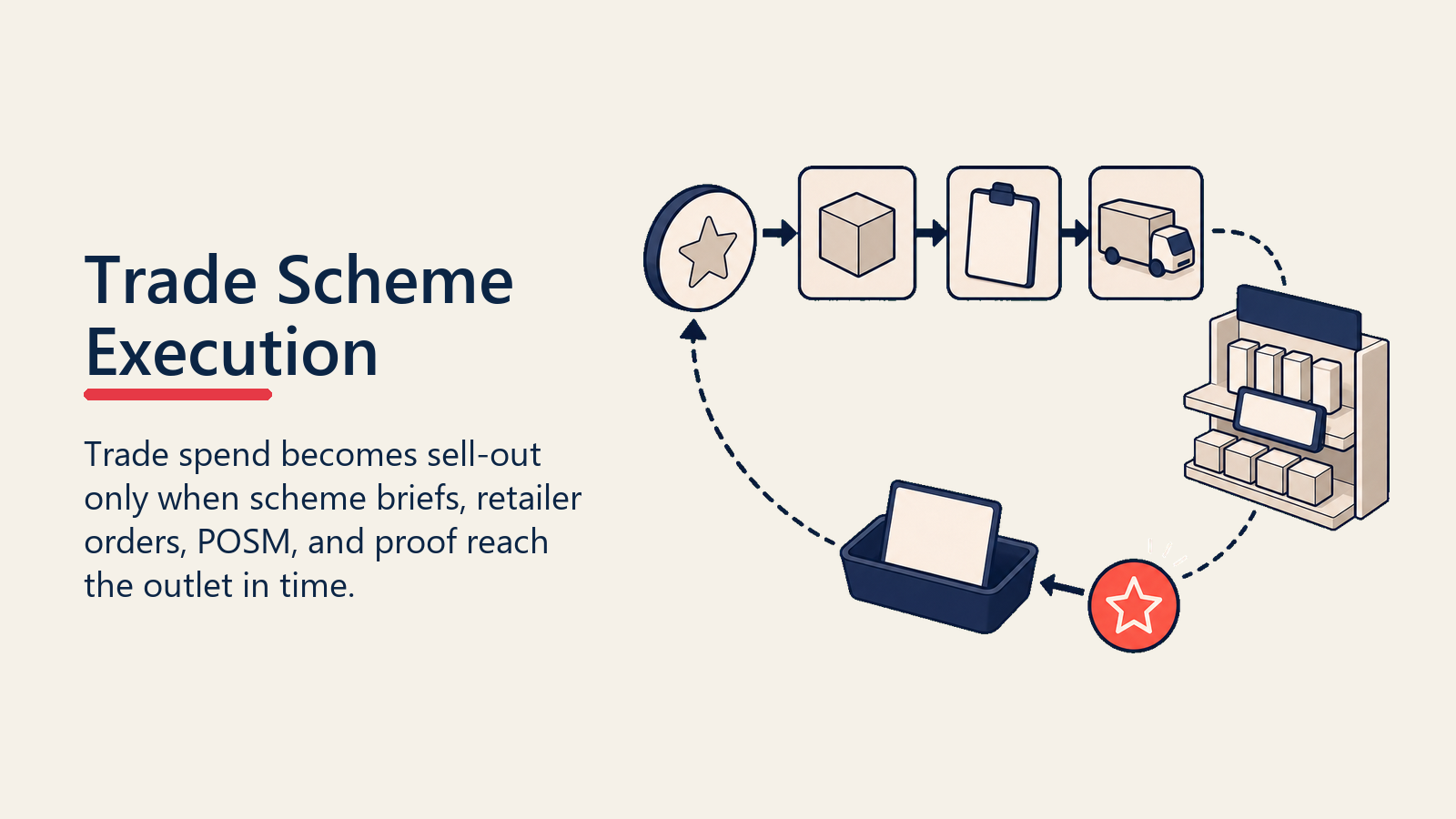
What happened between the commercial planning room and the retailer's shelf is the story of most FMCG trade promotion failure. It's not a strategy problem. The strategy was fine. It's a field execution problem: the rep briefed the retailer in week three of a four-week campaign, the POSM arrived late, the incremental order uplift wasn't tied to the scheme terms at the counter, and nobody photographed the shelf to confirm that any of it happened.
Field execution is where trade spend becomes sell-out or becomes a write-off. There's no other variable that matters as much.
How Do Trade Schemes Work at the Outlet Level?
Before a rep can execute a trade scheme, she needs to understand what she's selling and why the retailer should care. Trade promotions come in several structural forms, each with different mechanics at the outlet level.

Key Facts: Trade Promotion Execution
- McKinsey research on CPG trade promotions found that CPG companies worldwide invest approximately 20% of their revenue in trade promotions, making trade spend the second-largest cost line after COGS. Of those promotions, 59% lose money globally, and 72% in the United States alone.
- The execution gap between sell-in and sell-out is a structural leak in most FMCG markets. Retailers who over-stock on promotional terms and sell at non-promotional price post-scheme create "forward buying" distortion, which makes quarterly volume look healthy while consumer offtake data stays flat.
- Rep briefing timing is one of the highest-impact execution variables: promotions briefed in week one of a four-week window are estimated to generate 35-40% more incremental uplift than the same promotion briefed in week three, because the retailer has more time to increase her order cycle before the window closes (practitioner estimate from trade promotion management teams; no single published study).
Off-invoice discounts. The simplest form: a percentage or absolute amount taken off the unit price for orders placed during the promotion window. The retailer buys at a lower cost and either passes some of the saving to consumers (boosting sell-out) or retains the margin. Rep responsibility: confirm the discount applies to the correct SKUs and order quantities, and that the retailer understands the window dates.
Volume rebates. A payment made to the retailer after the fact, conditional on reaching a volume threshold during the promotion period. The retailer buys at full price but receives a check (or credit note) if her total purchases meet the target. Rep responsibility: brief the retailer on the threshold at the start of the window, track her progress toward it across visits, and remind her in the final week if she's close to hitting the tier.
Conditional schemes. More complex schemes that tie a discount or rebate to a specific behavior, such as achieving a target facing count, deploying POSM, or purchasing a specific SKU mix. A common conditional scheme in FMCG is: "Buy twelve cases of the Sunsilk range and receive a 10 percent discount on the full soap range." Rep responsibility: confirm the behavioral condition is met at the outlet, not just the volume condition. A retailer who qualifies on volume but hasn't deployed the POSM shouldn't be approved for a claim that requires POSM deployment.
Sell-in vs sell-out mechanics. Sell-in schemes reward the retailer for buying from the distributor. Sell-out schemes reward the retailer for selling to consumers, typically tracked through loyalty data or receipted sales. In general trade markets where sell-out data is sparse, most schemes operate on sell-in mechanics, which is why forward-buying distortion is endemic. Understanding whether the scheme is sell-in or sell-out determines how the rep frames the commercial conversation with the retailer.
The Execution Chain
Trade promotions travel through a chain before they reach the outlet. Every link in that chain is a place where information degrades, timing slips, or accountability gets diffused.
Head office designs the scheme and negotiates terms with the finance director. The brand team translates the commercial terms into a rep-level brief. The field manager receives the brief and needs to train the rep before the campaign starts. The rep needs to understand the terms well enough to brief the retailer at the first call of the promotion window. The retailer decides whether to participate, how much to order, and whether to deploy the supporting POSM.
That chain has at least five handoffs, and each one is a potential failure point. The most common breakdowns:
Brief arrives late. The rep receives the promotion brief after the campaign has already started. Three days of the window are gone before the first retailer is briefed. In a four-week promotion, that's a material loss.
Brief is incomplete. The rep knows the discount percentage but not the SKU eligibility, the window dates, or the claim validation requirements. She briefs the retailer on what she knows and creates ambiguity that generates disputes at claim time.
Rep doesn't prioritize the brief. The brief arrives on time but the rep treats it as paperwork rather than a commercial task. The outlet visits during week one focus on regular orders rather than scheme communication.
Retailer doesn't participate. The rep mentions the scheme briefly but doesn't explain the financial logic clearly enough for the retailer to see the benefit. The retailer files it away and continues ordering normally.
Each of these breakdowns is preventable. The next section shows exactly what needs to happen, week by week, to avoid them.
What Should a Rep Do During Each Week of a Promotion Window?
Structured promotion execution requires specific rep behaviors at specific points in the promotion window. These aren't optional activities. They're the difference between trade spend that drives sell-out and trade spend that drives forward buying. The Four-Week Execution Cadence: brief and confirm incremental order in week one, check sell-through and POSM in week two, track rebate thresholds in week three, and collect claim evidence in week four. The sequence is fixed; the scheme terms vary by campaign.
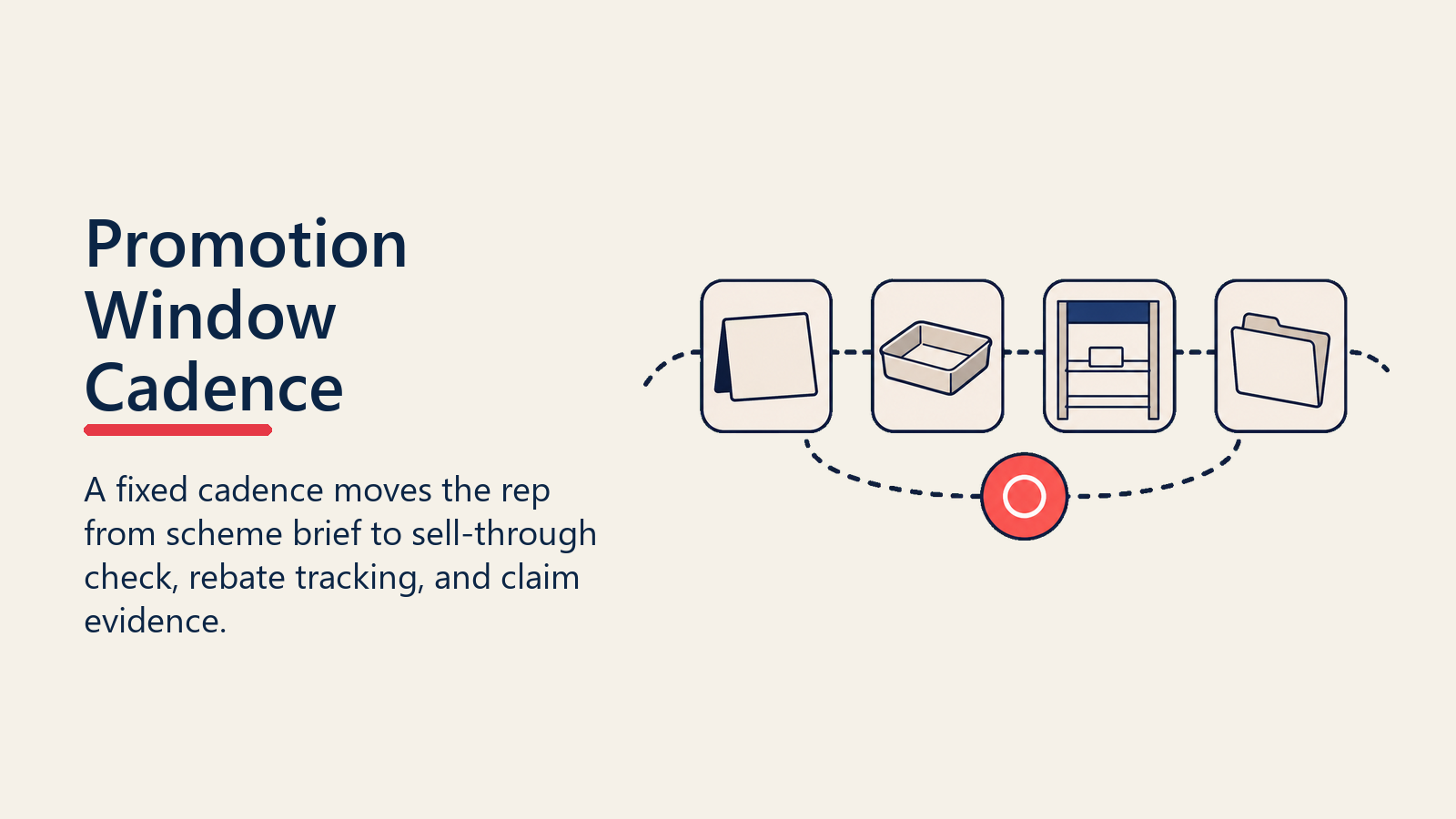
Week 1: Scheme brief and incremental order confirmation. Every retailer in the relevant outlet tier should receive a clear scheme brief in week one. The brief covers the scheme terms (what discount, what condition, what SKUs, what dates), the recommended incremental order quantity, and any POSM that needs to be deployed. The incremental order uplift should be confirmed and logged in the SFA on the first visit, not discussed in passing.
| Week | Rep Action | SFA Record |
|---|---|---|
| Week 1 | Brief retailer on scheme terms; propose and confirm incremental order uplift; deploy campaign POSM | Scheme brief delivered (Y/N); incremental order amount; POSM deployed (Y/N) |
| Week 2 | Check sell-through on incremental stock; confirm POSM is still in position; flag any competitor counter-promotion | Sell-through estimate; POSM status; competitive activity noted |
| Week 3 | For volume rebate schemes: track progress toward threshold; propose top-up order if retailer is close to tier | Progress toward rebate threshold; top-up order (if applicable) |
| Week 4 | Collect claim evidence (photos, order records); confirm final order aligns with scheme terms; brief retailer on post-scheme pricing | Photo evidence submitted; claim evidence complete (Y/N); post-scheme pricing confirmed |
Confirming incremental order uplift tied to the scheme. The scheme is only worth something to the brand if the retailer orders more than she would have anyway. The rep's job is to translate the scheme terms into a specific incremental quantity recommendation. "The scheme runs for four weeks and you're on a two-week order cycle. I'm proposing you add eight cases to your next two orders to take full advantage of the discount. At your current sell-through rate, those eight cases will move before the scheme closes."
That's not a generic pitch for more volume. It's a specific, time-bound recommendation built from the retailer's own order history and sell-through rate. This is where order taking and upselling discipline and promotion execution overlap: the three-stage upsell sequence uses the scheme as the Stage 3 incentive that converts the stretch SKU conversation into a confirmed incremental order.
Deploying and checking promotion POSM. Every retailer who participates in a promotion should have the campaign POSM deployed by end of week one. The rep checks the POSM status at every subsequent visit and replaces or repositions materials as needed. Full details on deployment mechanics are in the POS visibility execution framework.
Monitoring competitor counter-promotions. When a competitor runs a counter-promotion in the same window, the rep needs to note it, understand the terms, and flag it to the field manager. A competitor offering a deeper off-invoice discount on directly competing SKUs changes the commercial context and may require a commercial response from the field manager. The rep doesn't negotiate competitive responses unilaterally, but she's the only person in the field who can see the counter-promotion in real time.
Collecting evidence for claim validation. For any scheme that requires retailer evidence at claim time (conditional schemes, POSM-linked discounts), the rep collects the evidence during the promotion window. This means compliance photos with GPS tags, order records from the SFA, and confirmation of any behavioral conditions met (facing count, POSM placement, SKU mix). Waiting until after the scheme closes to collect evidence means depending on the retailer's records and the rep's memory. Both are unreliable.
Retailer Scheme Communication
The pitch for a trade scheme at the outlet counter is a commercial conversation, not a form to fill in. Retailers in general trade have heard many scheme pitches and can distinguish between a rep who understands the terms and a rep who is reading from a brief she hasn't processed.
The scheme communication that works is built from three elements: the financial benefit to the retailer, the specific incremental ask, and the time constraint that makes delay costly.
"This cycle, any order you place for the full Sunsilk range of six variants gets a 12 percent off-invoice discount on each case. Based on your usual order of four cases per cycle and your two-cycle window, I'm recommending you order eight cases this cycle to cover both the remaining weeks at the lower price. That's a saving of about [amount in local currency] on this order alone. The scheme closes on [date], so we want to lock in the order today."
That script has a specific number (12 percent), a specific quantity (eight cases), a specific saving in currency the retailer will feel, and a specific deadline. Vague scheme communication ("we have a good promotion running, you should order more") produces vague retailer response.
For more complex conditional schemes, the negotiation fundamentals playbook provides the framework for handling retailer resistance to behavioral conditions. The retailer who says "I don't want to commit to a specific facing count" needs to understand the financial benefit of meeting the condition, not the internal commercial reason the brand attached the condition to the scheme.
Tracking Scheme Compliance
During an active promotion, the weekly rep scorecard should expand beyond standard call KPIs to include promotion-specific tracking. Scheme compliance is invisible in a standard call count or order value report. It needs its own metrics.
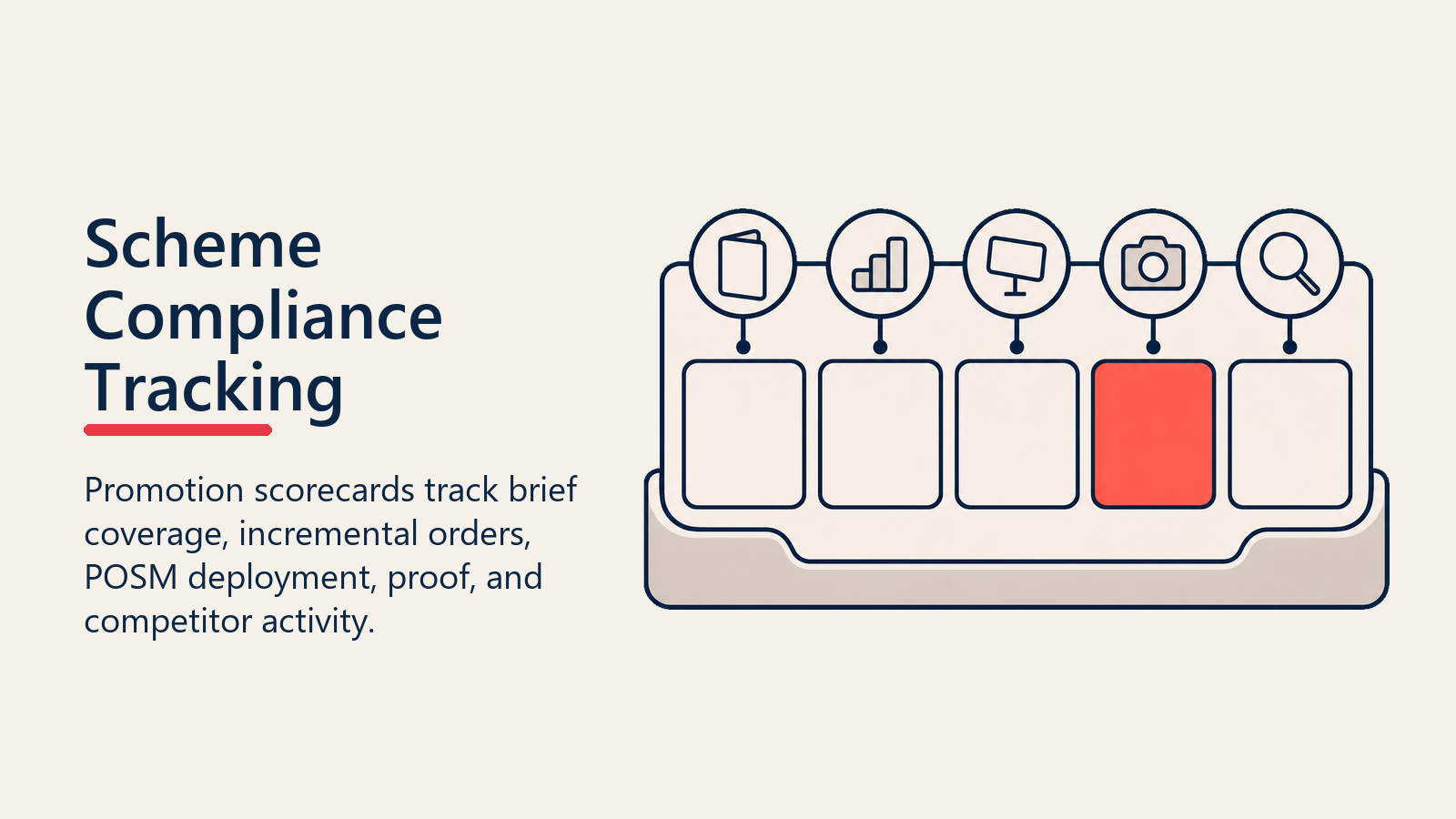
Rep daily scorecard during a promotion run:
| Metric | Daily Target | Weekly Target |
|---|---|---|
| Outlets briefed on scheme (% of route) | 100% of relevant tier outlets | All relevant tier outlets briefed by end of week 1 |
| Incremental orders confirmed | Tracked per outlet | Territory total vs scheme uplift target |
| POSM deployed (% of briefed outlets) | 80%+ | 85%+ by end of week 1 |
| Compliance photos submitted | 100% of POSM deployments | 100% |
| Competitor counter-promotions noted | Flag same-day | Weekly summary to field manager |
Field managers who review these daily during a promotion window can catch execution gaps while the window is still open. A manager who sees 45 percent POSM deployment at mid-week 1 can redirect coaching and logistics before another two weeks of deployment opportunity are lost.
Claim Integrity and Deduction Risk
Trade promotion claims submitted to finance or to the distributor need to be accurate and supported by field evidence. When claim documentation is poor, two bad outcomes happen: the brand can't defend the claim internally, leading to underpayment to the retailer; or the retailer raises a deduction dispute based on a scheme interpretation the rep communicated incorrectly in the field.
Both outcomes cost more than the original scheme investment when they compound across hundreds of outlets and multiple promotion cycles.
The foundation of clean claims is accurate field documentation. Every outlet visit during a promotion window should produce a SFA record that captures: scheme brief delivered (yes/no), incremental order confirmed (quantity), POSM deployed (yes/no, photo attached), behavioral condition met (yes/no for conditional schemes), and any exception or variance from the standard scheme terms.
That documentation shouldn't require extra effort from the rep if the SFA has a promotion-specific call template loaded for the window. The trade promotion management system should feed scheme terms into the SFA so the rep has the brief, the conditions, and the claim checklist in one place during the outlet visit.
Post-Promotion Evaluation
Every promotion should close with a structured evaluation that compares what the brand planned against what actually happened. The evaluation has four components:
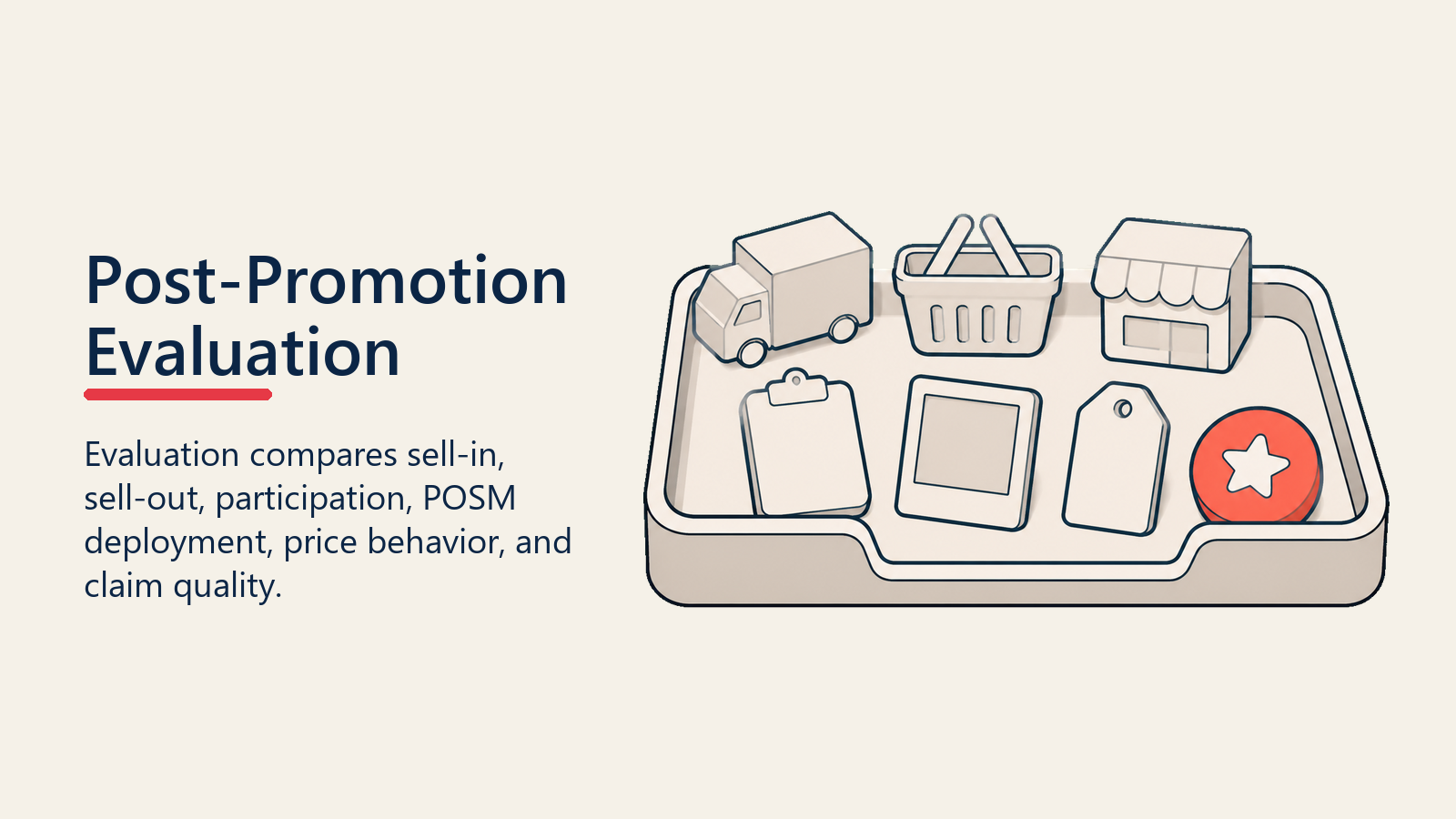
Sell-in vs sell-out reconciliation. How much product went into the trade channel during the promotion window (sell-in from the distributor) versus how much moved through to consumers (sell-out from the retailer's shelf)? A large gap between the two means the promotion drove forward buying without driving consumer demand. That's trade spend creating future volume risk, not future revenue. Precision revenue growth management tools now help commercial teams detect this gap in near-real-time rather than after the scheme window closes.
| Metric | Definition | What the gap tells you |
|---|---|---|
| Promotion sell-in uplift | % increase in distributor sell-in vs pre-promo baseline | How much the trade channel loaded up |
| Promotion sell-out uplift | % increase in retailer sell-out vs pre-promo baseline | How much consumers actually responded |
| Sell-in to sell-out ratio | Sell-in uplift divided by sell-out uplift | Ratios above 1.5x signal forward buying risk |
| Retailer participation rate | % of targeted outlets that placed an incremental order | Coverage of the scheme across the territory |
| POSM deployment rate | % of targeted outlets with compliance photo confirming deployment | Execution quality of the visibility investment |
Market share shift. Did the promotion improve the brand's share of the category at the outlet level? If sell-out went up but competitor sell-out went up faster, the promotion didn't deliver competitive value.
Retailer participation rate. What proportion of targeted outlets actually participated in the scheme? Low participation indicates briefing gaps, poor scheme design, or competitive counter-promotion pressure. This is the metric that flags execution failure most directly.
Post-promotion pricing confirmation. Did retailers return to standard pricing after the scheme closed, or did they continue selling at promotional price from forward-bought stock? Post-promotion price audits at a sample of outlets two weeks after the scheme closes catch this quickly.
The FMCG sales KPIs and metrics framework integrates these promotion evaluation metrics into the standard territory review cycle so that learnings from one campaign inform the brief for the next.
For a dashboard view of how trade promotion spend tracks against revenue outcomes across the commercial plan, a revenue operations dashboard provides the aggregation layer that field-level scheme data should feed.
The trade marketing and field alignment function is the operational bridge between the commercial team's scheme design and the rep's outlet execution. When that alignment breaks down, the symptoms appear in the post-promotion evaluation: retailer participation below target, sell-in to sell-out gaps, and claim disputes. The diagnosis usually traces back to brief timing, rep training quality, or a disconnect between the scheme mechanics trade marketing designed and what a general trade rep can realistically communicate at a kirana counter in ninety seconds.
Quotable Nuggets
"The promotion that ran for three weeks before the rep mentioned it had already burned half its window. Field execution is what makes trade spend pay off or pay nothing."
"A sell-in uplift of 18 percent with a sell-out uplift of 4 percent is not a promotion success. It is forward buying that will arrive as a deduction request in three months."
Frequently Asked Questions about Promotions and Trade Scheme Execution
What is the difference between sell-in and sell-out promotion mechanics?
Sell-in schemes reward the retailer for purchasing volume from the distributor, regardless of how much the retailer then sells to consumers. Sell-out schemes reward the retailer for actual consumer sales, typically tracked through receipted sales or loyalty data. Most general trade promotions run on sell-in mechanics because sell-out data is sparse in those channels. The risk is forward buying: the retailer loads up at the promotional price and sells at full margin after the scheme closes, making the sell-in number look strong while consumer demand stays flat.
What is forward buying and why does it distort FMCG volume data?
Forward buying is when a retailer orders more than her normal sell-through rate during a promotional window to benefit from the discounted price, then sells the excess stock at standard price after the promotion closes. It inflates sell-in numbers during the scheme window and suppresses orders in the following one or two cycles as the retailer runs down the excess stock. McKinsey research identifies forward buying as a structural leak that makes quarterly volume look healthy while consumer offtake stays flat.
How should a rep calculate the right incremental order recommendation?
Base the recommendation on the retailer's current sell-through rate and the length of the promotion window, not on a generic uplift target. "You sell four cases every two weeks. The scheme runs for four weeks. Ordering eight cases covers both cycles at the promotional price and clears before the scheme closes." That framing gives the retailer a specific number grounded in their own sales pattern. A vague "you should order more" produces a vague response.
What evidence does a rep need to collect during a promotion window?
For any scheme requiring retailer claim validation: compliance photos with GPS tags and outlet ID; order records from the SFA confirming incremental volume; and, for conditional schemes, confirmation of the behavioral condition met (facing count, POSM placement, SKU mix). Collect evidence throughout the window on every visit, not at close. Waiting until after the scheme ends means depending on the retailer's records and the rep's memory. Both are unreliable.
What should a rep do when a competitor runs a counter-promotion in the same window?
Note the competitor's specific terms (discount percentage, SKU range, window dates), the outlet's response to those terms, and any reduction in your own sell-through. Log it in the SFA the same day and flag it to the field manager. The rep doesn't negotiate competitive responses unilaterally, but she is the only person in the field who can see the counter-promotion in real time. A pattern of competitor counter-promotions across 10 or more outlets in a territory is a signal that trade marketing needs to know about while the window is still open.
How does post-promotion price auditing work?
Two weeks after a scheme closes, visit a sample of participating outlets and check whether they have returned to standard pricing or are still selling from forward-bought stock at the promotional price. If promotional pricing persists post-scheme, the retailer is eroding your channel price integrity and creating consumer expectations that the promotional price is the real price. Catch it in the first two cycles after close and the correction is manageable. Let it run for a full quarter and it becomes a market-level pricing problem.
Conclusion: Trade Spend Is Only Effective When It Reaches the Consumer
Trade promotion investment is significant in most FMCG P&Ls. The decision to spend it is made by commercial directors and finance teams who expect a return. But the return doesn't materialize in spreadsheets or in the commercial planning room. It materializes when the retailer increases her order, the POSM goes on the shelf, and the consumer picks up the promoted product instead of the competitor's.
Field execution is the only variable that closes the gap between what the brand planned and what the consumer experiences. A rep who briefs retailers in week one, confirms incremental orders tied to scheme terms, deploys POSM before the first weekend of the campaign, and collects clean evidence throughout the window is doing the commercial work that makes trade spend return its investment.
A rep who mentions the scheme in passing in week three has burned half the window. Training the first behavior and removing the second is the highest-return investment in trade promotion efficiency that any sales director can make.
Learn More

Senior Implementation Consultant
On this page
- How Do Trade Schemes Work at the Outlet Level?
- The Execution Chain
- What Should a Rep Do During Each Week of a Promotion Window?
- Retailer Scheme Communication
- Tracking Scheme Compliance
- Claim Integrity and Deduction Risk
- Post-Promotion Evaluation
- Quotable Nuggets
- Conclusion: Trade Spend Is Only Effective When It Reaches the Consumer
- Learn More