Returns, Damages and FIFO Freshness Management in FMCG Field Sales
Turn this article into takeaways for your work.


Each assistant summarizes the article only for you and suggests best practices for your work.
A stale product on a retailer's shelf is a trust problem before it's a stock problem.
The retailer who finds near-expiry product tucked behind fresher stock on her shelf doesn't think: "this is a logistics issue." She thinks: "this rep put old stock on my shelf and I didn't notice until today." She thinks about the customer who bought that product yesterday. She thinks about whether to reorder from the same brand at the next cycle.
Most FMCG companies manage returns and freshness as back-office functions. They happen after the problem: a retailer complains, a credit is raised, a write-off is logged, someone runs a monthly report that no area manager looks at closely. The field rep is mostly an intermediary who collects the complaint and passes it up the chain.
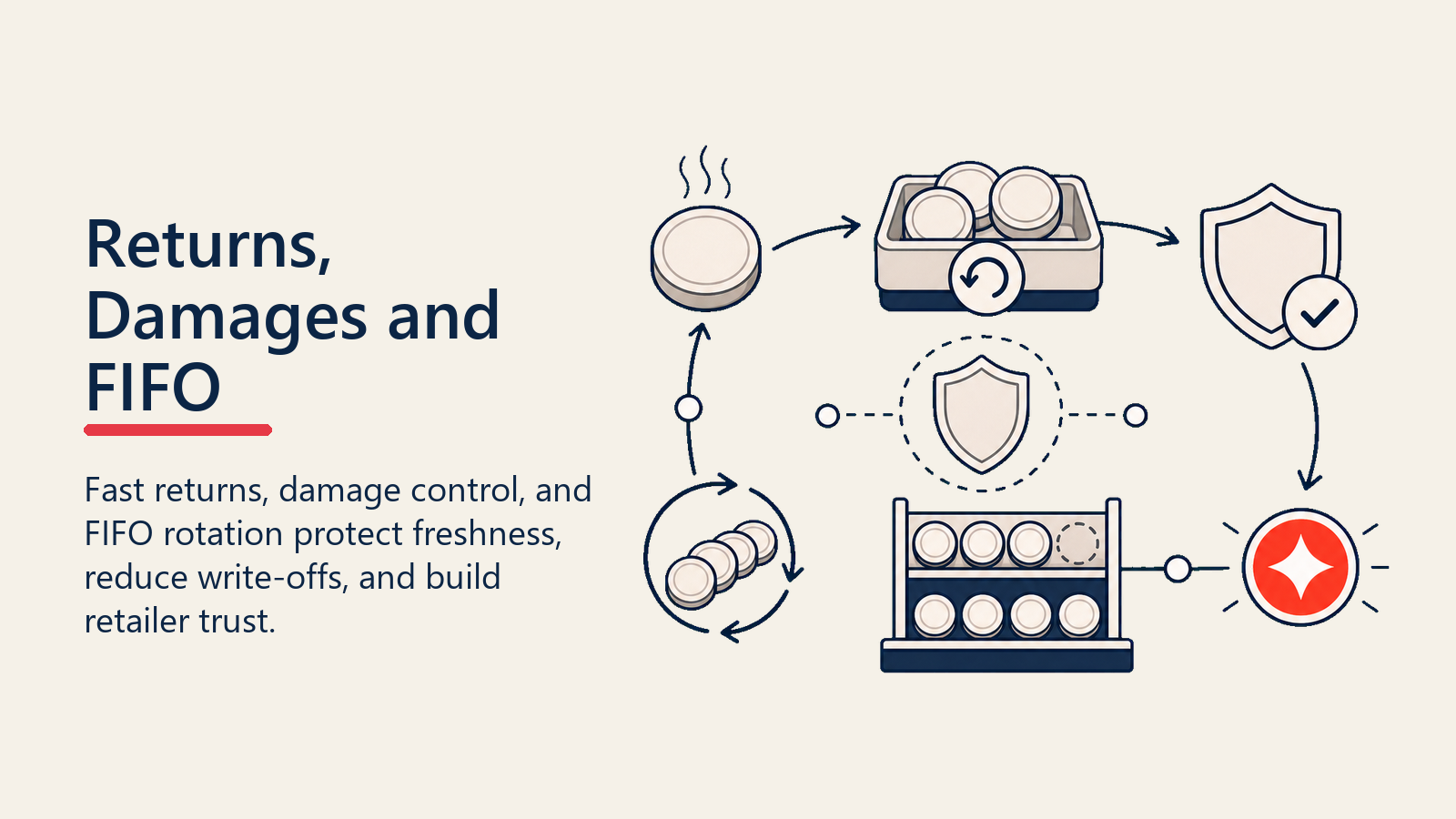
But that model misses the commercial opportunity entirely. A field team that handles returns quickly, executes FIFO rotation on every call, and reduces damage rates through loading discipline doesn't just reduce costs. It builds the kind of retailer trust that drives repeat orders, cooler maintenance cooperation, and new SKU acceptance. Service failure handled well is a retention accelerator. Service failure handled slowly or inconsistently is a churn trigger.
This article gives field sales managers a practical framework for returns, damage reduction, and FIFO rotation as frontline commercial activities, not back-office exceptions.
Quotable Nuggets
- "Around 12 percent of the world's food is lost due to insufficient refrigeration. The last mile is where that risk is highest.", FAO Energy and Food Systems
- "A retailer who raises a returns issue on Tuesday and has a credit on her account by Wednesday is a retailer who will say yes to the next order, yes to the new SKU, and yes to the planogram request.", FMCG field sales principle
- "FIFO isn't a warehouse task. It's a call-step item. The outlet is where rotation failures actually create cost.", FMCG distribution practitioner
The ACR Protocol (Acknowledge, Commit, Return): The three-step field conversation framework for handling returns at the outlet. Acknowledge the issue without argument and confirm the physical problem in front of the retailer. Commit to a specific next action and timeline (credit within 24 hours, rotation fix now). Return on the next scheduled visit with confirmation that the credit landed and verification that FIFO (First In, First Out, oldest stock sells first) is holding. Programs that train the ACR Protocol as a call skill report lower repeat complaint rates than those that leave the conversation to rep judgment.
What Types of Returns and Damage Do Field Teams Encounter?
Key Facts: Returns and Freshness in FMCG
- The FAO estimates that around 12 percent of food produced globally is lost due to insufficient refrigeration in the supply chain, making cold-chain discipline in the last mile a material financial risk. (FAO, Energy and Food Systems)
- A UK consumer study reported in The Grocer (sponsored by TELUS Consumer Goods) found that 45 percent of shoppers switch to a competing brand when their preferred product is out of stock, a finding from the UK grocery context that is directionally consistent with broader FMCG out-of-stock research, though the exact proportion varies by market and category. (The Grocer / TELUS Consumer Goods, UK study)
- Industry-observed estimate: near-expiry returns and transit damage account for roughly 1.5 to 3.5 percent of delivered case value across FMCG general trade markets, concentrated in a small number of routes and SKUs with poor rotation discipline. (Estimate based on Southeast Asian general trade field data; no universal published benchmark.)
Field reps deal with four categories of return and damage situations, each with a different cause, a different cost-bearer, and a different prevention lever.
Near-Expiry Returns
Products approaching expiry date that the retailer can't sell before the date passes. The cause is usually one of three things: incorrect order quantity at the last visit (rep over-pushed a volume that the outlet couldn't sell at normal velocity), poor FIFO rotation that allowed newer stock to sit in front of older stock until the older stock crossed its expiry window, or a demand slowdown that the rep didn't anticipate based on previous sell-through rates.
Who bears the cost depends on the trading agreement, but in most general trade FMCG relationships, the manufacturer or distributor carries near-expiry returns on the premise that the rep controlled the order quantity and the shelf rotation. This makes near-expiry returns a field behavior problem first and a logistics problem second.
Transit Damage
Product damaged between the warehouse and the retailer, either during van loading, unloading at the outlet, or secondary movement by the retailer's staff. Cracked bottles, crushed cartons, broken seals. The cause is often loading discipline (heavy cases on top of fragile ones, inadequate secondary packaging, rough unloading at the door).
Transit damage is the most controllable category in the field because the rep has direct authority over how the van is loaded and how product is handled during delivery.
Incorrect Delivery
Wrong SKU, wrong quantity, or wrong variant delivered against the order. Usually a warehouse picking error, but sometimes a rep error in order entry. The retailer flags it at delivery or at the next visit. Resolution requires a credit note for the wrong item and a replacement delivery, which doubles the logistics cost.
Promotional Over-Supply
Product pushed into the outlet during a promotional loading period that the outlet can't absorb at the promotional sell-out rate. Common when trade marketing runs volume-based promotional incentives without a sell-out velocity check. The retailer takes the promotional allocation to hit the rebate threshold, and three weeks later there's near-expiry promotional stock that nobody reordered.
The Van Sales vs Pre-Sell model choice affects all four of these categories. Van sales teams have more physical control over product condition at the point of delivery but carry more risk on in-van damage. Pre-sell teams have a cleaner order-and-deliver separation but need stronger coordination between order entry and warehouse picking to prevent incorrect delivery.
FIFO Explained for Field Sales
First In, First Out (FIFO) means the oldest stock gets sold first. At the outlet level, this means the product that arrived at the shop first is the product that the next customer buys. And in practical field sales terms, it means the product that was on the shelf before the rep arrived is positioned in front of whatever the rep is loading today.
This sounds obvious. But watch a rep who's in a hurry load a case of beverage into a retailer's shelf. She'll open the case at the front, slide product onto the shelf from the front, and the new stock sits in front of the existing stock. The existing stock is now behind the new stock. The new stock sells first. The old stock ages.
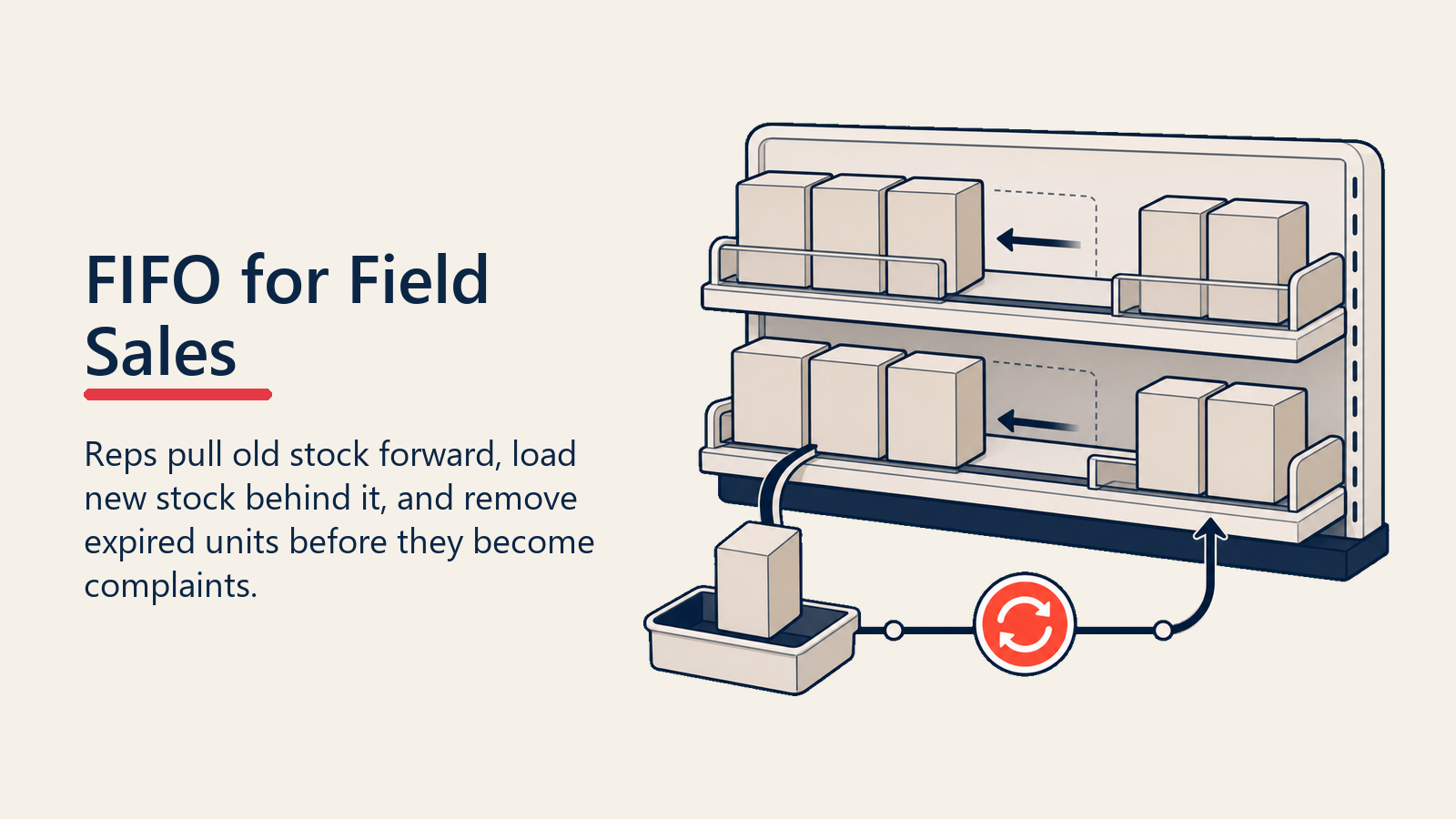
Two visits later, the rep or the retailer finds three units of the old stock behind the new stock, 10 days from expiry. Nobody bought them because nobody could see them. That's a write-off, a retailer complaint, and a trust problem that could have been prevented by 45 seconds of rotation discipline.
FIFO Is a Call-Step Item, Not a Warehouse Task
Most FMCG companies have FIFO protocols in their warehouses. Fewer have them enforced at the outlet level during rep visits. But the outlet is where FIFO failures actually create cost, because warehouse FIFO controls don't guarantee that the rep rotates the stock correctly when restocking the retailer's shelf.
FIFO at the outlet level needs to be in the Perfect Store and the Call Steps protocol as a non-negotiable step, not an optional housekeeping activity.
Back-Stock vs Front-of-Shelf Sequencing
The FIFO rotation sequence for a field rep is:
- Pull all existing stock on the shelf to the front (including product at the very back)
- Check dates on all existing front-facing units
- Identify the oldest date present
- Load new stock behind the existing stock, not in front of it
- Confirm the oldest date is the one now facing the customer
- Remove any expired units immediately and log them on the returns form
In cooler restocking, the same sequence applies with the additional step of checking whether any stock has been pushed to the back of the cooler by the retailer's own restocking or by competitor encroachment. See Cooler and Chiller Space Management for the cooler-specific FIFO protocol.
Why Sell-Through Rate Matters for FIFO Planning
FIFO compliance is a prevention tool, but it only prevents write-offs if the order quantity matches the outlet's actual sell-through velocity. A rep who consistently over-orders for an outlet will generate near-expiry returns even with perfect FIFO rotation, because the total volume exceeds what the outlet can sell before the expiry date.
Order quantity calibration and FIFO rotation work together. The Secondary Sales and Stock Visibility framework covers how to track secondary sales velocity at the outlet level to calibrate order quantities. The short version: if the outlet moves 8 units per week on average and your SKU has a 30-day shelf life from delivery, the maximum safe order quantity is 30 to 34 units. Anything above that starts accumulating near-expiry risk.
Returns Process Design
Every return needs a defined workflow so that the retailer knows what to expect, the rep knows what to authorize, and the credit note reaches the retailer's account before the next order cycle.
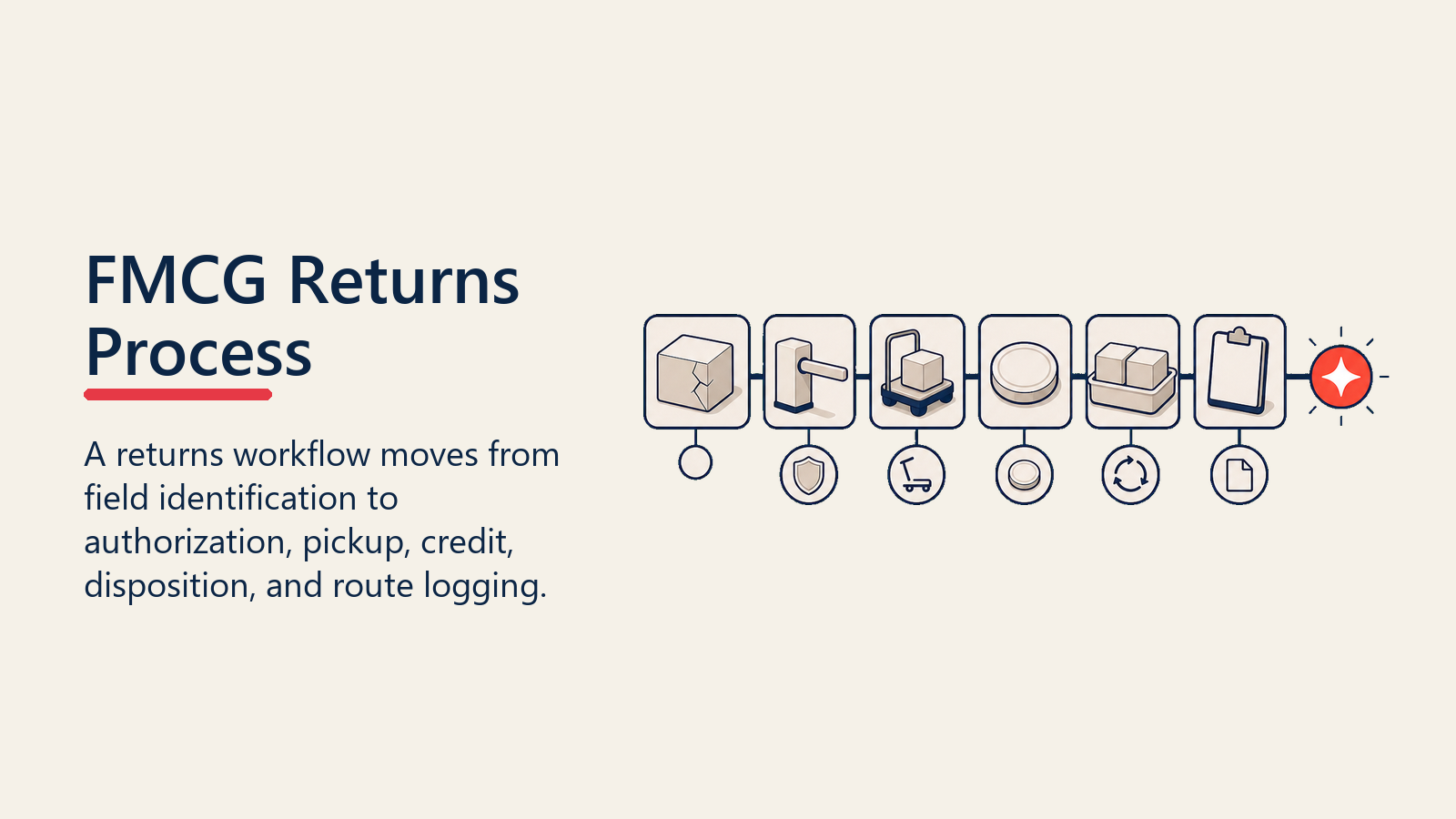
| Step | Activity | Owner | Timeline | System Action |
|---|---|---|---|---|
| 1. Identification | Rep identifies returnable product at the outlet (expired, near-expiry, damaged, incorrect delivery) | Rep | At the visit | Log in CRM with photo |
| 2. Authorization | Rep authorizes return against pre-approved return criteria; escalates non-standard returns to area manager | Rep / Area Manager | Within 2 hours of visit | CRM return flag set |
| 3. Physical pickup | Product collected from outlet on current van or scheduled pickup | Rep / Driver | Same visit or next scheduled delivery | Van manifest updated |
| 4. Credit note issue | Credit note issued to retailer's account or distributor | Finance / Distributor | Within 24 hours of pickup | Invoice credit or account adjustment |
| 5. Product disposition | Returned product assessed: rework (repackage), redistribution (different channel), or destruction | Warehouse | Within 3 business days | Write-off or rework record |
| 6. Route-level logging | Return logged by SKU, route, and reason code in the reporting system | Area Manager / Sales Ops | Monthly review | KPI dashboard update |
The 24-hour credit note standard is non-negotiable for preserving retailer trust. Any process design that puts the credit note timeline beyond 48 hours for standard returns creates the trust erosion pattern described in the Outlet Relationship Management framework.
Pre-authorization protocols simplify step 2 for the most common return types. Define which return categories the rep can authorize in the field without escalation: typically, products within 14 days of expiry, visually damaged units (cracked, broken seal, label damage), and incorrect SKUs against the order form. Everything else requires area manager approval.
Damage Reduction Levers
Not all damage is controllable, but the most costly damage categories are. Field teams can reduce transit damage rates by an estimated 40 to 60 percent through consistent discipline on three levers (practitioner range from field loading-protocol programs; no single published study).
Loading and Unloading Discipline
The most common transit damage cause in FMCG van delivery is improper loading sequence: heavy or rigid product on top of fragile product, cases stacked beyond the safe column height, or product shifting during transit because the van isn't loaded to stability.
The loading protocol should specify:
- Heavy cases (glass bottles, canned product) loaded at the bottom of the stack
- Fragile product (chilled beverages with lightweight plastic packaging, snack packaging) loaded at the top
- Case columns no higher than four units for fragile product without a racking system
- Product stacked flush against the van wall rather than in the center of the bay where it shifts on cornering
Unloading discipline is equally important. Dropping cases onto a pavement or onto the floor of an outlet creates damage rates that don't appear in the delivery manifest but show up as retailer complaints at the next visit.
Van Temperature Management
For cold-chain product, maintaining van temperature within the required range from depot to outlet is a freshness and returns issue, not just a quality compliance issue. Product that warms above the specified range during delivery loses shelf life at a rate that accelerates the near-expiry timeline. Temperature control in the last mile is a material financial risk, not a secondary operations detail.
Van temperature logs should be checked at departure, at midpoint, and at each delivery stop. Any deviation above threshold during transit should be flagged immediately and the relevant load evaluated for accelerated sell-out or return authorization.
Secondary Packaging Standards
Products that arrive at the outlet without adequate secondary packaging (inner cartons, shelf-ready packaging, dividers for glass bottles) are at higher damage risk during the retailer's own shelf stocking. If the secondary packaging specification is inadequate for how the retailer handles product, feed that back to the supply chain team rather than absorbing the damage as a field returns cost.
KPIs for Freshness and Returns
Field managers and NSMs need four metrics to manage this area operationally. These should be on the weekly or bi-weekly area manager dashboard, not a monthly supply chain report that nobody acts on in time.
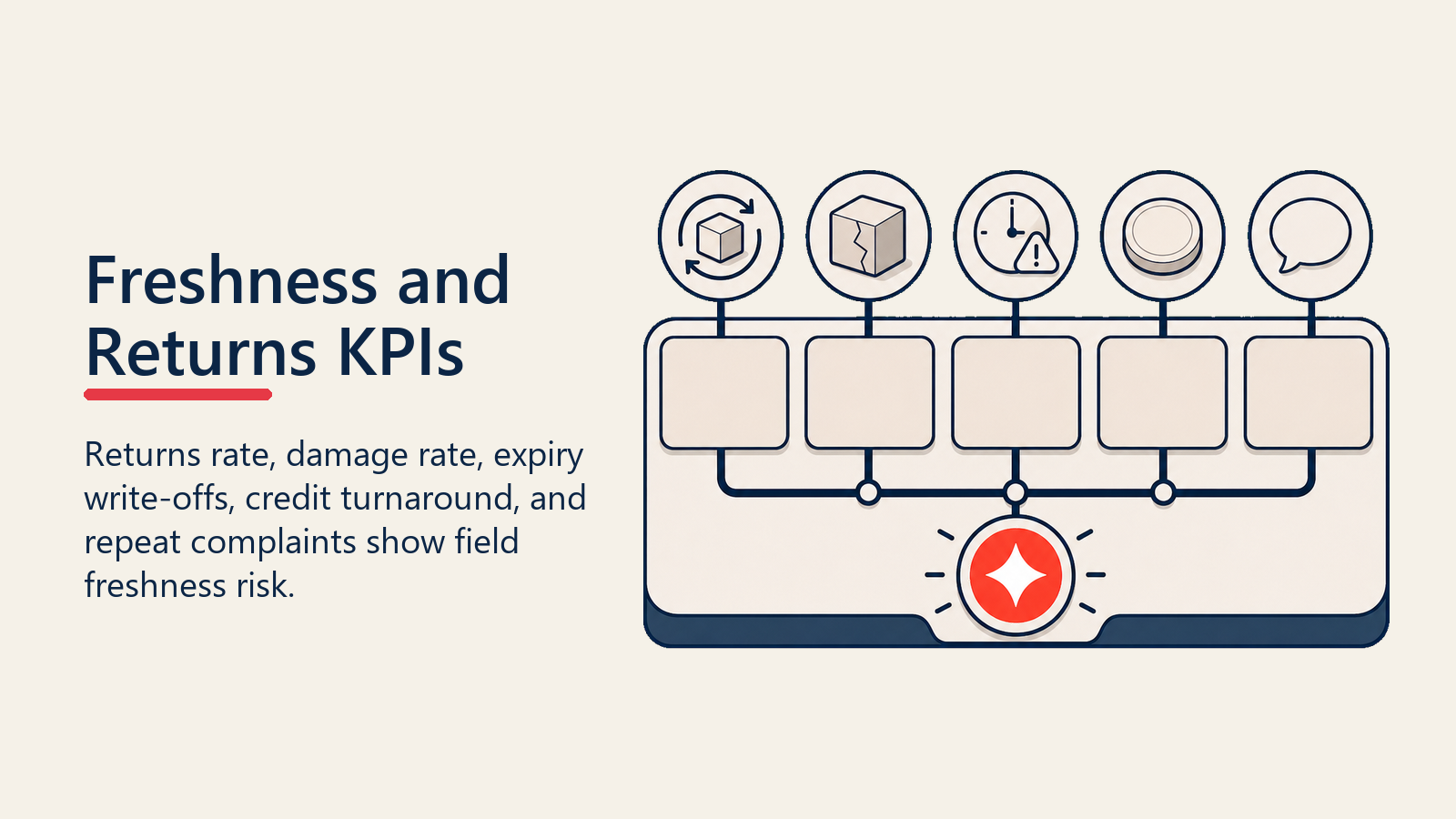
| KPI | Definition | Target | Alert Threshold | Action |
|---|---|---|---|---|
| Returns rate by SKU | Returns volume as percentage of delivered cases, by SKU | Below 1.5% | Above 3% | Root cause by SKU: over-ordering or FIFO non-compliance |
| Returns rate by route | Returns volume as percentage of delivered cases, by route | Below 2% | Above 4% | Rep coaching, FIFO audit, order quantity review |
| Damage as percentage of delivered cases | Cases with visible damage at delivery as percentage of total delivered | Below 0.5% | Above 1.5% | Loading audit, secondary packaging review |
| Expiry write-off value by territory | Value of products written off due to expiry, by territory | Set based on category shelf life | Any territory above 1.5x average | FIFO enforcement, outlet order quantity calibration |
| Credit note turnaround time | Average days from return authorization to credit on retailer account | Under 24 hours | Above 48 hours | Process review, distributor SLA enforcement |
| Repeat complaint rate by outlet | Outlets with two or more returns complaints in a quarter | Below 5% of outlet base | Above 10% | Individual outlet review, FIFO compliance check |
The route-level returns rate is the most actionable indicator for area managers because it points directly to field behavior rather than category or market dynamics. A route with twice the territory average returns rate has either an FIFO discipline problem, an over-ordering problem, or both. Both are manageable at the rep level with coaching and monitoring. The same sell-out velocity data that prevents out-of-stocks when calibrated correctly also prevents over-ordering that leads to near-expiry returns. That connection is what makes the retailer conversation the next lever to get right.
The Retailer Conversation: Freshness as a Partnership
When a retailer raises a freshness or returns issue, the conversation matters as much as the resolution. A rep who responds defensively ("that's not how we delivered it") destroys the trust that a quick credit resolution would otherwise build. A rep who responds collaboratively ("I see it, let's sort it out now, here's what happens next") turns a service failure into a demonstration of reliability.
The framework for the retailer conversation has three steps:
Acknowledge without argument. "You're right, that product shouldn't be in this condition. Let me see what we've got."
Take ownership of the next action. "I'm authorizing a return for those units right now. The credit will be on your account within 24 hours. I'll check our rotation while I'm here so this doesn't happen again."
Leave a clear commitment. "When I come back next week, I'll confirm the credit landed. And I want to show you how we're going to stack the shelf this time so the fresh stock is always rotating correctly."
And that three-part response shows the retailer that the brand takes the issue seriously, that the rep has authority to act, and that there's a prevention plan, not just a reactive credit. It's the difference between a retailer who tells other shop owners about the time the brand left expired product on her shelf and one who tells them how fast the problem was fixed.
Similar dynamics show up in pharmaceutical trade: the pharmacist who receives a freshness problem handled well is more likely to maintain stock levels than one who received the same problem handled poorly.
FIFO Rotation Checklist for Field Reps
Use this at every shelf restock, cooler restock, and new delivery:
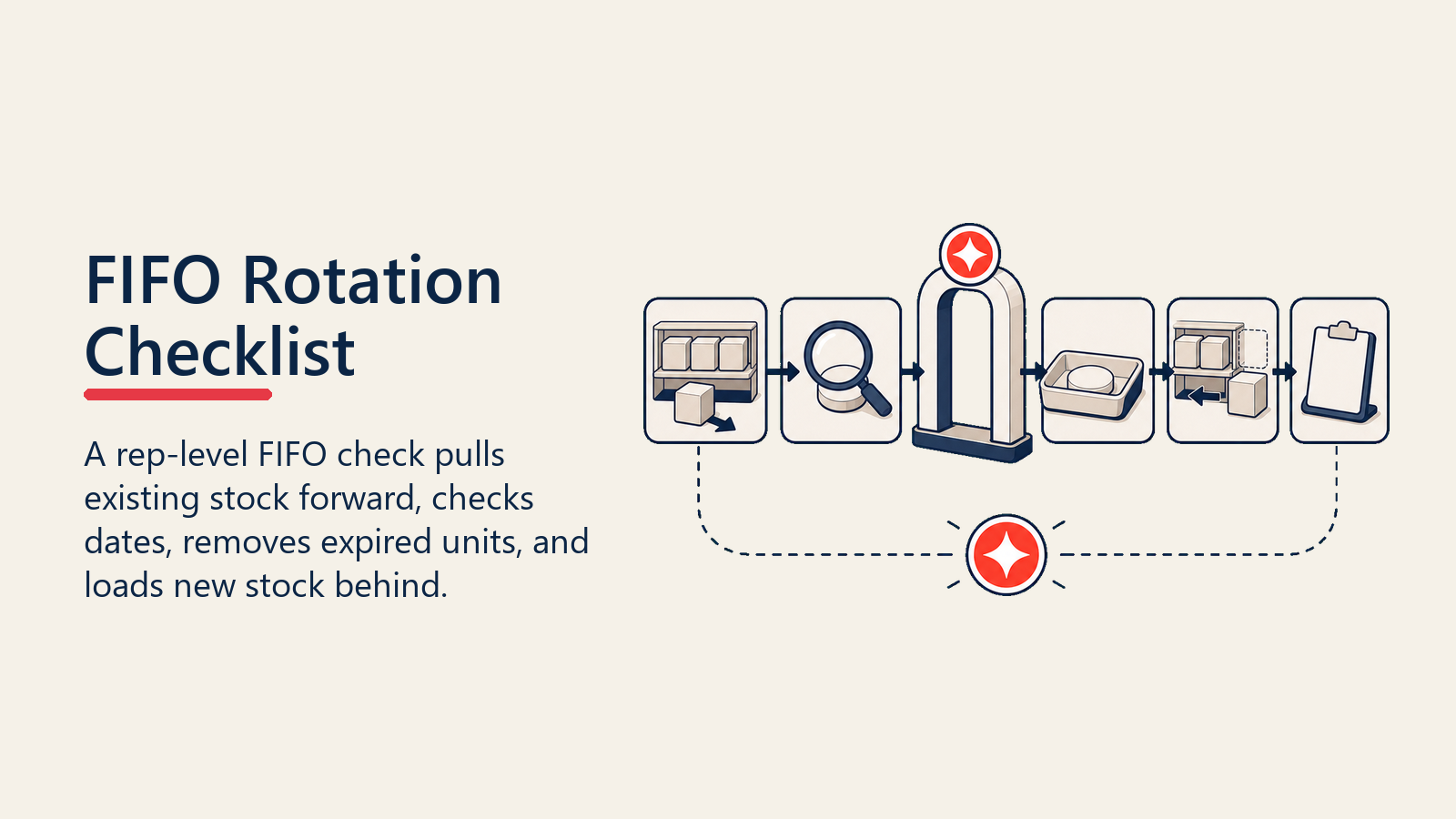
- Pull all existing shelf or cooler stock to the front before unloading new product
- Check dates on all front-facing units: note the oldest date visible
- Look behind or under existing stock for any units that may have been pushed back
- Remove any expired units immediately; log on the returns form before leaving the outlet
- Load new product behind existing stock, not in front of it
- Confirm after loading: oldest date is the one the customer sees first
- For near-expiry units (within 14 days of expiry): raise authorization for return immediately
- Log stock condition in CRM before leaving the outlet car park
This checklist takes under three minutes per shelf section. Applied on every visit across a route of 25 to 30 outlets, it prevents the near-expiry accumulation that creates 80 percent of freshness-related returns complaints.
Conclusion: Fast Credit and Clean FIFO Convert Service Failure into Loyalty
The field team that handles returns and freshness well doesn't just reduce write-offs. It builds the kind of retailer trust that is harder to acquire than any promotional investment and more durable than a price discount.
A retailer who raises a returns issue on Tuesday and has a credit on her account by Wednesday is a retailer who will say yes to the next order, yes to the new SKU, and yes to the planogram request. A retailer who waits two weeks for a credit note, finds the same near-expiry problem at the next visit, and can't get a straight answer from the rep about what happened is a retailer who is pricing the relationship against the competitor who called last week.
FIFO rotation is a call-step item. Returns authorization is a visit activity, not an exception process. Credit note turnaround is a service SLA, not a finance department timeline. Embed all three in the Perfect Store call protocol, measure them on the area manager's weekly dashboard, and coach them on joint visits the same way you coach order-taking and shelf positioning.
The route that has the lowest returns rate and the fastest credit turnaround isn't the lucky route. It's the route with the most disciplined FIFO habits and the most reliable service execution. That discipline is trainable, measurable, and worth significantly more to the brand's retailer relationships than it costs to build.
Frequently Asked Questions about Returns, Damages and FIFO Freshness Management in FMCG Field Sales
What is FIFO in FMCG field sales?
FIFO stands for First In, First Out. In field sales terms, it means that product delivered to an outlet first should be the product the customer buys first. Practically, it means field reps pull existing shelf stock to the front before loading new product, so the oldest units are always customer-facing. FIFO compliance at the outlet level prevents near-expiry accumulation, reduces write-off costs, and protects the retailer's confidence in the brand's freshness standards.
Who should authorize returns in FMCG field sales?
Standard returns covering expired or near-expiry product, visible transit damage, and incorrect delivery against the order form should be authorized by the rep in the field, against a pre-defined returns criteria document. Non-standard returns, promotional over-supply disputes, or high-value claims should require area manager authorization within two hours of the visit. The goal is to prevent the retailer from waiting for a resolution that requires three levels of approval for a product that's already off her shelf.
How quickly should a credit note be issued for FMCG returns?
Within 24 hours of return authorization and physical pickup. This is the threshold that maintains retailer trust. Practitioner surveys from field sales programs in Southeast Asian FMCG markets suggest that retailers who receive credits within 48 hours are significantly more likely to reorder in the next cycle without rep prompting compared to retailers who wait longer than five business days (estimated uplift of 35 to 50 percent has been observed in some programs, though no single published academic study is available for this specific figure). Credit turnaround time is a relationship metric, not just a finance process metric.
What are the main causes of FMCG transit damage?
The three most controllable causes are loading sequence errors (heavy product on top of fragile product), improper case stacking height, and rough unloading at the outlet. Secondary causes include inadequate secondary packaging for the product format and cold-chain temperature deviation during transit for temperature-sensitive SKUs. Most transit damage can be reduced substantially (practitioners report 40 to 60 percent reductions) through consistent loading protocol enforcement without any change to packaging specification (practitioner estimate; no single published study).
How do you measure FMCG returns and freshness performance?
Track five KPIs weekly or biweekly at the area manager level: returns rate by SKU (returns as percentage of delivered cases), returns rate by route, damage as percentage of delivered cases, expiry write-off value by territory, and credit note turnaround time. Route-level returns rate is the most actionable indicator because it points directly to field behavior and can be addressed through rep coaching and FIFO audit without waiting for a monthly supply chain report.
How should returns authorization be structured to avoid rep overreach?
Define a pre-authorization list that specifies which return categories the rep can authorize in the field without escalation. Standard field-authorizable returns typically cover: product within 14 days of expiry date, units with visible transit damage (cracked packaging, broken seals, crushed cartons), and incorrect SKUs delivered against a confirmed order form. Everything outside those criteria should route to the area manager for approval within two hours of the visit. The goal is a structure where the retailer gets a same-visit commitment, not a "I'll check with my manager" that leaves them without a resolution for days.
What is the commercial impact of slow credit note processing on reorders?
When credit note turnaround exceeds 48 hours for standard returns, the retailer's trust in the brand's service reliability degrades. In FMCG general trade, trust in service reliability is a key factor in the retailer's willingness to accept recommended order quantities from the rep, participate in loyalty programs, and stock new SKUs without a heavy discount incentive. A rep who resolves a credit quickly builds the kind of relationship capital that shows up as faster reorder cycles and less resistance to planogram requests. A rep whose credits take two weeks to process spends that relationship capital on every subsequent visit.
Learn More

Senior Implementation Consultant
On this page
- What Types of Returns and Damage Do Field Teams Encounter?
- Near-Expiry Returns
- Transit Damage
- Incorrect Delivery
- Promotional Over-Supply
- FIFO Explained for Field Sales
- FIFO Is a Call-Step Item, Not a Warehouse Task
- Back-Stock vs Front-of-Shelf Sequencing
- Why Sell-Through Rate Matters for FIFO Planning
- Returns Process Design
- Damage Reduction Levers
- Loading and Unloading Discipline
- Van Temperature Management
- Secondary Packaging Standards
- KPIs for Freshness and Returns
- The Retailer Conversation: Freshness as a Partnership
- FIFO Rotation Checklist for Field Reps
- Conclusion: Fast Credit and Clean FIFO Convert Service Failure into Loyalty
- Learn More