Van Sales vs Pre-Sell: Choosing the Right FMCG Route-to-Market Model
Turn this article into takeaways for your work.


Each assistant summarizes the article only for you and suggests best practices for your work.
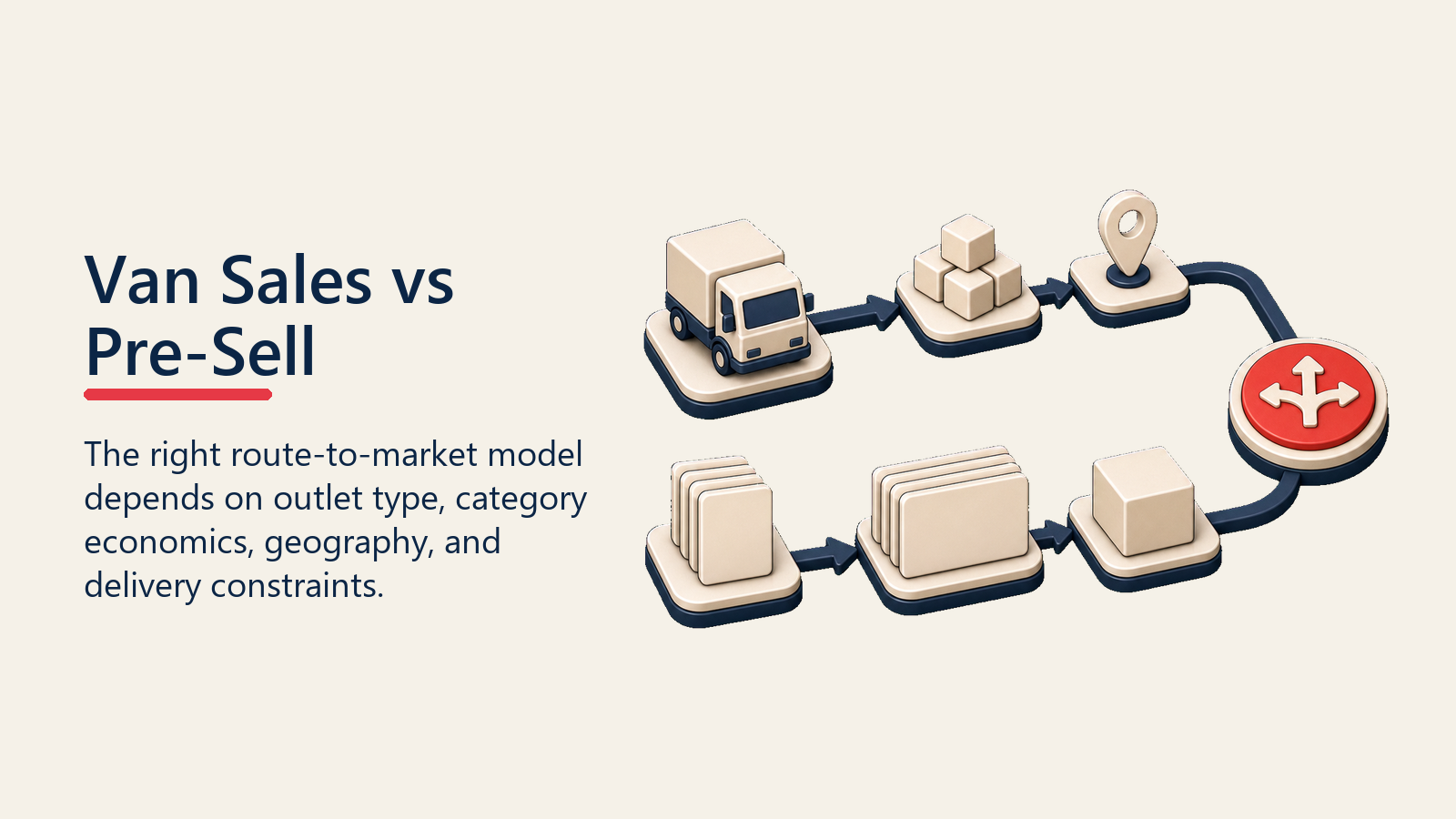
Two reps leave the depot at 07:00. One is a van sales rep: she's got a truck loaded with stock and she'll sell from the vehicle, collect payment, and deliver in a single call. The other is a pre-sell rep: he carries an order pad, takes commitments from outlet owners, and a separate delivery vehicle will follow the route behind him tomorrow.
By 17:00, their numbers look different. She has cash in hand and cleared stock on 22 outlets. He has 34 orders confirmed with a total value 40% higher. But she'll close out no stock discrepancy tonight. He'll have three outlets that change their order between today and tomorrow's delivery, plus one that won't be open when the truck arrives.
Neither model is better. Each one is right under specific conditions. The mistake route-to-market (RTM) directors make is choosing by habit rather than by channel economics, outlet type, and category characteristics. Then they watch the wrong model generate the wrong constraints and wonder why the field profit and loss is under pressure.
This article defines both models precisely, maps the conditions that favor each, and shows how leading FMCG companies build hybrid operations that use both where they fit.
Van Sales Defined
In a van sales model, the rep is also the delivery. She loads product at the depot in the morning, visits outlets on the route, sells from the vehicle, collects payment, and delivers product before moving to the next stop. The entire commercial and physical transaction happens in one call.
Key Facts: FMCG Route-to-Market Models
- NielsenIQ reports that traditional trade accounts for over 45% of FMCG sales in Asia across more than 18 million stores. The scale and fragmentation of this channel is why van sales and pre-sell model selection is a strategic commercial decision, not a logistics default.
- Van sales models generate same-day close rates of 85-95% of visited outlets but cover 30-40% fewer outlets per day than pre-sell reps, due to the time required for physical delivery at each stop. (Industry operating range; individual market variation is significant.)
- Pre-sell operations typically support two to three times the SKU range of a van sales operation for the same category, because the rep is not constrained by what physically fits on the vehicle that morning. (Operational characteristic of the model, not a published survey figure.)
Quotable Nuggets: Van Sales vs Pre-Sell
- "The choice between van sales and pre-sell isn't a company preference. It's a commercial decision that follows the outlet type, category characteristics, geographic density, and transaction economics of the specific channel being served."
- NielsenIQ analysis shows the top 50% of stores in a region typically account for 86% of category sales. The model that reaches those stores most cost-effectively wins on field P&L, regardless of which model has the higher headline outlet coverage number.
- In rural markets, the delivery economics of a separate pre-sell truck erases the efficiency gain that makes pre-sell work in dense urban environments. Geography changes which model is right, even for the same company and the same category.
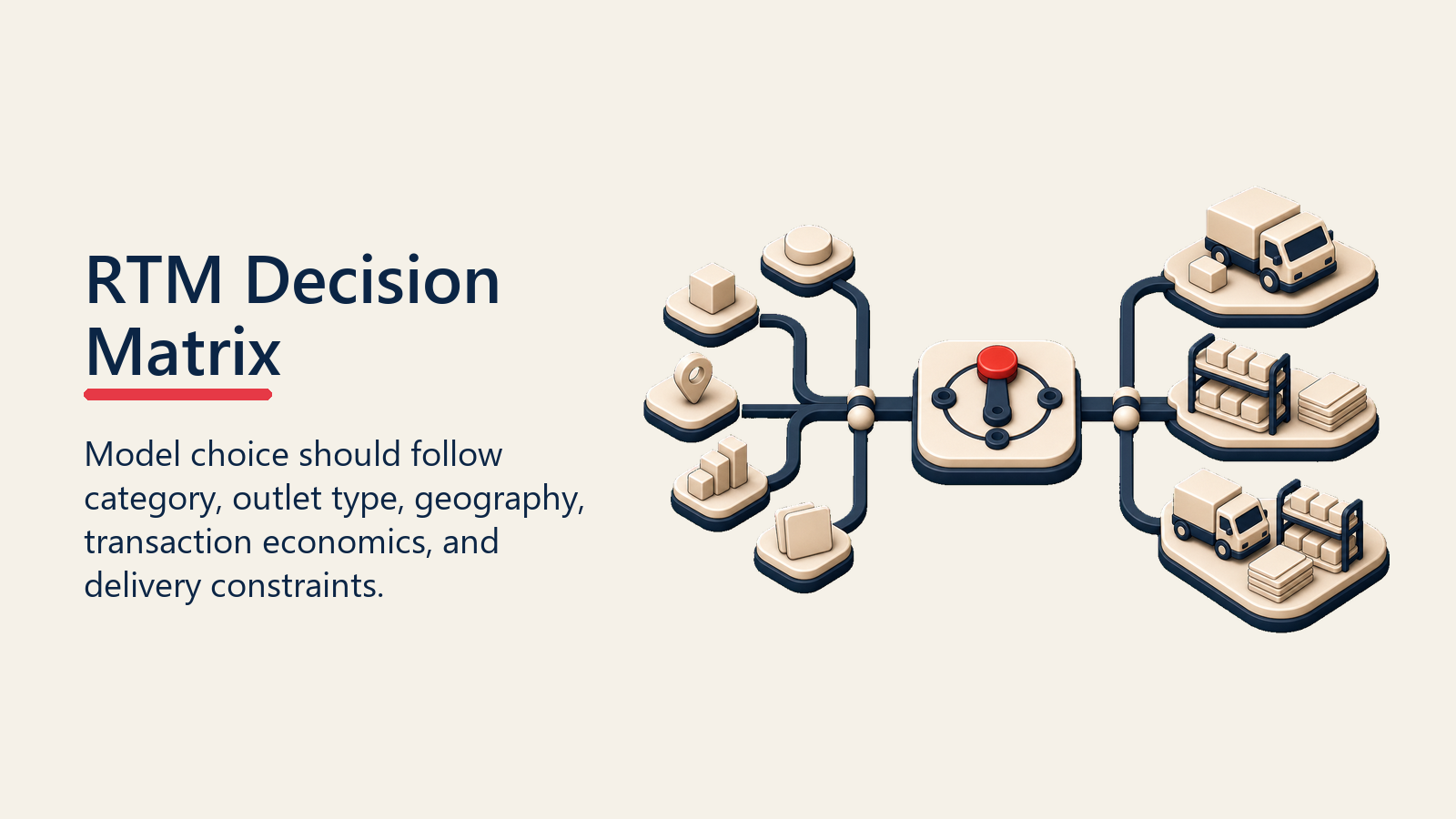
The Channel-Category-Geography Decision Matrix: A three-axis framework for selecting between van sales, pre-sell, and hybrid models. The first axis is channel type (kiosk and small traditional trade favor van sales; modern trade and large traditional trade favor pre-sell). The second is category characteristics (impulse and perishable categories favor van sales; wide-range portfolios and promotional-window categories favor pre-sell). The third is geographic density (rural and dispersed routes favor van sales; dense urban routes favor pre-sell where delivery vehicle consolidation is possible). A route-to-market map built from all three axes produces a hybrid allocation that serves each segment with the model that fits its operating reality.
Typical use case: High-frequency perishable or impulse categories in traditional trade channels where outlet owners buy based on what they can see and touch, cash turnover is fast, and storage capacity is low. Beverages, bread, fresh dairy, confectionery, and ice cream are classic van sales categories. The outlet owner wants to buy what he knows he can turn over today, not commit to a delivery that arrives tomorrow.
Strengths:
- Immediate order confirmation and delivery with no order-to-fulfillment gap
- High same-day close rate because the product is physically present and the transaction can complete immediately
- Cash collection on delivery reduces credit risk and bad debt
- Ability to capture unplanned impulse orders based on the outlet owner seeing the actual product
- Simple logistics: one vehicle, one rep, one route, one transaction per outlet
Constraints:
- Number of outlets visited per day is limited by the physical delivery time at each stop; a van sales rep typically visits 20-30 outlets per day versus 35-50 for a pre-sell rep
- SKU range is constrained by vehicle load capacity; a standard commercial van carries a limited number of SKU variants, and slow-moving or bulky items eat space that fast movers need
- Load factor efficiency is difficult to optimize when each outlet's order size and mix is unknown until the call; the morning load is a forecast, and either under-loading or over-loading generates waste
- Product returns and unsold stock require management at end of day, and write-off risk sits with the company until the product sells
Pre-Sell Defined
In a pre-sell model, the selling call and the delivery are separate events. The pre-sell rep visits outlets, takes orders, and a separate delivery vehicle (or dedicated delivery team) fulfills those orders on a following day. The rep has no physical product to deliver.
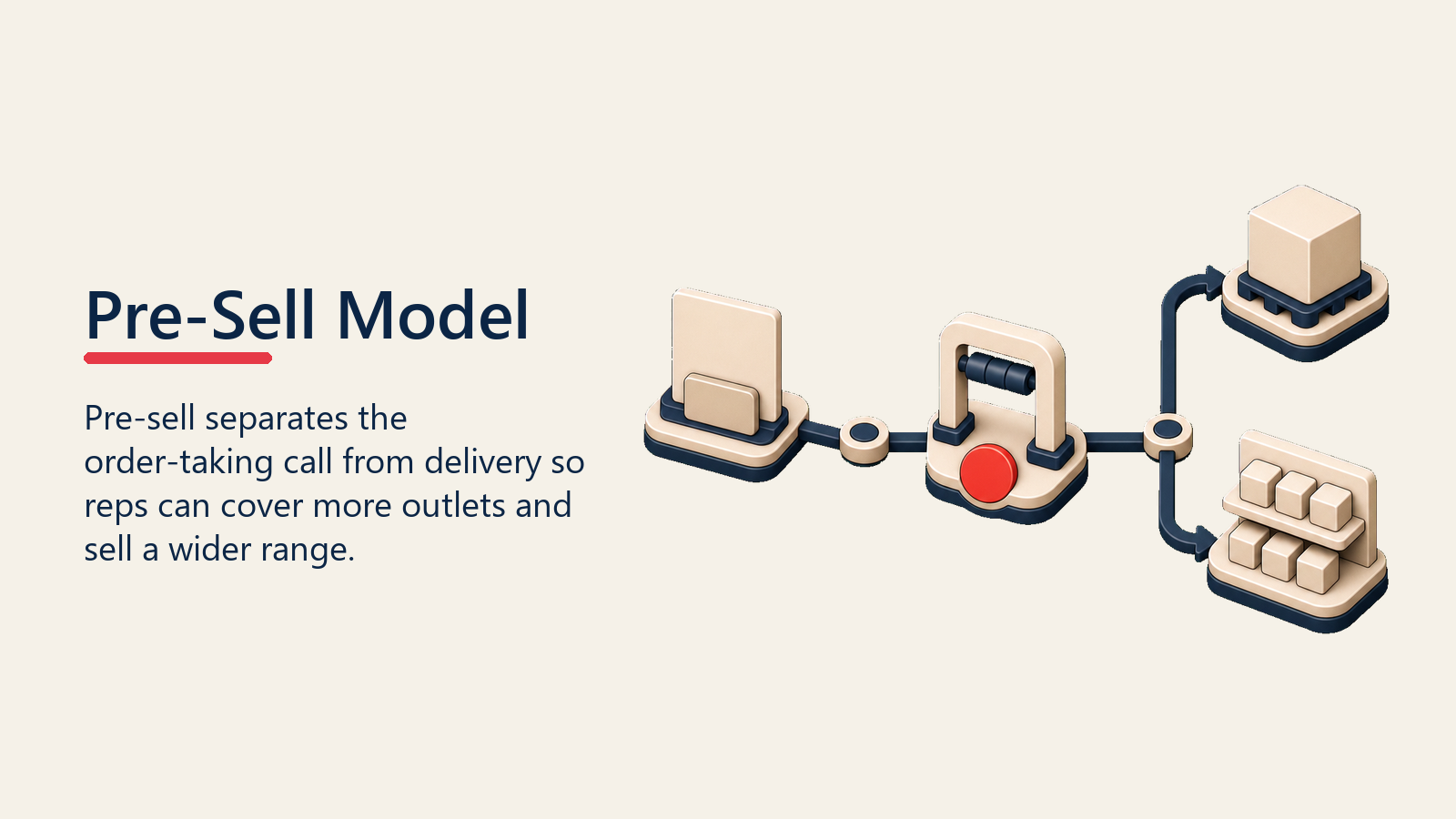
Typical use case: Wide-range portfolio selling into modern trade, large traditional trade, or accounts that require relationship-based selling with price negotiation, promotional consultation, and detailed order planning. Household care, personal care, packaged foods with broad range, and premium categories benefit from the pre-sell model because the conversation is about range, value, and strategy rather than immediate availability.
Strengths:
- Rep can cover significantly more outlets per day because no delivery time is spent at each stop
- Full SKU range is available on the order pad regardless of vehicle constraints; a rep can sell any item in the catalog, including new launches, promotional packs, and slow-moving SKUs that wouldn't fit on a van
- Order accuracy is higher when the conversation is unrushed; the rep can review the full range with the outlet owner, check the previous order, and propose the optimal assortment
- Promotional windows can be sold in advance; the rep can take orders for a promotional campaign that starts next week and build a confirmed order bank before the campaign opens
- Separation of selling and logistics allows each to be optimized independently
Constraints:
- Order-to-delivery gap (typically 24-48 hours) creates cancellation and modification risk; outlet owners change their minds, stock situations shift, or the outlet is closed when the delivery arrives
- Cash collection is separated from the commercial conversation, requiring a separate collections process or credit terms that introduce receivables risk
- The rep can't demonstrate product physically; new launches and premium SKUs require stronger verbal selling skills and sampling programs to compensate for the absence of tangible product
- Delivery truck scheduling and routing is a separate logistics function with its own cost structure and failure modes
Side-by-Side Comparison
The comparison is easiest to read by looking at how each model changes cash, inventory, order timing, and field productivity.
Van Sales vs Pre-Sell: Model Comparison
| Dimension | Van Sales | Pre-Sell |
|---|---|---|
| Outlets per rep per day | 20-30 | 35-50 |
| SKU range per call | Limited to vehicle load | Full catalog |
| Order close rate | 85-95% same-day | 70-85% confirmed, 5-15% cancellation before delivery |
| Cash handling | On delivery | Separate collections or credit |
| Order accuracy | Variable (impulse-driven) | Higher (planned conversation) |
| Freshness control | Immediate (product leaves depot that morning) | Dependent on delivery cycle |
| Cost per drop | Higher (selling + delivery time combined) | Lower (dedicated delivery vehicle, optimized routes) |
| Promotional activation | Limited to loaded stock | Full promotional range available |
| NPD introduction | Physical product shown | Verbal selling plus sample kits |
| Load factor management | Complex (morning forecast required) | Delivery truck optimized independently |
When Van Sales Wins
Van sales outperforms pre-sell under four specific conditions:
Impulse categories where visibility drives purchase. When the outlet owner buys what she sees and her customers buy what they see, the van is the demonstration. Carbonated drinks, confectionery, and impulse snacks move because the rep opens the van side, the outlet owner sees the chilled stock, and the decision happens in seconds. A pre-sell rep describing a flavour she can't show doesn't close the same way.
Rural beats with low storage capacity. An outlet that can store only two days of product has no reason to plan a weekly order. She buys what she needs today. A van sales call that arrives twice a week is the supply chain for that outlet. A pre-sell model with 48-hour delivery cycles is fundamentally wrong for her operating reality.
Outlets where cash turnover is the commercial relationship. In markets where outlet owners operate on very short cash cycles (buy today, sell today, buy again tomorrow), the van sales model aligns with their business model. They can see what they're buying, pay cash, and turn the product the same day. Credit-based pre-sell models create friction in cash-flow-sensitive channels.
Fast-moving perishables with freshness requirements. Bread, fresh dairy, and chilled products need to move from the production facility to the consumer within tight windows. A van sales model that loads fresh product at the bakery or dairy every morning and delivers to outlets within hours is structurally sound. A pre-sell model with a 24-hour order-to-delivery cycle is structurally risky for freshness categories.
When Pre-Sell Wins
Pre-sell outperforms van sales under four different conditions:
Wide SKU portfolios where range selling is the commercial opportunity. When the commercial objective is getting a portfolio of 80+ SKUs distributed across a tiered outlet universe, the pre-sell rep can have the full range conversation that a van loaded with 15 SKUs can't. The rep walks through the catalog, matches SKUs to the outlet's customer profile, and builds a complete order. A van sales rep can only sell what she loaded.
Promotional order windows that require advance commitment. When a major promotional campaign opens in two weeks and the commercial objective is securing confirmed orders before the window opens, the pre-sell model is the right tool. Reps can take pre-orders, build order bank numbers for sales and operations planning (S&OP), and ensure stock is allocated correctly before the promotion launches. Van sales can only activate promotions on the day stock is loaded.
Modern trade and high-value traditional trade accounts that require relationship selling. A modern trade buyer who is managing a planogram review, negotiating promotional placement, and deciding on a new range isn't buying off the back of a van. She's in a conversation with a pre-sell rep who has category data, the marketing calendar, and authority to propose a commercial arrangement that justifies the shelf allocation. The commercial depth required is incompatible with the van sales transaction model.
High-volume accounts where delivery optimization matters. An account that orders 200 cases a week benefits from a dedicated delivery truck, a planned loading manifest, and a route that aggregates high-volume drops for efficiency. The van sales model, where the same rep sells and delivers, makes large-volume drops prohibitively time-consuming per account.
How Do Leading FMCG Companies Combine Van Sales and Pre-Sell in a Hybrid Model?
Most FMCG companies of scale don't choose one model. They run a hybrid, assigning van sales or pre-sell by channel, category, or geography.
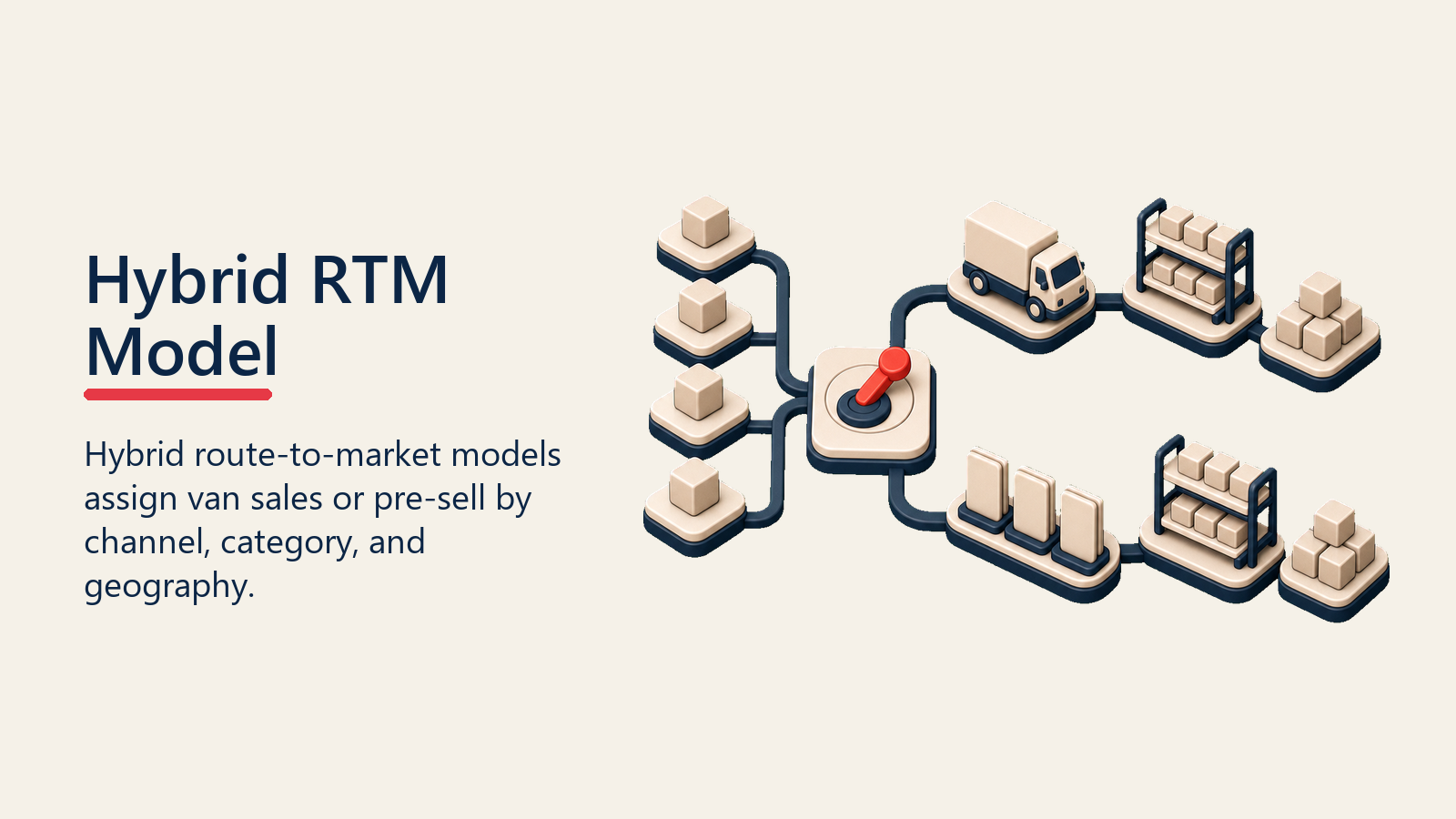
Channel-based split: Modern trade and large traditional trade accounts use pre-sell for range selling and relationship management. Small traditional trade, kiosks, and wet market outlets use van sales for high-frequency, cash-based, impulse-category selling.
Category-based split: A beverages company might run van sales for carbonated drinks (impulse, daily turnover, small storage) and pre-sell for juice, energy drinks, and premium water (planned purchase, wider range, promotional sensitivity).
Geography-based split: Dense urban routes use pre-sell because outlet concentration allows high outlet coverage per day, and delivery vehicles can make efficient consolidated runs. Rural or low-density routes use van sales because the delivery economics of a separate truck visit per outlet are prohibitive.
Day-of-week split: Some companies run van sales on high-traffic days (weekends near a market or school) and pre-sell on weekdays when the commercial conversation is less rushed. This is uncommon but exists in markets with very pronounced weekly trading rhythms.
Hybrid Routing Example: Beverages Company, Urban Market
| Route Type | Model | Outlets per Day | Categories | Days |
|---|---|---|---|---|
| Urban traditional trade (dense) | Pre-sell | 42 | Full portfolio (80+ SKUs) | Mon-Fri |
| Market/kiosk zone | Van sales | 26 | Carbonated drinks, water, confectionery | Mon, Wed, Fri |
| Modern trade (hypermarket + supermarket) | Pre-sell | 8 | Full portfolio, promotional negotiation | Tue, Thu |
| Rural circuit (2-hour from depot) | Van sales | 18 | Core 12 SKUs | Alternating weeks |
The logic behind this split isn't complexity for its own sake. The rural circuit's 18 outlets need the immediacy of van delivery because the logistics economics of a separate pre-sell delivery truck for that geography don't work. The urban traditional trade benefits from the wider range that pre-sell enables. Modern trade requires relationship selling. Market and kiosk zones are impulse-buy territory.
Cost Implications
The financial trade-offs between models are real and worth quantifying before choosing.
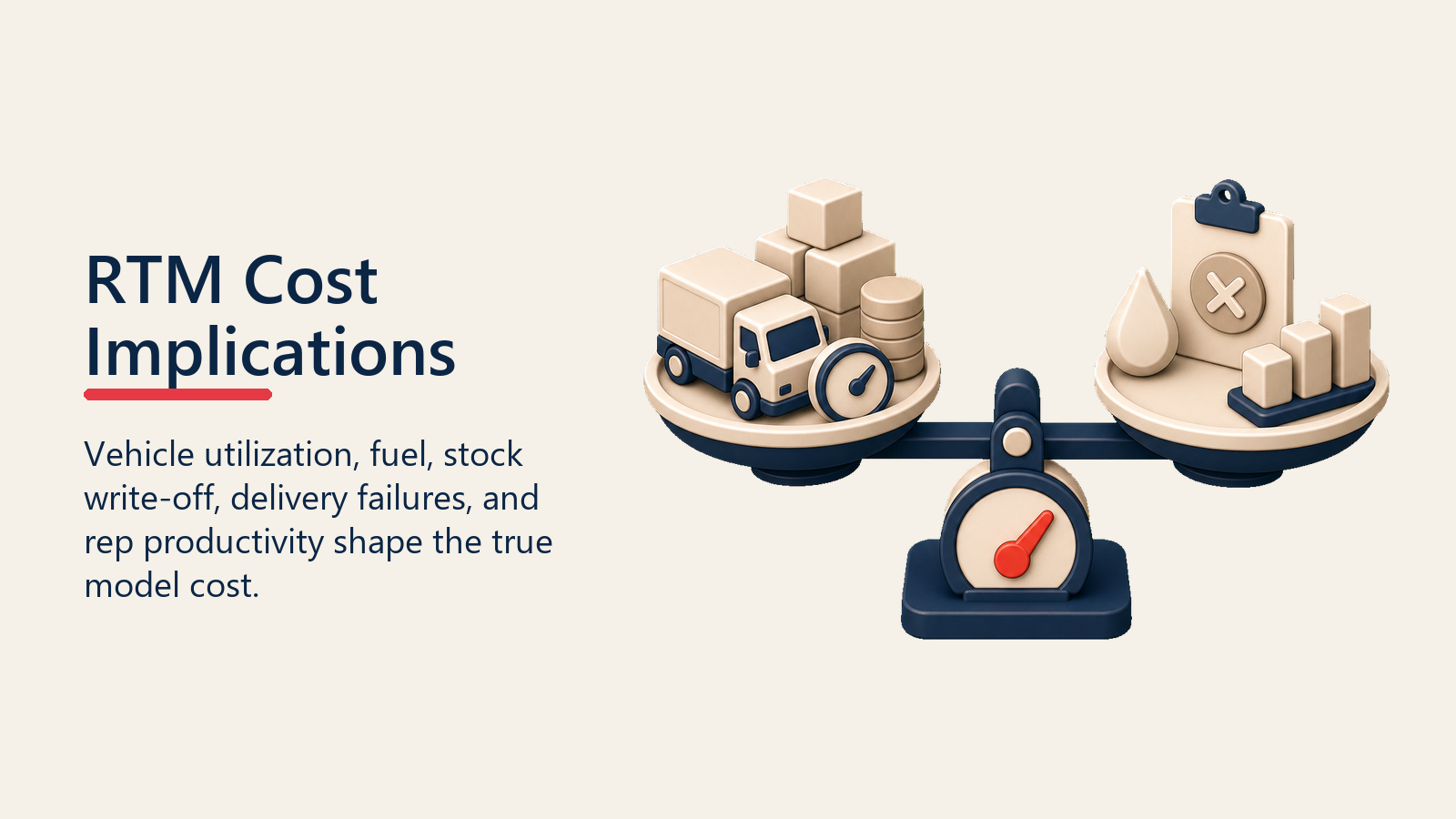
Load factor and vehicle efficiency. A van sales vehicle loaded to 60% capacity in the morning and returning with 20% unsold stock is running at poor asset efficiency. Pre-sell delivery vehicles can be loaded to 90%+ because the manifest is confirmed before loading. The fuel cost per revenue dollar delivered is materially lower in an optimized pre-sell delivery operation.
Stock write-off. Van sales creates daily write-off risk on perishables and near-expiry stock that didn't sell off the truck. Pre-sell, where the order is confirmed before stock is committed, eliminates most unplanned write-off. For categories with short shelf life, this cost difference is significant.
Rep productivity. A pre-sell rep covering 42 outlets per day at an average order value of $150 generates $6,300 in confirmed order value per day. A van sales rep covering 26 outlets per day at the same average order value generates $3,900. But the pre-sell figure includes a 10% cancellation rate; the net delivery value is closer to $5,670. And the van sales figure includes the delivery cost embedded in the rep's time, which pre-sell separates.
Collections cost. Van sales collects cash on delivery, eliminating a separate collections process. Pre-sell requires either credit terms (and the receivables management and bad-debt cost that comes with them) or a separate collections call, which adds a third visit event to the customer relationship.
The total cost-per-drop (cost to sell and deliver one outlet visit) is typically 15-25% lower for pre-sell in dense urban markets. In rural markets, the opposite is true: the delivery cost of a separate truck to serve a dispersed route erases the efficiency gain.
FMCG field sales economics covers the full profit and loss structure of field operations. NielsenIQ analysis shows that targeting the right stores can unlock 10% incremental market share, with the top 50% of stores in a region typically accounting for 86% of category sales. The model choice is one of the largest determinants of the field cost structure and should be treated as a strategic financial decision, not a logistical default.
Direct store delivery is a specific variation of the van sales model where the manufacturer's own fleet delivers direct to retail, bypassing distributors entirely. The economics are distinct and covered in depth in that article.
Choosing the Right Model: Decision Matrix
Model Selection Decision Matrix
| Condition | Van Sales | Pre-Sell | Either |
|---|---|---|---|
| Category: impulse/perishable | Preferred | ||
| Category: wide range/premium | Preferred | ||
| Outlet type: kiosk/small traditional trade | Preferred | ||
| Outlet type: modern trade/large traditional | Preferred | ||
| Geography: rural, dispersed | Preferred | ||
| Geography: dense urban | Preferred | ||
| Transaction type: cash-intensive | Preferred | ||
| Transaction type: credit/promotional | Preferred | ||
| Promotional activation: immediate | Preferred | ||
| Promotional activation: advance order window | Preferred | ||
| SKU range: narrow core | Preferred | ||
| SKU range: broad portfolio | Preferred |
The matrix doesn't require a uniform answer. A company with a broad portfolio in both rural and urban markets will typically find that the decision matrix points to van sales in one geography and pre-sell in the other, which is exactly the logic behind a hybrid operation.
Standard operating procedures for whichever model is selected need to document the specific call steps, SFA requirements, cash handling protocols, and delivery confirmation processes so that the model runs consistently across all reps and routes. A model choice that isn't operationalized in a documented SOP remains a strategy, not an execution.
Conclusion: The Model Should Follow the Outlet and Category
The choice between van sales and pre-sell isn't a company preference. It's a commercial decision that follows the outlet type, category characteristics, geographic density, and transaction economics of the specific channel being served.
A company that runs van sales across its entire operation because that's how distribution was set up 15 years ago is probably over-investing in delivery time and under-investing in range selling in channels where pre-sell would generate materially more revenue per rep day. A company that runs pure pre-sell across rural beats is probably paying delivery economics that don't make sense for the volume those outlets represent.
The right answer is a model map: which channels, categories, and geographies benefit from which model, and what hybrid structure serves the full market efficiently. Build the map from the decision matrix. Quantify the cost differences. Set a review cadence for the allocation, because the right model for a channel today may not be right in three years as the channel evolves, the outlet base grows, and delivery economics shift.
The model is a tool. Make sure it fits the job.
Frequently Asked Questions about Van Sales vs Pre-Sell
Can the same rep run both van sales and pre-sell in the same day?
Operationally possible but usually inefficient. A rep switching between models mid-route carries either a van with stock (useful for van sales stops, dead weight for pre-sell stops) or no stock (appropriate for pre-sell, unable to close a van sales call). Some companies run a hybrid where the morning route is van sales (high-frequency traditional trade, done before noon) and the afternoon is pre-sell (modern trade and large accounts that expect a planned commercial conversation). But the SFA systems, collection processes, and call step protocols need to be different for each model, and training reps to switch cleanly is a non-trivial coaching investment.
How do you calculate the right load for a van sales operation?
The base calculation is: average outlet order size multiplied by number of outlets on the route, adjusted upward by a buffer factor (typically 15-20%) for impulse orders that exceed the average. The buffer is the art: too small and the van runs out of popular SKUs by mid-route; too large and unsold stock has to be managed at end of day. SFA data from the previous three to four cycles at each outlet gives a reliable demand forecast. Seasonal adjustments (school holidays, Ramadan, local market days) add a separate planning layer.
What's the typical cancellation rate for pre-sell orders?
In a well-run pre-sell operation with clear delivery windows and a reliable rep-outlet relationship, cancellation rates of 5-8% are typical. In operations with poor delivery reliability, long order-to-delivery gaps, or inconsistent rep coverage, cancellation rates can reach 15-20%. The cancellation rate is one of the most sensitive indicators of pre-sell operational health. Elevated cancellations almost always trace back to either delivery failures (outlet closed, wrong product sent, damaged stock on arrival) or relationship failures (the outlet owner changed her mind because the rep didn't build sufficient commitment before leaving).
How does new product development affect the model choice?
New product development (NPD) strongly favors pre-sell for the first 90 days of a launch. A pre-sell rep can carry sample kits and printed materials, have an unrushed conversation about the product's consumer positioning, and build a committed order for delivery when the product is available. A van sales rep introducing NPD needs the product physically loaded on the van from day one of availability, which constrains the launch ramp to whatever the depot can load rather than whatever the market can absorb. For NPD-heavy categories (personal care, household products, premium packaged food), this is a strong argument for pre-sell as the primary model even if van sales dominates other parts of the portfolio.
What is the typical cost-per-drop difference between van sales and pre-sell?
In dense urban markets, pre-sell's cost-per-drop is typically lower than van sales because delivery vehicles can be loaded to 90%+ capacity from a confirmed order manifest and routes can be optimized for consolidated high-volume drops. In rural or dispersed markets, the equation reverses: the delivery cost of a separate pre-sell truck serving dispersed outlets can exceed the embedded delivery cost of a van sales rep covering the same route. The correct comparison is the total cost to sell and deliver per outlet visit, not just the rep time component.
How do you manage stock write-off risk in a van sales operation?
The primary risk is perishable or near-expiry product that does not sell off the truck. The mitigation has three layers: first, use SFA data from the previous three to four cycles at each outlet to build a realistic demand forecast and load accordingly, with a 15-20% buffer for impulse uplift. Second, sequence the route so that higher-volume Diamond and Gold accounts are called early, when the van is fully stocked and the product is freshest. Third, define an end-of-day unsold stock protocol: which categories can be returned to depot, which are offered at trade price to a secondary outlet, and which are written off immediately rather than carried forward.
Learn More

Senior Implementation Consultant