Wholesale Channel Management: Using FMCG Wholesalers as a Force Multiplier
Turn this article into takeaways for your work.


Each assistant summarizes the article only for you and suggests best practices for your work.
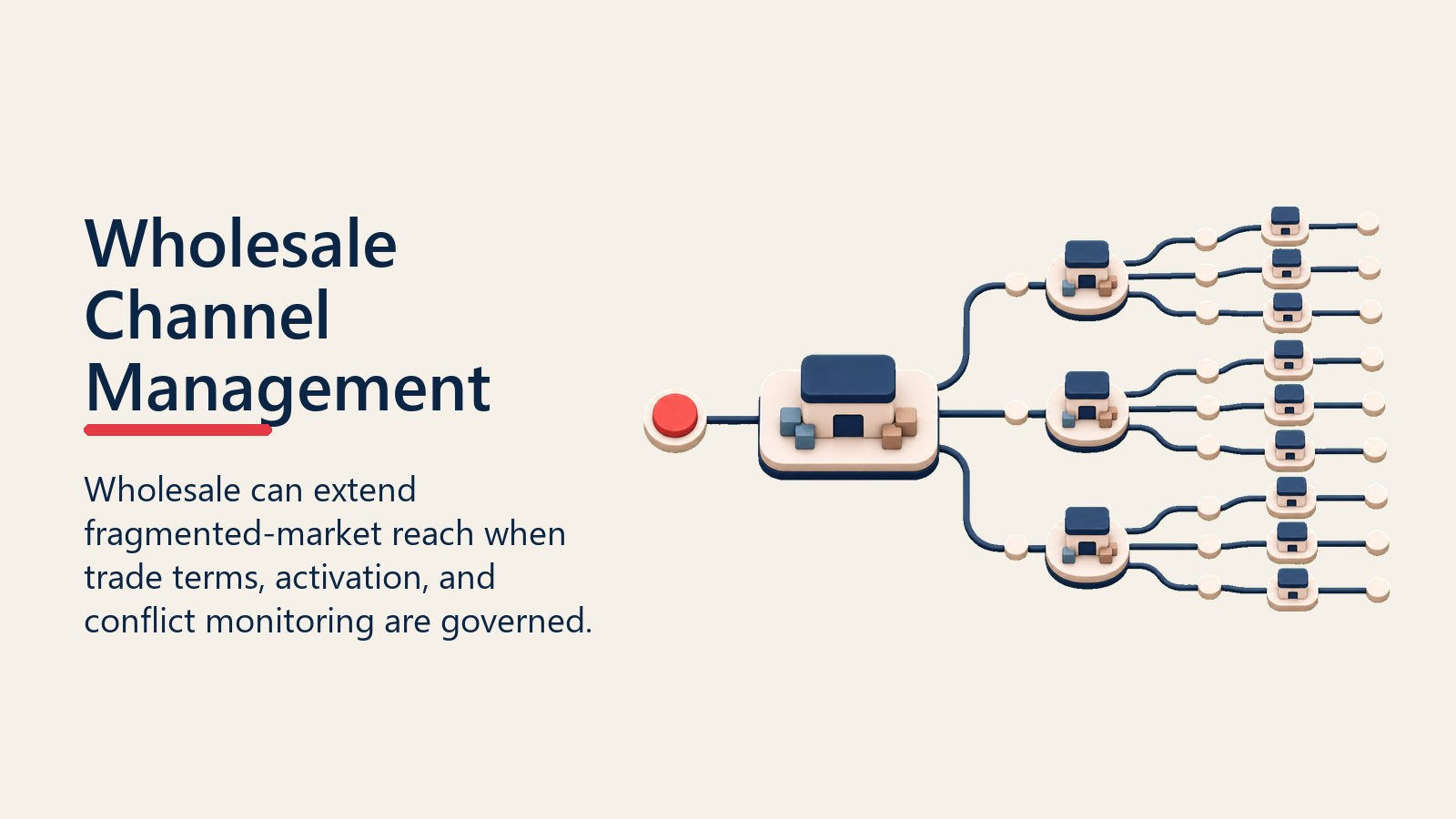
There's a particular irony in how most FMCG companies manage their wholesale channel. It's the channel they least control, often the channel they least actively manage, and frequently the channel that moves the most volume of their product in fragmented retail markets.
Wholesale operators, whether cash-and-carry operators (self-service depots where retailers buy and carry stock away themselves), super-stockists, or other depot formats, function as distribution amplifiers. They aggregate product from manufacturers and distributors, hold significant stock, extend credit to small retailers, and serve as the purchase point for hundreds of mom-and-pop shops that can't or won't order directly from a brand's distributor network. In some FMCG markets, a single large cash-and-carry operator in a tier-two city might supply more general trade outlets than the primary distributor covering that same geography.
The problem is that this volume comes with almost no commercial visibility and significant conflict risk. Wholesale is where price discipline erodes, where gray-market product flows, and where a small retailer can buy your brand at a margin that undercuts your distributor's retail price. Left unmanaged, wholesale becomes an uncontrolled overflow valve that undermines the commercial architecture you've built in every other channel.
The goal of wholesale channel management is turning that dynamic around: using wholesale as a deliberate force multiplier that extends your distribution economics without proportional field-force investment, while keeping enough governance in place to prevent it from corroding the rest of your channel structure.
Wholesale vs Distributor: Getting the Definitions Right
Cash-and-carry operators, super-stockists, and wholesale depots get conflated with distributors, and the confusion leads to misaligned trade terms and mismanaged channel relationships. They're fundamentally different models.
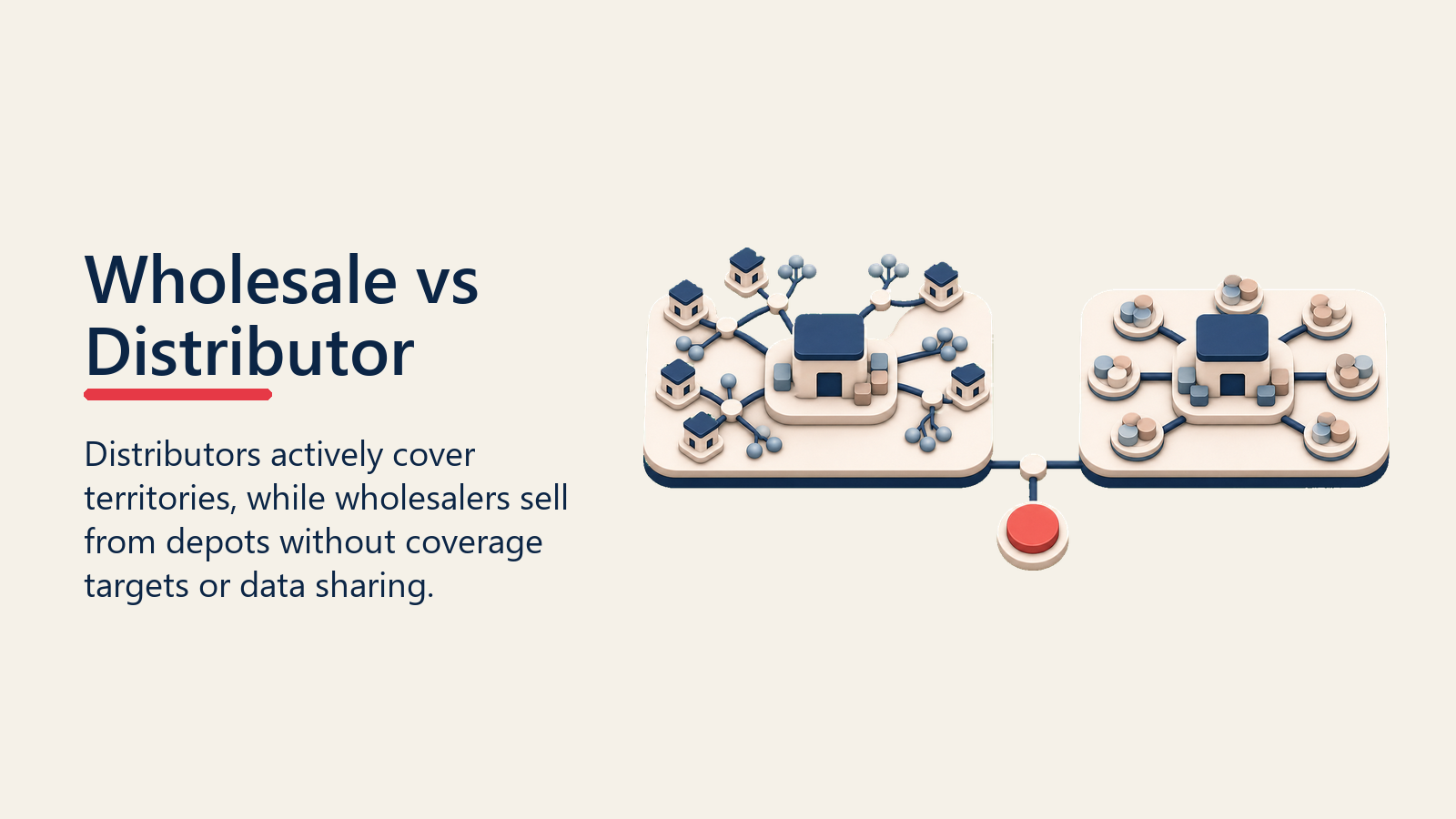
Primary Distributors are territory-bound commercial partners who hold stock purchased from the manufacturer, operate van sales teams that actively call on outlets, and bear credit risk on their downstream customers. Their commercial relationship with the manufacturer is ongoing and managed: monthly targets, performance scorecards, exclusive territory assignments, and active field support.
Wholesalers and Cash-and-Carry Operators typically don't hold territory exclusivity. They buy stock at trade prices, hold it in a depot or warehouse format, and sell to any retailer who walks through the door or places an order. They don't actively sell in the field. They don't commit to coverage targets. And they don't typically share sales-out data with manufacturers.
Super-Stockists sit in a hybrid position: they're larger-format wholesale operators, often regionally significant, who may have some degree of commercial relationship with specific manufacturers while also serving as a multi-brand wholesale outlet. In South Asian markets, the super-stockist often supplies sub-distributors and small town wholesalers who in turn service rural retailers.
| Channel Type | Territory Commitment | Active Selling | Manufacturer Relationship | Data Sharing |
|---|---|---|---|---|
| Primary Distributor | Yes, exclusive | Yes, van sales | Managed, formal | Secondary sales reporting |
| Super-Stockist | Loose at best | Minimal | Commercial relationship, not managed | Rarely |
| Cash-and-Carry | None | None | Transactional | None |
| Self-Service Depot | None | None | Transactional | None |
Understanding which type of wholesale operator you're dealing with determines what kind of commercial relationship is realistic and what governance tools are available.
Key Facts: FMCG Wholesale Channel
- Traditional trade channels still account for more than 70 percent of FMCG retail sales in rural Asia-Pacific markets, with wholesale depots and cash-and-carry operators functioning as the primary restocking point for the majority of those retailers (Allied Market Research FMCG Market Report, 2024).
- Emerging markets are expected to account for approximately three-quarters of global FMCG industry growth by 2028, with wholesale and fragmented trade channels remaining the dominant route-to-consumer in those markets (Bain Consumer Products Report, 2025).
- Wholesale and cash-and-carry formats serve as the primary credit and restocking mechanism for micro-retailers that distributor van routes cannot economically reach directly, a structural role documented across Southeast Asian and South Asian FMCG markets.
What Strategic Role Should Wholesale Play in Your Channel Mix?
Wholesale isn't a channel to compete with your distributor. It's a channel that fills the gaps in your distributor coverage map and serves retailer segments that your distributor network doesn't reach efficiently.
Geographic gap filling: Your primary distributor covers the major outlets in a territory, but there are always retailers in secondary towns, market clusters, or border areas between territories who are undersupported. A regional wholesale depot in the right location can service these retailers at a lower cost than extending distributor coverage.
Low-MOQ retailer service: Very small retailers who order in single-unit quantities can't be economically served by a primary distributor's van route. The minimum order value that justifies a distributor van visit often exceeds the small retailer's monthly purchase volume. Wholesale operators serve this tail of micro-retailers efficiently because the retailer comes to them rather than the other way around.
Trade credit provision: In markets where cash flow is tight at the retailer level, wholesale operators who extend credit to small shops fill a financing gap that your distributor network can't always cover. A kirana owner who can buy on 7-day credit from a nearby cash-and-carry will source from that channel even if your distributor theoretically covers their area. The IFC estimates that Indonesia alone has three million small FMCG merchants whose economics depend on exactly this kind of wholesale credit access.
New market entry coverage: When entering a new geography where you haven't yet built a distributor network, wholesale outlets in that market can provide interim coverage while you recruit and onboard a primary distributor. This is a tactical use of wholesale, not a permanent channel strategy.
None of these roles requires you to cede commercial control. But they do require you to define what you want wholesale to do, and then set the commercial terms and governance to make sure it does that and nothing more. The first place that control shows up is in the price architecture.
Wholesale Trade Terms vs Distributor Trade Terms
The most consequential decision in wholesale channel management is the price architecture. Set the wholesale buying price too close to the distributor's price, and you've created an arbitrage opportunity that the wholesale buyer will exploit. Set it too far below, and you've undermined your distributor's ability to compete.
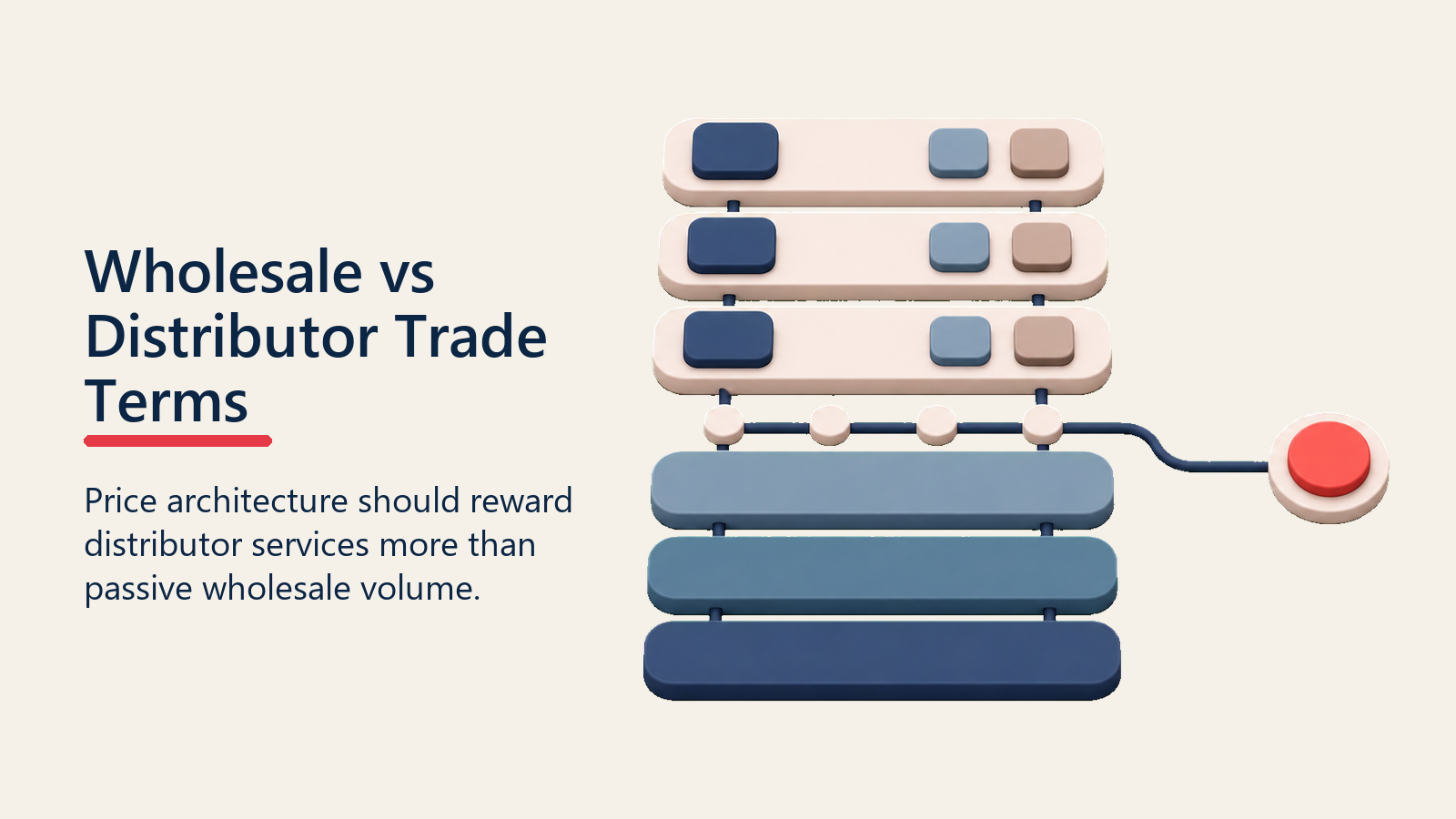
The principle is that each channel tier's buying price should be set to reflect the value of the commercial services that tier provides, not the volume they can purchase. A distributor gets a better buying price than a cash-and-carry operator because the distributor actively sells into the trade, holds territory exclusivity, meets coverage targets, and shares secondary-sales data. A cash-and-carry operator who does none of these things shouldn't receive the same price.
| Trade Term Dimension | Primary Distributor | Super-Stockist | Cash-and-Carry |
|---|---|---|---|
| Base buying price discount (from RRP) | 18-25% (market-dependent) | 12-16% | 8-12% |
| Payment terms | 21-30 days credit | 7-14 days or cash | Cash or 7 days |
| Volume rebate availability | Yes, quarterly | Limited | Rarely |
| Promotional co-investment | Yes, structured | Selective | Minimal |
| New SKU listing cooperation | Required | Optional | Voluntary |
These ranges are illustrative and highly market-dependent; actual structures vary by category, country, and negotiating leverage. The key principle is the price differential: the distributor's buying price should always be sufficiently better than the wholesale buying price to protect the distributor's ability to service the trade at a margin that motivates performance.
Negotiation fundamentals apply here. The wholesale negotiation is simpler than a modern trade negotiation in terms of relationship complexity, but the price point you set has systemic consequences for every other channel's economics. Walk in knowing your floor.
Distributor management and ROI frameworks should explicitly model what happens to distributor ROI when wholesale buying prices are set at different levels. If the wholesale price is within a few margin points of the distributor's buying price, you're inadvertently incentivizing your distributor to shift volume into the wholesale channel (by buying to resell rather than actively distributing) rather than investing in field coverage. Once the price architecture is solid, the next question is how to make wholesale operators actively work for your brand.
Activation and Visibility in Wholesale
Wholesale operators don't sell your brand; they make it available. But you can influence the prominence with which they display, position, and promote your product within their depot.
In-Depot Displays: Branded display structures, end-of-aisle stacks, and gondola placements within a cash-and-carry depot can significantly increase purchase rates among retailer buyers who enter the depot for one brand and walk past another. Permanent branding structures (branded bays, cooler units for beverage categories) are negotiated as part of a key-account relationship with the wholesale operator.
Key Account Activation Programs: Large cash-and-carry operators or regional super-stockists who qualify for key-account treatment should have structured activation calendars: quarterly purchase targets, volume rebate milestones, case-stack promotions tied to seasonal periods, and planned product demonstrations or in-depot sampling for new SKU launches.
Case-Stack Promotions: In wholesale environments, the primary in-store execution tool is case stacking. Bulk display of product at a promotional price point (typically tied to a minimum case purchase) drives volume purchase from retailer buyers who are price-sensitive and purchase-volume-aware. Case-stack promotions in wholesale should be coordinated with your distributor promotional calendar to avoid simultaneous discounting that creates channel pricing confusion.
New SKU Penetration: Wholesale is often the fastest channel for getting a new SKU into retailer hands when you need immediate distribution coverage during a launch. A new product listed in a regional cash-and-carry outlet can reach hundreds of small retailers who buy from that depot within the same month, without requiring your field force to call on each individual outlet. Track new SKU listing penetration in wholesale as a leading indicator of launch velocity.
Trade marketing and field alignment is what ensures your wholesale activation investments don't run in isolation from your GT distributor activities. A case-stack promotion in a cash-and-carry should not be funded from the same trade budget as a GT display scheme running simultaneously in the same market, or you'll be cannibalizing your own trade investment.
Wholesale-Specific KPIs
Managing wholesale as a deliberate channel means tracking its performance on its own terms, not just including wholesale offtake in your total channel volume and leaving it there.
Wholesale KPI Dashboard
| KPI | Definition | Target Benchmark |
|---|---|---|
| Depot offtake rate | Average cases per depot per month for primary SKU range | Set per depot tier and region |
| Stock days at depot | Average inventory cover held by wholesale operator | 15-25 days (avoids overstocking, prevents stockouts) |
| Brand share within depot | Your brand's share of category volume through the wholesale operator | Track against target category share |
| New SKU listing penetration | % of target wholesale accounts stocking new SKU within 60 days of launch | >70% for strategic launches |
| Wholesale retail price compliance | % of retailer buyers purchasing at or above the minimum retail price floor | >85% compliance |
| Wholesale-to-retail price spread | Gap between wholesale buying price and average retailer selling price | Monitor for compression signals |
Numeric and weighted distribution metrics for wholesale differ from GT metrics. What matters isn't just that a product is listed in the wholesale depot; it's whether retailers in that depot's catchment are actually buying and stocking it. Wholesale listing without retailer pull-through is a vanity metric.
The same coverage-versus-over-penetration trade-off that pipeline coverage analysis applies to sales pipelines applies to wholesale accounts: you need enough wholesale coverage to avoid geographic blind spots, but not so many competing depots in the same catchment that they drive each other into a price war on your products. When that happens, the channel that was supposed to fill gaps starts creating them.
Conflict Management: Keeping Wholesale in Its Lane
The most common failure mode in wholesale channel management isn't neglect; it's allowing wholesale to drift from its intended role as a gap-filler into a channel that actively competes with your distributor on price, geography, and outlet coverage.
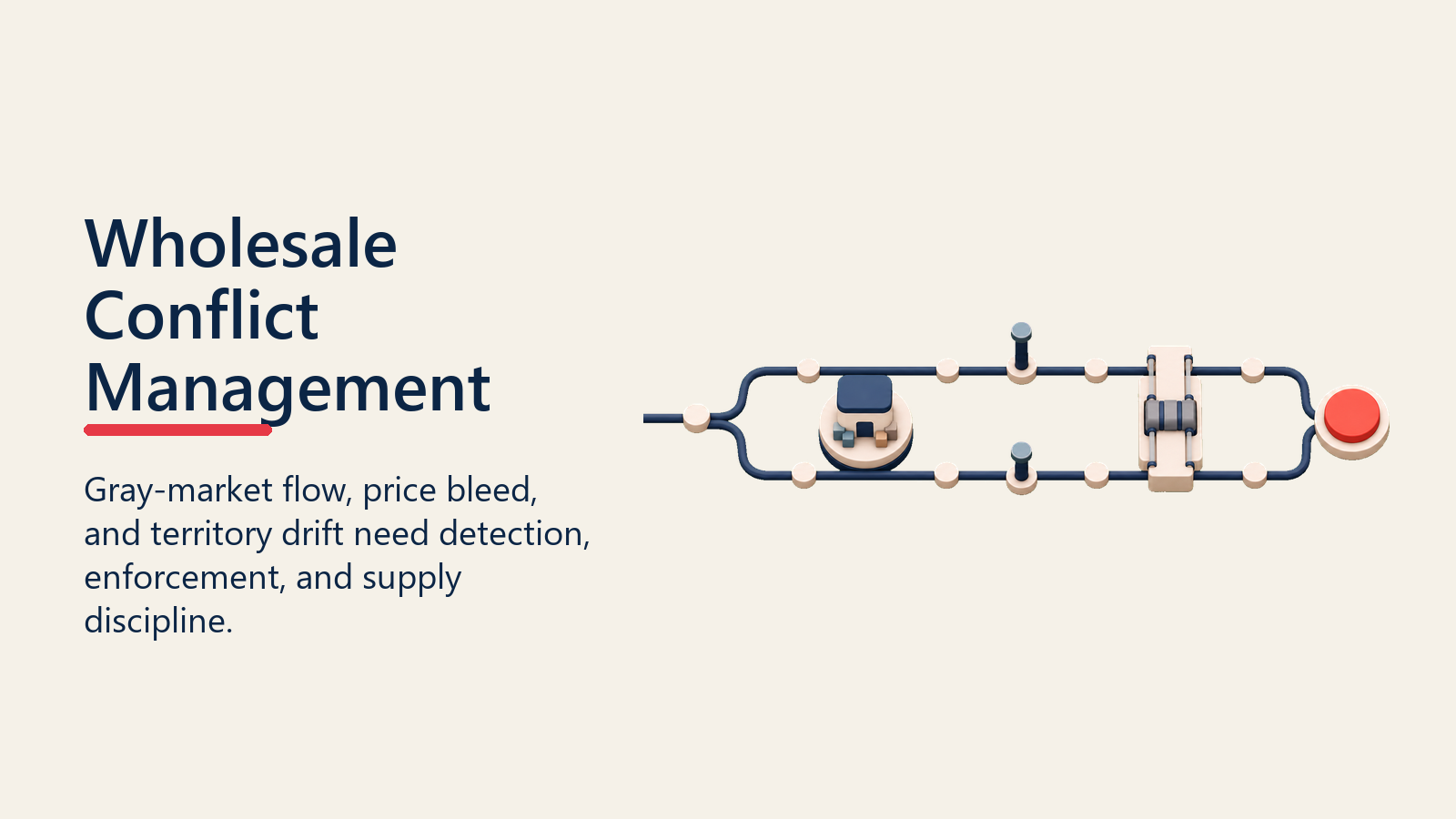
Gray-Market Flow Prevention: Gray-market product moves from a lower-cost channel into a higher-cost channel, typically driven by a large retailer or wholesaler arbitraging price differentials. If your wholesale buying price is significantly below a neighboring market's retail price, product will flow from wholesale buyers into that market through informal channels. Pack-level serialization and batch tracking can detect unusual wholesale purchase patterns before they become a gray-market volume problem.
Price Bleed Control: When a cash-and-carry operator sells to general trade retailers at a price that undercuts the distributor's selling price, the retailer has a rational incentive to buy from the cash-and-carry rather than the distributor. This erodes the distributor's business, which weakens their commercial motivation to invest in your brand. Control wholesale-to-retail price bleed by setting minimum retail price commitments in wholesale agreements, monitoring through retail price audits, and restricting supply to wholesale operators who consistently breach the minimum price floor.
Territory Discipline: Cash-and-carry and wholesale operators don't respect distributor territory boundaries unless you manage them into doing so. A regional cash-and-carry that draws retailer buyers from three different distributor territories is effectively serving all three territories, but at wholesale price, not at the distributor's commercial terms. Define the geographic catchment of each wholesale account in your commercial agreements, and monitor unusual cross-territory purchase patterns through retailer buyer zip code analysis if the wholesale operator can provide it.
General trade, modern trade and eB2B channel governance principles intersect here: the same price architecture discipline that prevents eB2B price bleed into GT also prevents wholesale price bleed into distributor-served channels. The wholesale channel needs its own position in the price architecture, clearly separated from the distributor tier by enough margin to protect the distributor's commercial viability.
Route-to-market frameworks should explicitly map the wholesale channel's intended role and geographic scope, so that conflicts between wholesale and distributor coverage are predictable and manageable rather than discovered after the damage is done.
Wholesale Conflict-Risk Matrix
| Conflict Type | Risk Level | Detection Method | Resolution Mechanism |
|---|---|---|---|
| Wholesale undercutting distributor retail price | High | Retail price audit; retailer complaints | Minimum retail price clause enforcement; supply restriction |
| Gray-market flow across markets | Medium-High | Sales volume spike in source market; product tracking | Serialization; supply cap on suspicious volumes |
| Wholesale buying product to re-sell as distributor | Medium | Unusual purchase volume vs depot size | Purchase volume cap; depot registration verification |
| Retailer bypassing distributor to buy wholesale | Low-Medium | Distributor volume decline in affected outlets | Investigate price differential; tighten wholesale price architecture |
Knowing the failure modes is only useful if you have a system to catch them early. That's what the governance stack provides.
The Wholesale Governance Stack
Managing wholesale as a deliberate channel requires three layers of control working together. This is the Wholesale Governance Stack: Price Architecture, Activation, and Conflict Monitoring.
Price Architecture is the foundation. Each channel tier's buying price must reflect the commercial services that tier delivers. Distributors earn the best buying price because they actively sell, maintain territory coverage, and share secondary-sales data. Cash-and-carry operators earn a meaningfully worse buying price because they do none of those things. A well-constructed price architecture creates natural channel gravity: retail buyers buy from the channel that offers them the best combination of price, credit, and convenience, but that channel is determined by the price architecture you've set, not by whoever offers the steepest discount.
Activation converts a wholesale operator from a passive stock-holder into an active brand-building channel. Branded depot fixtures, case-stack promotions timed to seasonal periods, and new SKU penetration programs give the wholesale operator a commercial reason to feature your brand rather than a competitor's. Without activation, wholesale is just a lower-margin version of your distributor business with no service obligations attached.
Conflict Monitoring is the early-warning layer. Wholesale-to-distributor price bleed is the most common failure mode, and it usually starts small: a few retail customers switching from distributor purchase to depot purchase because the cash-and-carry price is marginally better. Left unchecked, the pattern escalates as more retailers learn the arbitrage is available. Regular retail price audits, distributor volume monitoring by outlet tier, and a fast-response mechanism for pricing anomalies keep the conflict from becoming structural.
Quotable Nuggets
"A regional cash-and-carry that draws retailer buyers from three distributor territories is effectively serving all three at wholesale price. The question isn't whether that's happening. It's whether you have the governance in place to manage it." (Synthesized from FMCG channel conflict analysis; consistent with Consumer Goods Forum South Asia working group findings)
"The wholesale channel you least control often moves the most volume in fragmented markets. The difference between a force multiplier and an uncontrolled overflow valve is almost entirely a function of the trade terms you set and the monitoring cadence you maintain."
"Emerging markets are expected to account for approximately three-quarters of FMCG industry growth by 2028. Wholesale and fragmented trade are the routes through which that growth happens at the outlet level." (Bain Consumer Products Report, 2025)
Wholesale as a Deliberate Channel Strategy
The brands that manage wholesale well don't let it happen to them. They make an explicit choice about which wholesale operators they work with, on what terms, for what strategic purpose, in which geographies. They set trade terms that position wholesale clearly below the distributor in the commercial hierarchy. They invest in activation programs that grow their brand share within the wholesale depot. And they monitor the conflict-risk matrix consistently enough to catch price bleed and gray-market flow before it becomes structural.
Done this way, wholesale extends distribution economics significantly. A well-managed regional cash-and-carry can service 500 small retailers in its catchment at a cost-to-serve that's a fraction of what your distributor network would spend trying to cover the same retailers directly. Bain's research on winning in emerging markets consistently identifies distribution scale through wholesale and fragmented trade as a defining factor separating market leaders from followers. And it does this without a single additional field sales rep on your payroll.
The alternative is treating wholesale as a passive overflow. Product flows through when your distributor can't cover demand or when large retailers find it convenient to buy from a cash-and-carry instead of your distributor. Volume happens, but without visibility, without governance, and with the ongoing risk that wholesale activity is quietly eroding the price discipline and distributor motivation you've spent years building.
Wholesale as a force multiplier requires intent, structure, and consistent monitoring. But the distribution economics it generates, at scale, are difficult to replicate through any other channel without proportional field-force investment.
Frequently Asked Questions about Wholesale Channel Management
What is the difference between a wholesaler and a distributor in FMCG?
A distributor is a commercial partner with territory exclusivity, active van sales teams, coverage targets, and a formal performance relationship with the manufacturer. A wholesaler or cash-and-carry operator holds stock and sells to any retailer who orders from them, without territory commitment, active field coverage, or formal performance obligations. The distributor earns a better buying price because they deliver commercial services the wholesaler doesn't.
How do you prevent wholesale from undercutting your distributor?
Set the wholesale buying price at a level that gives the wholesale operator a viable margin while keeping the distributor's buying price meaningfully better, typically 6 to 10 percentage points better depending on the market and category. Then enforce a minimum retail price in wholesale agreements and audit compliance through field price checks. Restrict supply to wholesale operators who consistently sell below the minimum retail floor.
What KPIs should FMCG brands track for wholesale?
The core wholesale KPIs are: depot offtake rate (average cases per depot per month), stock days at depot (inventory cover), brand share within the depot's category mix, new SKU listing penetration, and retail price compliance among retailer buyers sourcing from the depot. Track these separately from distributor channel KPIs so wholesale performance is visible on its own terms.
When should FMCG brands use wholesale instead of distributors?
Wholesale is best suited as a supplement to distributor coverage, not a replacement. Use it to fill geographic gaps where distributor coverage is thin, to service micro-retailers whose order size falls below the distributor's minimum drop threshold, and to extend distribution during new market entry before a primary distributor network is in place. Wholesale should not be treated as a primary distribution channel for any market where you have the volume and territory density to support an active distributor network.
How do you detect gray-market flow through the wholesale channel?
Early signals include a sudden spike in purchase volumes from a specific wholesale account that doesn't match the depot's typical footprint, retailer buyers appearing in depot footage or sales data from geographic areas that fall outside the depot's natural catchment, and distributor volume declines in territories adjacent to high-volume wholesale accounts. Pack-level serialization is the most reliable detection tool: when individual units can be tracked from factory to first sale, unusual purchase patterns in wholesale become visible before they reach full-scale gray-market operation.
What is a super-stockist and how is it different from a cash-and-carry?
A super-stockist is a larger wholesale operator, often regionally significant, who may have a semi-commercial relationship with specific manufacturers while also functioning as a multi-brand wholesale outlet. In South and Southeast Asian markets, super-stockists typically supply sub-distributors and small-town wholesalers, acting as an intermediate tier between the manufacturer's primary distributor and the final retail outlet. A cash-and-carry is generally a self-service depot format with no territorial commitment or manufacturer relationship, where any retailer can purchase without a prior arrangement. Super-stockists are closer to managed partners; cash-and-carry operators are essentially trade customers.
Learn More

Senior Implementation Consultant
On this page
- Wholesale vs Distributor: Getting the Definitions Right
- What Strategic Role Should Wholesale Play in Your Channel Mix?
- Wholesale Trade Terms vs Distributor Trade Terms
- Activation and Visibility in Wholesale
- Wholesale-Specific KPIs
- Conflict Management: Keeping Wholesale in Its Lane
- The Wholesale Governance Stack
- Quotable Nuggets
- Wholesale as a Deliberate Channel Strategy
- Learn More