SFA and Distributor Management Systems: The Technology Stack That Runs FMCG Field Operations
Turn this article into takeaways for your work.


Each assistant summarizes the article only for you and suggests best practices for your work.
Most FMCG companies that deploy Sales Force Automation (SFA) tools end up with a very expensive GPS tracker. Direct Sales Representatives (DSRs) check in at outlets. Supervisors see green dots on a map. Someone in head office pulls a monthly call compliance report. And that's where the commercial value stops.
The system exists. But the operation it was meant to power doesn't. That gap between technology purchased and commercial outcome delivered is where field execution investments go to die.
SFA and Distributor Management Systems (DMS) are the nervous system of FMCG field operations. When they're configured, integrated, and governed well, they give commercial leaders visibility from the DSR's call at a kirana store all the way to distributor secondary sales and inventory aging. When they're not, they're attendance systems with expensive licenses.
This article covers how to close that gap: what SFA and DMS actually need to do, where they overlap, how they connect to the rest of the commercial technology stack, and what it takes to govern adoption without destroying field morale.
What SFA and DMS Actually Cover
SFA and DMS are related but distinct systems that cover different parts of the commercial value chain. Getting the scope wrong is the first deployment mistake. The Wikipedia article on sales force management systems defines the category clearly: these are information systems that automate sales and sales force management functions across all stages of the selling cycle, from contact entry to order fulfillment.
SFA covers everything the DSR does in the field. Its core modules are:
- Call plan and journey management: the daily route the DSR follows, which outlets to visit, in what order, with what call objectives
- Call report and activity capture: what happened at each outlet, products discussed, orders taken, compliance checked, issues logged
- GPS attendance and time management: confirming the DSR visited the outlet they claimed, at the time they claimed
- Order capture: translating the DSR's outlet visit into a sellable order, pushed to the distributor system
- Must-sell compliance tracking: whether the DSR confirmed that priority SKUs are ranged, stocked, and displayed correctly at each outlet
DMS covers everything the distributor does. Its core modules are:
- Distributor inventory management: stock on hand, stock aging, warehouse bin locations
- Secondary sales recording: actual sales from the distributor to the outlet, not just shipments from the principal to the distributor
- Van stock management: for distributors running van sales operations, tracking what stock each van carries and reconciling daily
- Credit management: distributor credit limits, outstanding receivables, order blocking when limits are breached
- Scheme redemption processing: tracking and validating trade promotion claims from distributors and retailers
The overlap between SFA and DMS sits at the order capture point. When a DSR takes an order in the SFA app, that order needs to land in the distributor's DMS for fulfillment. This handoff is where most integration gaps appear.
Key Facts: SFA and DMS in FMCG
- A Bain & Company survey of 120 consumer products executives found that only half saw a clear link between corporate strategy and what their field salesforces were actually executing, a gap that SFA and DMS data is specifically designed to close. (Bain, "Perfecting Sales Execution")
- An estimated 43% of sales teams never fully utilize their SFA or CRM software, meaning technology deployment without adoption governance produces expensive underperformance. (FieldAssist, FMCG SFA Guide)
- The global DMS market is projected to reach double-digit billions in the early 2030s as FMCG and CPG companies accelerate investment in secondary sales visibility infrastructure; specific size estimates vary by research firm (market sizing figures cited by FieldAssist, an SFA/DMS vendor, in their 2025 DMS Guide reference third-party reports, verify with an independent source such as Grand View Research or Verified Market Reports for investment decisions).
SFA Capabilities That Actually Matter
Not all SFA platforms deliver the same commercial value. The capability differences that matter for FMCG field operations are:
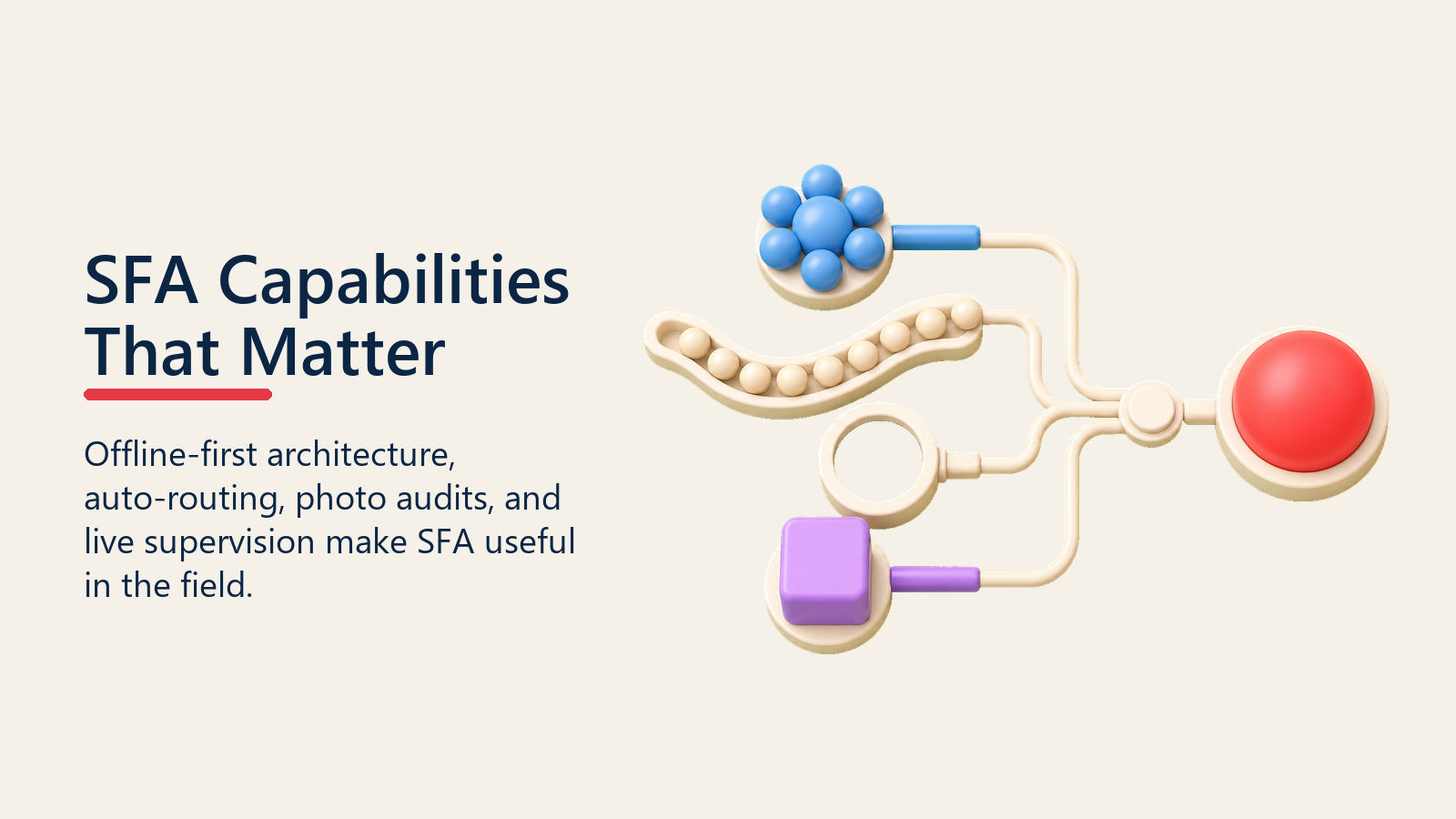
Offline-first mobile architecture. Your DSRs aren't visiting air-conditioned offices. They're in wet markets, industrial zones, and rural towns with 2G connectivity at best. An SFA app that fails without internet doesn't get used. Offline-first means the app functions fully without connectivity, caches all field activity locally, and syncs when connection is available. Anything less is a non-starter for FMCG field operations.
Auto-call routing from journey plan. The SFA should build the DSR's daily route automatically from the beat plan, sequencing outlets geographically to minimize travel time. DSRs who have to plan their own routes every morning either spend 20 minutes doing it or skip low-priority outlets. Neither is what you want.
Photo-based execution audit. The DSR captures shelf photos at the outlet. The SFA either sends these to a supervisor review queue or, in more advanced deployments, runs AI image recognition (software that reads shelf photos to identify products and check shelf layout) to check planogram compliance, shelf share, and POS material presence. Photo evidence makes must-sell compliance auditable. Without it, compliance data is self-reported and unreliable.
Real-time supervisor dashboard. The area manager needs to see where their DSRs are, which outlets have been completed, and which beats are running behind, all in real time during the business day. Not a report at the end of the day. Not a weekly export. A live dashboard that allows a supervisor to redirect a DSR who's stuck or to cover a skipped outlet before the market closes.
For a deeper look at how Beat and Journey Planning structures the underlying route logic that SFA executes, that article covers the planning methodology in detail.
DMS Capabilities That Actually Matter
On the distributor side, the capabilities that deliver commercial value are:
Near-real-time secondary sales feed. The principal needs to see what the distributor is selling to the market, not just what the principal is shipping to the distributor. Primary sales data (sell-in) masks distributor inventory buildup. Secondary sales data (sell-out) shows actual market demand. A DMS that pushes secondary sales to the principal's analytics layer within 24 hours is genuinely useful. A DMS where secondary sales data is available weekly or on request is just an inventory system.
Stock aging alerts. Distributors sitting on stock that's approaching expiry is a distributor relationship problem, a returns liability, and a secondary distribution problem all at once. DMS stock aging alerts flag at-risk inventory automatically so the area manager or trade marketing team can intervene with pricing, redistribution, or accelerated push activity before expiry, not after.
Distributor claim automation. Trade promotion claim processing is manual, disputed, and slow in most FMCG operations. DMS integration with scheme parameters allows claim validation to happen automatically against system records rather than manually against invoices. This reduces claim processing time from weeks to days and reduces disputes from claim errors.
For the connection between DMS data and downstream analytics, Secondary Sales and Stock Visibility covers how secondary sales feeds integrate into territory performance analysis.
Integration Architecture
The commercial value of SFA and DMS individually is meaningful. The commercial value of SFA, DMS, ERP, and analytics connected to each other is a different order of magnitude. But it requires getting the integration architecture right from the start.
The integration points that matter are:
SFA to DMS (order handoff). When a DSR captures an order in the SFA app, the order needs to land in the distributor's DMS for fulfillment in near real time. Manual order transcription from SFA to DMS introduces delay, errors, and reconciliation work. The integration should be automatic and auditable.
DMS to ERP (primary sales reconciliation). The distributor's DMS needs to push secondary sales and inventory data to the principal's ERP for demand planning, scheme budget reconciliation, and distributor receivables management. This integration is often where data quality problems appear, because DMS product codes don't always match ERP product codes and distributor identifiers differ across systems.
DMS/SFA to analytics (commercial intelligence). Both SFA call data and DMS secondary sales data need to flow into the analytics layer where commercial dashboards are built. The analytics layer is where call compliance meets volume performance: you can see whether territories with high call adherence are also delivering better secondary sales growth. That correlation is the commercial intelligence that justifies the field force investment.
Without a common outlet master across SFA and DMS (the same outlet record, same outlet code, same geographic assignment), data joins fail and reports can't be trusted. Outlet master hygiene isn't glamorous. But it's the foundation that everything else depends on.
This integration model parallels what Pharma CRM and Sales Force Automation describes for pharmaceutical field force operations: the field execution system only creates commercial intelligence when it connects to the downstream data layers that measure outcomes. Getting that architecture right is the prerequisite. But it still fails if the field team doesn't use it.
Why Do Most FMCG SFA and DMS Deployments Fail?
Most FMCG SFA and DMS deployments fail in predictable ways. Knowing the failure modes makes them avoidable. McKinsey's consumer goods commercial excellence research found that fewer than 25 percent of CPG companies report using real-time AI-driven field activity data, which means most field forces are flying on lagged information even when the technology to do better is theoretically in place.
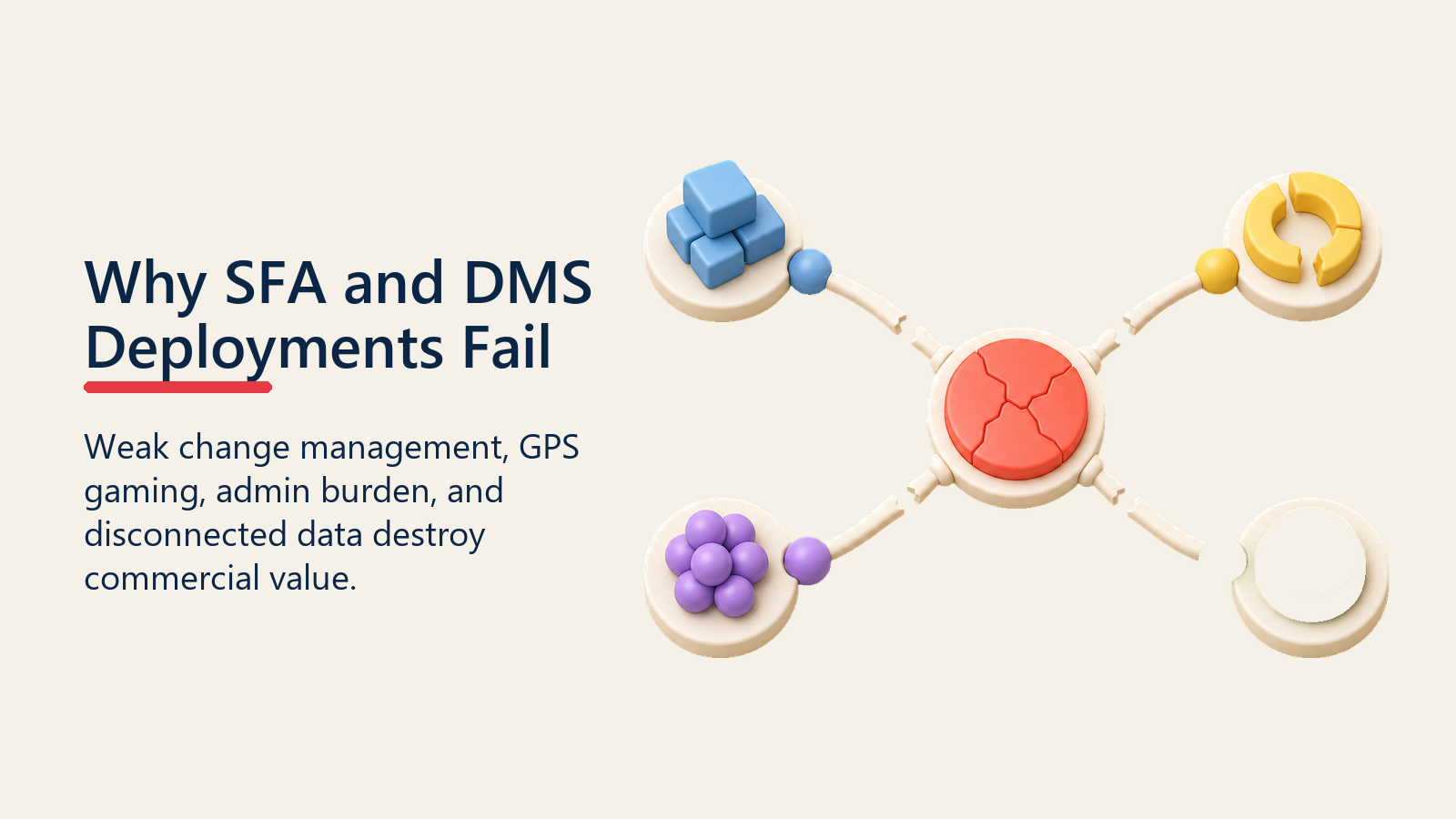
Poor change management. Technology deployment isn't behavior change. DSRs who've been writing call reports on paper for five years don't automatically adopt a mobile app because it was installed on their phone. Change management means explaining why the system matters to the DSR (better route efficiency, less paperwork at end of day), training on the device in the same conditions they'll use it (outdoor, low connectivity), and resolving adoption blockers in the first 30 days before workarounds become habits.
GPS gaming. DSRs who feel GPS monitoring is punitive find workarounds: leaving the phone at the outlet while they run errands, sharing phones to cover missed visits, or marking outlets as visited from the road. GPS gaming is a symptom of a trust problem between field managers and DSRs, and it produces data that looks clean but is commercially useless. The fix isn't tighter GPS enforcement. It's a culture where field data is used for coaching rather than surveillance.
Admin burden driving non-adoption. If the call report takes 8 minutes to complete per outlet and a DSR visits 20 outlets a day, that's 160 minutes of data entry. DSRs will take shortcuts: incomplete forms, copy-paste from previous visits, or simply not opening the app. Call report design needs to be obsessive about minimising required fields to only those that drive commercial decisions.
Disconnected DMS and SFA data. This is the most common commercial failure. SFA shows 92% call compliance. DMS shows secondary sales flat. And no one can explain the relationship between the two because the systems don't share outlet codes, territory assignments, or time-period definitions. Without integration, you have two datasets describing different parts of the same operation with no way to connect them.
Adoption Governance
Quotable Nuggets
"90% of consumer products CEOs rank sales execution among their top five business priorities, but fewer than half feel their salesforces are operating at full potential.", Bain & Company, survey of 120 consumer products executives (source)
"Minimal training requirements and intuitive interface design are consistently cited as the top drivers of frontline SFA adoption in FMCG field operations.", Proxima SFA (source; note: Proxima is an SFA vendor)
The Five-Layer Adoption Stack: A useful framework for assessing where SFA deployments lose commercial value. Each layer must be working before the next delivers returns:
- Device and connectivity, the app functions offline; DSRs have working hardware
- Usage compliance, DSRs open and complete the app on every call
- Data quality, outlet codes, product codes, and GPS anchors are consistent
- Integration, SFA order data flows to DMS; DMS secondary sales flow to analytics
- Commercial intelligence, leadership acts on the signals the system produces
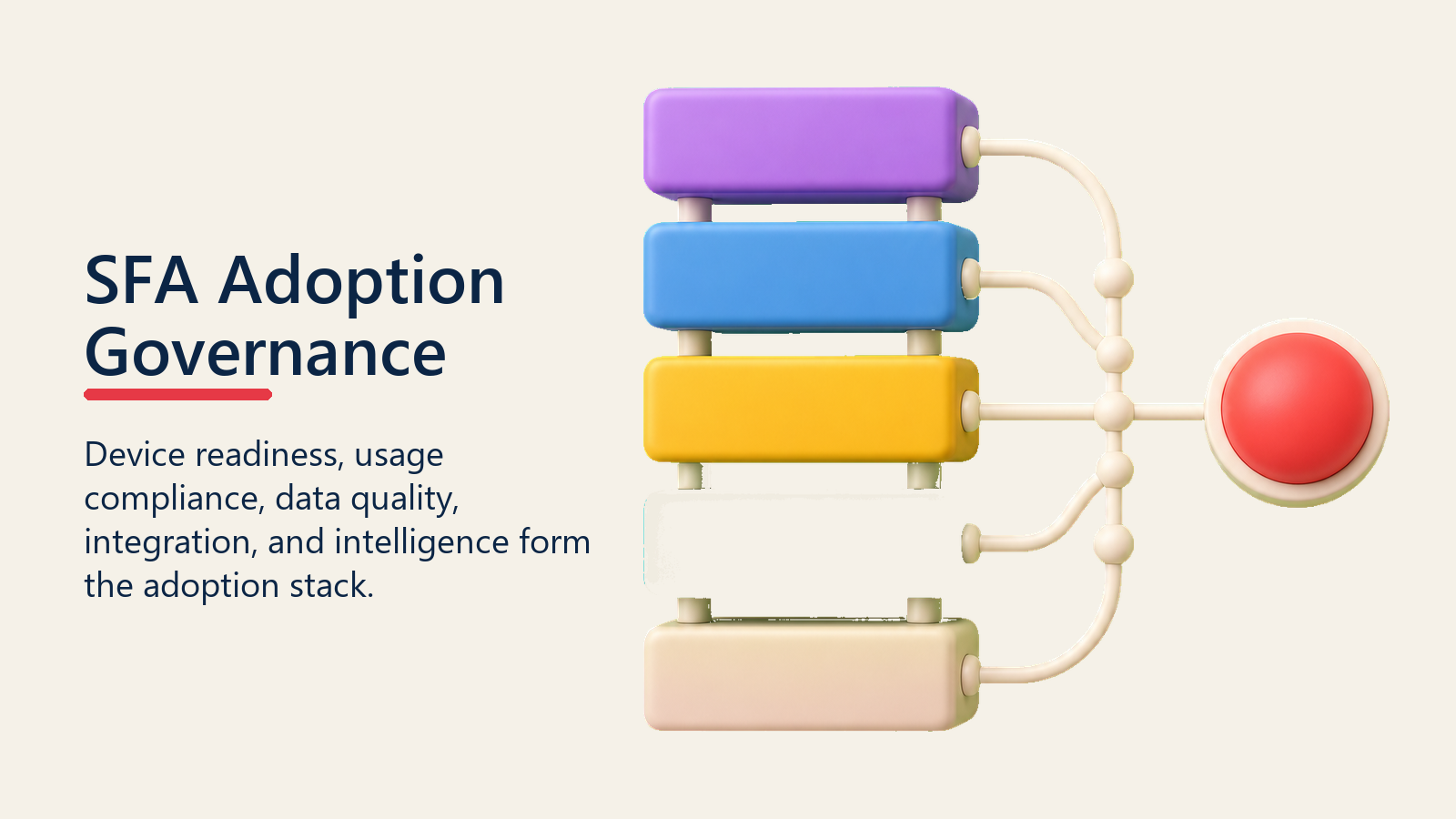
Most failed deployments stall at layer 2 or 3, while investment decisions are made as if layer 5 is already operating.
Measuring SFA adoption without a governance model turns adoption metrics into a compliance exercise that the field works around. The five metrics below show where that governance should focus.
The adoption governance checklist for FMCG field operations:
- Call compliance rate (calls completed / calls planned): track daily by DSR, weekly by area, monthly by region. Flag DSRs below 80% for coaching within the week, not at month end.
- Call report completion rate (complete reports / calls logged): a call that GPS-verified happened but has no call report is commercially useless. Track separately from attendance compliance.
- Order capture rate (orders taken in SFA / total orders placed by distributor): the gap between orders captured in SFA and orders in the DMS reveals shadow ordering outside the system.
- Journey plan adherence (outlets visited in planned sequence / total outlets visited): high call compliance but low journey plan adherence means DSRs are cherry-picking easy outlets and skipping planned calls.
- Photo submission rate (photos submitted / calls completed): for operations using photo-based compliance, photo submission rate tracks whether the evidence layer is active.
For the connection between adoption governance and field coaching programs, Sales Capability and Coaching covers how supervisors translate these metrics into structured coaching conversations with DSRs.
The revenue operations CRM Adoption Operating Model describes governance and accountability structures that make CRM adoption sustainable in B2B contexts. The same principles apply directly to SFA in FMCG: sponsorship from senior leadership, adoption metrics reviewed at the same cadence as commercial metrics, and field-level champions who troubleshoot rather than just enforce.
Data Quality Standards
Even when adoption is high, commercial decisions built on bad data are wrong decisions. Data quality in SFA and DMS requires attention to three master data domains.
Outlet master hygiene. Every outlet in the market needs a single unique identifier that's consistent across SFA, DMS, and the analytics layer. Duplicate outlet records (the same kirana store appearing twice under different codes) inflate coverage numbers and make geographic analysis unreliable. Outlet master governance requires a defined process for adding new outlets, merging duplicates, and deactivating closed outlets, with accountability for data quality sitting with a named operations owner.
Product master synchronization. SKU codes, product descriptions, and pack hierarchies need to be consistent between SFA (which captures orders and compliance), DMS (which tracks inventory), and ERP (which records sales). A product that's coded differently in each system creates reconciliation work every time someone tries to connect call data with secondary sales data.
Distributor code alignment. When distributor codes in the DMS don't match distributor codes in the ERP, financial reconciliation requires manual intervention. Distributor code alignment sounds like an IT problem but it surfaces as commercial visibility gaps: secondary sales from a specific distributor can't be attributed to the correct territory because the codes don't match.
The CRM Data Hygiene framework from revenue operations maps directly onto FMCG outlet and distributor master data: the same principles of deduplication, standardization, and governance apply, with outlet master and distributor master standing in for the B2B CRM contact and account records. Clean master data is what makes the commercial intelligence layer possible. And that's where the commercial case for SFA and DMS ultimately rests.
SFA and DMS as the Nervous System of Field Execution
The frame that changes how commercial leaders think about SFA and DMS is this: these aren't attendance systems. Bain's sales execution research for consumer goods found that only half of consumer products executives see a clear link between corporate strategy and what actually happens in the field, a gap that integrated SFA and DMS data is specifically designed to close. They're the nervous system of field execution.
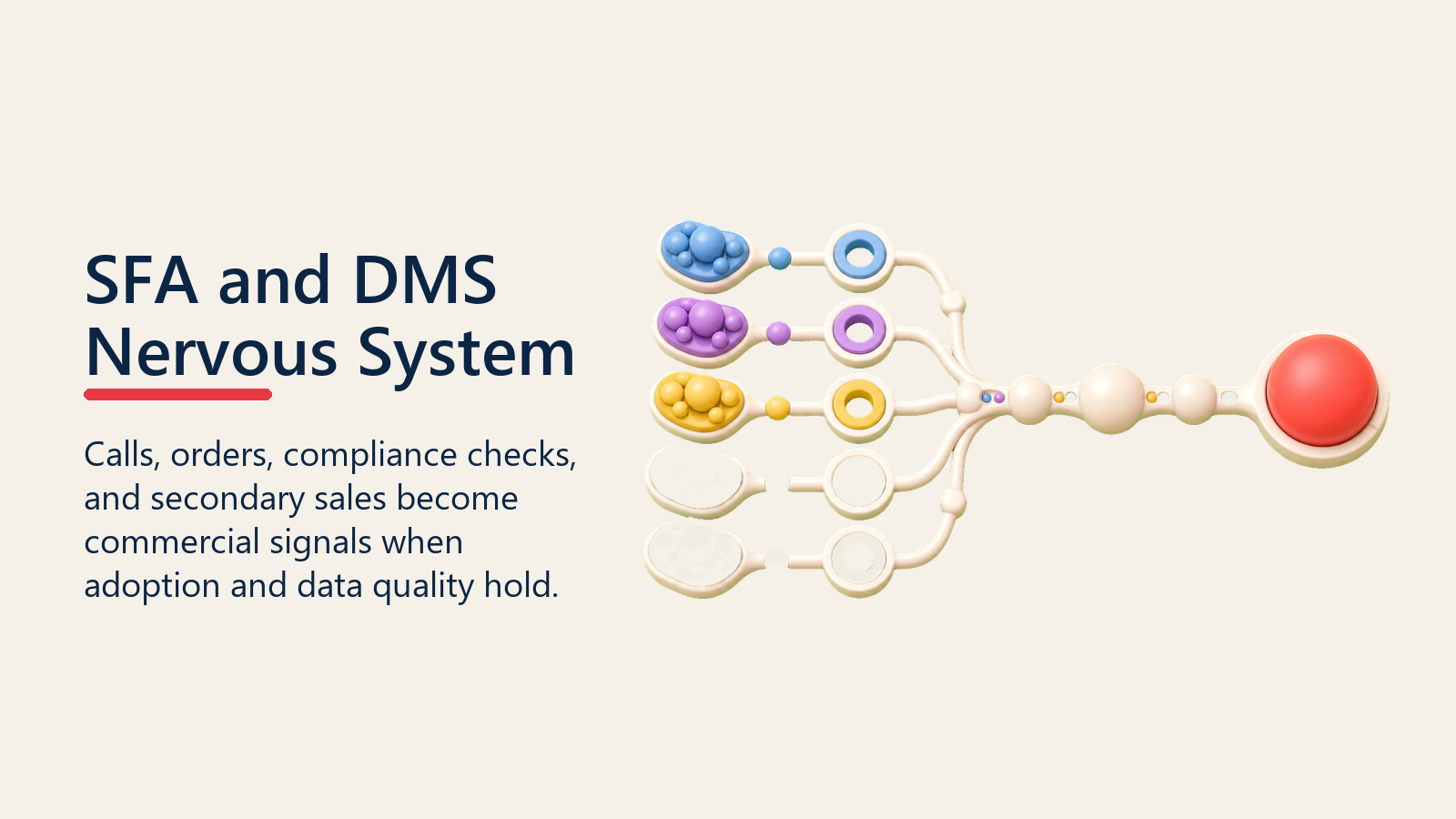
Every call a DSR makes, every order captured, every compliance check completed, every secondary sales transaction recorded by a distributor feeds into a commercial intelligence picture that tells leadership where distribution is building, where it isn't, and what the field force is actually doing versus what the plan requires.
That intelligence is only as good as the adoption rate and data quality that feed it. A 95% adoption rate with clean outlet master data produces commercial signals leadership can act on. A 65% adoption rate with inconsistent outlet codes produces noise with a dashboard on top.
The investment in SFA and DMS isn't in the license. It's in the deployment discipline: change management, governance cadence, data quality standards, and integration architecture. Get those right, and the technology is a commercial engine. Get them wrong, and it's an expensive attendance tracker with a very good sales pitch.
For how the data produced by SFA and DMS translates into commercial dashboards and decision-making cadence, FMCG Sales Dashboards and Retail Execution Analytics cover the analytics layer that sits on top of this technology foundation.
Frequently Asked Questions about SFA and Distributor Management Systems
What is the difference between SFA and DMS in FMCG?
SFA (Sales Force Automation) covers everything the field sales representative does: call planning, route execution, call reporting, order capture, and in-store compliance checking. DMS (Distributor Management System) covers everything the distributor does: inventory management, secondary sales recording, van stock reconciliation, credit management, and scheme redemption. They overlap at the order capture point, where a DSR's order taken in SFA needs to flow into the distributor's DMS for fulfillment.
Why do most FMCG SFA deployments fail to deliver commercial value?
The most common causes are: systems that require internet connectivity in low-connectivity markets, call report designs that are too complex for field conditions, GPS monitoring used punitively rather than operationally, and disconnected SFA and DMS data that can't be joined at the outlet level. The technology failure is usually a deployment failure: insufficient change management, no governance cadence, and master data misalignment that prevents the two systems from producing a connected commercial picture.
What data needs to be consistent across SFA, DMS, and ERP?
Three master data domains: outlet master (consistent outlet identifier and geographic assignment across all systems), product master (consistent SKU codes, descriptions, and pack hierarchies), and distributor codes (consistent distributor identifiers between DMS and ERP). Without alignment in these three domains, any attempt to connect call data with secondary sales data with financial reconciliation requires manual intervention and produces reconciliation gaps.
How should GPS data be used in SFA governance?
GPS data should be used to confirm that DSRs are executing their journey plans (visiting planned outlets in planned geographies) and to identify route efficiency improvement opportunities. It should not be used as a surveillance tool that assumes DSRs are not where they claim without investigation. GPS gaming (where DSRs find workarounds to appear compliant while not visiting outlets) is a trust problem that enforcement makes worse. The governance model that works treats GPS as an operational tool for coaching, not a disciplinary tool for catching.
What metrics should DSR adoption governance track weekly?
Five metrics form the minimum viable set: call compliance rate (calls completed vs. planned), call report completion rate (complete reports vs. GPS-verified calls), order capture rate (orders taken in SFA vs. total orders in DMS), journey plan adherence (planned sequence followed vs. cherry-picked route), and photo submission rate for teams using photo-based audit. The critical point is to track these at DSR level and flag exceptions within the same week, not at month-end when the opportunity for course correction has passed.
How long does it take for an SFA deployment to deliver measurable commercial value?
Based on practitioner experience across FMCG markets, measurable call compliance improvements typically appear within 60 to 90 days of a structured adoption program. Commercial value (meaning changes in secondary sales or distribution traceable to SFA data) generally requires 4 to 6 months. That lag reflects the 4 to 8 week delay between field activity changes and volume impact, plus the time needed for data quality to stabilize and analytics to become reliable enough to act on. (These timelines are estimates drawn from field deployment experience; results vary by market, team size, and adoption governance quality.)
Learn More

Senior Implementation Consultant