Cold Chain and Perishable Distribution: Managing Temperature-Sensitive FMCG at Scale
Turn this article into takeaways for your work.


Each assistant summarizes the article only for you and suggests best practices for your work.
A carton of ambient dry goods that sits in a warm warehouse for an extra day is a minor inconvenience. A pallet of dairy or frozen product that spends the same extra day outside its temperature range is a write-off. In the worst cases, it's a food safety incident too. Cold chain and perishable distribution carries a different risk profile than the rest of FMCG route-to-market, and it needs a management approach built around that difference, not a standard distribution playbook with "keep it cold" added as a footnote.
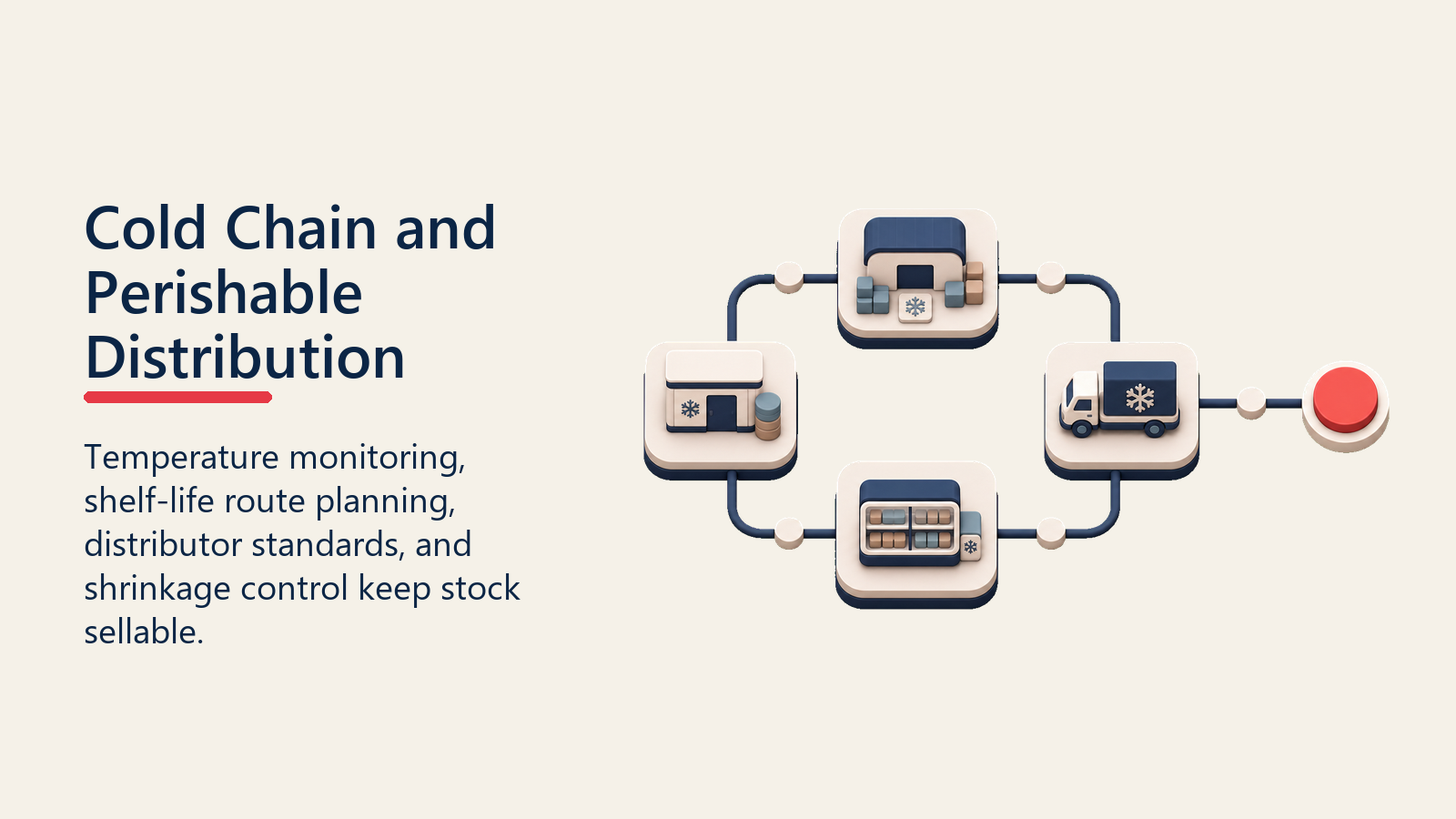
Every link in the chain, warehouse, distributor storage, delivery vehicle, and the outlet's own display chiller, has to hold temperature. A failure at any single point compromises the product regardless of how well the other links performed. This article covers the operational disciplines that keep perishable and temperature-sensitive FMCG products safe, sellable, and profitable from the point of manufacture to the shopper's basket.
FAO research on food loss and refrigeration puts the scale of this problem at roughly 526 million tonnes of food lost globally each year, about 12 percent of total production, due to insufficient cold chain infrastructure. That's the scope of what's at stake before a single truck even leaves the warehouse.
Why Cold Chain Failures Are Different From Standard Distribution Problems
A stockout in ambient goods distribution is a lost sale opportunity. A cold chain failure is a lost sale plus a write-off plus, in the worst cases, a food safety liability that extends well beyond the immediate commercial impact.
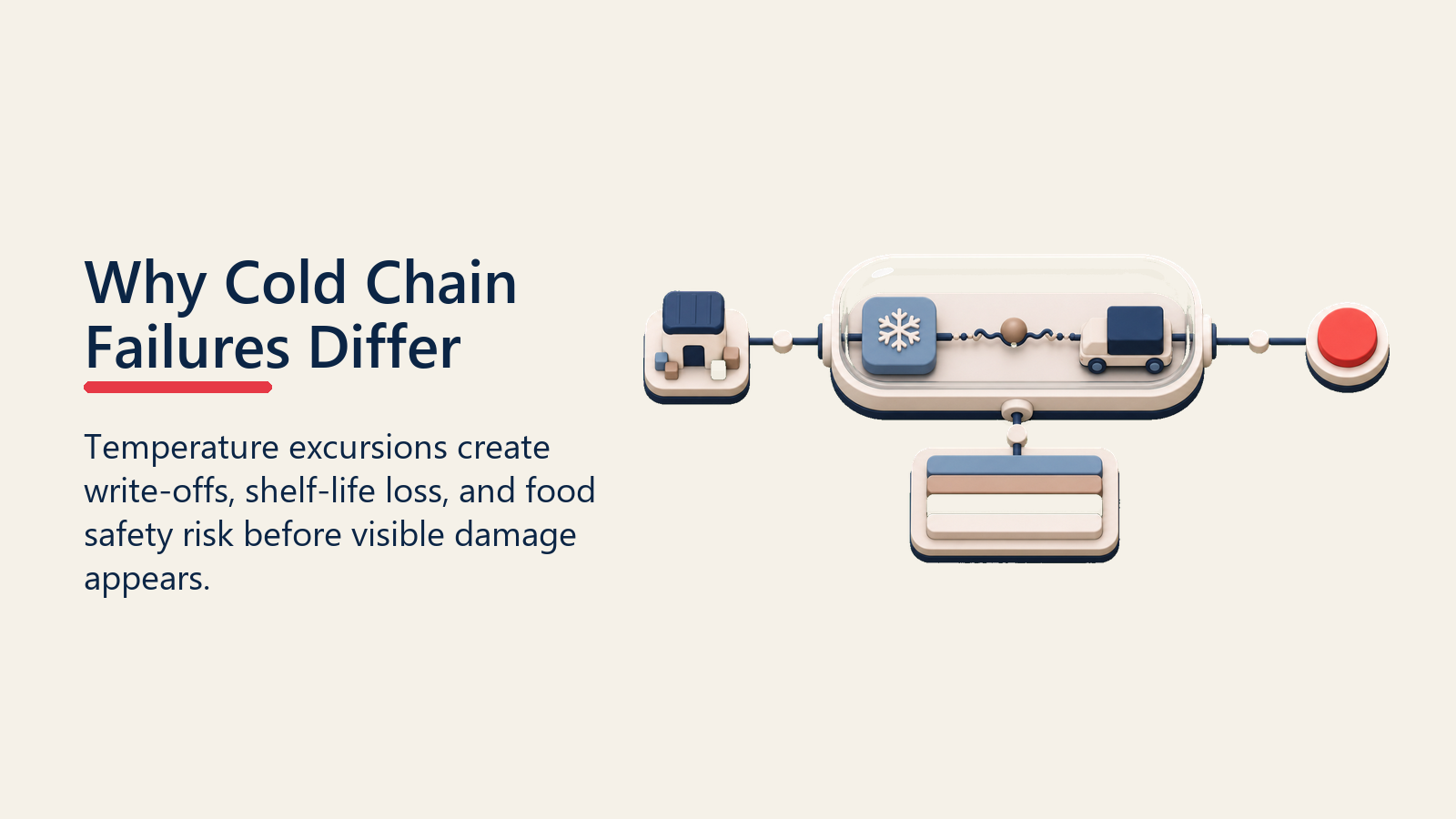
The risk compounds because cold chain breaks are often invisible until the damage is done. A chiller that drifts a few degrees above the required range for several hours doesn't visibly change the product's appearance immediately. Stock might look and even taste acceptable at the point of sale while its shelf life has already been meaningfully shortened by the temperature excursion, creating a problem that surfaces as consumer complaints or spoilage days later, disconnected from the actual failure point.
This is why cold chain management requires continuous monitoring and verification at every handoff, rather than periodic spot checks. You cannot manage what you can only observe intermittently when the failure mode itself is often invisible in the moment. The Global Cold Chain Alliance's overview of cold chain management confirms the underlying risk: failing to hold product at the correct temperature at any point in the chain can cause textural degradation, discoloring, and microbial growth, damage that a visual check alone will not reliably catch until it has already progressed.
Key Facts: Cold Chain and Perishable Distribution
- Industry estimates for FMCG cold chain product loss due to temperature excursions and handling failures commonly range from 5-15% of volume in markets with inconsistent cold chain infrastructure, though the figure varies significantly by product category and market maturity.
- Continuous temperature logging (versus periodic manual spot checks) is widely associated in cold chain literature with catching temperature excursions early enough to take corrective action before product quality is compromised, rather than discovering the failure after the fact.
- Shelf-life-aware route sequencing, prioritizing deliveries to outlets based on remaining shelf life rather than a fixed route order, is a commonly cited lever for reducing near-expiry write-offs in perishable FMCG distribution.
The Four Links That Must Each Hold Temperature
Cold chain integrity depends on four handoff points, and each needs its own verification standard because a strong link elsewhere doesn't compensate for a weak one. Call this The Weakest Handoff Rule: cold chain reliability is set by the least-monitored link, not the average or the best-performing one, so a single unverified handoff can undo every other well-run stage.
Manufacturing and primary warehouse storage. Product needs to enter the cold chain at the correct temperature from the point of production, with warehouse storage capacity and redundancy (backup power, backup refrigeration units) sufficient to maintain temperature during equipment failures or power outages. Verify this isn't just adequate on paper but tested under actual outage conditions.
Distributor cold storage. This is often the weakest link in emerging-market cold chains, because distributor cold storage investment lags behind their general warehousing investment. The scale of the gap is well documented at the national infrastructure level: cold storage capacity in North America, Western Europe, and Oceania averages around 200 cubic meters per 1,000 people, versus roughly 20 cubic meters per 1,000 people in the least developed countries, a 10x gap reported in World Bank-linked research on sustainable food cold chains. That same infrastructure gap shows up one level down, at the individual distributor, which is why distributor cold storage capacity, temperature monitoring equipment, and backup power should be a hard qualification criterion for any distributor handling temperature-sensitive SKUs, evaluated with the same rigor used in the broader distributor selection scorecard (linked under Learn More).
Delivery vehicle refrigeration. Whether it's a dedicated reefer truck or an insulated van with ice packs for shorter routes, the delivery vehicle needs temperature control matched to route duration and ambient conditions. A van that holds temperature adequately on a 45-minute route may fail on a 2-hour route during summer, so vehicle specification needs to match actual route conditions, not a generic fleet standard applied everywhere.
Outlet display and storage. The final link is often the most overlooked, because it's the point where control shifts from the manufacturer or distributor to the outlet. A general trade shop with an underpowered or poorly maintained display chiller can undo everything upstream. See Cooler and Chiller Space Management for how to manage this outlet-level equipment as part of the broader distribution relationship.
Cold Chain Verification Standards by Link
| Link | Monitoring Method | Verification Frequency | Failure Response |
|---|---|---|---|
| Manufacturing/primary warehouse | Continuous digital temperature logging | Real-time, reviewed daily | Immediate quarantine of affected batch |
| Distributor cold storage | Digital logger with alert threshold | Real-time or daily check-in | Supply hold until corrected, re-inspection required |
| Delivery vehicle | Vehicle-mounted logger or manual check at load/unload | Every trip | Route redesign or vehicle reassignment if repeated |
| Outlet display chiller | Manual spot check plus rep visual inspection | Every visit for chilled SKUs | Coaching, chiller service referral, or display removal |
Shelf-Life-Aware Route Planning
Standard beat and journey planning optimizes for call frequency and travel efficiency. Perishable product distribution needs an additional layer on top of that: sequencing deliveries based on remaining shelf life, not route geography alone.
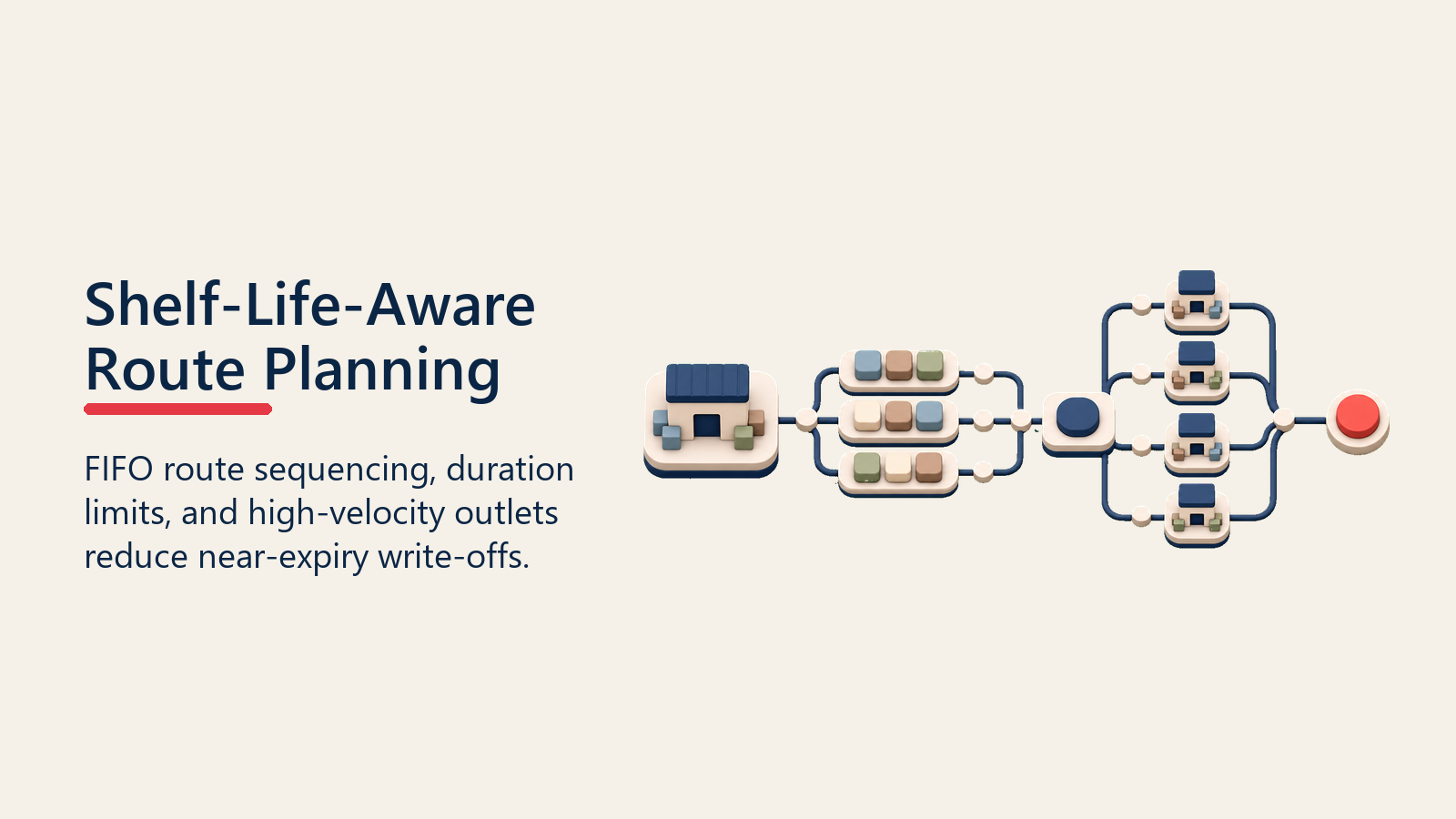
First-expiry-first-out (FIFO) at the distribution level, not just the outlet level. Most FMCG companies apply FIFO discipline at the outlet and warehouse shelf level but don't extend the same discipline to route sequencing. If two batches with different remaining shelf life are both scheduled for delivery this week, the shorter-shelf-life batch should go to the outlet with faster sell-through, not simply the next stop on the standard route order.
Route duration limits tied to shelf life, not just distance. A route that takes 4 hours to complete may be fine for ambient goods but too long for a chilled product with limited out-of-refrigeration tolerance. Set maximum route duration standards specific to each product's cold chain tolerance, and don't let a single route carry both an ambient product optimized for a longer run and a chilled product that needs a shorter one.
Prioritize high-velocity outlets for perishable SKUs. An outlet with fast sell-through of chilled or perishable products reduces the window during which product sits at risk of excursion or approaching expiry. Route sequencing that puts perishable SKU delivery ahead of ambient SKU delivery within the same beat, when both are on the same route, reduces total time the perishable product spends in transit.
See Returns, Damages, and Freshness FIFO for the broader freshness management discipline this route-level FIFO practice needs to connect to.
Monitoring and Documentation
Temperature monitoring only creates value if it's continuous, documented, and actually reviewed, not just collected and archived.
Digital loggers over manual temperature checks. A manual spot check, even done diligently, only captures the temperature at that single moment. A digital logger captures the full temperature curve, showing whether a chiller cycled outside range for 20 minutes overnight even if it was back in range at the time of the morning check. The investment in digital logging pays for itself in the write-offs it prevents by catching problems early rather than after spoilage.
Alert thresholds that trigger action, not just data collection. A logging system that generates a report nobody reviews until month-end is not a monitoring system. Set alert thresholds that notify a responsible person in near-real-time when temperature drifts outside range, so corrective action (backup power, product transfer, or in the worst case, product quarantine) can happen within hours, not after the fact.
Chain-of-custody documentation at each handoff. When product moves from warehouse to distributor to delivery vehicle to outlet, each handoff should have a documented temperature check, even if brief. This creates an audit trail that matters both for quality control and, in the event of a food safety concern, for determining where in the chain a failure occurred.
Cold Chain Monitoring Checklist
- Digital temperature logging installed at primary warehouse, distributor storage, and delivery vehicles
- Alert thresholds configured to notify a named responsible person, not just log silently
- Chain-of-custody temperature check documented at each handoff point
- Monthly review of temperature logs to identify recurring excursion patterns, not just isolated incidents
- Outlet-level chiller spot checks incorporated into standard rep call steps for chilled SKUs
- Corrective action protocol documented and communicated to all handling parties
How Do You Manage Shrinkage and Write-Offs?
Even a well-managed cold chain will have some shrinkage. The goal is keeping it within a predictable, budgeted range rather than letting it become an untracked cost that erodes category profitability without anyone noticing until the quarterly numbers come in.
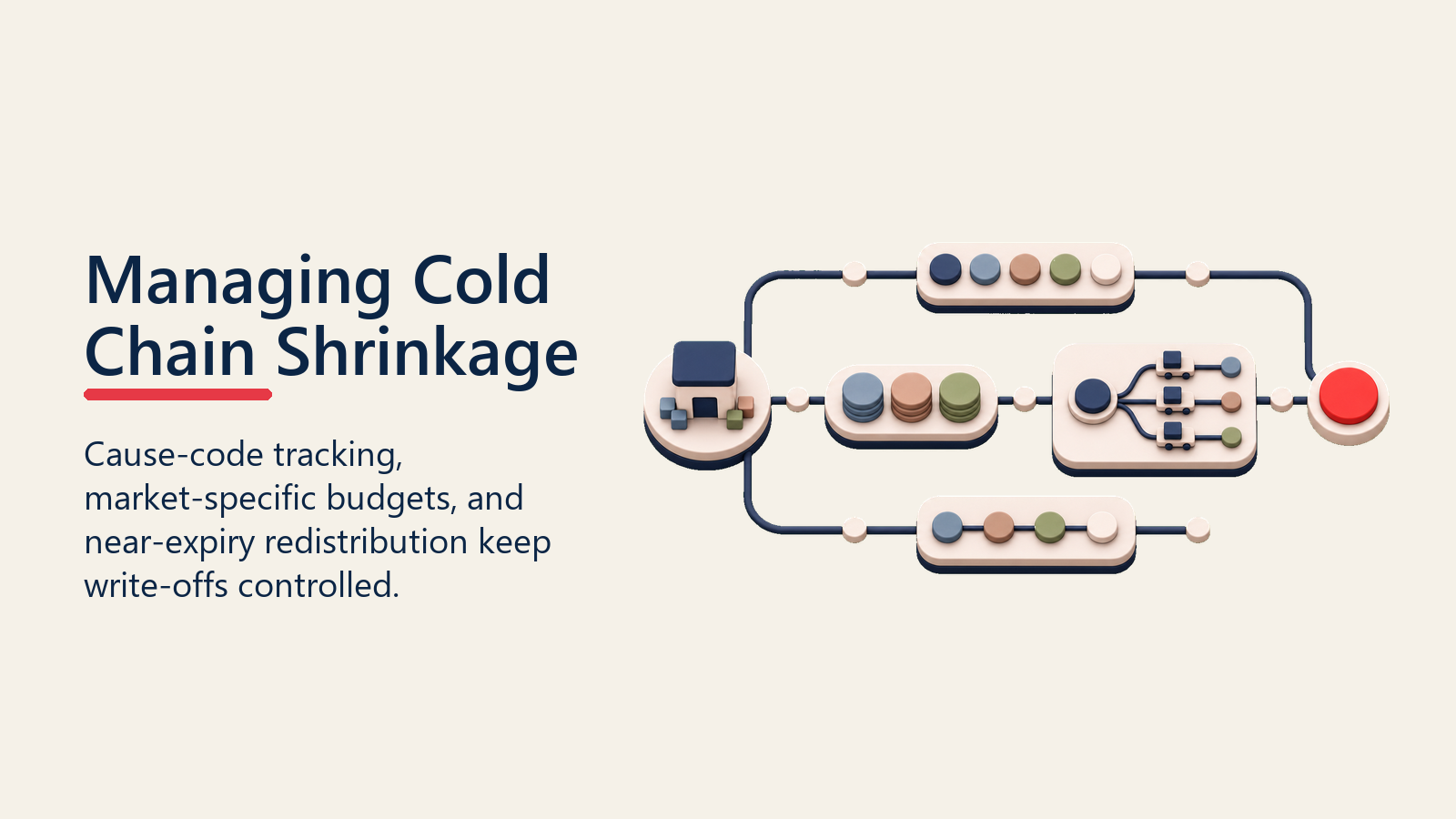
Track shrinkage by cause code, not just as an aggregate write-off number. Separate temperature excursion losses from expiry losses (product that held temperature fine but simply didn't sell through in time), from handling damage, and from theft or diversion. Each cause requires a different fix, and an aggregate shrinkage number obscures which one is actually driving the cost.
Set shrinkage budgets by product category based on realistic shelf-life and cold chain infrastructure conditions in each market, rather than a single company-wide target that doesn't reflect the actual infrastructure quality in every territory. A market with less mature cold chain infrastructure will carry a higher realistic shrinkage rate, and pretending otherwise just produces bad data as field teams under-report to hit an unrealistic target.
Build a near-expiry redistribution process. Product approaching expiry at a slow-moving outlet should be identified and redirected to a faster-moving outlet while there's still sellable shelf life left, rather than being written off at the original location or, worse, discovered only when a shopper complaint or shelf audit flags expired stock still on display. Deciding which outlets qualify as "faster-moving" destinations works best when it's backed by the same kind of ranked, evidence-based prioritization used in lead scoring: outlets with a proven sell-through track record earn the reroute first, not whichever one a rep happens to visit next.
Quotable Nuggets
Cold storage capacity in North America, Western Europe, and Oceania averages around 200 cubic meters per 1,000 people, versus roughly 20 cubic meters per 1,000 people in the least developed countries, a 10x infrastructure gap documented in FAO research on sustainable food cold chains.
A chiller that drifts outside its temperature range for a few hours does not visibly change a product's appearance immediately, which is why cold chain failures are commonly discovered as consumer complaints days after the actual failure point, not at the moment they occur.
How Should Cold Chain Coordinate With Distributor Management?
Cold chain requirements need to be built into distributor contracting and review from the start, not treated as a side compliance issue.
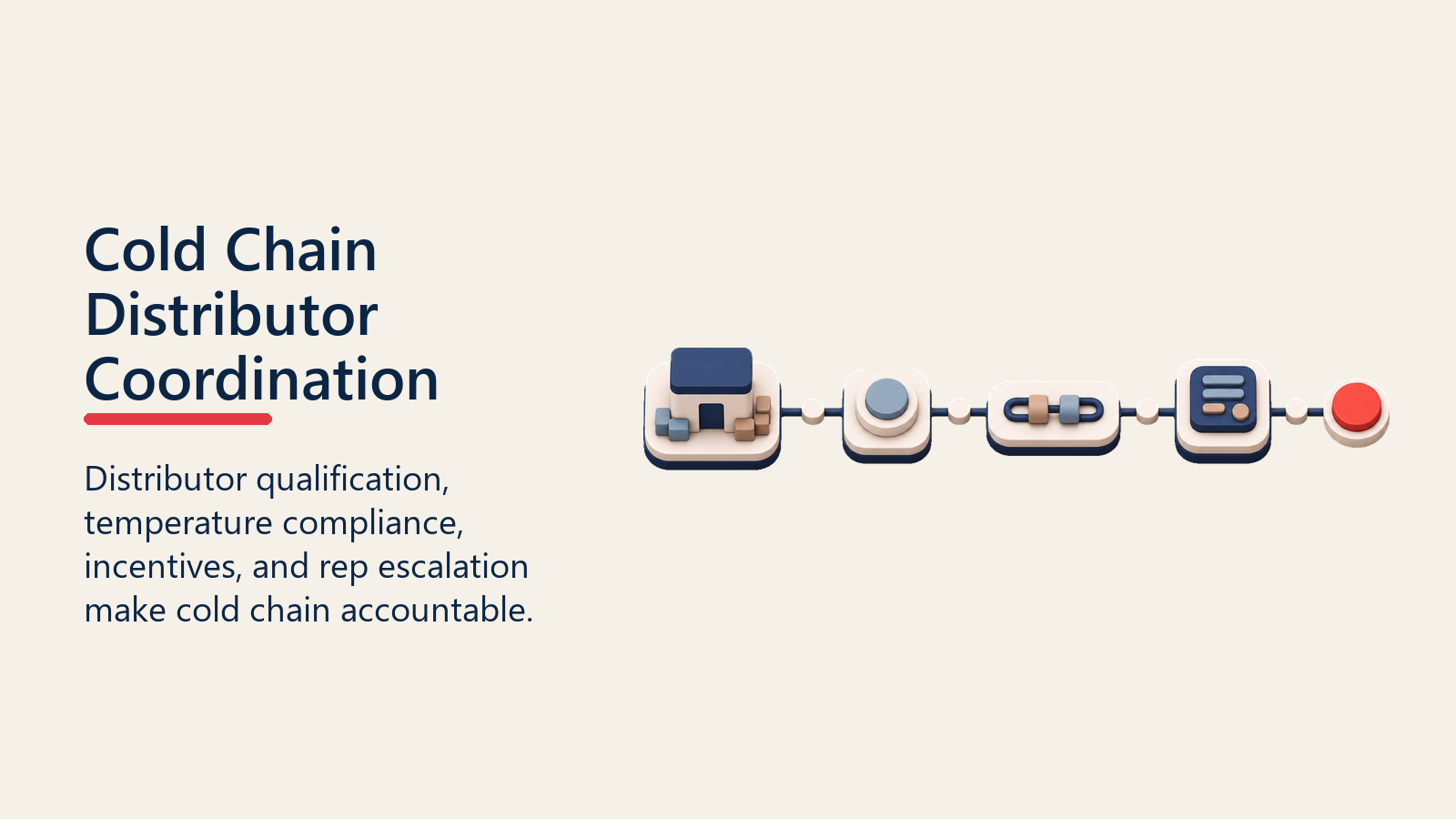
Make cold storage capacity, equipment condition, and backup power a hard qualification gate for any distributor handling temperature-sensitive SKUs, verified through physical inspection rather than a self-reported checklist. A distributor who meets every other selection criterion but lacks adequate cold storage infrastructure should not be appointed for chilled or frozen categories, even if they're a strong partner for the ambient portfolio.
Include temperature compliance as a specific line item in the regular distributor performance review, not folded generically into overall service quality. A distributor with strong sell-through numbers but recurring temperature excursion flags is carrying a hidden risk that aggregate sales metrics won't surface. Tie a portion of trade terms or incentive eligibility to temperature compliance the same way distributor ROI management ties incentive eligibility to secondary-sales reporting compliance. And when a distributor pushes back on a compliance-linked term during contract renewal, treat it like any other high-stakes account conversation: diagnose what they're actually objecting to before you concede anything, the same discipline covered in negotiation fundamentals (linked under Learn More).
Train the rep force to spot cold chain problems at the outlet level as part of standard call steps, since reps are in outlets far more often than any centralized quality team could be. A rep noticing a chiller running warm, overcrowded, or with a broken door seal during a routine visit is a low-cost early warning system, provided the escalation path back to a resolution (technician visit, temporary stock reduction, chiller replacement) actually works. That same real-time visibility discipline is what secondary sales and stock tracking is built on: data is only useful if it reaches someone who can act on it before the problem compounds.
Field Team Training for Cold Chain Categories
Reps and merchandisers handling temperature-sensitive SKUs need specific training beyond the standard perfect-store call steps used across the rest of the portfolio.
They need to understand basic cold chain science well enough to recognize a problem: why a chiller running above the target range compromises shelf life even if the product looks fine, and why "it was only out of the chiller for twenty minutes" during a merchandising reset isn't a trivial detail for certain product categories. They need clear protocols for what to do when they find a cold chain problem at an outlet, whether that's escalating for a chiller repair, temporarily reducing stock levels, or in rare cases pulling compromised stock from sale. And they need to be evaluated on cold chain compliance as part of their regular performance review, not just on sales volume, so there's no implicit incentive to overlook a chiller problem in order to keep pushing volume into a location that can't safely hold it.
Conclusion
Cold chain and perishable distribution is where a single weak link, a distributor's underpowered cold room, a van without adequate refrigeration for its route length, an outlet chiller nobody's serviced in a year, can undo the value created by every other well-executed step in the distribution chain. The companies that manage this well don't treat cold chain as an add-on requirement bolted onto standard distribution practice. They build temperature verification into every handoff, sequence routes around shelf life rather than just geography, and hold distributors and reps accountable for cold chain compliance with the same rigor applied to sales targets.
The cost of getting this right is real: better cold storage infrastructure, continuous monitoring systems, training time. The cost of getting it wrong is higher: write-offs, food safety risk, and the brand damage that follows a shopper finding spoiled product on a shelf.
Frequently Asked Questions about Cold Chain and Perishable Distribution
What's the biggest cause of cold chain failure in FMCG distribution?
Distributor cold storage is commonly the weakest link, because distributor investment in cold storage infrastructure and backup power often lags behind their general ambient warehousing investment. This should be treated as a hard qualification criterion when selecting or reviewing distributors for temperature-sensitive categories, verified through physical inspection rather than a self-reported claim.
How is route planning different for perishable products?
Perishable route planning needs to sequence deliveries based on remaining shelf life, not just travel efficiency and standard call frequency. This means prioritizing high-velocity outlets for shorter-shelf-life batches, capping route duration based on the product's out-of-refrigeration tolerance rather than distance alone, and applying first-expiry-first-out logic at the route level, not just at the warehouse or outlet shelf.
Should temperature monitoring be manual or digital?
Digital logging is strongly preferred over periodic manual checks because it captures the full temperature curve, including excursions that happen between manual check intervals. A manual check only confirms the temperature at that single moment, while a digital logger can reveal that a chiller cycled outside range overnight even if it reads correctly during a morning inspection.
How much cold chain shrinkage is normal in FMCG distribution?
There's no universal benchmark, since realistic shrinkage rates vary significantly by market infrastructure maturity and product category, but tracking shrinkage by cause code (temperature excursion, expiry, handling damage, diversion) is more useful than chasing a single aggregate target. Set category and market-specific shrinkage budgets based on actual infrastructure conditions rather than applying one company-wide number that doesn't reflect real conditions on the ground.
Who should be responsible for catching cold chain problems at the outlet level?
Field reps and merchandisers are the most cost-effective early warning system, since they're physically in outlets on a regular call cycle that a centralized quality team can't match. This requires specific training so reps understand what to look for (chiller temperature, door seal condition, overcrowding) and a clear, working escalation path so a spotted problem actually results in corrective action rather than being noted and forgotten.
What is the Weakest Handoff Rule in cold chain management?
The Weakest Handoff Rule states that overall cold chain reliability is set by the least-monitored link in the chain, not the average performance across all links. A well-run warehouse and delivery fleet cannot compensate for an outlet chiller nobody has serviced in a year, which is why each handoff, warehouse, distributor, vehicle, and outlet, needs its own verification standard rather than a single blanket compliance check.
Learn More

Senior Implementation Consultant
On this page
- Why Cold Chain Failures Are Different From Standard Distribution Problems
- The Four Links That Must Each Hold Temperature
- Shelf-Life-Aware Route Planning
- Monitoring and Documentation
- How Do You Manage Shrinkage and Write-Offs?
- How Should Cold Chain Coordinate With Distributor Management?
- Field Team Training for Cold Chain Categories
- Conclusion
- Learn More