Retailer Loyalty Programs in FMCG: Designing Incentive Structures That Hold Shelf Space and Drive Sell-Out
Turn this article into takeaways for your work.


Each assistant summarizes the article only for you and suggests best practices for your work.
There's a difference between a retailer who stocks your brand and one who sells it. The first pulls your product into their shop because the distributor pushed it in, because there was a promotional deal, or because the rep had a good quarter. The second restocks before running out, positions your product at eye level, recommends it to customers who ask for a similar product, and responds to your field team's planogram requests without argument.
Most FMCG loyalty programs accidentally build the first kind and wonder why sell-out numbers don't track with distribution numbers. They reward purchase volume rather than sell-out behavior, give rebates to whoever orders the most cases, and spend the trade budget on the largest accounts while the mid-tier general trade quietly drifts toward the competitor who offers a simpler cash incentive.
A well-designed retailer loyalty program isn't a discount scheme repackaged with a points card. It's a structured sell-out engine that changes how retailers behave toward your brand's products on a daily basis, not just at order time.
Quotable Nuggets
- "Top-performing loyalty programs boost revenue from redeeming customers by 15 to 25 percent annually by increasing purchase frequency or basket size, or both.", McKinsey, Next in Loyalty (2021)
- "59% of trade promotions globally don't break even. Programs that reward sell-out behavior rather than purchase volume alone are one structural fix for that.", McKinsey / Nielsen
- "A loyalty program that can't be explained in two sentences is a loyalty program the rep can't sell on the call.", FMCG trade marketing practitioner principle
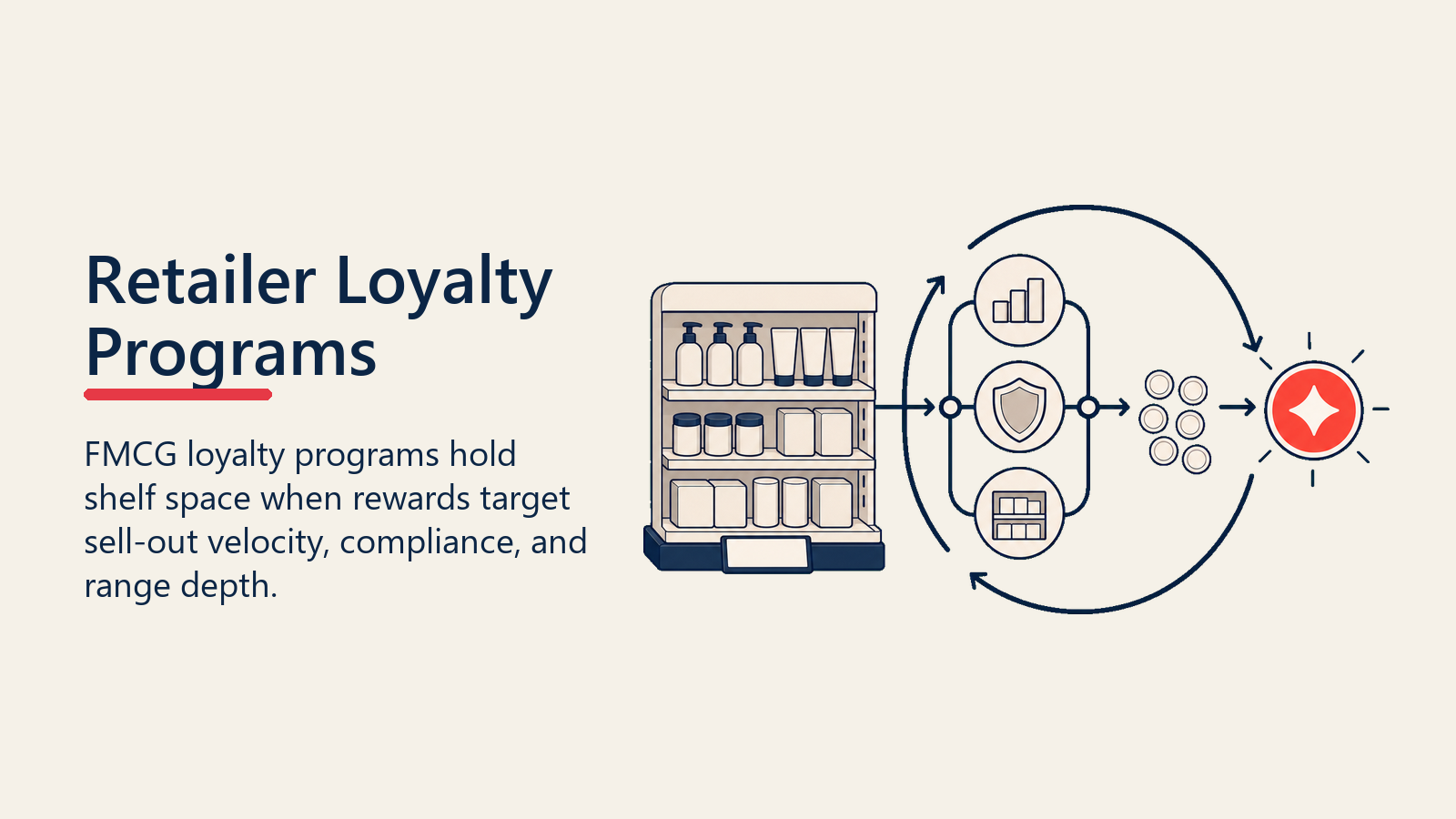
The Sell-Out Currency Framework: Design every loyalty program trigger around one of three sell-out currencies: Velocity Currency (reward sell-through rate, not order volume), Compliance Currency (reward planogram and range adherence), or Depth Currency (reward SKU range breadth in-store). Programs that mix all three without prioritizing one tend to confuse retailers and underperform programs with a single dominant sell-out signal.
Why Do Loyalty Schemes Exist in FMCG Trade?
Key Facts: Retailer Loyalty Program Performance
- McKinsey research finds that top-performing loyalty programs can boost revenue from customers who redeem rewards by 15 to 25 percent annually, driven by increases in purchase frequency, basket size, or both. (McKinsey, 2021)
- Roughly 59 percent of trade promotions globally fail to break even, and 72 percent fail in the US, according to McKinsey and Nielsen analysis, making sell-out-linked incentive structures (rather than volume-only deals) a sharper use of trade spend. (McKinsey)
- Industry-observed estimate: program redemption rates in general trade loyalty schemes drop below 20 percent when the payout cycle exceeds 90 days, compared to 55 to 70 percent for programs with monthly or cycle-based rewards. (Industry estimate based on Southeast Asian general trade data; no universal published source.)
Every general trade FMCG category has more brands than the average retailer can give meaningful attention to. A wet market minimart in Jakarta or a provision shop in Klang Valley has 40 to 60 square feet of ambient shelf space and three to four brands competing for every category position on that shelf. The retailer's default behavior is to stock whoever shows up most consistently and offers the best trade price.
Without a loyalty structure, your brand competes on price and rep presence alone. Both are expensive to maintain and easy for a competitor to match or undercut for one quarter.
A loyalty scheme changes the competitive dynamic in two ways:
Shelf retention. When the retailer is enrolled in a loyalty program and earning toward a reward, switching to a competitor breaks the accumulation. That switching cost is modest compared to large-account contracts, but in a general trade environment where margins are thin and decisions are made one conversation at a time, it's meaningful. The enrolled retailer has an active reason to maintain the brand's shelf position that goes beyond the current week's margin.
Active sell-out behavior. A loyalty program that rewards sell-out velocity rather than purchase volume creates the right incentive. The retailer earns more by selling faster, so she recommends the product, positions it well, and keeps it in stock rather than letting it run low and ordering a replacement case after three days of zero sales. That behavior change compounds across a territory of 200 or 300 enrolled outlets into measurable sell-out lift.
Program Architecture: Four Design Decisions Every Scheme Needs
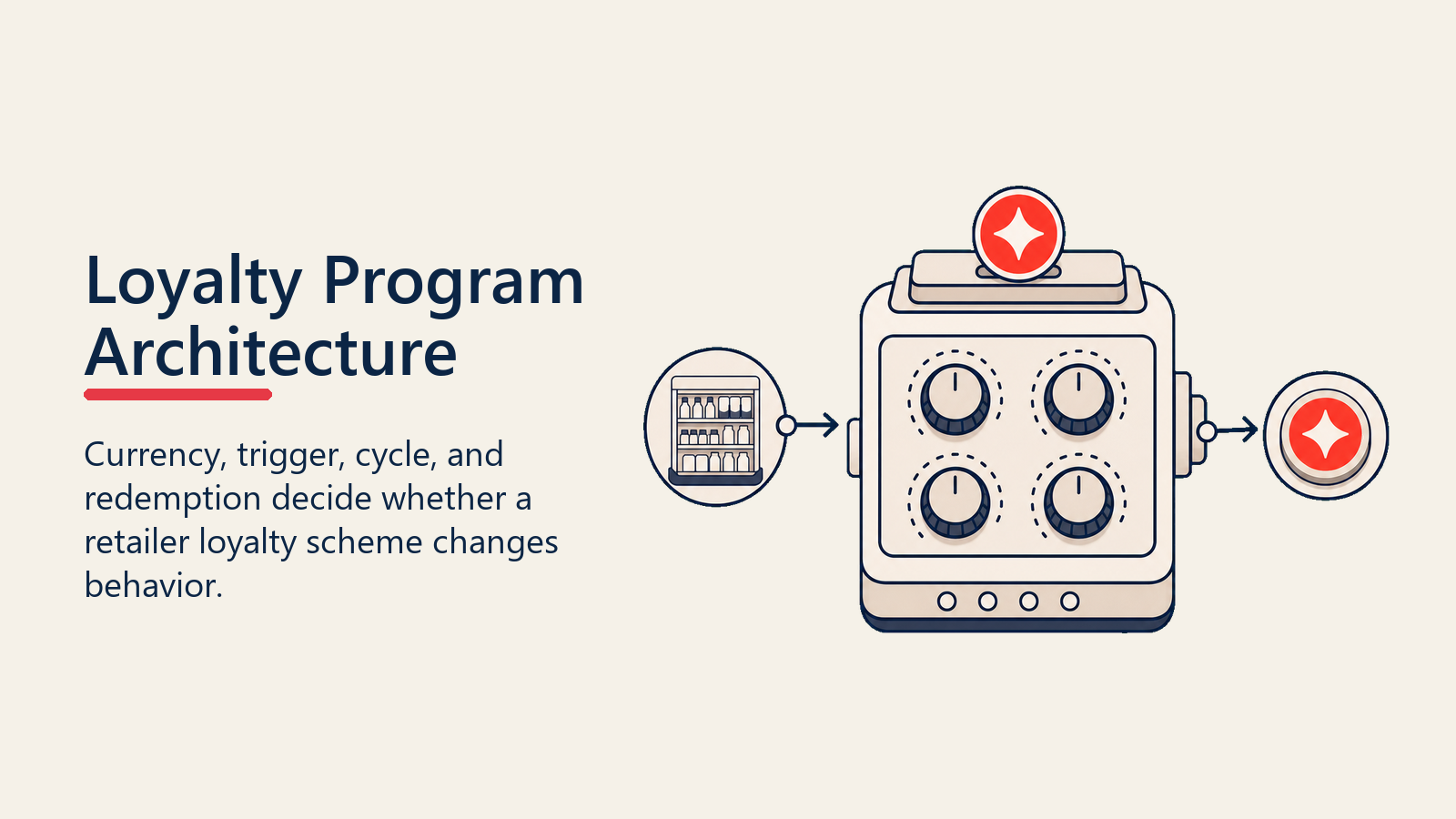
Most loyalty programs that underperform were designed with vague answers to these four questions. Getting them right before launch is the difference between a program that changes retailer behavior and one that costs trade marketing budget without measurable return.
Decision 1: Currency
The reward currency determines whether the retailer finds the program worth engaging with.
Points work when the redemption catalog is attractive and the redemption process is simple. Points programs in general trade fail when the catalog has items the retailer doesn't want (branded merchandise that sits in a drawer) or when redemption requires forms, approvals, or a visit to a distributor depot.
Tiered rebates work for higher-volume accounts where the retailer can project their order pattern forward and see a meaningful dollar value at the end of the cycle. A 2 percent rebate on RM 5,000 of quarterly orders is RM 100, which is visible enough to influence behavior. The same rebate on RM 500 of orders is RM 10, which isn't.
Merchandise (free goods, household items, store equipment) works for small retailers where the cash value of merchandise exceeds what a cash-equivalent rebate would feel like. A minimart owner who receives a refrigerator stand or a fan as a loyalty reward has received something that visibly improves their shop, which creates goodwill that outlasts the reward period.
Cash-back is the simplest currency and the most universally valued in general trade. The downside is that cash-back schemes attract opportunistic participation: retailers take the cash-back on a large order and then don't maintain the brand's shelf position. Design controls are needed (compliance scoring, minimum stocking duration) to prevent this.
Decision 2: Trigger
What behavior does the program reward? This is the most important design decision and the one most often made incorrectly.
Purchase volume triggers reward ordering large quantities. The risk is channel inventory build-up: retailers order to hit the threshold, then reduce subsequent orders while they clear the stock. The brand sees a spike followed by a trough, and the retailer's real sell-out hasn't changed.
SKU range triggers reward stocking a defined number of SKUs from the range. This is useful for range extension launches but needs to be combined with a sell-out component to prevent the retailer from stocking the SKU without selling it.
Compliance score triggers reward meeting merchandising standards: planogram compliance, cooler stocking standards, POS display presence. These work well when the field team has a reliable audit process, but they require rep time for scoring and create disputes if the scoring criteria aren't objective and clearly communicated.
Sell-out velocity triggers reward actual secondary sales at the outlet level. This is the most commercially aligned trigger and the hardest to measure, because it requires either sell-out data from the retailer's till system or a rep-observed stock-depletion proxy calculation. In markets where sell-out data is available through digital payment systems or modern trade integration, this is the target architecture.
In practice, most well-designed programs combine purchase volume with a compliance or range component: earn base points on orders above a minimum threshold, earn bonus points for maintaining planogram compliance or stocking a defined SKU range. This hybrid prevents pure channel loading while still creating an achievable threshold for small retailers. Get this right and the cycle and redemption decisions become much easier to enforce.
Decision 3: Cycle
How often does the program reset and pay out?
Monthly cycles maintain engagement but create administrative complexity at the distributor level. They work for programs with simple currency (cash-back or points-to-cash) and automated tracking.
Quarterly cycles are the most common choice for FMCG trade loyalty in Southeast Asian general trade. The cycle is long enough to reward sustained behavior rather than one-off spikes, but short enough that retailers can stay motivated. Quarterly also aligns with the trade planning calendar.
Annual cycles work for the top tier of high-volume accounts but are too distant in time for small general trade retailers to maintain engagement. A minimart owner making a monthly order doesn't connect a December payout to the stocking decision she made in February.
Design your cycle for the audience. For micro-retailers in the general trade, quarterly or shorter. BCG's global loyalty research confirms that programs relying solely on tangible rewards are losing their power to create stickiness, making cycle design and personalization increasingly important for any loyalty program that wants to hold behavior.
Decision 4: Redemption
Redemption simplicity is a compliance driver. If claiming the reward requires filling out a paper form, visiting a depot, waiting on a call from a sales rep, or navigating a digital portal designed for an audience with different literacy levels, the redemption rate will be low and the program's retention effect will be weak.
The target architecture for general trade loyalty redemption:
- Automatic credit to the next invoice or delivery where possible
- Or a simple acknowledgment from the rep at the next scheduled visit: "Your points this quarter hit the threshold. Here's your [cash/voucher/merchandise]."
- No forms. No portal. No multi-step process.
Program Types by Channel
Not all channels need the same program design. A micro-retailer and a modern trade category captain are different businesses with different decision-making processes and different relationships to incentives.
| Channel Type | Outlet Description | Best Currency | Best Trigger | Best Cycle | Redemption Method |
|---|---|---|---|---|---|
| General trade micro-retailer | Minimart, provision shop, wet market stall, under RM 10K/month orders | Cash rebate, merchandise, prize draw | Purchase volume + compliance score | Monthly or cycle-based (every 4 weeks) | Direct at delivery or rep visit |
| Sub-stockist and wholesaler | Supplies downstream retailers, RM 30K-200K/month orders | Tiered volume bonus, merchandise package | Purchase volume + SKU range | Quarterly | Invoice credit or bank transfer |
| Modern trade category captain | Supermarket, convenience chain, formal category review process | Joint business plan (JBP), marketing co-investment | Sell-out velocity, promotional compliance, JBP milestone | Annual or semi-annual | Formal agreement settlement |
| Semi-modern independent | Mid-size independent with point-of-sale system, organized shelving | Points-to-cash or tiered rebate | SKU range + compliance score | Quarterly | Digital credit or rep-delivered |
The general trade micro-retailer segment is where most FMCG brands underinvest in loyalty design because the individual account value is low. But it's also where the aggregate commercial impact of sell-out behavior change is highest, because the segment represents the largest proportion of outlet universe by count and the highest impulse purchase conversion rate in most categories.
See Trade Marketing and Field Alignment for how loyalty program design decisions need to be coordinated between trade marketing and the field team to avoid programs that the field can't operationalize.
Common Design Failures
Rewards Too Distant in Time from the Behavior
A quarterly payout tied to an annual enrollment date creates a situation where the retailer who enrolled in January earns her first payout in April, and the connection between her February stocking decision and the April cash-back is too distant to reinforce the behavior. Move the cycle shorter or build in mid-cycle progress communications ("You're 60 percent toward your Q2 threshold") to maintain the connection.
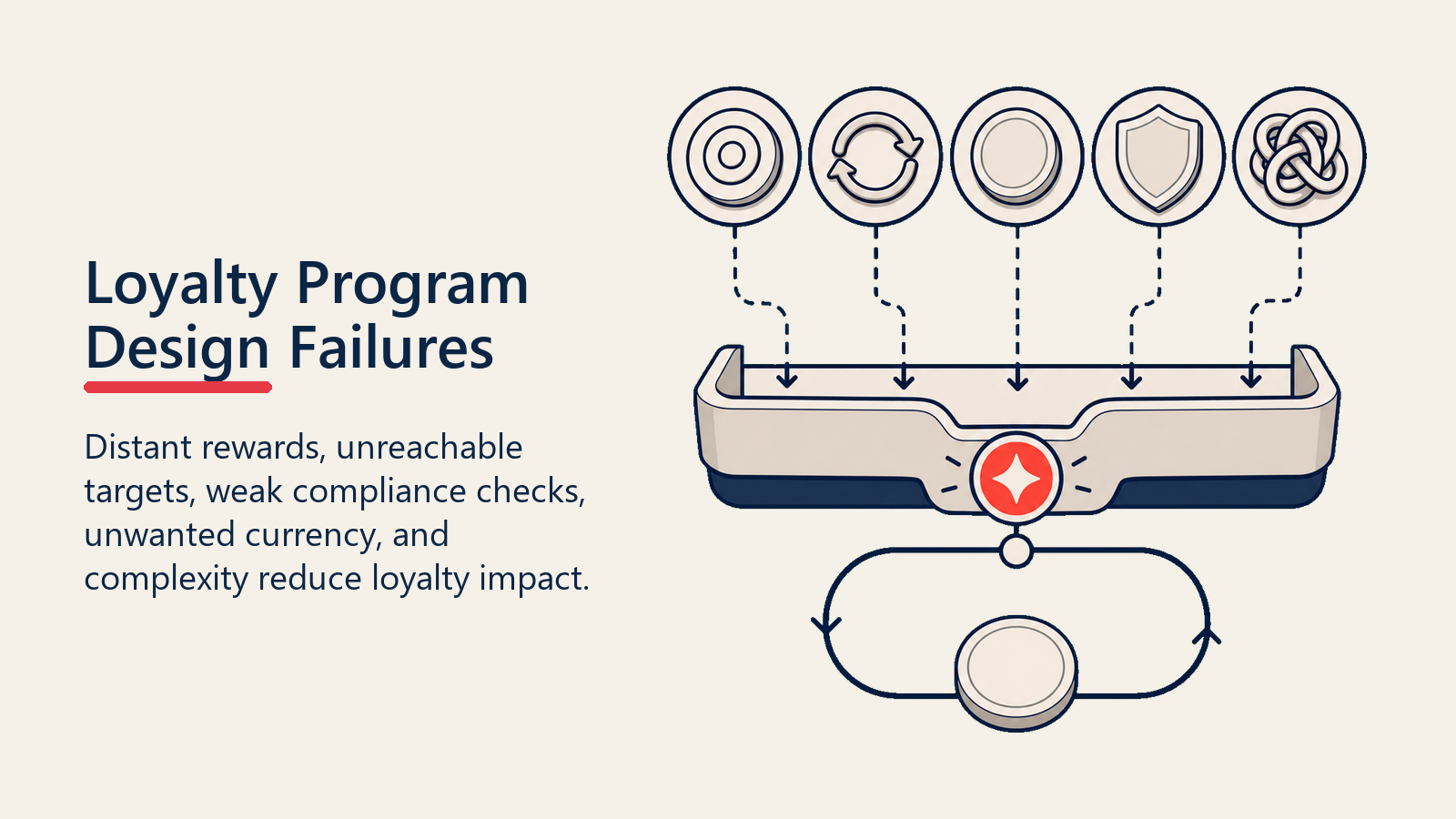
Targets Set Too High for Small Outlets
A loyalty threshold of 50 cases per month is a meaningful threshold for a high-volume convenience outlet but is unachievable for a micro-retailer moving 8 to 10 cases per month of the category. When the target is unreachable, the retailer doesn't engage with the program. Segment your outlet universe by volume potential and set thresholds that create stretch without being discouraging. A micro-retailer who hits 12 cases on a normal month should have a program target of 14 to 16, not 50.
No Field Enforcement of Compliance Criteria
A program that rewards compliance scoring but relies on self-reported compliance rather than rep-observed scoring will be gamed. The field team needs to own the audit and scoring process at each visit, and the compliance score needs to be built into the CRM so that area managers can verify it. Without enforcement, compliance-based rewards become purchase-volume rewards by default.
Currency the Retailer Doesn't Want
A branded merchandise catalog that features items the retailer has no use for is a loyalty program that doesn't motivate loyalty. Run a simple survey of your retailer segment before finalizing the catalog. In most general trade markets, practical household items, store equipment, and cash-equivalent vouchers outperform branded merchandise by two to three times on redemption rate.
Program Complexity That Requires Rep Explanation on Every Visit
If a rep needs to spend five minutes per visit explaining how the program works, the program is too complex and the rep is spending five minutes not selling. The program design should be explainable in two sentences: "Every case you order earns X points. Hit 100 points in a quarter and you get RM 50 cash-back on your next invoice." That's it.
Measurement Framework: Calculating Loyalty Program ROI
A loyalty program that can't be measured can't be improved and can't be defended in budget reviews. The ROI framework has two components.
Incremental Sell-Out Calculation
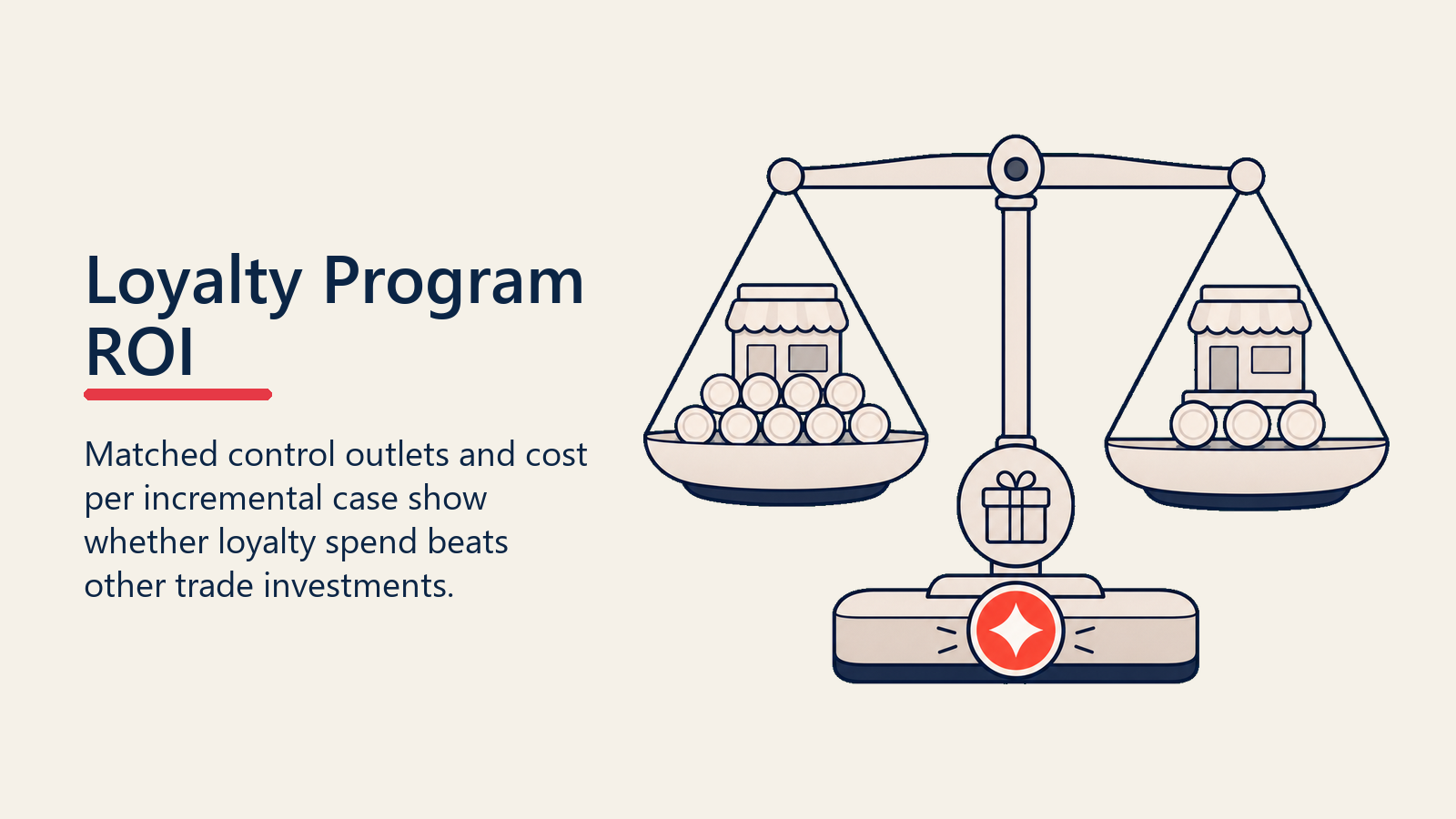
Compare enrolled outlets to a control group of non-enrolled outlets matched on channel type, volume tier, and geography. Measure the difference in sell-out velocity (cases per outlet per month) over the program period.
Incremental sell-out per enrolled outlet = Enrolled outlet sell-out average minus Control group sell-out average
Apply this across the enrolled outlet count to get total incremental cases generated by the program.
Cost Per Incremental Case
Add up all program costs: reward payouts (cash, merchandise, or equivalent), administrative costs (rep time for audit scoring, distributor processing), and marketing costs (program enrollment materials, communications).
Cost per incremental case = Total program cost divided by total incremental cases
Compare this to the cost per case of alternative trade marketing investments in the same period: promotional price discounts, additional field rep time, distributor incentives. If the loyalty program cost per incremental case is lower than the alternative, the program has positive ROI relative to the counterfactual.
In practitioner programs tracked across Southeast Asian general trade beverage categories, cost per incremental case from a loyalty scheme has been observed to run below equivalent cost from a straight price promotion, because the loyalty scheme changes baseline behavior across the enrolled period rather than generating a one-week spike (this is a directional practitioner estimate; no independently published benchmark is available for this specific comparison). Bain's consumer loyalty practice argues that programs which are easy to join, responsive to service failures, and targeted by purchase behavior consistently outperform programs that are complex to operate, a principle that applies equally at the outlet level. (Bain, rewards and loyalty)
Design Failure Checklist
Before launching a new loyalty program or redesigning an existing one, check each of these:
- Can the reward trigger be explained in two sentences without reference to terms and conditions?
- Is the cycle length 90 days or shorter for the general trade micro-retailer segment?
- Is the enrollment threshold achievable for an average-volume outlet in this segment, not just for the top decile?
- Does the currency reflect what the retailer segment actually values, confirmed by a sample survey?
- Is there a field enforcement mechanism for any compliance scoring components?
- Is redemption automatic or achievable in a single step at the point of delivery or the next rep visit?
- Does the program reward sell-out behavior (velocity, compliance, range) rather than purchase volume alone?
- Is there a baseline control group for measuring incremental sell-out versus non-enrolled outlets?
- Is the program integrated with the CRM so area managers can track enrollment, progress, and payout by territory?
- Have the Outlet Relationship Management principles been applied to ensure that loyalty program communication doesn't replace relationship-building visit behaviors?
Conclusion: A Well-Designed Loyalty Program Is a Sell-Out Engine
The retailer who stocks your brand but doesn't sell it is a distribution number that doesn't translate into market share. A well-designed loyalty program converts stocking into selling by structuring incentives around the behaviors that drive sell-out: active product recommendation, consistent shelf positioning, range maintenance, and fast reorder when stock runs low.
But that conversion doesn't happen automatically. It requires the right currency for the retailer segment, a trigger aligned with sell-out behavior rather than purchase volume, a cycle short enough to maintain engagement, and a redemption process simple enough that the retailer doesn't need the rep to explain it every visit.
Get those four decisions right, enforce the program through the field team's audit and CRM infrastructure, and measure the incremental sell-out against a proper control group. A loyalty program designed and run this way isn't a trade marketing expense. It's a structured distribution retention and sell-out investment with a calculable return.
Frequently Asked Questions about Retailer Loyalty Programs in FMCG
What is the difference between a retailer loyalty program and a consumer loyalty program in FMCG?
A consumer loyalty program rewards end shoppers for repeat purchases, typically through a points card or app. A retailer loyalty program rewards the shopkeeper or outlet owner for stocking, displaying, and selling the brand's products. The two serve different functions: consumer programs build shopper preference for the brand; retailer programs build channel distribution and sell-out compliance. In general trade FMCG, both can operate simultaneously, but they require separate design because the retailer's incentives (cash, merchandise, business tools) differ entirely from the shopper's (personal rewards, discounts).
What is a retailer loyalty program in FMCG?
A retailer loyalty program is an incentive structure that rewards retailers for specific behaviors that benefit the brand: maintaining shelf space, hitting volume thresholds, stocking the full SKU range, or meeting merchandising compliance standards. In FMCG, the best-performing programs reward sell-out velocity and compliance behavior rather than purchase volume alone, because purchase-volume rewards can drive channel inventory build-up without changing actual consumer sell-out rates.
How long should an FMCG retailer loyalty program cycle run?
For general trade micro-retailers, 30 to 90 days is the maximum effective cycle. Industry estimates from Southeast Asian general trade data suggest redemption rates drop below 20 percent when the payout cycle exceeds 90 days (no universal published source; treat as a directional benchmark). Quarterly cycles (90 days) are the most common choice for balancing administrative simplicity with engagement maintenance. Annual cycles work only for the largest accounts with formal joint business plan structures.
What rewards work best for general trade retailers?
Cash-back, cash-equivalent vouchers, and practical merchandise (household items, store equipment) consistently outperform branded merchandise in general trade loyalty programs. The key test is whether the retailer can use and value the reward immediately. A RM 50 cash credit on the next invoice is almost always more motivating for a micro-retailer than RM 50 worth of branded merchandise they didn't ask for.
How do you measure the ROI of a retailer loyalty program?
Compare sell-out velocity (cases per outlet per month) between enrolled outlets and a matched control group of non-enrolled outlets over the program period. Calculate cost per incremental case by dividing total program cost by the total incremental cases generated by the enrolled group. Compare that cost per incremental case to the cost per incremental case from alternative trade investments (promotional pricing, additional rep visits). If the loyalty program's cost per incremental case is lower, the program has positive ROI relative to the alternative.
What is the biggest design mistake in FMCG retailer loyalty programs?
Setting a reward trigger tied to purchase volume alone rather than sell-out behavior. A purchase-volume trigger rewards the retailer for ordering large quantities, which can cause channel inventory build-up without any change in actual consumer sell-out. The retailer hits the threshold, earns the rebate, and then slows subsequent orders while clearing the overstock. The result is a primary sales spike followed by a trough, and the brand's actual in-store sales velocity doesn't improve. The fix is to combine a minimum volume threshold with a compliance or velocity component so the program rewards what actually drives brand sales.
Can small distributors run retailer loyalty programs effectively?
Yes, but the program must be designed for their operational capacity. A small distributor running 15 to 20 routes can operate a simple points-to-cash program through manual tracking if the cycle is quarterly and the catalog is limited to two or three reward options. The design mistake smaller distributors make is copying large-brand program structures (tiered bonuses, complex catalog, digital portal) without the back-office infrastructure to administer them. Start simple: one trigger, one currency, one cycle, one redemption method. Complexity can be added after the first full cycle proves the model works.
How do you prevent gaming in a retailer loyalty program?
Gaming occurs when retailers game the trigger to earn rewards without sustaining the behavior the program intends to change. The most common gaming patterns are: bulk ordering to hit a volume threshold followed by slow sales, self-reporting compliance scores that the field team doesn't verify, and enrolling multiple small accounts under a single retailer identity. Prevention controls include: rep-observed compliance scoring rather than self-reporting, a minimum sell-through requirement before the reward is released, field team verification of stock levels at the point of reward redemption, and a per-outlet enrollment cap for multi-location retailers.
Learn More

Senior Implementation Consultant
On this page
- Why Do Loyalty Schemes Exist in FMCG Trade?
- Program Architecture: Four Design Decisions Every Scheme Needs
- Decision 1: Currency
- Decision 2: Trigger
- Decision 3: Cycle
- Decision 4: Redemption
- Program Types by Channel
- Common Design Failures
- Rewards Too Distant in Time from the Behavior
- Targets Set Too High for Small Outlets
- No Field Enforcement of Compliance Criteria
- Currency the Retailer Doesn't Want
- Program Complexity That Requires Rep Explanation on Every Visit
- Measurement Framework: Calculating Loyalty Program ROI
- Incremental Sell-Out Calculation
- Cost Per Incremental Case
- Design Failure Checklist
- Conclusion: A Well-Designed Loyalty Program Is a Sell-Out Engine
- Learn More