Outlet Relationship Management: How Field Sales Teams Build Retailer Trust That Drives Repeat Orders
Turn this article into takeaways for your work.


Each assistant summarizes the article only for you and suggests best practices for your work.
Two reps cover the same geography. Same product range. Same distribution partner. Same trade marketing budget. One of them opens 40 new outlets every quarter and spends the next quarter trying to get them to reorder. The other opens 25 new outlets and holds 90 percent of them through three or four cycles without chasing. By month nine, the second rep has more active distribution than the first.
The difference isn't personality. It isn't luck. It's whether the rep treats outlet relationships as a commercial asset that gets actively managed, or as a social byproduct of showing up.
Outlet relationship management is how FMCG field sales teams convert first-order placements into recurring sell-out velocity. It's not a soft skill. It's an operational discipline with measurable inputs, trackable outputs, and a direct link to numeric distribution retention (the percentage of total territory outlets actively stocking the brand).
What Does Outlet Relationship Management Actually Mean in FMCG Field Sales?
Let's be precise about what relationship management means in this context, because it gets misused as a label for general friendliness.
Relationship management in FMCG field sales is the systematic set of behaviors a rep executes on every call to build and maintain a retailer's trust in three areas: reliability of service, quality of commercial partnership, and consistency of presence. Those three areas translate directly into the retailer's decision to reorder, to cooperate with merchandising requests, and to give the brand preferential shelf space when capacity is limited.
A retailer who trusts that the rep will show up when scheduled, resolve complaints within 48 hours, and share useful market information about what's selling in the neighborhood is a retailer who is more likely to say yes to a new SKU, more likely to cooperate with a planogram request, and less likely to switch to a competitor when they come calling with a price discount.
Key Facts: Outlet Relationship and Retention
- McKinsey's consumer goods commercial excellence practice highlights outlet segmentation by revenue, profit potential, and ability to influence as a key driver of distribution retention, with companies applying structured segmentation outperforming those relying on broad store-type alone. Acquiring a new customer costs five times more than retaining an existing one, a principle that applies directly to outlet re-acquisition in general trade. (McKinsey, consumer goods commercial excellence)
- FMCG companies operating structured retailer relationship programs report 20-30% higher numeric distribution retention rates compared to companies relying on transactional ordering alone (practitioner benchmark from route-to-market programs in Southeast Asia; no single published academic study).
- Complaint and credit resolution time is consistently cited as the highest-weighted factor in retailer satisfaction across Southeast Asian general trade markets, outranking price and product range as a driver of repeat ordering (practitioner surveys from field sales programs; no published academic study).
That's the commercial logic of relationship management. A friendly rep is nicer to be around. But a reliable rep generates lower account churn, higher sell-out cooperation, and more favorable trading terms than an equally capable but inconsistent rep.
Relationship Tiers: Classifying Outlets by Relationship Depth
Not all outlets need the same relationship investment. The Preferred-Cooperative-Transactional Tier Model: classify every active outlet as Preferred Supplier (Tier 1, reorders without prompting), Cooperative (Tier 2, reorders with a visit prompt), or Transactional (Tier 3, reorders only on promotion or heavy persuasion). Tiers determine visit frequency, stock allocation, and service intensity. A tiering framework lets the rep and the area manager allocate time and service intensity where it has the highest commercial return.
Tier Classification Framework
| Tier | Label | Characteristics | Reorder Rate | Visit Frequency |
|---|---|---|---|---|
| Tier 1 | Preferred Supplier | Reorders without prompting, cooperates with all merchandising standards, provides shelf priority, long-term stocking relationship | 85-95% per cycle | Weekly or biweekly |
| Tier 2 | Cooperative | Reorders with a visit prompt, generally compliant with planogram, occasionally accepts new SKUs, stable relationship | 60-80% per cycle | Biweekly or monthly |
| Tier 3 | Transactional | Reorders only on promotion or heavy persuasion, inconsistent compliance, price-sensitive and competitor-switchable | Below 50% per cycle | Monthly or as needed |
The tiering is not static. An outlet moves between tiers based on its behavior over the last two or three cycles. A Tier 3 outlet that has reordered consistently for six consecutive months and accepted a new SKU range is a Tier 2 outlet now. Update the classification in the CRM and adjust visit frequency accordingly.
The Outlet Segmentation and Classification framework covers the broader segmentation logic that tiers feed into, including channel type and volume potential.
How Tier Determines Service Priority
Tier 1 outlets get the first allocation when stock is tight, the first notification of promotional pricing windows, and the highest priority for cooler placement and trade marketing investment. Tier 3 outlets get service but not preferential service: they receive what the rep can deliver on a standard call cadence without premium investment until they demonstrate the reorder consistency that warrants moving up.
This sounds harsh. It isn't. It's how you protect your highest-value distribution assets while maintaining the portfolio. A Tier 1 outlet that reorders without prompting generates three to four times the sell-out contribution per rep hour invested compared to a Tier 3 outlet that requires intensive persuasion every cycle. Prioritizing accordingly is commercial sense.
Practical Relationship Levers: What Reps Do on Every Call to Build Equity
Relationship equity isn't built in annual review meetings or over lunch. It's built in the accumulated quality of hundreds of routine visits. The following behaviors, executed consistently, are what separate the rep whose outlets hold from the rep whose outlets churn.
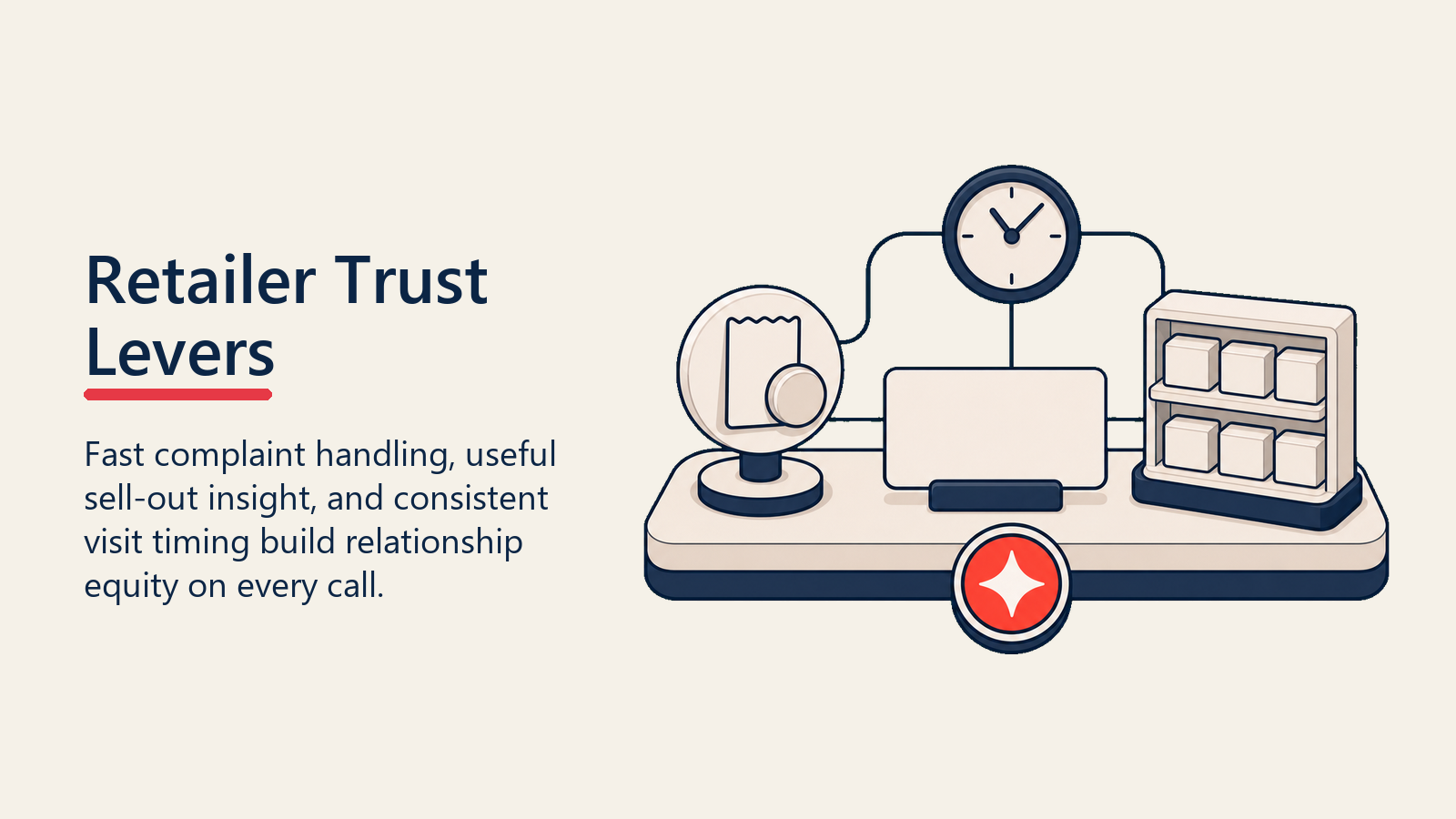
First-Call Service: Resolving Complaints, Credits, and Returns Promptly
When a retailer has a complaint or a pending credit note, nothing else the rep does in that visit matters until it's addressed. The rep who walks in, ignores the pending issue, and tries to take a new order first sends an unmistakable signal: the brand's agenda comes before the retailer's problem.
The protocol is simple: before pitching anything, ask about any outstanding issues from the last visit. "Is there anything from last week's delivery I need to sort out before we look at this week's stock?" That question earns goodwill and surfaces the issues the rep needs to know about regardless.
Credit note turnaround time should be under 48 hours for standard returns. Near-expiry returns that were pre-authorized at the last visit should be credited on the delivery day if possible. The Beat and Journey Planning cycle needs to build in capacity for credits and returns on every route, not treat them as exception handling.
Sharing Sell-Out Data and Local Market Insight
A rep who brings useful information to the retailer rather than just taking orders is a different kind of commercial partner. General trade retailers are small businesses with limited information about what's selling in their category beyond what they observe on their own shelves.
A rep who can say "the 250ml sachet format has been the fastest-moving SKU in outlets two streets over this month, and the weather forecast has three more weeks of this heat" is giving the retailer something they can act on: a stocking decision that's informed by the market rather than just habit.
This doesn't require sophisticated data systems. It requires the rep to be paying attention to sell-out patterns across the route and to synthesize that into one or two sentences of useful context per visit. McKinsey's research on manufacturer-retailer collaboration shows that companies who share market data and co-develop commercial plans with retailers capture meaningfully higher sell-out uplift than those who manage the relationship transactionally. It's the kind of information sharing that the Voice of Customer Programs model applies at a corporate level, operationalized at the rep level as a visit habit.
Consistent Visit Timing as a Trust Signal
This is underrated and consistently overlooked. A rep who arrives within the same 90-minute window every scheduled visit day builds a specific kind of trust: the retailer can plan around the rep's presence. They'll hold a stock query for the visit rather than calling the distributor. They'll save a complaint for the next visit rather than escalating through channels that create friction for everyone.
Consistency of timing is especially important in markets where the retailer is managing their own shop single-handed. Arriving at 9:30 every Tuesday means the retailer has slotted the rep into their weekly rhythm. Arriving at random times or skipping visits without notice breaks that rhythm and signals that the rep's time management, and by extension the brand's reliability, is unpredictable.
The Perfect Store and the Call Steps framework embeds visit timing standards into the call step compliance score for exactly this reason.
The Service Scorecard: Relationship KPIs by Tier
| KPI | Tier 1 Target | Tier 2 Target | Tier 3 Minimum | Measurement Frequency |
|---|---|---|---|---|
| Complaint resolution time | Under 24 hours | Under 48 hours | Under 72 hours | Per complaint |
| Credit note turnaround | Same day or next delivery | Within 3 business days | Within 5 business days | Per credit event |
| Repeat order rate | 85-95% per cycle | 60-80% per cycle | Track for tier movement | Monthly |
| Visit adherence (on scheduled day) | 95%+ | 90%+ | 85%+ | Monthly per route |
| New SKU acceptance rate | 60%+ | 30-50% | Track for trend | Per launch |
| Complaint escalation rate | Below 5% | Below 10% | Track and address | Monthly |
These KPIs connect to the broader Retention Fundamentals framework: track what predicts churn, act on the leading indicators, not the lagging ones. A declining visit adherence score and rising complaint resolution time is a churn signal two cycles before the outlet stops reordering.
Common Failure Modes: Behaviors That Erode Retailer Trust
Relationship equity is harder to build than to destroy. Most reps who lose outlet relationships don't lose them dramatically. They lose them through accumulated small failures that eventually tip the retailer's cost-benefit calculation toward the competitor who's been consistently calling.
Credit note delays. A retailer who raised a return in week one and hasn't seen the credit by week three is a retailer who will tell the next FMCG rep they speak to that your company doesn't process credits promptly. That reputation travels down the street faster than any promotional offer.
Inconsistent visit schedules. Three visits in a row, then two consecutive missed scheduled days with no notice, then a partial visit where the rep only took an order and left without checking stock. The retailer reclassifies the rep as unreliable and reduces their ordering commitment accordingly.
Overselling then disappearing. A rep who persuades a retailer to take a full case of a new SKU and then doesn't follow up for three visits to see if it's moving has created a retailer problem without providing a solution. When the SKU sits on the shelf, the retailer concludes that the brand doesn't track what it places, and they resist new SKU pitches at the next two or three visits.
Making promises that the supply chain can't keep. Committing to a delivery date that the distributor can't honor, or promising a promotional pricing window that trade marketing hasn't confirmed, erodes trust more severely than simply not making the commitment. The retailer remembers what you promised, not what you intended.
Ignoring complaints to push the order first. This one is the fastest trust destroyer in the field. Any rep who takes an order and logs the call before addressing a pending complaint has made the brand's commercial agenda the priority over the retailer's relationship. The retailer notices every time.
Treating all outlets identically. A Tier 1 outlet that has been reordering reliably for 18 months and receives the same interaction as a new Tier 3 account eventually notices that their loyalty earns them nothing. Differentiated service based on relationship tier is how brands demonstrate that long-term commitment has value.
The Churn Prevention Strategy framework at the account level describes how these failure modes map to churn triggers. The FMCG outlet equivalent is the same: recognize the signals early and intervene before the retailer makes an active decision to reduce or drop the brand's allocation.
Connecting Relationship Quality to Numeric Distribution Retention
The commercial case for outlet relationship management is clearest when expressed as numeric distribution retention.
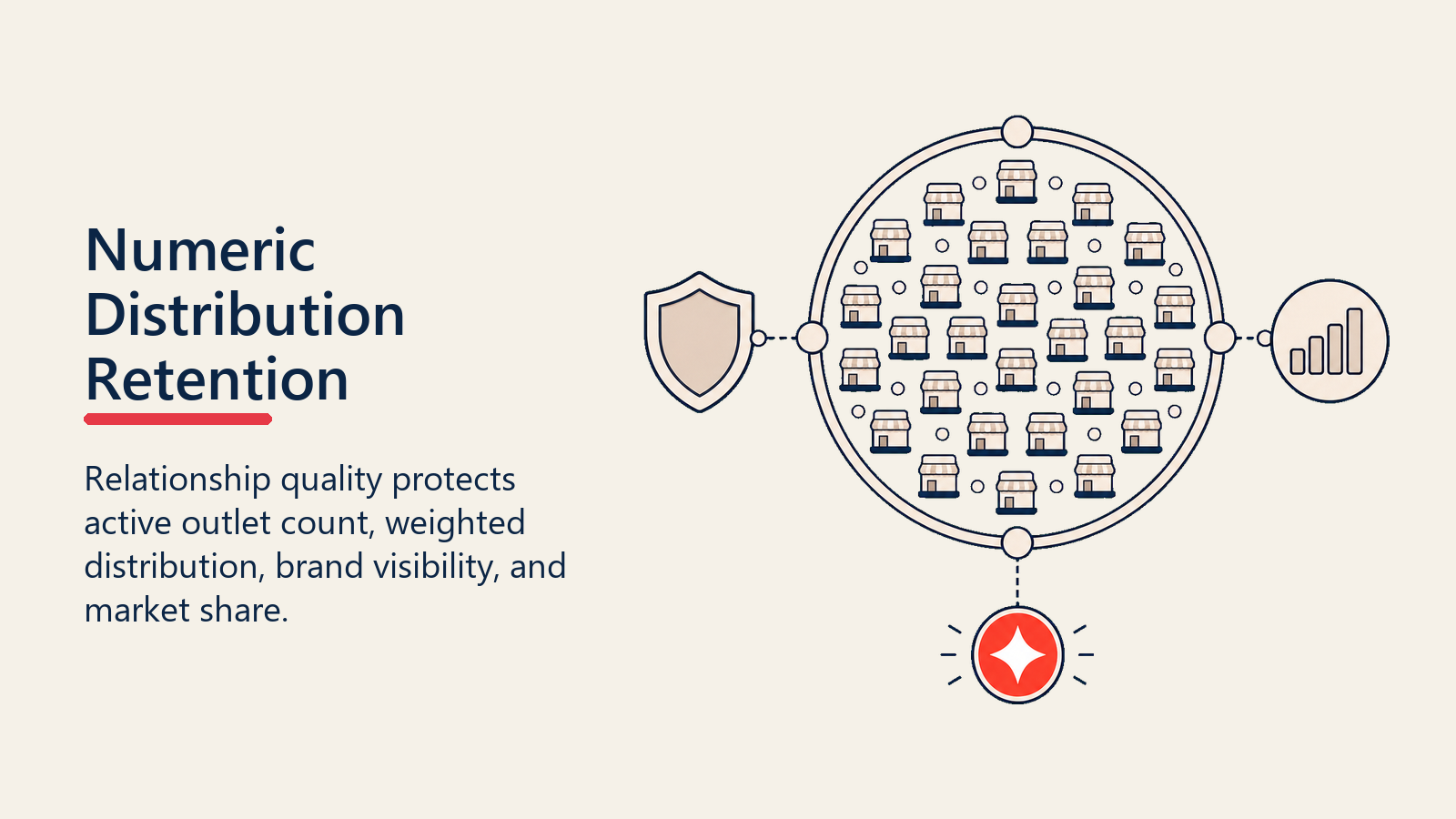
Numeric distribution is the percentage of total outlets in the territory that stock at least one SKU from the brand. A company targeting 80 percent numeric distribution in 2,000 outlets needs 1,600 active outlets stocking the brand at any given measurement point.
Losing 100 of those 1,600 outlets in a quarter means dropping to 75 percent numeric distribution, which drops weighted distribution, which drops brand visibility scores, which eventually compresses market share. Recovering those 100 outlets costs the field team approximately 3 to 4 times the effort it would have cost to retain them, because re-establishing a relationship after a break requires more visits, more persuasion, and often a promotional incentive that retention-focused servicing wouldn't have required.
The math is directionally straightforward: if structured outlet relationship management costs the rep an additional 15 percent of visit time per cycle in service and communication activities, but it reduces outlet churn by an estimated 25 to 30 percentage points (a practitioner-observed range; not from a single published study), the net commercial return is substantially positive. That's the same logic as the retailer loyalty programs investment rationale: the cost of structured retention is lower than the cost of re-acquisition.
Measuring and Reporting Relationship Quality
Area managers and NSMs can't directly observe relationship quality across hundreds of outlets on the route. But they can track the proxy metrics that reflect it.
Build a monthly outlet relationship dashboard that covers four indicators:
Repeat order rate by outlet tier. If Tier 1 outlet repeat rates drop below 85 percent, something is eroding the relationship at that tier. Investigate immediately.
Credit resolution time by territory. Territory-level averages above 72 hours signal a process failure, not just a rep behavior issue. Either the credit authorization process is too slow or reps aren't raising credits at the point of resolution.
Visit adherence by rep and route. Route-level visit adherence below 90 percent on scheduled days creates the inconsistency that erodes retailer trust over time.
Outlet complaint escalation rate. Complaints that escalate past the rep to the distributor or to the company's customer service line are complaints that the relationship wasn't strong enough to contain at the field level. Track the rate and the rep-level pattern.
These four metrics together give leadership a view of relationship health that's distinct from order volume. An outlet can be placing orders while the relationship is eroding; the lagging indicator is when orders stop. These metrics catch the erosion earlier.
Conclusion: Relationship Equity Is a Retention Asset
Outlet relationship management isn't a personality trait that some reps have and others don't. It's an operational discipline with defined behaviors, measurable outputs, and a clear return on investment.
The rep who resolves complaints before taking orders, shares sell-out insight on every visit, arrives at the same time every scheduled day, and tracks which outlets are trending toward churn before they actually churn is building a retention asset. That asset shows up in numeric distribution retention, in sell-out cooperation, and in the willingness of retailers to accept new SKUs and promotional activations when the brand needs commercial push.
Quantify it. Manage it. Measure it like the retention asset it is. The companies that treat outlet relationship quality as a data problem rather than a charm problem are the ones whose numeric distribution holds through competitive pressure, price promotions from competitors, and the inevitable quarterly targets that tempt reps to skip service for the sake of one more order.
Quotable Nuggets
"The rep who opens 40 new outlets every quarter and loses most of them inside six months has lower active distribution by month nine than the rep who opens 25 and holds 90% through three cycles."
"McKinsey's consumer goods commercial excellence practice consistently points to structured outlet segmentation, by revenue, profit potential, and influence potential, as a meaningful driver of distribution retention over store-type-only approaches." (McKinsey, consumer goods commercial excellence)
"Recovering 100 lost outlets costs the field team approximately three to four times the effort it would have cost to retain them, because re-establishing a relationship after a break requires more visits, more persuasion, and often a promotional incentive that retention-focused servicing wouldn't have required."
Frequently Asked Questions about Outlet Relationship Management
What is outlet relationship management in FMCG?
Outlet relationship management is the systematic set of behaviors field reps execute on every call to build a retailer's trust in three areas: reliability of service, quality of commercial partnership, and consistency of presence. The commercial outcome is higher numeric distribution retention, greater sell-out cooperation, and lower cost of re-acquisition compared to brands that manage outlets transactionally.
How do you measure outlet relationship quality?
Track four proxy metrics monthly: repeat order rate by outlet tier, credit resolution time by territory, visit adherence by rep and route, and outlet complaint escalation rate. These metrics reflect relationship health before it shows up in order volume, giving area managers the ability to intervene before an outlet churns rather than after.
What is the most common way FMCG reps erode retailer trust?
Credit note delays and inconsistent visit schedules are the most common trust destroyers in general trade FMCG. A retailer who raised a return and hasn't seen the credit three weeks later is a retailer who is re-evaluating the relationship. A rep who misses scheduled visits without notice is a rep whose outlets will be more receptive to the next competitor who shows up consistently.
How does outlet tier classification work?
Outlets are classified into three tiers based on reorder behavior, planogram compliance, and relationship stability: Preferred Supplier (Tier 1), Cooperative (Tier 2), and Transactional (Tier 3). Tier determines visit frequency, service priority, and stock allocation preference. Classifications update based on outlet behavior over the last two or three cycles, and the CRM should reflect current tier for every active outlet.
Why does consistent visit timing matter for outlet relationship quality?
A rep who arrives within the same 90-minute window on every scheduled visit day gives the retailer something specific: the ability to plan around that presence. The retailer saves stock queries, complaints, and reorder conversations for the visit rather than escalating through channels that create friction. Reps who arrive at random times or skip visits without notice break the retailer's rhythm and send a signal about the brand's reliability, not just the rep's time management.
How do you use sell-out data to build retailer trust?
A rep who brings local sell-out context to the retailer is providing something small businesses can't generate themselves. "The 250ml sachet format has been the fastest-moving SKU at outlets two streets over this month" is the kind of information that helps the retailer make better stocking decisions. It repositions the rep as a commercial partner with useful market intelligence, not a logistics contact who collects orders. McKinsey research on manufacturer-retailer collaboration confirms that companies sharing market data with retailers capture meaningfully higher sell-out uplift than those managing the relationship transactionally.
What is the commercial case for investing in Tier 1 outlet retention?
A Tier 1 outlet that reorders without prompting generates three to four times the sell-out contribution per rep hour invested compared to a Tier 3 outlet requiring intensive persuasion every cycle. The cost of re-acquiring a lost outlet (extra visits, promotional incentives, rebuilding trust) is three to four times the cost of retaining it. And the broader numeric distribution impact compounds: every 100 outlets churning from a 1,600-outlet universe drops weighted distribution, which drops brand visibility scores, which eventually compresses market share. Retention at the Tier 1 level is the highest-return use of field service investment.
Learn More

Senior Implementation Consultant
On this page
- What Does Outlet Relationship Management Actually Mean in FMCG Field Sales?
- Relationship Tiers: Classifying Outlets by Relationship Depth
- Tier Classification Framework
- How Tier Determines Service Priority
- Practical Relationship Levers: What Reps Do on Every Call to Build Equity
- First-Call Service: Resolving Complaints, Credits, and Returns Promptly
- Sharing Sell-Out Data and Local Market Insight
- Consistent Visit Timing as a Trust Signal
- The Service Scorecard: Relationship KPIs by Tier
- Common Failure Modes: Behaviors That Erode Retailer Trust
- Connecting Relationship Quality to Numeric Distribution Retention
- Measuring and Reporting Relationship Quality
- Conclusion: Relationship Equity Is a Retention Asset
- Quotable Nuggets
- Learn More