Direct Store Delivery (DSD): When FMCG Brands Should Cut Out the Middleman
Turn this article into takeaways for your work.


Each assistant summarizes the article only for you and suggests best practices for your work.
Direct store delivery, or DSD, is the distribution model where a manufacturer's own vehicles deliver product directly from depot to retail outlet. No distributor holds stock. No third-party van team handles the last mile. The manufacturer controls everything from factory to shelf.
It's also the most expensive route to market in the FMCG toolkit. And for specific categories and geographies, it's the only model that actually works.
That tension sits at the center of every DSD investment decision. You're trading away the cost efficiency and reach of distributor-mediated delivery for operational control, execution quality, and the kind of shelf-level responsiveness that a third-party distributor with 200 other SKUs simply can't consistently deliver.
The companies that get DSD right treat it as a strategic capability for specific categories and conditions, not a universal preference. Coca-Cola runs DSD in many markets because high velocity, cold-chain requirements, and shelf merchandising standards make it the right model for carbonated beverages in high-throughput channels. Lays (PepsiCo) uses it in the United States because direct replenishment and merchandising compliance in a freshness-and-visibility-driven impulse category justify the cost. Both would tell you the economics depend on drop size density, route configuration, and how much you're willing to pay for execution control.
This article gives you the framework to evaluate that trade-off for your own portfolio and markets.
What DSD Is
Within the model, two operational variants determine how the driver-salesperson role is split.
In practice, there are two operational variants:
Driver-Salesperson (DSP) Model: The vehicle driver is also the sales representative. They carry pre-loaded inventory on the truck, visit assigned outlets on a fixed route, replenish shelves directly from the truck, take the next order, and collect payment. This is the classic DSD model for high-frequency, impulse categories like beverages, snacks, and bread. The route is planned in advance; the driver executes a sell-and-deliver cycle at each stop.
Pre-Sell DSD Model: A dedicated sales representative visits outlets in advance to take orders and confirm stock needs. A separate delivery truck follows the route to fulfill those orders. This model trades some efficiency (two trips per outlet cycle) for better order accuracy and deeper merchandising time, and it's common in categories with more complex in-store execution requirements.
Van sales vs pre-sell is a specific execution choice within the broader DSD framework. The choice between them depends on your category's demand predictability, the complexity of in-store execution, and the skill set you want your driver-salespeople to carry.
When Does DSD Make Commercial Sense?
DSD's cost premium is justified by specific category and channel characteristics. There are four primary conditions where DSD creates competitive advantage.
Short shelf life or freshness requirements: Bread, fresh dairy, chilled ready meals, and certain beverages have shelf lives measured in days, not weeks. A distributor with 48-hour order-to-delivery cycles and a warehouse that services dozens of manufacturers can't reliably maintain the freshness window these categories require. DSD allows the manufacturer to control replenishment frequency precisely, pull near-expiry product, and maintain freshness standards that translate directly into consumer repeat purchase.
Cold-chain requirements: Chilled or frozen products need temperature continuity from factory to shelf. Distributor cold-chain capability varies enormously, and a temperature break in the distributor's warehouse or van is both a product-quality risk and a regulatory compliance issue. DSD gives you control over every link in the cold chain.
High-velocity SKUs with impulse-purchase dynamics: In categories where visible, well-stocked shelves directly drive sales volume, the merchandising compliance that comes with DSD has measurable revenue impact. A Coca-Cola brand manager who can guarantee that their 2-liter bottles are faced, cold, and at eye level in 95 percent of their DSD outlets is making a different quality claim than one relying on a third-party distributor who may or may not prioritize facing compliance during a rushed van visit.
Tight execution standards in premium channels: Modern trade key accounts and petrol station forecourts often have specific delivery windows, compliance requirements, and merchandising standards that a distributor serving dozens of brands can't reliably meet. DSD allows the manufacturer to control delivery timing, shelf placement, and in-store execution to the standard the retailer requires.
Knowing when DSD is right is half the decision. The other half is understanding exactly what you're trading away by choosing it.
DSD vs Distributor Delivery: The Trade-Off Table
The decision to run DSD versus distributor-mediated delivery isn't binary in most FMCG portfolios. Many brands run DSD in certain channels or regions and distributor delivery in others. Understanding the trade-off by dimension helps set the boundaries.
| Dimension | DSD | Distributor Delivery |
|---|---|---|
| Cost-to-serve | High (vehicle fleet, driver-salesperson payroll, depot cost) | Moderate (distributor absorbs fleet and warehousing) |
| Geographic coverage | Limited by depot location and route density | Broader (distributor's own network extends reach) |
| Execution control | High (your employees at point of sale) | Variable (depends on distributor's commercial priorities) |
| Merchandising compliance | Tight (driver-salesperson controls shelf) | Inconsistent (van salesperson has 200 SKUs to sell) |
| Cold-chain reliability | Full control | Dependent on distributor infrastructure |
| SKU complexity tolerance | Low to moderate (simpler SKU mix per route is more efficient) | High (distributor aggregates many SKUs across the route) |
| Shelf data and order capture | Real-time (driver app captures sales data at outlet) | Delayed (depends on distributor secondary-sales reporting) |
| Payment collection | Direct (driver collects at point of delivery) | Intermediated (distributor manages retailer credit) |
The distributor management and ROI framework is the counterpart to this analysis: before concluding that DSD is superior, you need to model what a well-managed distributor can actually deliver in your market, not what a poorly managed one has been delivering.
Key Facts: Direct Store Delivery (DSD)
- DSD products represent 24 percent of unit sales in US grocery stores but generate 52 percent of retail profits in the channel, reflecting the disproportionate category value of high-velocity DSD categories like beverages, snacks, and fresh bakery (Grocery Manufacturers Association / Packaged Goods Services Association, 2021).
- Seven of the ten largest US grocery categories by unit volume are managed through DSD, including carbonated beverages, salty snacks, bread, and milk, confirming the model's dominance in impulse and freshness-sensitive categories (GMA/PGSA, 2021).
- 62 percent of new consumer goods products launched in North America were brought to market using DSD processes, making DSD the primary innovation channel for category introductions that require rapid, controlled shelf placement (GMA/PGSA, 2021).
Designing the DSD Operation
If the category and channel conditions justify DSD, the operational design determines whether the model is profitable. Three elements are non-negotiable: territory sizing, vehicle routing, and the driver-salesperson role definition.
Territory and Route Sizing
A DSD route is profitable when it generates enough revenue per route-day to cover vehicle costs, driver-salesperson compensation, and the allocated depot overhead, with margin contribution remaining. The minimum viable route size depends on your cost structure, but a useful planning anchor is: the route must cover all variable costs (vehicle operating cost, driver compensation) within 50 to 60 percent of its revenue, leaving the remaining 40 to 50 percent to contribute to fixed costs and margin.
In practice, this means designing routes that balance two tensions: enough outlet density to minimize dead travel time between stops, and enough outlet volume per stop to justify the time invested at each location. A route with 40 stops averaging 5 minutes of productive time at each outlet generates 200 minutes of outlet-level selling time in a 10-hour workday, which is barely adequate. Routes should target 20 to 30 high-volume stops where each stop delivers meaningful drop size and merchandising time.
Beat and journey planning tools are critical for DSD route design. Optimizing the sequence of stops to minimize travel time, while respecting delivery window constraints and outlet priority tiers, can reduce per-case delivery cost by 10 to 20 percent compared to unoptimized routes.
Vehicle and Load Configuration
The vehicle size should match the average daily load requirement, not the maximum. Undersized vehicles create double-loading days; oversized vehicles incur fuel and maintenance costs that the load volume doesn't justify. Most urban DSD operations for FMCG categories use medium-duty trucks (2 to 5 tonnes payload) configured with a cooled or insulated body for temperature-sensitive SKUs. Load configuration within the vehicle matters: outlet delivery sequence should determine the loading order, so the first outlet's products load last and are accessible at the back of the vehicle without disturbing subsequent outlet loads.
Driver-Salesperson Role
The driver-salesperson is the brand's face at the point of sale. In a DSD operation, they're doing more than delivering boxes: they're verifying stock levels, replenishing the shelf, pulling near-expiry product, placing display materials, collecting payment, and capturing the next order. This is a demanding multi-skill role that requires a hiring and training profile different from a standard delivery driver.
Companies that treat DSD driver-salespeople as glorified drivers consistently underperform on execution quality. Companies that invest in structured onboarding, clear execution standards per outlet tier, and performance bonuses tied to merchandising compliance typically see measurable improvements in numeric distribution, shelf compliance, and secondary sales performance within the first six months. What those improvements look like at the shelf is what the next section explains.
In-Store Execution Advantage
The reason brands invest in DSD despite its cost premium is what happens at the point of sale when your own employee is executing the outlet visit rather than a distributor rep with 30 other brands competing for their attention.
A DSD driver-salesperson in a high-traffic convenience store can: verify that the cold-room temperature is correct, check that your product is on the assigned shelf position, replace out-of-date facing stock, top up from the backroom, place the promotional shelf barker, and capture a scan of the outlet's competitor facings. In 15 minutes. Consistently. At every visit.
A distributor van salesperson in the same outlet, working a 45-outlet route with 200 SKUs across a dozen brands, spends less time per outlet, focuses on the order transaction rather than execution quality, and has no personal incentive to prioritize your brand's shelf position over any other brand in their book.
The execution advantage compounds over time. Outlets where your DSD team consistently maintains great execution have better sell-through rates, which justifies more product volume, which improves route economics, which allows you to service those outlets more frequently. The virtuous cycle is real, and it starts with getting the driver-salesperson role design right. NielsenIQ's distribution growth analysis quantifies how consistent outlet coverage translates into measurable share gains.
Secondary sales and stock visibility is an inherent advantage of DSD. When your own driver captures the order at the shelf, you have real-time point-of-sale data without depending on distributor reporting. This data feeds sales forecasting methods with a speed and accuracy that distributor-mediated secondary-sales reporting can rarely match. But none of this matters if the route economics don't work.
The Profitability Gate
DSD's economics can deteriorate quickly when route density falls, drop sizes shrink, or shrinkage creeps up. Before scaling a DSD operation, validate the profitability gate across three variables.
Minimum Drop Size: The revenue generated per outlet stop must exceed the fixed cost of the stop (driver time, vehicle operating cost per kilometer allocated to that stop). A commonly used planning benchmark is a minimum drop size of $75 to $150 per visit, the exact threshold varies by market, vehicle cost structure, and category margin. Below that floor, the cost-per-case delivered typically exceeds what the category margin can absorb.
Run this calculation per outlet and per route before committing to DSD coverage of any outlet tier. Outlets that fall below the minimum drop size threshold should be served by a distributor or through eB2B ordering, not by DSD. Automating route profitability calculations from order data lets you continuously identify which outlets are above and below the gate and adjust route assignments accordingly.
Route Density: A profitable DSD route needs enough stops per day to spread vehicle and driver fixed costs across a sufficient delivery volume. In urban markets with high outlet density, 25 to 35 stops per route-day is achievable. In peri-urban or suburban markets, 15 to 25 may be the realistic maximum. Route density below 12 to 15 stops per day in most cost structures makes the route unprofitable regardless of drop size.
DSD Profitability Gate Checklist
| Checkpoint | Minimum Threshold | Action if Below Threshold |
|---|---|---|
| Average drop size per outlet per visit | $100 or above (vary by market) | Reassign outlet to distributor coverage |
| Stops per route-day | 20+ in urban; 15+ in suburban | Merge underperforming routes or reduce frequency |
| Routes at or above vehicle utilization rate | 70%+ of vehicle capacity used | Resize vehicle fleet or adjust route volume targets |
| Shrinkage rate (returns, damage, theft) | Below 2% of revenue | Audit loading, in-transit handling, and outlet return process |
| Route-level contribution margin | Positive before fixed overhead allocation | Investigate cost structure; route may not be viable |
Shrinkage Control: DSD operations have a specific vulnerability to shrinkage from driver theft, short-delivery claims from retailers, and product damage in transit. Cash-collection controls (sequential invoice numbering, daily cash reconciliation against delivery manifests), mobile-app order capture that creates a real-time audit trail, and regular route supervisor audits are the standard shrinkage mitigation toolkit.
DSD as Strategic Asset
The framing that leads FMCG companies into bad DSD decisions is treating it as a cost center. If DSD is a cost, you'll forever be comparing it to the lower explicit cost of distributor delivery without accounting for the revenue impact of execution quality.
The right framing is that DSD is a strategic capability for categories and channels where execution control creates defensible commercial advantage. The Coca-Cola DSD operation isn't expensive logistics. It's what keeps Coca-Cola's cold availability compliance consistently above 95 percent in convenience channels, which is a primary driver of impulse purchase rates that would deteriorate immediately if the company shifted to distributor delivery.
For brands in high-velocity, execution-sensitive categories, the DSD investment should be evaluated against the revenue at risk from losing execution control, not just against the cost of the alternative delivery model. When you model it that way, the economics of DSD often look very different.
Route-to-market models frameworks should position DSD as one option in a portfolio of delivery models, selected deliberately based on category, channel, and market characteristics rather than defaulted into or out of based on cost-per-case comparisons alone.
The DSD Profitability Triangle
One useful way to think about DSD viability is through the DSD Profitability Triangle: Drop Size, Route Density, and Execution Premium. All three legs must hold for DSD economics to work.
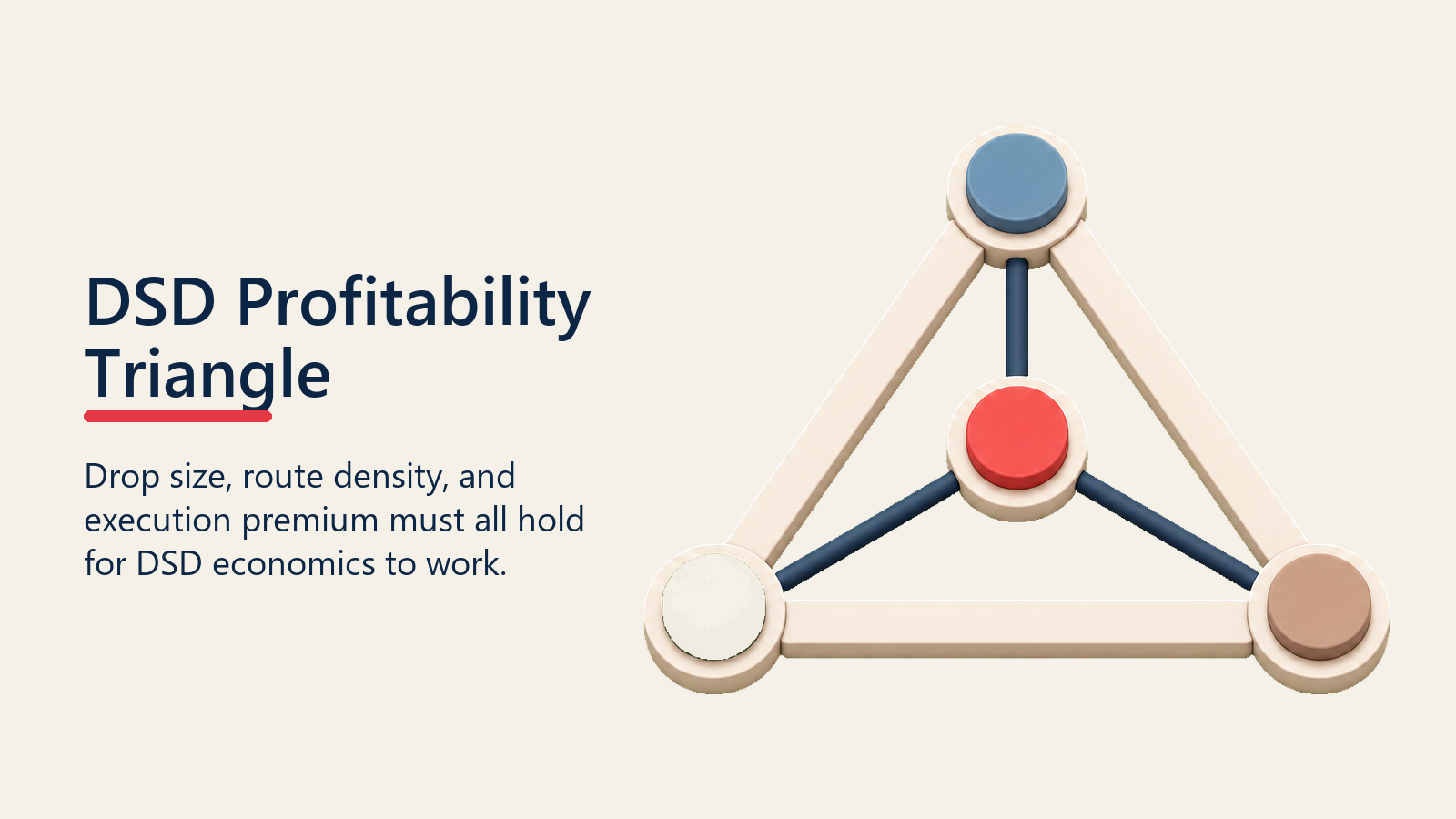
Drop Size sets the floor on what each route visit must generate to cover fixed costs. When drop size falls below the minimum threshold (see the Profitability Gate section above for planning benchmarks), the route stop destroys rather than creates value.
Route Density determines how many viable stops a route can sustain per day. The density thresholds discussed above apply here: below roughly 12 stops per day, fixed costs cannot be spread across enough revenue-generating visits to break even regardless of drop size.
Execution Premium is the commercial benefit that DSD's shelf-level control generates above what distributor delivery would achieve. This is the hardest leg to quantify but often the most important: the incremental revenue from better compliance, faster replenishment, and consistent merchandising is what makes the DSD cost premium rational. If the execution premium is low, either because the category doesn't reward shelf control or because the driver-salesperson role isn't well designed, DSD becomes an expensive version of simple delivery.
When any one leg weakens, the other two cannot compensate indefinitely. Right-sizing DSD coverage means continuously auditing all three.
Quotable Nuggets
"A DSD driver-salesperson in a high-traffic convenience store is doing five things in 15 minutes that a distributor van rep with 200 SKUs can rarely do consistently at scale: verifying temperature, checking shelf position, replacing aged stock, placing the promotional barker, and capturing the competitor facing. Each visit compounds."
"The companies that frame DSD as a cost center will always be looking for ways to cut it. The companies that frame it as a strategic capability will be asking what distribution quality they'd lose if they stopped." (Synthesized from route-to-market analysis; consistent with Consumer Goods Forum field research)
Frequently Asked Questions about Direct Store Delivery
What is direct store delivery in FMCG?
Direct store delivery (DSD) is a distribution model where the manufacturer delivers product directly from its own depot to the retail outlet, bypassing the distributor's warehouse and van sales network. The manufacturer controls the full supply chain from factory to shelf, including vehicle routing, in-store execution, and payment collection. DSD is most common in high-velocity, freshness-sensitive categories like beverages, snacks, and fresh bakery where execution control and replenishment speed justify the higher cost-to-serve.
How is DSD different from distributor delivery?
In distributor delivery, the manufacturer sells product to a distributor who then warehouses, sells, and delivers to retail outlets. The manufacturer loses direct control over in-store execution, replenishment timing, and shelf-level compliance once the product leaves the factory. In DSD, the manufacturer's own driver-salesperson or contracted vehicle operates at the shelf level on the manufacturer's behalf, enabling real-time order capture, direct merchandising, and execution standards that a third-party distributor typically can't consistently deliver.
What categories are best suited for DSD?
DSD works best in categories with short shelf lives (bread, fresh dairy, chilled ready meals), cold-chain requirements, high purchase frequency and impulse dynamics (beverages, snacks), and demanding in-store execution standards that drive sell-through. It's less suited for slow-moving SKUs, commodity categories with low margin, or markets where outlet density is too low to achieve profitable route density.
How do you know if a DSD route is profitable?
Calculate route-level contribution: daily revenue from all outlet deliveries on the route, minus variable costs (vehicle operating cost, driver compensation, product cost), should be positive before allocating fixed depot overhead. The primary profitability levers are average drop size per stop (should exceed minimum threshold, typically $75 to $150), stops per day (should achieve planned density), and vehicle utilization rate (should run at 70 percent or above). Routes that consistently miss these parameters either need outlet additions to improve density or should be converted to distributor coverage.
What is the difference between the DSP model and the pre-sell DSD model?
In the Driver-Salesperson (DSP) model, the driver is also the salesperson: they carry pre-loaded inventory, replenish shelves directly from the truck, take the next order, and collect payment on the same visit. In the pre-sell DSD model, a dedicated salesperson visits outlets in advance to take orders, and a separate delivery truck fulfills those orders on a subsequent route run. DSP is more efficient for high-frequency impulse categories where demand is predictable. Pre-sell works better when in-store execution is complex, order accuracy is critical, or the category requires more time at the shelf than a DSP visit allows.
Can DSD and distributor delivery run in parallel for the same brand?
Yes, and this is common in FMCG portfolios of any size. Many brands run DSD in high-density urban channels and key modern trade accounts where the execution premium justifies the cost, while using distributor delivery for secondary towns, low-density rural areas, and outlet tiers where drop sizes don't support DSD economics. The boundary between DSD and distributor-served channels is managed through a profitability gate calculation at the route level: outlets above the minimum drop size threshold in high-density areas go into DSD coverage; outlets below the threshold or in geographies where route density is insufficient go into the distributor network.
Learn More

Senior Implementation Consultant