Rural Distribution and Sub-Stockist Models: Reaching the Last Mile in FMCG
Turn this article into takeaways for your work.


Each assistant summarizes the article only for you and suggests best practices for your work.
Rural markets represent the largest underpenetrated opportunity in most FMCG portfolios. In India, rural consumers account for roughly 45 percent of FMCG consumption, with rural demand growth outpacing urban across most categories in recent quarters. In Indonesia, provinces outside Java and Bali hold over 40 percent of the population and a growing share of consumer spending. Across Sub-Saharan Africa, the rural-urban income gap is narrowing as mobile money and improved road infrastructure open new consumption corridors.
But the number most FMCG commercial leaders know better than the opportunity figure is the cost-per-drop. In many rural geographies, the economics of serving a small retailer in a village 80 kilometers from the nearest city don't work with the same distribution model that serves urban general trade. Drop sizes are smaller. Roads are inconsistent. Order frequency is lower. And the distributor who covers the nearest town often draws an informal boundary at the edge of the district headquarters.
The result is a familiar pattern: brands with strong urban positions and significant marketing investment in rural consumers can't close the gap between brand awareness and brand availability. The consumer wants the product. The distributor can't make money getting it there.
This article is about breaking that impasse through model design rather than effort alone.
Why Rural Distribution Fails
The failure mode for rural distribution is usually structural, not motivational. Distributors aren't covering rural markets because the standard urban distribution economics don't translate.
High cost-per-drop: In urban GT, a van route can serve 30 to 50 outlets per day with average drop sizes that justify the vehicle and driver cost. In rural areas, the same van might serve 10 to 15 outlets spread across a much larger geographic area, with smaller average drop sizes. The cost-per-case delivered rises sharply, and the distributor's margin doesn't compensate.
Low order frequency: Rural retailers order less frequently because their working capital is tighter and their storage space is limited. Weekly van visits often aren't economically justified, which means the retailer is either understocked between visits or buying from a local wholesaler who makes infrequent trips at poor prices.
Poor infrastructure: Unpaved roads, monsoon-season access problems, and fuel costs in remote areas add a logistics premium that doesn't show up in urban cost-to-serve models. A 100-kilometer rural route can take as long as an urban route covering 20 kilometers.
Distributor reluctance: Primary distributors are often managed on primary sales targets. Extending into rural coverage adds operational complexity, increases credit risk on smaller retailers they don't know well, and requires additional van and headcount investment that may not be covered by the incremental revenue. Without specific rural incentives or coverage mandates, most distributors will focus where the economics are easiest.
The distributor management and ROI framework matters here because changing rural economics often requires changing the incentive structure for the primary distributor, not just asking them to cover more territory with the same margins.
The solution isn't more effort from the existing distributor. It's a different intermediary designed for the last mile.
Key Facts: Rural FMCG Distribution
- Rural India accounts for approximately 45% of FMCG consumption, with rural demand outpacing urban growth across most categories in recent quarters (NielsenIQ, 2024). Indonesia's traditional trade, concentrated in rural and peri-urban areas, still held a 69% share of FMCG channel volume as of Q3 2023 (Statista, 2024), reinforcing the scale of the rural distribution opportunity across emerging markets.
- The IFC's last-mile retailer work across Asia and Africa documents persistent rural access gaps. Transportation costs as a share of total logistics costs are widely estimated at 40-50% for emerging-market FMCG companies serving rural routes, rising sharply for smaller drop sizes and longer drive times, an estimate drawn from IFC program documentation rather than a single audited figure. (IFC Last-Mile Retailer Framework)
- Hindustan Unilever's Shakti program, which uses women micro-entrepreneurs as rural distributors, had reached over 120,000 Shakti entrepreneurs operating across more than 175,000 villages in 18 Indian states as of 2020, one of the largest agent-based rural distribution networks documented in FMCG. (HUL Shakti program data, 2020)
The Sub-Stockist Model
The sub-stockist model solves rural distribution economics by inserting a smaller, lower-cost intermediary between the primary distributor and the rural retailer.
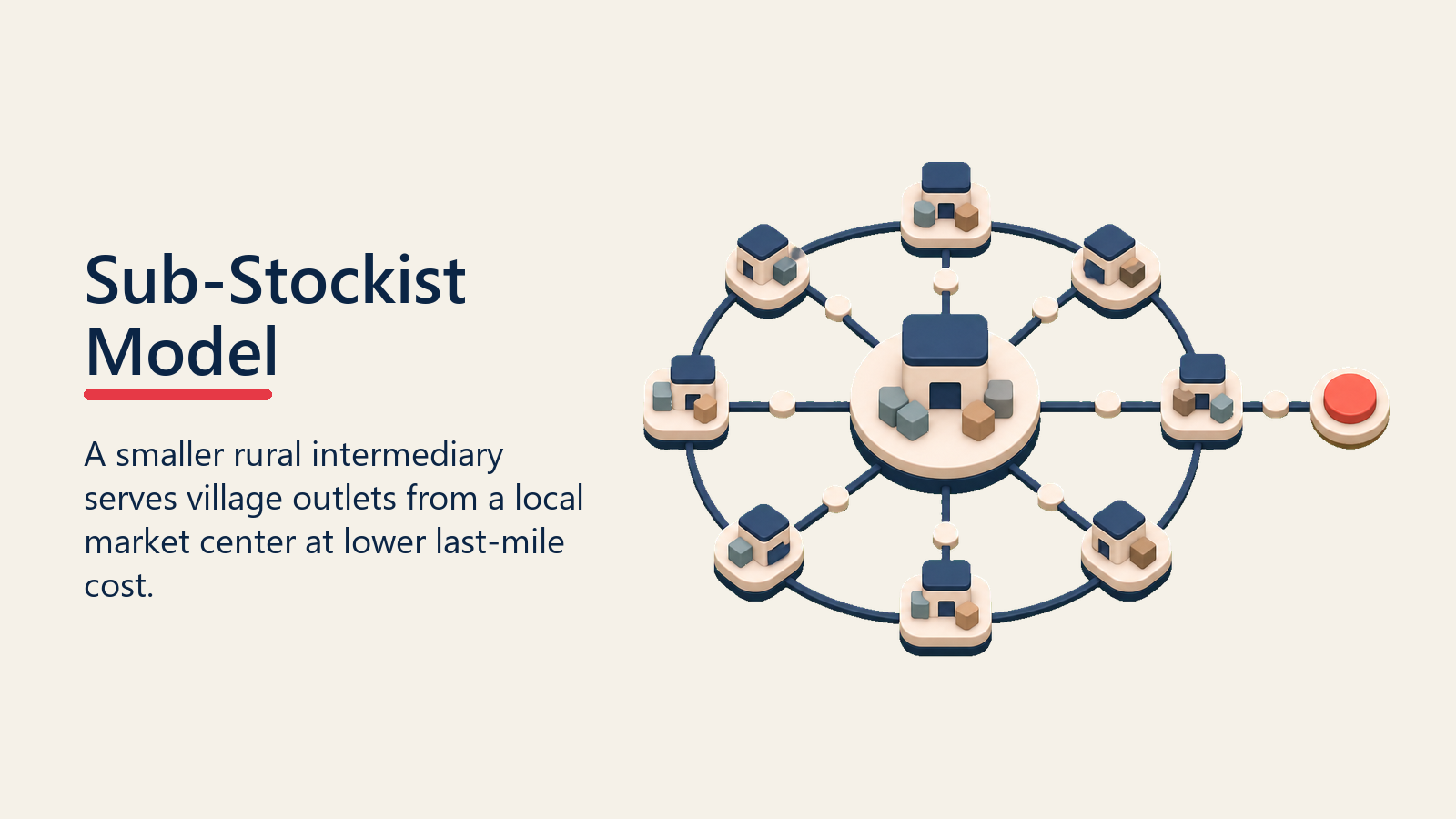
A sub-stockist (sometimes called a sub-dealer, rural stockist, or feeder) is a small entrepreneur in a rural town or market center who takes stock from the primary distributor and redistributes it to villages within a defined catchment. They typically cover a radius of 15 to 30 kilometers from their base location, serve 50 to 150 retail outlets, and carry a narrow SKU range aligned to rural demand patterns.
The sub-stockist's commercial proposition is straightforward: they earn a margin on the stock they move, they're closer to the rural outlets they serve, and they can operate at a lower cost structure than a primary distributor van because their territory is compact and their overhead is minimal. Many run the business from a small shop or a two-wheeler rather than a van.
Sub-Stockist Appointment Criteria
Before appointing a sub-stockist, evaluate candidates across five dimensions:
| Criterion | What to Evaluate | Weight |
|---|---|---|
| Location in catchment | Base in a recognized market center with good rural connectivity | 25% |
| Working capital | Ability to fund initial stock purchase; reference from local bank or trader | 25% |
| Local trade relationships | Known to and trusted by retailers in the target catchment | 20% |
| Storage and transport | Adequate storage; access to two-wheeler or light vehicle for delivery | 15% |
| Willingness to commit coverage targets | Agreement to cover defined outlet list with defined call frequency | 15% |
Territory Design for Sub-Stockists
The single most common mistake in sub-stockist network design is drawing territories on a map without validating the actual road network. A sub-stockist based in a market town 25 kilometers from a cluster of villages may be 45 minutes away by road during dry season and effectively unreachable during monsoon. Territory design should be based on travel time and road-quality data, not straight-line distance.
Aim for sub-stockist territories that allow the sub-stockist to service all assigned outlets in a single day, with enough call frequency to maintain appropriate stock cover. In most rural configurations, this means territories covering 50 to 100 outlets accessible within 30 to 40 minutes of drive time from the sub-stockist's base.
Margin Structure
The sub-stockist earns a margin that sits between the primary distributor's selling price and the retail selling price. A typical structure gives the sub-stockist a net margin of 5 to 8 percent on the SKUs they handle, after accounting for the primary distributor's margin. The exact structure depends on category margin norms, SKU price points, and the cost-to-serve economics of the rural territory.
Some FMCG companies incentivize sub-stockists with a separate rural coverage bonus, payable quarterly against verified outlet coverage targets. This is particularly effective when launching a new SKU into rural markets or when trying to drive coverage depth beyond the sub-stockist's natural economic incentive.
The logistics architecture that makes this network work at scale is the hub-and-spoke model.
How Does Hub-and-Spoke Logistics Make Sub-Stockist Networks Work?
The hub-and-spoke model is the logistical architecture that makes sub-stockist networks work at scale. The structure is simple: a mother depot (typically the primary distributor's warehouse) supplies a network of smaller sub-depots (the sub-stockist's storage locations), and the sub-stockist makes the final delivery to village retailers.
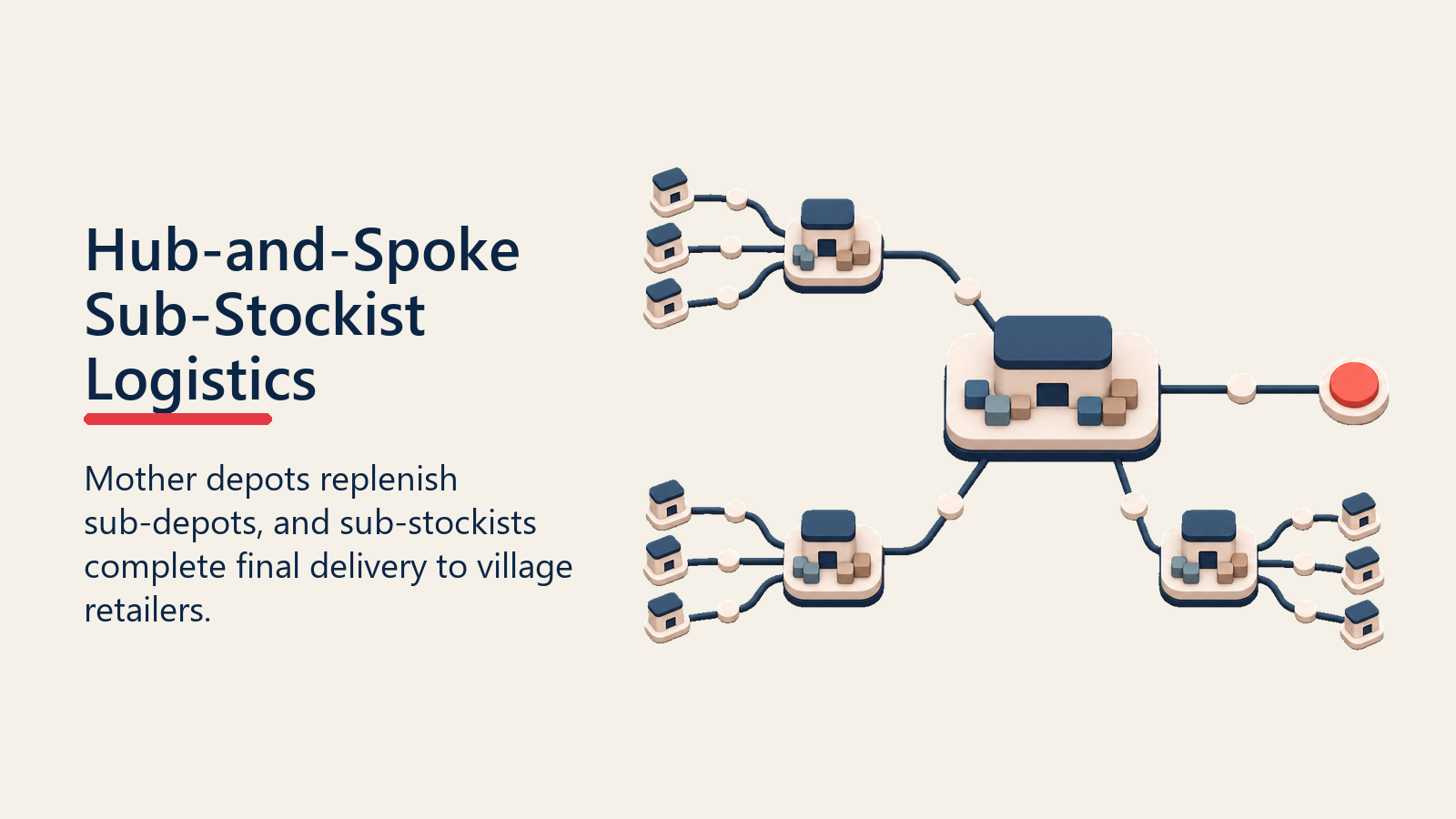
Mother Depot Functions: Stock holding for the full SKU range, order consolidation, van loading for sub-depot replenishment runs, and primary sales tracking. The mother depot's van runs a weekly or bi-weekly route to replenish sub-stockists rather than trying to reach every rural retailer directly.
Sub-Depot Functions: Local stock holding for the rural SKU set (typically a curated 30 to 60 SKU range for the rural market), local order collection from village retailers, and last-mile delivery by two-wheeler or light vehicle. Sub-depots don't need a full distribution infrastructure, just adequate dry storage and basic order management.
When Hub-and-Spoke Pays
The model generates a positive ROI when: (1) the cluster of rural outlets in a sub-stockist's catchment generates enough volume to justify the sub-stockist's margin and the mother depot's replenishment cost; (2) the alternative (direct distributor coverage) would cost more per case to execute; or (3) the absence of coverage is costing you more in lost sales than the sub-stockist network would cost to build.
A simple payback model: if a sub-stockist territory covers 80 outlets averaging 20 cases per month in offtake, that's 1,600 cases per month. At an average case value of $5 and a sub-stockist margin of 6 percent, the sub-stockist earns $480 per month. If the alternative is zero coverage of those 80 outlets, the revenue foregone is $8,000 per month at the manufacturer level. The sub-stockist cost is justified by the third case order.
Your route-to-market models framework should model the hub-and-spoke structure explicitly, comparing cost-per-case across direct coverage and sub-stockist alternatives before committing to a rural coverage strategy.
Once the model is right, coverage metrics tell you whether it's working.
Rural Coverage Metrics
Rural distribution performance requires its own KPI dashboard. The urban metrics (numeric distribution across all general trade outlets, share of shelf in high-traffic stores) don't translate well to rural geographies where the retail universe is fragmented and outlet quality varies enormously.
Rural Coverage KPI Dashboard
| Metric | Definition | Target (Indicative) |
|---|---|---|
| Villages covered | Number of villages with at least one stocking outlet | Tiered by village population size |
| Outlets per village | Average retail outlets stocking at least one SKU | 2+ for villages above 2,000 population |
| Rural numeric distribution | % of target rural outlets stocking primary SKU range | 60%+ for core SKUs |
| Cost-per-case (rural) | Total rural distribution cost divided by cases shipped to rural outlets | Modeled against urban benchmark |
| Sub-stockist active rate | % of appointed sub-stockists placing orders in the trailing 30 days | >90% |
| Rural out-of-stock rate | % of visited rural outlets reporting stockout on primary SKU | Below 10% |
Coverage and frequency optimization principles apply to rural territory design: the question isn't just how many outlets you're reaching, but whether you're reaching them often enough to maintain adequate stock cover given the infrequent reorder patterns of rural retailers.
Numeric and weighted distribution tracking in rural contexts is most useful when the outlet universe is segmented by village population size, so that coverage of high-population villages gets prioritized before smaller settlements.
Coverage without demand activation is shelf presence without turn. Here's how to drive it.
Activating Rural Demand
Distribution without demand activation generates shelf presence without turn. Rural consumers need to encounter the product not just in a stocking outlet but in a context that drives trial, especially for categories where the consumer is loyal to a local or regional brand and the national brand is unfamiliar.
Haats and Melas: Weekly rural markets (haats in India, pasar tani in Malaysia) concentrate consumer foot traffic that's otherwise dispersed across villages. A van activation at a haat can expose a brand to several hundred consumers in a single day at a fraction of the cost of door-to-door sampling. FMCG companies that systematically build haat calendars into their rural activation programs typically report trial rates estimated at 3 to 5 times higher than static retail display alone, a practitioner range based on field activation experience rather than a single controlled study.
Agri-Input Shop Tie-Ins: In farming communities, the agri-input retailer (seed, fertilizer, pesticide dealer) often has higher trust and foot traffic than the general retailer. Co-locating FMCG brand displays with agri-input retailers, or running joint promotions during sowing and harvest seasons when cash is available, gives brands access to a high-credibility point of sale.
Mobile Van Activations: A branded van that moves through a rural circuit, combines sales ordering with consumer sampling and brand education, is one of the most effective rural activation tools for categories where trial barriers are high. The van activation model works best when it follows the sub-stockist's coverage route, so that consumers who trial a product during the van visit can find the same product stocked locally within a week.
Influencer Network Models: Following models like Hindustan Unilever's Shakti program, appointing local women entrepreneurs as brand representatives who sell from their homes and local networks can extend reach into villages where a retail outlet doesn't exist or doesn't stock the brand's SKU range. These models work best for personal care and household products where trusted local recommendation drives trial. The IFC's last-mile retailer framework documents similar micro-entrepreneur models across Asia and Africa as a proven method for closing the distribution gap in rural communities.
Technology Enablers
Rural distribution has historically been the last area to benefit from sales force automation and digital tools, partly because of connectivity constraints and partly because the average rural DSR (distributor sales representative) has lower digital literacy than urban counterparts. That gap is closing.
GPS-Tracked Van Routes: Basic GPS tracking on rural delivery vans gives the area sales manager visibility into whether the van is following its planned route and making its scheduled stops. This is particularly important in rural contexts where the temptation to cut short a long route is higher than in urban areas where call compliance is easier to verify.
SFA Apps for Rural DSRs: Lightweight sales force automation apps that work offline and sync when connectivity is available allow rural DSRs to record outlet visits, stock checks, and orders without relying on paper call cards. Apps designed for low-bandwidth environments (2G connectivity in many rural geographies) with simple interfaces have improved rural SFA adoption rates significantly. Beat and journey planning tools support the planning layer: territory designers can optimize rural beat sequences based on travel time and outlet clustering.
SMS-Based Ordering for Sub-Stockists: In contexts where smartphone penetration among sub-stockists is still growing, SMS-based ordering systems allow sub-stockists to submit reorder requests without requiring an internet connection. The system generates an order record, triggers dispatch from the mother depot, and provides a confirmation SMS back to the sub-stockist. It's not as data-rich as an app, but it's more reliable and more widely accessible.
Territory-Based Routing: Routing optimization tools that cluster rural outlets by travel time and road network can significantly improve the efficiency of rural van routes. In markets where rural distributor DSRs plan their own beats without systematic optimization, computerized route planning is estimated to reduce travel time per outlet served by 15 to 25 percent, a commonly cited practitioner range for route optimization gains in fragmented territory environments.
A standard operating procedure for rural distribution coverage should document the expected outlet call sequence for each sub-stockist, the frequency of mother-depot replenishment runs, the escalation process when a sub-stockist goes inactive, and the performance review cadence. See the Learn More section below for a template framework.
Building Rural Distribution as a Competitive Moat
The economics of rural distribution improve over time as the network matures. Sub-stockist operations become more efficient as they learn their territories. Mother depot replenishment routes become denser as more sub-stockists are added. Consumer familiarity with the brand reduces the activation investment required to drive trial.
But the moat only forms if you build before competitors do. In most emerging markets, rural distribution leadership is established early, and the sub-stockist or agent who is already servicing a territory with a competing brand has a strong structural reason to limit shelf space for a later entrant. The first mover advantage in rural channel development is real. Bain's emerging-market FMCG research confirms that traditional trade will remain relevant in semi-urban and rural areas for the foreseeable future, which makes early rural channel investment a structural differentiator rather than a tactical choice.
The brands that built rural distribution networks in India during the 1990s and early 2000s, investing in coverage and demand activation when the economics were marginal, are the ones that hold dominant market share today in rural consumption categories. The investment preceded the return by years in some cases.
Building rural distribution is a long-term commercial commitment, not a short-term coverage project. Model the economics honestly, design the sub-stockist structure deliberately, activate demand at the point of sale, and track coverage metrics with the same rigor you apply to urban trade performance. The rural market is too large and too important to leave to the default behavior of an urban-focused distributor network.
The Rural Coverage Build Sequence
The build sequence keeps rural expansion economically grounded by adding coverage only after the market-center base works.
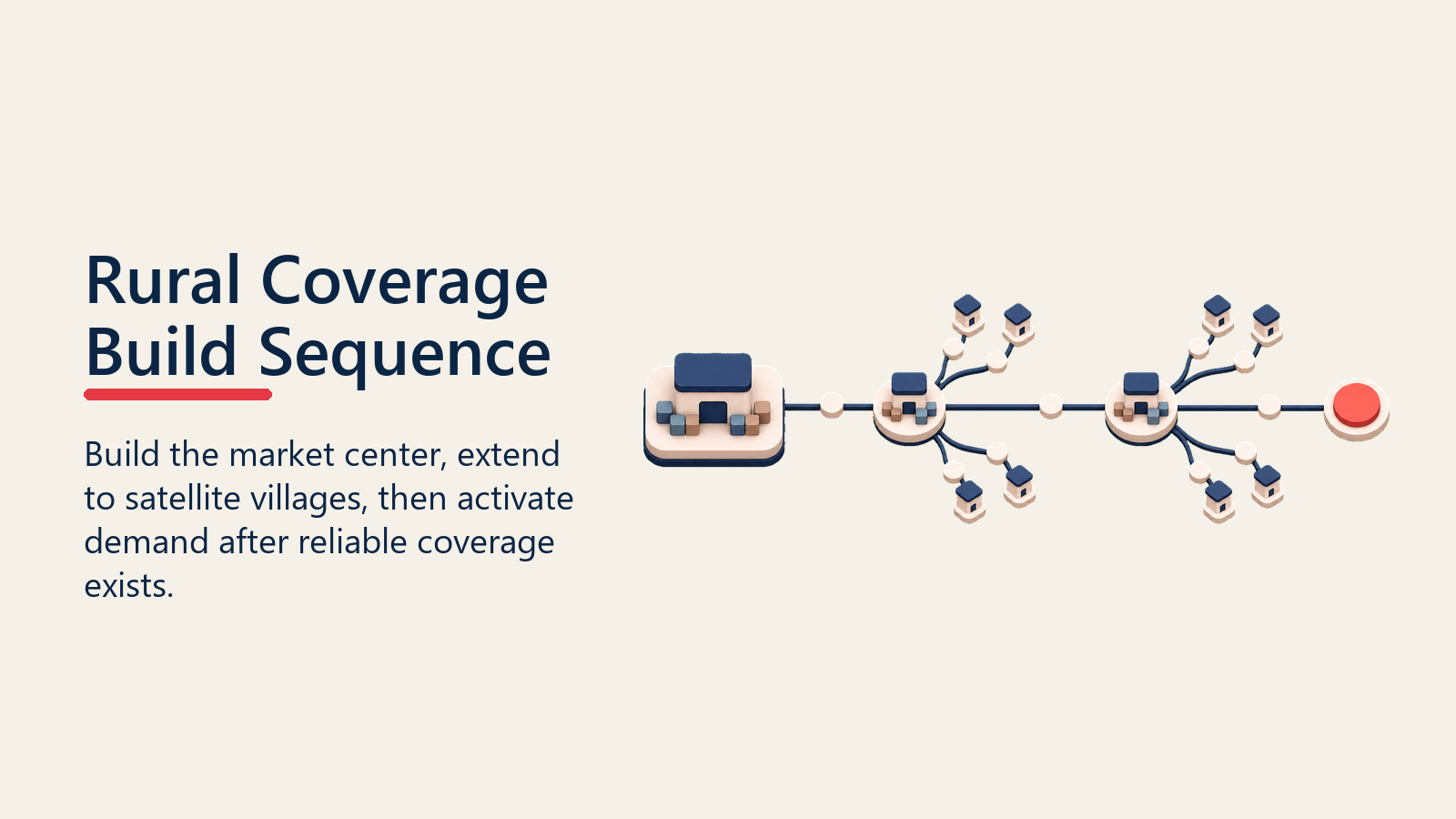
The Rural Coverage Build Sequence: Rural distribution networks fail when companies try to cover everything at once. The sequence that works starts with the market center: identify the rural towns and district headquarters where weekly markets concentrate consumer foot traffic and where a sub-stockist can operate with basic storage and two-wheeler transport. Stage 1 coverage focuses on these market centers and the outlets within 15 kilometers of each. Stage 2 extends from market centers to satellite villages, using the established sub-stockist as the replenishment source. Stage 3 is demand activation: haat calendars, mobile van circuits, and influencer networks that convert brand awareness into purchase in outlets that are now stocked. Companies that skip Stage 1 and try to reach satellite villages before the market center is served reliably create coverage gaps that undermine the economics of the whole network. Build the hub before the spokes.
"The failure mode for rural distribution is usually structural, not motivational. Distributors aren't covering rural markets because the standard urban distribution economics don't translate. No amount of sales target pressure changes that calculation."
"The sub-stockist's competitive advantage is proximity. They know the shopkeepers, they can call in on a two-wheeler, and they can take small orders without the cost structure of a van route. That's the last-mile problem solved, if you design the territory right."
"Rural distribution leadership is established early. The sub-stockist who is already servicing a territory with a competing brand has a structural reason to limit your shelf space. First-mover advantage in rural channel development is real and it compounds." (Consistent with Bain emerging-market FMCG research, 2023.)
Frequently Asked Questions about Rural Distribution and Sub-Stockist Models
What is a sub-stockist in FMCG distribution?
A sub-stockist (also called a sub-dealer or rural stockist) is a small entrepreneur in a rural market center who takes stock from a primary distributor and redistributes it to retail outlets within a defined rural catchment. Sub-stockists operate at lower cost structures than primary distributors because their territory is compact and their overhead is minimal, making them effective at serving rural outlets where primary distributor van economics don't work.
How do you calculate rural distribution economics?
Start with the target catchment: how many outlets, what average drop size, what call frequency. Then calculate the sub-stockist's revenue (outlets times average order size times call frequency) against their margin (typically 5 to 8 percent of the selling price). Compare the sub-stockist's cost against the cost of direct distributor coverage (which typically runs 2 to 3 times higher per case in rural geographies due to longer routes and smaller drops). The sub-stockist model pays when the alternative is either no coverage or direct coverage that destroys margin.
What rural-specific SKU range should an FMCG brand push?
Rural SKU selection should prioritize high-velocity, affordable pack sizes that match rural purchasing power and storage constraints. Single-serve sachets, small-format packs, and value-bundle configurations typically outperform the premium or large-format SKUs that drive urban modern trade. Limit the rural active SKU range to the 20 to 40 products that account for 80 percent of rural volume, and resist the temptation to push the full portfolio before basic distribution depth is established.
How do you keep a sub-stockist network from going inactive?
Sub-stockist inactivity is usually a financial performance problem, not a motivation problem. If the sub-stockist's offtake is too low to justify the working capital they need to hold stock, they'll reduce orders or stop entirely. Address this by validating the territory economics before appointment (is there enough outlet volume to sustain the sub-stockist's margin?), setting a minimum coverage bonus payable quarterly against verified outlet targets to bridge the early period before the network matures, and assigning an area sales manager to conduct monthly sub-stockist visits in the first two quarters. Sub-stockists who go six to eight weeks without a manufacturer visit typically show declining order frequency.
What is the difference between a sub-stockist and a wholesaler in rural distribution?
A wholesaler operates from a fixed location and services retailers who come to them to buy. A sub-stockist is appointed by the primary distributor to actively cover a defined rural territory, carrying stock to village retailers rather than waiting for them to visit. Sub-stockists have a defined outlet list, a coverage commitment, and a margin structure linked to that territory. Wholesalers have none of these obligations; they sell to whoever arrives and optimize for margin per transaction rather than territory coverage. For planned rural distribution expansion, the sub-stockist model produces the coverage density that a passive wholesaler network can't.
How long does it take to build a viable sub-stockist network from scratch?
Expect 12 to 18 months before a new sub-stockist network reaches sustainable operating economics in most emerging markets. The first three months focus on territory design, appointment, and initial stock loading. Months four through nine are the most fragile: sub-stockists are building outlet relationships, learning their routes, and sometimes struggling with working capital. Manufacturer field support during this period (call rides, promotional materials, priority stock allocation) significantly reduces attrition. By month 12, sub-stockists who are still active typically show improving order frequency and expanding outlet coverage. By month 18, the economic model either validates or reveals a territory design problem.
Learn More

Senior Implementation Consultant