Promoter and BTL Activation Management: Making In-Store Marketing Pay Off
Turn this article into takeaways for your work.


Each assistant summarizes the article only for you and suggests best practices for your work.
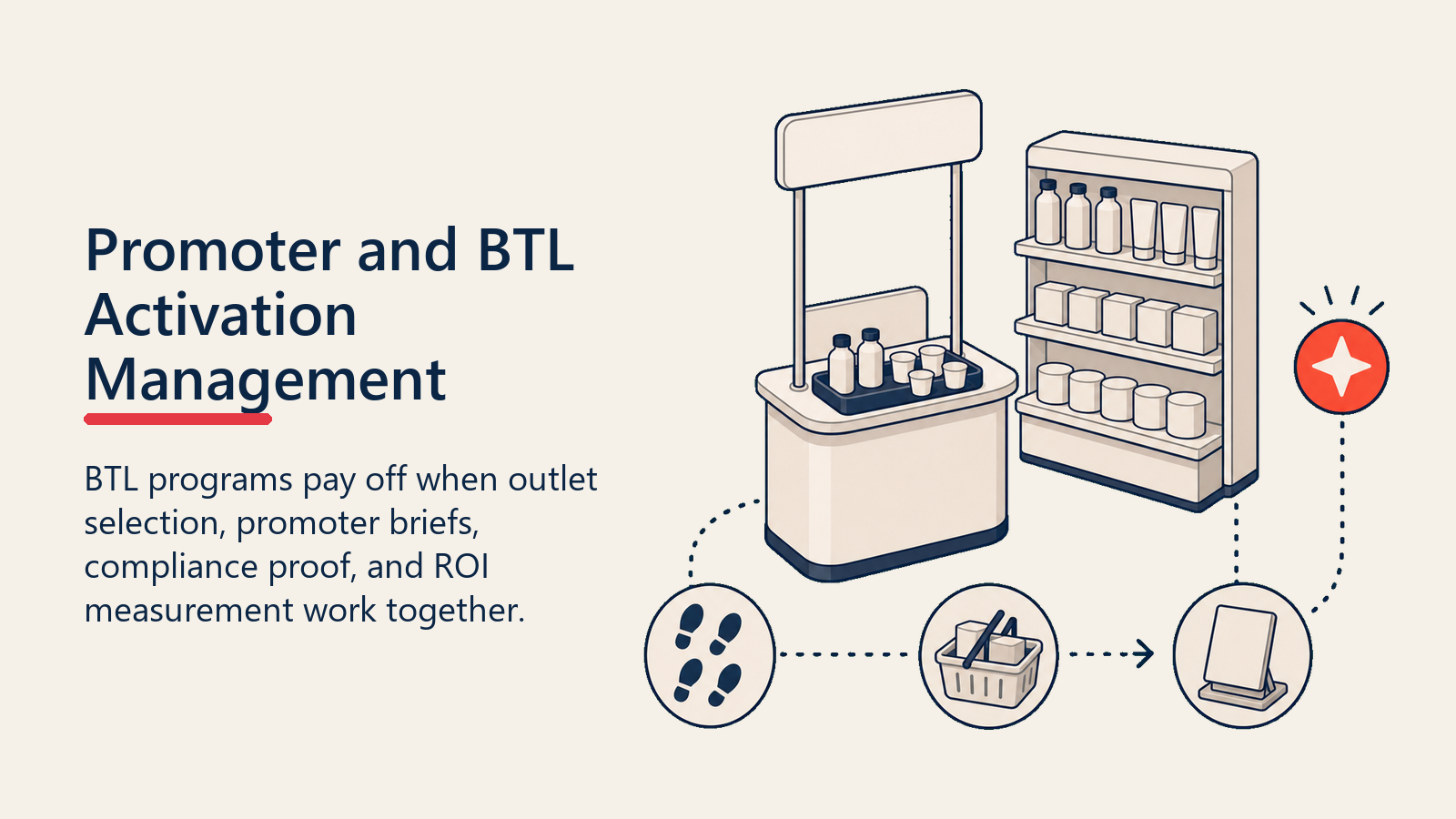
A promoter standing next to a shelf for eight hours a day is either one of the highest-leverage sales tools an FMCG brand has, or a fixed cost generating almost nothing. The difference isn't the promoter. It's whether the deployment, the brief, and the measurement around them were built with any rigor.
Below-the-line (BTL) activation, promoters, demo stands, sampling drives, in-store contests, is one of the largest discretionary spend lines in FMCG trade marketing, and, as Kantar's trade promotion research notes, one of the least rigorously measured. Most companies can tell you how many promoter-days they funded last quarter. Few can tell you which ones generated incremental sales versus which ones just supervised a shelf that would have sold the same volume anyway.
This article covers how to plan promoter deployment, manage day-to-day compliance in the field, and measure BTL activation ROI in a way that lets you cut the activations that don't work and scale the ones that do.
Why BTL Spend Is Hard to Manage
Three structural problems make promoter and BTL management harder than it looks on a media plan.
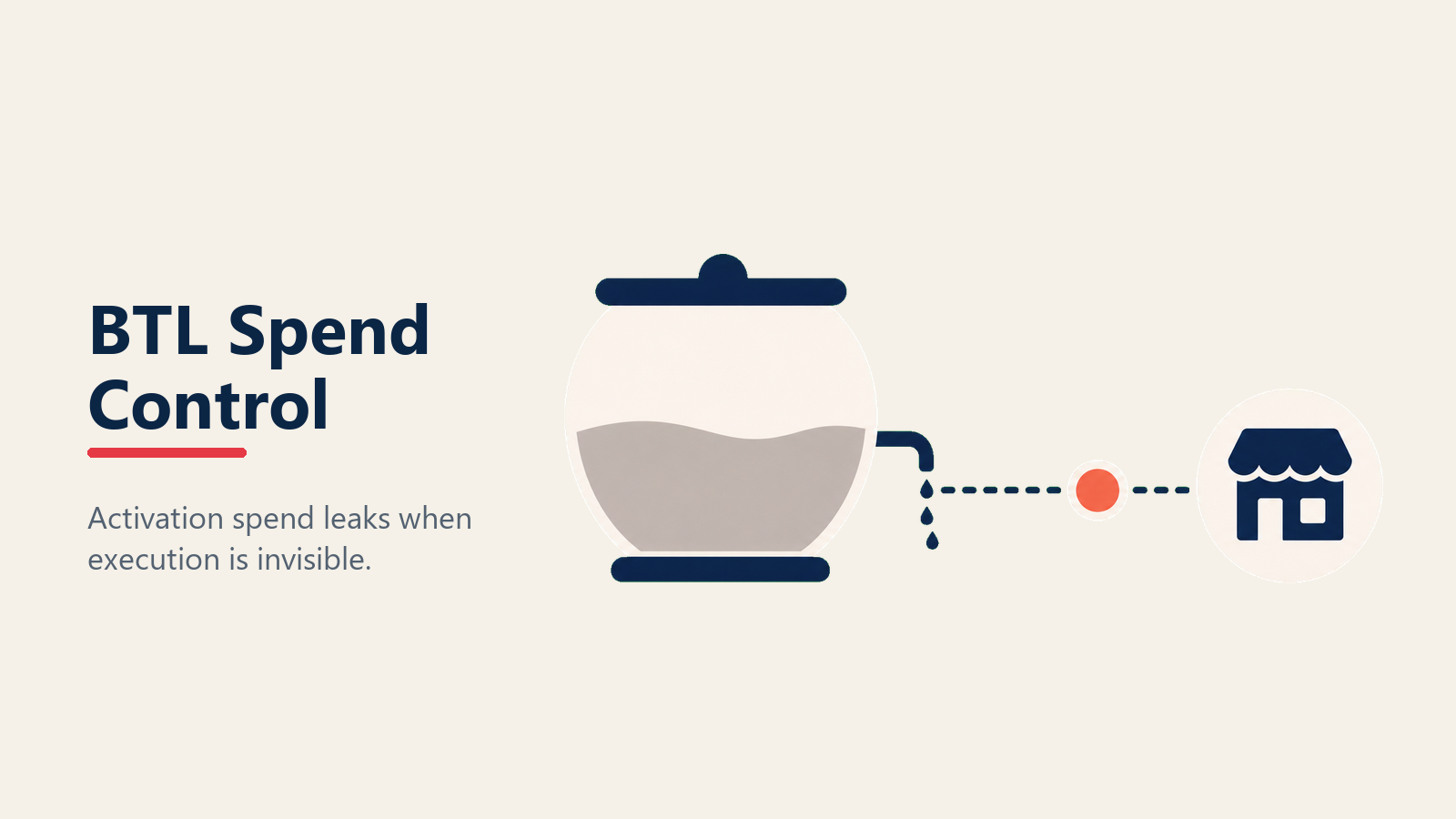
Deployment decisions are made centrally, execution happens locally. A trade marketing team decides to fund 200 promoter-days across a region based on aggregate sales potential. The actual outlet-by-outlet allocation, which stores get a promoter and which don't, is often left to distributor or agency discretion, disconnected from which outlets would actually benefit most from an activation.
Promoters are usually third-party or agency staff, not direct employees. This creates a natural incentive gap. The agency is paid for promoter-days delivered, not for incremental sales generated. Without a compliance and outcome tracking layer, there's no way to tell if a promoter showed up, followed the brief, and drove a lift, versus showed up and stood quietly near the shelf.
Attribution is genuinely difficult. Sales at an outlet during a promoter activation reflect the promoter's effort, but also seasonality, competitor activity, general footfall, and whether the shelf was in stock that day. Isolating the promoter's actual contribution takes a real comparison approach, not a simple before/after read. Kantar's research on trade promotion management finds that most FMCG organizations still lack the processes and tools to properly plan and evaluate promotional and in-store investment, which is exactly the gap that lets an unverified before/after comparison pass as evidence when it shouldn't.
None of these problems mean BTL activation doesn't work. It's one of the most effective retail execution levers available when outlets are chosen well and compliance is verified. It means the management discipline around it has to be tighter than most companies currently run it.
Key Facts: Promoter and BTL Activation Management
- Well-targeted in-store promoter activations in FMCG commonly generate sales lifts in the range of 15-40% at the activated outlet during the activation period, though the range varies significantly by category, activation type, and baseline outlet performance.
- Promoter compliance verified through photo or geo-tagged check-in typically runs meaningfully higher than compliance under a self-reported or unverified model, based on common retail execution practice.
- Activations run without a defined outlet selection criteria tend to concentrate in easy-to-access urban outlets rather than the highest-potential outlets, diluting average ROI across the program.
Planning Deployment: Which Outlets Get a Promoter
Not every outlet benefits equally from a promoter or BTL activation. Deployment decisions should follow a selection framework, not availability or convenience. Call this The Conversion Gap Method: rank candidate outlets by the size of the gap between foot traffic and category sales, and staff the gap, not the address book of outlets an agency finds easiest to cover.
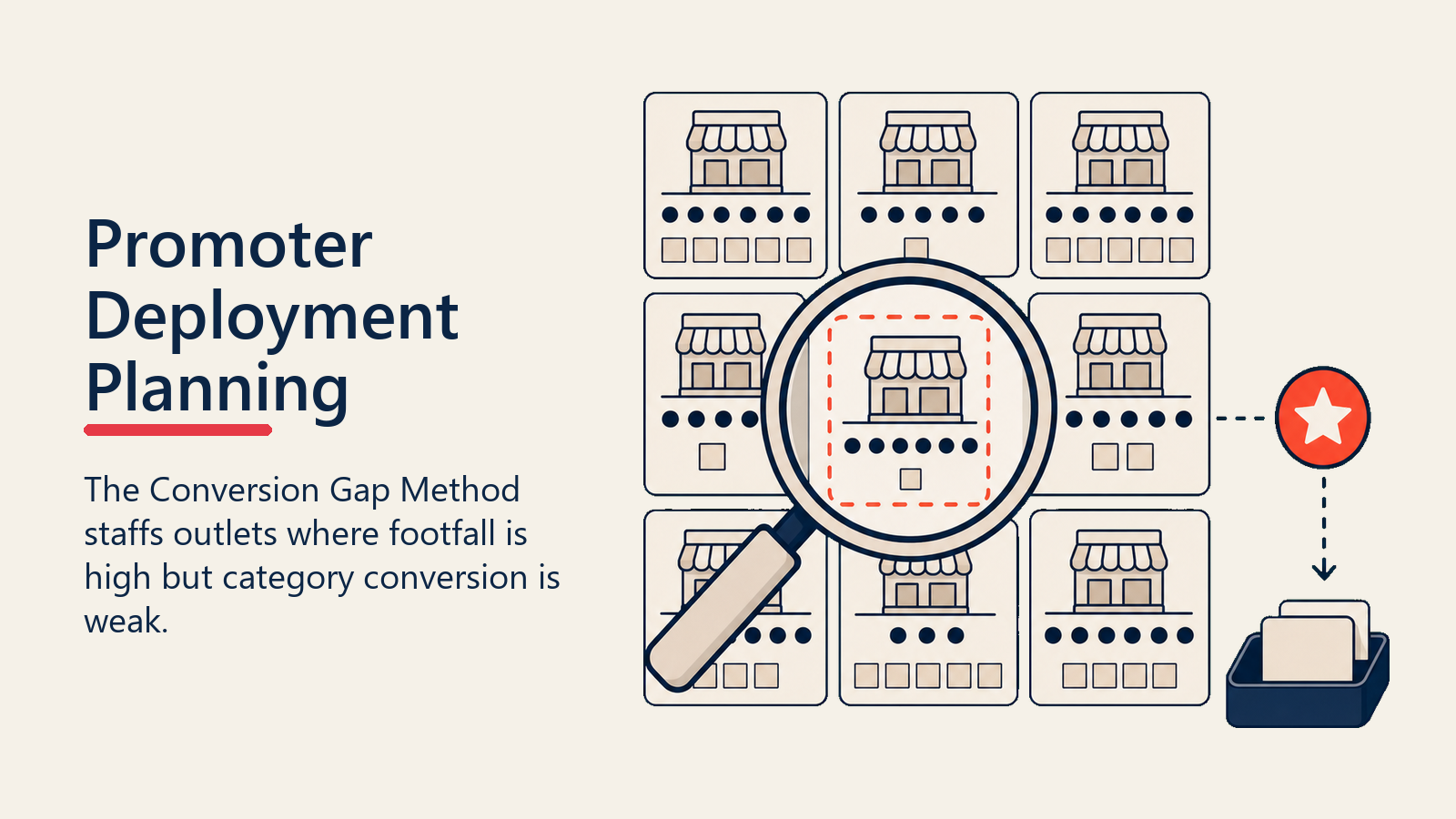
High footfall, low conversion outlets. An outlet with strong foot traffic but underwhelming category sales is the ideal promoter target. The traffic is already there; the promoter's job is converting browsers into buyers through active recommendation, sampling, or a visible demo.
New product or relaunch windows. Promoters are highly effective at driving trial during a launch window, when the core job is educating shoppers on a product they don't yet have a habit around. See New Product Launch and Distribution Build for how activation timing should sync with the broader launch sequence.
Competitive pressure points. Outlets where a competitor has recently launched an aggressive promotion or activation need a countering promoter presence too. What's at stake there is share of shelf attention, which matters just as much as share of shelf space.
Outlets with poor shelf visibility. If a product is consistently placed in a weak shelf position due to space constraints, a promoter can partially offset that with active recommendation, though this should be a temporary fix while the underlying merchandising issue in In-Store Merchandising and Planograms gets addressed.
Deployment Selection Scorecard
| Criterion | Weight | Signal | Priority Level |
|---|---|---|---|
| Footfall vs category conversion gap | 30% | High traffic, underperforming category sales | High |
| Launch or relaunch window | 25% | Product in first 90 days of listing | High |
| Competitive activity | 20% | Competitor activation or promo detected | Medium |
| Shelf visibility constraint | 15% | Poor facing or position, temporary fix | Medium |
| Outlet accessibility | 10% | Practical for agency staffing and supervision | Low, tiebreaker only |
Outlet accessibility should be the last tiebreaker, not the primary filter. Programs that default to "wherever the agency can easily staff" end up over-indexed on convenient urban outlets and under-indexed on the outlets where a promoter would generate the most incremental lift.
The Activation Brief: What a Promoter Actually Needs
A promoter without a clear brief defaults to passive shelf-standing. The brief needs to specify four things in concrete, checkable terms.
The specific behavior expected. Not "promote the product" but "approach every shopper who pauses at the category shelf for more than 5 seconds, offer a sample, and mention the current promotional price." Vague briefs produce vague execution.
The sampling or demo protocol. If sampling is involved, specify quantity per day, hygiene protocol, and what to do when samples run out (stop sampling and switch to verbal pitch, versus close the activation early). Running out of samples by 2pm and then standing idle for the rest of the shift is a common and entirely preventable failure mode.
Reporting requirements. What the promoter needs to log each day: units sold during the shift (if trackable), sample count distributed, shopper interactions estimated, and any competitor activity observed at the same outlet. That last item is what turns every promoter into a low-cost field intelligence source and not just another sales body.
Escalation path. Who the promoter contacts if the outlet runs out of stock mid-shift, if the outlet owner asks them to leave, or if a competing brand's team sets up an activation at the same time. Promoters without an escalation path either freeze or make an uncoached decision that may not serve the brand well.
Compliance Tracking: Verifying the Activation Actually Happened
The single highest-leverage investment in BTL management is compliance verification, because it's the input that determines whether every other measurement is trustworthy.
Photo verification at shift start and end. A geo-tagged photo of the activation setup (banner, table, promoter in uniform) at the start of the shift and a shelf photo at the end gives a verifiable record that the activation occurred at the specified outlet and time.
Check-in and check-out timestamps. GPS-verified check-in and check-out through a mobile app confirms the promoter was actually on-site for the contracted hours. Paid for the shift and present for the shift aren't the same thing.
Sample or unit reconciliation. If sampling stock was issued, reconcile distributed quantity against remaining stock at shift end. Consistent discrepancies indicate either poor execution or, less charitably, samples not actually being distributed as reported.
Random field audits. A sales manager or trade marketing field auditor should conduct unannounced spot checks on a rotating sample of active promoters, at minimum 10-15% of active activations per month. This is the check that catches problems photo verification alone can miss, like a promoter present but not actively engaging shoppers.
Compliance Tracking Checklist
- Geo-tagged photo at shift start showing setup and promoter presence
- Geo-tagged photo at shift end showing shelf state and any remaining stock
- App-based check-in and check-out timestamp captured
- Daily activity log submitted (units sold, samples distributed, interactions)
- Sample/stock reconciliation completed weekly
- Unannounced field audit conducted on rotating sample monthly
- Non-compliance flagged and routed to agency management within 48 hours
Measuring BTL and Promoter ROI
Measuring activation ROI requires isolating the promoter's contribution from baseline sales the outlet would have generated anyway. Three approaches work, in increasing order of rigor.
Before/after comparison at the same outlet. Compare sales velocity during the activation period against a comparable pre-activation period (same days of week, adjusted for seasonality). This is the simplest method but overstates lift if the comparison period wasn't a fair baseline.
Matched control outlet comparison. Select a comparable outlet with similar footfall, format, and baseline sales that did NOT receive a promoter during the same period, and compare sales lift between the two. This controls for market-wide seasonality and competitive effects that a simple before/after can't isolate.
Cost-per-incremental-case. Total activation cost (promoter wages, samples, materials, agency management fee) divided by the incremental case volume attributed to the activation, using either method above. This is the number that lets you compare BTL ROI against other trade investment options, like a straight price promotion or an in-store merchandising upgrade. Kantar's research on trade promotion management cited above found that most FMCG organizations still lack the right processes and tools for this kind of measurement discipline, which is exactly why a single comparable metric across activation types matters more than any individual activation's raw sales number.
BTL ROI Calculation Example
| Metric | Outlet A (with promoter) | Outlet B (matched control, no promoter) |
|---|---|---|
| Daily average units, baseline period | 45 | 42 |
| Daily average units, activation period | 78 | 46 |
| Lift attributable to activation | 29 units/day (matched control adjusted) | n/a |
| Activation cost (daily, allocated) | $65 | n/a |
| Cost per incremental unit | $2.24 | n/a |
Without the matched control, the naive before/after comparison at Outlet A alone would have overstated the lift as 33 units/day instead of the more accurate 29, since Outlet B's own 4-unit organic increase reflects a market-wide trend the promoter didn't cause. That gap matters when you're deciding whether to renew a six-figure annual BTL contract.
Quotable Nuggets
A before/after sales comparison without a matched control outlet routinely overstates promoter-driven lift, because it credits the promoter for market-wide seasonal or category movement the outlet would have captured anyway.
An agency paid purely on promoter-days staffed has no built-in incentive to ensure quality execution, which is why compliance metrics, not headcount delivered, belong in the payment formula.
How Do You Manage the Agency Relationship?
Most promoter and BTL execution runs through third-party agencies, and the agency relationship needs the same performance discipline as a distributor relationship.
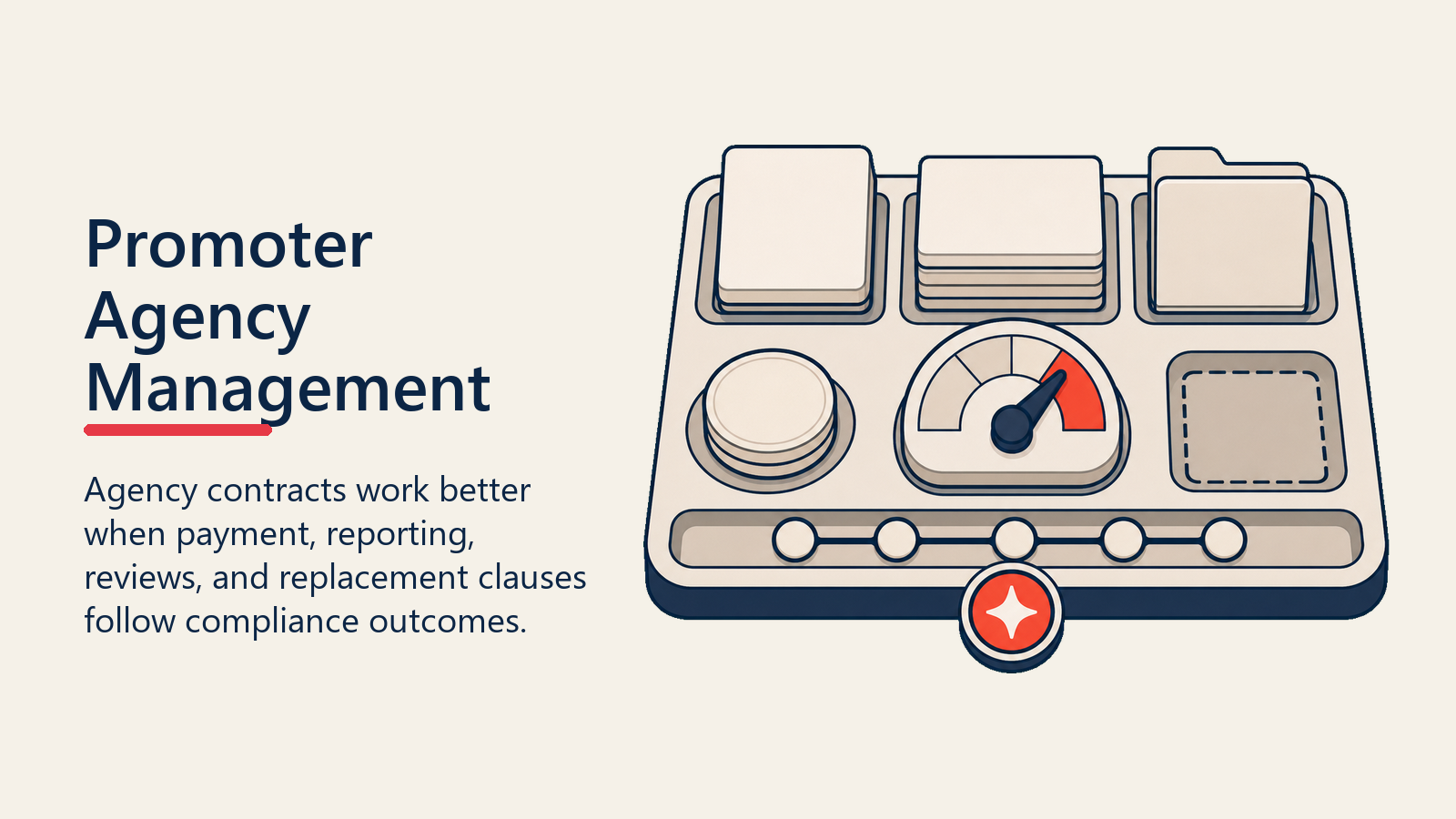
Tie payment to compliance, not headcount alone. An agency contract that pays purely on promoter-days staffed has no incentive to ensure quality execution. Structure at least a portion of the fee around compliance metrics: photo verification rate, check-in reliability, and reporting completeness.
Require standardized reporting, not agency-format summaries. Agencies naturally want to report in whatever format is easiest for them. Insist on your own reporting template so data is comparable across agencies and regions, and so it feeds directly into your ROI calculation rather than requiring manual reformatting every month.
Review agency performance quarterly, separate from individual promoter performance. An agency can have strong promoter compliance in one region and weak compliance in another due to local management quality. Track agency performance at the regional level to catch this pattern before it becomes a national problem.
Build a rotation or replacement clause into the contract. Poor-performing individual promoters should be replaceable within a defined notice period (5-7 days is typical) without contract renegotiation, so a single weak promoter doesn't become a semester-long drag on activation ROI at that outlet. Negotiating these terms up front, rather than after a problem surfaces, follows the same logic as structured negotiation approaches in B2B deal-making: fix the mechanism before you need it, not while you're already arguing about a specific underperforming promoter.
Coordinating BTL with the Broader Trade Calendar
BTL activation works best when it's synchronized with, not disconnected from, the broader promotional and merchandising calendar.
Align promoter deployment windows with trade promotion periods so the in-store push and the pricing incentive land at the same time. A promoter actively pitching a product that isn't on any current promotion is working harder than necessary to convert a sale. See Promotions and Trade Scheme Execution for how to sequence trade schemes with in-store activation support.
Coordinate with the merchandising team so the shelf or secondary display the promoter is working next to is actually stocked and compliant before the activation starts. A promoter working a shelf that's out of stock or poorly merchandised is generating shopper interest that can't convert into a sale, which wastes both the activation spend and the shopper's attention.
Feed activation performance data back into outlet segmentation. An outlet that consistently delivers strong lift from promoter activation is a candidate for more frequent or longer activation windows, following the same logic used in lead scoring models where you double down on the segments that convert best rather than spreading investment evenly regardless of demonstrated response.
When Should You Cut an Activation Program?
Not every BTL program deserves to continue. Use clear cutoff criteria rather than letting underperforming activations run on inertia or sunk cost.
Cut or redesign an activation if cost-per-incremental-unit exceeds the margin the unit generates, meaning the activation is losing money even before accounting for the base cost of the product itself. Cut if compliance verification consistently fails at a specific outlet or with a specific promoter after one documented coaching cycle. Cut if a matched-control comparison shows lift indistinguishable from outlets with no activation at all, which indicates the outlet or category wasn't a good fit for this type of investment regardless of execution quality.
Redesign, rather than cut entirely, if compliance is strong but lift is weak: the issue may be outlet selection or brief design rather than execution, and a different outlet or a sharper brief may recover the investment.
Conclusion
Promoter and BTL activation is one of the most direct, high-touch tools an FMCG brand has for converting foot traffic into sales. It's also one of the easiest budget lines to waste, because the default state of an unmanaged promoter program is a fixed cost with unverified output.
The discipline that separates the two outcomes isn't complicated: choose outlets based on a real selection framework, give promoters a specific and checkable brief, verify compliance instead of trusting self-reported activity, and measure ROI against a fair comparison baseline instead of raw before/after numbers. Companies that build this discipline into their trade marketing operation turn BTL from a cost center into one of their most reliable growth levers.
Frequently Asked Questions about Promoter and BTL Activation Management
How do you measure the ROI of an in-store promoter?
Compare sales velocity at the activated outlet during the activation period against a matched control outlet with similar footfall and baseline sales that didn't receive a promoter during the same window. Divide total activation cost by the incremental case volume attributed to the activation to get cost-per-incremental-unit, which lets you compare BTL spend against other trade investment options on a consistent basis.
What's the biggest compliance risk in promoter programs?
The biggest risk is unverified activity: a promoter is scheduled and paid for a shift but there's no independent confirmation they were present, followed the brief, or actively engaged shoppers rather than passively standing near the shelf. Geo-tagged photo verification, app-based check-in timestamps, and unannounced field audits address this risk directly and should be built into every program from day one, not added after problems surface.
Should promoter compensation be tied to sales performance?
A blended model usually works best: a base wage that covers the guaranteed hours, plus a modest incentive tied to units sold or samples converted during the shift. A fully commission-based model can push promoters toward aggressive tactics that damage the outlet relationship or misrepresent the product, while a fully fixed wage removes any incentive to actively engage shoppers rather than passively staff the activation.
How many outlets should get a promoter versus rely on standard merchandising?
There's no universal ratio, but promoter deployment should concentrate on the outlets identified through the selection scorecard: high footfall with underperforming category conversion, active launch windows, or specific competitive pressure points. Spreading a limited promoter budget evenly across all outlets regardless of potential dilutes the ROI compared to concentrating it where the selection criteria indicate the highest expected lift.
How do you handle an agency that consistently under-delivers on compliance?
Address it through the contract's performance review clause first, tying a portion of agency payment to compliance metrics rather than headcount delivered alone. If compliance remains weak after a documented improvement conversation, use the rotation or replacement clause to swap underperforming promoters or, if the pattern is agency-wide rather than isolated to individuals, treat it as a vendor performance issue requiring the same corrective-action discipline used with underperforming distributors.
What is the Conversion Gap Method for choosing promoter outlets?
The Conversion Gap Method ranks candidate outlets by the size of the gap between foot traffic and actual category sales, rather than by which outlets are easiest for an agency to staff. An outlet with strong footfall but weak category conversion is the ideal target, because the traffic already exists and the promoter's job is simply converting more of it into sales.
Learn More

Senior Implementation Consultant
On this page
- Why BTL Spend Is Hard to Manage
- Planning Deployment: Which Outlets Get a Promoter
- The Activation Brief: What a Promoter Actually Needs
- Compliance Tracking: Verifying the Activation Actually Happened
- Measuring BTL and Promoter ROI
- How Do You Manage the Agency Relationship?
- Coordinating BTL with the Broader Trade Calendar
- When Should You Cut an Activation Program?
- Conclusion
- Learn More