Retail Product Sales in Salons: Turning Services into a Product Revenue Stream
Turn this article into takeaways for your work.


Each assistant summarizes the article only for you and suggests best practices for your work.
Walk into most salons and you'll see a retail shelf. Products arranged by brand, maybe a small sign, perhaps a handwritten price tag. But ask the owner how much retail contributes to monthly revenue and you'll often hear something like "not much" or "I wish it was more."
The shelf isn't the problem. The missing system is.
Retail doesn't underperform because clients don't want products. It underperforms because the recommendation and purchase experience hasn't been designed with any intention. There's no moment built into the service flow where a natural, credible recommendation happens. There's no training that gives staff confidence without making them feel like they're hawking products. And there's no merchandising that does any of the selling before the conversation even starts.
The salons that hit 15-20% of service revenue through retail aren't doing something exotic. They've made deliberate choices about product selection, display, staff behavior, and commission structures for salon staff. And those choices compound over time.
Key Facts: Retail in Salons
- Industry standard retail revenue target is 10-20% of total service revenue (Professional Beauty Association)
- Clients who purchase retail products rebook 30% more frequently than non-retail buyers (Salon Today research)
- The average salon captures only 3-5% of service revenue through retail, well below the achievable benchmark
According to the Professional Beauty Association's salon benchmarking data, retail product sales represent one of the highest-margin revenue lines available to salon owners, yet most businesses leave it systematically underdeveloped.
The Retail Revenue Benchmark
A beauty center is a salon or spa that combines hair, skin, nail, and wellness services with take-home product sales, and retail is the revenue line most owners underuse. The industry benchmark is 10-20% of total service revenue from retail, yet the average salon captures only 3-5%. Closing that gap turns every service into a product revenue stream and a retention driver.
If your salon generates $50,000 per month in services, the realistic retail target is $5,000 to $10,000 per month. Most single-location salons are running at $1,500 to $2,500, leaving $3,000 to $7,500 on the table every month.
The math compounds quickly. At 15% retail penetration, a salon doing $600,000 annually in services would add $90,000 in retail revenue. That's nearly all incremental. Retail has minimal labor overhead compared to services, and margin on professional products typically runs 40-50%. McKinsey's analysis of beauty services competition found that in-salon product revenue is growing faster than the overall services market, making it a strategic priority for operators seeking diversified revenue streams.
But the revenue number doesn't capture the full picture. Clients who buy retail are fundamentally different clients. They're invested in the result of their service, they maintain it between visits, and they come back. Retail is a retention mechanism dressed up as a revenue line, and it connects directly to loyalty programs for beauty centers that reward repeat purchasing behavior.
Retail revenue target calculator: Take your monthly service revenue and multiply by your target retail percentage. A salon at $40,000 in monthly services targeting 12% retail needs to hit $4,800 per month. Divide by the number of active client visits and you get a per-visit retail target. At 400 visits per month, that's $12 per visit in retail, achievable with a single $25 product on half of visits.
Product Selection and Vendor Partnerships
Too many salons carry too many brands. Twelve different shampoo lines, four color brands, three styling product companies. The retail shelf becomes a wall of confusion, staff can't keep track of what does what, and recommendation becomes impossible without deep product knowledge across every SKU.
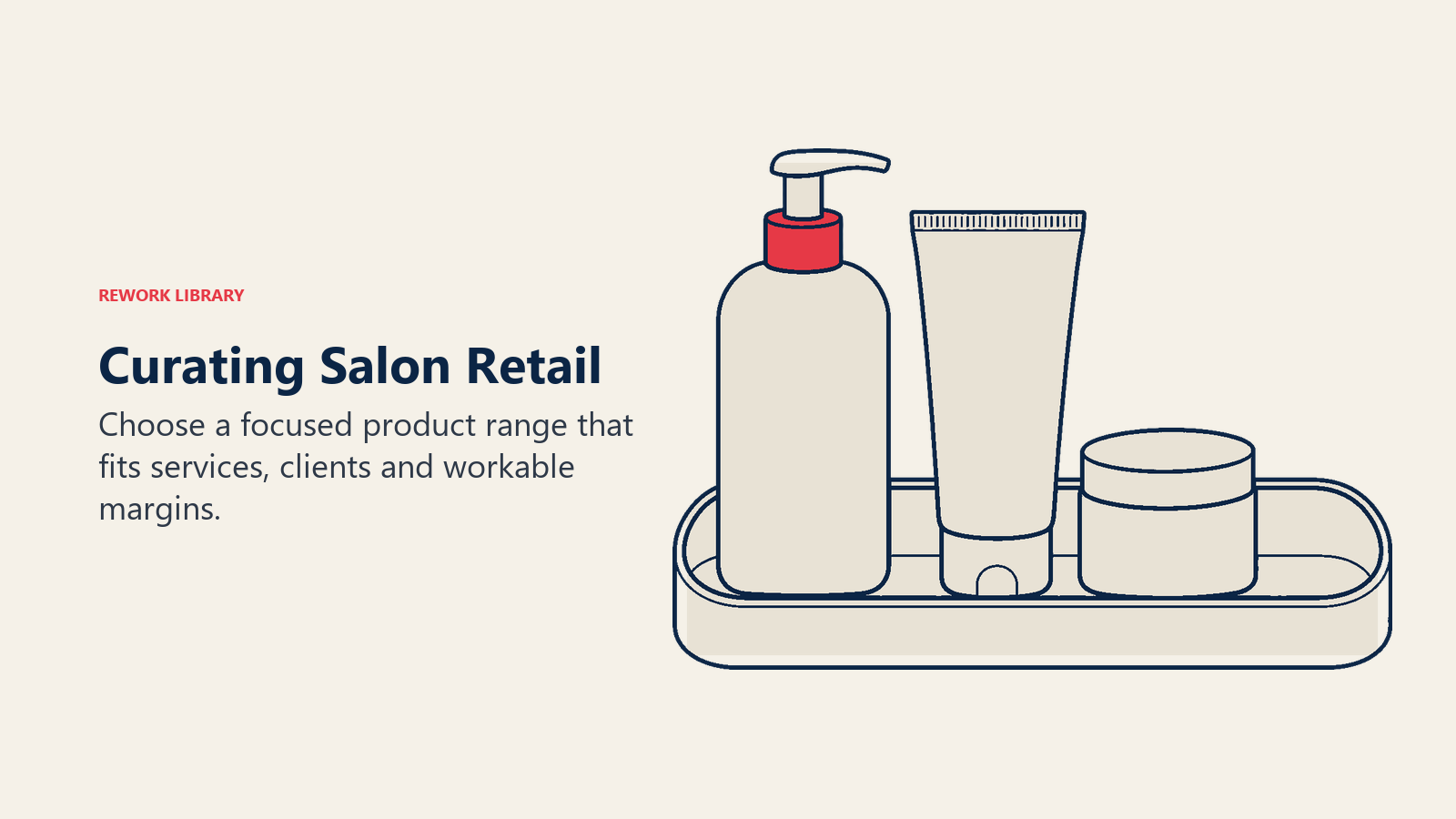
Winning retail programs focus on two to three curated product lines that align with the services the salon performs and the clients it serves. This discipline also connects to your broader service menu optimization, the products on your shelf should complement the treatments on your menu. Here's the evaluation framework:
Margin: Professional product lines offered through salon exclusivity typically provide 40-50% gross margin. If a brand is offering you less than 35%, the economics don't support investment in display and staff training. The IBISWorld report on beauty supply stores notes that professional-grade product lines consistently outperform mass-market alternatives on margin for authorized distributors.
Exclusivity: Products available at Ulta, Target, or Amazon aren't products you can recommend with credibility. The moment a client checks their phone and finds the same shampoo for half the price, you've lost the sale and a little trust. Prioritize lines with meaningful professional exclusivity.
Brand alignment: The product brands on your shelf signal something about your salon. A high-end color salon carrying a mass-market retail line creates dissonance. Your products should make sense alongside your service menu and price point.
Opening orders and minimum commitments: Most professional brands require opening orders of $500 to $2,000 and ongoing minimums. Negotiate for testers and demo product as part of the opening order, since sensory engagement drives conversion and displaying products clients can smell and touch doubles retail pickup rates.
SKU discipline: Set a maximum. A salon with eight staff and a focused service menu shouldn't carry more than 60-80 active retail SKUs. Below that threshold, every staff member can know every product well enough to recommend it without hesitation.
Retail Display and Merchandising
Where your products live in the salon matters more than how many you stock. There are three placement zones to work with:
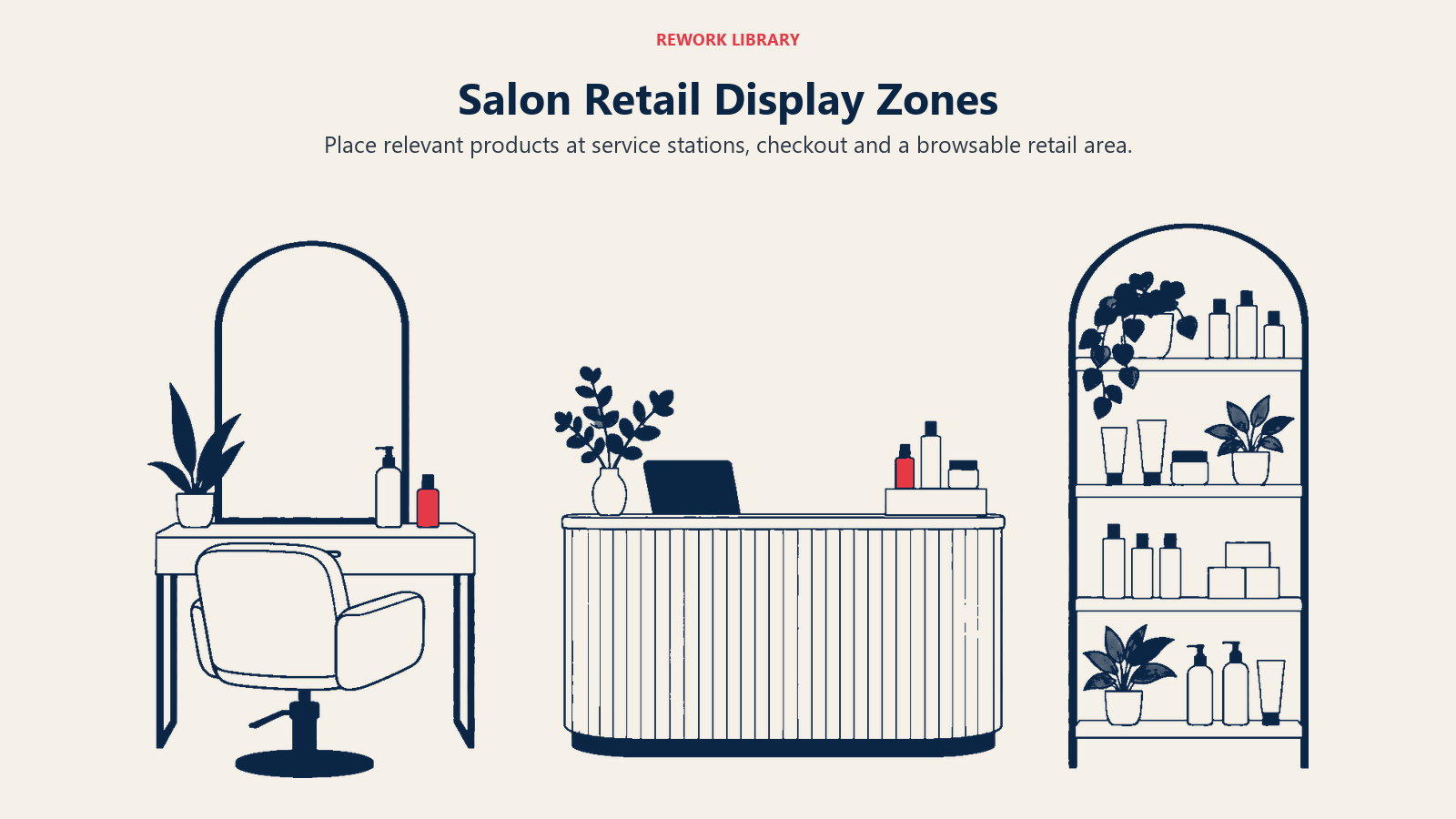
Point of service: products at or near the station where services are performed. This is where the recommendation moment happens. A shampoo bottle visible during a scalp treatment, a styling product the stylist uses during the blowout, these create natural conversation starters. Keep two to three hero products at each station.
Point of sale: near the reception desk or checkout area. This is impulse territory. Small-ticket items ($15-35) priced visibly, positioned at eye level. Stock top-sellers here, not full-line displays.
Dedicated retail section: if you have floor space, a browsable product area invites self-directed shopping. But it requires organization by use case (color care, scalp health, styling) rather than by brand, since clients shop by need, not by logo.
Display height matters. Product placed at eye level (60-66 inches) outsells product placed below knee height by 3x. Front-facing labels, clean organization, and visible price tags remove friction. If a client has to pick up a product to see the price, you've lost half the conversions.
Testers are non-negotiable. Display models with a pump or open top convert at significantly higher rates than sealed product. The sensory experience of smell and texture is what moves professional products. It's the one advantage your salon has over any e-commerce channel.
Staff Product Recommendations
The recommendation moment is the most important part of retail, and it's consistently underdeveloped. Here's what separates a recommendation from a sales pitch:
A recommendation is connected to what just happened. A sales pitch is disconnected from the service.
"I used this conditioning treatment on you today because your ends were really dry. That's the one I'd suggest for home use" is a recommendation. It's honest, specific, and grounded in the service just delivered. The stylist's credibility from delivering a great result transfers directly to the product.
"Can I show you some products on your way out?" is a sales pitch. It's disconnected from the service and requires the client to shift into a buying frame of mind.
Train staff to make one to two specific product recommendations at the end of every service, connecting each recommendation to something they observed or used during the appointment. The goal isn't to sell. It's to extend the result the client is about to leave with. This skill fits naturally within broader upselling and cross-selling beauty services training that equips staff to recommend add-ons without pressure.
Sample recommendation script:
"[Client name], I want to mention the two products I used today. For your color, I used [Product A] in the rinse. It's what's going to keep that vibrancy between visits. And I finished with [Product B] because your hair has some frizz in the mid-lengths. Both are at the front desk if you want to grab them."
That's it. No pressure, no "would you like to buy," no discount offer. Just information, offered naturally after a service that earned trust.
Commission on Retail
Retail commission motivates only when the structure is clear and the reward is meaningful. Here's how the common models compare:
Flat commission (10-15% of retail price): Simple to understand, consistent motivation. On a $30 product, the stylist earns $3-4.50. Works best in high-volume environments where small amounts accumulate.
Tiered commission (10% base, 15% above target, 20% at top tier): Creates a performance ceiling that high performers pursue. More complex to administer but more motivating for competitive staff.
Team bonus pool: Retail revenue above a threshold is shared across all staff. Removes individual competition, encourages mutual support. Better cultural fit for collaborative teams.
Whatever structure you choose, make sure retail performance is visible. Post a weekly retail leaderboard (by conversion rate, not raw dollars, to level the playing field between full-time and part-time staff). Review retail numbers in team meetings. Recognize top performers. The U.S. Bureau of Labor Statistics Occupational Outlook for cosmetologists projects 5% employment growth through 2034, meaning competitive retail programs will become an increasingly important differentiator for retaining high-earning stylists.
One rule: never let commission structures create pressure that damages the client experience. If clients feel they're being pushed products, they stop coming back. Track retail performance alongside client satisfaction and rebooking strategies for salons to ensure one isn't being sacrificed for the other.
Inventory Management
Retail inventory that stockouts loses sales. Inventory that overaccumulates creates cash tied up in slow-moving product. The goal is a system that keeps top-sellers continuously available without bloating your back stock. Proper inventory management for beauty centers pairs well with retail tracking inside most salon management software.
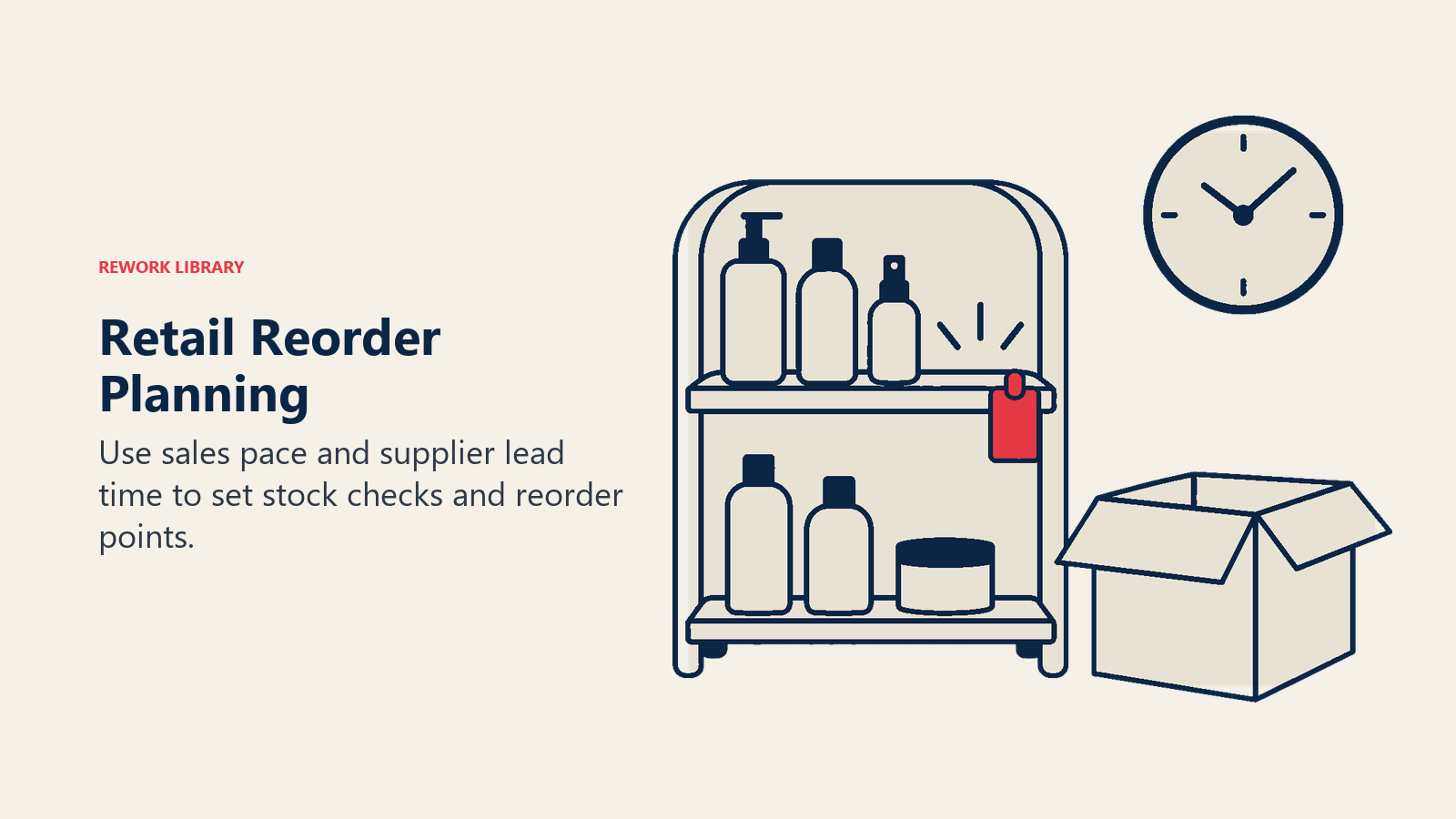
Set par levels for every SKU based on weekly sales velocity. If your best-selling shampoo sells 8 units per week and your lead time from the distributor is five days, your reorder point is any time stock drops below 12 units. Below that, you risk stockout before the order arrives.
Shrinkage in retail runs 1-3% in most salons. Products small enough to pocket, testers refilled by staff for personal use, and counting errors all contribute. Monthly inventory counts and a sign-out policy for testers controls most of it.
When products near expiration or go discontinued, run a clearance at cost rather than holding price and watching the units age. A $12 loss on a slow-moving SKU is better than $0 after the product expires.
E-Commerce Extension
Selling salon products online makes sense for some businesses and not for others. The decision depends on whether you can control the brand relationship and whether the economics justify the platform investment.
If your product partners offer affiliate retail programs (where clients purchase through a salon-specific link and you earn commission), that's worth exploring. It extends your recommendation footprint beyond the appointment without building an e-commerce operation. Some professional brands offer this through programs like Prose Professional or similar platforms.
Building your own e-commerce store for professional products works best for established salons with large client bases and a brand identity strong enough to compete with general retail on service and trust. The operational overhead (fulfillment, customer service, returns) is real, and margin often compresses because of platform fees.
For most single-location salons, the better investment is optimizing in-salon retail conversion rather than building online infrastructure. The in-person recommendation from a trusted stylist converts at rates that no product page can match.
Building Retail as a Service Extension
The salons that make retail work don't think of it as a separate business sitting next to their service floor. They think of it as part of the service itself: the take-home component that extends the result clients just paid for. Understanding your unit economics for beauty centers helps you see exactly how retail margin contributes to overall profitability at a per-appointment level.
When a colorist recommends a color-protecting shampoo, they're not upselling. They're completing the service. When a nail technician suggests a cuticle oil, they're not pitching. They're giving advice that keeps the client's nails looking good until the next appointment.
That framing changes everything about how staff approach recommendations, how clients respond to them, and how retail performs as a revenue line. The recommendation credibility built during a service is the primary conversion mechanism. All the display and commission structure in the world supports it, but it doesn't replace it.
Start with product selection, train your staff on one honest recommendation script, and measure retail as a percentage of service revenue monthly. At 10%, celebrate and push toward 15%. At 15%, you've built something that pays for itself many times over.
Frequently Asked Questions about Retail Product Sales in Salons
What is a beauty center?
A beauty center is a salon or spa that delivers a range of personal care services, such as hair, skin, nail, and wellness treatments, alongside take-home product sales. Retail product sales are one of the highest-margin revenue lines a beauty center can run, often reaching 40-50% gross margin on professional product lines.
How much retail revenue should a salon generate?
The industry standard target is 10-20% of total service revenue from retail, according to Professional Beauty Association benchmarks. Most single-location salons run at only 3-5%, so a salon doing $50,000 per month in services should target $5,000 to $10,000 in monthly retail rather than the typical $1,500 to $2,500.
How do you sell retail products without being pushy?
Connect every recommendation to the service just delivered. Saying "I used this conditioning treatment because your ends were dry, and it is the one I would use at home" is honest and grounded in the appointment, which builds trust. A disconnected pitch like "want to see some products on your way out" feels transactional and converts poorly.
How many product brands should a salon carry?
Focus on two to three curated product lines that match your services and clientele, and cap active SKUs at roughly 60-80 for a salon with eight staff. Carrying too many brands creates a wall of confusion, makes confident recommendations impossible, and ties up cash in slow-moving inventory.
Learn More