Commission Structures for Salons: Compensation Models That Drive Performance
Turn this article into takeaways for your work.


Each assistant summarizes the article only for you and suggests best practices for your work.
A salon commission structure sets how stylists are paid: straight commission (35-50% of service revenue), hourly plus commission, salary, or a hybrid base plus tiered commission. The right model keeps total labor cost between 35-45% of revenue while still motivating your top producers. Start from your revenue requirement, not the commission rate.
The commission structure conversation is the most uncomfortable one in salon ownership, and the most consequential. Get it wrong in one direction and your best performers look for a chair rental arrangement or head to a competitor. Get it wrong in the other direction and you're paying your team well while paying yourself nothing. The U.S. hair salon industry generates roughly $60 billion annually (IBISWorld, 2026), meaning even small margin differences in compensation structure compound significantly at scale.
Most salon owners set commission rates by copying what they heard at a trade show or from a friend who runs a different type of salon in a different market. That's not a compensation strategy. It's guesswork with a business-ending downside. The math behind these decisions becomes clearer once you understand your unit economics for beauty centers, specifically what each service chair actually costs and generates.
This guide gives you the math and the framework to design a compensation model that's fair to your team, viable for your business, and connected to the performance outcomes that actually matter.
Key Facts: Salon Compensation
- Labor cost (including all staff compensation) should stay between 35-45% of total revenue for a salon to remain profitable (Salon Business, 2024)
- Straight commission at 45%+ is common in booth-rental-heavy markets but unsustainable for salons with high overhead
- Hybrid models (guaranteed base + commission) have grown in adoption by approximately 30% since 2020, particularly in markets with tight labor supply
- The U.S. Bureau of Labor Statistics reports median hourly wages of $16.95 for hairstylists and cosmetologists (May 2024), a key benchmark when modeling your compensation floor
The Four Main Compensation Models
Before you can choose a model, you need to understand what each one is actually doing, for your staff and for your P&L.
| Model | Structure | Best For | Risk |
|---|---|---|---|
| Straight Commission | % of service revenue only | High-volume salons with established client bases | Income instability for staff; no fixed cost for owner |
| Hourly + Commission | Guaranteed hourly + % of services above threshold | New hires, building clientele | Higher floor cost; management complexity |
| Salary | Fixed weekly or monthly amount | Front desk, junior assistants | No performance incentive; fixed cost regardless of revenue |
| Hybrid | Base wage + tiered commission | Recruiting in competitive markets | Requires tighter tracking; more complex payroll |
There's no universally correct model. A single-stylist suite owner charging premium prices may run salary. A high-volume blowout bar may run straight hourly. A mid-market salon with five stylists and a full service menu probably runs some form of hybrid or commission with a floor. The model you choose also affects how you think about pricing strategies for beauty centers, because your labor cost percentage directly constrains how much pricing flexibility you have.
Straight Commission: The Math You Need to Run
Traditional straight commission in the industry runs between 35-50% of service revenue, with most experienced stylists in the 40-45% range. Senior producers with established books sometimes command 48-50%.
Before you set a rate, run this break-even calculation:
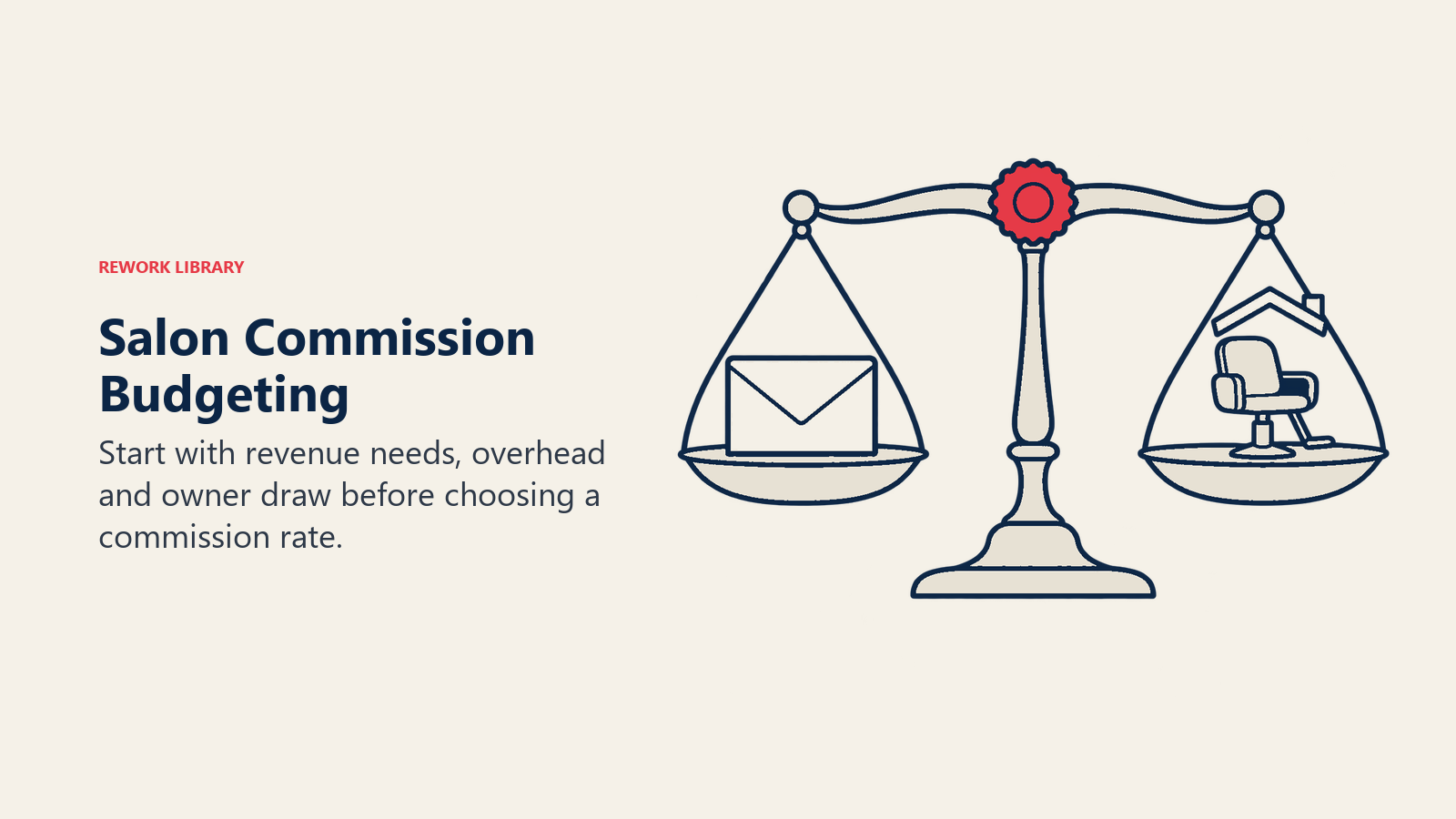
Monthly overhead (rent, utilities, supplies, insurance, software): $8,000 Your target owner's draw: $5,000 Total monthly revenue needed: Revenue = Overhead + Labor + Owner Draw
If your overhead is $8,000 and your total labor cost target is 40% of revenue, and you need $5,000 as an owner's draw:
$8,000 + $5,000 = $13,000 covered by the 60% non-labor portion of revenue Required revenue = $13,000 / 0.60 = ~$21,700/month
At that revenue level, labor (at 40%) = $8,680. If you have three stylists, that's roughly $2,893 per stylist. At 40% commission, each stylist needs to produce $7,230/month in service revenue to fund their own compensation.
Run this math for your actual numbers before setting rates. Don't start with the commission rate. Start with the revenue requirement.
The Hidden Risk of High Commission in Slow Periods
At 45% commission, a stylist who produces $3,000 in a slow month earns $1,350. That may be below livable income in your market. Staff who can't pay rent start looking for employment elsewhere or negotiate chair rental. High commission rates that feel attractive in busy months become a retention problem in January and July. This is also where seasonal promotions for beauty businesses become a staff retention tool as much as a marketing one. Keeping revenue up in slow months protects both sides of the pay arrangement.
Sliding Scale Commission: Aligning Incentives
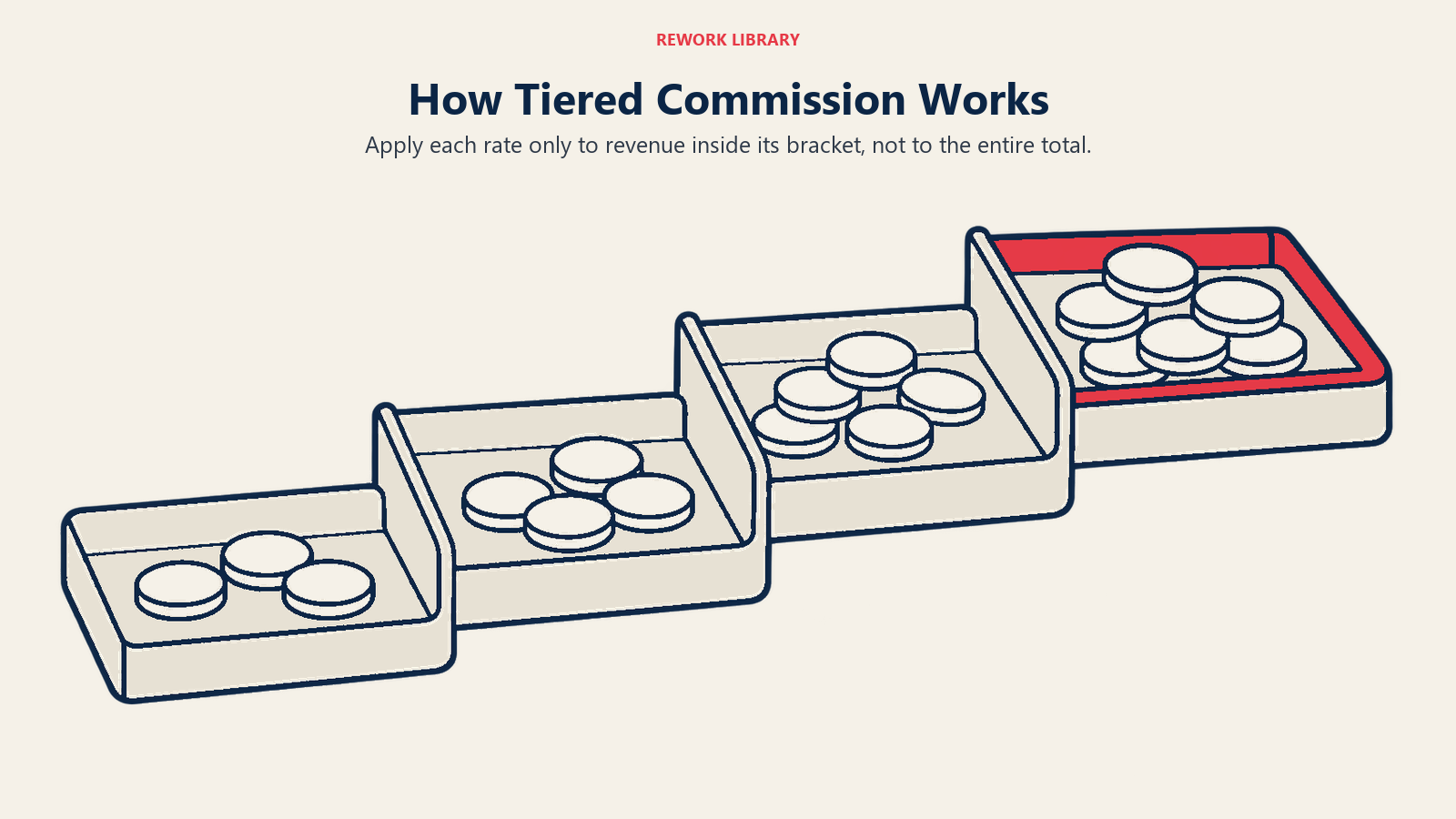
A tiered structure solves the flat-rate problem by rewarding higher producers while keeping the base rate sustainable for the business.
Example structure for a mid-market salon:
| Monthly Service Revenue | Commission Rate |
|---|---|
| Up to $2,000 | 35% |
| $2,001 - $4,000 | 40% |
| $4,001 - $6,000 | 43% |
| Above $6,000 | 45% |
A stylist producing $5,000 in a month earns: (35% × $2,000) + (40% × $2,000) + (43% × $1,000) = $700 + $800 + $430 = $1,930. Not 43% of $5,000 ($2,150), because the tiered rate applies only to each bracket.
The practical benefit: high performers are motivated to push through each threshold, and your labor cost percentage naturally stays more consistent across different production levels.
Avoiding the Cliff-Edge Problem
Don't create a structure where hitting a threshold drops a stylist's effective rate on previous earnings. The tiered bracket approach above avoids this: each rate applies only to earnings within that bracket, not retroactively to all earnings.
Retail Commission
Retail compensation is often an afterthought, but it matters both for profitability and for staff motivation.
Industry standard sits at 10-15% of retail sales credited to the staff member who made the recommendation. Some salons pay 15% to the recommending stylist and track it to individual name; others pool retail commission into a team bonus.
Individual tracking consistently outperforms team pooling for retail sales volume. When a stylist knows that the $45 shampoo they just recommended generates $6.75 directly into their paycheck, they're more likely to make the recommendation. The Professional Beauty Association provides industry benchmarks on retail performance that can help owners evaluate whether their current retail commission rate is motivating or being ignored. When it goes into a shared pool, the incentive diffuses.
The link between retail commission and product knowledge training is direct. Staff who understand why a product works sell more of it. Invest in product education. The commission structure will perform better as a result. For a full view of retail as a revenue line, retail product sales in salons covers the merchandising and stocking decisions that sit alongside the compensation piece.
Team Bonuses: When They Work and When They Don't
Team bonuses work when the objective is genuinely collective and when every team member can influence the outcome. Good triggers:
- Overall client satisfaction score hitting a monthly target (Net Promoter Score, review average)
- Rebooking rate across the salon exceeding a threshold
- Retail sales as a percentage of service revenue hitting a goal
Team bonuses fail when top performers resent carrying weaker contributors, or when individual accountability disappears into collective performance. Use team bonuses to reinforce culture-level outcomes, not to replace individual performance incentives. Loyalty programs for beauty centers can complement team bonus structures by giving staff a concrete client retention tool that feeds directly into those collective metrics.
Hybrid Models: The Competitive Advantage in Tight Labor Markets
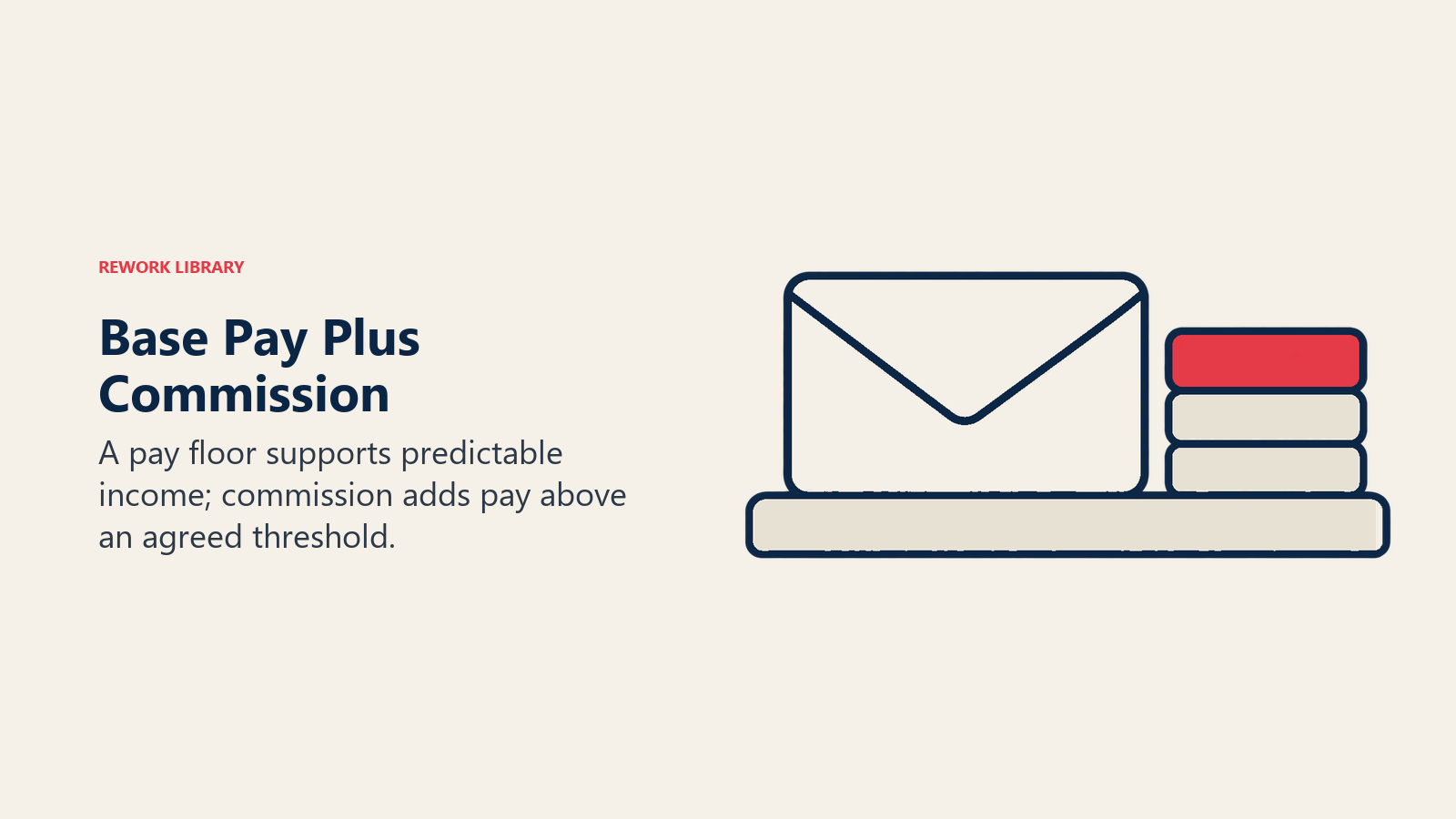
The hybrid model (a guaranteed hourly base plus commission on services above a threshold) has become one of the most effective recruiting tools for salons competing in markets where stylists have multiple employment options.
A workable structure:
- Guaranteed base: $15-18/hour for a 40-hour week
- Commission kicks in once service revenue exceeds the equivalent of $1.5x their hourly cost
- Commission rate on services above the threshold: 20-30%
Example: A stylist guaranteed $16/hour works 40 hours, earning $640 guaranteed. If their total service revenue for the week is $2,000, and the threshold is $1,000 (roughly 1.5x their guaranteed earnings), they earn commission on $1,000 at 25%, an additional $250. Total: $890 for a $2,000 service week, representing 44.5% of revenue including both base and commission.
The math gets tighter in slow weeks, but the floor is what recruits the candidate who's weighing your offer against a competitor's straight-commission shop. Some stylists, particularly those building a new clientele, will take a lower ceiling in exchange for a reliable floor.
Structuring for Profitability
Labor cost percentage is the single most important number in salon financial management. The target: total compensation including payroll taxes should stay between 35-45% of total revenue.
Below 35% is difficult to achieve without exploiting staff or running a lean team model. Above 45% and most salon P&Ls break down when overhead is factored in.
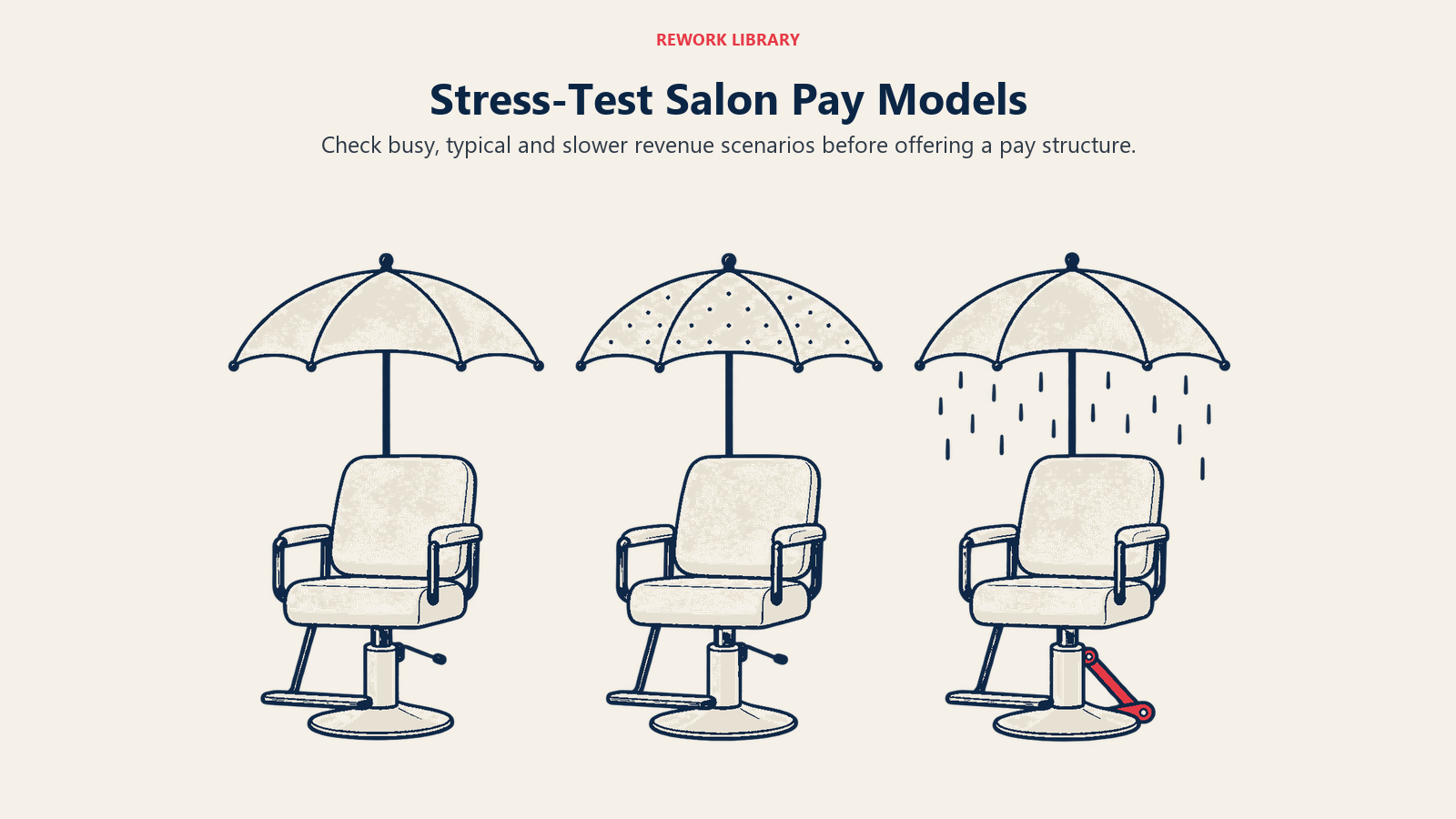
Before finalizing any compensation structure, model three scenarios:
Best case: Revenue at 90th percentile production for your market Base case: Revenue at your current trailing 12-month average Stress test: Revenue at 20% below current average (illness, seasonality, economic softness)
If the stress test scenario puts you above 50% labor cost, your commission structure needs adjustment before you offer it.
When to renegotiate: If a stylist's book has grown significantly, a proactive conversation about their commission rate or tier progression is better than waiting for them to bring it up. Stylists who feel they've outgrown their compensation package start the chair rental conversation on their own timeline. Retention is also shaped by the work environment and development opportunities you offer. See training programs for beauty staff for the non-compensation side of keeping high performers.
The Commission Structure Design Worksheet
Work through these inputs before setting any rates:
- Monthly overhead (fixed costs excluding labor): $____
- Owner's target draw: $____
- Target labor cost percentage: ____% (aim for 38-42%)
- Number of service providers: ____
- Average monthly service revenue per provider (trailing 12 months): $____
- Total monthly labor budget: (Revenue × labor cost %) - ____
- Average effective commission rate supportable: Labor budget ÷ total service revenue = ____
If the supportable effective rate is below 35%, your overhead structure or pricing needs attention before the commission conversation makes sense. If it's above 45%, your pricing power and volume are strong enough to offer competitive rates.
The one thing successful salon owners do differently in compensation conversations: they share the math. According to HBR's research on professional development and retention, staff who understand the financial context of their compensation are significantly more likely to stay than those who see rates as arbitrary decisions. Stylists who understand why the rates are set where they are (who can see the overhead, the targets, the model) are far more likely to stay within a structure that's fair but not lavish than stylists who feel the rates are arbitrary. Tracking all of this accurately over time is what makes data-driven decisions for salon owners possible. The numbers only tell a story if you're consistently capturing them.
Frequently Asked Questions about Salon Commission Structures
What is a typical salon commission rate?
Straight commission usually runs 35-50% of service revenue, with most experienced stylists in the 40-45% range. Senior stylists with established client books sometimes command 48-50%. Always check the rate against your overhead before committing, because a high rate that works in busy months can become unaffordable in slow ones.
What commission structure is best for a salon?
There is no single best model. A high-volume salon may run straight commission, a new hire building clientele may need hourly plus commission, and salons recruiting in tight labor markets often win with a hybrid base plus tiered commission. Choose the model that keeps total labor cost between 35-45% of revenue.
How do I calculate a salon commission rate?
Start with your revenue requirement, not the rate. Add monthly overhead and your target owner's draw, then divide by the non-labor share of revenue to find required revenue. Apply your target labor cost percentage (aim for 38-42%) to set the supportable effective commission rate.
Why does a tiered (sliding scale) commission work better?
A tiered structure pays a sustainable base rate on lower production and higher rates only on revenue inside upper brackets. This rewards top producers, keeps your labor cost percentage consistent across production levels, and avoids the cliff-edge problem where hitting a threshold cuts a stylist's effective rate on earlier earnings.
Learn More

Senior Operations & Growth Strategist
On this page
- The Four Main Compensation Models
- Straight Commission: The Math You Need to Run
- Sliding Scale Commission: Aligning Incentives
- Retail Commission
- Team Bonuses: When They Work and When They Don't
- Hybrid Models: The Competitive Advantage in Tight Labor Markets
- Structuring for Profitability
- The Commission Structure Design Worksheet
- Learn More