Service Menu Optimization: Designing a Profitable Beauty Service Lineup
Turn this article into takeaways for your work.


Each assistant summarizes the article only for you and suggests best practices for your work.
Most salons set their service menu once, when they open, and then leave it largely unchanged for years. New services get added when a supplier pitches them. Old services stay on because clients expect them. Prices get adjusted annually but rarely by much. The result is a menu that reflects the history of the business, not the financial reality of running it.
The fundamental problem is that salons typically evaluate services by how much they charge for them, not by how much those services actually contribute to profitability per hour. A $120 keratin treatment sounds like a winner until you calculate that it takes 3.5 hours, involves $35 in products, and occupies a chair that could have completed four $40 blowouts in the same window. The blowout set generates $160 of revenue at higher margin. The keratin treatment generates $120.
Optimizing your service menu is one of the highest-return management activities in beauty operations. Done properly, it can lift revenue by 20–30% without adding a single new client or expanding hours. This kind of internal financial discipline, combined with sound pricing strategies for beauty centers, is the foundation of sustainable growth at any stage.
Key Facts: Service Menu and Revenue
- Revenue per available service hour is the primary profitability metric in salons, not per-service price (Professional Beauty Association)
- Salons that conduct quarterly menu reviews report 18% higher profit margins on average (Beauty Business Report, 2024)
- Reducing a service menu by 20% (removing low-performers) increases average ticket size by 12% due to reduced decision complexity
What Service Menu Optimization Actually Means
Menu engineering is a concept borrowed from restaurant management. The discipline was first formalized in 1982 by Kasavana and Smith and has since been applied across service industries beyond restaurants. A menu isn't just a list of services. It's a financial document designed to drive profitable client behavior. The same principle applies to salon and spa service menus.
The framework classifies every service into one of four quadrants based on two variables: profitability and demand.
Stars: High profit, high demand. These are your best services. They generate strong margin and clients want them. Promote them prominently, train every staff member to deliver them consistently, and make them the centerpiece of your menu.
Plowhorses: High demand, low profit. These services are popular but don't make you much money. They're often legacy services that clients expect but are priced too low for their time cost. The fix: re-price, reduce service time, or bundle with high-margin add-ons into package deals and bundles that increase transaction value while managing your time cost.
Puzzles: High profit, low demand. These services make excellent money when booked but clients aren't choosing them often enough. The problem is usually positioning, not the service itself. These need better marketing, a name change, or staff trained in upselling and cross-selling beauty services who can recommend them actively during consultations.
Dogs: Low profit, low demand. These services cost you time and product without meaningful return. They're candidates for removal or conversion to optional add-ons within other services.
But revenue per service isn't enough for this analysis. Time is the real currency in beauty businesses.
Time as the Real Currency: Revenue Per Hour Per Chair
The metric that matters most isn't what you charge for a service. It's how much revenue that service generates per hour of chair or treatment room time.
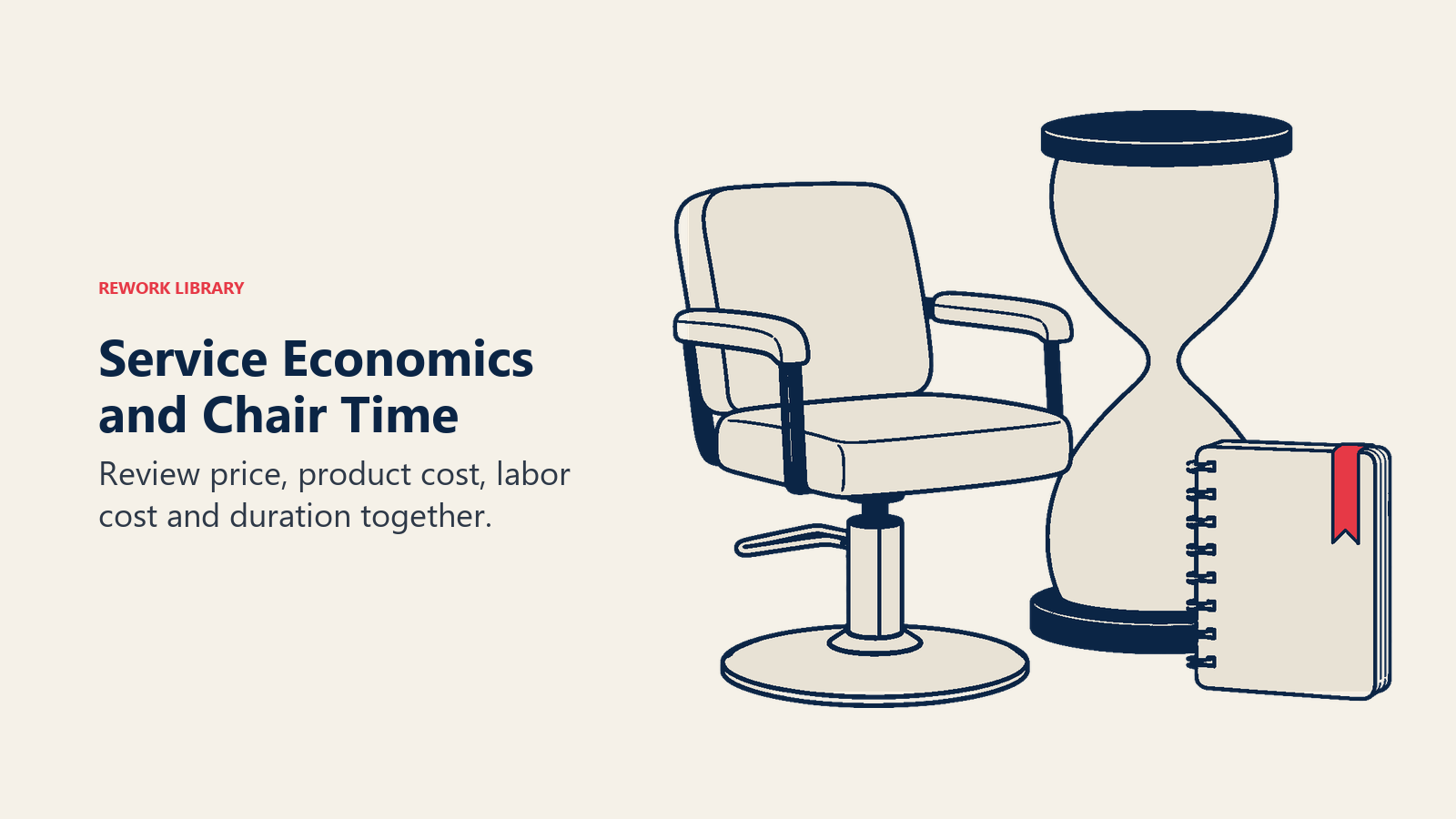
A $100 facial that takes 90 minutes generates $67/hour. A $60 express facial that takes 30 minutes generates $120/hour.
The express facial is 79% more profitable per hour despite costing $40 less per appointment. Multiply that difference across every chair, every working day, and the financial impact is substantial.
Calculating true profit per service
For each service, you need four numbers:
- Service price (revenue)
- Average duration (time cost)
- Product cost (consumables used)
- Labor cost (staff time at their wage rate)
Net margin = Price - Product Cost - Labor Cost Revenue per hour = Net Margin / (Duration in hours)
The Service Profitability Matrix
Build this table for your top 20 services. The data you need is in your booking system (average duration, booking frequency) and your product inventory records (product cost per service).
| Service | Price | Avg Duration | Product Cost | Labor Cost | Net Margin | Monthly Bookings | Monthly Contribution |
|---|---|---|---|---|---|---|---|
| Women's Haircut + Style | $85 | 60 min | $3 | $22 | $60 | 180 | $10,800 |
| Balayage + Toner | $220 | 180 min | $28 | $65 | $127 | 45 | $5,715 |
| Express Blowout | $45 | 30 min | $2 | $12 | $31 | 90 | $2,790 |
| Deep Conditioning Treatment | $55 | 45 min | $12 | $15 | $28 | 35 | $980 |
| Color Correction | $300 | 240 min | $45 | $88 | $167 | 8 | $1,336 |
Once you have revenue per hour for each service, classification becomes straightforward.
Acting on the Four Quadrants
Stars: Protect and promote
Don't mess with Stars beyond ensuring consistent delivery quality. Feature them prominently in your menu layout, on your website, and in social media content. Train all staff to deliver them at the same quality level. Stars are where you want to be fully booked.
Plowhorses: Fix the economics
Plowhorses are demanding your resources without adequate return. You have four options:
- Re-price: Raise the price to reflect the actual time invested. If clients push back, you've confirmed they don't value the service at its true cost.
- Reduce service time: Can you deliver the same result in less time with better processes or tools?
- Bundle with higher-margin add-ons: A $50 service that takes 45 minutes becomes a $75 service with a $15 add-on (scalp treatment, toner, express conditioning) that adds only 10 minutes.
- Convert to an add-on: Some Plowhorses work better as an enhancement within another service than as a standalone booking.
Puzzles: Fix the marketing
If a service is profitable but not popular, the problem is visibility or presentation. Consider:
- Renaming it to better communicate the result ("Moisture Revival Treatment" vs "Deep Conditioning")
- Training staff to recommend it during consultations
- Running a 60-day promotional push to build awareness
- Featuring it in social media content showing results
Dogs: Phase them out thoughtfully
Dogs are the services where you lose the most by keeping them. But removing a service clients expect requires care.
The right approach: stop promoting them in your menu and website first. If bookings drop naturally (they often do), remove them in the next menu revision without announcement. For services with a loyal, vocal client base, offer a transition to the nearest profitable alternative with a one-time accommodation. "We're retiring [service] in April, but [alternative] achieves the same result in less time. I'd love to book you for a complimentary trial."
Menu Layout Psychology: How Presentation Drives Selection
The way your services are organized and presented influences what clients choose, often more than they realize.
Visual hierarchy
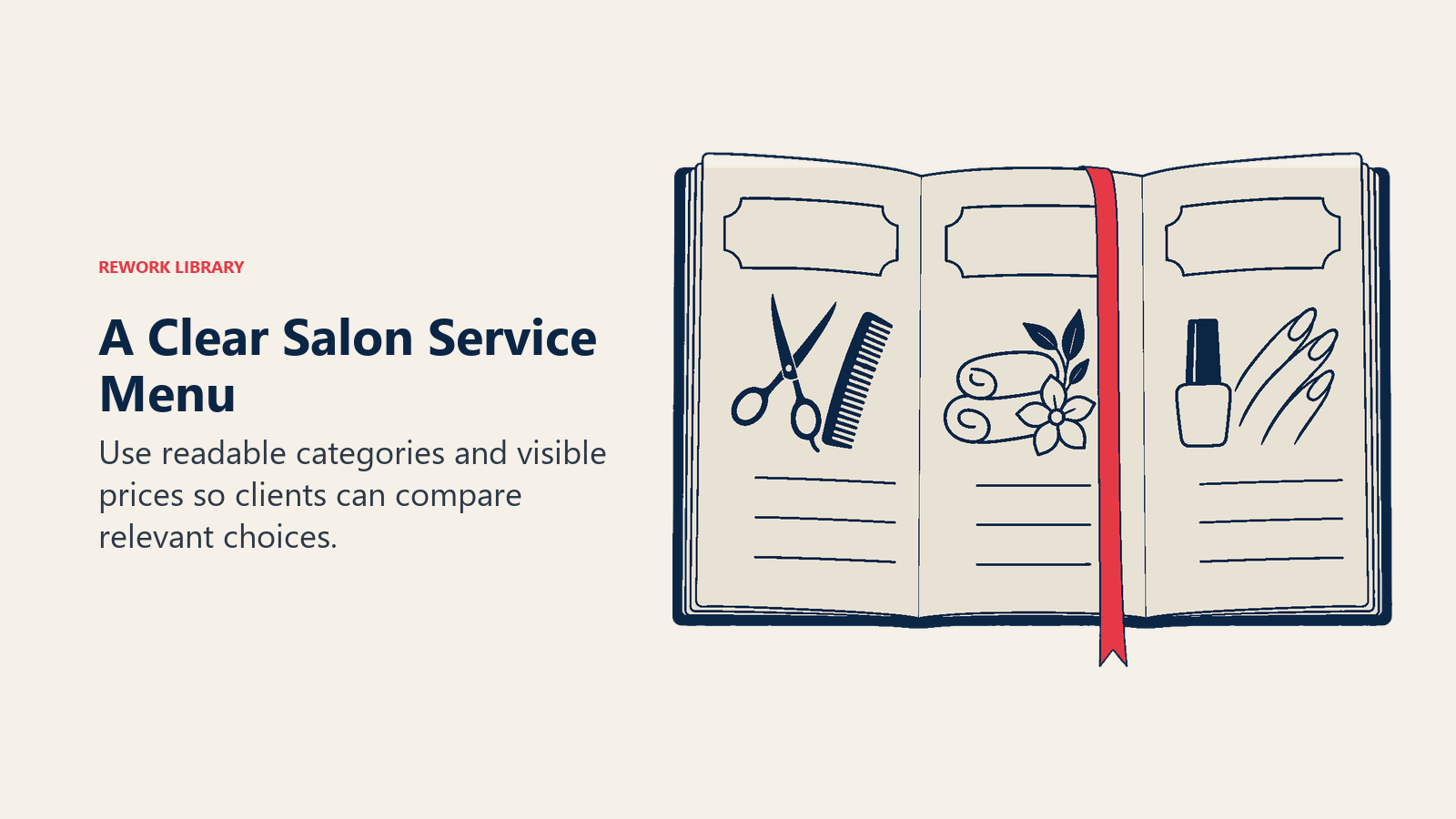
The top-left position on a menu is where the eye lands first. The bottom-right is where it goes last. Stars belong in top-left and top-center positions. Dogs belong off the menu entirely, not highlighted in prime positions.
Price anchoring
Place a high-ticket service at the top of each category to anchor client expectations. This applies the principle that how customers perceive a price is as important as the price itself, the anchor shapes whether everything below it feels like fair value or expensive. A $350 hair extension service listed first makes the $150 balayage below it feel like a reasonable choice. Without the anchor, $150 feels expensive. This anchoring principle connects directly to tiered pricing strategies, where a junior-senior-master structure creates natural price ladders across all service categories.
Reducing choice overload
Research consistently shows that too many options lead to lower satisfaction and lower spend. McKinsey's analysis of revenue growth techniques through menu and assortment optimization highlights how reducing complexity lifts both conversion and average spend. A service menu with 60 items creates decision paralysis. A menu with 30 well-organized options generates higher average tickets because clients can navigate to the right choice without confusion.
Aim for 4–8 services per category maximum. Group them logically (haircut services together, color services together) and use clear section headers that help clients self-sort.
Seasonal Services: Managing Demand Cycles
A static menu misses revenue opportunities in peak demand windows and fails to manage slow periods.
Seasonal service additions
Spring/summer: Express services, brightening facials, SPF treatments, summer hair protection. Fall/winter: Repair treatments, moisture-intensive services, holiday styling packages. Event seasons: Wedding packages, prom styling, holiday party packages.
Limiting seasonal services to a defined window creates urgency and perceived exclusivity. "Our Summer Brightening Facial is available June through August" is more compelling than a permanent menu item. Coordinating these windows with seasonal promotions for beauty businesses amplifies demand by pairing the limited-time service with targeted marketing campaigns.
Seasonal service removal
Services that underperform in specific seasons are good candidates for temporary removal. This keeps the menu clean and allows you to reintroduce them as "seasonal favorites," which generates more interest than a service that's always been there.
Introducing New Services: The 90-Day Test
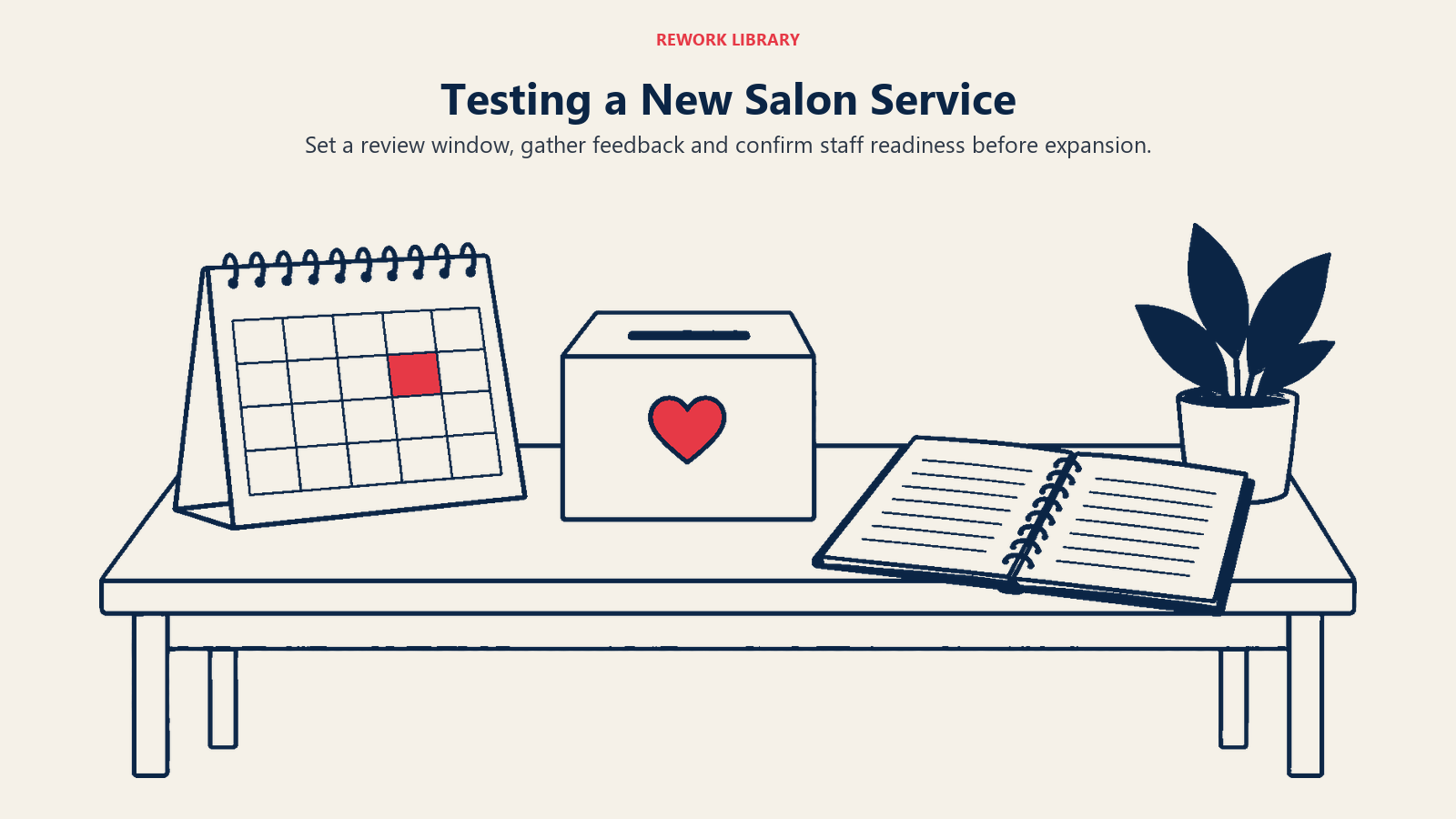
Every new service should be evaluated against a 90-day performance threshold before it becomes a permanent menu fixture.
Soft launch to existing clients
Before adding a service to your public menu, offer it to your loyal client base at a preferred pricing. This generates early bookings, tests delivery quality, gathers feedback, and avoids committing to a service that turns out to have operational problems. The full playbook for this process is covered in introducing new services, including staff training requirements and 90-day success benchmarks.
Set measurable thresholds
Define what success looks like before you launch: "If this service generates 15 bookings in 90 days at a net margin above $40/hour, it joins the permanent menu." Without a threshold, you'll keep underperformers indefinitely because they've generated some revenue.
Staff training and product investment alignment
Don't add a service until every staff member who will deliver it has been properly trained. A new service delivered inconsistently damages your reputation faster than not offering it at all.
Quarterly Menu Reviews: The Management Habit That Compounds
The most profitable salons review their service menu quarterly, not annually. The U.S. hair salon industry encompasses over 1 million businesses competing for clients, which means internal financial discipline on service mix is a genuine competitive advantage. A quarterly review takes 60–90 minutes and covers:
- Which services moved between quadrants since last review?
- Which services are trending toward Dog status?
- What's the average revenue per hour by service category?
- Are there any Puzzles ready for re-launch?
- What seasonal adjustments are needed for the next quarter?
A well-run service menu is a financial instrument that compounds in value over time. Each quarterly refinement improves margin slightly. Four refinements per year, sustained over three years, can transform the profitability profile of the business. Tracking the financial impact of these refinements is easiest when you apply unit economics principles for beauty centers, which give you the framework to measure revenue per chair hour and margin per service category consistently over time. High-performing salons also pair menu reviews with data-driven decisions for salon owners, using their booking software's reporting tools to surface performance shifts before they become problems.
Learn More

Senior Operations & Growth Strategist
On this page
- What Service Menu Optimization Actually Means
- Time as the Real Currency: Revenue Per Hour Per Chair
- The Service Profitability Matrix
- Acting on the Four Quadrants
- Menu Layout Psychology: How Presentation Drives Selection
- Seasonal Services: Managing Demand Cycles
- Introducing New Services: The 90-Day Test
- Quarterly Menu Reviews: The Management Habit That Compounds
- Learn More