Market Positioning for Salons & Spas: Standing Out in a Saturated Market
Turn this article into takeaways for your work.


Each assistant summarizes the article only for you and suggests best practices for your work.
There are over one million hair and nail salon businesses operating in the United States, according to IBISWorld. In most zip codes, a potential client can reach three to five salons within a five-minute drive. When supply is that dense and the core service (cutting, coloring, treating hair) looks similar from the outside, the default competition becomes price.
Price competition is a trap. Once you enter it, you're in a race with the Supercuts franchise down the street that has centralized buying, optimized scheduling software, and can absorb losses on individual locations you can't. Independent salons and spas don't win on price. But the ones that grow, and grow profitably, win on position. The beauty center business models you choose will also shape your positioning options, since commission salons have more brand-building latitude than booth rental operations.
Positioning isn't a tagline or a mood board. It's the answer to a specific question: "When a client chooses between us and the alternatives, what is the one reason they choose us?" If you can't answer that question with precision, your salon is competing on price by default, even if you don't intend to.
Key Facts: Salon & Spa Market Positioning
- 72% of salon clients say they selected their salon based on a recommendation or specific service reputation, not price (American Salon Survey)
- Salons in the top-tier price segment (above $120 average ticket) report 65% higher client retention rates than value-tier salons (Professional Beauty Association)
- Niche-positioned salons (those focused on a specific technique, demographic, or service category) report 30% higher average ticket values than full-service generalists in the same market
The Commoditization Trap and How to Escape It
A salon becomes a commodity when clients can't articulate why they'd choose it over the next option. This happens gradually: you start with competitive prices to attract early clients, you offer everything so you don't turn anyone away, and you never invest in building a distinctive identity because it feels like a luxury rather than a necessity.
But here's the cost: when clients don't have a strong reason to stay, they leave for any reason. A new salon opens closer to their office. A stylist posts a $10-off promotion. A friend recommends somewhere new. Retention collapses, and you're constantly filling the same slots with first-time clients who haven't committed.
Positioned salons don't have this problem at the same rate. When a client specifically sought out your Brazilian Blowout expertise, or chose you because you're the only salon in the area that specializes in textured natural hair, or books with you six weeks in advance because your balayage work matches no one else nearby. They're not leaving for a Groupon. Running a thorough competitive analysis for beauty businesses helps you identify the exact white-space positioning opportunities that competitors are missing in your local market.
The Positioning Matrix: Four Quadrants to Understand Your Options
Market positioning in beauty sits along two primary axes: service scope (niche vs. full-service) and price tier (value vs. premium). These create four distinct positions, each viable in the right market context.
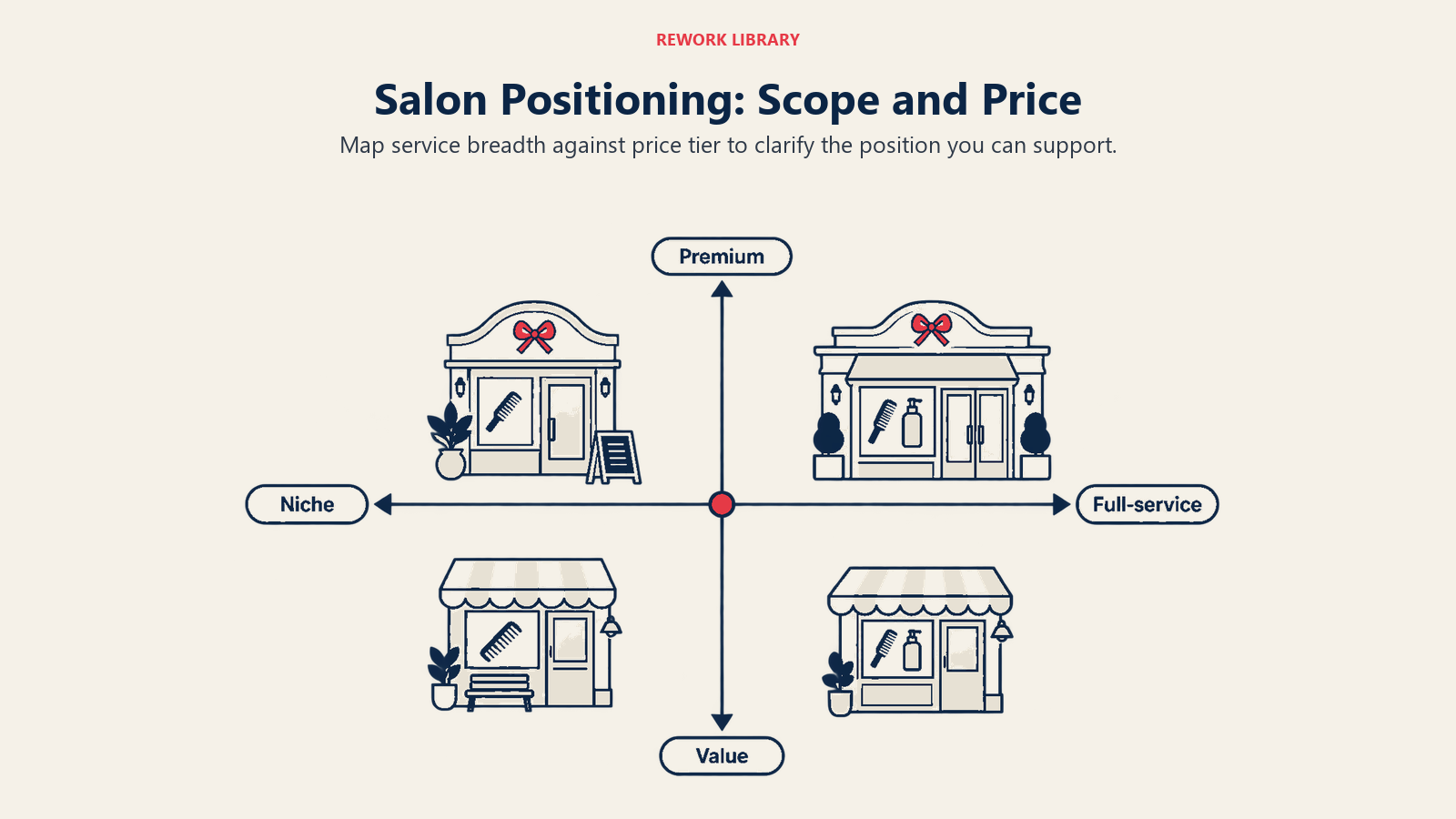
Niche + Premium: Specialist studios focused on a single service or demographic at elevated price points. Examples: Dry bar concepts, brow-only studios, curly hair specialists, medical spa-adjacent skin studios. Highest average ticket, lowest management complexity, easiest to build a referral reputation around.
Niche + Value: Accessible specialists, think $20 blowout bars, express massage studios, or nail bars with efficient service models. Works in high-traffic locations with volume economics.
Full-Service + Premium: Destination salons and day spas offering a wide service menu at luxury price points. High startup cost, requires exceptional client experience across every touchpoint, but captures the highest total wallet share per client visit.
Full-Service + Value: Traditional commission or franchise salons competing on convenience and price. Viable with volume and strong operational efficiency, but the hardest position to defend long-term as an independent.
Most independent salons that struggle are trying to occupy the full-service + value quadrant against franchises and chains that are structurally better positioned to win there. The move is usually toward specialization, premium, or both. McKinsey's State of Beauty report confirms this trajectory: strong growth is expected in specialized offerings such as luxury spas and specialized hair services, while traditional salon chains and nail care concepts face slower recovery. A focused service menu optimization exercise is often the first practical step toward claiming a more defensible position.
Building Your Ideal Client Persona
Before you can position, you need to know who you're positioning for. Not "women 25-55 who care about their appearance." That's too broad to be useful. A useful client persona is specific enough to make decisions with.
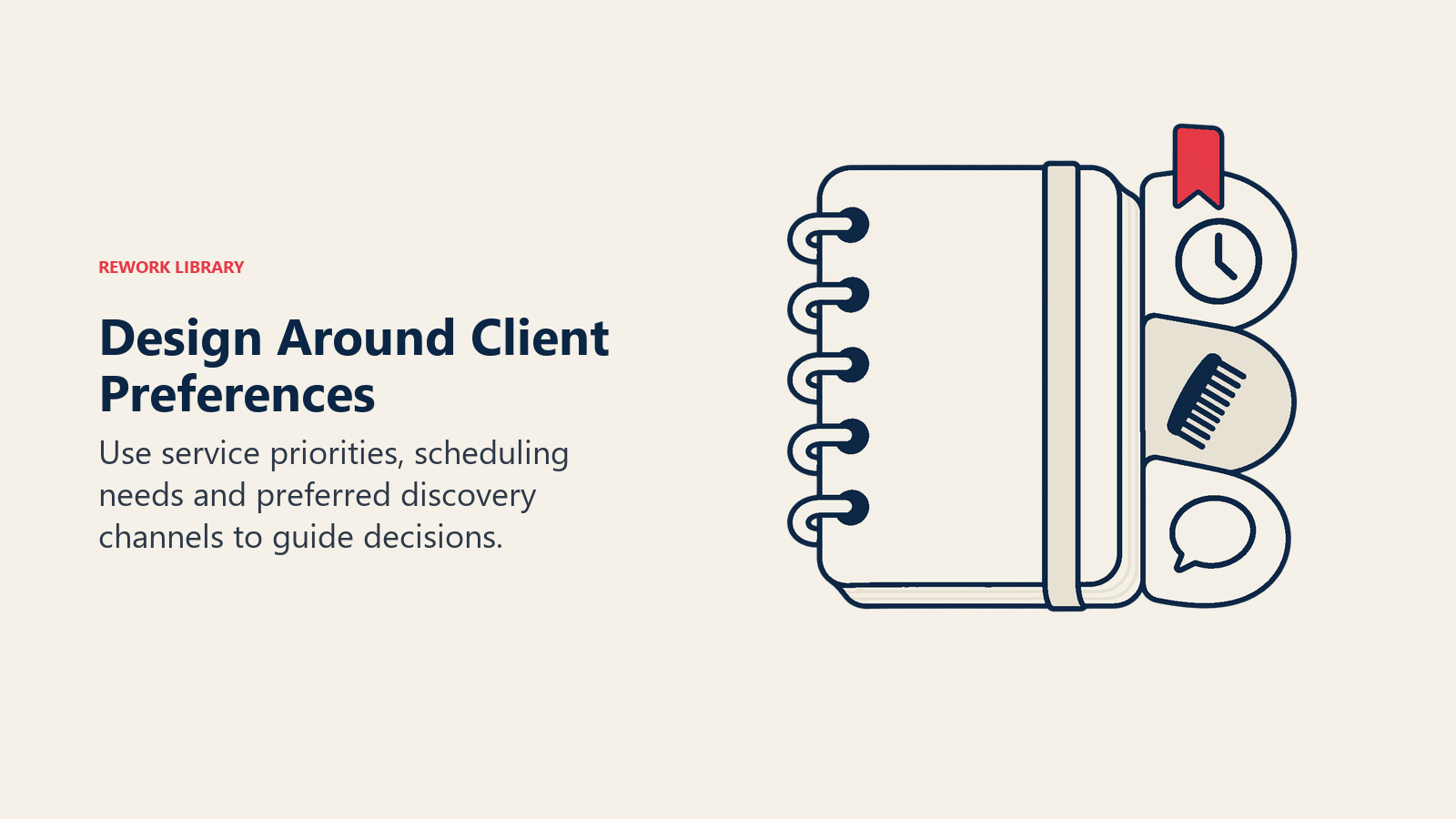
Build your persona across four dimensions:
Demographics: Age range, household income, neighborhood or commute zone, family status. A salon serving working mothers in a suburban market needs different hours, parking, and speed than one serving downtown professionals.
Psychographics: What does your ideal client value? Efficiency and consistency? Discovery and trend? Wellness and ritual? Self-expression? The client who wants the same excellent cut every six weeks is a different person than the client who wants a bold color change each visit, and they respond to different marketing, different service menu design, and different stylist personalities.
Spending behavior: What's their typical monthly beauty spend? Do they buy retail products or rely on drugstore brands? Do they book add-ons or always stick to their core service? High-retail buyers, frequent visitors, and tip-generously clients are your most valuable segment. Understanding how to reach them through the right channels matters as much as identifying them, which is why local SEO for beauty centers and social media marketing for salons should align with the persona you define here.
Channel preferences: Where do they discover new salons? Instagram, Google search, local Facebook groups, friend referrals? This determines where you invest your marketing, not the other way around. The global beauty and personal care market is projected to reach US$677 billion by 2025 according to Statista, with the United States leading at over $104 billion, meaning the opportunity is substantial for businesses that identify and own a clear position within their local slice of that market.
Brand Differentiation Levers
Once you know your position and your ideal client, you have five levers to make that position real and defensible.
Service menu curation: A focused menu signals expertise. A spa that offers 40 treatments looks like it does everything adequately. A spa that offers 12 treatments, each with clear depth and specialized options, signals mastery. Cut the services that don't align with your position or that you can't deliver at a high level.
Atmosphere and environment: The physical space either confirms or contradicts your positioning. A premium niche studio with IKEA furniture sends a mixed signal. A value salon with elaborate decor creates an expectation mismatch. Invest in the elements your target client notices, not everything, just the signals that matter to them.
Stylist/therapist expertise narrative: Your team's credentials, training, and specializations are positioning assets. Are your colorists certified in a specific technique? Have your estheticians completed advanced training in a particular skin concern? These facts, when communicated, justify premium pricing better than any tagline.
Signature experiences and rituals: These are the small, proprietary moments that clients remember and talk about. A warm towel finish. A custom fragrance used in every service. A complimentary scalp massage during the shampoo. These aren't expensive, but they're hard to copy and easy to reference word-of-mouth. Systematically designing these moments is the domain of client experience design, which translates positioning intent into repeatable service standards.
Brand voice and visual identity: The way you write your social media captions, the tone of your booking confirmation emails, the aesthetic of your photography. These should all feel consistent and intentional, not random. A luxury salon that posts casual, typo-filled Instagram captions undermines its own positioning.
Local Competitive Positioning
Before finalizing your position, you need to know where the gaps are. Spend two hours mapping your local market: list the top 10-15 competitors within your service radius, visit their websites and social channels, note their price points, service menus, and apparent target client.
Look for white space: segments that aren't being served well. In many suburban markets, there's no premium option for curly or textured hair care. In urban cores, there's often a gap between the $25 blowout bar and the $300 luxury experience with nothing in between. In wellness-oriented communities, spa-adjacent skin services with clinical credibility are often underserved.
Your position doesn't have to fill a gap to succeed. But knowing the gaps tells you where competition will be lightest and client acquisition will be easiest. Once you identify your opening, pricing strategies for beauty centers can help you calibrate rates that communicate your tier without pricing out the clients you've defined as ideal.
Writing Your Positioning Statement
A positioning statement is a single sentence that captures your market position precisely. It's not a tagline. It's an internal compass that guides every decision from service menu design to hiring to marketing spend.

The formula: [Business name] is the [category] in [geographic market] for [target client] who want [primary benefit], unlike [alternatives] which [key differentiator].
Example: "Volta Studio is the color specialist in Brooklyn's Williamsburg neighborhood for style-forward professionals who want precise, editorial-quality balayage work, unlike full-service salons that divide attention across every category."
Write it. Test it against every major decision you make. If you're considering adding nail services and your positioning statement is about color expertise, that addition either needs to be cut or it signals a position drift you should be intentional about.
Testing and Validating Your Position
Positioning isn't something you set once and leave alone. It's something you calibrate based on market response.
Watch three signals: Booking conversion rate (what percentage of inquiries convert to appointments), retention rate (what percentage of new clients return within 90 days), and average ticket growth over time. Research from BrightLocal shows that review ratings and the number of reviews are among the top factors driving local search clicks, which means the way clients describe your business publicly is both a positioning signal and a ranking asset. A strong position should produce above-average performance on all three. Review management for beauty businesses provides a structured way to harvest the feedback signal that tells you whether clients are describing you the way you intend.
Client feedback, whether from exit conversations, post-visit surveys, or what clients say when they refer friends, tells you whether your position is landing. If clients are describing you the way you intend to be described, you're positioned correctly. If they describe you as "a good salon near my house," you have work to do. A well-run referral program for beauty centers is a particularly useful test: if clients are referring others enthusiastically, your position is resonating with precision.
Learn More

Senior Operations & Growth Strategist