CRM for Salons & Beauty Centers: Managing Client Relationships at Scale
Turn this article into takeaways for your work.


Each assistant summarizes the article only for you and suggests best practices for your work.
Walk into Salon A, and your stylist asks how your vacation went. She remembers you mentioned it at your last visit. She knows you prefer your color slightly warmer in the winter, and she doesn't have to ask whether you want tea or coffee because it's been the same answer for three years.
Walk into Salon B, and the new stylist greets you generically, asks about your color goals as if she's never seen you before, and spends the first 15 minutes of your appointment filling in information she should already have.
The difference isn't that Salon A has better staff. It's that Salon A has built a system where client knowledge lives in the business, not in individual employees' heads.
When a top stylist leaves Salon B, she takes that knowledge with her. Clients who had a strong relationship with her feel lost, and a significant number follow her out the door. Studies consistently show that 40-60% of clients who primarily identified with a departing stylist will follow that stylist to their new location within six months. Stylist and therapist retention strategies reduce the likelihood of these departures, but a strong CRM limits the damage when they do happen.
A CRM doesn't prevent staff turnover. But it dramatically reduces the revenue damage that turnover causes, because the client relationship is preserved in the system, not in a person.
Key Facts: CRM Impact on Salons
- Salons with complete client profiles (service history, preferences, allergy notes) report 34% higher client retention rates at 12 months versus salons without structured CRM data (Salon Today)
- The cost of acquiring a new client is 5-7x the cost of retaining an existing one (Harvard Business Review)
- Automated win-back campaigns triggered at 90 days of client inactivity recover 15-25% of lapsed clients at a fraction of new client acquisition cost
Harvard Business Review's foundational research on the value of keeping the right customers established that acquiring a new customer costs five to 25 times more than retaining an existing one, a dynamic that hits particularly hard in service businesses like salons where relationship quality drives repeat booking.
Client Profile Management
A CRM is only as useful as the data in it. Incomplete profiles (missing email addresses, no service history, blank preference notes) make the system useless for personalization. The Statista global CRM software market forecast projects the market to surpass $262 billion by 2032, driven by demonstrated ROI on client retention, making even basic CRM adoption by small service businesses a competitive necessity rather than a luxury.
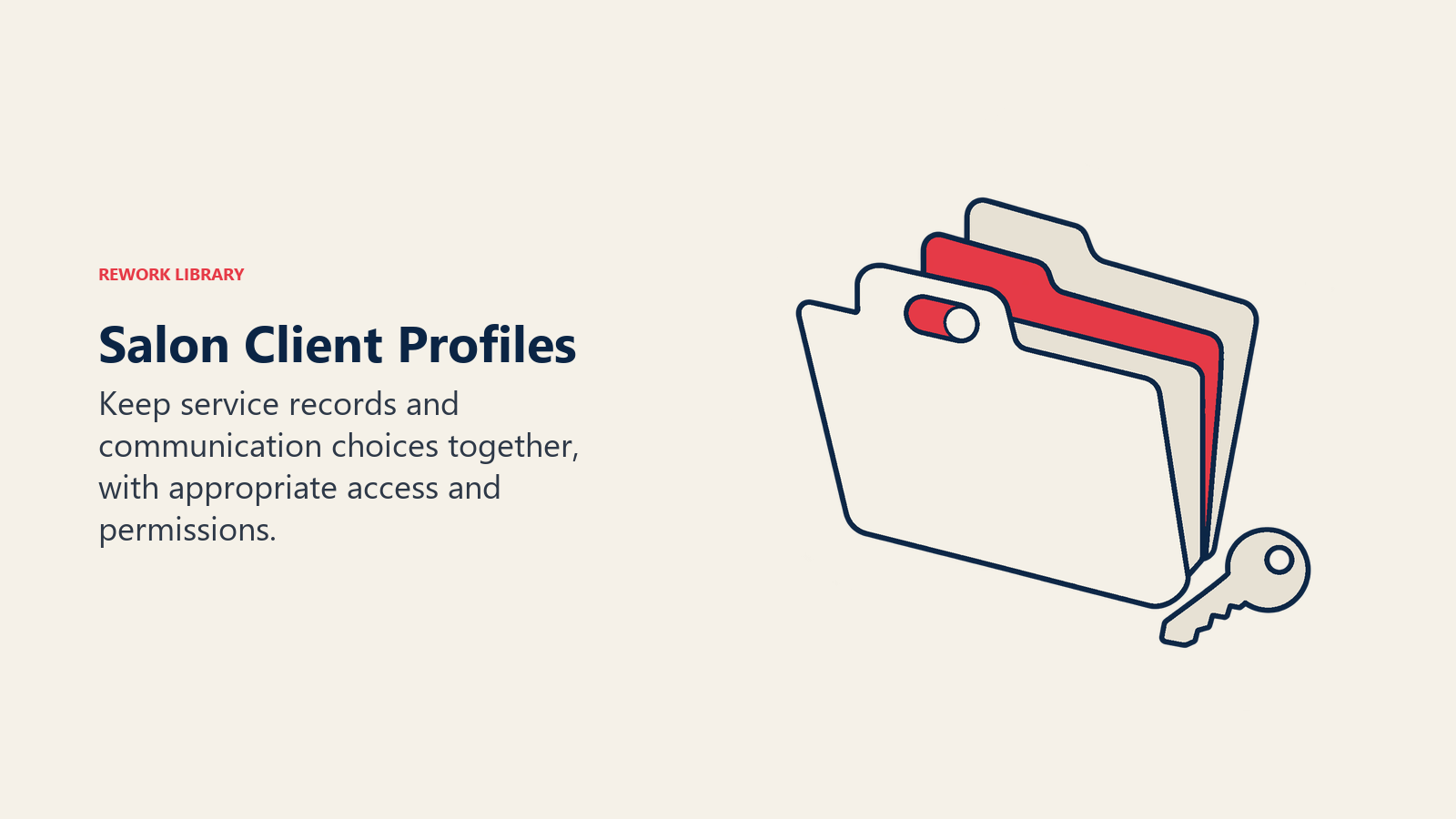
Here's what a complete client profile looks like:
Contact and communication:
- Full name, phone, email
- Preferred communication channel (SMS vs. email vs. phone call)
- Communication opt-in status (email marketing, SMS, both, neither)
- Emergency contact if relevant (for spa or treatment services requiring health intake)
Service history:
- Complete appointment history with service type, stylist, duration, price
- Product purchases with date and amount
- Gift card purchases and redemption history
- Outstanding loyalty points or membership credits
Technical notes:
- Color formula (for color clients, this is mission-critical)
- Allergy and sensitivity flags (specific ingredients, latex, fragrance)
- Service modifications (always add 15 extra minutes for thick hair, prefers lower heat)
- Scalp/skin condition notes relevant to services performed
Preference notes:
- Preferred stylist and backup preference
- Preferred appointment day and time
- Communication preference ("prefers early morning, doesn't like to talk during services")
- Beverage preference if you offer hospitality
Relationship metrics:
- Total lifetime spend
- Average ticket value
- Visit frequency (average days between appointments)
- Acquisition source (referred by, walk-in, social media, gift card)
- VIP status or segment classification
The fields that get skipped most often are the most valuable: color formula notes, allergy flags, and visit frequency data. Train every stylist and front desk staff member that incomplete profiles are a business risk. When a client with a latex allergy comes in and the new staff member doesn't know, the liability exposure is real. Connecting profile completeness to training programs for beauty staff ensures data discipline becomes part of onboarding, not an afterthought.
Visit History Tracking
The appointment history in a client profile is more than a record. It's a decision support tool.
A client who visited every five weeks for three years and hasn't been in for 12 weeks is showing a pattern change. Without visit history tracking, you might never notice. With it, she's flagged automatically at 90 days of inactivity, and a win-back message goes out before she becomes permanently lapsed.
A client whose average ticket has been $95 for 18 months and suddenly starts booking only $55 services is either price-sensitive or considering downgrading. Noticing this pattern early creates an opportunity to address it (a personalized conversation from their stylist, a loyalty reward, or a targeted offer) before the relationship deteriorates.
Visit history also enables better service recommendations. A client who's booked keratin treatments three times is a natural candidate for a premium hair care retail line. A client who's added brow shaping to five of her last six color appointments clearly values her brows. She's the right client to introduce to a microblading consultation. This is where CRM data directly supports upselling and cross-selling beauty services: the history tells you exactly who to approach and with what.
The principle: data accumulated over time tells you things about your clients that no amount of one-appointment observation can reveal. The landmark HBR study on zero defections and service quality by Reichheld and Sasser found that a 5% increase in customer retention increases profits by 25 to 95%, a compounding effect that makes visit history tracking one of the highest-ROI data disciplines a salon can adopt.
Preference Notes and Personalization
The preference notes section of a client profile is where the personalization experience is actually built. These are the non-technical details that transform a service into a relationship.
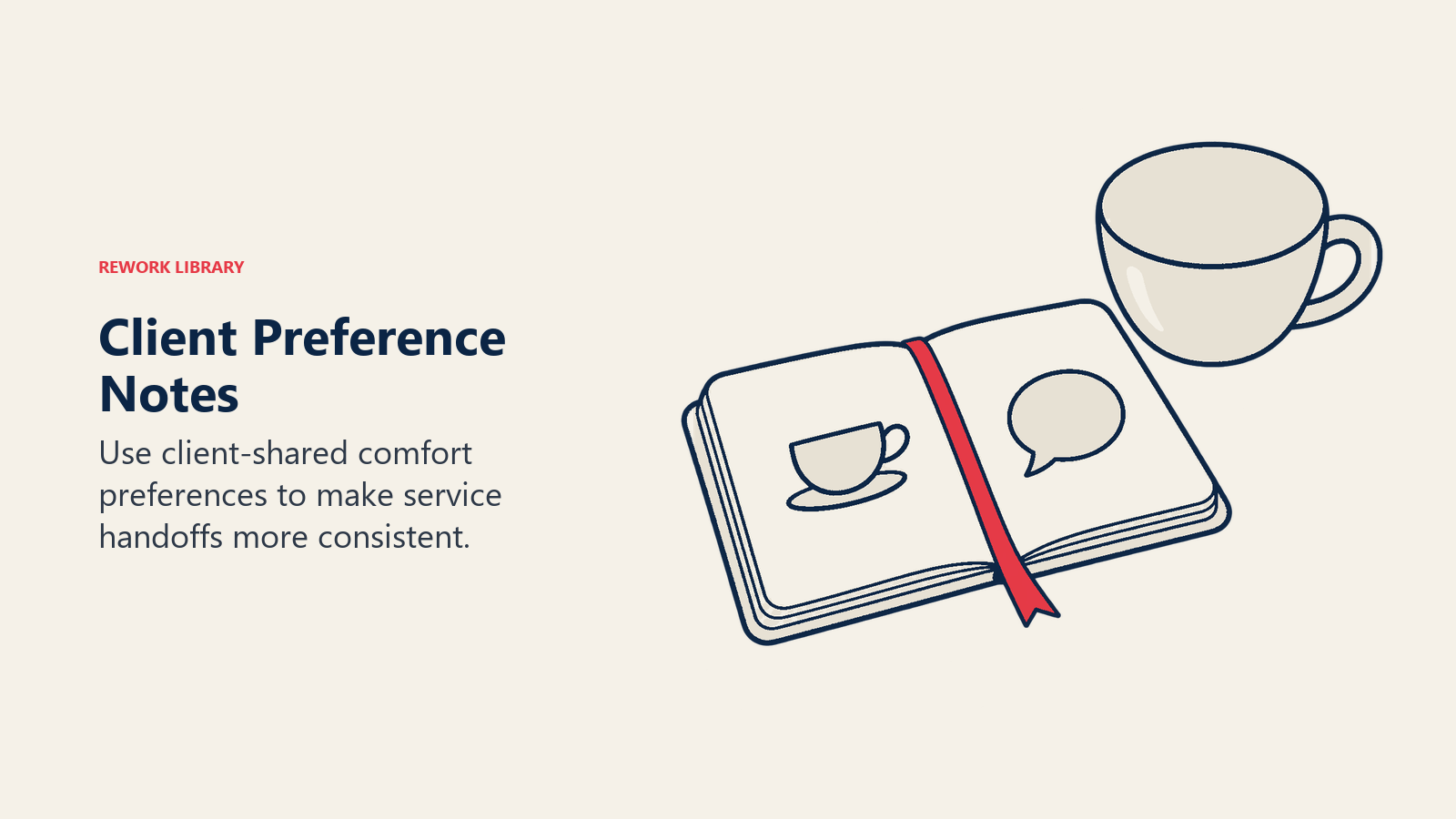
Train staff to log one to two new preference observations after every appointment. This doesn't need to be formal. A 30-second note in the system after checkout is enough. Over time, profiles accumulate the kind of detail that makes every visit feel like a conversation with someone who knows you.
Examples of preference notes that drive retention:
- "Prefers no small talk during service, brings a book"
- "Always asks about her daughter's upcoming soccer schedule (great rapport builder)"
- "Sensitive to chemical smell, always seat at station near the door"
- "Getting married June 14th, ask about bridal prep needs at next visit"
- "Prefers 10am Saturday appointments, rarely cancels these"
When a client's regular stylist is unavailable and she's served by someone else, the preference notes allow that substitute stylist to deliver a recognizable experience, not a generic one. That consistency is what keeps clients from wandering when schedules change.
Client Segmentation for Marketing
Not every client should receive the same communication. A CRM that enables segmentation turns generic mass emails into targeted messages that convert.
The four segments every beauty salon should maintain. McKinsey's research on personalizing the customer experience in retail found that businesses using customer segmentation for targeted communication generate significantly higher lifetime value per client than those relying on mass messaging, the same principle that makes CRM segmentation so effective in the salon context:
VIP clients (top 20% by annual spend): These are your highest-value relationships. They deserve exclusive communication: early access to new services, personal outreach from the owner or senior stylist on their birthday, invitations to in-salon events. A client spending $3,000 per year with you shouldn't receive the same "we miss you" coupon that goes to a client who visited twice. A membership model for spas and salons can formalize this VIP tier with predictable monthly revenue and exclusive benefits.
Appropriate communication: Personal outreach, exclusive offers, priority booking windows, first access to new services.
Lapsed clients (no visit in 90+ days): At 90 days without a visit, a client is at elevated churn risk. At 180 days, they're likely already booking elsewhere. The 90-day trigger is the window where win-back campaigns have meaningful conversion rates.
Appropriate communication: Win-back sequence with a personalized message acknowledging the gap ("We've missed seeing you"), an offer with real urgency (valid for 30 days), and a direct booking link.
New clients (first 90 days): The first 90 days after a new client's first visit are when retention habits form. A client who books twice in the first 90 days has an 85% chance of becoming a long-term regular. A client who doesn't book again within 60 days has a less than 30% chance of returning.
Appropriate communication: Post-visit follow-up within 24 hours, rebooking prompt at 30 days, "how are you loving your [service]" at 45 days.
Clients by service type: Segment by primary service: color clients, nail clients, lash clients, facial clients. Service-specific communication is more relevant and converts better than generic beauty content. A color client who hasn't tried lash extensions is a cross-sell opportunity; a nail client who's never booked a facial is another.
Appropriate communication: Service-specific educational content, promotion of complementary services, new service announcements relevant to their service category.
Automated Workflows: The Four Core Automations
A CRM that requires manual triggers for every communication isn't a CRM. It's a contacts list. The value is in automations that run continuously without staff intervention:
1. Birthday message with gift offer
Trigger: Client birthday (from profile) Message: Personalized birthday greeting with a gift: a complimentary add-on, a retail product, or a small service discount valid during their birthday month. Expected outcome: 20-35% redemption rate, incremental visit within 30 days for clients who might not have booked that month.
2. Post-visit review request
Trigger: 24-48 hours after appointment completion Message: Brief thank-you from their stylist, with a link to leave a Google review. Expected outcome: 10-20% review conversion on clients who had a positive experience. Reviews compound over time into a significant local SEO advantage. A structured review management for beauty businesses process ensures you respond to reviews, monitor sentiment, and use feedback to improve service quality.
3. Lapsed client win-back sequence
Trigger: 90 days since last appointment Message 1 (Day 90): "We've missed you. Here's what's new at [Salon Name]" with a soft offer. Message 2 (Day 107): Direct offer with urgency: "Your [hair/skin/nails] could use some attention. Book this week and receive [offer]." Expected outcome: 15-25% of lapsed clients rebook within 30 days of the sequence.
4. Rebooking prompt at service interval
Trigger: Calculated from typical service interval (color clients every 6-8 weeks, haircut clients every 4-6 weeks) Message: "Your color is approaching its 6-week mark. Want to schedule a refresh?" with direct booking link. Expected outcome: Incremental bookings from clients who intended to rebook but hadn't acted.
These four automations, running continuously, represent the core of a functional client retention system. They don't require weekly management, just periodic review to ensure message content stays current and offers remain relevant.
Integration with Booking System
A CRM that doesn't connect to your appointment calendar creates the exact problem it's supposed to solve. If staff have to manually update client profiles after every appointment, it won't happen consistently. And inconsistent data is worse than no data because it creates false confidence.
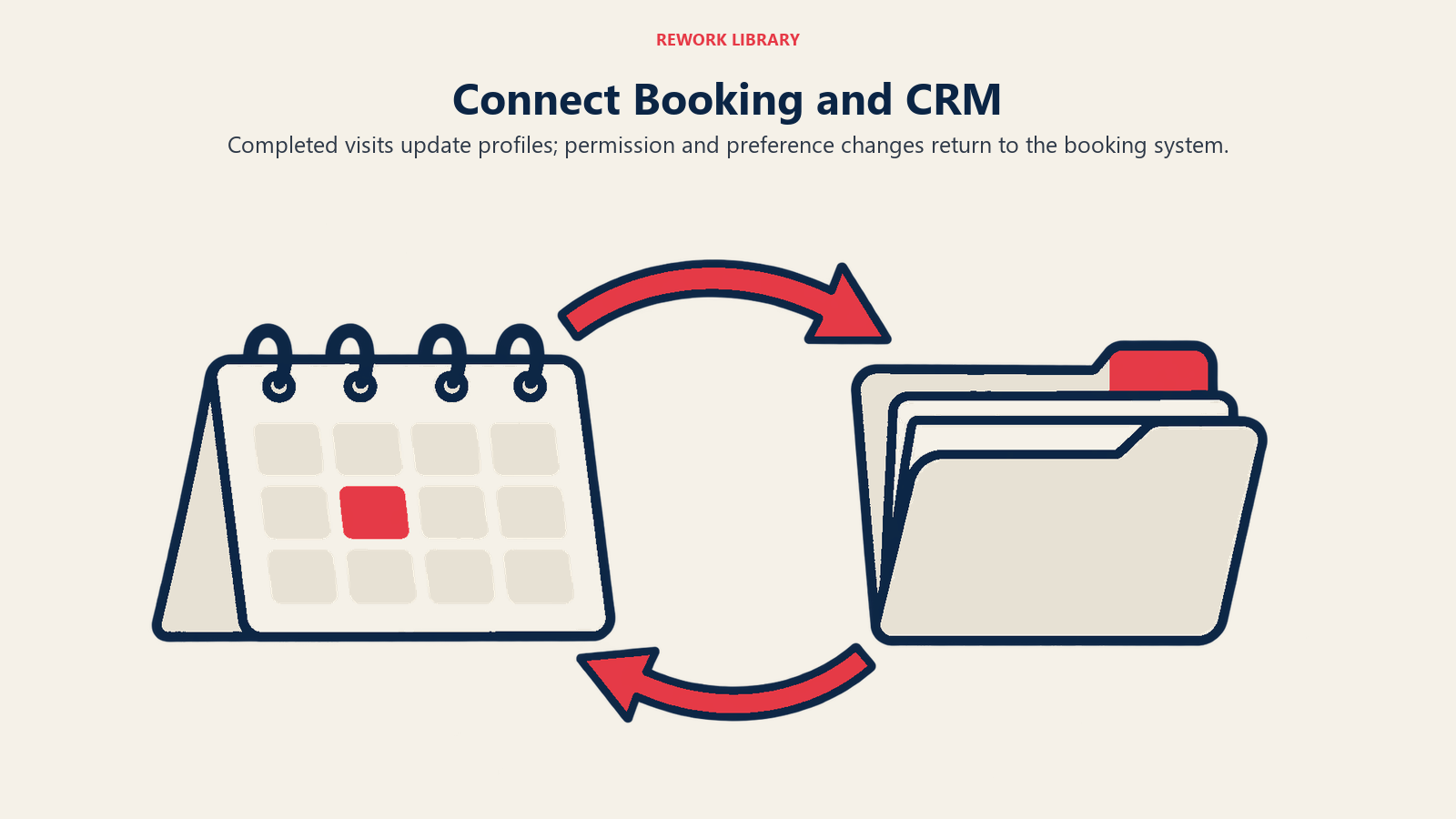
The best implementations are native: booking systems like Boulevard, Vagaro, and Mindbody that include CRM functionality built into the same platform. Every completed appointment automatically logs to the client profile. Every product purchase updates the purchase history. Visit frequency calculates automatically. The salon management software guide covers how to evaluate whether a platform's built-in CRM meets your needs or whether a dedicated integration is required.
If your booking system is separate from your CRM (for example, using Square Appointments with a separate email marketing CRM), ensure the integration is bidirectional: appointment completions update the CRM, and CRM actions (opt-ins, preference updates) sync back to the booking system.
The practical test: after a client's appointment, does their profile update without anyone manually entering data? If the answer is no, the integration isn't working well enough to maintain data quality at scale.
CRM ROI: A Concrete Example
A salon with 400 active clients and a 55% 12-month retention rate retains 220 clients per year. At an average annual spend of $800 per client, retained revenue is $176,000.
Implementing structured CRM (complete profiles, four core automations, active segmentation) typically improves 12-month retention by 8-12 percentage points. At 65% retention (a 10-point improvement), the salon retains 260 clients instead of 220.
40 additional clients × $800 average annual spend = $32,000 in incremental retained revenue.
The CRM isn't a line item. It's a $32,000 annual revenue improvement that compounds as the client base grows.
CRM as Business Infrastructure
The salons that use CRM effectively don't think of it as a software feature. They think of it as the memory system of their business: the infrastructure that makes every client feel known, regardless of which staff member serves them.
That system doesn't run itself. It requires data discipline: staff who log preferences consistently, managers who review segments regularly, and automations that stay current as prices, services, and offers change. But when the discipline is in place, the CRM quietly does the work of retention that manual relationship management can't scale.
Learn More

Senior Operations & Growth Strategist