Local SEO for Beauty Centers: Ranking #1 in Your Area
Turn this article into takeaways for your work.


Each assistant summarizes the article only for you and suggests best practices for your work.
When someone searches "hair salon near me" on their phone, something specific happens before they scroll a single inch: they see three businesses in a map pack at the top of the results. BrightLocal research shows that local pack results capture 42% of all clicks for local queries, with review ratings and review volume being the primary drivers of which listing gets the click. The other one million salons in America get to compete for the remaining attention.
Local SEO is the discipline of getting your beauty center into that map pack and keeping it there. It's not paid advertising. It's not social media. It's the organic ranking system that Google uses to decide which businesses are most relevant, most trustworthy, and most proximate for a given search at a given location.
For most beauty centers, local SEO delivers higher ROI than any other acquisition channel over a 12-24 month horizon. A Google Business Profile ranking #1 for "nail salon [your city]" generates booking inquiries every day without ongoing ad spend. The work compounds and keeps working long after you've moved on to other growth priorities. For a complete profile optimization guide, the dedicated article on Google Business Profile for salons goes deeper on every GBP feature relevant to beauty businesses.
Key Facts: Local SEO for Beauty Centers
- 46% of all Google searches have local intent, and "near me" beauty searches have grown by over 200% in the past five years (Google Search Insights)
- The top 3 results in Google's local pack capture 70% of clicks for location-based service searches (BrightLocal Local Consumer Review Survey)
- Google Business Profile optimization is cited as the #1 local ranking factor by 93% of local SEO practitioners surveyed (Moz Local Search Ranking Factors Report)
How Google Decides Who Ranks Locally
Before optimizing anything, understand what you're optimizing for. Google's local ranking algorithm weighs three factors:
Relevance: Does your business match what the searcher is looking for? A salon that clearly communicates it offers balayage services is more relevant to a "balayage near me" search than a salon whose Google listing just says "full-service salon."
Proximity: How close is your business to the searcher's location? This is the factor you can't control, but you can influence how far your geographic relevance extends by building strong authority for searches in your specific neighborhood and city.
Prominence: How well-known and trusted is your business? Prominence is built through review volume and quality, backlinks from local websites, citation consistency across directories, and overall engagement with your Google Business Profile.
You optimize relevance through content. You build prominence through reviews, citations, and links. You can't change proximity, but you can appear for searches in a wider radius as your prominence grows.
Google Business Profile: The Highest-Impact Optimization
Your Google Business Profile (GBP) is the single most important local SEO asset you control. Before doing anything else, make sure it's completely and correctly set up.
Name, Address, Phone (NAP): Your business name, address, and phone number must be exactly consistent with what appears on every other online directory. "Main St" versus "Main Street" versus "Main St." looks trivial but creates confusion signals that hurt rankings. Pick a format and use it everywhere.
Category selection: Choose your primary category carefully, as it has the highest weight in relevance matching. "Hair Salon," "Nail Salon," "Day Spa," "Massage Therapist" are distinct primary categories. Add secondary categories for every service type you offer: if you're a hair salon that also does nails, "Nail Salon" should be a secondary category.
Services menu: GBP allows you to list specific services with descriptions and prices. Fill this out completely. Every service you list is a potential keyword match. "Brazilian Blowout" listed in your services makes you more relevant to "Brazilian Blowout [city]" searches.
Photos: Businesses with more than 100 images on their Google Business Profile receive 520% more calls than the average business, along with significantly more direction requests and website clicks. Upload before/after transformations, interior shots, team photos, product photos, and event images. Add new photos weekly. Photo freshness is a signal.
Posts: GBP Posts function like mini blog entries visible in your knowledge panel. Post weekly about promotions, new services, seasonal trends, or team news. Each post keeps your profile active and gives Google fresh content to index.
Booking link integration: Connect your online booking platform (Booksy, Vagaro, Fresha, StyleSeat) directly to your GBP. This reduces booking friction and signals to Google that you're an active, bookable business. The broader strategy for converting search traffic into completed appointments is covered in online booking optimization.
Q&A section: Proactively seed your own questions and answers. Common ones: "Do you accept walk-ins?" "What is your cancellation policy?" "Do you offer gift cards?" These appear in your profile and preemptively answer client questions that might otherwise prevent a booking.
Local Keyword Strategy
Local SEO requires a different keyword approach than general content SEO. You're targeting searchers with explicit geographic and service intent.
"Near me" and geo-modified keywords: These are your primary targets. "Hair salon near me," "nail salon [city name]," "massage therapy [neighborhood name]," "balayage specialist [city]." Build pages and GBP content that explicitly use these terms.
Service + location combinations: Create content on your website for specific service-location pairs. If you're a color specialist in Chicago's Lincoln Park neighborhood, you want a page that targets "hair color Lincoln Park Chicago," not just a generic services page.
Long-tail question keywords: "How much does balayage cost in [city]?" "Best nail salon for acrylics near [neighborhood]?" These longer searches convert at higher rates because they signal a searcher further down the decision path. A FAQ section on your website targeting these terms can rank well with relatively little competition.
Use Google's autocomplete (type your service + city and see what Google suggests) and the "People Also Ask" boxes on search results pages to discover specific queries your target clients are using. A competitive analysis for beauty businesses will often reveal which keywords your top local competitors rank for, giving you a more targeted list to pursue.
Citation Building: Consistent Business Listings
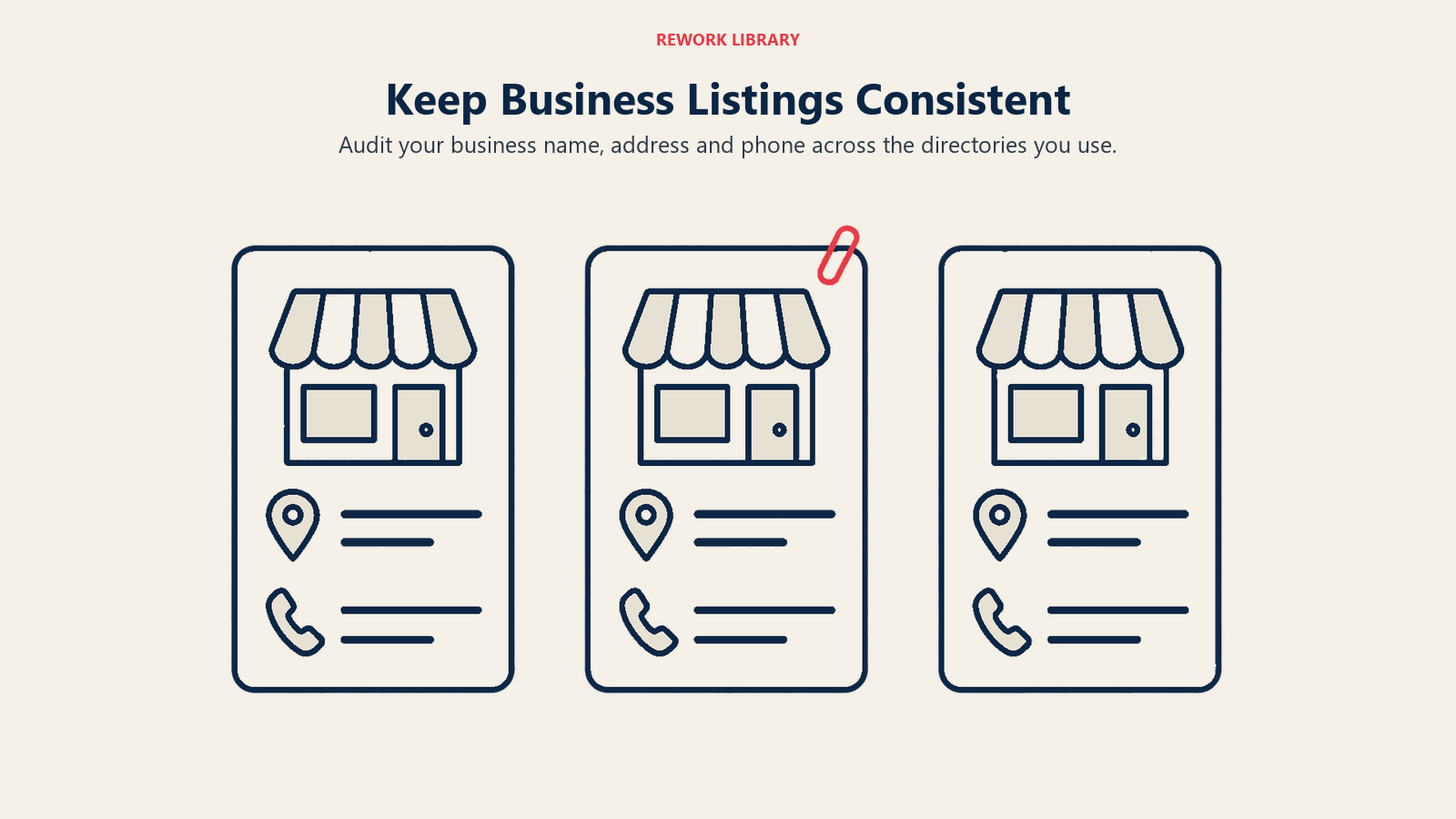
A citation is any online mention of your business name, address, and phone number. Consistent citations across major directories confirm to Google that your business is legitimate and that your NAP information is accurate.
Priority citation directories for beauty businesses:
- Yelp
- StyleSeat
- Vagaro
- Booksy
- Fresha
- Facebook Business
- Apple Maps
- Bing Places
- Yellow Pages
- Foursquare
- Local chamber of commerce directory
- Neighborhood-specific directories (NextDoor Business, local event sites)
The key word is consistent. If your address appears as "Suite 201" on your website but "Ste. 201" on Yelp and "Suite #201" on Booksy, that inconsistency creates noise that dilutes your citation signals. Audit your existing citations using a tool like Moz Local or BrightLocal and fix any discrepancies before building new ones. Once your citations are clean, pairing this foundation with Google Ads for beauty businesses lets you capture high-intent searches while your organic rankings continue building.
Review Signals: Volume, Recency, and Sentiment
Reviews are a ranking factor and a conversion factor simultaneously. A business with 200 reviews at 4.7 stars outperforms one with 35 reviews at 4.9 stars in most local ranking algorithms. Volume matters alongside quality.
Build a systematic review generation process without violating Google's policies (which prohibit incentivizing reviews or posting fake ones):
Timing matters: Ask for a review while the client is still at the salon or immediately after checkout, not days later when the experience is less fresh. Verbal requests with a direct link ("I'd love it if you shared your experience on Google. Here's the link, I'll text it to you now") dramatically outperform passive review request emails.
Direct link: Create a short link directly to your Google review form and add it to your email signature, booking confirmation, and post-visit SMS. Don't make clients find you. Send them directly to the review form.
Respond to every review: Google confirms that responding to reviews is a ranking signal. Respond to positives with specific acknowledgment (not just "Thank you!") and respond to negatives with empathy and a resolution offer. Your response to a negative review is read by far more people than the review itself. For a deeper strategy on managing your review profile proactively, see the full guide to review management for beauty businesses.
Review request script example: "We loved having you in today. If you have a minute, an honest review on Google helps us a lot. It's how new clients find us. I'll text you the link right now." Simple, direct, no pressure.
Target a minimum of 50 reviews with a 4.5+ average before considering your review profile competitive. Top-ranking local salons in competitive markets typically have 150-400+ reviews.
On-Page Local SEO: Your Website's Role
Your GBP is the primary local ranking asset, but your website amplifies it. Several on-page elements matter specifically for local ranking:
Location page: If you have one location, your homepage should include your full address, phone number, embedded Google Map, and the city and neighborhood terms you're targeting. Don't bury your location. Google needs to see it clearly.
Local schema markup: Schema markup is code that tells Google exactly what type of business you are, where you're located, and what you offer. LocalBusiness schema, Service schema, and Review schema all help Google understand and display your business information accurately. If you're not technical, your web developer or a plugin can implement this.
Mobile page speed: Over 60% of beauty searches happen on mobile. A page that loads in 4+ seconds loses a significant portion of visitors before they see anything. The Bureau of Labor Statistics projects 5% employment growth for hairstylists and cosmetologists through 2034, with roughly 84,200 annual job openings, meaning competitive density in local beauty markets will continue to increase, making mobile search performance an ever more critical differentiator. Use Google's PageSpeed Insights to test your site and identify fixes. Slow load times are especially damaging if you're also running paid search, since mobile landing page speed directly affects Google Ads Quality Scores.
NAP on every page: Your Name, Address, and Phone should appear in your website footer on every page, not just the contact page.
Tracking and Measuring Local SEO
Local SEO without measurement is faith-based marketing. Track these metrics monthly:
Google Business Profile Insights: Views (how often your profile appears in search), searches (what terms triggered your appearance), website clicks, direction requests, and phone calls. These are free and available directly in your GBP dashboard.
Google Search Console: Shows which search queries are driving traffic to your website, including local queries. Free, requires verification of your website.
Ranking tracking: Use a tool like BrightLocal or Whitespark to track your local pack ranking for your target keywords over time. Seeing rank movement from position 8 to position 2 for "balayage [city]" is meaningful even before you see the corresponding booking increase.
Booking source attribution: Ask every new client how they found you. "Google search" is a valid and trackable answer that helps you understand local SEO's contribution to new client acquisition without relying solely on digital analytics. Combining this with email marketing for beauty centers gives you a retention layer that converts organically acquired first-time clients into repeat visitors.
Local SEO Compounds Over Time
The most important thing to understand about local SEO is that it's not a campaign. It's a compounding asset. The citations you build today, the reviews you generate this month, the GBP posts you publish this week all accumulate into an authority profile that gets stronger over time.
A salon that commits to consistent local SEO activity for 12 months will have a competitive advantage that a new competitor can't replicate quickly. According to IBISWorld, the U.S. hair salon industry includes over one million businesses, in that environment, the compounding authority built through consistent local SEO is one of the few durable moats available to an independent operator. And unlike paid advertising, that advantage doesn't disappear when you stop writing the check.
Start with your GBP. Make sure it's complete, accurate, and active. Then build citations, generate reviews systematically, and create local content on your website. Six months of consistent execution typically produces visible ranking improvements. Twelve months produces a meaningful, measurable booking increase. Pairing this organic foundation with social media marketing for salons creates a two-channel presence that captures clients at every stage of the discovery process.
Learn More

Senior Operations & Growth Strategist
On this page
- How Google Decides Who Ranks Locally
- Google Business Profile: The Highest-Impact Optimization
- Local Keyword Strategy
- Citation Building: Consistent Business Listings
- Review Signals: Volume, Recency, and Sentiment
- On-Page Local SEO: Your Website's Role
- Tracking and Measuring Local SEO
- Local SEO Compounds Over Time
- Learn More