Competitive Analysis for Beauty Businesses: Finding Your Edge
Turn this article into takeaways for your work.


Each assistant summarizes the article only for you and suggests best practices for your work.
Competitive analysis for a beauty business is the ongoing practice of studying local rivals to find gaps you can own. The process has five steps: define your competitive radius, build a competitor list, run a service-gap analysis, benchmark pricing, and mine competitor reviews and social presence. Done quarterly, it turns scattered observation into specific decisions on positioning, menu, pricing, and marketing.
Most beauty center owners could name their five nearest competitors without thinking twice. But ask them to describe those competitors' average service ticket, their most-praised service on Google reviews, their posting cadence on Instagram, or which client segment they're underserving, and you'd get mostly guesses. With over one million hair and nail salon businesses in the U.S. according to IBISWorld, operating on intuition rather than competitive intelligence is a structural disadvantage that compounds over time.
Knowing your competitors exist is not competitive intelligence. It's just awareness. The salons and spas that use competitive analysis to grow are doing something different: they're treating it as an ongoing practice, not a one-time exercise they complete before opening, and they're converting what they learn into actual decisions about positioning, service menu, pricing, and marketing.
Done well, competitive analysis doesn't tell you what to copy. It tells you where the gaps are, and those gaps are where your growth lives. What you discover feeds directly into your market positioning for salons and spas, sharpening the differentiation argument that lets you stop competing on price.
Key Facts: Competitive Analysis in Beauty
- 67% of clients say they chose their current salon by eliminating options rather than selecting a clear first choice, meaning most salons win by default, not distinction (American Salon Client Survey)
- The top 3 Google local results receive 70% of clicks for "salon near me" searches, making competitive visibility as important as competitive service differentiation
- Beauty businesses that conduct structured competitive analysis and adjust positioning based on findings report 22% higher new client acquisition rates in the following 12 months (Beauty Industry Group)
Competitive Analysis as an Ongoing Practice
Here's the most important mindset shift: competitive analysis isn't something you do once when you're writing a business plan or considering a new service. It's a quarterly practice that keeps your intelligence current and your decisions grounded in what's actually happening in your market.
Local beauty markets shift. A new luxury nail studio opens. The massage therapy chain closes two locations. A stylist who was a top performer at your competitor launches their own booth rental. Prices adjust. Social media trends change which services look popular. What was true about your competitive position six months ago may not be true today.
Build a simple competitive tracking system (a spreadsheet or a folder of bookmarked links) and commit to reviewing it every 90 days. This isn't a major time investment. Two to three hours per quarter keeps your intelligence current and gives you a consistent strategic advantage over owners who aren't doing it at all. Tracking search visibility is part of this picture, and monitoring where competitors rank for local searches is central to local SEO for beauty centers.
Defining Your Competitive Radius
Not all competitors are equally relevant. Before building your competitor list, define the geographic zones that matter for your business type.
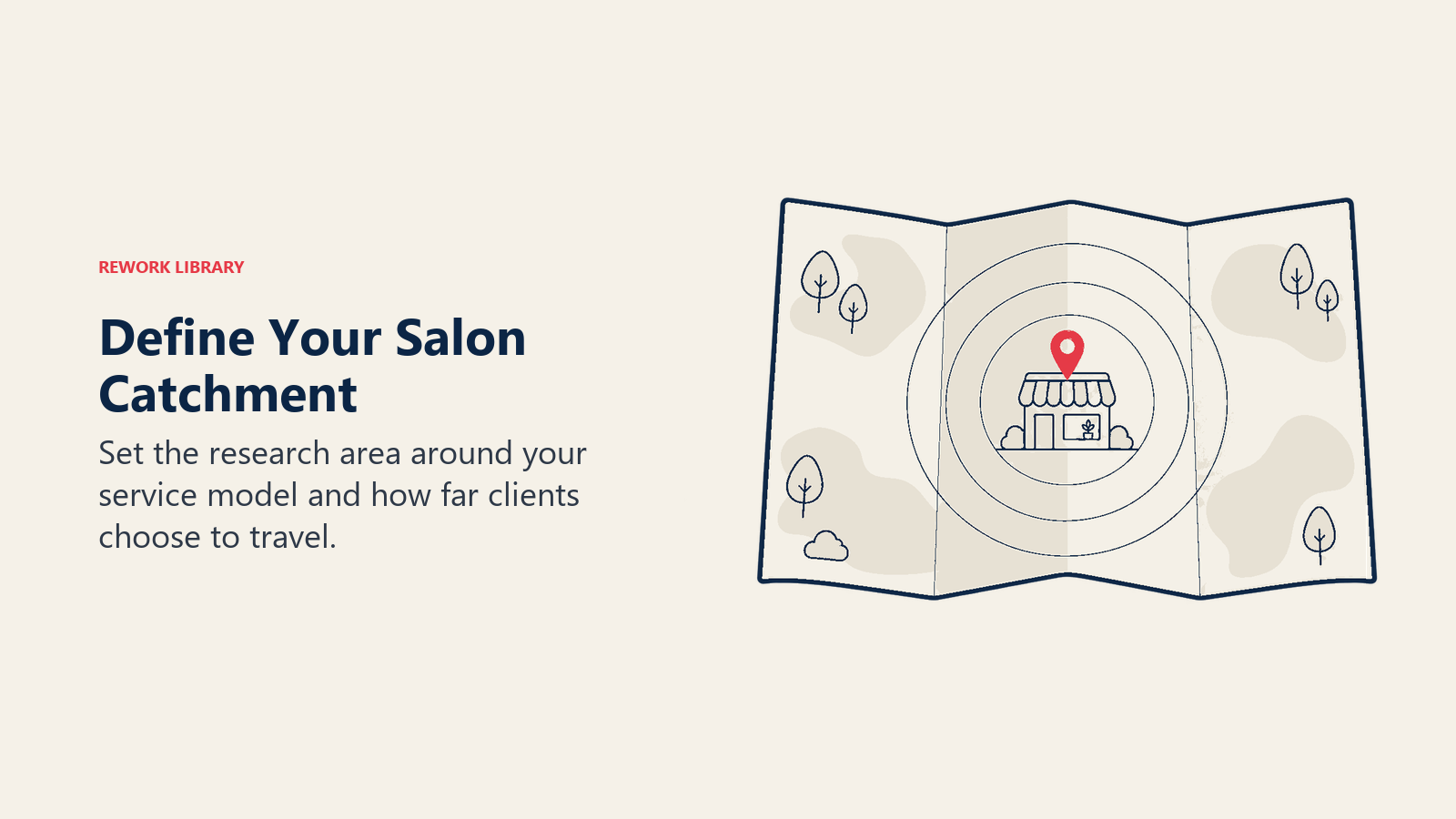
1-mile radius: Your primary zone for walk-in and convenience-driven clients. Nail bars, blowout studios, and quick-service concepts live and die in this radius.
3-mile radius: The zone most clients will cross for a preferred stylist or a specialty service. Full-service salons and mid-range spas compete primarily in this ring.
10+ mile radius: Relevant only for destination businesses: luxury day spas, highly specialized clinics, or salons with a strong reputation for a specific technique like keratin treatment or advanced color work. These pull clients who plan the visit, not just the closest option.
Match your radius to your business model. A premium curly hair specialist in a major metro might have clients who drive 20 minutes specifically to see them. A walk-in nail bar is unlikely to pull anyone past a 5-minute drive.
Building Your Competitor List
Start with Google Maps. Search your primary services ("hair salon," "spa," "nail salon") with your city or neighborhood. Look at the businesses that appear in the local pack and the first page of organic results. These are the competitors capturing the most search-driven clients.
Expand with Yelp, Booksy, Vagaro, and StyleSeat, depending on your service category. Social search (Instagram location tags, TikTok location-based search) surfaces competitors that are generating organic reach even if their website ranking is weak.
Categorize what you find into three types:
Direct competitors: Same service category, similar price tier, overlapping target client. These require the most attention because you're fishing in the same pond.
Indirect competitors: Different service category but competing for the same client budget and time. A massage therapy studio and a facial spa are indirect competitors for a client's wellness spending. A dry bar and a full-service salon compete for the same appointment slot for a client who only needs a blowout.
Partial substitutes: DIY services, at-home kits, or the client just skipping the service entirely. These are relevant for understanding category-level demand, but less actionable for direct positioning decisions.
Build a master list of 10-15 competitors across all three types. You won't track all of them with equal depth, but you want a comprehensive view before prioritizing.
Service Gap Analysis: Finding the White Space
Once you have your competitor map, look for what's missing. Service gaps (services that are underserved or absent in your local market) represent your clearest growth opportunities.
Run through this process for each major service category relevant to your business:
- List every service offering across your top 10 competitors
- Note which services multiple competitors offer (saturated) versus which appear at only one or two (underserved)
- Identify services that have strong national or industry demand but low local availability
- Cross-reference with what clients in your market are searching for on Google (Google Trends and Google's autocomplete suggestions for your service category and city are free tools for this)
Common white spaces that appear in competitive analyses across markets:
- Advanced color services (balayage, lived-in color) in markets served primarily by cut-and-color generalists
- Specialized textured hair care in markets with diverse demographics but few trained specialists
- Men's grooming beyond basic cuts in markets where barber services are limited
- Integrative spa services (combining skin, massage, and wellness treatments) in markets with siloed service providers
- Membership or subscription models in markets where no competitor has formalized retention
A white space doesn't guarantee demand. It signals an opportunity worth testing. Verify before investing by talking to current clients about their service gaps and tracking what competitors you're regularly asked about. When a gap is confirmed and you're ready to act on it, the guidance in introducing new services helps you launch without disrupting your existing client base.
Pricing Benchmarks: Where to Price Relative to Market
Pricing in isolation is a guess. Pricing with competitive context is a strategy.
For each competitor, record the price of your five most comparable services. Build a simple pricing matrix:
| Competitor | Women's Haircut | Full Color | Balayage | Facial (60 min) | Avg Ticket Est. |
|---|---|---|---|---|---|
| Competitor A | $45-65 | $95-130 | $180-240 | $85 | $115 |
| Competitor B | $35-55 | $80-110 | n/a | n/a | $75 |
| Your Salon | $75-95 | $140-175 | $220-280 | n/a | $155 |
This matrix tells you where you sit in the market. If you're consistently at the high end but your reviews and booking rates are strong, you may have room to raise prices further. If you're priced at the top but your occupancy is struggling, the market may be telling you that your positioning hasn't justified the premium yet.
Don't price-match competitors automatically. But know where you are relative to the market and have an intentional reason for your position. The full strategic framework for setting and defending your rate structure is covered in pricing strategies for beauty centers.
Mining Competitor Reviews for Unmet Needs
Google and Yelp reviews from your competitors are one of the most underused intelligence sources in beauty business management. They're essentially free market research: clients telling you exactly what they valued and what they found lacking. BrightLocal's Local Consumer Review Survey finds that review ratings and review volume are among the primary factors driving clicks in local search results, making competitor review patterns a signal not just about service quality, but about local search visibility.
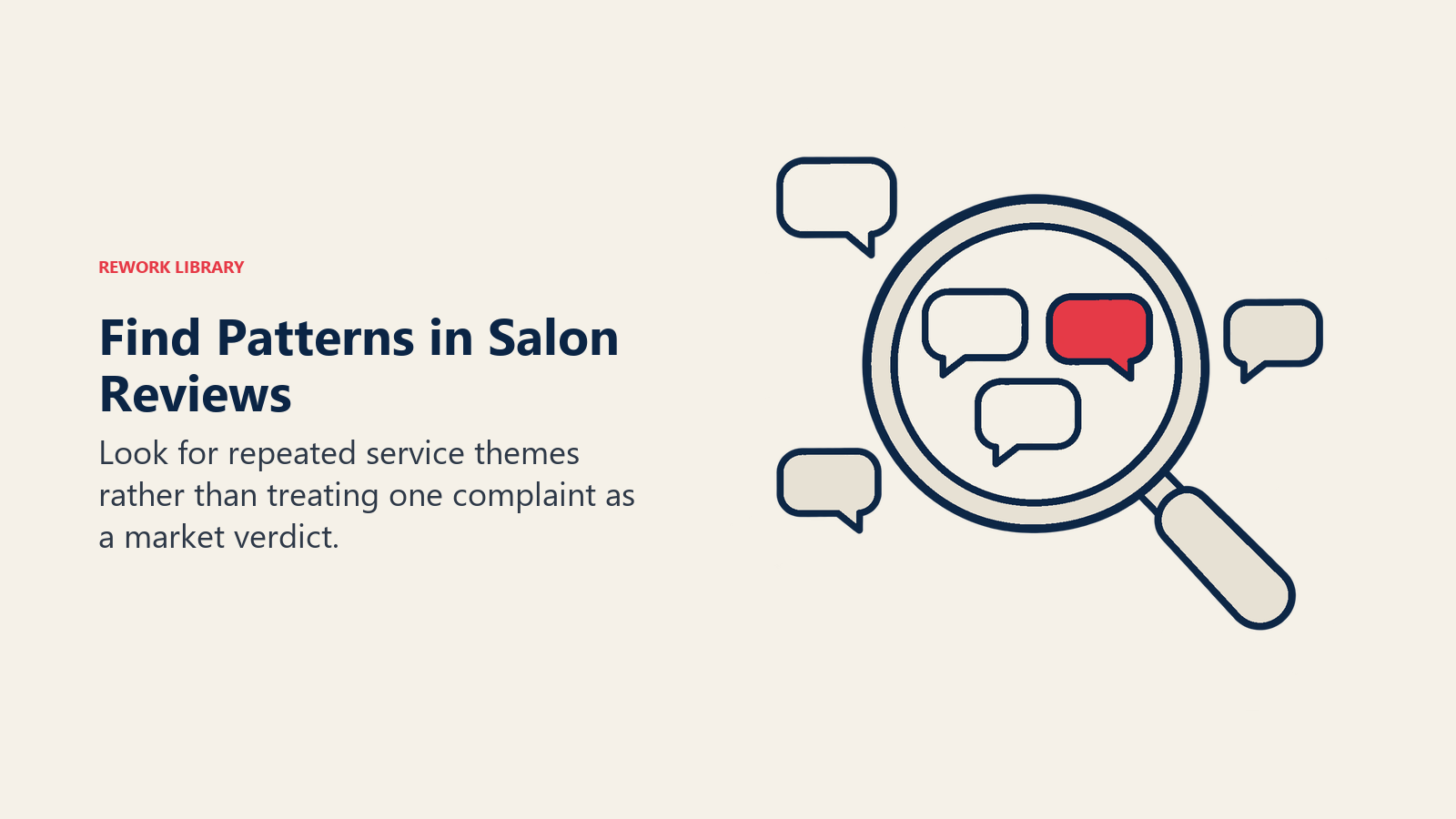
For each major competitor, read the most recent 30-40 reviews. Look for patterns in two categories:
Frequently praised qualities: What do clients consistently celebrate? "Amazing balayage," "so relaxing," "always on time," "remembered my preferences." These tell you what the market values, and you need to deliver these as table stakes, not differentiators.
Recurring complaints: What are clients consistently frustrated by? "Couldn't get an appointment for three weeks," "pricing wasn't clear before the service," "the wait area was uncomfortable," "the stylist didn't listen to what I asked for." These are your opportunities. Every consistent complaint at a competitor is a service standard gap you can fill.
A pattern of complaints about wait times at a competitor with strong technical reviews might signal that capturing their overflow clients with a same-day booking option would be effective. A competitor getting praised for atmosphere but criticized for inconsistent results means technical excellence is the gap to fill. These review insights also directly inform your review management for beauty businesses strategy by showing you what praise signals to encourage and what complaints to preemptively address.
Social Presence Analysis
Social media competitive analysis tells you what content resonates in your local market and where you have visibility advantages or disadvantages.
For each competitor, note:
- Instagram follower count and average post engagement rate (likes + comments / followers)
- TikTok presence and average video view count
- Posting frequency (daily, 3x/week, sporadic)
- Content mix (before/after transformations, Reels, educational, lifestyle)
- Most-engaged posts (what content type is driving the most response)
You're looking for two things: what content format is working in your market, and where the visual quality gap exists that you could fill. Many local salons post inconsistently and at low visual quality. If you can commit to three consistent, high-quality posts per week (especially video), you'll often outpace competitors with much larger audiences within six to nine months. According to Sprout Social's research, beauty and fashion brands have led social media engagement for over a decade, meaning your competitors' social presence benchmarks reflect real consumer attention, not just vanity metrics. The execution playbook for this is laid out in social media marketing for salons.
Mystery Shopping: What to Evaluate
There's no substitute for experiencing your competitors as a client does. Mystery shop your top two or three direct competitors at least once per year. Pay attention to the full journey:
Pre-visit: How easy is it to book? How long is the wait for an appointment? Is the website clear about services and pricing? Do they follow up before the visit?
Arrival and welcome: First impression of the space, how you're greeted, how long you wait after arrival, whether anyone acknowledges you immediately.
Service experience: Consultation quality (did they ask what you wanted?), technical execution, communication during the service, product recommendations.
Checkout and follow-up: Was checkout smooth? Did they recommend rebooking? Did you receive any follow-up communication afterward?
Every element you experience is a data point. The goal isn't to find ways to criticize the competition. It's to identify where you'd authentically rate them high or low, because that tells you what clients experience when they compare your businesses.
Turning Insights into Strategy
All of this analysis produces a picture: where your competitors are strong, where they're weak, what clients in your market value, what they're not getting, and where your business sits relative to the competitive landscape.
Now convert that picture into three to five specific decisions:
- A pricing adjustment to better reflect your market position
- One or two service additions or deletions based on gap analysis
- A specific client experience standard to implement based on competitor review complaints
- A content strategy adjustment based on what's resonating in your local market
- A positioning statement update or sharpening based on where white space exists
Competitive analysis that doesn't produce decisions isn't intelligence. It's research for its own sake. The discipline is completing the loop from observation to action. McKinsey's analysis of the beauty market identifies market saturation as one of the core threats to beauty industry growth, meaning businesses that systematically understand where competitors are weak, and act on those gaps, will be structurally better positioned as the market tightens. Tracking those actions through a data-driven decisions framework for salon owners ensures the improvements you implement are measurable and repeatable.
Frequently Asked Questions about Competitive Analysis for Salons
What is competitive analysis for a beauty business?
It's a structured review of the salons, spas, and substitutes competing for your clients, covering their services, prices, reviews, and social presence. The goal isn't to copy rivals but to find underserved gaps you can fill and to price and position with market context instead of guesswork.
How often should a salon do competitive analysis?
Treat it as a quarterly practice, not a one-time exercise. Two to three hours every 90 days keeps your intelligence current as competitors open, close, raise prices, or shift their service mix. Owners who never refresh their view make decisions on stale assumptions.
How many competitors should I track?
Build a master list of 10-15 competitors across direct rivals, indirect rivals, and partial substitutes. You won't track all of them at equal depth, but a broad list helps you prioritize the two or three direct competitors worth mystery shopping each year.
What's the fastest way to find market gaps?
List every service across your top 10 competitors, flag which ones appear at only one or two of them, then cross-reference with local search demand using Google Trends and autocomplete. Underserved services with real local search volume are your clearest white space.
Learn More

Senior Operations & Growth Strategist
On this page
- Competitive Analysis as an Ongoing Practice
- Defining Your Competitive Radius
- Building Your Competitor List
- Service Gap Analysis: Finding the White Space
- Pricing Benchmarks: Where to Price Relative to Market
- Mining Competitor Reviews for Unmet Needs
- Social Presence Analysis
- Mystery Shopping: What to Evaluate
- Turning Insights into Strategy
- Learn More