Inventory Management for Beauty Centers: Controlling Costs Without Stockouts
Turn this article into takeaways for your work.


Each assistant summarizes the article only for you and suggests best practices for your work.
Beauty inventory planning is the system that keeps the right products in stock without tying up cash in overstock or letting product expire. It means separating back-bar from retail, setting par levels from real usage and supplier lead times, counting on a fixed weekly schedule, and auditing monthly. Done well, it pulls back-bar cost toward 5 to 8 percent of service revenue and ends mid-appointment stockouts.
Running out of a color mid-appointment or discovering a product you ordered three months ago sitting expired in a cabinet. Both represent the same underlying problem: no system. One costs you the appointment and the client relationship. The other costs you the product margin and the cash that paid for it.
For most beauty centers, inventory is managed by feel. The senior stylist notices supplies are running low and mentions it to the manager. Someone puts in an order, too much of some things, too little of others. Products accumulate on a back shelf until no one remembers when they were purchased. Retail displays go understocked for days before anyone reorders.
The cost of this is real. Back-bar product waste, theft, spoilage, and overstocking typically erode 3-5% of revenue in beauty centers without a formal inventory system. For a salon generating $500,000 per year, that's $15,000-$25,000 quietly leaving through the back door. These losses show up directly in the unit economics for beauty centers: back-bar cost as a percentage of service revenue is one of the clearest signals of operational efficiency or waste.
Key Facts: Beauty Center Inventory
- Back-bar costs should represent 5-8% of service revenue. Most unmanaged salons run 10-14% (Salon Today).
- Retail shrinkage (theft, damage, expiry) averages 2-4% of retail inventory value in beauty businesses without formal controls
- Salons with formal monthly inventory audits reduce product costs by 18-22% within 90 days of implementation
For broader context, McKinsey's analysis of retail shrinkage reduction documents how systematic audit programs and portion controls drive the largest shrinkage reductions, the same principles that apply directly to back-bar waste and retail inventory loss in beauty businesses.
The Two Inventory Categories: Back-Bar vs Retail
Back-bar inventory and retail inventory are fundamentally different and need to be managed differently. Treating them as one pool is one of the most common inventory management mistakes in beauty businesses.
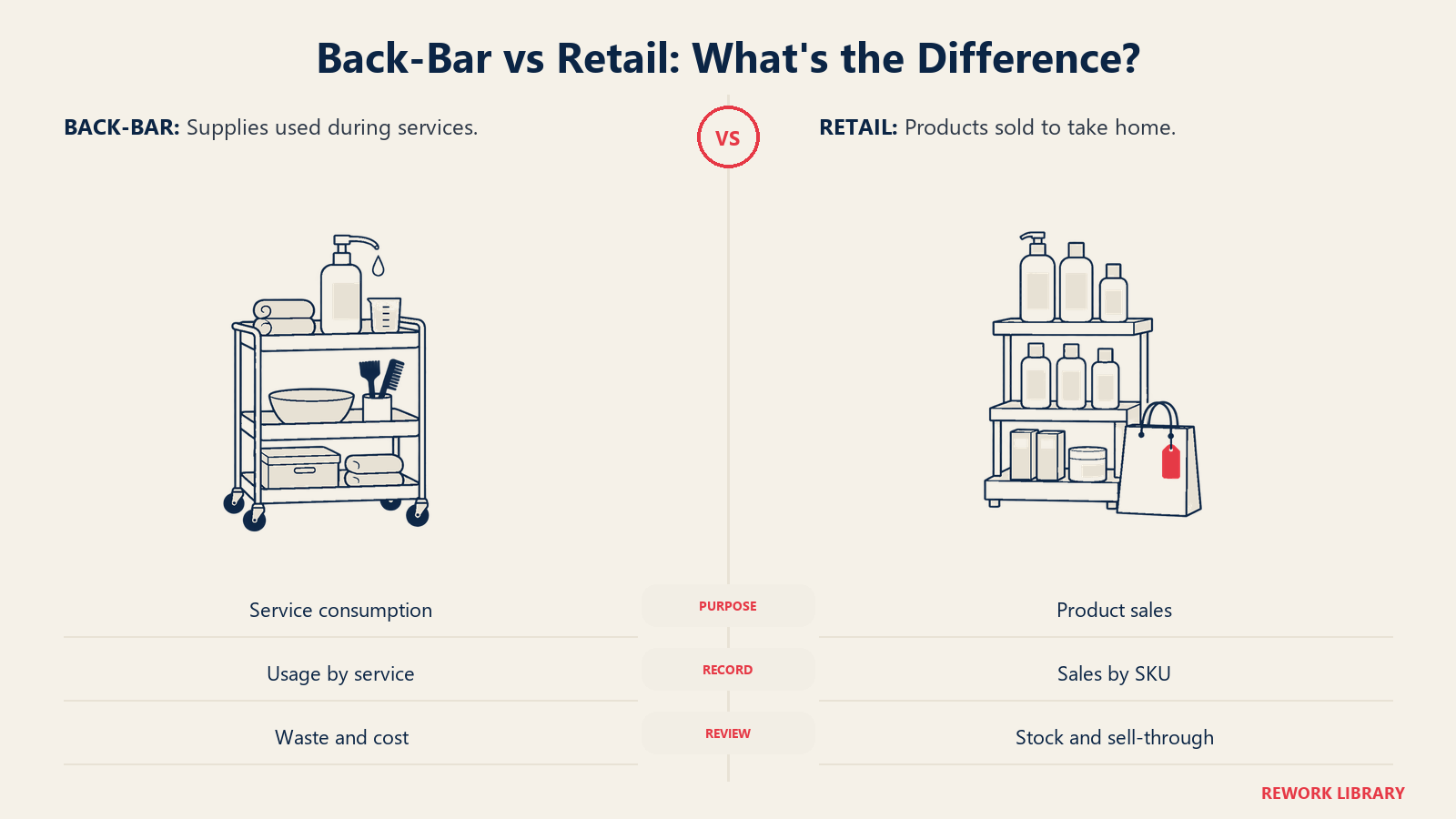
Back-bar inventory (also called professional use or service inventory) is the product consumed during services. Color, developer, toner, shampoo, conditioner, treatment products, wax, nail products. This is a cost of goods. It should be tracked against service revenue and targeted to stay within 5-8% of service revenue.
Retail inventory is product displayed and sold to clients to take home. This is a revenue opportunity. It has different margins (typically 40-50% markup), different theft dynamics, different expiry considerations, and different tracking needs. Retail performs best when tracked against retail sales targets, not mixed into a general product cost calculation.
The mistake of treating them as one pool means you can't tell whether your product cost problem is a back-bar waste problem (staff over-applying products, no portion controls) or a retail management problem (expired products, slow-moving SKUs, shrinkage). The fix for each is completely different. Building a disciplined retail product sales strategy for salons depends on separating retail inventory from back-bar so you can accurately measure retail margins and sell-through rates.
Product Tracking Systems
You don't need expensive software to run a functional inventory system. But you do need a system, something that isn't in your head or relying on a stylist's memory.
Paper-based tracking works fine for small salons (under 5 stylists, under 100 SKUs). A simple log with columns for product name, quantity on hand, reorder point, last order date, and supplier. Updated weekly. Checked against par levels monthly.
Digital tracking scales better and integrates with purchasing and POS systems. Options range from a shared Google Sheet (free, requires discipline) to inventory modules in booking software (Vagaro has one, as do several salon-specific POS platforms) to dedicated inventory tools like Salon Iris or SalonBiz.
What to track for every product:
- Product name and supplier
- Current quantity on hand (in your unit of measurement: ounces, liters, units)
- Par level (minimum quantity before reordering)
- Reorder quantity (how much to order when you hit par)
- Last order date and supplier lead time
- Cost per unit
A weekly product count takes 15-30 minutes for most salons. The count should happen on the same day each week, before any orders are placed. Consistency in timing is what makes the data useful. Counts at random intervals generate unreliable trend data. The salon management software guide covers which platforms include inventory modules and how they integrate with purchasing workflows.
Setting Par Levels
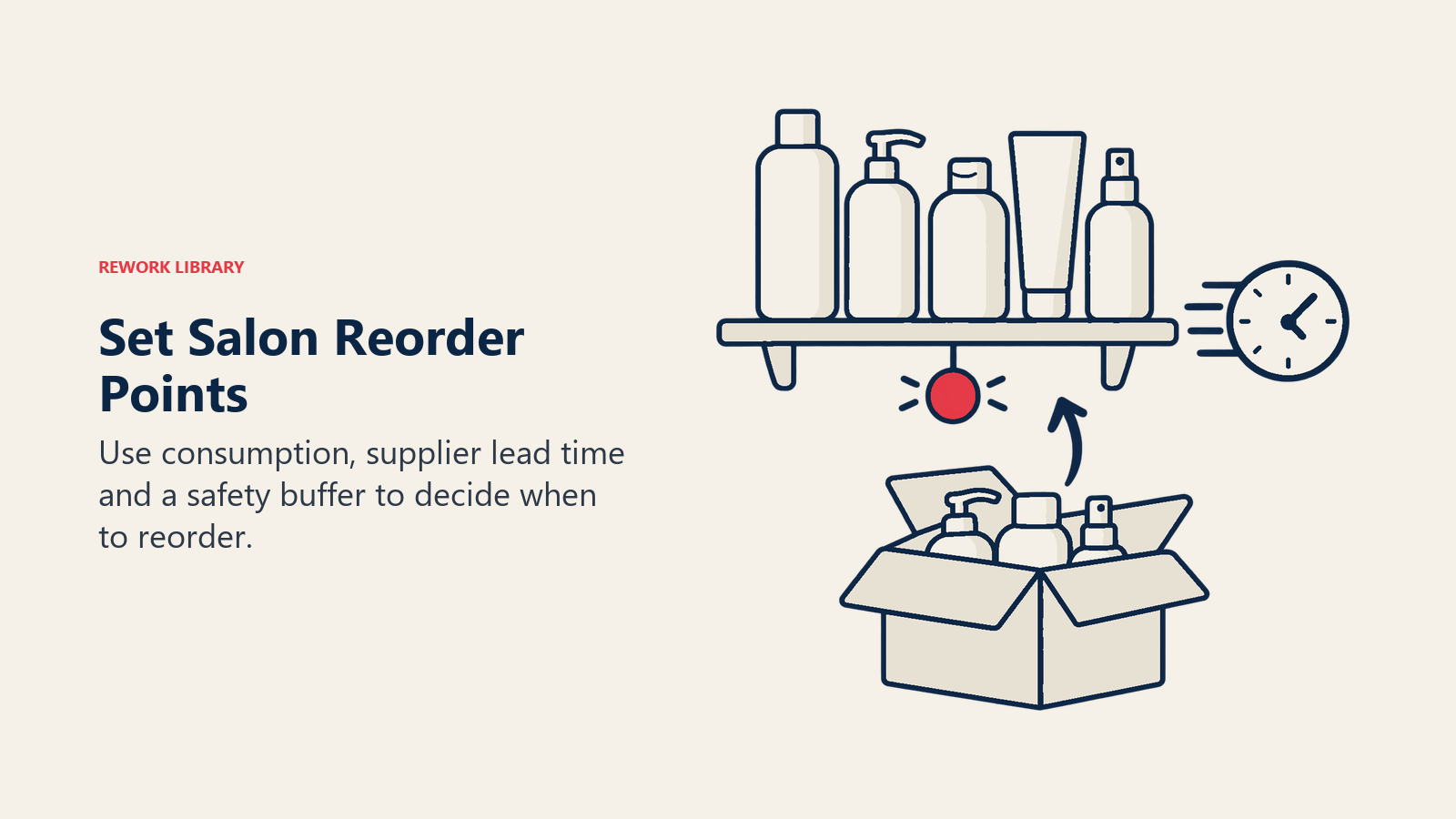
A par level is the minimum quantity of a product you should have on hand before reordering. Getting par levels right is the difference between running out and over-ordering.
How to calculate par level:
Par level = (Average weekly usage) × (Supplier lead time in weeks) × (Safety buffer)
If you use 2 liters of a specific developer per week and your supplier delivers in 3-4 days (roughly 0.5 weeks), your base par level is 1 liter. A safety buffer of 1.5x brings it to 1.5 liters. So when your stock drops to 1.5 liters, you reorder.
By product category, realistic par levels for a mid-sized salon (4-6 stylists):
- Color lines: 2-3 week supply of top-selling shades, 1-week supply of less-used shades
- Developer: 4-6 liter minimum across all volumes
- Toners and glosses: 1-2 week supply
- Shampoo/conditioner (back-bar): 2-3 week supply
- Styling products: 1-2 week supply
Review par levels seasonally. Demand for balayage services peaks in spring and fall. Color correction volume tends to spike post-holiday season. A par level set in January may underserve a March demand spike if it's never adjusted. These seasonal patterns also affect retail demand. Seasonal promotions for beauty businesses often drive spikes in specific retail product categories that need to be reflected in your par level planning.
Par Level Calculation Worksheet
Use this simple framework for each product category:
| Product | Weekly Usage | Lead Time (days) | Safety Buffer | Par Level |
|---|---|---|---|---|
| [Color brand] main line | 3 liters | 3 days | 1.5x | 2 liters |
| Developer 20vol | 1 liter | 3 days | 1.5x | 0.5 liters |
| Retail shampoo (each SKU) | 2 units | 5 days | 2x | 2 units |
| Wax (hard) | 1 kg | 7 days | 1.5x | 0.5 kg |
Fill this out for your 20-30 highest-volume SKUs first. Those products drive 80% of your inventory management impact. The rest can be managed with less precision.
Vendor Management
Most beauty centers work with 3-5 suppliers: a primary color distributor, a professional product distributor, a retail brand partner or distributor, and perhaps a specialty supplier for treatments or nails.
Consolidating where it makes sense: Ordering from fewer suppliers reduces administrative overhead, often unlocks volume pricing tiers, and simplifies the accounts payable process. If two suppliers carry overlapping inventory, consolidating spend with one often generates meaningful discounts.
Negotiating with distributors: Payment terms (net 30 vs net 15 vs upfront), minimum order requirements, and delivery frequency are all negotiable, especially if you've been a consistent customer. A simple ask ("We're ordering consistently every two weeks. Is there a volume discount available if we increase our average order size?") often produces results.
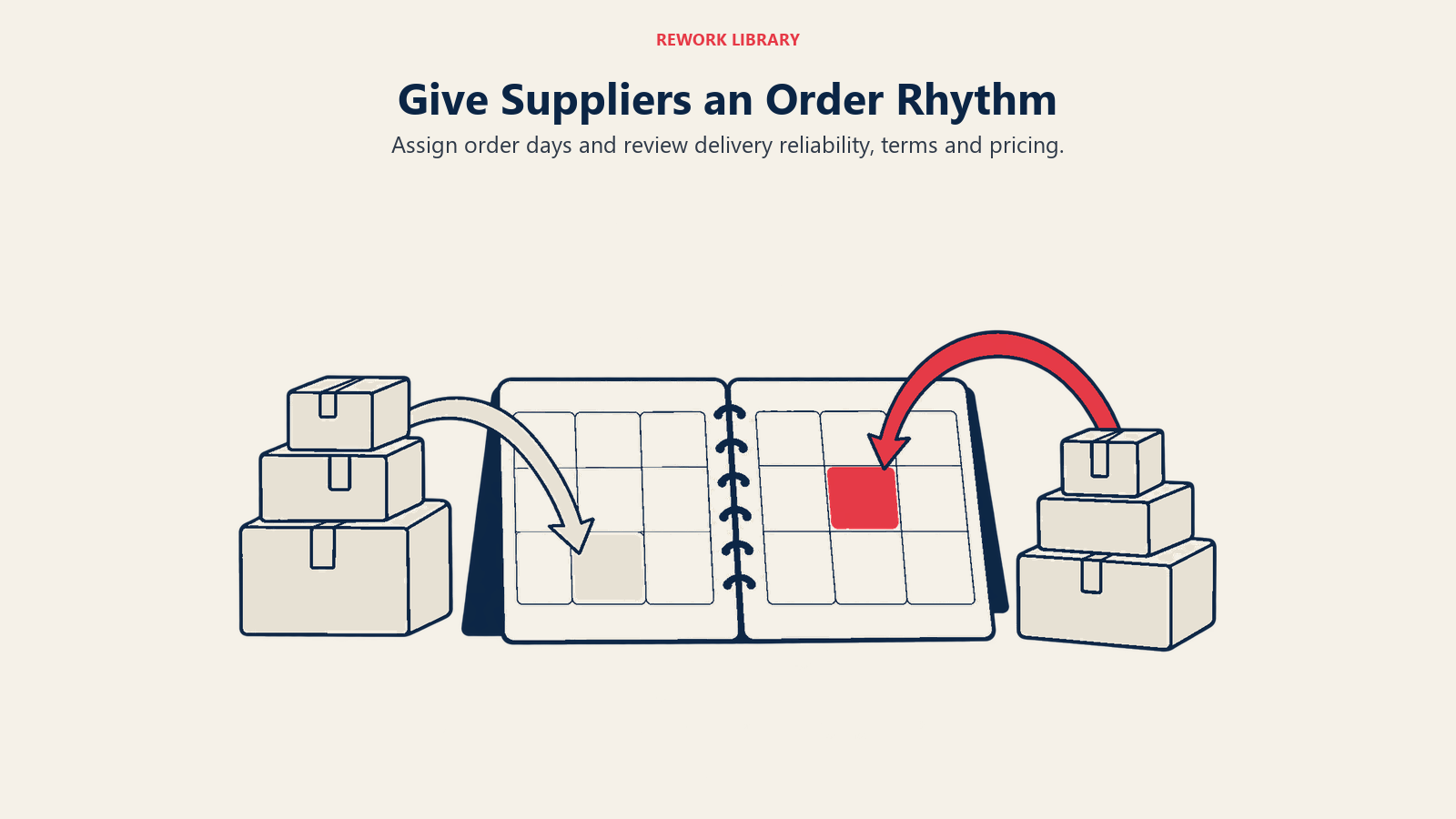
Managing multiple suppliers without chaos: Assign each supplier a dedicated order day. Monday is supplier A. Thursday is supplier B. This creates a predictable rhythm that takes supplier management off the mental queue for the rest of the week.
Red flags in vendor relationships: Unexplained price increases without notification, consistently inaccurate orders, and long lead times on staple products are all reasons to evaluate alternatives. The switching cost of finding a new distributor for a product category is typically lower than the ongoing cost of managing a problematic supplier relationship.
Preventing Theft and Waste
Product loss in beauty centers comes from three primary sources: staff overuse during services, client self-service (helping themselves to products in retail areas or during services), and outright theft. A fourth source, expiry, is a form of waste that usually reflects poor par level management.
Staff overuse is the most common and most correctable source of back-bar cost inflation. It happens when staff apply products without awareness of quantity, or when they use professional products for personal use without compensating the business.
Portion control practices that work:
- Measured dispensers for high-volume products (shampoo, conditioner)
- Pre-measured color packets for common formulas
- Clear communication of expected product use per service type
- Regular waste tracking. If a particular stylist's back-bar cost per client is consistently higher than peers, that's a conversation worth having.
The goal isn't to make staff feel surveilled. It's to make waste visible so it can be addressed. Framing it as "we're tracking this so we can price services correctly and keep wages competitive" lands better than "we're watching how much product you use." These conversations are easier within a culture of transparency. The same management approach that supports stylist and therapist retention makes it possible to discuss product usage without creating defensiveness.
Client access to retail products: Lock or secure the retail area if you're seeing unexplained retail inventory shrinkage. Many salons keep retail accessible to encourage browsing, and that's reasonable. But if shrinkage is running above 2% of retail sales, a more secured display or a checkout-only model is worth implementing.
Personal use policy: A clear, written policy about staff personal use of products (what's allowed, like a small stylist discount on retail purchases, and what isn't, like taking back-bar products for personal use) removes ambiguity and makes enforcement straightforward.
Cost of Goods Benchmarks
These benchmarks give you a target to aim for and a signal to investigate when you're running above it.
| Business Type | Back-Bar Target | Red Flag Threshold |
|---|---|---|
| Hair salon (service only) | 5-8% of service revenue | Above 12% |
| Full-service salon (hair + skin + nails) | 6-9% of service revenue | Above 13% |
| Day spa (skin/body focus) | 7-10% of service revenue | Above 15% |
| Nail salon | 8-12% of revenue | Above 18% |
Retail margin benchmarks:
- Markup at wholesale: 40-60% (meaning a product costing $10 wholesale retails for $16-$18)
- Shrinkage target: under 2% of retail inventory value
- Sell-through rate: 80%+ within 60 days for new SKU introductions
Statista's data on U.S. retail inventory shrinkage rates shows the national average retail shrink at 1.6% in fiscal year 2022, a useful external benchmark to compare your beauty retail loss rate against, since exceeding this general retail average signals that beauty-specific controls (display security, staff access policies) need tightening.
If your back-bar cost is running above target, the typical causes are: no portion controls, high staff turnover (new stylists use more product while learning formulas), expired products being disposed of, or outdated par levels that lead to over-ordering perishable items. Running these benchmarks alongside data-driven decisions for salon owners gives the numbers proper context. A single month above target may reflect a staffing transition, while three consecutive months above target signals a structural issue.
Inventory Audits
The monthly spot-check and the quarterly full audit serve different purposes and shouldn't be confused.
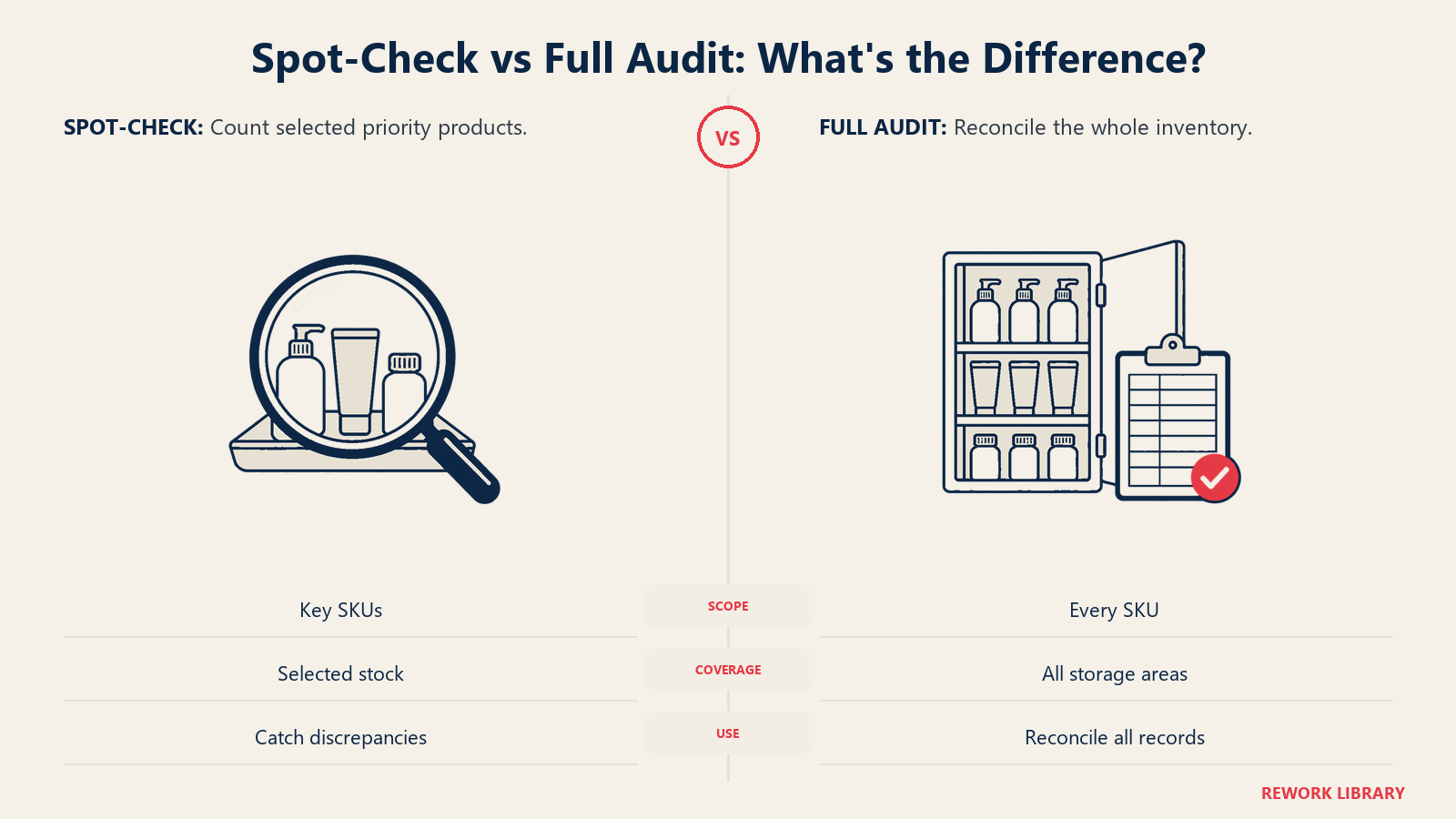
Monthly spot-check (15-20 minutes): Count your 10-15 highest-volume and highest-cost SKUs. Compare physical count to what your tracking system shows. If there's a discrepancy of more than 5-10%, investigate before the next order cycle. This catches errors, theft, and tracking inconsistencies before they compound.
Quarterly full audit (2-4 hours): Count everything. Every SKU, every quantity, every product in every storage area (including the cabinet in the break room that everyone forgot about). Reconcile against your records. Identify expired products, products with no usage in 90+ days (candidates for discontinuation), and any category running significantly above or below target.
Using discrepancy trends: A single discrepancy between physical count and records could be a counting error. The same discrepancy appearing in three consecutive monthly counts on the same SKU is a pattern worth investigating.
One-Page Inventory SOP
Any beauty center can implement this system in a week:
Weekly (20 minutes, same day each week):
- Count all products against par levels
- Place orders for anything below par
- Log any waste or expired products disposed of
Monthly (30 minutes):
- Run spot-check on top 15 SKUs
- Reconcile against records
- Review retail sell-through by SKU. Discontinue slow movers.
Quarterly (2-4 hours):
- Full physical count of all inventory
- Reconcile against records
- Calculate back-bar cost as % of service revenue
- Adjust par levels for upcoming season
- Review vendor relationships: pricing, terms, reliability
The one metric that signals whether your inventory system is working:
Back-bar cost as a percentage of service revenue, tracked monthly. For a full picture of how inventory and product costs fit into the broader salon P&L, the IBISWorld Hair Salons industry analysis provides cost structure benchmarks across the $60 billion U.S. hair salon market, including typical product and supply cost ratios by business model. If this number is declining toward the 5-8% target, the system is working. If it's flat or rising, there's a leak the audit process hasn't caught yet.
Frequently Asked Questions about Beauty Inventory Planning
What is beauty inventory planning?
It is the process of forecasting product demand, setting reorder points, and tracking stock so a beauty center never runs out of a service product or over-orders perishable items. It covers both back-bar (professional-use) supplies and retail products, which are tracked separately because they have different margins, theft risks, and goals.
How do you set par levels for salon products?
Use the formula par level equals average weekly usage times supplier lead time in weeks times a safety buffer. For example, 2 liters used per week with a half-week lead time and a 1.5x buffer gives a par level of 1.5 liters. Start with your 20 to 30 highest-volume SKUs, since they drive most of the impact.
What should back-bar cost be as a percentage of revenue?
For a service-only hair salon, back-bar product should run 5 to 8 percent of service revenue, with anything above 12 percent a red flag. Full-service salons, day spas, and nail salons run higher targets. Tracking this number monthly is the single clearest signal of whether your inventory system is working.
How often should a beauty center audit inventory?
Run a quick weekly count against par levels, a monthly spot-check of your top 10 to 15 SKUs, and a full quarterly audit of every product in every storage area. The weekly count keeps orders accurate, while the quarterly audit catches expired stock, slow movers, and shrinkage before they compound.
Learn More