Pricing Strategies for Beauty Centers: Value-Based Pricing That Drives Growth
Turn this article into takeaways for your work.


Each assistant summarizes the article only for you and suggests best practices for your work.
A beauty center is a service business offering hair, skin, nail, and body treatments, and the way it prices those services decides whether it grows or stalls. The strongest pricing approach is value-based: you charge for the result and experience a client buys, not just the cost to deliver it. That protects margin, attracts better clients, and lets you raise prices without losing the people you want to keep.
Most salons price their services by doing one of two things: calculating their costs and adding a markup, or looking at what the salon down the street charges and matching it. Both approaches are understandable. Neither is a growth strategy.
Cost-plus pricing tells you the floor, the minimum you need to cover expenses. Competitive pricing tells you what the market accepts. But neither captures what clients actually pay for: results they trust, an experience they enjoy, and expertise they can't find anywhere else. That's value. And value-based pricing is what separates salons that grow their revenue year over year from those that compete perpetually on price.
The fundamental insight is simple: clients don't leave salons that raise their prices by 8% per year. They leave salons that raise prices without justifying the increase with consistent quality and experience. Price is rarely the issue. Value perception is. Understanding where your pricing sits relative to your market requires honest competitive analysis for beauty businesses before you make any positioning decisions.
Key Facts: Beauty Industry Pricing
- 73% of salon clients say they would pay 10–20% more for a demonstrably better experience (Mindbody Consumer Report, 2024)
- Salons that implement tiered pricing structures report an average 22% increase in revenue per client within 12 months (Professional Beauty Association)
- Annual price increases of 5–10% implemented consistently compound to a 63–159% price increase over 10 years, while cost-matching competitors stay flat
The Three Pricing Models in Beauty
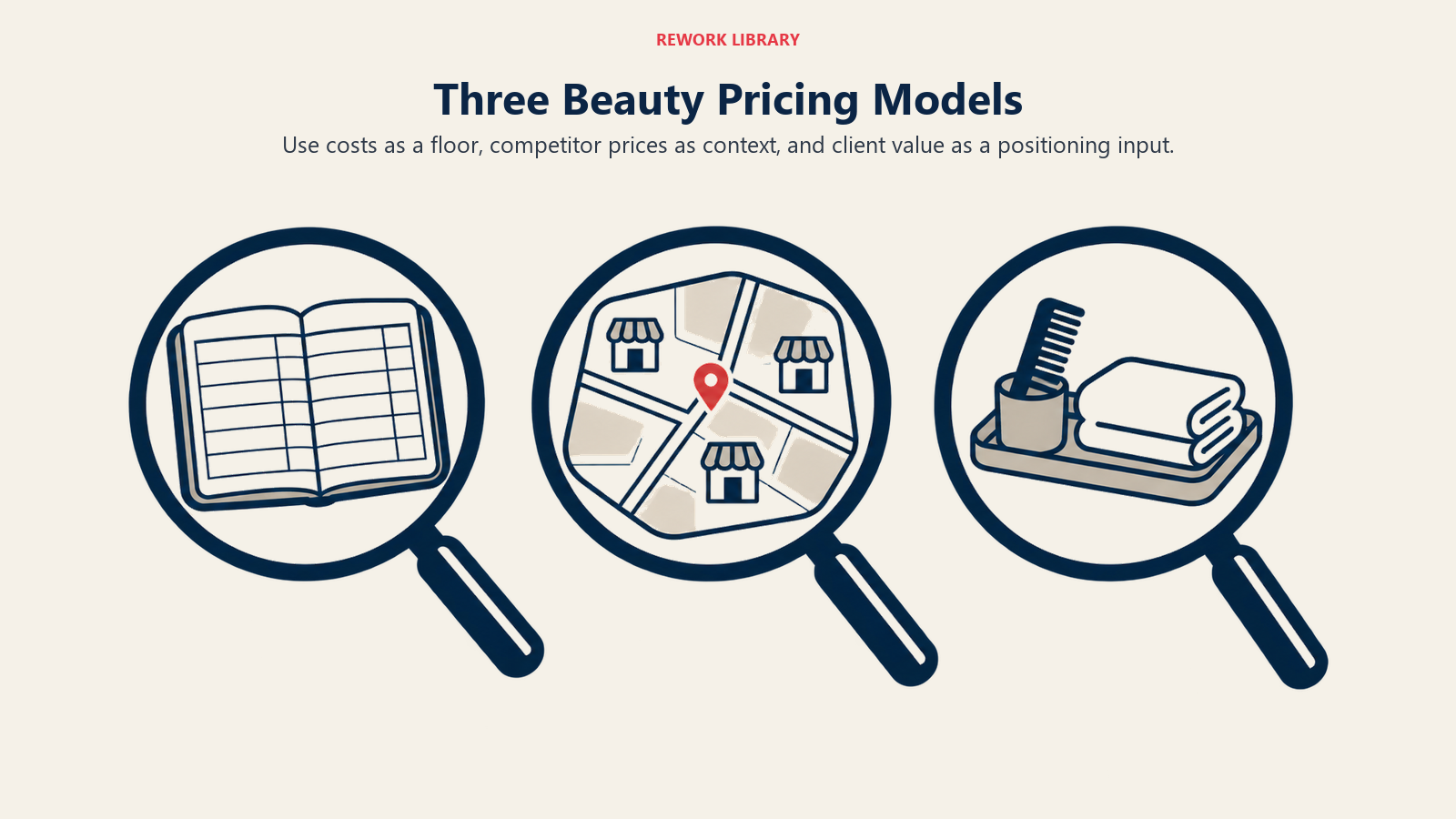
Understanding the three models gives you a framework for where you are now and where you want to go.
Cost-plus pricing
Calculate your costs (product, labor, overhead) and add a target margin percentage. If a haircut costs you $25 in combined costs, and you want a 60% margin, you charge $42.
The problem: this approach ignores what the client is willing to pay. A $42 haircut at a premium downtown salon is leaving $20–30 of value on the table. A $42 haircut at an underperforming location charging more than the market supports is overpriced. Cost-plus doesn't account for either.
Competitive pricing
Survey local competitors, position yourself within their range, and set prices accordingly. This is low-risk and widely practiced. It's also limiting, because it caps your pricing at what the least-differentiated salon in your area charges. If you've invested in better training, premium products, and a superior client experience, competitive pricing doesn't let you capture any of that investment.
Value-based pricing
Charge based on what the result is worth to the client, not what it costs you to deliver. McKinsey's research on setting value rather than price argues that businesses consistently undercharge because they anchor to cost rather than to the outcome the client is purchasing. A client getting a color correction for a big job interview isn't buying hair dye and two hours of labor. They're buying the confidence to show up as the best version of themselves. That has a very different price ceiling.
Value-based pricing requires clear positioning and the ability to articulate your value. It's harder to implement than the other two models, and it requires ongoing confidence in your quality standards. But it generates the highest margins and attracts the best clients. It also works in tandem with market positioning for salons and spas, which helps you define the positioning story that makes premium pricing believable to prospective clients.
Competitor Price Mapping: The Foundation Before You Price
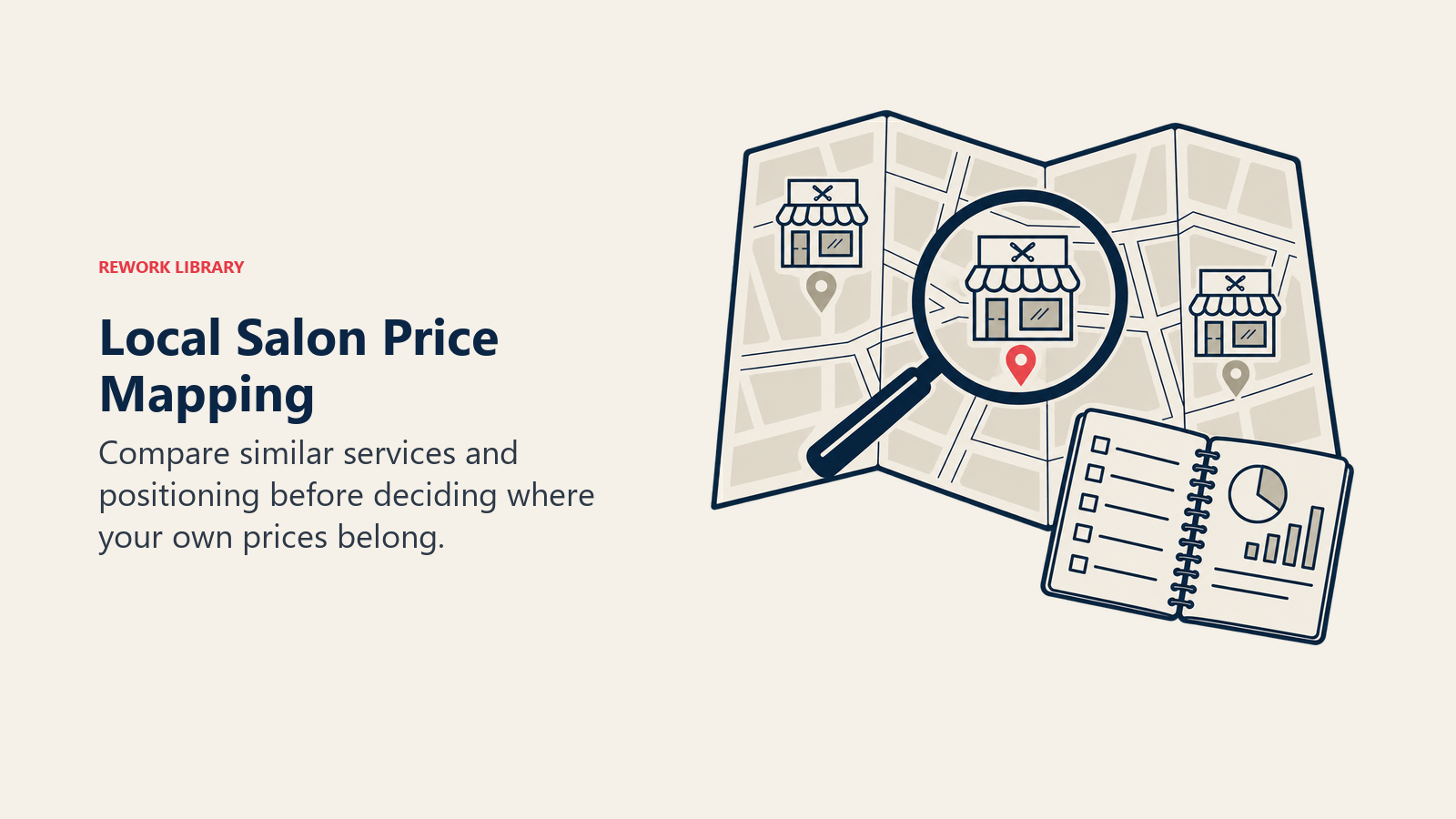
You need to know your competitive landscape before you price, not to copy it, but to understand where you sit and where you want to sit.
How to audit your local market
Visit or call 5–8 competitors in your area. For each one, capture: price for a women's haircut, price for a single-process color, price for a full-color balayage, and price for a standard facial or signature treatment.
Competitor Price Audit Template
| Competitor | Women's Cut | Single Color | Balayage | Positioning |
|---|---|---|---|---|
| Competitor A | $45 | $75 | $160 | Budget/value |
| Competitor B | $65 | $95 | $220 | Mid-market |
| Competitor C | $90 | $130 | $290 | Premium |
| Competitor D | $120 | $165 | $350 | Luxury |
| [Your Salon] | $75 | $110 | $245 | Mid-to-premium |
Once you've mapped the landscape, decide your positioning. Don't default to mid-market because it feels safe. If your quality, training, and experience genuinely position you as premium, price accordingly. Underpricing a premium experience sends the wrong signal, since clients perceive price as a quality indicator, and a price that's too low creates doubt rather than desire.
Why matching price is usually wrong when you have differentiators
If your salon uses higher-quality products, employs more trained staff, has a better booking experience, and delivers more consistent results, why would you charge the same as the salon using discount products and undertrained stylists? Your price should reflect the gap. If it doesn't, you're subsidizing client value that they would willingly pay for.
Tiered Pricing: Junior, Senior, Master Stylist Structures
Tiered pricing is the single most effective pricing change a multi-staff salon can make. It increases total revenue, gives clients choice, and creates an internal career progression that retains talent.
How tiered pricing works
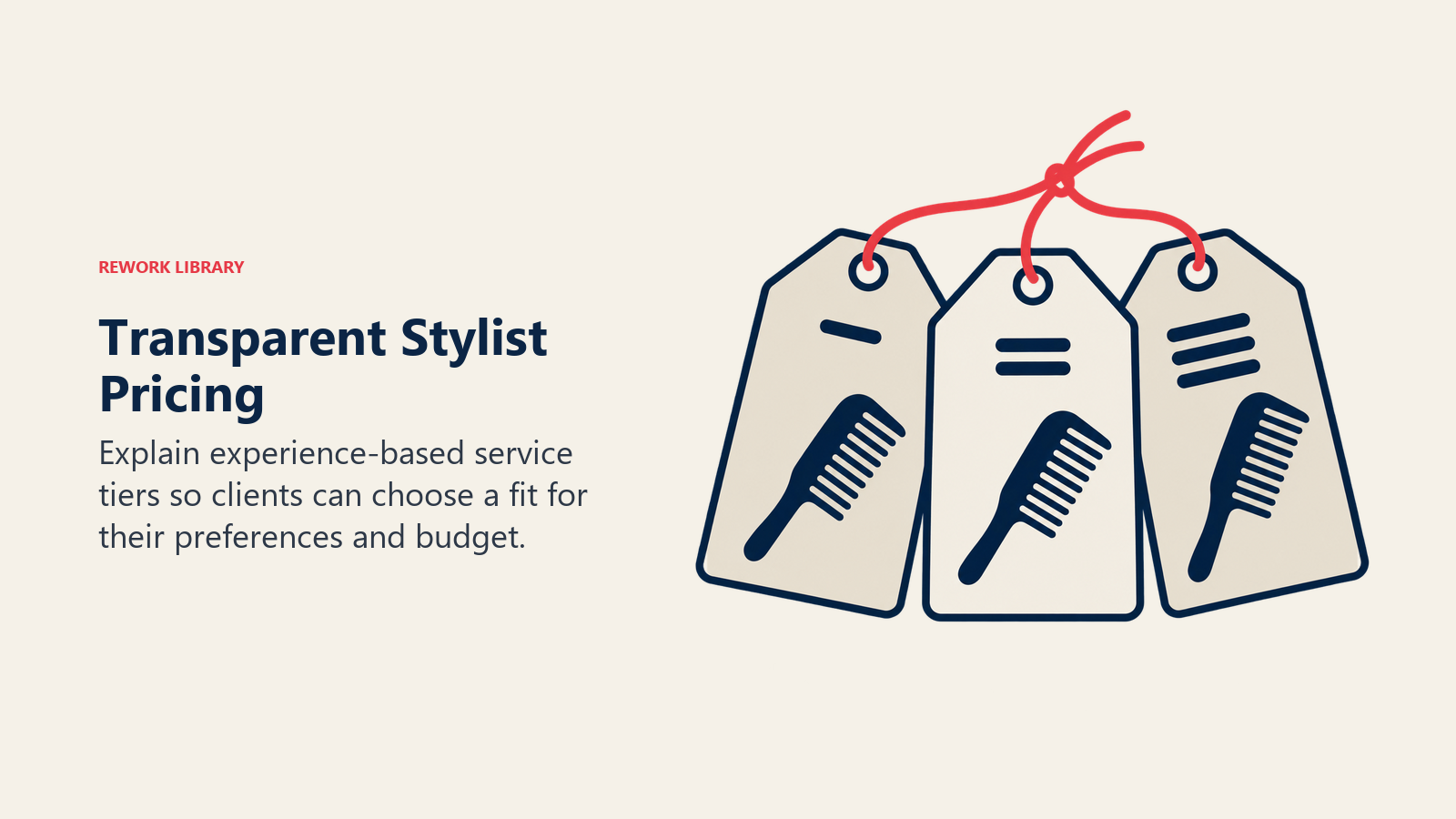
Services are priced differently based on which stylist or therapist delivers them. A haircut with a junior stylist might be $55. With a senior stylist, $75. With the salon's master or creative director, $100.
This isn't dishonest. It reflects genuine differences in training, experience, and results consistency. And it gives clients control over their spending, which they value.
Tiered Pricing Structure Example
| Service | Junior (0–2 years) | Senior (2–5 years) | Master (5+ years) |
|---|---|---|---|
| Women's Haircut | $55 | $75 | $100 |
| Single Color | $75 | $100 | $135 |
| Balayage | $185 | $240 | $310 |
| Express Facial | $65 | $85 | $110 |
| Deep Cleanse Facial | $90 | $115 | $145 |
The retention benefit
Tiered pricing gives junior staff a clear pathway. When a stylist moves from junior to senior tier, their earnings increase because the client pays more, not because the salon changes their wage structure alone. This creates a performance-tied financial incentive that reduces turnover significantly. This connects closely to how you structure commission structures for salons, where tiered pricing and compensation tiers need to be designed together to remain motivating at every level.
Client psychology of tiers
Most clients choose the middle tier. This is well-documented in pricing psychology, HBR's analysis of how consumers respond differently to prices based on framing and context confirms that tier structure shapes selection in predictable ways. The extremes feel like compromise or excess; the middle feels like good judgment. Design your tiers so the middle tier (senior) represents your core client base and primary revenue generator.
Value-Based Pricing in Practice: What Clients Actually Pay For
Value-based pricing requires you to understand what your clients are really buying.
Expertise and specialization
Color correction, extensions, advanced skin treatments, and specialized techniques command premium prices because not every salon can deliver them at high quality. If you have a true specialist, someone who does color corrections that other salons refer out, that's worth 30–50% premium pricing. The client isn't comparing you to the average salon; there's no meaningful alternative at comparable quality.
Experience and environment
A client who books with you gets a seamless online booking system, arrives to a clean and beautifully designed space, is greeted by name, offered a beverage, and receives a consistent service from a stylist who remembers their preferences. Compare that to a salon where booking is by phone, the front desk is chaotic, and each visit feels like starting from scratch. Online booking optimization and client experience design are the operational systems that make premium pricing credible through every touchpoint.
Both experiences might involve the same physical service. The value experience is demonstrably different. And 73% of clients, when surveyed, say they'd pay meaningfully more for the better experience.
Results reliability
The premium for consistency is real and underestimated. A client who has been disappointed by a salon once will pay significantly more to go somewhere they trust. Reliability, knowing that the result will be what they expected, is itself a service worth pricing.
Annual Price Increases: The Mechanics of Sustainable Pricing
Price increases should be annual, planned, and modest, not reactive, sporadic, or dramatic.
The math of consistent increases
A 7% annual price increase applied consistently doubles prices in approximately 10 years. With the U.S. hair, skin, and nail salon market valued at $69 billion, clients have choices, and salons that build systematic annual pricing discipline capture a larger share of that spending over time. A salon charging $65 for a haircut today charges $128 in 2036 if they implement this discipline. A salon that increases every 3–4 years and reacts to cost pressure charges $80 in the same period. The compounding effect is substantial.
Timing and advance notice
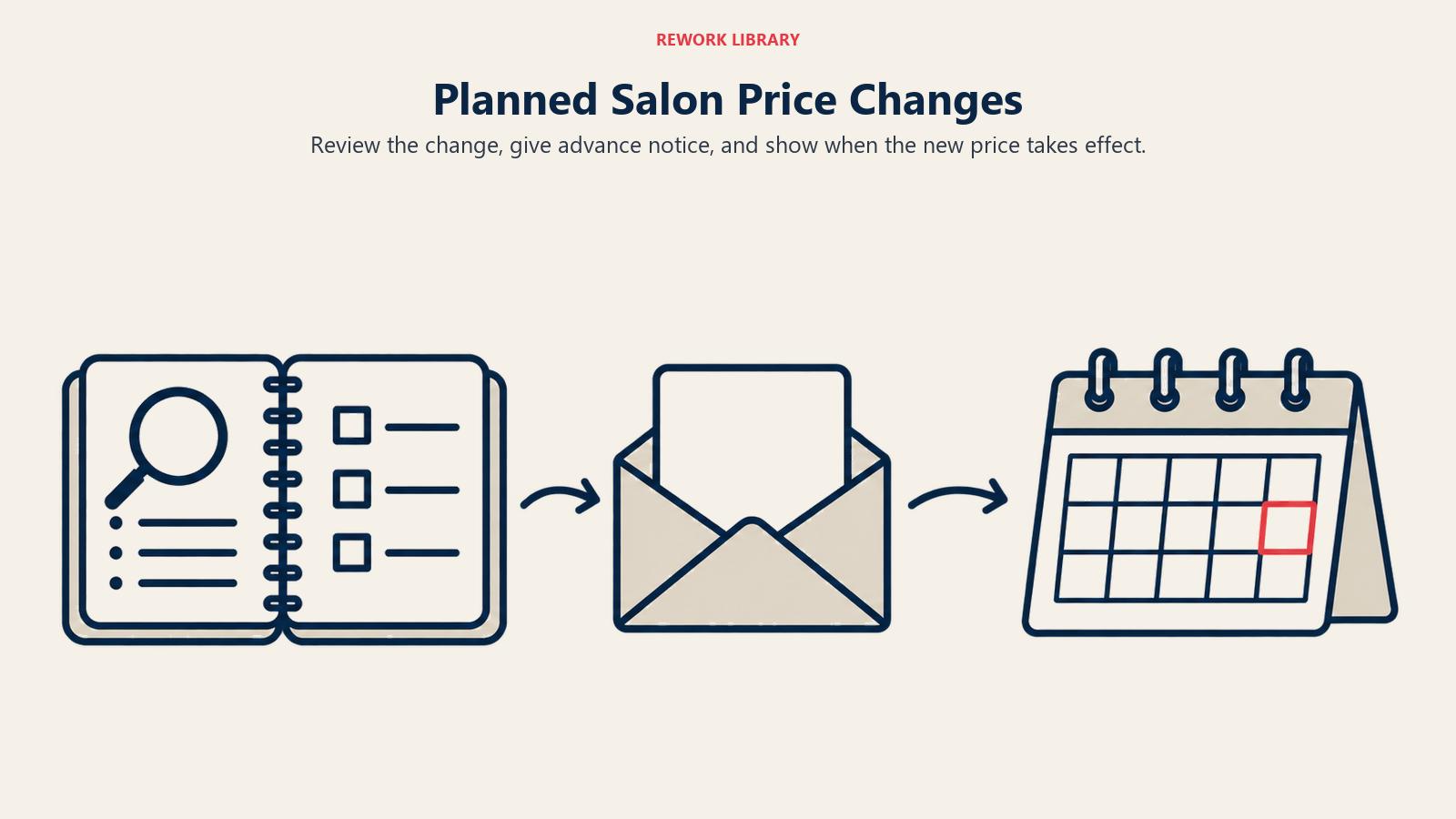
Announce price increases 4–6 weeks before they take effect. Never raise prices at peak seasons (December, Mother's Day, graduation periods). January is the most accepted time, since clients expect costs to increase in a new year. Email is the most effective communication channel for this announcement; see email marketing for beauty centers for segmentation tactics that let you personalize the message for different client groups.
Grandfathering loyal clients
Some salons grandfather existing clients at their previous price for one additional booking cycle (90 days). This gesture rewards loyalty and gives clients time to adjust. But it creates administrative complexity. An alternative: give a complimentary add-on at the first post-increase appointment rather than maintaining two-tier pricing.
Price Increase Announcement Email Template
Subject: A note about our pricing from [Salon Name]
Dear [Client Name],
Thank you for being such a valued part of [Salon Name]. It's genuinely a privilege to take care of you.
As of [Date], we'll be updating our service prices to reflect increases in the cost of our premium products, ongoing staff training and development, and the upgrades we've made to our space and service experience.
Your [haircut/color/facial] will increase from [old price] to [new price]. We believe this investment continues to represent exceptional value, and we're committed to giving you results and an experience that justify every dollar.
Your next appointment on [date] is not affected. This pricing takes effect for bookings from [date] onward.
If you have any questions, please don't hesitate to reach out. We're looking forward to seeing you.
Warmly, [Your name], [Salon Name]
Communicating Price Changes: Keeping Clients Through Transitions
The announcement is only half the work. Managing client response is where most salons stumble.
How to handle "That's more than I expected"
Don't apologize for your prices. Don't justify them defensively. A simple, confident response: "We've invested significantly in [product quality / staff training / our space] over the last year, and I think you'll feel the difference. We're really proud of the value we're delivering."
Clients who push back on price usually aren't leaving. They're testing confidence. A confident response without discounting almost always retains them.
When a client does leave over price
Some clients will leave when prices increase. This is acceptable. A client who chooses a competitor over a 10% price increase was never going to be a loyal, long-term client. You've identified a segment of your book that isn't aligned with your positioning, and freed up capacity for clients who are.
Premium Pricing Psychology: Being Chosen for Being More Expensive
Counter-intuitively, higher prices sometimes increase demand rather than reducing it. This is the Veblen effect in action: consumers perceive price as a quality signal, and a price that's too low creates doubt rather than desire. In beauty services, where the result matters and a bad experience is visible on your head or face, clients use price as a quality proxy.
The "cheap haircut" problem is real. A client who paid $15 for a haircut and got a bad one is not going to risk their appearance at $20. They'll pay $75 at a reputable salon because the price signals that quality is likely. Price filters for the clients you actually want: ones who value quality, commit to regular appointments, and don't book discount deals elsewhere between visits.
This doesn't mean price arbitrarily. But it does mean that discounting in a premium-positioned salon sends a conflicting signal. If your pricing says "premium" and your promotions say "cheap," the message is confused. Clients don't know which to believe. The right alternative to discounting is adding perceived value through package deals and bundles, which increase the transaction without eroding your rate card, and review management for beauty businesses, which builds the social proof that makes premium pricing credible to new clients who haven't visited yet.
Frequently Asked Questions about Beauty Center Pricing
What is a beauty center?
A beauty center is a service business that offers treatments such as hair, skin, nails, facials, and body care under one roof. Some focus on a single category (a hair salon or nail bar), while a full-service center combines several. Pricing strategy matters more for these businesses than for many retailers, because clients pay for results and experience, not just products.
What pricing model works best for a beauty center?
Value-based pricing usually generates the highest margins. Instead of adding a markup to your costs (cost-plus) or matching the salon down the street (competitive pricing), you set prices based on what the result is worth to the client. This works best when you can clearly articulate your quality, expertise, and experience advantage.
How often should a beauty center raise prices?
Annual, planned increases of 5 to 10 percent work better than infrequent, dramatic jumps. Announce changes four to six weeks ahead, avoid peak seasons, and use January when clients already expect new-year cost changes. Consistent small increases compound far more than reacting to cost pressure every few years.
Will raising prices make clients leave?
A small number will, and that is acceptable. Clients rarely leave over a modest increase that is justified by consistent quality and experience. The ones who switch over a 10 percent rise were usually price shoppers, not loyal regulars, so you free up capacity for clients who match your positioning.
Learn More

Senior Operations & Growth Strategist
On this page
- The Three Pricing Models in Beauty
- Competitor Price Mapping: The Foundation Before You Price
- Tiered Pricing: Junior, Senior, Master Stylist Structures
- Value-Based Pricing in Practice: What Clients Actually Pay For
- Annual Price Increases: The Mechanics of Sustainable Pricing
- Communicating Price Changes: Keeping Clients Through Transitions
- Premium Pricing Psychology: Being Chosen for Being More Expensive
- Learn More