Beauty Center Business Models: Choosing the Right Growth Structure
Turn this article into takeaways for your work.


Each assistant summarizes the article only for you and suggests best practices for your work.
The most consequential decision a beauty center owner makes isn't the location, the equipment, or even the service menu. It's the business model. Get this wrong early, and you'll spend years fighting structural constraints that no amount of marketing or hustle can fix. Get it right, and the model itself becomes an engine for growth.
Here's the uncomfortable truth: most salon owners choose their structure by default. They open as a commission shop because that's what they worked in, or they shift to booth rental because a consultant told them it was lower risk. But the best-run beauty businesses treat model selection as a strategic decision, one that gets revisited as the business evolves.
The five primary models each carry their own revenue logic, management requirements, and scalability ceilings. Understanding how money flows through each one, and what that means for your take-home pay and growth potential, is the foundation of every decision that follows. According to IBISWorld, the U.S. hair salon industry alone generates roughly $60 billion in annual revenue across more than one million businesses, making structural decisions carry significant financial weight at scale. Before settling on a model, it also helps to understand where you are in the business lifecycle by reviewing the beauty center growth stages that shape what's achievable at each phase.
Key Facts: Beauty Center Business Models
- Booth rental salons typically retain 25-40% of total gross revenue as owner income, compared to 10-20% in commission models before considering payroll overhead (Salon Today Industry Survey)
- The U.S. beauty industry has over 1 million licensed cosmetologists, with approximately 40% working as independent contractors in booth rental arrangements (Professional Beauty Association)
- Franchise beauty brands have grown at roughly 8% annually over the past five years, with Great Clips, Sport Clips, and similar brands operating over 10,000 combined locations
The Five Primary Beauty Center Business Models
1. Solo Ownership (Owner-Operator)
The solo model is exactly what it sounds like: one person owns and operates the business, performing all or most services personally. This is where the majority of beauty businesses start, and many stay there by choice.
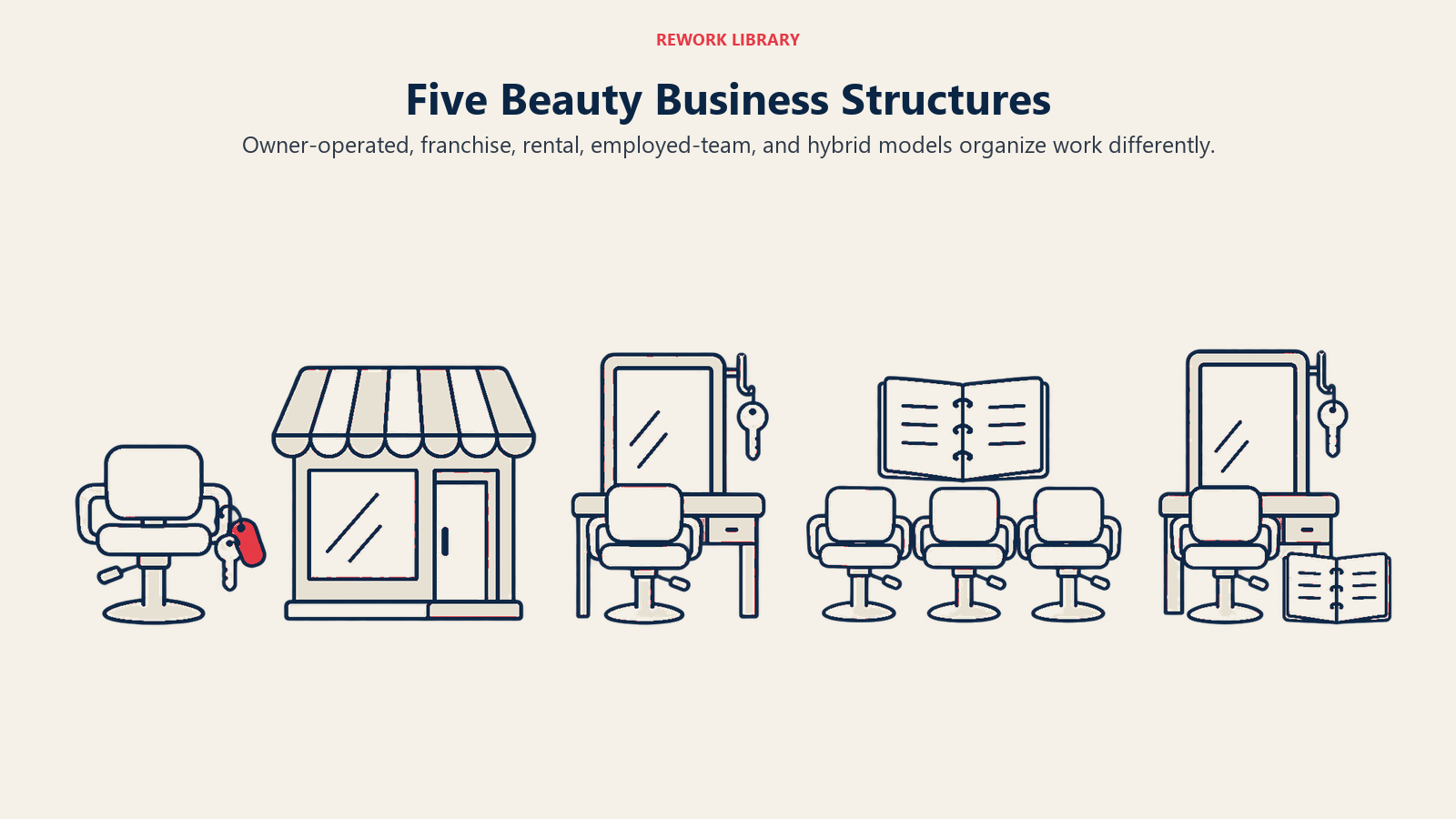
Revenue is straightforward: the owner captures nearly all service revenue minus booth or space costs, product, and overhead. The ceiling is the owner's own capacity: how many hours per week they can work, how much they can charge per hour, and whether retail sales add meaningful margin.
Solo operators doing premium work can clear $80,000-$150,000 annually in major markets. But growth is physically capped. You can't scale yourself.
2. Franchise Model
Beauty franchises like Great Clips, Drybar, Massage Envy, and European Wax Center provide a turnkey business structure: brand recognition, operating systems, marketing support, and supplier relationships in exchange for franchise fees (typically $30,000-$50,000 upfront) and ongoing royalties (5-8% of gross revenue). The Bureau of Labor Statistics projects employment of hairstylists and cosmetologists to grow 5 percent through 2034, with roughly 84,200 job openings annually, a talent pipeline that franchise operators actively compete for.
The model works best for owners who want a proven playbook without building systems from scratch. It works worst for owners who want creative control or have a strong independent brand vision. Revenue flows through the franchise company's pricing structure, which limits pricing power in both directions.
3. Booth Rental / Chair Rental
In a booth rental model, the salon owner leases chair or station space to independent stylists or therapists who pay a fixed weekly or daily rental fee, typically $150-$400 per week per station depending on market and amenities.
The owner's income is predictable: number of stations multiplied by weekly rent, minus occupancy and overhead costs. A 10-station salon at $250 average weekly rent generates $130,000 annually in gross rental income before expenses. Importantly, the owner doesn't manage service quality, client relationships, or stylist scheduling. All of that belongs to the renters.
The tradeoff is control. You can't mandate retail sales, enforce service standards, or build a unified brand experience when every chair is essentially an independent business operating under your roof. Understanding commission structures for salons helps clarify exactly what you give up financially when you move to a rental model instead.
4. Commission-Based Employment
Commission salons employ stylists and technicians as W-2 employees (or 1099 contractors in some structures), paying them a percentage of service revenue, typically 40-60% depending on experience, market, and service type.
The owner controls the experience: training, service standards, pricing, retail expectations, and client relationships belong to the business rather than the individual stylist. This is the model that allows genuine brand building and the highest long-term client retention. Stylist and therapist retention becomes a primary operational concern in this model, since your client relationships are tied to your employed staff.
The challenge is that commission structures require sophisticated management. You're responsible for payroll, benefits, scheduling, training, and performance management. And in slow weeks, fixed overhead continues while revenue doesn't.
5. Hybrid Models
Many mature beauty businesses operate hybrid models, with some chairs on commission and some on booth rental. This gives owners flexibility: they can retain their best employee stylists on commission while filling remaining capacity with booth renters who pay regardless of booking volume.
Hybrid models are more complex to manage legally and operationally, but they can optimize both cash flow predictability (from booth rent) and brand consistency (from employed staff).
Revenue Structures Compared
How money actually flows through each model determines what the owner keeps. Here's a simplified comparison for a 10-chair salon at 75% average occupancy with $65 average service ticket:
| Model | Gross Revenue | Owner Retention | Complexity |
|---|---|---|---|
| Solo (owner-operator) | $120K-$180K | 65-75% | Low |
| Franchise | $600K-$900K | 8-15% after fees/royalties | Medium |
| Booth Rental | $130K (rent income) | 40-55% after overhead | Low-Medium |
| Commission | $600K-$900K | 12-22% net | High |
| Hybrid | $400K-$700K | 18-28% net | Medium-High |
The commission model generates the highest gross revenue but requires the most operational investment to retain a meaningful owner margin. Booth rental generates lower gross revenue but delivers more predictable owner income with less management overhead. Either way, understanding unit economics for beauty centers is essential before deciding which revenue structure to pursue.
Pros and Cons by Model
Solo Ownership
Pros: Maximum income per hour worked, no staff management, low overhead, creative freedom. Cons: Revenue ceiling tied to personal capacity, no business value without the owner, zero scalability, burnout risk.
Franchise
Pros: Proven systems, brand recognition, marketing support, supplier pricing. Cons: High upfront cost, royalty burden, limited creative control, standardized service menu.
Booth Rental
Pros: Predictable income, minimal staff management, renters handle their own clients. Cons: No control over client experience, can't mandate retail sales, renter turnover is disruptive, difficult to build unified brand.
Commission
Pros: Full brand control, employee loyalty programs possible, unified client experience, scalable with systems. Cons: High management complexity, payroll risk in slow periods, requires strong HR practices.
Hybrid
Pros: Balances cash flow with control, flexible to market conditions. Cons: Complex legal considerations around mixing employment types, harder to maintain consistent culture.
When to Choose Which Model
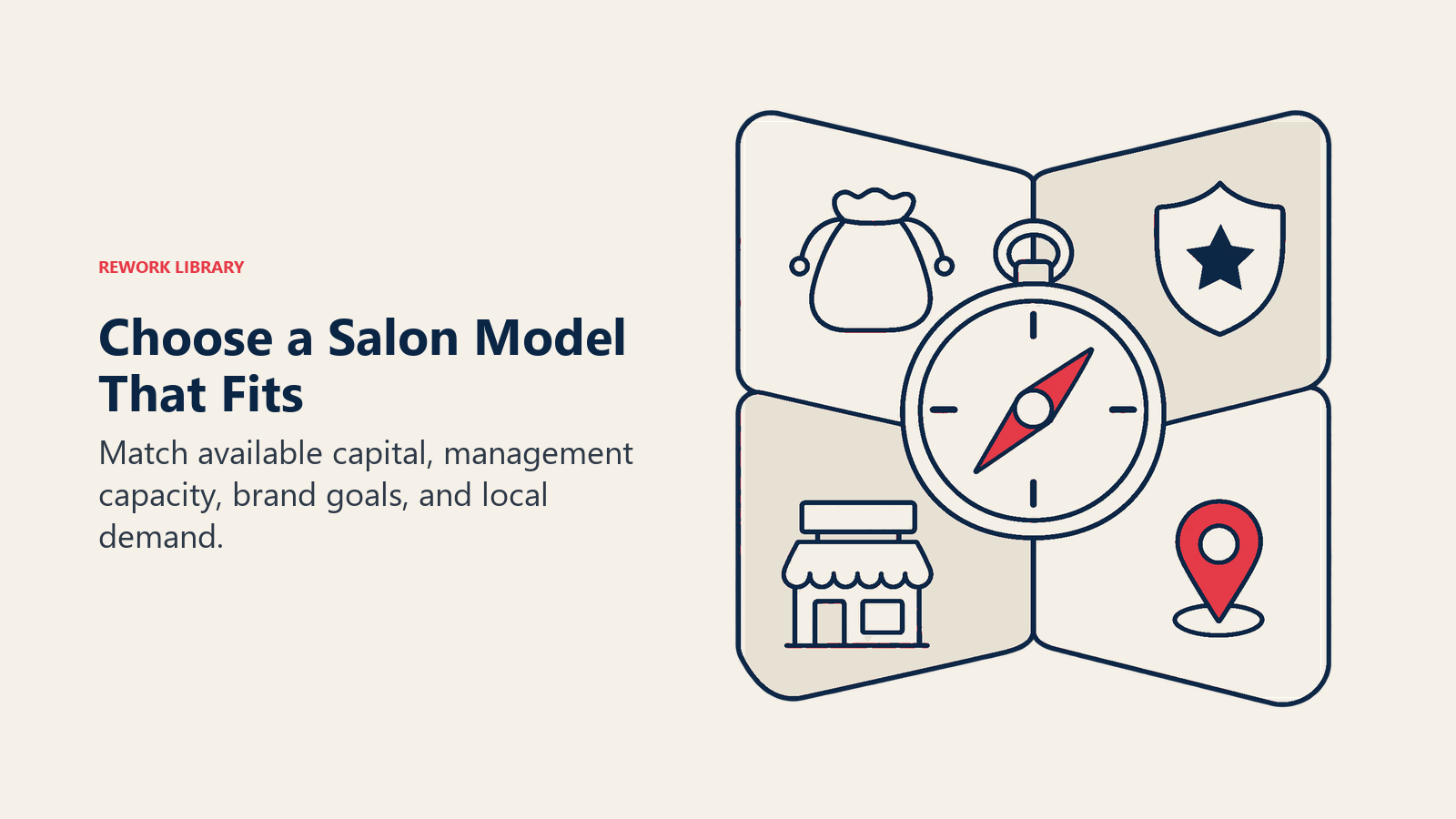
The right model depends on four factors: your capital situation, your management appetite, your brand ambitions, and your target market. Your positioning choices will also influence this decision, so reviewing market positioning for salons and spas alongside model selection helps ensure structural and brand alignment.
Choose solo ownership if you're an elite practitioner who can charge premium rates, you want simplicity over scale, and your income goal is under $200K annually. Many world-class colorists and estheticians run this model intentionally.
Choose franchise if you have $150,000-$500,000 in startup capital, you want an established system rather than building your own, and you're comfortable operating within brand standards. Franchise beauty is best for operator-investors rather than craft-focused owners.
Choose booth rental if you want steady rental income with minimal staff management, you're in a market with strong independent stylist demand, and you don't need to control the client experience or build a unified brand.
Choose commission if you want to build a real business with scalable value, you have (or can develop) management skills, and your long-term goal includes multi-location growth for beauty centers or eventual sale.
Choose hybrid if you're transitioning between models, you want to test commission with some staff while maintaining booth rental revenue stability, or you've reached full booth rental capacity and want to grow differently.
Transitioning Between Models
Model transitions happen, and they're often necessary as businesses mature. The most common shift is commission-to-booth-rental, driven by owner frustration with payroll management and staff turnover. Building strong training programs for beauty staff before considering a transition can reduce turnover pressures and make the commission model more sustainable.
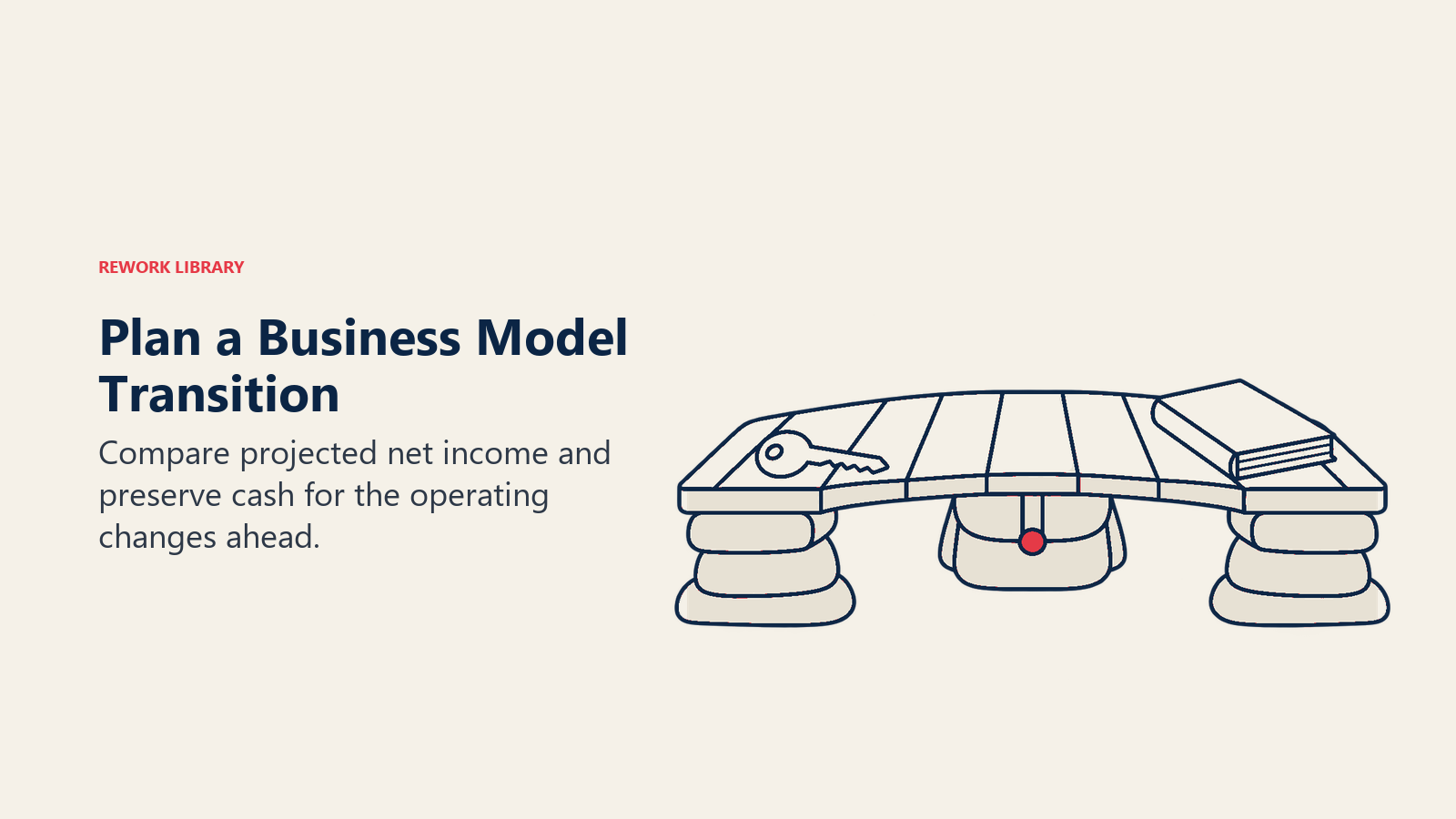
But this transition isn't always right. Before making the move, calculate what you'd actually net under each model at your current revenue. Many owners discover that booth rental income, while more predictable, is significantly lower than what a well-run commission salon can generate.
If you're transitioning from booth rental to commission (which happens when owners want to build a brand), expect 12-18 months of reduced net income as you invest in employment infrastructure, training systems, and culture development.
The key to any model transition is timing: make the change when cash reserves can absorb a temporary income dip, not when you're already under financial pressure. According to BLS data, about half of all new business establishments survive five years or more, a reminder that transitions made from a position of financial stability outperform reactive pivots made under pressure.
Aligning Model with Long-Term Strategy
Your business model isn't just a staffing preference. It's the operating architecture that determines what's possible. A booth rental salon can't realistically sell for 5x EBITDA because the revenue leaves with the renters. A well-run commission salon with strong client retention and documented systems can. Investing early in loyalty programs for beauty centers and rebooking strategies for salons compounds this advantage by keeping clients connected to the business rather than to individual stylists.
If your goal is to build a business with transferable value, commission or hybrid models with strong systems are the path. If your goal is income now with minimal management complexity, booth rental makes sense. Neither is wrong. But defaulting into a model without this analysis is. McKinsey's research on the beauty services sector notes that the beauty services industry remains highly fragmented, with enterprises employing more than 250 people nationwide making up only 11 percent of the market, which means structural and positioning decisions at the individual business level carry outsized strategic importance.
Start with the end in mind. What do you want this business to look like in five years? The model you choose today either enables or constrains that vision.
Learn More

Senior Operations & Growth Strategist
On this page
- The Five Primary Beauty Center Business Models
- 1. Solo Ownership (Owner-Operator)
- 2. Franchise Model
- 3. Booth Rental / Chair Rental
- 4. Commission-Based Employment
- 5. Hybrid Models
- Revenue Structures Compared
- Pros and Cons by Model
- Solo Ownership
- Franchise
- Booth Rental
- Commission
- Hybrid
- When to Choose Which Model
- Transitioning Between Models
- Aligning Model with Long-Term Strategy
- Learn More