Stylist & Therapist Retention: Keeping Your Best Talent
Turn this article into takeaways for your work.


Each assistant summarizes the article only for you and suggests best practices for your work.
The average beauty professional changes employers every 2-3 years. And when a senior stylist or experienced therapist walks, they don't just take their paycheck. They take their clients, their referral network, and institutional knowledge that took years to build. The remaining team absorbs the scheduling gaps. Recruitment and training take months. The business carries the cost of that departure long after the person is gone.
Most salon owners attribute staff turnover to pay. And yes, compensation matters. But the data from industry exit surveys tells a more nuanced story: pay ranks third or fourth among reasons stylists leave, behind career growth, management quality, and scheduling flexibility. The owners who understand this tend to build more stable teams than those who simply try to outbid competitors. Retention is ultimately a beauty center growth stages problem. Salons that scale without addressing staff retention consistently hit capacity ceilings when their best producers leave just as demand grows.
Key Facts: Beauty Industry Retention
- The average beauty professional tenure at a single employer is 2-3 years (Professional Beauty Association)
- Replacing a senior stylist with an established client base costs 6-9 months of that stylist's revenue in recruitment, lost bookings, and training (IBISWorld)
- 68% of stylists who left their last employer cited career path limitations or management issues, not pay, as the primary reason (NCEA 2023)
The BLS Occupational Outlook Handbook for barbers, hairstylists, and cosmetologists notes that a significant proportion of beauty professionals are self-employed, a structural alternative that defines what salon employment is being compared against every time a stylist evaluates whether to stay or leave.
Why Stylists and Therapists Leave: The Real Top 5
1. Lack of career path (cited by 41% of leavers)
The most common reason senior stylists move to booth rental isn't money. It's ceiling. They've been "senior stylist" for three years. Nothing new has happened. No new title, no new responsibility, no new earning potential. Booth rental offers autonomy and uncapped income in exchange for benefits and stability. When your employment structure doesn't offer visible growth, booth rental wins that comparison by default.
2. Poor management and leadership (38%)
This one's hard to hear, but it's the data. "My manager didn't listen to me," "I felt micromanaged," "There was favoritism in scheduling," "Conflict was never addressed." These aren't vague complaints. They're patterns that show up consistently in exit interviews when anyone bothers to ask. Staff leave managers more than they leave businesses.
3. Scheduling inflexibility (31%)
Stylists and therapists are often parents, caregivers, students, or artists with creative commitments outside of work. A schedule that offers zero accommodation for life outside the salon becomes unsustainable. This is especially acute for part-time booth rental options that offer complete scheduling autonomy. The staff scheduling approach for salons and spas matters here. How schedules are built, how preferences are collected, and how much advance notice staff receive are all practical levers on scheduling-related turnover.
4. Toxic team culture (28%)
Cliques, gossip, competitive hoarding of client referrals, unequal treatment of new staff. A toxic culture is largely invisible to owners who aren't paying close attention, but it's immediately apparent to the staff living it every day.
5. Feeling undervalued (25%)
This isn't just about pay. It's about whether contributions are acknowledged. Whether the owner knows the names of their staff's regular clients. Whether a stylist who generated $80,000 in service revenue last year received any recognition for it. Feeling invisible at work is a slow-burning retention risk that often doesn't surface until a resignation is already in hand.
Competitive Compensation That Retains
Pay doesn't rank first in exit interviews, but it can't be ignored. Underpaying relative to market is a fast path to losing good people, even if management and culture are strong. The BLS wage data for hairdressers, hairstylists, and cosmetologists provides current median earnings by state and employment setting, a practical starting point for benchmarking your compensation structure against what the market is actually paying.
The compensation structures that retain best:
Sliding scale commission: As a stylist's revenue grows, their commission percentage increases. This creates an aligned incentive: the more they generate, the more they keep. A typical structure: 40% commission up to $5,000/month in service revenue, 45% from $5,001-$8,000, 50% above $8,000. Staff can see a clear path to higher earnings without changing jobs. The commission structures for salons guide covers the full range of models (graduated, tiered, and hybrid structures), along with how to communicate a structure change to existing staff.
Performance bonuses: Quarterly bonuses tied to retention rate, rebooking rate, or retail sales conversion. These reward specific behaviors the business values, not just raw revenue production.
Paid education: Treating education as part of compensation (not just a perk) is highly valued. A $500 annual education allowance plus 2 paid education days per year costs the business relatively little but ranks consistently high in retention surveys.
Benefits where feasible: Health insurance, paid time off, and retirement contributions are increasingly expected by experienced professionals. Salons that can offer even partial health insurance coverage have a significant recruitment and retention advantage over those that don't.
Compensation conversations proactively: Don't wait for a stylist to bring up pay. Schedule annual compensation reviews, compare to market rates, and make adjustments before the stylist has already started interviewing elsewhere. Reactive pay increases after a retention conversation are less effective than proactive increases that signal you're paying attention.
Career Path Development: The Growth Frame
The absence of a growth path is a silent retention killer because it's easy to ignore until it's too late. A stylist who joined your team three years ago and hasn't received a new title, new responsibility, or new earning tier since then is at risk, regardless of how much they seem to like working there.
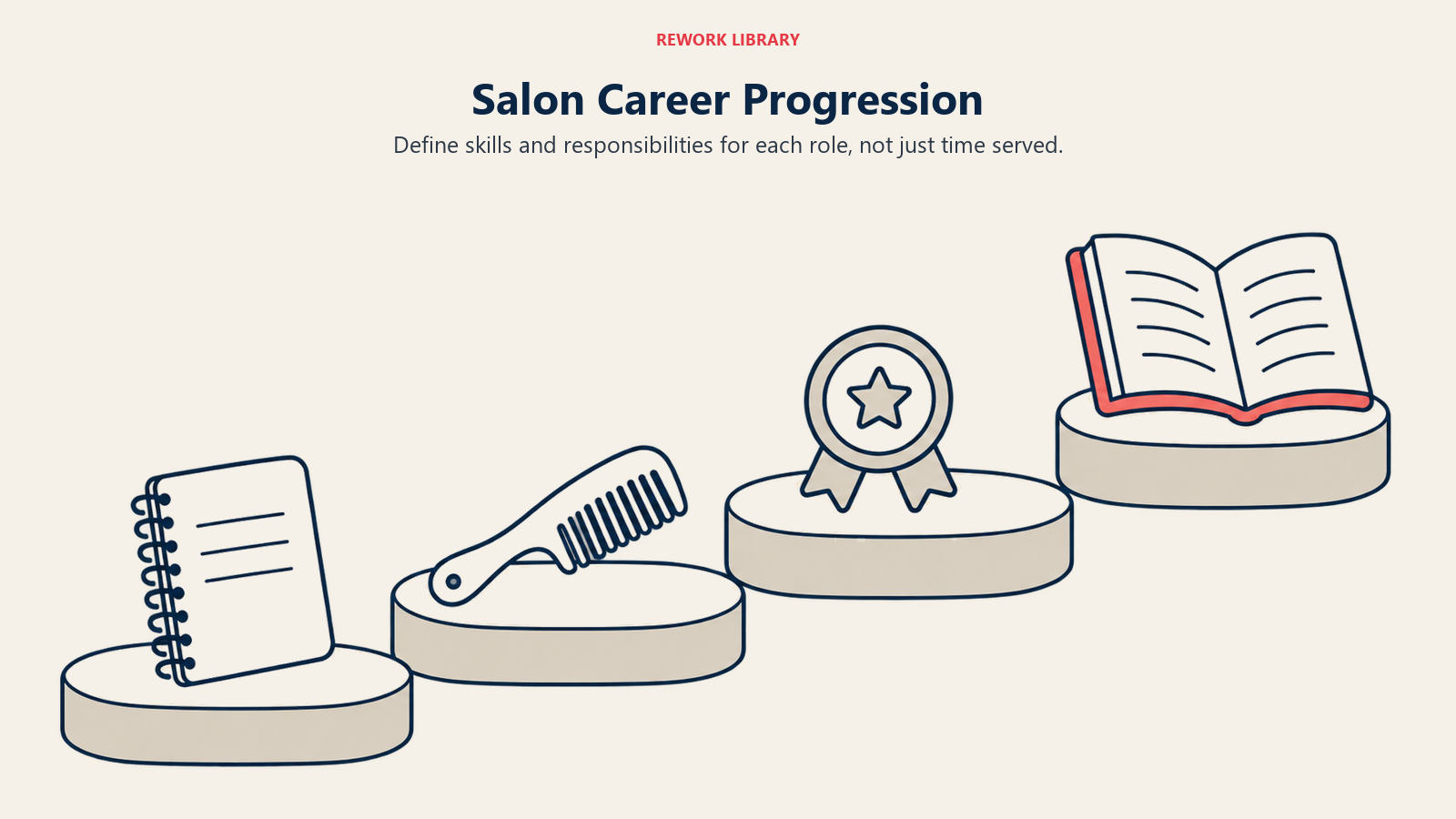
A tiered progression system creates visible growth within your structure:
Junior Stylist (0-2 years): Assisted services, building client base, learning the business's systems and standards. Commission: 35-40%.
Stylist (2-4 years): Full client book, independently managing appointments and consultations. Commission: 40-45%. Eligible for team mentoring opportunities.
Senior Stylist (4+ years, established client base): Specialization in advanced services, mentoring junior staff, ambassador for new service launches. Commission: 45-50%. Priority scheduling preferences.
Lead Stylist / Educator: Management responsibilities, training coordination, team culture ownership. Salary + bonus structure. Invitation to ownership or partnership conversations (for the right candidates).
Each level has defined criteria, not just time served. "You'll be considered for Senior Stylist when your rebooking rate exceeds 70% and your monthly service revenue consistently exceeds $7,000" is a concrete, achievable target. "You'll get promoted when we think you're ready" is not. Structured training programs for beauty staff make each career stage meaningful. Without clear skill development at each level, progression becomes a title change rather than genuine growth.
Workplace Culture: The Practical Elements
Culture isn't a poster on the wall or a mission statement in the employee handbook. It's the daily micro-interactions that signal whether someone is respected.
How leaders handle conflict signals everything: If problems between team members are ignored until they boil over, or resolved by the manager picking sides, the culture is fragile. If conflict is addressed promptly, privately, and fairly, the culture feels safe enough to raise concerns rather than silently leave.
How credit is given: Does the owner know which stylist brought in the new client? Does a high-performing month get acknowledged, even informally? Credit flowing appropriately to the people who earned it is one of the lowest-cost, highest-impact retention moves available.
How new staff are onboarded: The first 90 days set the relationship. A new stylist who feels dropped into the deep end, without structure or support, develops a sense of the business as indifferent. An onboarding process that assigns a mentor, provides clear expectations, and checks in weekly at minimum communicates the opposite.
The daily micro-interactions: greetings at the start of shifts, acknowledgment of good work, managers who know what's happening in their team members' lives outside of work. These small signals accumulate into a culture that people want to be part of, or don't. This culture also shows up in the client experience: a team that feels valued delivers better consultations, more genuine rebooking asks, and higher client experience scores.
Continuing Education as Retention
Education is one of the highest-ROI retention investments, and one of the most underutilized. Stylists and therapists who feel they're growing technically are dramatically more engaged than those who feel stagnant. And a business that invests in its staff's skills signals a long-term relationship, not just a transactional one.
The train-and-leave concern: Many owners hesitate to invest in education because they worry about training someone who then leaves. But the research runs the other way: staff who receive regular education support are more loyal, not less. Inc.'s reporting on the hidden costs of employee turnover quantifies what many salon owners intuitively know: replacement costs run 30–200% of annual salary depending on seniority, making even generous education benefits a fraction of what a single departure actually costs. The ones most likely to leave are those who feel the business isn't investing in them.
Structuring education benefits without risk:
- Education allowances vest over time. An annual $1,000 education budget might require one year of continued employment after the training to be fully funded by the business.
- Preferred brand education partnerships (Schwarzkopf, Redken, Wella, etc.) often provide training at low or no cost in exchange for using their product lines.
- In-salon education (inviting guest educators, running monthly technique clinics) keeps training accessible without travel costs.
What education to prioritize: Advanced color techniques, business skills (how to build a clientele, how to talk to clients about services), and leadership development for staff on a senior or lead track. All three serve retention directly. Education also feeds directly into the business's capacity to introduce higher-margin services. Introducing new services works best when the team has been trained and is confident, rather than rushed into service launches without adequate preparation.
Booth Rental vs Employment: A Clear-Eyed Comparison
Booth rental is often the competitor you're losing talent to. Understanding the comparison honestly helps you compete where it matters.
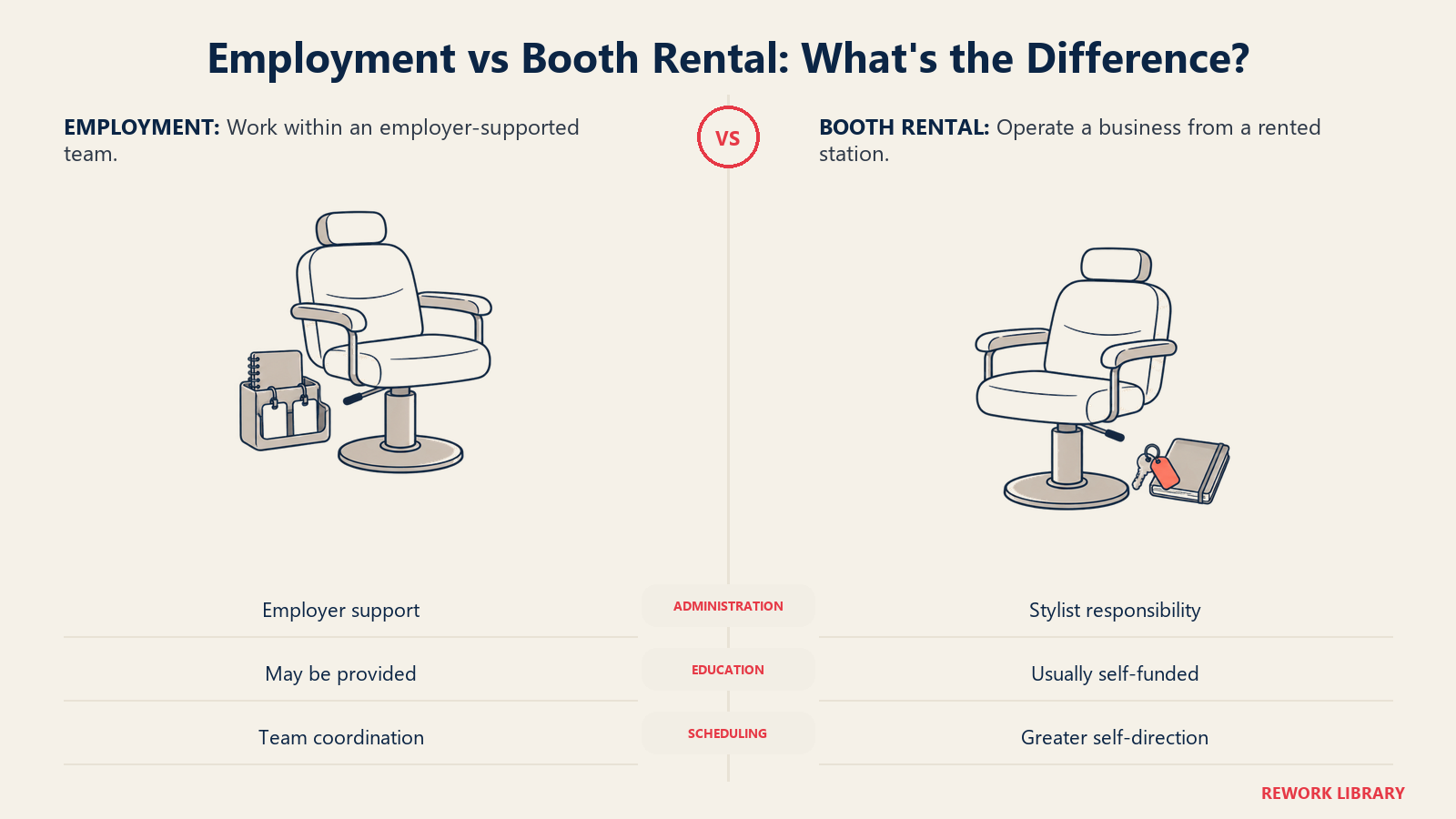
| Factor | Employment | Booth Rental |
|---|---|---|
| Scheduling control | Limited (business drives it) | Complete autonomy |
| Earning potential | Capped by commission % | Uncapped (minus expenses) |
| Client ownership | Often business-owned | Stylist-owned |
| Education support | Usually employer-provided | Self-funded |
| Business admin | Handled by employer | Stylist responsibility |
| Benefits eligibility | Yes (if offered) | No |
| Financial risk | Low | Higher (slow months hurt) |
| Advancement path | Clear (if designed) | None (solo business) |
Employment wins on stability, benefits, education, and advancement path. Booth rental wins on autonomy and uncapped earning. The stylists most likely to choose booth rental are experienced, have established client bases, and value control over their time above almost everything else.
Hybrid models that some successful salons are exploring: a "commission + low booth fee" model that gives stylists some of the autonomy of rental while maintaining a team environment; or an "associate program" that prepays stylists a guaranteed weekly minimum while they build their book.
Exit Interview Insights
Most salons conduct no exit interview, or a perfunctory one where the departing stylist says polite things that don't reflect why they're actually leaving. That's a missed opportunity.

Creating a safe enough environment for honest answers: The exit interview should be conducted by someone other than the direct manager (ideally the owner, or a trusted senior staff member). The framing should be genuine: "We want to get better, and your perspective is valuable. Nothing you say here will be held against you. You're leaving regardless."
Questions worth asking:
- What were the top 2-3 reasons you decided to make a change?
- Was there a specific moment or event that accelerated your decision?
- What did we do well that you'll miss?
- What would have made you stay?
- Is there anything we could change that would make this a better place for the team you're leaving behind?
Patterns worth acting on: If you hear "no clear path forward" from three departing stylists in a year, that's a systemic issue. If you hear "scheduling was impossible to work around" twice, that's worth examining. Individual exits have individual reasons, but patterns across exits reveal structural problems. Treating exit data the same way you treat client feedback (as signals to act on, not just to file) is part of a data-driven approach to salon decisions.
Retention Risk Audit
Answer these 10 questions honestly to assess your current retention risk:
- Do all team members have a documented career progression path with clear criteria?
- Have you had a formal compensation review with each team member in the past 12 months?
- Do you publish schedules 3+ weeks in advance?
- Do you have a formal conflict resolution process that staff know how to access?
- Did you provide paid education to every team member in the past 12 months?
- Do you know the top 5 clients of each of your stylists/therapists?
- Have you acknowledged exceptional individual performance in the past 30 days?
- Do new staff members have a structured onboarding plan and assigned mentor?
- Do you know which team members are at highest risk of leaving in the next 6 months?
- Have you personally asked each team member "what would make this a better place to work for you?" in the past year?
If you answered no to 4 or more of these questions, your retention risk is material. The good news: most of these are addressable within 30-60 days. Start with the ones that signal the biggest gaps.
The one change with the biggest impact on retention: Ask the question. Not in a performance review context, not in a group setting, but one-on-one, with genuine curiosity: "What would make this a better place to work for you?" The act of asking signals that the answer matters. And the answers, when acted on, are the most personalized retention strategy available.
Learn More

Senior Operations & Growth Strategist
On this page
- Why Stylists and Therapists Leave: The Real Top 5
- Competitive Compensation That Retains
- Career Path Development: The Growth Frame
- Workplace Culture: The Practical Elements
- Continuing Education as Retention
- Booth Rental vs Employment: A Clear-Eyed Comparison
- Exit Interview Insights
- Retention Risk Audit
- Learn More