Multi-Location Growth for Beauty Centers: Scaling Without Losing Quality
Turn this article into takeaways for your work.


Each assistant summarizes the article only for you and suggests best practices for your work.
Opening a second location feels like validation. The first salon is successful, clients are asking about other locations, and the energy of growth is real. But the number of beauty businesses that opened a second location and wished they hadn't is at least as large as the number that expanded successfully.
The pattern is almost always the same: the first location succeeded because of the owner's direct involvement in every aspect of the business: the culture, the hiring decisions, the quality checks, the client relationships. The second location opens, the owner splits their attention, and within six months both locations are operating below their potential. HBR's classic research on the five stages of small business growth identifies the transition from single-site to multi-site operation as one of the most challenging inflection points in a business's lifecycle, the challenges described there map directly onto beauty center expansion. The problems that existed in the first location don't disappear. They replicate.
Multi-location growth isn't a milestone, it's an operations challenge. The businesses that scale well are the ones that have documented how they work before they try to replicate it. Understanding where your business sits in the beauty center growth stages is the first honest conversation to have before signing a second lease.
Key Facts: Multi-Location Beauty Business Growth
- The typical timeline to profitability for a second beauty location is 12-18 months from opening (Salon Today, 2024)
- 60% of beauty businesses that open a second location within three years of their first report that the first location's performance declined temporarily during the expansion period
- Salons with documented operational systems (training manuals, service protocols, hiring criteria) reach target productivity in new locations 40% faster than those without
- The U.S. hair and nail salon industry has grown to approximately $90.9 billion (IBISWorld, 2025), creating real market opportunity for well-prepared multi-location operators while also intensifying local competition
Readiness Assessment: Are You Actually Ready?
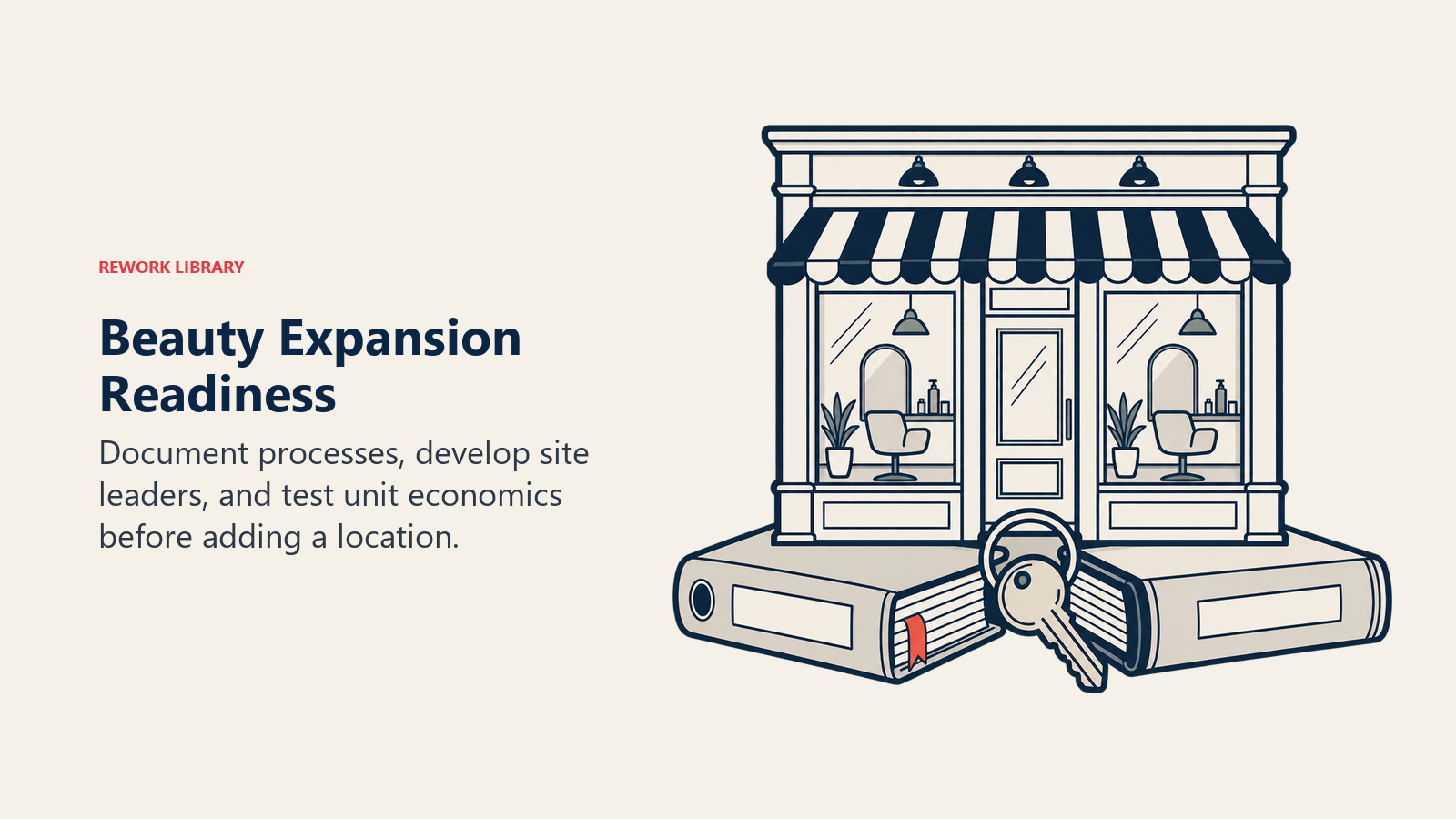
The worst time to open a second location is when the first location is so busy you feel like you need the capacity. Busy isn't the same as systematized. And a second location that replicates your chaos rather than your quality is a liability, not an asset.
Genuine Readiness Indicators:
- Consistent occupancy: Your first location has been running at 75-85% occupancy for at least 12 consecutive months, not just in peak season
- Documented processes: You have written SOPs for hiring, onboarding, service delivery, client communication, complaint handling, and daily operations, not just in your head
- Strong management bench: There is at least one person at the first location who can run it independently in your absence for two weeks without the business degrading
- Healthy unit economics: The first location is generating sustainable margins, not just revenue, after paying yourself a market-rate salary. If the first location only works because you're underpaying yourself, the second location won't fix that. The unit economics for beauty centers framework is the right tool for testing whether your margin profile can support an expansion investment.
- Client demand for expansion: You're regularly losing clients due to lack of availability, and geographic analysis suggests a new location would capture meaningful demand without significantly cannibalizing the existing one
Warning Signs That Expansion Is Premature:
- You can't take two consecutive weeks away from the first location without things going off the rails
- Your team turnover is above 30% annually
- Client rebook rates are below 55%
- You don't have a general manager or lead stylist who could run daily operations independently
- The first location's profitability is improving but still inconsistent month-to-month
Readiness Scorecard (Score 1-5 on each):
| Factor | Score (1-5) |
|---|---|
| Operational consistency at location 1 | __ |
| Quality of documented processes | __ |
| Strength of management bench | __ |
| Unit economics and margins | __ |
| Geographic demand evidence | __ |
| Owner's capacity to split attention | __ |
Total out of 30. A score below 20 suggests premature expansion risk. A score of 25+ suggests genuine readiness for structured expansion planning.
Location Selection: What Made the First Location Work?
Before you select a second location, be honest about what made the first one successful. Was it the specific neighborhood? The foot traffic from a particular anchor tenant nearby? Your personal reputation built over years in that community? Or was it repeatable systems, strong marketing, and a staff culture that could exist independent of your direct presence?
If the first location's success is partly personality-dependent (meaning clients book because of you specifically), expansion is more complex. You're not just replicating a business model. You're replicating a brand, which requires codifying the things that currently live only in your head and your relationships.
Location Selection Criteria:
- Demographic profile: Does the target neighborhood have the income profile and lifestyle characteristics that match your service offering and price point?
- Competition density: How many salons of similar positioning are within a 1-mile radius? The goal isn't to avoid competition (some competition signals market demand) but to assess whether you have a differentiated reason for clients to choose you.
- Proximity to existing location: Within 3-5 miles and you risk cannibalizing your own client base. Over 20 miles and operational oversight becomes significantly harder. The sweet spot depends on your market. In a dense city, 3 miles might be far enough. In a suburban market, 8-10 miles may still be shared clientele.
- Lease terms: Negotiate rent-free or reduced-rent periods for fit-out and ramp-up. Standard in the industry is 1-3 months rent-free at the start of a lease. Negotiate hard. A landlord who won't offer any concession in a negotiation tells you something about the deal.
- Physical space: Assess the number of stations, natural light, ventilation (critical for a salon with chemical services), parking availability, and ADA accessibility. The cost of retrofitting an unsuitable space almost always exceeds initial estimates.
Management Structure: How the Org Chart Changes
A single-location salon with an owner-operator model has a straightforward structure: owner runs everything, senior staff lead their areas, front desk manages daily coordination. This breaks immediately when a second location opens.
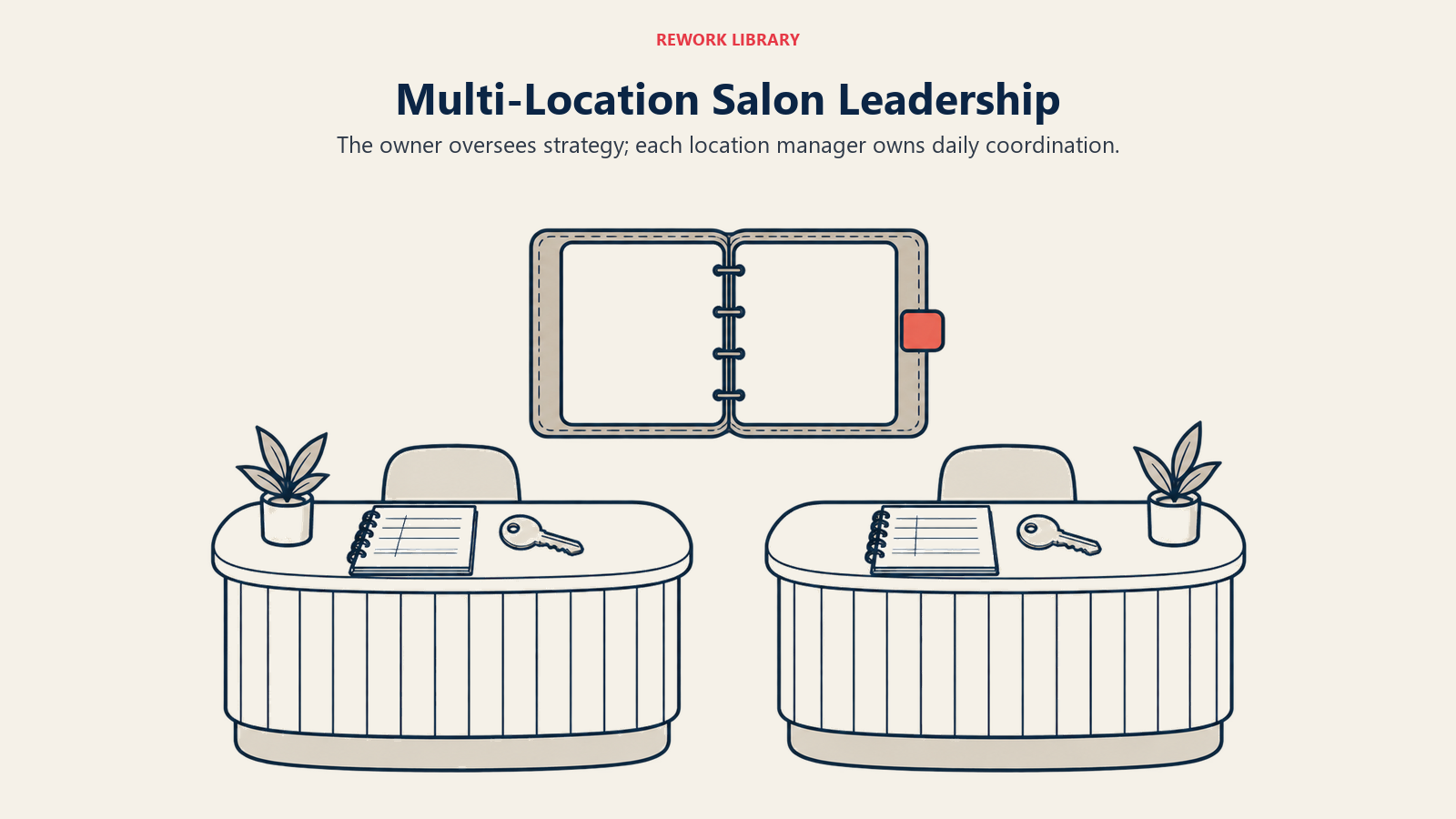
The Two-Location Org Chart:
- Owner: strategy, culture, financial oversight, cross-location quality checks
- Location Manager (each site): daily operations, staff scheduling, client experience, local issues
- Senior Stylists/Lead Therapists (each site): technical quality, junior staff mentorship
- Front Desk/Reception (each site): bookings, client communication, retail
The role that most owners underinvest in: Location Manager. Hiring an experienced manager for the first location, which allows the owner to genuinely shift attention to expansion, is the most important hire in a growth business. Inc.'s guide to managing multiple business locations identifies the "out-of-sight, out-of-mind" management gap as the most common failure point in multi-location businesses, a problem that only a capable on-site manager can solve. Trying to manage both locations directly from the middle rarely works for more than six months. A robust staff scheduling system for salons and spas is one of the first tools a new location manager needs to operate with real independence.
Span of Control: One manager can effectively oversee 8-12 direct reports. A salon with 15 staff across two locations needs either a manager at each site or a general manager covering both with team leads at each location. Get the structure right on paper before opening, because retrofitting it later is harder and more disruptive.
Brand Consistency: Standardizing the Client Experience
The client who visits your first location should have a near-identical experience at your second: same greeting protocol, same consultation approach, same product recommendations, same quality standards, same follow-up communication. This doesn't happen by accident.
What Needs to be Standardized:
- Service protocols: Step-by-step delivery for each service on your menu
- Pricing: Consistent pricing across locations (exceptions for rent-cost-driven differences should be clearly documented and communicated)
- Client communication scripts: How staff greet, consult, handle complaints, and close the rebook conversation
- Staff presentation: Uniform policy, personal hygiene standards, phone use during service
- Retail display standards: Which products, how displayed, what the recommendation workflow looks like
Training Transfer: Your training program for the second location should use the same documentation as the first. A new hire at location two should go through the same 90-day onboarding structure, the same skills matrix assessment, and the same product knowledge program. This is only possible if you've already documented these things at location one. If your first location doesn't yet have a formal program, training programs for beauty staff gives you the framework to build one before expansion makes it urgent.
Quality Assurance Visits: Schedule monthly or quarterly visits to each location specifically for quality assurance, not management oversight, but structured evaluation of client experience standards. Use a checklist. Note what's drifting and address it in the next team meeting.
Centralized vs Decentralized Operations
Not everything should be managed centrally, and not everything should be left to individual locations. The goal is centralization of the functions that benefit from scale and consistency, and local autonomy for the functions that require community context.
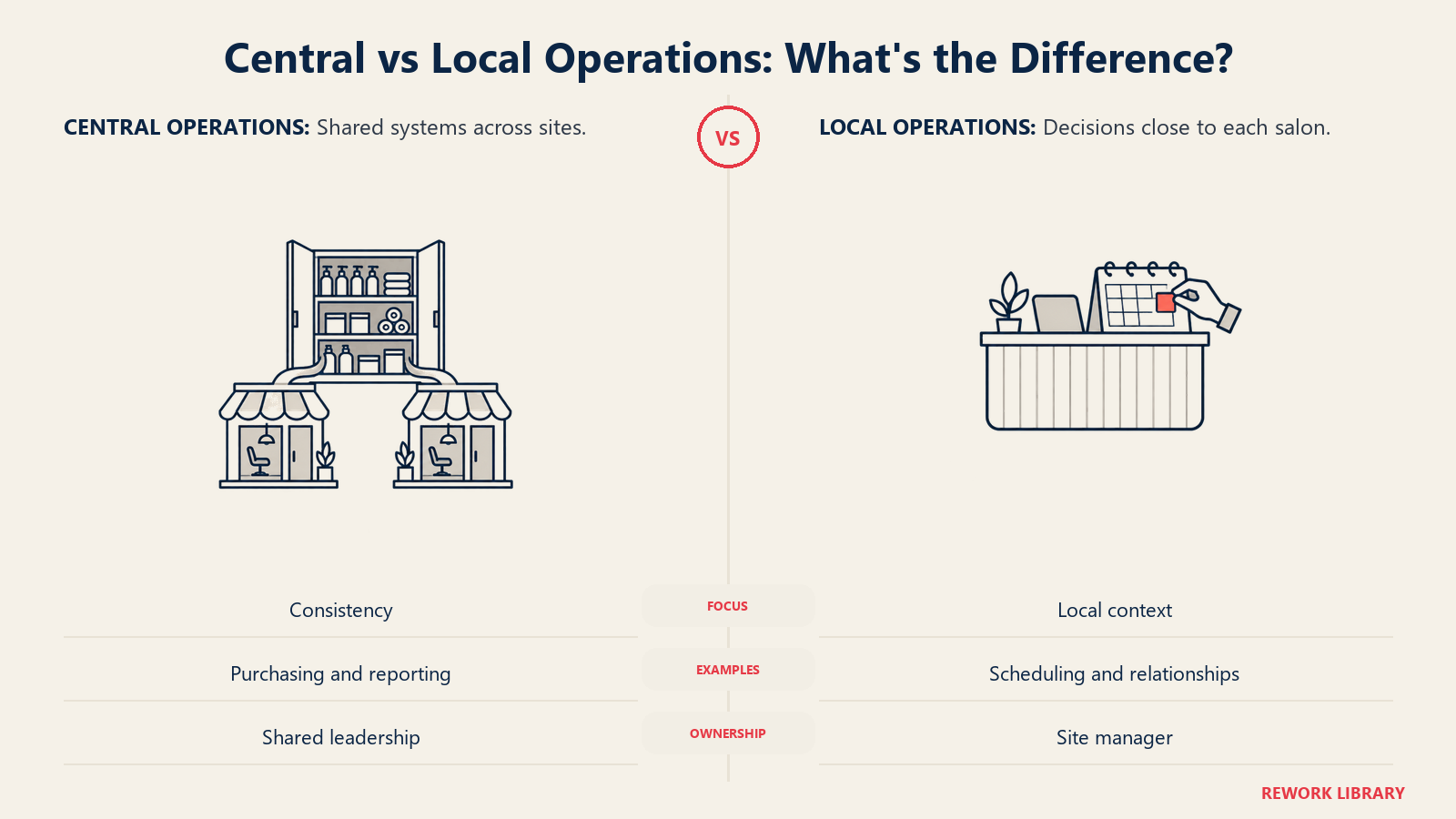
Centralize:
- Marketing and social media (brand consistency, scale)
- Payroll and HR systems (consistency, compliance)
- Inventory purchasing (volume pricing, standardized products)
- Booking system (single platform, cross-location visibility)
- Financial reporting (owner visibility across both P&Ls)
- Hiring standards and onboarding protocols
Keep Local:
- Day-to-day scheduling decisions
- Client relationship management (specific clients' preferences and histories)
- Community partnerships and local marketing execution
- Staff performance management and team culture
Technology Stack for Centralization: A salon management platform that handles multi-location booking, reporting, and client records under a single account is essential for efficient centralization. Boulevard, Mindbody, and Vagaro all support multi-location management at various price points. The salon management software guide compares these platforms on the criteria that matter most for multi-location operations, reporting depth, booking flexibility, and staff management tools.
Financial Modeling: What the Numbers Actually Look Like
Most second-location failures could have been predicted with a realistic financial model built before signing the lease.
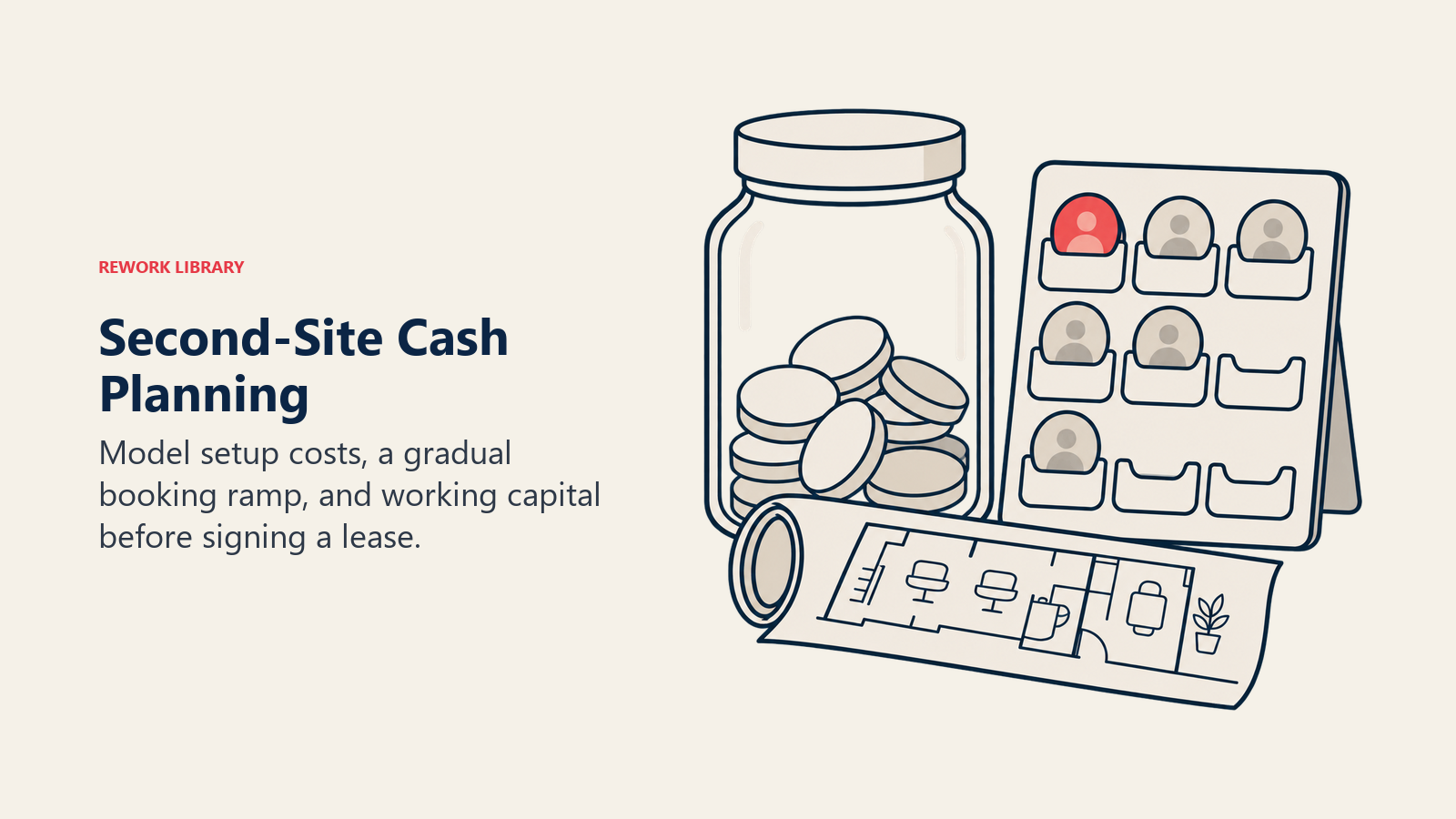
Key Inputs for a Second-Location P&L:
- Fit-out cost: New salon fit-outs typically run $80-200 per square foot depending on specification. A 1,500 sq ft salon = $120,000-300,000 in fit-out cost.
- Working capital requirement: Budget for 6-9 months of operating costs before reaching breakeven. A salon with $25,000 monthly overhead needs $150,000-225,000 in working capital reserve.
- Ramp-up timeline: New locations typically operate at 40-50% occupancy in months 1-3, 60-70% in months 4-6, and reach target occupancy (75%+) at 12-18 months. Build this revenue curve into the model. Don't assume full occupancy from month one.
- Impact on location one: The owner's split attention typically reduces first-location performance by 5-15% in the first 6 months of expansion. Model this in.
Common Financial Mistakes:
- Underestimating fit-out costs (contractor estimates are rarely final)
- Ignoring working capital requirement (revenue doesn't cover costs from day one)
- Not modeling the ramp-up period (assuming immediate occupancy)
- Forgetting the management hire cost at location one (someone has to run it while you're building location two)
Common Scaling Mistakes and How to Avoid Them
| Mistake | Why It Happens | Mitigation |
|---|---|---|
| Expanding before location one is systematized | Success feels like readiness | Complete the readiness scorecard honestly before committing |
| Replicating personality, not process | Owner drives location one's culture personally | Document every decision that currently lives only in your head |
| Underestimating management bandwidth | Owner assumes they can do both | Hire or promote a location manager before opening, not after |
| Overlooking cannibalization risk | Second location feels additional | Map client home zip codes before choosing a second location radius |
| Ignoring ramp-up cash requirements | Optimistic revenue assumptions | Model 12-month cash flow with conservative occupancy ramp |
| Moving too fast on a third location | Early success at location two | Wait until location two hits consistent profitability before considering three |
Multi-location growth is the right move for many beauty businesses, but only when the first location has been built into a system, not just a successful business. The Professional Beauty Association tracks operational benchmarks across tens of thousands of U.S. salons and provides industry standards that can serve as an external validation check before committing to a second lease. The difference between a system and a successful business is documentation: the hiring criteria, the training program, the service protocols, the financial benchmarks. When those things exist on paper, expansion is a process of replication. When they exist only in the owner's judgment, expansion is just risk. Owners considering expansion also need to think through competitive analysis for beauty businesses in the target market before committing, understanding the local landscape is as important as assessing internal readiness.
Learn More

Senior Operations & Growth Strategist
On this page
- Readiness Assessment: Are You Actually Ready?
- Location Selection: What Made the First Location Work?
- Management Structure: How the Org Chart Changes
- Brand Consistency: Standardizing the Client Experience
- Centralized vs Decentralized Operations
- Financial Modeling: What the Numbers Actually Look Like
- Common Scaling Mistakes and How to Avoid Them
- Learn More