Seasonal Promotions for Beauty Businesses: Driving Revenue Year-Round
Turn this article into takeaways for your work.


Each assistant summarizes the article only for you and suggests best practices for your work.
Most beauty businesses run two kinds of promotions: the ones they planned and the ones they panicked into. The planned ones happen around Valentine's Day and Mother's Day because those feel obvious. The panicked ones happen when a Tuesday looks slow and someone posts a last-minute Instagram discount.
Neither approach builds a sustainable revenue system.
The salons that grow consistently aren't necessarily busier during the two obvious holidays. They're capturing revenue from eight other high-intent windows that most operators overlook. They're also protecting their margin by knowing the difference between a promotion that builds the business and one that trains clients to wait for the sale. Loyalty programs for beauty centers complement a structured promotional calendar by rewarding consistent clients rather than only attracting discount-seekers.
Building a 12-month promotional calendar isn't complicated. But it requires more planning discipline than most beauty businesses apply to marketing, and it requires understanding what promotions are actually for.
Key Facts: Seasonal Promotions in Beauty
- Salons with a planned promotional calendar generate 23% more revenue per year than those running reactive promotions (Salon Today annual survey)
- Discount-based promotions reduce average ticket value by 18-22% among clients who redeem them, and 60% of those clients expect the discount on future visits (Professional Beauty Association)
- Email promotions sent 10-14 days before a holiday convert at 3x the rate of promotions sent 3 days before
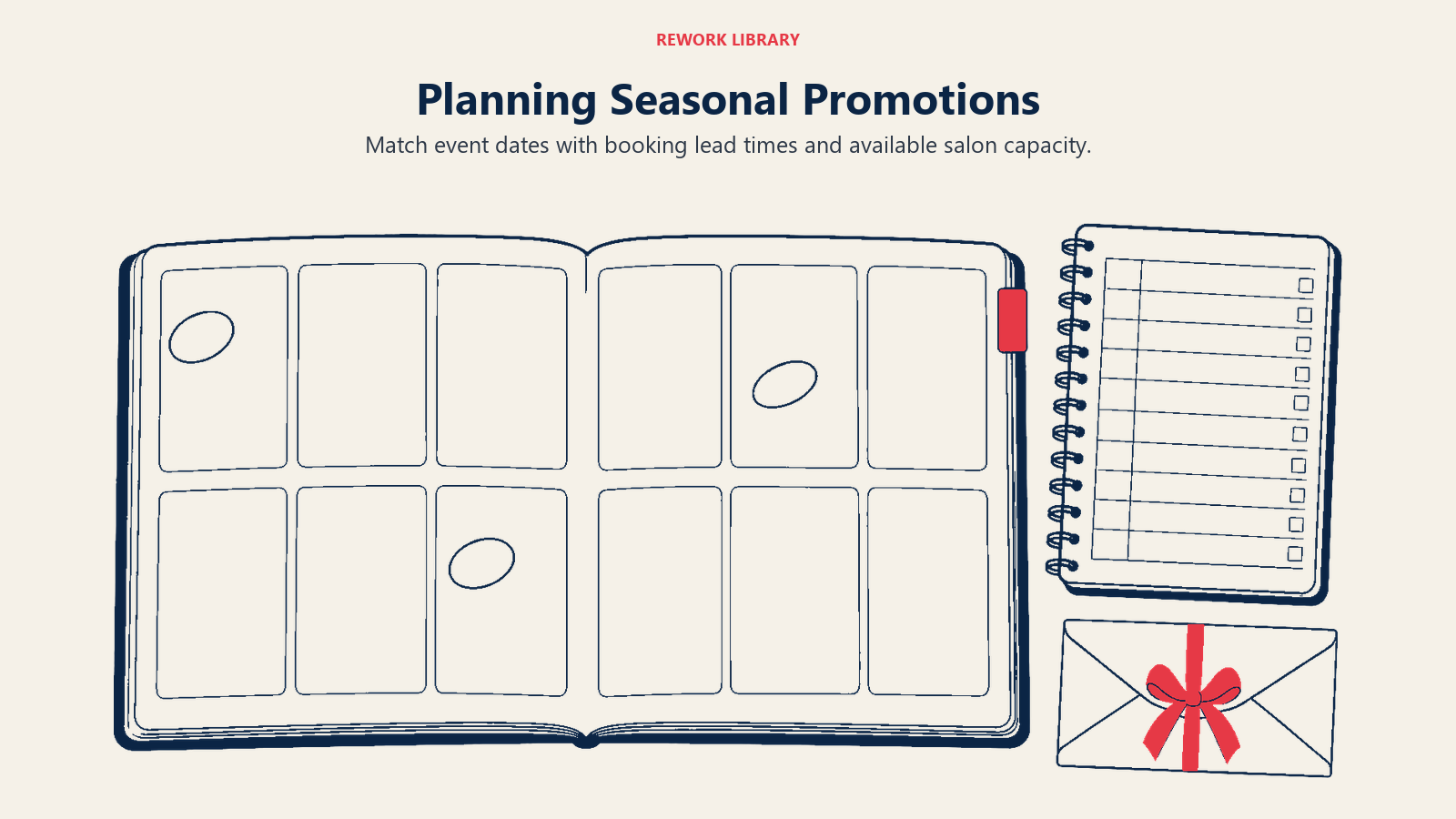
The Seasonal Calendar: 12 Months of High-Intent Windows
Here's the full year mapped against beauty demand patterns:
| Month | Demand Trigger | Ideal Promotion Type | Lead Time |
|---|---|---|---|
| January | New Year transformations, dry winter skin | New-look packages, skin treatment bundles | Send Jan 2-5 |
| February | Valentine's Day, winter date nights | Couples packages, lip/brow refresh | Send Jan 28 |
| March-April | Spring refresh, Easter gatherings | Color refresh, lash + brow combos | Send 2 weeks prior |
| April-May | Prom season, graduation | Updo packages, spray tan + hair combos | Send April 15 |
| May | Mother's Day | Gift cards, relaxation packages | Send May 1-5 |
| June | Wedding season begins, summer prep | Bridal packages, waxing + skin packages | Send late May |
| July-August | Summer travel, beach look maintenance | Express services, waterproof treatment packages | Send June 30 |
| September | Back-to-school, fall color previews | Color refresh, kids' cuts combo, fall trend previews | Send Aug 25 |
| October | Halloween events, fall color peak | Bold color packages, special occasion styling | Send Oct 1 |
| November | Holiday party season starts, Black Friday | Gift cards, holiday glam packages, retail bundles | Send Nov 1 |
| December | Christmas gifts, NYE prep | Gift cards, party styling packages | Send Dec 1 |
| Year-round | Birthdays (individual) | Birthday month discount or add-on | Automated |
The key insight: most of these windows have a predictable preparation window. Wedding season bookings happen in April and May for June ceremonies. Halloween styling gets booked in early October, not on October 30th. Getting your promotion in front of clients while they're planning, not when they're scrambling, is the difference between capturing the booking and missing it. McKinsey's retail marketing and branding research shows that advance-sequenced promotions, reaching buyers in their planning window, not their purchase window, consistently outperform last-minute offers on both conversion rate and average ticket. Solid client communication and follow-up systems ensure your promotional messages reach the right clients at the right moment.
Promotion Types That Work
Not all promotions are created equal, and not all seasons call for the same promotional mechanic.
Discount-based promotions (10-20% off a service or package) generate the most immediate response. But they carry the highest long-term cost: clients trained on discounts expect them, and the margin erosion compounds with every visit. Use discounts sparingly: for genuinely slow periods and for new-client acquisition, not for your highest-demand windows. HBR research on retail promotions and consumer behavior found that non-price-based promotions are more effective at building long-term brand attachment than straight discounts, particularly for service businesses where perceived expertise is part of the value.
Value-add promotions (free treatment with a service, complimentary product with booking) deliver urgency without cutting service price. "Book a color service in January and receive a complimentary deep conditioning treatment" maintains your price point while adding perceived value. This is the better structure for most seasonal promotions.
Bundle promotions combine two or more services at a combined price that feels like a discount without itemizing the reduction. A "Bride-to-Be Package" at $250 that includes a trial blowout, eyebrow shaping, and scalp treatment is worth $285 at individual prices, but the client sees a package price, not a percentage off. The full strategy behind these structures is covered in package deals and bundles for beauty businesses.
Limited-edition services create novelty without discounting. A "December Glam Blowout" or a "Summer Skin Reset Facial" positioned as seasonal-only creates natural urgency without touching your standard menu pricing. The service may be composed of existing treatments, but the positioning as a limited seasonal offering drives bookings.
Event-tied packages connect beauty services to social occasions in the client's life: prom, graduation, a wedding, a holiday party. These book well because the occasion creates inherent urgency, and clients are already spending on the event.
Avoiding the Over-Discounting Trap
Here's what happens when a salon discounts too frequently: clients stop booking at full price. They've learned that waiting gets them a better deal. The average ticket value drops. Staff morale follows, because commission on a discounted ticket is less than commission on a full-price service. Research on pricing and promotions analytics from McKinsey confirms that frequent promotional discounting trains consumers to become price-dependent, ultimately undermining baseline revenue without attracting loyalists.
The data is consistent: salons that run discount promotions more than 4-6 times per year see meaningful declines in full-price booking rates among their regular clients. The clients who respond to discounts are the same clients who are most price-sensitive and least likely to rebook without another discount. Your pricing strategies for beauty centers should set the floor so you always know the margin impact before committing to any promotional rate.
Compare the margin impact:
A $120 haircut promotion at 20% off nets $96. Staff commission on $96 (at 45%) is $43.20, leaving $52.80 to cover overhead and profit. At full price, that same haircut nets $120 with $54 to commission and $66.00 remaining. The 20% discount costs $13.20 on that single ticket, and if the client now expects 20% off every visit, that cost repeats indefinitely.
A value-add alternative: offer a complimentary $15 conditioning treatment with the same haircut booking. Your cost is $4-6 in product. The client perceives $15 in added value. You've preserved the $120 ticket price and kept your margin intact.
Value-adds, bundles, and limited-edition services deliver urgency without the compounding margin erosion that discounting creates.
Marketing Timing and Execution
The number one reason promotions underperform isn't the offer. It's the timing of the announcement.
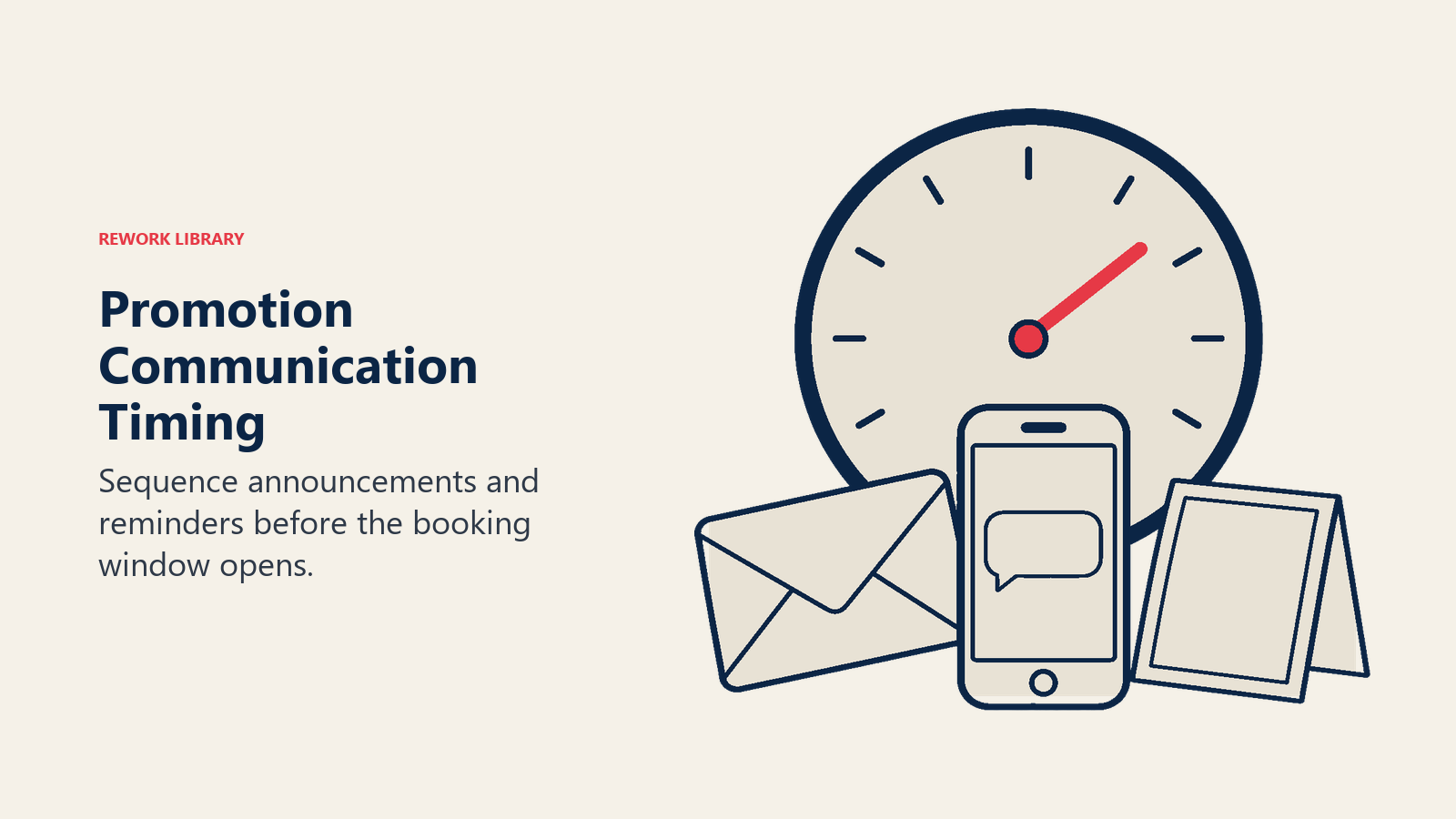
Most salons promote too late. A Mother's Day email going out on May 9th is arriving the day before Mother's Day when clients have already made plans or bought gift cards elsewhere. The optimal window for a major holiday promotion is 10-14 days before the date. For a seasonal promotion tied to a month rather than a specific date, start announcing in the final week of the preceding month.
Channel sequencing:
Email should go first, since it reaches your most engaged clients and allows for the most complete message. Send the primary announcement 12-14 days before the promotion window opens. Email marketing for beauty centers covers segmentation and sequence structure in detail.
SMS follows 7 days before, with a shorter reminder to clients who didn't open the email. SMS open rates run 95-98% versus 20-35% for email. Use it for reminders, not primary announcements. Keep SMS messages under 160 characters.
Social media runs throughout the promotion window: teaser content before launch, booking-focused posts during the window, last-chance messaging in the final 48 hours.
In-salon signage should go up the week before the promotion starts, not the day it launches. Clients booking their next appointment while currently in your chair are your most motivated segment.
The common mistake is treating these channels as separate campaigns rather than a sequenced communication. A client who sees the email, then the SMS reminder, then the Instagram post is far more likely to book than a client who sees only one touchpoint.
Measuring Promotion ROI
Revenue during a promotion period isn't the right success metric on its own. You need to distinguish between bookings that wouldn't have happened without the promotion and bookings that would have happened anyway and just came with a lower ticket.
Track these metrics for every promotion:
Incremental bookings: How many appointments were booked above your baseline for that period? Compare same-period bookings from the prior year or from a non-promotional week in the same season. The delta is your incremental lift.
Average ticket during promotion vs. baseline: If average ticket drops during a promotion, calculate the revenue cost. If 100 bookings happen at $96 instead of $120, the promotion cost $2,400 in margin, before factoring in the incremental lift.
New client capture rate: What percentage of promotion bookings came from clients who hadn't visited before? This is where promotional discounts can justify themselves, if you're acquiring new clients who then rebook at full price. The U.S. hair and nail salon market reached over $90 billion in 2025, a highly competitive environment where new-client acquisition through well-timed seasonal promotions offers a meaningful edge for independent operators. A referral program for beauty centers can amplify this effect by encouraging promotional visitors to bring friends at full price.
Rebook rate of promo clients: Of clients who booked during a promotional period, what percentage rebooked at standard price within 90 days? Below 50% suggests you attracted price-sensitive clients who won't become regulars.
Simple ROI template:
- Incremental bookings × average ticket = incremental revenue
- Minus: discount cost (if any) × total promotion bookings
- Minus: any additional marketing spend
- = Net promotion contribution
A promotion generating 25 incremental bookings at $85 average ticket produces $2,125 in incremental revenue. If your standard marketing spend for that period was $200, the promotion ROI is strong. If you also discounted 80 existing bookings by 20%, the discount cost was $1,920, and you need to weigh incremental gain against existing-client margin erosion.
Staff Preparation
A promotion that hasn't been briefed to your team is a promotion waiting to go wrong.
Before any promotion launches externally, your entire team needs to know:
What is the promotion, exactly? What's included, what isn't, and how does it get applied at checkout?
How long does it run? Nothing erodes client trust faster than a staff member offering an expired promotion.
What are the booking constraints? If a promotion is for new clients only, or weekdays only, or excludes certain services, every team member must know this before the first client asks.
How do they upsell during a promotional visit? A client who books a discounted introductory service is the highest-value upsell opportunity you have. Train staff to treat promotional clients as new revenue, not discounted visitors.
The other staff preparation issue is appointment load. Promotions create volume spikes. If you're running a 20% off promotion and it generates 40% more bookings in the window, your schedule needs to be prepared. Pre-block time for walk-ins, ensure retail is stocked and visible for impulse purchases, and brief reception on managing the additional booking volume. Staff scheduling for salons and spas covers how to adjust coverage for demand surges without overstaffing quiet periods.
Building the System
The 12-month promotional calendar becomes a genuine revenue system when it's built once and refreshed annually rather than invented from scratch each season. Here's how to make it repeatable:
Document the promotion structure for each window: the offer type, the communication timing, the channels used, the metrics to track. After each promotion runs, add a brief post-mortem: what generated the most bookings, what the ROI was, and what you'd change. By the third year of running a structured promotional calendar, you'll have a playbook that removes most of the guesswork.
The goal isn't to be everywhere at once. It's to show up reliably at the moments your clients are already primed to buy, and to do it in a way that builds revenue without eroding the value of what you've built.
Learn More