Google Ads for Beauty Businesses: Maximizing ROI on Paid Search
Turn this article into takeaways for your work.


Each assistant summarizes the article only for you and suggests best practices for your work.
Every month, beauty center owners across the country hand Google $500, $1,000, or $3,000 in ad spend and receive in return a vague sense that "we got some calls from it." They can't tell you the cost per booking. They can't identify which campaigns drove results. They don't know if they made money or lost it on the spend. The U.S. beauty and personal care market is projected to generate over $104 billion in 2025 according to Statista, and for a business operating in that market, paid search without measurement is simply leaving acquisition economics to chance.
That's not an advertising problem. That's a measurement problem. Google Ads, when set up correctly with proper conversion tracking and campaign structure, is one of the most accountable marketing channels available to a beauty center. You know exactly what you spent, exactly what actions it drove, and you can calculate a cost per new client that you can compare directly to that client's lifetime value. Understanding that lifetime value starts with the unit economics for beauty centers framework, which gives you the LTV numbers that determine whether your cost per acquisition is an investment or a loss.
But the operative phrase is "set up correctly." Without a structured campaign architecture, intentional keyword selection, and conversion tracking from day one, you're essentially paying for impressions from people who may or may not need your services, with no way to optimize toward the ones who actually book.
Key Facts: Google Ads for Beauty Businesses
- The average cost per click (CPC) for beauty-related search terms ranges from $1.50-$4.00 in most U.S. markets, with high-competition terms like "hair salon near me" reaching $5-8 CPC in major metros (Google Keyword Planner data)
- Beauty businesses that use Google Local Services Ads (Google Guaranteed) report 30-50% lower cost per lead compared to standard Search campaigns due to higher trust signals
- The average conversion rate for beauty service landing pages is 3-7%, meaning every 100 clicks should produce 3-7 booking inquiries when the landing page is properly optimized
Why Google Ads Works Differently for Beauty
Google Ads is intent-based advertising. When someone searches "gel manicure near me" or "men's haircut [city]," they're not idly browsing. They're actively looking for a service provider. That's categorically different from showing them an ad on Instagram while they're scrolling through cooking videos. According to BrightLocal, 46% of consumers regularly use "near me" in local searches, and local pack results capture 42% of all clicks for those queries, making paid search a direct lever for capturing high-intent demand that already exists.
This intent signal makes search advertising exceptionally efficient for beauty businesses. You're not interrupting an unrelated activity; you're raising your hand to a person already looking for what you offer. The challenge is that your competitors are raising their hands too, and whoever is most relevant, most trusted, and most visible wins the click. Running a competitive analysis for beauty businesses before setting up campaigns helps you understand which competitors are already advertising and which keyword territories are less contested.
The structure of your campaign (how you organize keywords, write ad copy, design landing pages, and track conversions) determines whether your hand goes up for the right searches at the right cost.
Campaign Structure for Beauty Centers
A properly structured Google Ads account for a beauty center typically has three campaign types working together:
Search Campaigns by Service Category
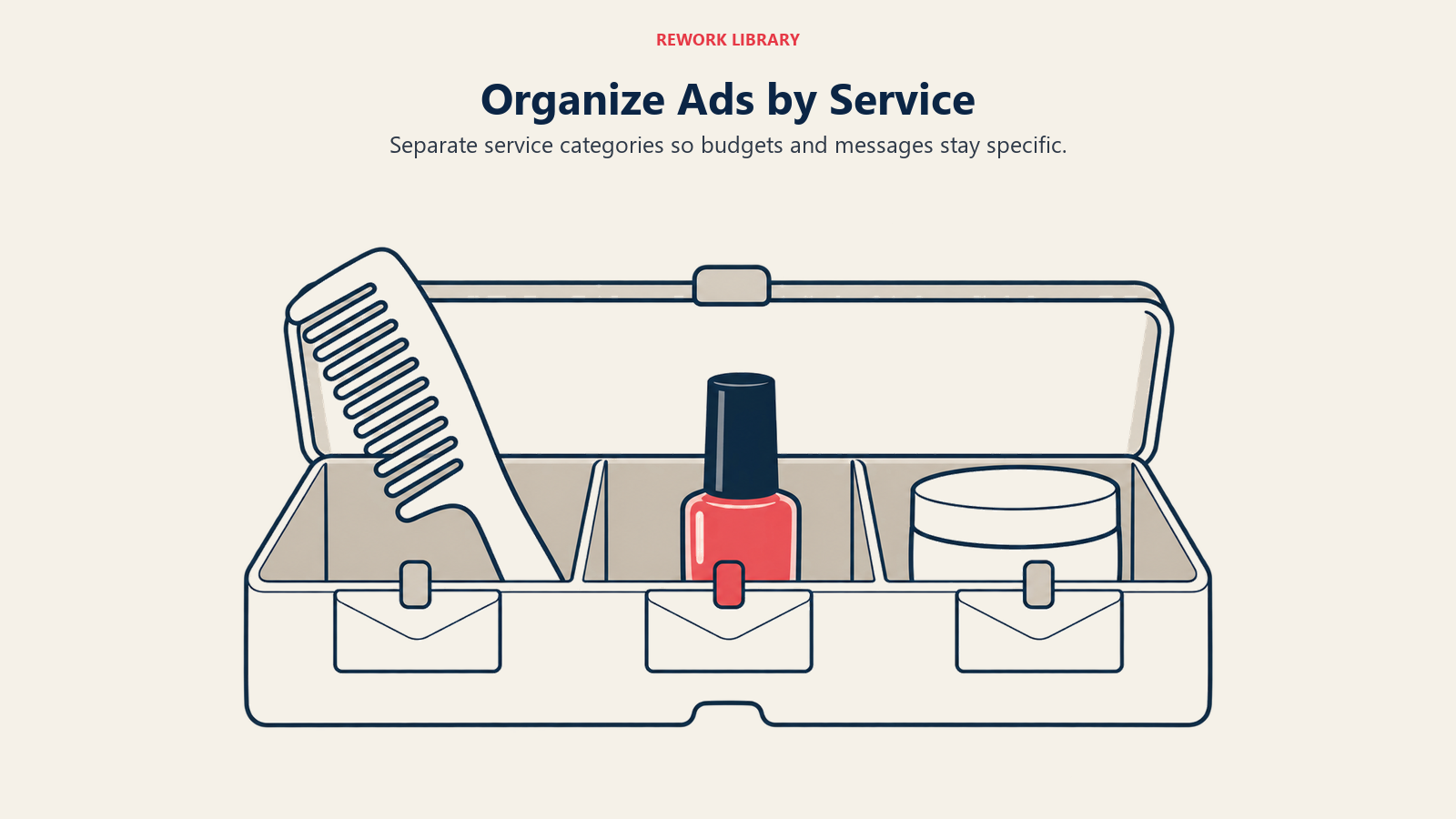
Organize your search campaigns by service type, not by location or any other variable. Each service category gets its own campaign with its own budget and its own dedicated ad groups.
Example structure for a full-service salon:
- Campaign: Hair Services
- Ad Group: Color Services (balayage, highlights, color correction keywords)
- Ad Group: Cut and Style (haircut, blowout, trim keywords)
- Ad Group: Treatments (keratin, deep conditioning, glossing keywords)
- Campaign: Nail Services
- Ad Group: Gel/Shellac Nails
- Ad Group: Acrylics and Extensions
- Ad Group: Pedicures
- Campaign: Skin Services (if applicable)
- Ad Group: Facials
- Ad Group: Waxing
This structure lets you allocate budget to your highest-margin services, write specific ad copy for each service type, and see performance at the category level. You'll know hair services drive 10 conversions per $400 while nail services drive 3 per $400, and adjust accordingly.
Google Local Services Ads
Google Local Services Ads (LSA), also called "Google Guaranteed," appear at the very top of search results above traditional paid ads. They show your business name, rating, and a verified badge indicating Google has verified your license and insurance.
The trust signal of the "Google Guaranteed" badge consistently produces higher click-through rates and higher conversion rates than standard search ads for service businesses. And LSAs work on a pay-per-lead model: you pay only when a client contacts you directly through the ad, not per click.
For beauty businesses, LSAs are particularly effective for categories where trust is paramount: medical-adjacent services (laser hair removal, chemical treatments), in-home services, or any first-time client interaction with a stranger in a personal service context. Your Google Business Profile for salons feeds directly into LSA performance, since the same review count and star rating that boosts organic rankings also strengthens the trust signals that make LSA ads convert.
Remarketing Campaigns
Only 2-4% of people who visit your website book an appointment on their first visit. Remarketing lets you show targeted ads to the other 96-98% after they leave.
A beauty center remarketing campaign can target:
- Website visitors who viewed your services page but didn't book
- Past clients who haven't visited in 90+ days (using customer match with your email list)
- People who started a booking process and abandoned it
Pairing remarketing with email marketing for beauty centers creates a two-touch re-engagement system: ads reach visitors who left your site, while emails reach clients already in your database who haven't returned recently.
Remarketing CPCs are significantly lower than prospecting search CPCs because you're targeting a warm audience. A $100/month remarketing campaign can meaningfully lift your overall conversion rate on search traffic.
Keyword Strategy
Your keyword selection determines which searches trigger your ads. Getting this wrong means paying for irrelevant clicks or missing your best potential clients.
High-Intent Service Keywords
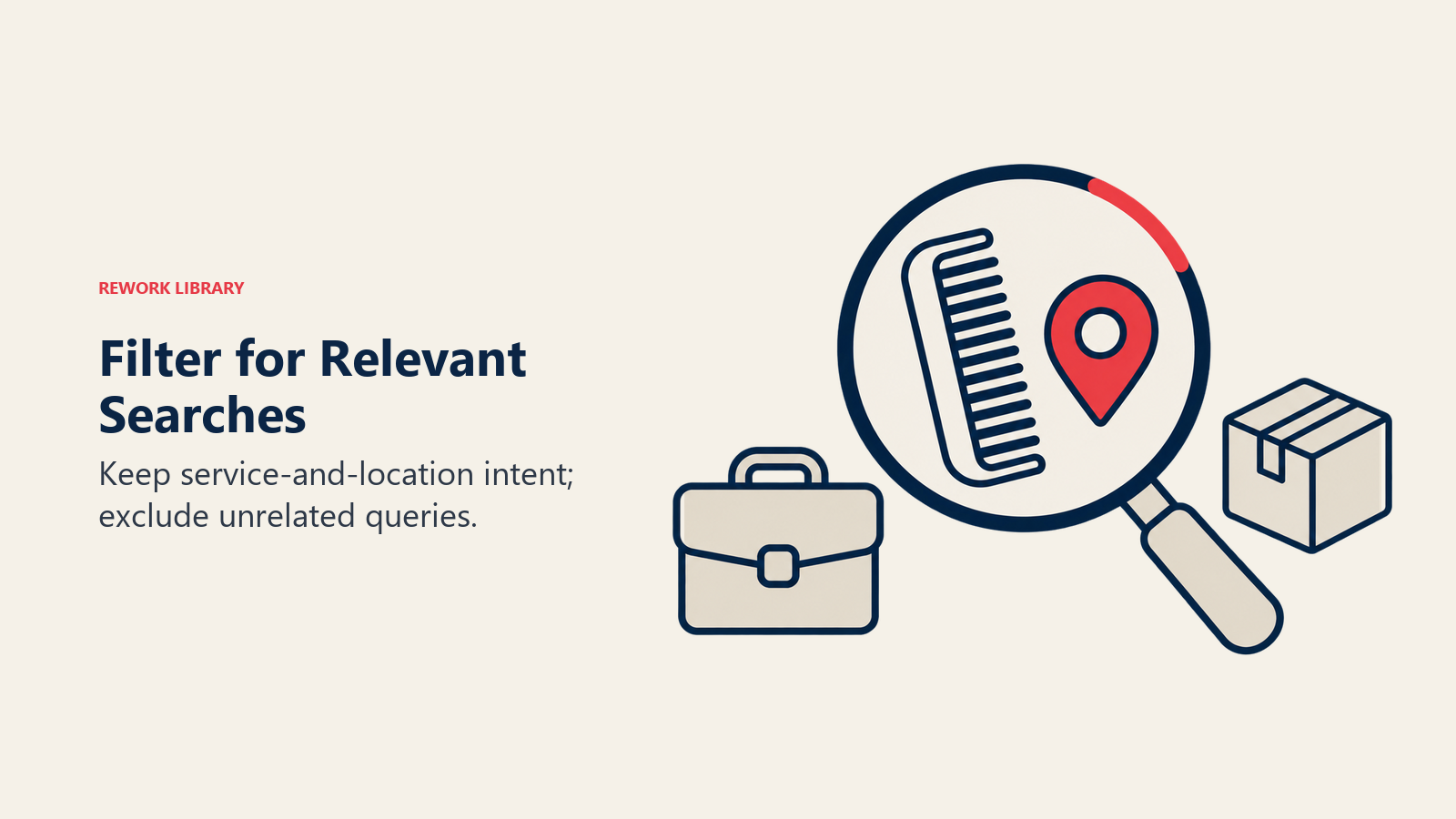
These are the keywords you build your campaigns around:
- "[Service] near me" (gel nails near me, hair salon near me)
- "[Service] + [city/neighborhood]" (balayage Chicago, massage therapy Midtown)
- "[Specific technique] + [location]" (Brazilian blowout Austin, eyelash extensions Brooklyn)
- "[Specific concern] + [location]" (color correction specialist Dallas, curly hair expert Seattle)
The more specific the keyword, the higher the intent and the lower the competition. "Balayage specialist Chicago Lincoln Park" will cost less per click and convert at a higher rate than "hair salon Chicago" even though the volume is lower.
Negative Keywords: Protecting Your Budget
Negative keywords prevent your ads from showing for irrelevant searches. Without them, you'll spend money on:
- Job searches ("salon stylist jobs near me")
- DIY content ("how to do gel nails at home")
- Product searches ("salon shampoo brands buy online")
- Competitor-specific searches (if you don't want to bid on competitor names)
- Price-checking without intent ("cheapest hair salon near me" if you're positioning as premium)
Build your negative keyword list before your campaigns launch, and add to it weekly during the first month based on the search term report in your Google Ads account.
Branded vs. Non-Branded Keywords
Branded keywords (your business name and variations) typically have very low CPC and high conversion rates. Someone searching your name already knows you. Run a low-budget branded campaign to protect your brand from competitors bidding on your name, and ensure you capture high-intent named searches.
Non-branded keywords (service + location) are your growth campaigns. These capture new clients who don't know you yet.
Ad Copy Best Practices
Your ad copy determines your click-through rate, which affects both your traffic volume and your Quality Score (which in turn affects your CPC). Strong ad copy for beauty businesses follows these principles:
Lead with the specific service: "Balayage & Color Specialists" is better than "Full Service Salon" for a balayage-focused ad. Match the ad to the specific ad group keyword theme.
Include your location: "Serving [City/Neighborhood]" or "[City] Salon Est. 2018" immediately filters for local intent and confirms you're relevant.
Social proof signals: "400+ 5-Star Reviews," "Google Guaranteed," "Award-Winning Stylists" are conversion signals that deserve headline real estate.
Clear call to action: "Book Your Appointment Online," "Schedule Your Consultation," "See Availability Now." Not "Click Here" or "Learn More." Be specific about the action.
Use all three headlines and both description fields: Google's Responsive Search Ads accept up to 15 headlines and 4 descriptions. Provide at least 8-10 headlines and 3-4 descriptions and let Google's algorithm test combinations. More assets give the algorithm more to work with.
Landing Page Requirements
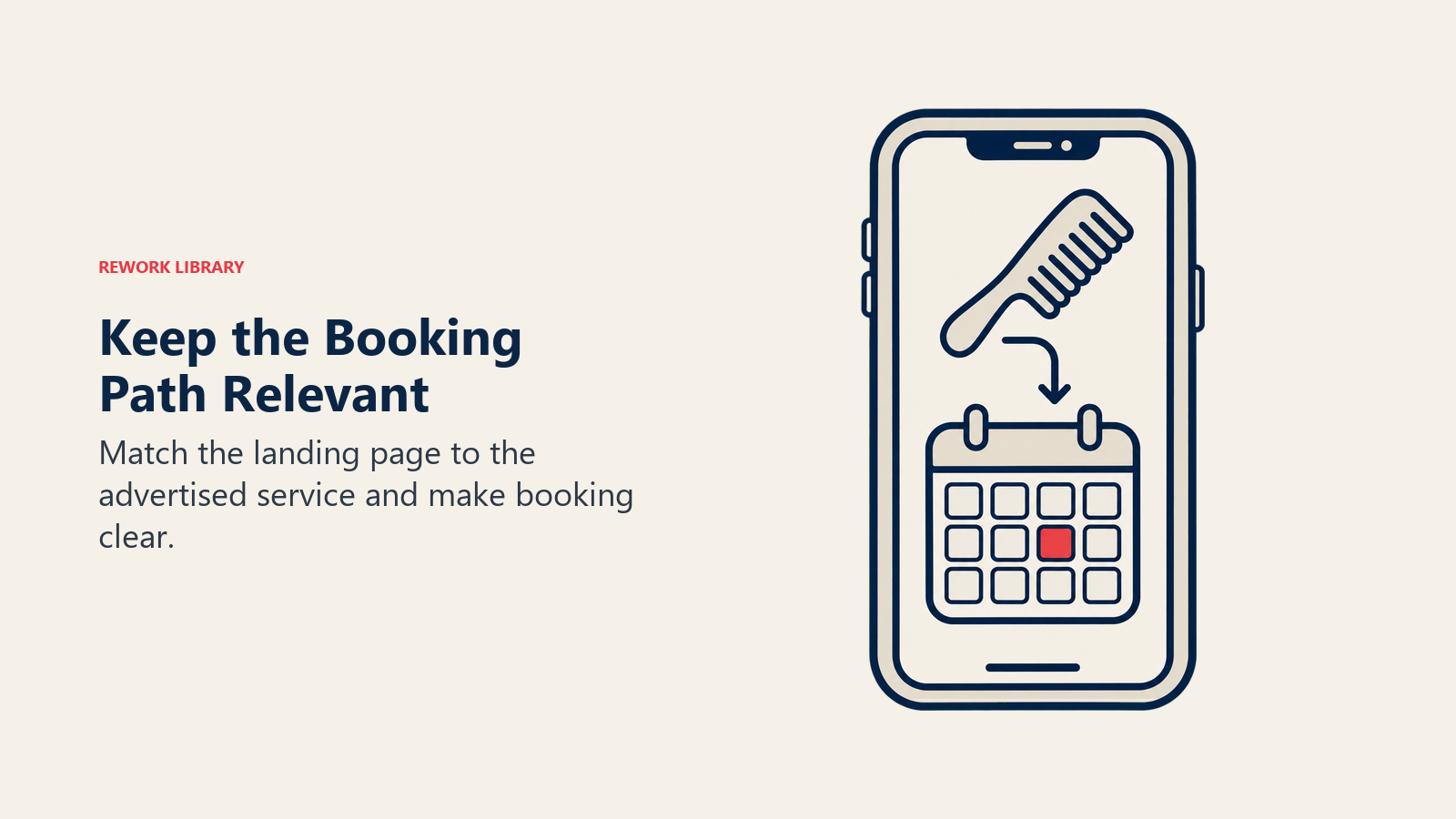
Your ad drives the click. Your landing page determines whether that click becomes a booking. A service-specific landing page consistently outperforms sending ad traffic to your homepage.
A beauty center landing page that converts needs:
Single service focus: If the ad is about balayage, the page is about balayage. Not your full menu. Not your homepage. The visitor should see immediate relevance: "This is the balayage page for the business I just searched for."
Visual proof: Gallery of before/after results for that specific service, ideally with location context (client names, neighborhood references if permissioned).
Specific social proof: "147 five-star reviews" or a highlighted review about that specific service, not a generic "clients love us" claim.
Clear, frictionless CTA: One primary CTA above the fold: "Book Your Balayage Appointment" with a direct link to your online booking system. Don't make them hunt for it. The structure of that booking flow itself can make or break your conversion rate, which is why online booking optimization is the natural complement to a well-built Google Ads campaign.
Mobile optimization: Over 60% of beauty ad clicks happen on mobile. If your landing page isn't fast (under 3 second load time) and easy to navigate on a phone, you're wasting a significant portion of your ad spend.
Click-to-call: Make your phone number a clickable link on mobile. Some clients would rather call than click. Give them that option without friction.
Budget Allocation and Bid Strategy
New to Google Ads? Start with a modest budget ($500-$1,000/month) in one or two service categories while you build conversion data. Scaling spend before you have conversion tracking in place is burning money on optimistic assumptions. Statista data on Google Ads for beauty and skincare shows the average CPC for the beauty and skincare category in the U.S. was $1.61 in late 2024, a relatively efficient cost per click that makes search advertising accessible even for smaller beauty center budgets when campaigns are structured correctly.
A practical starting allocation for a mid-size salon in a competitive market:
- Primary service campaign (your highest-margin services): 50% of budget
- Secondary service campaign: 25% of budget
- Remarketing: 15% of budget
- Branded keywords: 10% of budget
Bid strategy: For new campaigns without conversion history, start with "Maximize Clicks" to gather data while controlling spend with bid caps. Once you have 30-50 conversions tracked, shift to "Target CPA" (cost per acquisition), where you tell Google what you want to pay per booking and the algorithm optimizes toward that target. This is where the efficiency of Google Ads really compounds.
Market-based starting budgets:
- Small market (under 100,000 population): $400-$800/month
- Mid-size market: $800-$2,000/month
- Major metro (NYC, LA, Chicago): $2,000-$5,000/month for meaningful visibility
Geo-Targeting: Precision Over Reach
Beauty center clients book local. A potential client in a suburb 12 miles away is unlikely to book with you when they have three salons within two miles. Targeting too broad a radius wastes budget on low-probability clicks. Your local SEO for beauty centers research will have already defined the geographic radius where most of your organic clients come from. Use that same radius as your starting geo-target for paid search.
Start with a tight radius, typically 3-5 miles from your location. Adjust based on your specific market and service category. A luxury spa or a specialized technique studio can viably target a 10-15 mile radius because clients will travel for the right offer.
Use bid adjustments to increase your bids for the geographic zones closest to your salon (your highest-conversion radius) while maintaining lower bids in the outer rings.
Conversion Tracking: The Non-Negotiable Foundation
If you run Google Ads without conversion tracking, you have no idea what's working. This isn't optional. It's the foundation of everything.
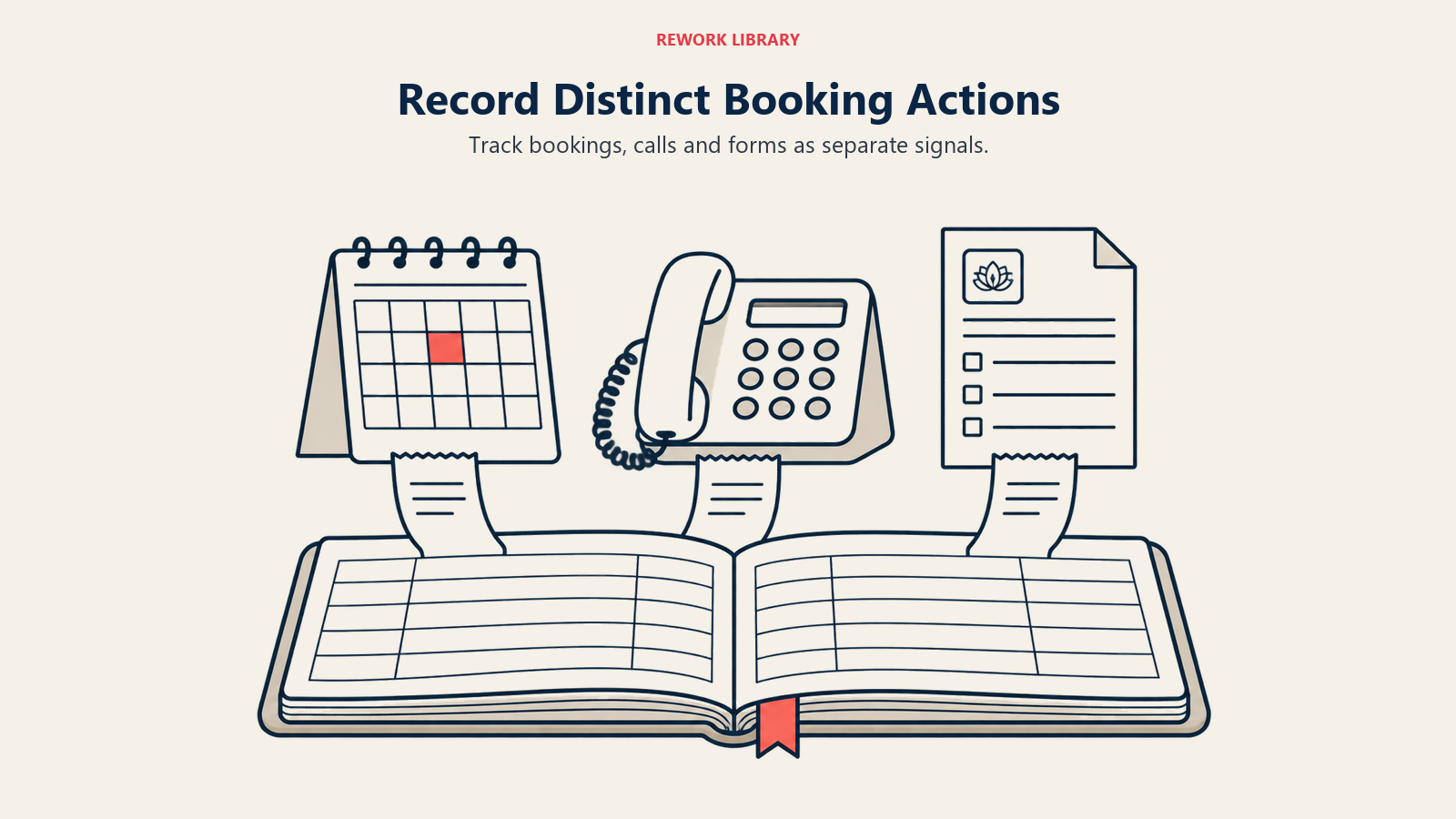
Track at minimum:
- Online bookings: Install Google Ads conversion tracking on your booking confirmation page (the "thank you for booking" page your booking software shows after a completed reservation)
- Phone calls: Google Ads provides call tracking numbers that count calls generated directly from your ads
- Form fills: If you use a contact form, track successful form submissions as conversions
Connect Google Ads to Google Analytics for fuller attribution data, and link both to your Google Business Profile.
With conversion tracking in place, you can calculate your actual cost per new client:
Cost per acquisition = Total ad spend / Number of conversions
If you spent $600 last month and generated 12 booking inquiries with 8 showing up for appointments, your cost per new client is $75. Compare that to the LTV of a new client ($4,000-$8,000+ over their lifetime) and $75 starts to look like an excellent investment, not a cost. Protecting that investment after acquisition by reducing no-shows is equally important, and a structured no-show and cancellation management process ensures paid-search clients don't book and disappear.
Industry Benchmarks
Calibrate your expectations with these industry benchmarks. According to WordStream's Google Ads benchmarks, 65% of industries saw improved conversion rates in 2025 as Google's algorithm has matured, meaning a well-structured campaign today benefits from years of optimization learning that wasn't available to early adopters:
| Metric | Low | Average | Strong |
|---|---|---|---|
| Click-through rate (CTR) | 2-3% | 4-6% | 8%+ |
| Landing page conversion rate | 2-3% | 4-6% | 8%+ |
| Cost per click (CPC) | $2-3 | $3-5 | $1-2 (great targeting) |
| Cost per new booking inquiry | $25-40 | $40-80 | Under $25 |
| Show-up rate (inquiry to appointment) | 60% | 70-75% | 85%+ |
If your metrics are below the "Average" column after your first 60 days, the issue is almost always one of three things: wrong keywords (too broad or too generic), ad copy mismatch with the landing page, or a landing page that isn't converting clicks into inquiries.
Learn More

Senior Operations & Growth Strategist
On this page
- Why Google Ads Works Differently for Beauty
- Campaign Structure for Beauty Centers
- Search Campaigns by Service Category
- Google Local Services Ads
- Remarketing Campaigns
- Keyword Strategy
- High-Intent Service Keywords
- Negative Keywords: Protecting Your Budget
- Branded vs. Non-Branded Keywords
- Ad Copy Best Practices
- Landing Page Requirements
- Budget Allocation and Bid Strategy
- Geo-Targeting: Precision Over Reach
- Conversion Tracking: The Non-Negotiable Foundation
- Industry Benchmarks
- Learn More