Before & After Content Marketing: Visual Storytelling for Beauty Businesses
Turn this article into takeaways for your work.


Each assistant summarizes the article only for you and suggests best practices for your work.
A single before-and-after transformation can generate more new client inquiries than an entire month of promotional posts. It's the one content format in the beauty industry that does everything simultaneously: proves the skill, creates aspiration, builds trust, and delivers a clear reason to book.
Yet most beauty businesses do it inconsistently, poorly lit, with awkward angles, and without a caption that connects the viewer to the work. The result is content that gets a few likes from existing followers and converts almost nobody. This content format sits at the intersection of your Instagram and TikTok strategy for beauty. Without strong visuals, the best posting schedule in the world won't convert.
The businesses that use before-and-after content well treat it as a production system, not an afterthought. They have a standard lighting setup, a client consent process, a caption formula, and a posting workflow. The result isn't just better-looking content. It's a consistent stream of new client inquiries from people who saw the work and want the same result.
Key Facts: Visual Content in Beauty Marketing
- Before-and-after content generates 3-5x more saves and shares than standard promotional posts on Instagram (Sprout Social, 2024)
- 68% of beauty clients say transformation photos were a significant factor in choosing a new salon or therapist
- Video before-and-after content (reveal transitions) generates 40-60% more profile visits than static image comparisons
- Statista's data on beauty shopping on social media confirms that transformation and results-driven content is among the top drivers of beauty purchase decisions made through social platforms
Photography Setup: Getting the Technical Side Right
You don't need a professional photographer. You need consistent, good-quality photos, and those come from a repeatable setup, not expensive equipment.
Equipment
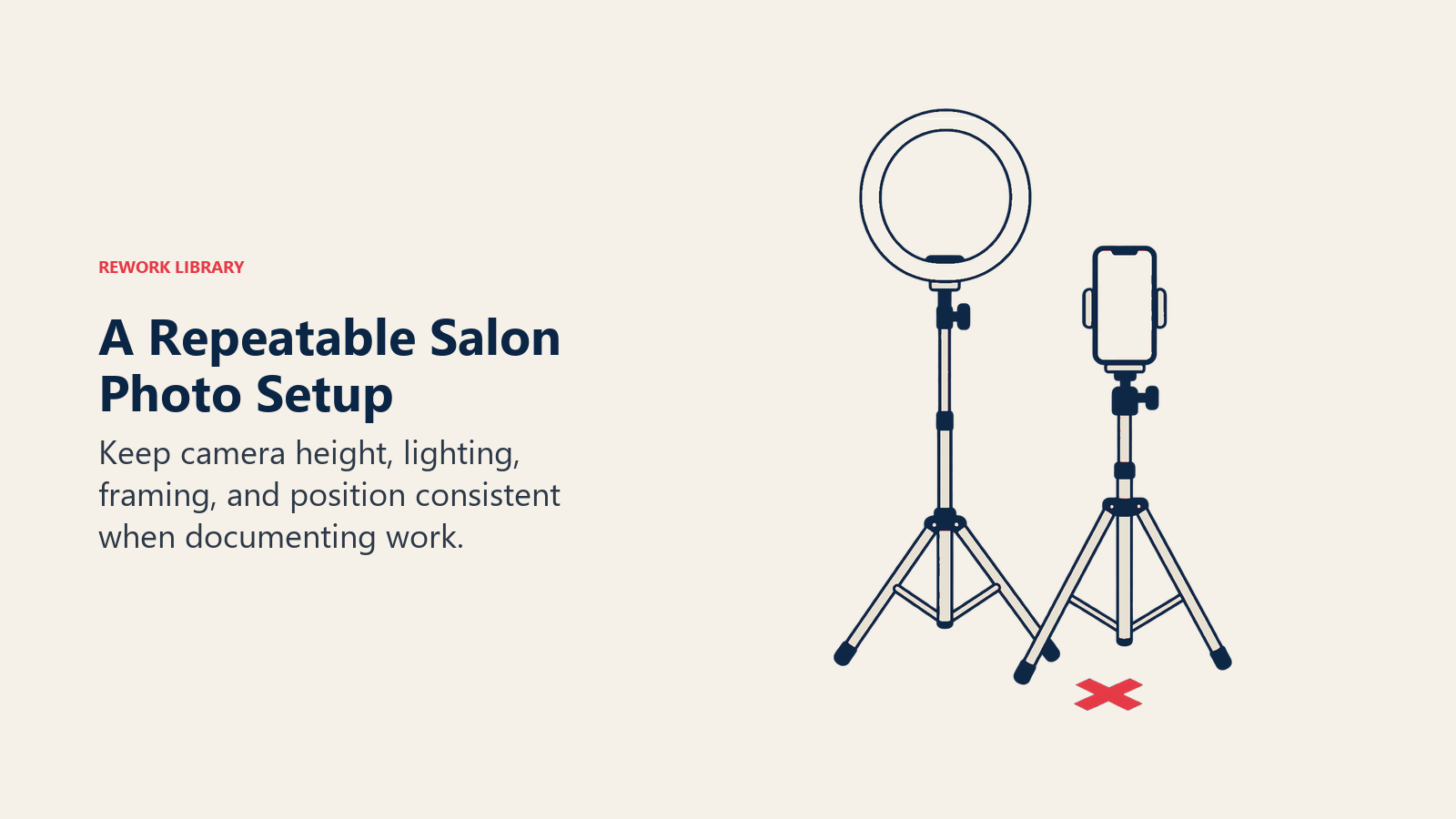
An iPhone 14 or newer (or equivalent Android flagship) shoots adequate transformation content. What matters far more than the camera is lighting and angle consistency. A $30 ring light is a better investment than a camera upgrade. The photos you create here become assets across multiple channels, and your Google Business Profile for salons benefits directly from fresh work photos added regularly.
For facial or skin treatment photography, a ring light positioned at eye level, 18-24 inches from the client's face, creates the flat, shadow-free lighting that shows skin texture accurately. For hair, an angled ring light or a softbox to the side shows dimension and shine better than straight-on flat lighting.
The Consistent Setup
Create a designated photography spot in your salon. This is non-negotiable for consistent results. Pick a wall (plain, neutral background: white, light grey, or your brand color), mark where the photographer should stand with a small piece of tape on the floor, and establish the camera height. Every before photo and every after photo is taken from this spot.
Why consistency matters: A before shot taken in one location with natural window light and an after shot taken under salon ceiling lights against a different background tells the viewer that the comparison isn't real. Inconsistent photography actively undermines your most powerful content.
Common Photography Mistakes
- Hair photos taken from too far away, so the texture and color detail that justifies the price can't be seen
- Before photos where the client looks tired, uncertain, or poorly lit (which makes the "transformation" look partially manufactured)
- Cluttered backgrounds with carts, mirrors, and cables visible
- Inconsistent framing, such as full head in the before but cropped differently in the after
The Before Photo Protocol: The best time to take the before photo is during the consultation, after the client is gowned up, with their hair in its natural state. Don't wait until you've started the service. Get the before shot before anything touches the hair or skin.
Consent, Permissions and Legal Basics
This is the part most salons skip entirely until something goes wrong. Don't skip it.
What Your Consent Form Needs to Cover
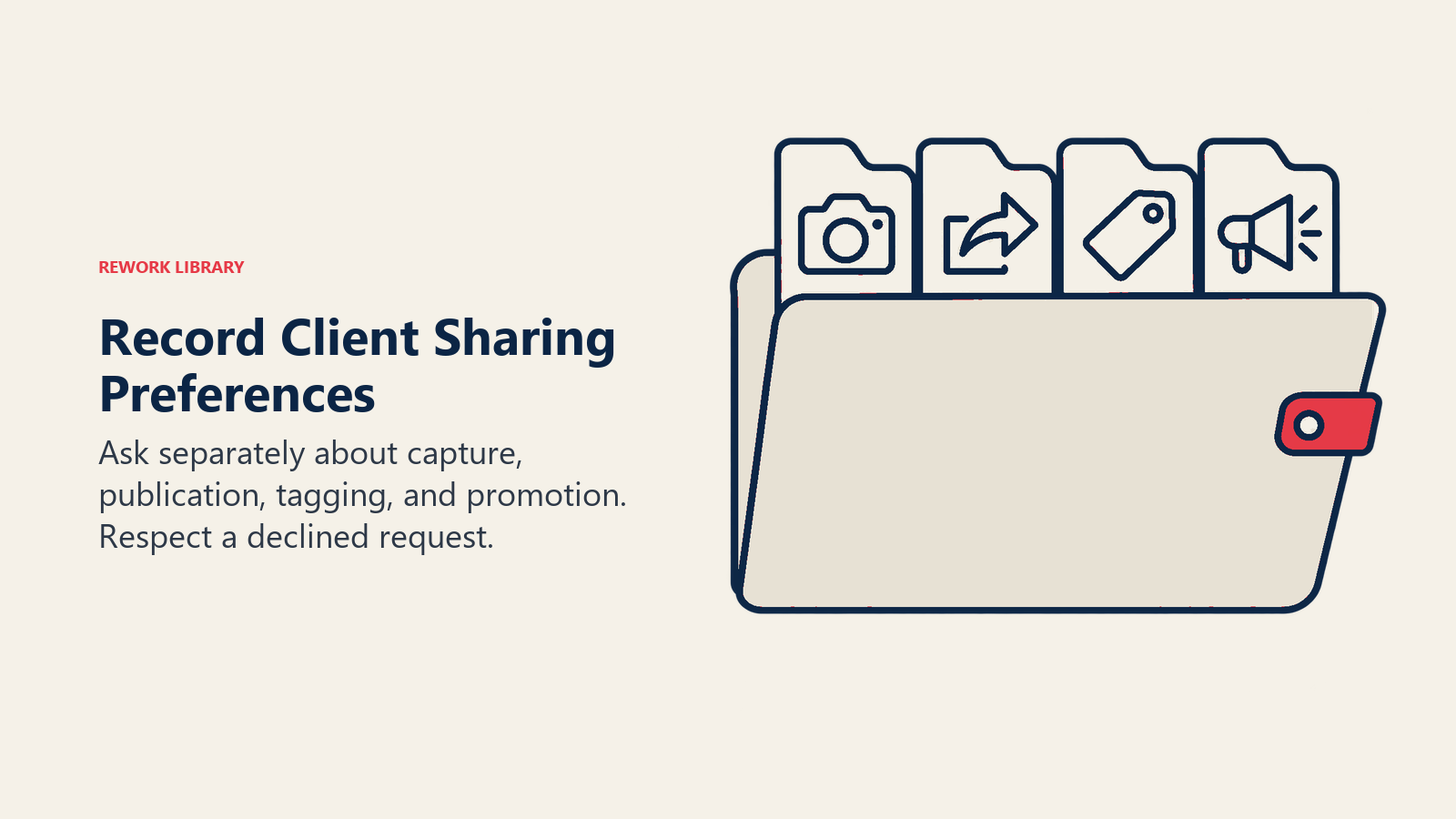
A written client photo consent form should include:
- Permission to photograph/video during and after the service
- Specific platforms where the content may be shared (Instagram, TikTok, website, Google Business Profile)
- Whether the client is willing to be tagged or prefers anonymous posting
- Permission to use the content for promotional purposes (advertising, boosted posts)
- A statement that the client can revoke consent with notice
Sample Consent Language
"I give [Salon Name] permission to photograph and/or record video of my hair/skin/nail service results for use on their social media platforms (Instagram, TikTok, Facebook), website, and marketing materials. I understand this content may be used for promotional purposes, including paid advertising. I [will / will not] be tagged in posts. I may revoke this consent at any time by contacting the salon in writing."
Keep signed copies on file, either paper or digital. Inc.'s overview of visual content marketing shows visual posts can earn 150% more engagement than text-only alternatives, but that advantage disappears the moment content is disputed and pulled. If you use salon management software, many platforms allow you to attach consent notes to client profiles. A good CRM for salons and beauty centers lets you log consent status alongside appointment history, so nothing falls through the cracks as your team grows.
Handling Client Hesitation
Some clients will decline. That's completely fine. Never pressure anyone. The way to increase consent rates is to show the client the before-and-after examples you've created for others (from willing clients) and let them see how you present the work. "We'd love to show off this transformation. Here's an example of how it looks on our Instagram" converts far more hesitant clients than a generic ask.
Privacy Considerations
Don't tag clients without explicit permission. Even if they've given consent to posting, tagging is a separate decision. Some clients are fine with their results appearing in your feed but don't want to be directly identified. Respect this distinction.
For any content featuring minors (teenage clients), parental consent is required in writing.
Platform Guidelines: Staying Compliant Without Watering Down the Content
Instagram and TikTok have specific policies around before-and-after content, particularly for aesthetic treatments, skin procedures, and anything that could be classified as medical or quasi-medical.
What Gets Flagged
Content that implies medical outcomes (dramatic skin clearing, weight-related transformations, language suggesting clinical results) gets flagged or suppressed. For beauty businesses, the specific risk areas are:
- Skin treatments: Avoid language like "cured acne" or "eliminated hyperpigmentation." Use "improved texture" and "brighter, more even-toned skin" instead
- Body contouring or slimming treatments: Before-and-after content showing body shape changes is heavily restricted on both platforms
- Any content positioned as a medical before-and-after rather than a beauty service transformation
How to Stay Compliant
Frame the transformation around the service, not the medical outcome. "Six-week skin program results" or "Hydrafacial before and after" is compliant. "Before our treatment, client had severe acne. After: completely clear" is flagged language.
For hair and nail content, platform restrictions are minimal. The main compliance issue is using before-and-after format in paid ads, as Meta requires specific disclosures for ads featuring transformation content.
Captions That Convert
Your before-and-after photo does the visual work. Your caption does the sales work. Most beauty businesses waste this opportunity with a caption that says "✨ Transformation Tuesday ✨" and nothing else.
A caption that converts tells the story and asks for the next step:
The Formula:
- What the client came in with (1 sentence): "She came in with 8 months of home color and wanted to go lighter without damage."
- What the challenge was (1-2 sentences): "The previous color had deposited heavily at the ends, which meant we needed to lift carefully and use a bond-builder throughout."
- What you did (2-3 sentences): "We did a three-step color correction over two sessions, starting with a gentle lift, toning, and finishing with a gloss to add shine and depth."
- The result (1 sentence): "The result: warm, dimensional blonde that looks natural and feels healthy."
- The CTA (1 sentence): "If you've been thinking about going lighter, drop a comment or book a consultation through the link in bio."
Include service name and a price indication if your market tolerates transparent pricing. The U.S. beauty and personal care market is projected to reach $104 billion in revenue in 2025 (Statista), meaning clients have no shortage of options, and your caption is often the deciding factor between booking with you or scrolling to a competitor. "Starting from $180 for a full balayage" removes the "how much does this cost?" friction that otherwise stops people from booking. Transparent pricing in captions also works as a natural filter: clients who are comfortable with your pricing strategies for beauty centers self-select in, reducing price-based objections at booking.
SEO Keywords in Captions: For Instagram discoverability, include service-specific terms naturally in the caption text, such as "balayage," "hair color correction," and your city name. Instagram now indexes caption text for search.
Video vs Photo: When Each Format Wins
Static side-by-side images work well for complex color work where the texture and detail need a long look. Video transitions (wipe cuts and reveal edits) work better for haircuts, blowouts, and skin treatments where the before-to-after movement is dramatic.
Tools for Video Before-and-Afters:
- CapCut: Free, has built-in before-and-after transition templates
- InShot: Clean interface, easy split-screen and reveal effects
- TikTok's native editor: For TikTok-first content, built-in effects work better than importing from third-party apps
The most effective format on TikTok right now: start the video on the "before" with a hook ("She wanted to go from box dye to balayage in one session. Here's what that actually looks like"), show the process in sped-up clips, and hold the reveal for the last three seconds. That structure keeps viewers watching through to the end, which signals quality content to the algorithm. If you're building out a full platform-specific approach, Instagram and TikTok strategy for beauty covers posting schedules, hashtag strategy, and conversion tactics that make this content type work harder.
Building a Portfolio Archive
Your before-and-after library is one of your most valuable business assets. Statista's data on beauty brands on social media shows that the top-performing beauty accounts are defined by consistent, results-driven visual archives (not individual viral posts), which is exactly what a well-organized transformation library enables. A salon that has been consistently shooting transformations for two years has hundreds of pieces of content that continue to sell the business on a website, in social ads, and on the Google Business Profile. This archive also feeds your review management strategy for beauty businesses, and transformation photos included in your responses to positive reviews make those replies far more compelling.
Organizing the Archive:
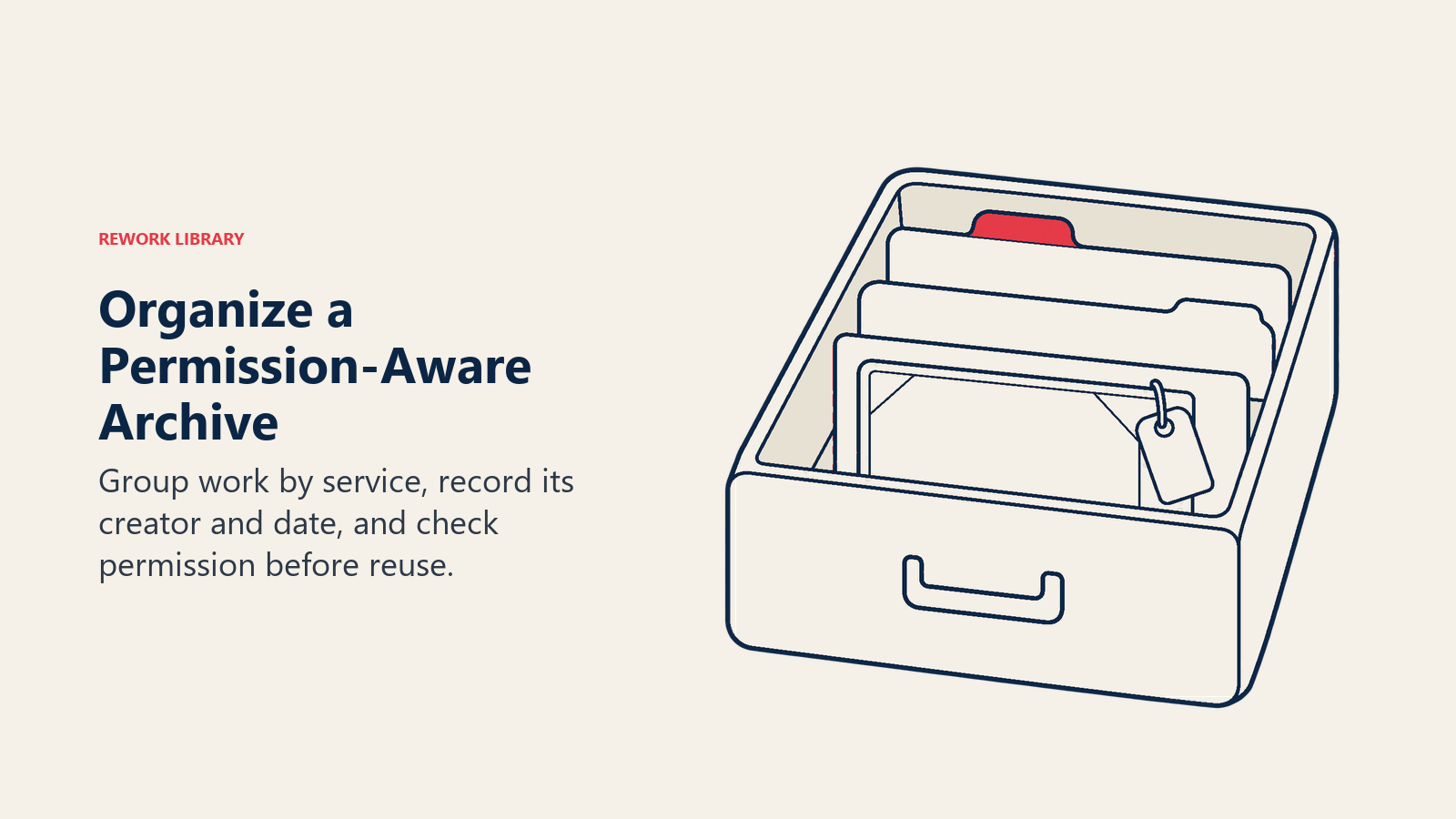
Create folders by service type:
/transformations/color-correction/transformations/balayage/transformations/haircut/transformations/skin-treatments
Tag each file with the stylist/therapist name and date. This makes it easy to pull content for specific promotions and to build individual staff portfolios.
Encouraging User-Generated Content
Some clients will post their own before-and-after on Instagram or TikTok and tag your business. This UGC is marketing gold: independent, third-party validation of your work.
Script for staff to use post-service: "If you're happy with how it turned out, we'd love it if you shared a before-and-after on Instagram and tagged us. We repost all our client results. It also helps other people find us who might be looking for the same thing."
When reposting UGC, always credit the original poster, and confirm you have permission to reshare. Most clients who tag you are happy to be reshared, but ask anyway.
Conclusion
Before-and-after content is your most credible sales asset. No promotional copy is as convincing as proof of the work. But proof only sells consistently when it's created consistently: standard lighting, a consent process that works, captions that explain and invite, and an archive that grows with every service delivered.
Build the system. The photography spot, the consent form, the caption formula, the posting schedule. Once the system is in place, the content is a byproduct of the work you're already doing, not an additional burden on top of it. When this content starts driving discovery, pairing it with walk-in conversion strategies ensures that the new visitors your visuals attract actually become paying clients.
Learn More

Senior Operations & Growth Strategist