Client Communication & Follow-Up: Staying Top of Mind Between Visits
Turn this article into takeaways for your work.


Each assistant summarizes the article only for you and suggests best practices for your work.
A beauty center is a business that offers personal care services like hair, skin, nail, and spa treatments under one roof. Its growth depends less on the appointment itself and more on what happens between visits. Structured client communication keeps people engaged, reduces lapse rates, and turns one-time guests into loyal regulars.
The gap between visits is where clients forget you and book elsewhere. Most beauty businesses invest everything in the appointment itself: the consultation, the service, the checkout experience. Then they go completely silent until the client decides it's time to come back. Or doesn't.
That silence is expensive. A client who had a great experience but heard nothing from you for eight weeks is more susceptible to a friend's recommendation, a competitor's Instagram ad, or simple inertia. The path of least resistance is to just stretch the interval a bit longer this month. Then next month. Then you've lost a client you didn't know you were losing. Pairing a strong follow-up rhythm with a deliberate client experience design ensures the in-salon impression and the post-visit outreach reinforce each other.
Communication between visits isn't about being pushy. Done right, it's about being helpful: delivering value, reinforcing the relationship, and making it easy for clients to come back before they drift.
Key Facts: Client Communication
- SMS messages have a 98% open rate vs 20-25% for email (CTIA 2023)
- Clients who receive a follow-up after their first visit are 70% more likely to return (Salon Today)
- Win-back campaigns for lapsed clients (90+ days) achieve 15-25% reactivation rates when personalized
Statista's SMS marketing research confirms that the primary reason businesses adopt text-based marketing over email is consistently higher open and click-through rates, a gap that is especially pronounced for time-sensitive messages like appointment reminders and rebooking nudges.
Post-Visit Follow-Up: The First 48 Hours
The thank-you message is the most underused touchpoint in salon communication. Sent within 24 hours of a visit, it has two jobs: reinforce the positive experience, and set the stage for the next booking.
What it should include:
- A genuine acknowledgment of the specific service (not a generic "thanks for your visit")
- Aftercare tips relevant to what was done (product advice, how to maintain the style, what to avoid)
- A soft next-step prompt (when to come back, not a hard sell)
Sample post-visit SMS: "Hi [Name], thanks so much for coming in today! Your highlights look beautiful. Remember to use a color-safe shampoo and avoid hot tools for 48 hours. See you in about 8 weeks! 💙 [Stylist Name] at [Salon Name]"
Sample post-visit email (new clients): Subject: It was great meeting you, [Name]
"It was great having you in for the first time today. I hope you love the results! A few aftercare notes: [2-3 specific tips]. If you have any questions about your service or products, just reply to this email. I'm happy to help. Looking forward to seeing you next time!"
The key distinction: a post-visit message should feel like it came from the stylist, even when it's automated. The warmth and specificity are what make it land differently than a generic confirmation receipt. Tools like CRM for salons and beauty centers make it possible to personalize automated messages at scale without losing that human quality.
Reactivation & Re-Engagement Campaigns
Lapsed clients (those who haven't visited in 60, 90, or 120+ days) represent one of the highest-value segments in your database. They've already been through acquisition. They've already experienced your service. Getting them back costs a fraction of finding a new client.
The challenge is that most salons don't have a systematic way of identifying and outreaching to lapsed clients. They're simply invisible until someone manually pulls a report and notices the absence.
The first step is defining your lapse thresholds by service type:
- Color clients: flagged as lapsed at 12+ weeks (normal interval is 6-8 weeks)
- Haircut clients: flagged at 10+ weeks (normal interval is 4-6 weeks)
- Facial clients: flagged at 10+ weeks (normal interval is 4-6 weeks)
- Nail clients: flagged at 8+ weeks (normal interval is 2-4 weeks)
Once flagged, the outreach sequence matters. Three-touch sequences consistently outperform single-message campaigns:
Touch 1 (at lapse threshold): Check-in message with no offer, just acknowledgment. "We haven't seen you in a while, hope you're doing well! [Stylist Name] has a few spots open next week if you'd like to come in."
Touch 2 (2 weeks later): Soft offer. "We'd love to welcome you back. Here's 15% off your next visit, valid through the end of the month."
Touch 3 (2 weeks after that): Last chance + personalization. "This is our last outreach for a while, and we don't want to clutter your inbox. If there's ever anything we can do better, we'd genuinely love to hear it. You're always welcome back."
Segment win-back campaigns by service type, not just time since last visit. A lapsed color client needs a different message than a lapsed nail client. The offer, the urgency, and the framing should match what they came in for. Seasonal promotions for beauty businesses can be layered on top of win-back campaigns during high-intent periods like spring refresh or pre-holiday season.
Birthday, Anniversary & Milestone Messages
Milestone messages are the highest-converting automated communication in beauty marketing, because they're personal, they're timed correctly, and they're expected.
Birthday campaigns work because clients are already in a mindset of celebration and self-investment. The conversion rate for birthday offers in beauty ranges from 25-40%, compared to 5-12% for standard promotional offers. McKinsey's work on experience-led growth shows that businesses achieving 20%+ improvements in customer satisfaction through personalized communication can boost cross-sell rates by 15-25%, the same dynamic that makes milestone messages so outperform generic promotions.
What makes a birthday campaign work:
The offer should apply to the birthday month, not just the birthday day. Requiring a visit on a specific day creates friction. "Enjoy a complimentary express treatment anytime this month" generates 3x the redemptions of "visit us on your birthday."
A free treatment converts better than a percentage discount. The experiential framing of "a gift" lands differently than "a deal." And the client who comes in for the free treatment typically adds services. The average birthday visit generates 30-40% more revenue than a standard visit.
Sample birthday SMS: "Happy birthday, [Name]! You deserve a little pampering this month. Enjoy a complimentary express facial on us, just mention this message when you book. Valid through [end of month]. 🎂 [Salon Name]"
Client anniversary messages (marking one year since their first visit) are underused and remarkably effective. "It's been a year since your first visit with us! We're so grateful for your trust. Here's a small thank-you: [offer]." The specificity of the milestone makes it feel intentional, not automated. Combining anniversary offers with loyalty programs for beauty centers turns milestone moments into tangible retention incentives rather than one-off gestures.
Channel Mix & Frequency Guidelines
The right channel depends on the message type, the client's preferences, and what you can actually execute consistently.
| Channel | Open Rate | Best For | Response Rate | Opt-in Required |
|---|---|---|---|---|
| SMS | 95-98% | Reminders, flash offers, rebooking | 25-35% | Yes (legal requirement) |
| 20-28% | Newsletters, education, detailed offers | 2-5% | Yes | |
| 85-90% | Personal follow-up, 1:1 conversations | 30-40% | Yes | |
| Push (app) | 40-60% | Loyalty updates, nearby offers | 10-15% | Yes |
SMS is your highest-impact channel for time-sensitive communication: appointment reminders, rebooking nudges, birthday offers. But SMS fatigue is real. More than 4-6 messages per month from any business triggers unsubscribes.
Email is better for content-rich communication: newsletters with seasonal styling tips, detailed loyalty program updates, new service announcements. Clients expect email to take a moment to read. SMS is for quick actions. A dedicated email marketing strategy for beauty centers covers the newsletter layer in detail, including subject line best practices, send frequency, and content structures that drive bookings rather than just opens.
Communication frequency guidelines:
- Post-visit follow-up: 1 SMS within 24 hours (always)
- Rebooking reminder: 1 SMS at 3-4 weeks post-visit
- Birthday campaign: 1 SMS + 1 email, both in birthday month
- Newsletter: Monthly email (maximum)
- Win-back sequence: 3 touches over 6 weeks, then stop
More frequent than this and you're generating unsubscribes, not bookings. The goal is to be present at the right moments, not omnipresent. For context on opt-in rates and acceptable frequency by industry, Statista's data on text marketing consumer preferences provides useful benchmarks for how much communication beauty and personal care clients will tolerate before disengaging.
A 90-Day Communication Calendar
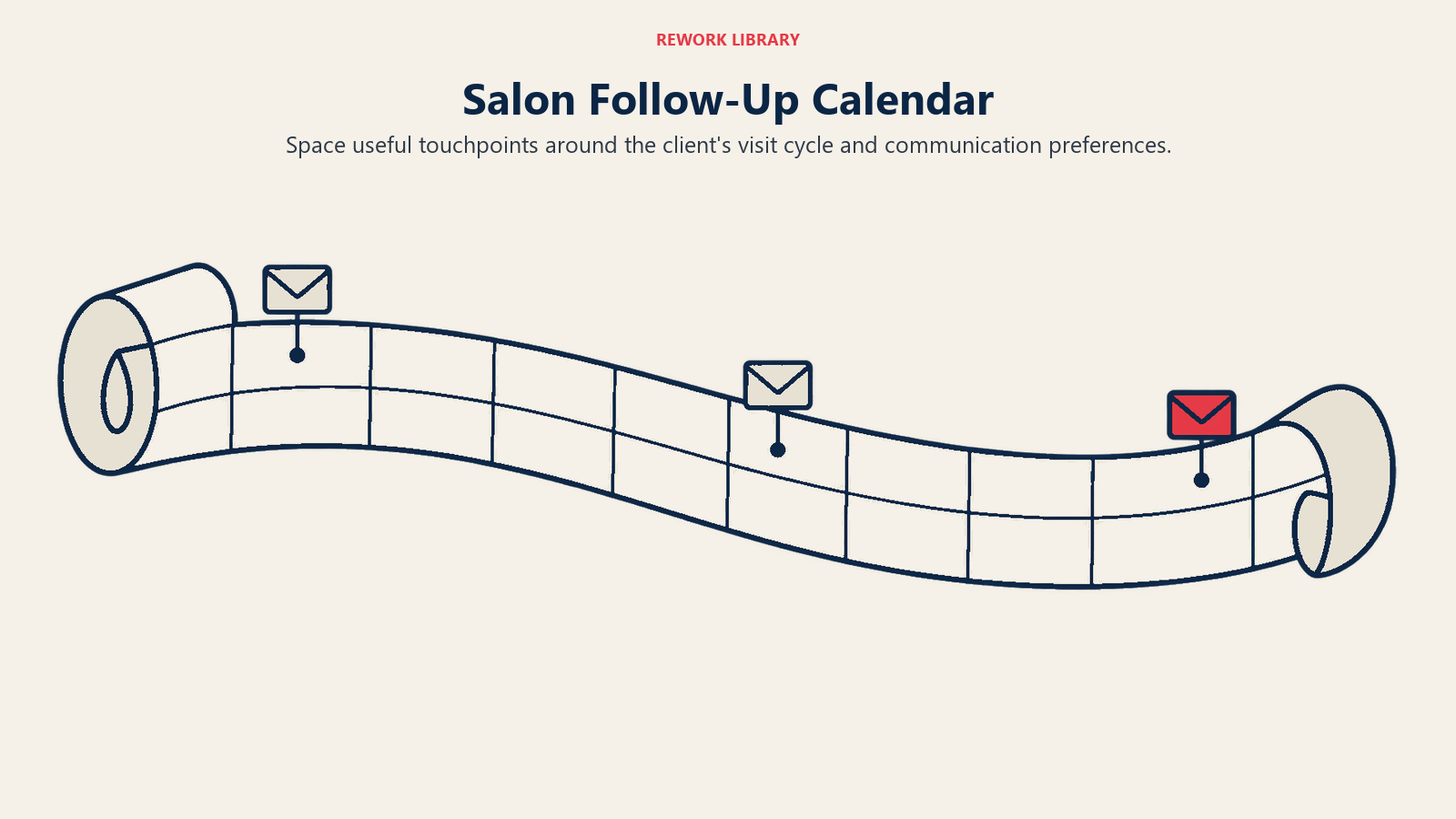
Here's a simple baseline communication cadence any salon can implement:
| Day | Channel | Message Type |
|---|---|---|
| Day 1 (post-visit) | SMS | Thank-you + aftercare tips |
| Day 21 | SMS | Rebooking reminder + booking link |
| Day 35 | Newsletter / seasonal content | |
| Day 42 | SMS | Last rebooking nudge (if not booked) |
| Day 60 | Check-in / lapse prevention | |
| Day 90 | SMS | Win-back offer (if still lapsed) |
| Birthday month | SMS + Email | Birthday offer |
| Client anniversary | Thank-you + loyalty update |
This isn't a rigid script. Adjust timing based on your client's service type and booking interval. A weekly blowout client shouldn't be getting a rebooking nudge on day 21. A color client who's 6 weeks post-visit absolutely should. The rebooking strategies for salons guide covers how to match timing to service cycle benchmarks by category.
The Message Most Businesses Skip
After three to five visits with a new client, the most impactful message you can send is a simple check-in with no ask attached.
Something like: "Hi [Name], it's been so great having you as a regular client. Just wanted to check in and see how the [color/cut/treatment] is holding up. Any questions or anything I can help with?"
No offer. No booking link. No call to action beyond genuine care.
This message does something none of the others do: it signals that the relationship matters beyond the transaction. Clients who receive this kind of outreach report significantly higher satisfaction scores and are substantially less likely to switch providers when a competitor comes along with a deal. Your review management strategy for beauty businesses benefits from this too, clients who feel genuinely cared for are far more likely to leave unsolicited positive reviews.
It takes 90 seconds to send. And it's the message most businesses never think to send because there's no immediate conversion attached to it.
That's exactly why it works.
Building the System
A communication strategy only delivers results if it runs consistently. The setup investment is the bottleneck. Once your templates are written, your automations are configured, and your team understands which messages require a human touch vs which run automatically, the system works without ongoing management.
Start with the two highest-impact automations: post-visit thank-you and rebooking reminder. Get those running first. Add birthday campaigns next. Build the win-back sequence after that.
Most booking platforms (Vagaro, Fresha, Boulevard, Mindbody) have automation tools that handle all of this natively. Setup time is typically 4-6 hours per campaign. Return on that investment shows up within the first month. The automated appointment reminders guide covers the technical setup for reminder sequences in these platforms, including the two-way confirmation format that reduces no-shows while doubling as a rebooking prompt.
Learn More
Senior Operations & Growth Strategist