Training Programs for Beauty Staff: Building a High-Performing Team
Turn this article into takeaways for your work.


Each assistant summarizes the article only for you and suggests best practices for your work.
Most beauty businesses train by osmosis. A new hire shadows someone for a week, picks up habits (good and bad) from whoever has time to supervise them, and then gets thrown into the schedule before they're ready. Six months later, the manager is still correcting the same problems that could have been built right from day one.
Inconsistent service quality isn't a talent problem. It's a training system problem. And in a business where a client's experience determines whether they rebook, refer friends, or leave a three-star review, the gap between a structured training program and no training program shows up directly in your revenue numbers. Understanding the link between staff development and stylist and therapist retention is where most salon improvement plans should begin.
This guide gives you a framework you can actually implement, from the first 90 days with a new hire through ongoing technical development, customer service standards, and product knowledge, with the metrics to tell you whether it's working.
Key Facts: Staff Training in the Beauty Industry
- Salons with structured onboarding programs report 50% higher new-hire retention in the first year (Professional Beauty Association, 2024)
- New stylists who receive formal training reach target productivity 3-4 weeks faster than those trained informally
- Client rebook rates for staff members who completed structured upselling training average 12-15 percentage points higher than untrained peers
- The U.S. Bureau of Labor Statistics projects employment of barbers, hairstylists, and cosmetologists to grow 5% through 2034, adding roughly 84,200 openings per year, making staff development a long-term competitive advantage
The First 90 Days: A Structured Onboarding Framework
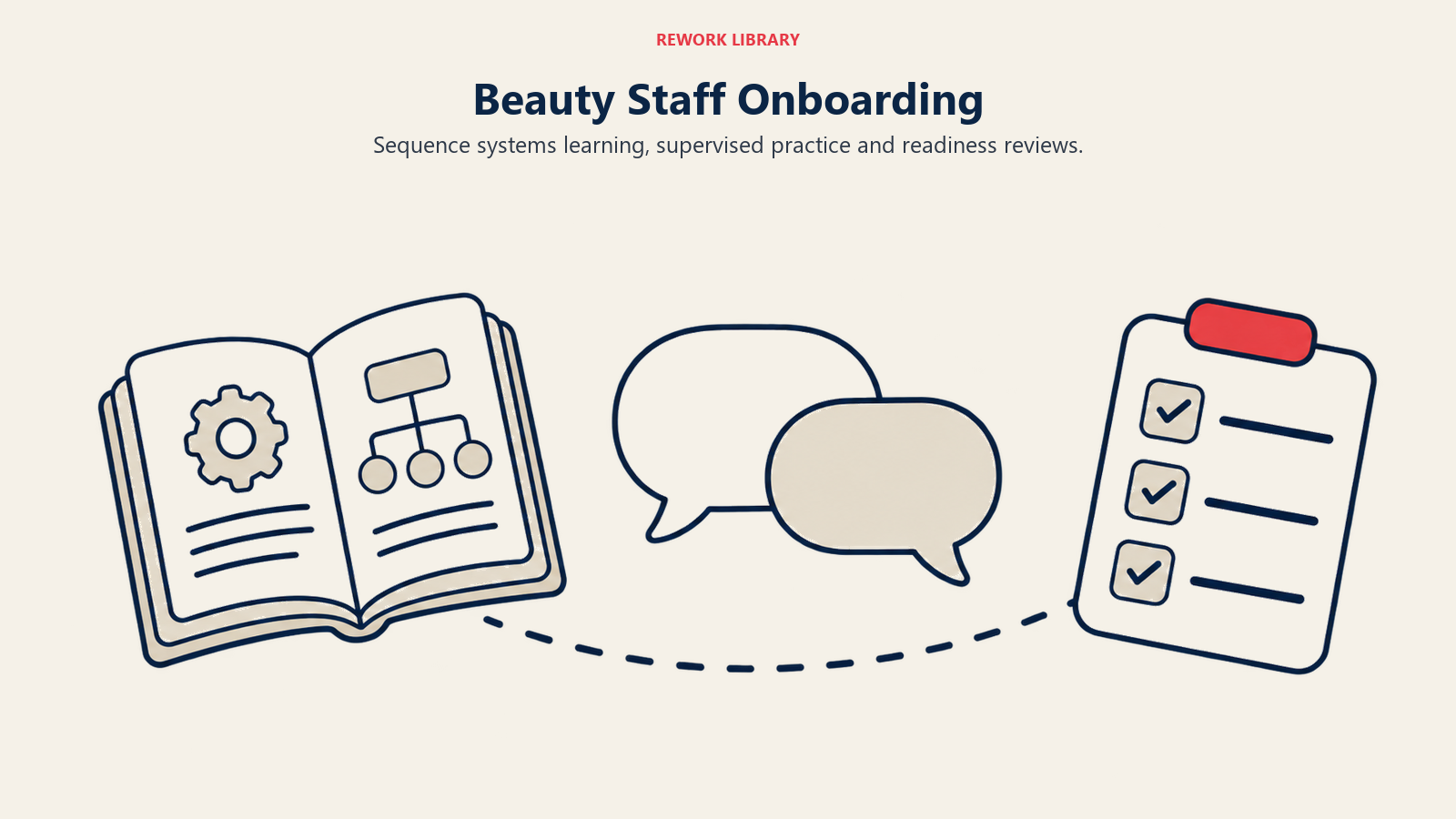
The goal of the first 90 days isn't to turn a new hire into your top performer. It's to get them to confident, consistent independence without needing to constantly borrow your time or another senior stylist's attention.
Week 1: Culture, Systems, and Expectations
Before anyone picks up scissors or mixes color, they need to understand how your business works. Week one should cover:
- Your booking system and how appointments are managed
- Client communication standards (how you greet, how you consult, how you handle complaints)
- Your retail setup and the products you carry
- Team norms: how staff communicate with each other, how scheduling requests work, what the expectations are around punctuality and phone use
This isn't onboarding paperwork. It's cultural calibration. A new hire who understands your standards before they start delivering services is more likely to meet them. This early phase also connects directly to staff scheduling for salons and spas, how shifts are structured affects how much supervised practice time a new hire actually gets.
Weeks 2-4: Supervised Technical Practice
Shadow first, then practice under observation. The structure that works:
- Days 8-10: Observe senior staff with at least two full-service appointments per day, noting consultation approach and client communication
- Days 11-15: Deliver services with a senior staff member present for observation and feedback
- Days 16-28: Solo delivery with daily check-in conversations covering what went well and where to improve
Days 30-60: Building Consistency
At the 30-day mark, do a formal skills review. Not a performance review, but a skills conversation. Where are they confident? Where do they still hesitate? Use your skills matrix (covered in the next section) to identify the gaps and build the next 30 days around closing them.
Days 61-90: Independent Performance
By day 90, a new hire should be operating independently, hitting basic productivity benchmarks, and contributing to the client experience without requiring active supervision. If they're not, that's a signal about either the hire or the training program.
Building a Skills Matrix by Role
A skills matrix makes training conversations objective. Instead of a general sense that someone "still has a lot to learn," you have a specific list of competencies mapped to each role.
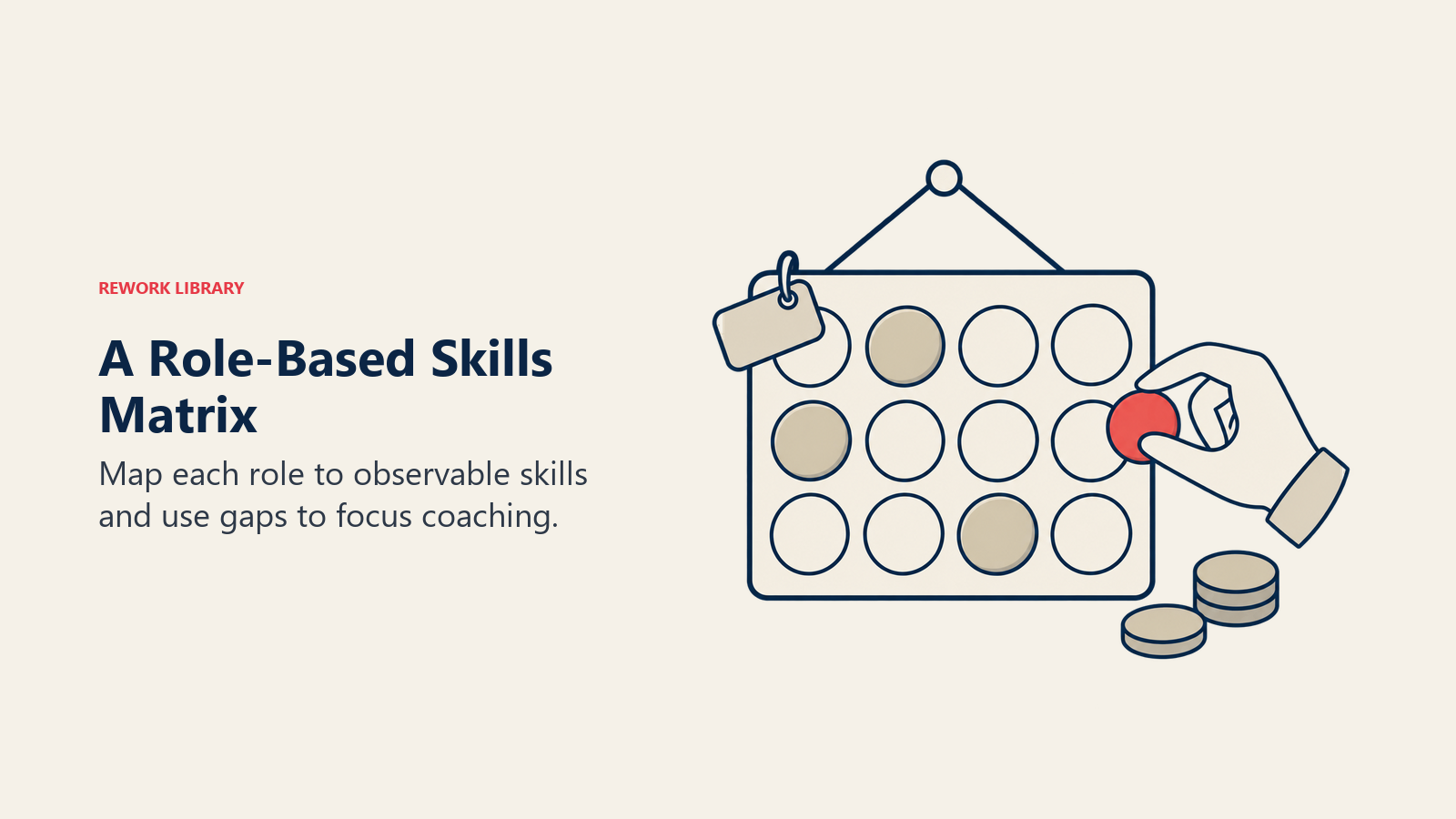
For a stylist role, the matrix might include:
| Skill | Beginner | Developing | Proficient | Expert |
|---|---|---|---|---|
| Consultation technique | Asks basic questions | Listens actively | Uncovers client goals | Advises on transformations |
| Cut technique | Guided only | Supervised | Independent | Teaching-ready |
| Color application | Basic one-process | Guided balayage | Independent balayage | Complex corrections |
| Retail recommendation | Rarely recommends | Mentions products | Links to service | Full consultation sell |
| Rebook conversation | Doesn't initiate | Sometimes asks | Consistently asks | High conversion rate |
Build one for each role (therapist, front desk, junior stylist) with the specific technical skills relevant to your service menu. Use it in every one-on-one conversation and every formal review.
Customer Service Training: Training Behaviors, Not Principles
Telling staff to "provide excellent customer service" doesn't work. Training specific, observable behaviors does.
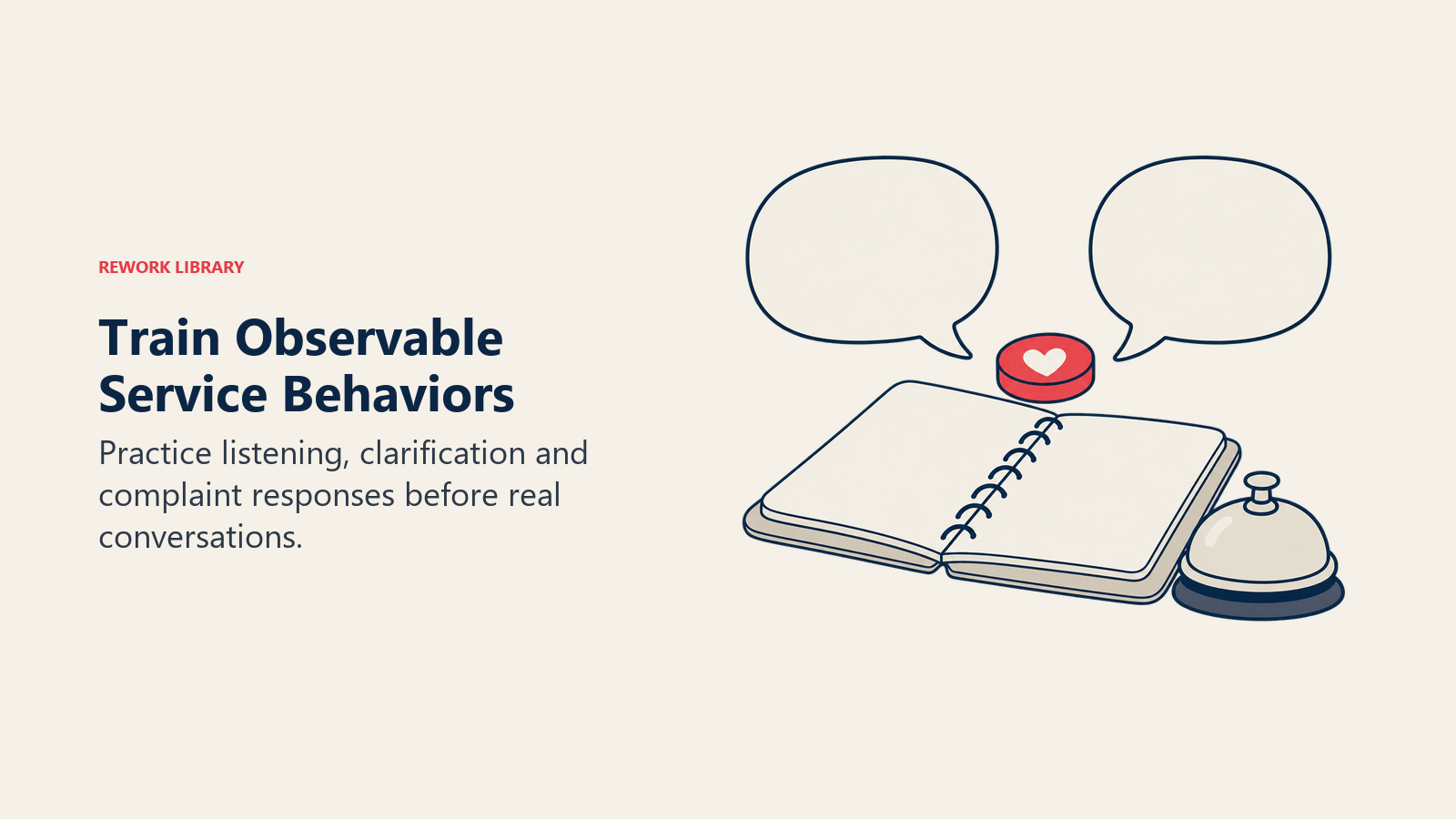
The behaviors that drive client retention in a beauty context:
The Greeting: Does every client hear their name within 30 seconds of walking in? Is the greeting warm without being performative? These are trainable, observable behaviors.
The Consultation: Train active listening specifically. This means making notes, reflecting back what the client said ("So what I'm hearing is..."), and asking clarifying questions before making recommendations. Role-play this with new hires until it feels natural.
The Complaint Response: Build a script. Not a word-for-word script, but a framework: acknowledge, apologize without over-explaining, offer a concrete resolution, follow up. Practice it before anyone is ever in the situation.
The Rebook Conversation: This is where client retention lives. Train staff to make rebooking a natural close rather than an afterthought. The line "Can I get you in for eight weeks?" is more effective than "Do you want to rebook?" because it assumes the next step rather than asking permission for it. For salons that want to go further, combining this behavior with formal rebooking strategies for salons creates a measurable lift in retention rates.
Product Knowledge: Making It Stick
Supplier education sessions are useful, but most staff retain about 20% of what they hear in a one-time training. Harvard Business Review research on why training employees pays off twice confirms that structured, repeated learning dramatically outperforms single-session knowledge transfer. The approach that actually works:
Weekly Product Focus: Pick one product or product category per week. Post a brief fact sheet in the staff area. Make the product the focus of any informal morning huddle. Ask staff to use it and report back.
The Recommendation Trigger: Train staff to connect specific products to specific services. After every color service, there are two products that are always relevant: the color-safe shampoo and the treatment for the hair type. Make this automatic, not discretionary.
Knowledge Checks: A simple five-question quiz after each product training session isn't punitive. It tells you what landed and what didn't. It also signals that product knowledge is taken seriously in your business.
Linking Product Knowledge to Retail Sales: Retail commission (typically 10-15% of retail revenue) is a direct incentive. But the link between product knowledge and retail performance is often underemphasized. Staff who can explain why a product works sell significantly more of it than staff who just hold it up. The broader opportunity here is worth understanding: retail product sales in salons can represent a meaningful additional revenue line when staff are properly trained to recommend.
Upselling Training: The Value Conversation
Upselling is uncomfortable for staff who think it means pressuring clients. The reframe that works: upselling is recommending an upgrade that genuinely improves the client's experience. If a client is getting a haircut, asking "Would you like to add a deep conditioning treatment? Your ends are quite dry today" is client service, not a sales pitch. The full framework for this is covered in upselling and cross-selling beauty services, including specific scripts broken down by service type.
The Natural Opportunity Script: Train staff to identify three specific upsell triggers during the consultation: hair or skin condition observations, upcoming events the client mentions, and services they've had before and responded well to.
Example language that doesn't feel like a pitch:
- "Your scalp is quite dry. Would you like me to add a scalp treatment today? It takes about ten extra minutes and makes a significant difference in how long your color holds."
- "You mentioned you've got a wedding coming up. We do a really beautiful blowout treatment that would work well for that. Want me to add it?"
Role-Playing Practice: Run monthly upselling role-plays at team meetings. One staff member plays the client with a specific brief (dry hair, upcoming event, first-time visitor). The other practices the conversation. Debrief together. It's slightly uncomfortable and highly effective.
Tracking by Staff Member: Log upsell conversion weekly: which staff member offers upgrades, how often, and what the conversion rate is. Share this in team meetings, not as pressure, but as visible proof that the training is working.
Measuring Training ROI
Training investment only makes sense if you can measure whether it's working. The metrics worth tracking:
Rebook Rate by Staff Member: Target 60-70% for established stylists. Track new hires separately and watch the trajectory. A new hire whose rebook rate is climbing from 30% to 50% to 65% over three months is responding to the training. Tracking these numbers consistently requires a solid salon management software setup that logs performance by individual staff member.
Retail Conversion Rate: What percentage of appointments include a retail purchase? Industry average is around 20-25%. Track by staff member and by product category. The Professional Beauty Association tracks retail performance benchmarks across more than 50,000 U.S. salons, a useful external reference when evaluating whether your numbers are above or below market.
Average Ticket Value: Are staff recommending and converting upgrades? A new hire whose average ticket value is tracking toward senior staff benchmarks within 90 days is on the right program.
Client Review Mentions: Staff members who are specifically named in positive reviews are doing something right. Track this quarterly.
Call-Out and Turnover Rates: High call-out rates often signal staff who feel unsupported. Structured training and clear expectations reduce this. HBR's research on onboarding new hires shows that companies with strong onboarding programs see up to 50% greater retention among new recruits, a benchmark worth keeping in mind when evaluating whether your current program is doing the job. Track whether it changes after you implement the program. When paired with the right commission structures for salons, a strong training program creates the dual conditions, skill and financial motivation, that keep good staff in place.
The 90-Day Training Roadmap
Here's a condensed roadmap any salon can adapt:
Days 1-7: Culture immersion, systems training, client expectation standards Days 8-28: Technical shadowing, supervised service delivery, daily check-ins Days 29-60: Skills matrix assessment, gap-targeted training, first upselling practice Days 61-90: Independent performance tracking, product knowledge certification, rebook rate monitoring
Review the program quarterly. Add the specific skills your menu requires. Remove anything that isn't translating into measurable outcomes.
The single training investment that consistently delivers the fastest return? The rebook conversation. Train every staff member on that specific behavior, track their rebook rate weekly, and you'll see revenue movement within 30 days.
Learn More

Senior Operations & Growth Strategist