Unit Economics for Beauty Centers: Revenue Per Chair, Client LTV & Key Metrics
Turn this article into takeaways for your work.


Each assistant summarizes the article only for you and suggests best practices for your work.
A beauty center is a salon or spa that sells personal-care services such as hair, nails, skin, and treatments, and its unit economics measure profit at the level of one chair, one service hour, and one client rather than total revenue. The core numbers are revenue per chair, client lifetime value, average ticket, service versus retail margin, and occupancy rate. Read together, they explain why a fully booked center can still lose money.
Here's a scenario that plays out in salons more often than most owners want to admit: fully booked calendar, team working at capacity, clients happy, and the owner is still not taking home what they expected. Revenue looks strong. But margins have been quietly eroded by commission structures, product costs, slow retail sales, and a pricing model that hasn't kept up with costs.
The problem isn't effort. It's the absence of unit economics literacy. Unit economics is the discipline of understanding your business not at the total revenue level, but at the level of a single chair, a single client, a single service hour. The U.S. hair and nail salon industry generates over $90 billion annually according to IBISWorld, yet most of that revenue flows through businesses that lack the financial visibility to know whether their individual chairs and client relationships are actually profitable. When you understand what each unit of your business generates and what it costs, you can identify exactly which levers to pull to improve profitability and stop guessing.
This isn't accounting. It's decision-making infrastructure. Owners who understand their numbers at the unit level make better choices on pricing, staffing, scheduling, and service mix than owners who only look at monthly revenue totals. The beauty center growth stages you're working through will determine which unit economics metrics demand the most attention right now.
Key Facts: Beauty Center Unit Economics
- The average client lifetime value in a full-service commission salon is $4,200-$8,500 depending on service category, visit frequency, and retention rate (Salon Today)
- Retail sales, which typically represent 15-20% of salon revenue, carry gross margins of 40-50% compared to 25-35% for services, making retail the highest-margin revenue type in most beauty businesses (American Salon)
- Salons operating at 85% occupancy versus 70% occupancy see 35-40% higher net profit due to fixed cost absorption (Professional Beauty Association Industry Report)
What Unit Economics Means for a Beauty Center
In manufacturing, unit economics describes the profit and loss on a single product unit. In beauty, the unit can be defined three ways, each useful for different decisions:
Per chair/station: How much revenue does each physical station generate per hour, per day, per month? This drives capacity planning and station investment decisions.
Per service hour: What is the effective revenue generated per clock hour of stylist or therapist time? This drives scheduling efficiency and service duration decisions.
Per client relationship: What is the total revenue a client generates over their lifetime with the business? This drives retention investment, acquisition cost limits, and loyalty program design.
All three lenses matter. A business that's strong on per-service-hour revenue but weak on client LTV is churning through clients without building a base. A business with high LTV but poor chair utilization is leaving capacity and cash on the table.
Revenue Per Chair: Calculating Utilization and Yield
Revenue per chair measures how much money each station in your salon generates. The formula is straightforward:
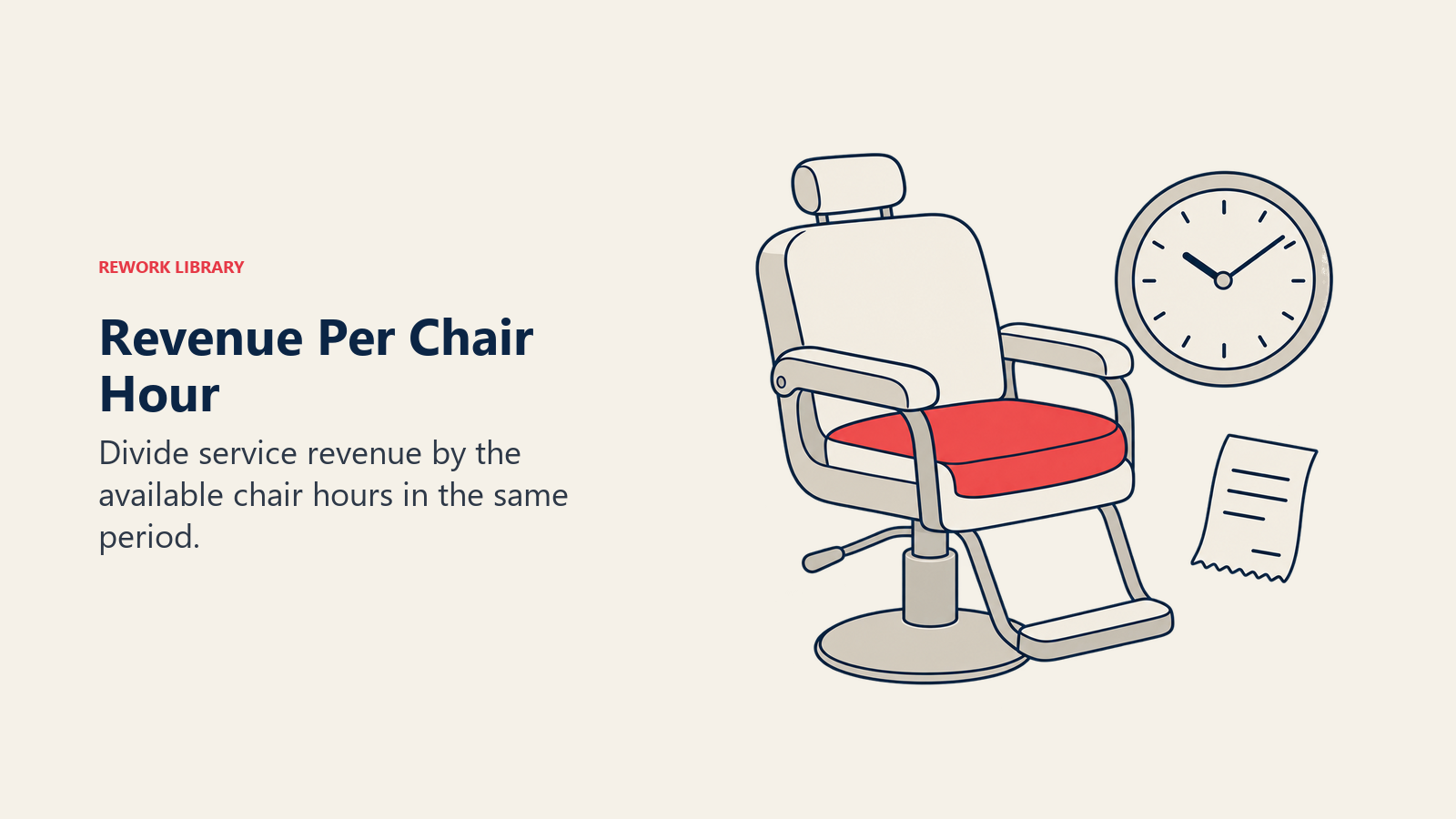
Revenue per chair = Total service revenue / Number of active chairs
But the more useful metric is revenue per available chair hour:
Revenue per chair hour = Total service revenue / (Number of chairs × Operating hours × Days open)
For example: a 10-chair salon open 50 hours per week, 52 weeks per year, has 26,000 available chair hours annually. If total service revenue is $520,000, revenue per chair hour is $20. If average service revenue is $65 per hour of chair time, that means the salon is running at roughly 31% of theoretical capacity, which looks terrible until you account for setup, checkout, and gap time.
A healthy occupancy rate for a commission salon is 70-80% of available service hours. The occupancy versus revenue impact is significant:
| Occupancy Rate | Annual Revenue (10 chairs, $65/hr) | Net Profit Diff (vs. 70%) |
|---|---|---|
| 55% | $455,000 | -$124,000 |
| 70% | $585,000 | Baseline |
| 80% | $676,000 | +$91,000 |
| 85% | $721,000 | +$136,000 |
Every occupancy percentage point gained at a stable commission rate goes almost directly to the bottom line because fixed costs don't change. This is why waitlist management and rebooking strategies for salons have disproportionate ROI, because they fill existing capacity before you spend a dollar on new client acquisition.
Client Lifetime Value: The Number That Should Drive Every Decision
Client lifetime value (LTV) is the total revenue a client generates during their relationship with your business. The formula:
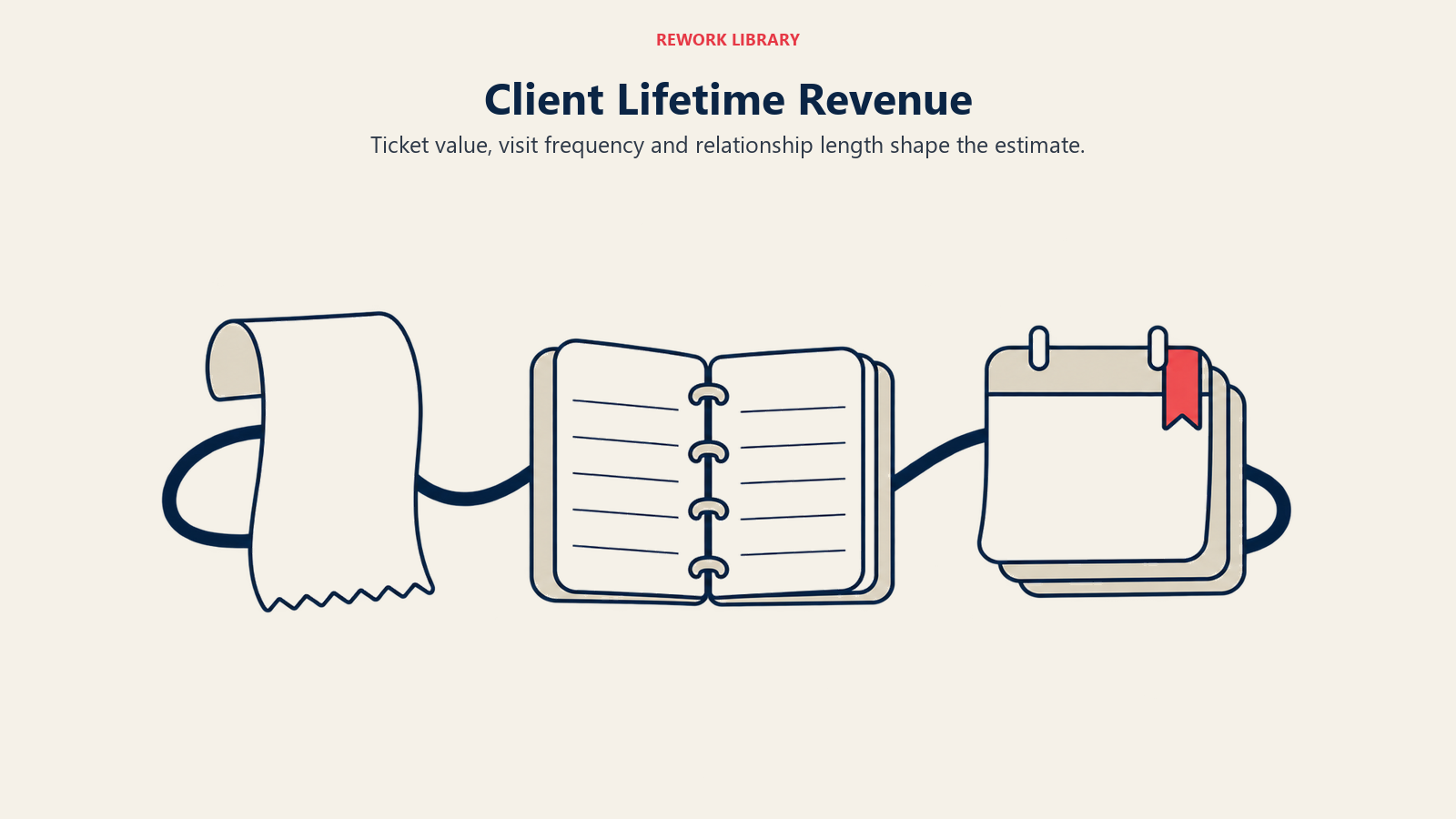
LTV = Average ticket value × Visit frequency (annual) × Average retention period (years)
Example: A color client with an $185 average ticket visits 6 times per year and stays with the salon for an average of 4 years.
LTV = $185 × 6 × 4 = $4,440
That single number changes how you think about acquisition and retention. If a new client is worth $4,440 over their lifetime, spending $75 on a targeted promotion to acquire them isn't a cost. It's a 5,800% ROI investment. And losing that client to a competitor who offered a $20 discount doesn't cost you $20. It costs you $4,440.
LTV also tells you how much to invest in retention. If improving your 90-day return rate from 45% to 60% increases average retention from 2.5 years to 4 years, every new client gained in that improvement window generates $1,110 in additional LTV. Running the math on your actual client base often reveals that retention improvements have 3-5x the ROI of acquisition campaigns. McKinsey's research on customer lifetime value confirms that retention has a decisive impact on CLV across service businesses, since low retention rates result in lifetime value that barely increases over time regardless of how many new clients you acquire. This is the economic case for investing in loyalty programs for beauty centers and structured client communication and follow-up.
Average Ticket Value: The Fastest Revenue Lever
Average ticket is the mean revenue per visit across all service clients. It's the most immediately controllable of all unit economics metrics.
Three components drive average ticket:
Service mix: Are clients booking higher-value services or defaulting to lower-cost options? A client booking a full color and treatment versus a root touch-up represents a $60-80 ticket difference with similar chair time.
Add-on attachment rate: What percentage of service clients add a treatment, gloss, or enhancement? A salon with 35% add-on attachment versus 15% generates meaningfully more revenue per hour without adding time.
Retail attachment rate: What percentage of clients purchase at least one retail product? Every retail sale is near-pure margin and requires zero additional appointment time. Industry benchmark: $25-35 in retail per service visit for well-performing salons.
If your average ticket is below market benchmarks for your service category, look at these three elements before raising prices. Often the gap closes with better consultation, menu design, and team training on recommending services. A structured approach to upselling and cross-selling beauty services provides the consultation framework that reliably improves add-on attachment without feeling pushy to clients or staff.
Service Margins vs. Retail Margins
Not all revenue is equal. Service revenue in a commission salon carries a margin burden: if you're paying 50% commission plus 15-20% in overhead (supplies, processing, product), your net on a $100 service can be $30-35. That's a 30-35% service margin.
Retail, by contrast, costs you the wholesale price of the product (typically 50% of retail price) plus minimal shelf space. On a $40 product sold at retail, you're keeping $20 gross margin with no labor cost beyond the recommendation. That's a 50% margin.
This is why salons that build strong retail programs (with training, display, and incentive structures) can be significantly more profitable than those focused only on service revenue. The Professional Beauty Association highlights retail products as one of the most underutilized profit levers for salon owners, noting that many businesses underestimate the significant impact retail can have on their bottom line relative to service-only revenue. A salon doing $600,000 in service revenue at 30% margin ($180,000 gross profit) plus $120,000 in retail at 50% margin ($60,000 gross profit) is generating $240,000 in gross profit. Versus a comparable salon doing $720,000 in services only at 30% margin, generating $216,000 gross profit. The retail-active salon wins on absolute profit despite lower gross revenue. For a detailed playbook on building this revenue stream, see retail product sales in salons.
Break-Even Analysis: The Floor Every Owner Must Know
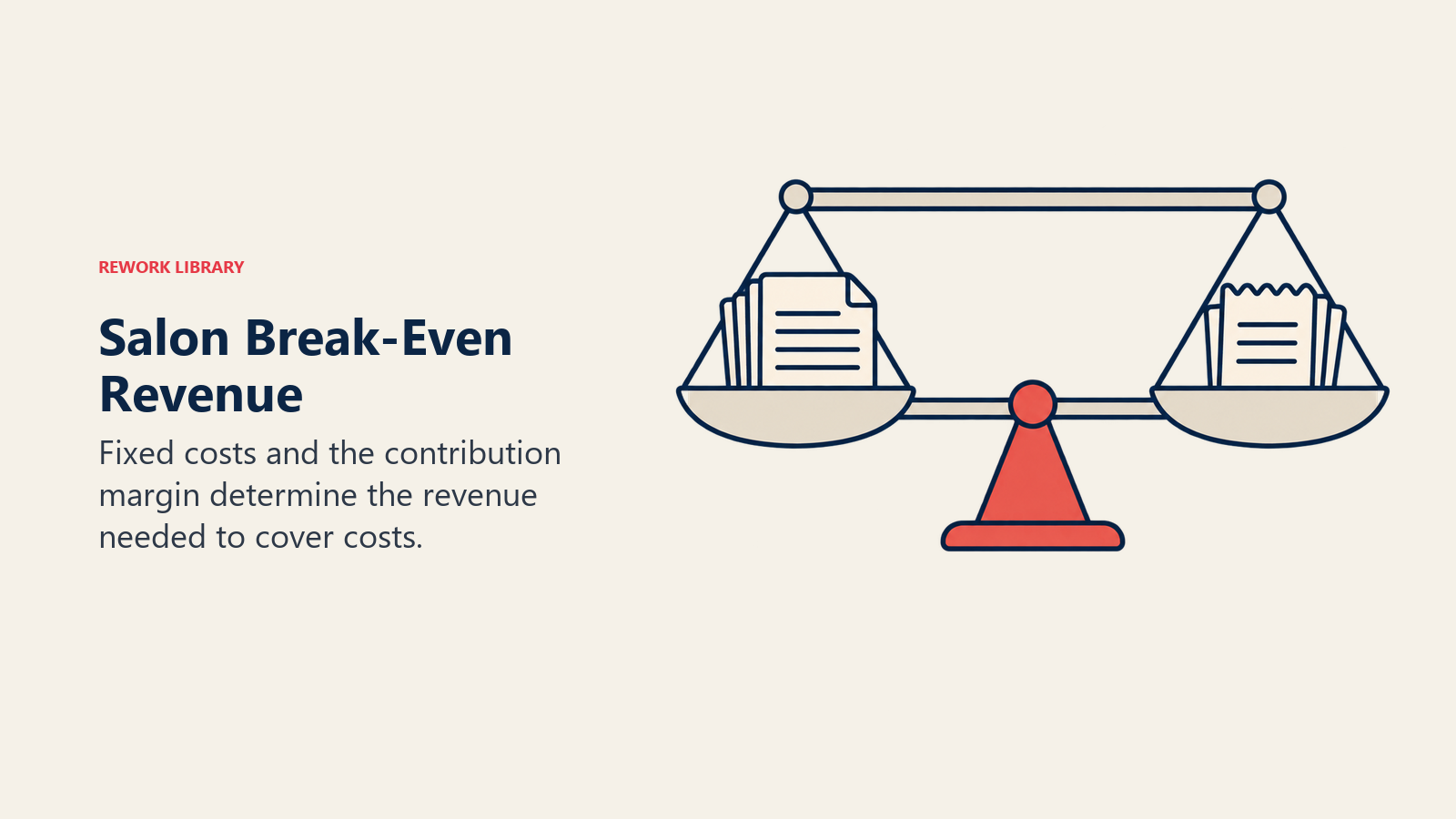
Break-even is the revenue point at which your business covers all fixed and variable costs with no profit and no loss. Knowing this number changes daily decision-making.
Fixed monthly costs (typical mid-size salon):
- Rent: $4,000-$12,000
- Utilities: $500-$1,200
- Insurance: $300-$600
- Software (booking, POS): $200-$500
- Payroll (non-commission staff): $3,000-$6,000
- Total fixed: $8,000-$20,300/month
Variable costs (as % of service revenue):
- Commission: 45-55%
- Products/supplies: 8-12%
- Credit card processing: 2-3%
- Total variable: 55-70%
If your fixed costs are $12,000/month and your variable costs run 60% of service revenue, your break-even calculation is:
Break-even = Fixed costs / (1 - Variable cost %) Break-even = $12,000 / (1 - 0.60) = $30,000/month in service revenue
Everything above $30,000/month in service revenue is your profit margin. Knowing this number tells you exactly how much cushion you have, what a slow week costs you in profitability terms, and how close you are to needing to take action.
Improving Unit Economics: Lever by Lever
Once you understand your unit economics, improvement comes down to five levers:
1. Price increases: Most salons are underpriced relative to market. A 10% price increase across services with 90% client retention improves revenue by 9% with no additional chair hours or staff costs. Run the math on your current prices versus market comparables before assuming you can't raise prices. According to Statista, U.S. consumers spend over $104 billion annually on beauty and personal care, signaling a market with substantial willingness to pay for quality, which most independent operators are not fully capturing.
2. Rebooking rate: What percentage of clients rebook at checkout versus calling back later? Industry research consistently shows that rebooking at checkout increases return rates by 20-30%. A jump from 40% to 60% rebooking at checkout can add $30,000-$60,000 annually to a mid-size salon without a single new client. Pairing rebooking with a systematic no-show and cancellation management process ensures that recaptured slots don't erode the gains.
3. Retail per client: Set a target for retail revenue per service visit. Train your team on consultation-based recommendations rather than passive display. Implement a simple incentive structure tied to retail performance.
4. Service duration efficiency: Analyze which services consume the most chair time relative to revenue generated. Treatments that take 45 minutes and generate $35 are occupying capacity that could generate $90 from a different service. This doesn't mean cutting corners. It means being intentional about your service menu design.
5. Occupancy optimization: Fill gaps in the schedule with targeted promotions, waitlist management, and off-peak pricing strategies. Every additional booked hour at your current margins directly improves net profit. Staff scheduling for salons and spas is the operational lever that turns occupancy targets into actual filled slots week over week.
Learn More

Senior Operations & Growth Strategist
On this page
- What Unit Economics Means for a Beauty Center
- Revenue Per Chair: Calculating Utilization and Yield
- Client Lifetime Value: The Number That Should Drive Every Decision
- Average Ticket Value: The Fastest Revenue Lever
- Service Margins vs. Retail Margins
- Break-Even Analysis: The Floor Every Owner Must Know
- Improving Unit Economics: Lever by Lever
- Learn More